
This page walks through the RSI Divergence Swing Strategy for EURUSD on M15: what it is, the tools it uses, the entry and exit rules, and a small example. Everything below is framed as a framework you can backtest and adapt — not a fixed recipe.
For more like this, browse the more strategy indicators for forex or jump to the full forex strategy hub.
Strategy overview
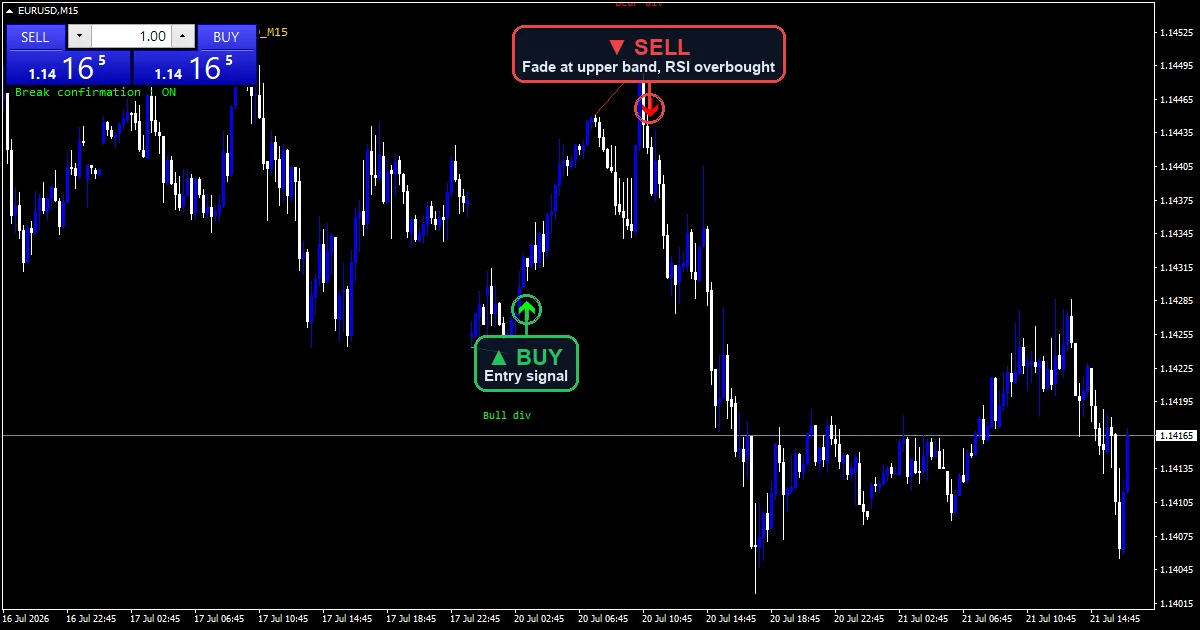
This RSI Divergence Swing Strategy uses clean, repeatable rules. The aim is to remove guesswork. You focus on managing the trade.
This RSI Divergence Swing Strategy trades EURUSD on the M15 chart. EURUSD carries the tightest spreads of the majors, which suits tight-stop rules. It suits traders who want a clear, repeatable framework. It is not a black-box system.
Tools used
- RSI (14) for divergence detection
- Swing pivots (5-bar) on the price chart
- Prior swing highs and lows for targets
- MT4 and MT5 for chart, alerts, and order placement.
A short note on tool choice: every line in this section is a building block. The strategy works because the tools confirm each other, not because any single one of them is special.
Setup checklist
Before you take a trade, run through this list:
- Higher-timeframe bias is clear on EURUSD (check the H1 chart)
- Price sits near the setup zone described below, not in the middle of nowhere
- There are no red-folder news releases for the pair’s currencies in the next 60 minutes
- The instrument is liquid during your trading session.
- You have written down your stop loss and your position size.
If any item fails, skip the trade. Patience is part of the RSI Divergence Swing Strategy.
Entry rules
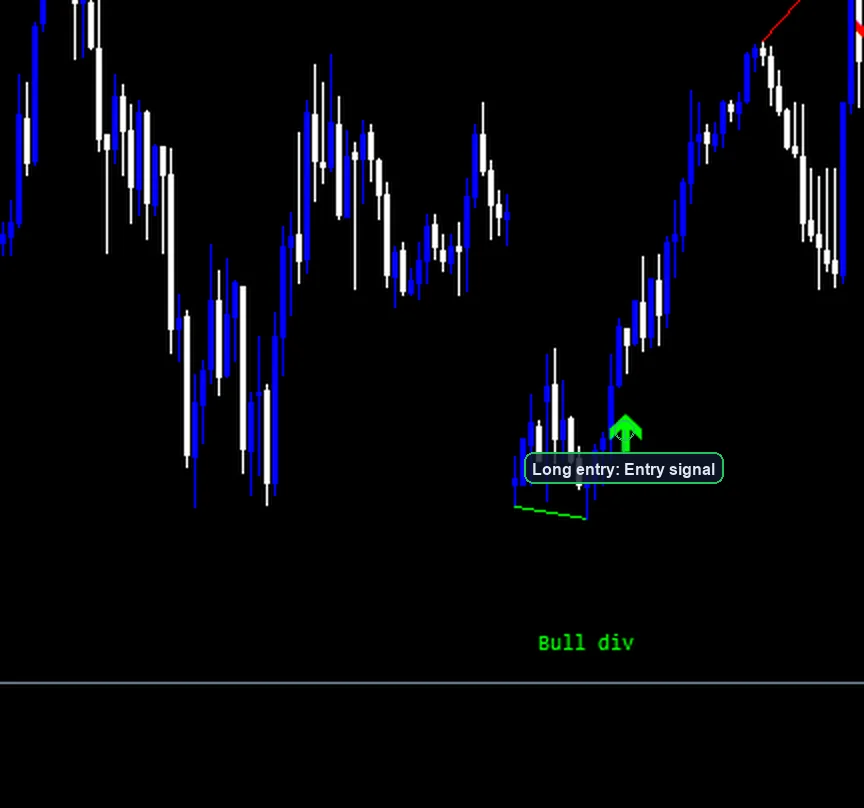
The indicator marks every valid setup with an arrow, so you can check each step against the chart image above.
Long entry:
- Wait for price to print a lower low at a swing pivot.
- Check RSI (14): it must print a higher low, with the first RSI low under 40. That is the bullish divergence.
- The trigger is a close above the high of the bar that made the second price low.
- Enter at the open of the next bar. The indicator prints a lime arrow under the divergence low.
Short entry: mirror the long rules. Price prints a higher high while RSI prints a lower high from above 60, and a close breaks the trigger bar’s low. The indicator prints a red arrow above the bar.
Exit rules
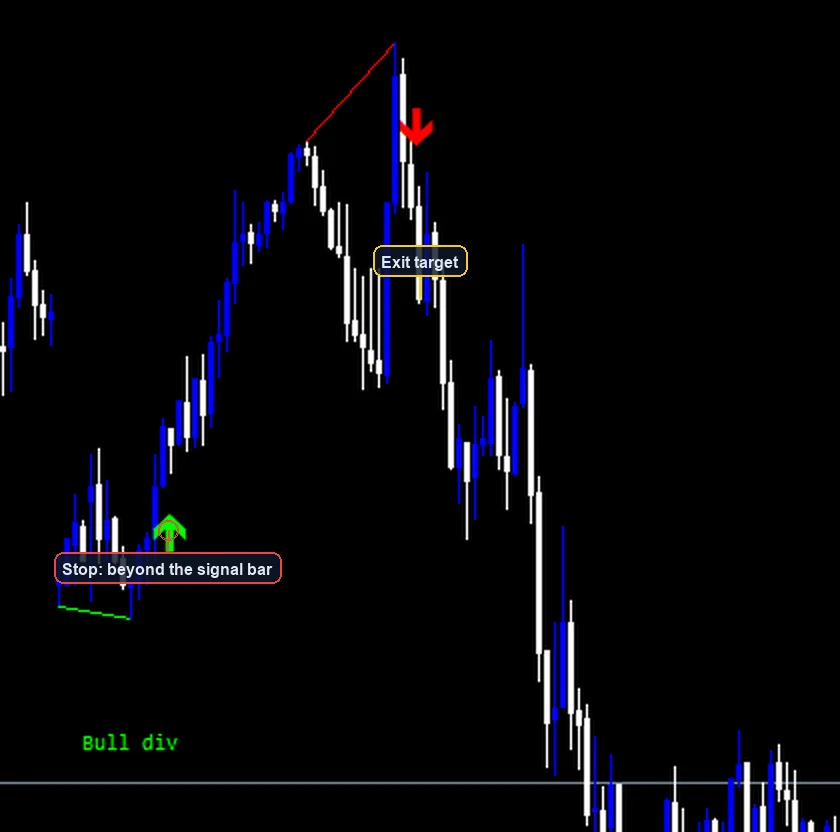
- First target. The prior swing high — the level that started the falling leg. Divergence trades aim at the other side of the swing.
- Stop loss. Place the stop below the divergence low. On EURUSD M15 that usually lands 8–18 pips out.
- Time stop. Divergence setups resolve slowly. Give the trade 20 closed bars; then exit at market.
Filters that improve the setup
- Skip divergences that form inside a tight range. The pattern needs a real falling leg behind it.
- The indicator waits at least 5 bars between signals, so overlapping divergences do not stack.
- Trade the London–NY overlap, when spreads are tight and flow is two-sided.
- Skip red-folder news for the pair’s currencies. News lows break divergence structure routinely.
Example trade walkthrough
Walk through the entry example image above.
- Price makes a lower low. RSI holds a higher low from under 40 — the divergence is on the chart.
- A bar closes above the trigger level and the indicator prints a lime arrow.
- The stop sits below the divergence low — on EURUSD M15, typically 8–18 pips from entry.
- The first target is the prior swing high. Take partial profit there and trail the rest.
These numbers are illustrative. They are not a forecast and they are not a promise. Run the rules on your own historical data first.
Risk management ideas
- Risk no more than 0.5–1% of account equity per trade while you are validating the strategy.
- Track every trade in a journal, including the screenshot, your reasoning, and the outcome.
- Scalping stops are tight, so one bad fill matters. Check your broker’s spread during your session before you size the trade.
- Take a break after three consecutive losses. Decision quality drops with consecutive losses; rules should hold up to that.
Indicator settings
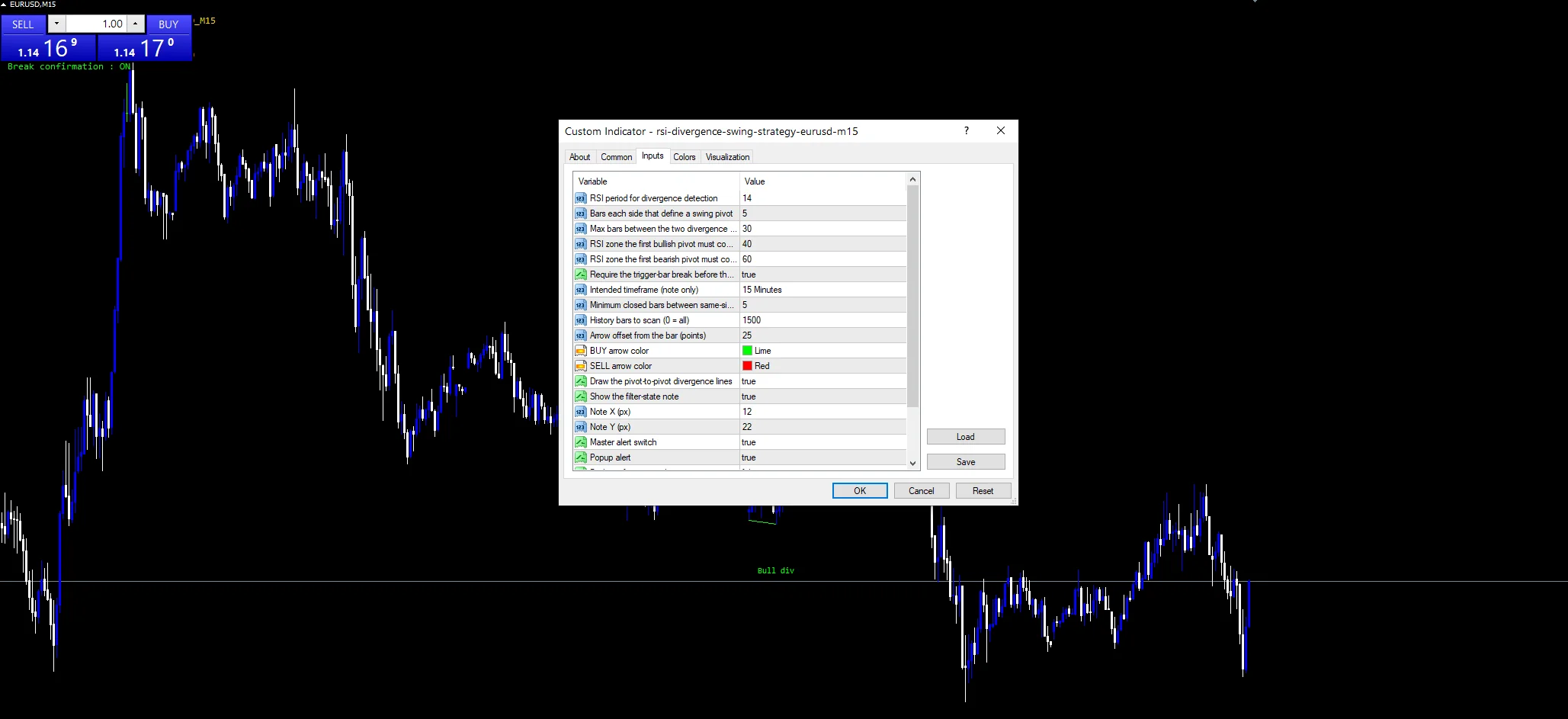
The download ships with these defaults. Every input is adjustable from the indicator’s settings panel.
| Input | Default | Purpose |
|---|---|---|
| RsiPeriod | 14 | RSI length for divergence detection |
| PivotLookback | 5 | Bars each side that define a swing pivot |
| MaxBarsBetweenLows | 30 | Maximum distance between the two divergence lows |
| OversoldRef / OverboughtRef | 40 / 60 | RSI zones the first pivot must come from |
| ConfirmBreak | true | Require the trigger-bar break before the arrow prints |
| MinBarsBetween | 5 | Cooldown bars between signals |
How this strategy was tested
The signal indicator behind this page is our own build. We compile it for MT4 and MT5 and check both versions on live charts before release. Signals print once per closed bar and stay fixed after the close — the arrow does not repaint. Alerts fire once per bar.
Download the RSI Divergence Swing Strategy template
Download the complete RSI Divergence Swing Strategy package for MT4 and MT5 below. The zip contains the compiled signal indicator for both platforms, a ready chart template for each, a STRATEGY-RULES.txt file with the exact rule list, and a README with install steps.
Download this strategy free
Enter your email and the file is yours. You also get the full MT4 and MT5 library.
You will receive the package by email after a one-step confirmation. If you are new to MetaTrader, follow the step-by-step MT4 and MT5 indicator install guide to load the indicator and the chart template.
Related on forexmt4systems.com: RSI Divergence Swing Strategy for EURUSD on H4 · RSI Divergence Swing Strategy for EURUSD on H1 · Judas Swing ICT Forex without Indicator MT4 + MT5.
FAQ
Is this RSI Divergence Swing Strategy suitable for beginners?
Traders can approach it who already know the basics of order types and risk per trade. If you are completely new to MT4 or MT5, work through a few weeks of demo before live capital.
What account size do I need?
Your account size depends on your risk per trade and your stop distance. Most traders running this style risk between 0.5% and 1% per trade while validating the rules.
Can I use this strategy on other pairs?
Yes — this exact rule set ships for several pairs and timeframes. Use the variant links in the Related section, or backtest your own pair first.
How many trades does it produce?
On the M15 chart of EURUSD, expect several valid setups per day during active sessions. Real divergences are rare by design — that is where their value comes from.
Reading the signals
Do I need a paid platform or feed?
You do not need a paid feed. Your standard MT4 or MT5 broker feed is enough. If your broker has unusual session hours, adjust the session filter accordingly.
For external background reading, see the Babypips forex school.
Are results guaranteed?
No. Trading involves risk. Results are not guaranteed. Past performance is not indicative of future results. The RSI Divergence Swing Strategy is a framework. Test it and adapt it to your risk tolerance before live capital.
Authoritative references
- Learn more about the Relative Strength Index (RSI).
- General background on technical indicators.

About the author
Written by Dominic Walsh, a Forex trader and MT4/MT5 indicator, Expert Advisor and script developer. Every tool on forexmt4systems.com is tested on live charts before release and ships with ready-to-use compiled MT4 (.ex4) and MT5 (.ex5) files. Learn more about the trader and developer behind this site.