Skip to content
  • About Us
  • Contact Us
  • Privacy Policy
  • Disclaimer
  • Install Guide
  • Editorial Policy
ForexMT4Systems
  • Indicators
    • MT4 Indicators
    • MT5 Indicators
    • AI
    • Bands and Channels
    • Binary Options
    • Breakout
    • Candle Sticks
    • Currency Strength
    • Cycles
    • Elliott Wave
    • Fibonacci
    • Gann
    • Harmonic
    • Heatmap
    • ICT
    • Ichimoku
    • Intraday
    • Levels
    • Liquidity
    • MACD
    • Momentum
    • Moving Average
    • Multi-Timeframe
    • News
    • Non-Repaint
    • Order Book
    • Order Flow
    • Oscillators
    • Overbought and Oversold
    • Pattern Recognition
    • Pivot Points and Fractals
    • Price Action
    • RSI
    • Range
    • Reversal
    • Risk Management
    • Scalper
    • Sessions
    • Signal and Forecast
    • Smart Money
    • Supply and Demand
    • Support and Resistance
    • Swing Trading
    • Trend
    • VWAP
    • Volatility
    • Volume
    • Volume Profile
    • ZigZag
  • Expert Advisors
  • Scripts
  • TradingView
    • All Free TradingView Indicators
    • Premium TradingView Indicators
  • Strategies
    • Forex
    • Breakout
    • Day Trading
    • ICT and SMC
    • Mean Reversion
    • News
    • Position
    • Price Action
    • Scalping
    • Swing
  • Guides
    • Best Indicators
    • Comparisons
    • How-To Guides
    • Indicator Settings
    • Currency Pairs
    • Timeframes
  • Education
    • Smart Money Concepts
    • Technical Analysis
    • Forex Basics
    • Risk Management
    • Prop Firm Trading
    • Trading Psychology
    • Candlestick Patterns
    • Chart Patterns
    • Fundamental Analysis
    • Trading Styles
    • Trading Plan and Journal
    • Order Types and Execution
    • Automated and Copy Trading
    • Market Sentiment
    • Forex Brokers
    • Backtesting and Systems
  • Tools
    • Position Size Calculator
    • Pip Value Calculator
    • Profit Calculator
    • Risk Reward Calculator
    • Trading Journal
    • Economic Calendar
    • Market Hours Clock
    • Forex Heatmap
    • View All 41 tools ->

Order Types and Execution

Order types and execution explained: market, limit, and stop orders, slippage, spreads, and how forex trades are actually filled.

What Is a Trailing Stop and How the Ratchet Really Works

what is a trailing stop - What Is a Trailing Stop and How the Ratchet Really Works featured image

Ask ten traders what is a trailing stop and you will hear ten different answers. Most of them describe the checkbox in the order ticket rather than the mechanism behind …

Leave a comment

Stop Order vs Limit Order: Which One Slips and Which Misses

stop order vs limit order - Stop Order vs Limit Order: Which One Slips and Which Misses featured image

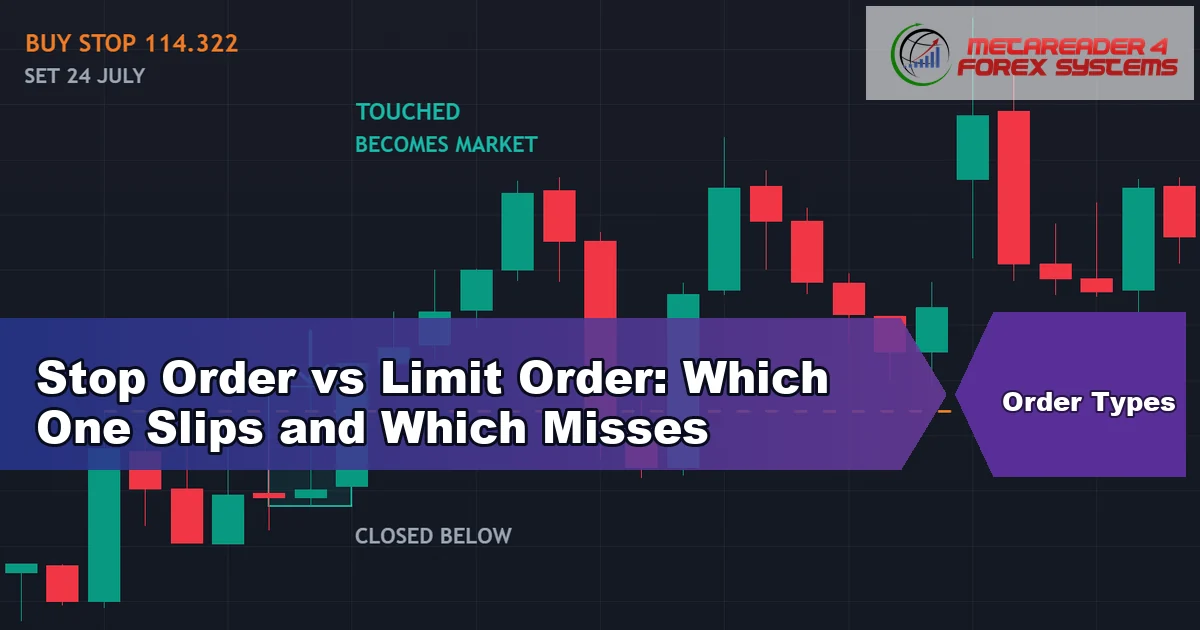
Two orders sit on the chart as identical horizontal lines. Stop order vs limit order is a comparison about what happens the moment price touches that line, and the two …

Leave a comment

What Is a Stop Order? How It Becomes a Market Order

what is a stop order - What Is a Stop Order? How It Becomes a Market Order featured image

One order type does two completely different jobs, which is why it confuses people. Ask what is a stop order and you might mean an entry above the market or …

Leave a comment

Stop Loss and Take Profit: Where Both Levels Belong

stop loss and take profit - Stop Loss and Take Profit: Where Both Levels Belong featured image

Most losing months trace back to one habit: entering first and deciding the exits afterwards. Stop loss and take profit belong on the chart before the order goes in, not …

Leave a comment

What Is a Stop Limit Order, and When Does It Miss Entirely

stop limit order - What Is a Stop Limit Order, and When Does It Miss Entirely featured image

Most order types make one promise. A stop limit order tries to make two, and the compromise it strikes has a sharp edge: in a fast move it can miss …

Leave a comment

What Is Slippage in Trading? Causes, Costs and Control

what is slippage in trading - What Is Slippage in Trading? Causes, Costs and Control featured image

You click buy at one price. The confirmation comes back at another, and the difference lands in your account as real money. So what is slippage in trading? It is …

Leave a comment

What Is a Requote in Forex? Causes, Costs and Fixes

what is a requote in forex - What Is a Requote in Forex? Causes, Costs and Fixes featured image

You click buy, and instead of a confirmation a small box appears offering a different price. Accept or decline, and the clock is running. That box is the answer to …

Leave a comment

What Is a Pending Order in Forex? The Four Types Explained

what is a pending order in forex - What Is a Pending Order in Forex? The Four Types Explained featured image

Two buttons dominate every trading platform, and neither one requires you to sit and watch. Ask what is a pending order in forex and the answer covers the whole resting …

Leave a comment

What Is a Partial Fill in Trading and Why It Happens

what is a partial fill - What Is a Partial Fill in Trading and Why It Happens featured image

You ask for five lots and three arrive. Nothing broke, and understanding what is a partial fill explains why that outcome is completely ordinary. This guide covers the mechanism, the …

Leave a comment

What Is a Market Order? Fills, Slippage and Real Costs

what is a market order - What Is a Market Order? Fills, Slippage and Real Costs featured image

Most traders send one long before they think about it. Ask what is a market order and the usual answer stops at “it buys right now”, which skips the part …

Leave a comment

Limit Order vs Market Order: Which Fills, Which Waits

limit order vs market order - Limit Order vs Market Order: Which Fills, Which Waits featured image

Every order you send forces one choice. Limit order vs market order is that choice at its simplest: you can insist on a price, or you can insist on a …

Leave a comment

What Is a Limit Order? Your Price or Better, or No Fill

what is a limit order - What Is a Limit Order? Your Price or Better, or No Fill featured image

Patience has a name on your trading platform. Ask what is a limit order and the short version runs like this: it buys below the market or sells above it, …

Leave a comment

Instant Execution vs Market Execution: The Real Difference

instant execution vs market execution - Instant Execution vs Market Execution: The Real Difference featured image

Two accounts at the same broker can answer the same click in completely different ways. One returns a box asking you to confirm a new price; the other just fills …

Leave a comment

Buy Limit vs Buy Stop: Pullback Entry or Breakout Entry

buy limit vs buy stop - Buy Limit vs Buy Stop: Pullback Entry or Breakout Entry featured image

Two orders, one direction, and endless confusion. Buy limit vs buy stop is the pair that catches almost every new trader, because both instructions buy and both sit on the …

Leave a comment

How to Avoid Slippage in Forex: Seven Real Controls

how to avoid slippage in forex - How to Avoid Slippage in Forex: Seven Real Controls featured image

Every trader meets a fill that arrived worse than the screen promised. The reaction is usually to hunt for a way to stop it happening again. Here is the honest …

Leave a comment
TradingView charts and trading platform
Instant Funding Master funded trading account offer
Cashback Forex broker rebates

Risk Disclosure: Trading futures and foreign exchange carries a high degree of risk and is not appropriate for everyone. You may lose part, all, or more than the funds you commit. Trade only with risk capital — money you can afford to part with without harming your financial stability or way of life. If you do not hold surplus capital of this kind, you should not trade these markets. Past performance is not necessarily indicative of future results.

Hypothetical Performance Disclosure: Simulated or hypothetical results carry built-in limitations, several of which are noted here. No claim is made that any account has achieved or is likely to achieve gains or losses comparable to those shown; in practice, live outcomes often diverge sharply from modelled ones. A key shortcoming of hypothetical figures is that they are usually constructed after the fact, with full knowledge of how the market moved. Back-tested trading also puts no real money on the line, so no simulated record can fully reflect how financial risk shapes live decisions. A trader's capacity to absorb drawdowns, or to keep following a system through a losing streak, materially affects real returns and cannot be reproduced in a model. Many further market and execution variables likewise escape any hypothetical calculation, and each can work against actual trading performance.

Testimonials Disclosure: Comments or reviews shown on this site reflect individual experiences and may not match the results of other visitors or customers. They are not a promise of future performance or success.

General Disclosure & Limitation of Liability: FOREXMT4SYSTEMS.COM publishes all material for educational and informational purposes only and accepts no liability for trading losses or for any decisions taken on the basis of this content. We may receive compensation through advertising, affiliate partnerships, or product sales; this never compromises our editorial independence or transparency. Trading carries risk, and past performance does not assure future results.

All Indicators A-Z · Install Guide · Editorial Policy

Copyright © 2026 FOREXMT4SYSTEMS.COM