
Most traders send one long before they think about it. Ask what is a market order and the usual answer stops at “it buys right now”, which skips the part that costs real money.
The honest version has two halves. Your fill arrives almost every time, and you get no say over the price attached to it.
What Is a Market Order in Plain Terms
A market order tells your broker to trade immediately, at whatever price the book offers. It carries no price condition at all.
So the instruction speaks to urgency, never to level. You are saying that taking part matters more than the exact number on the ticket.
That trade-off sits under every execution decision you make. Speed and price pull against each other, and this order type picks speed every single time.
A Real Example of the Moment It Fires
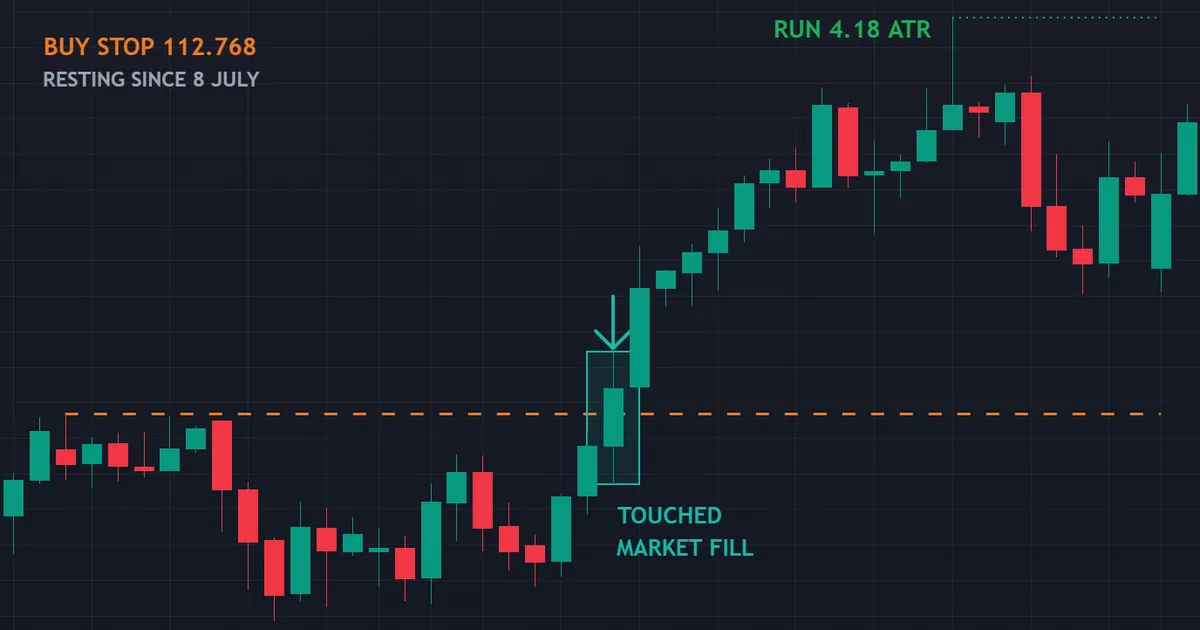
Above sits AUDJPY on four-hour bars around 14 July 2026. A buy stop had rested at 112.768 since 8 July, and the touch of that level released a market order into the book.
Watch what the platform did next. It never waited for 112.768 to return; it simply took the first price on offer and reported the result.
Price then slipped about 0.74 ATR against the new position before extending roughly 4.18 ATR in its favour. ATR here measures the average range of a bar, so it scales any move to what that market normally does.
What the Order Ticket Actually Carries
Open the ticket and count the fields that matter. Volume, direction and instrument travel to the broker, along with any attached stop and target.
One field stays blank on purpose. No entry price accompanies the request, because a price condition would create the very delay you wanted to avoid.
Attached exit levels behave differently, though. Those sit on the broker’s server afterwards and wait, so they belong to the resting family rather than to the immediate one.
Why Traders Reach for It
Three reasons cover almost every case. You want in before a move leaves without you, you want out of something going wrong, or a resting order has just triggered on your behalf.
All three share one feature. Time matters more than a fraction of a pip, and waiting carries a bigger cost than paying up.
Notice how none of those reasons mentions a better price. Anyone reaching for this order type in search of a bargain has picked the wrong instrument entirely.
How a Market Order Executes, Step by Step
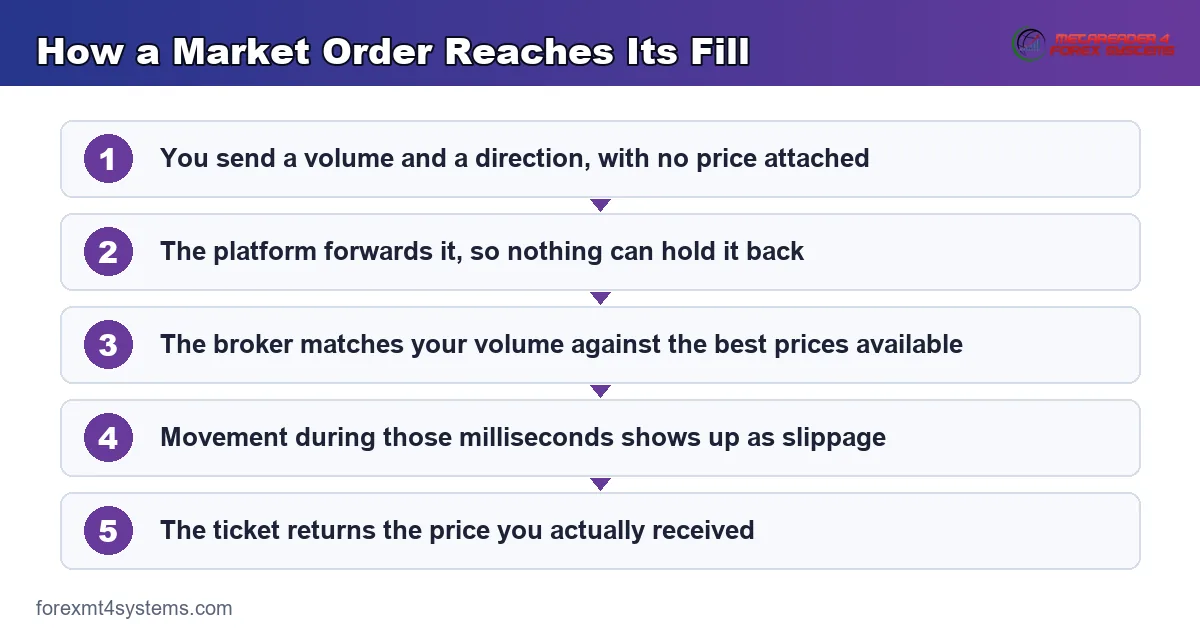
The sequence takes milliseconds, yet each stage adds something. Knowing the stages tells you exactly where your fill price comes from.
- You send the instruction. The ticket names a volume and a direction, and nothing else.
- The platform passes it on. No price condition travels with it, so nothing can hold it back.
- The broker matches it. Your volume meets the best prices currently available on the other side.
- Any movement in between shows up as slippage. Price rarely stands still during those milliseconds.
- The fill returns. Your ticket now shows the price you actually got, which may differ from the one you clicked.
Where Slippage Enters
Step four does all the damage people complain about. Between your click and the match, other participants keep trading, so the best available price shifts.
That shift runs both ways. Positive slippage happens often enough, though nobody writes support tickets about a better fill than expected.
Our guide to slippage in trading breaks down the mechanics in detail. Treat it as ordinary market behaviour rather than something your broker did to you.
Instant Execution Versus Market Execution
Brokers run one of two models, and the difference decides what happens when price moves mid-request. Both models appear in retail forex, often on different account types at the same firm.
Under instant execution, the broker either honours the price you clicked or refuses. A refusal arrives as a requote, which offers you a fresh number to accept or decline.
Under market execution, no requote exists. Your order fills at the next available price, however far that sits from the one on your screen.
Neither model removes the cost. One shows it to you as a delay and a second click, while the other shows it to you afterwards as slippage on the ticket.
Certain Fill, Uncertain Price
This one line separates the whole order family. Every other type trades some fill certainty for some price control.
The Two Halves People Confuse
Traders often assume a fast fill means a good fill. Those two things have nothing to do with each other.
A market order gets you in. Whether it gets you in near the number on your screen depends entirely on how busy that moment happens to be.
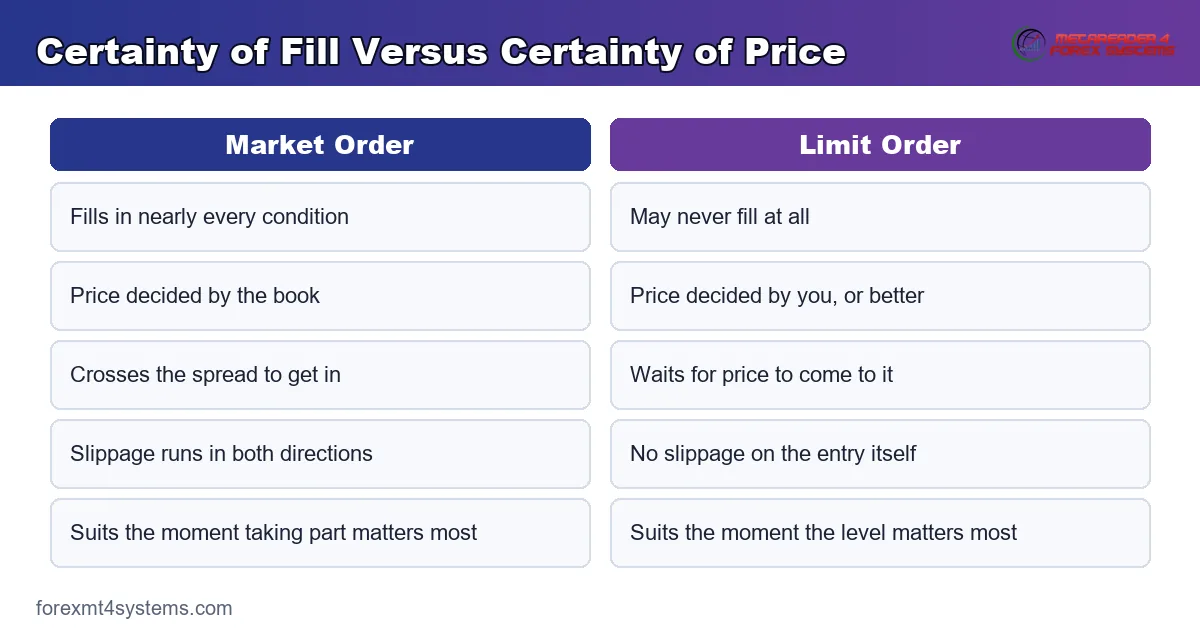
Compare that with a limit order, which fills at your price or better and may never fill at all. One type promises participation, the other promises a level.
What “Current Price” Really Means
Your platform shows two numbers, not one. You buy at the ask and you sell at the bid, and the difference between them belongs to the market maker.
So a market buy starts underwater by exactly that gap. Our explainer on the spread in forex covers why that cost lands before anything else does.
Crossing the spread twice, once in and once out, sets the floor under your trading costs. Frequent traders pay that floor far more often than patient ones.
Depth Decides the Damage
Behind the two numbers on your screen sits a ladder of resting interest. Your order climbs that ladder until it finds enough volume to fill.
A thin ladder means your volume reaches worse prices sooner. A deep one absorbs the same volume without moving at all.
Retail position sizes rarely trouble a major pair during London hours. The same size on an exotic cross at three in the morning can walk several levels up the book before it finds a match.
So the honest rule concerns liquidity rather than size. Ask how busy the market is right now, then decide whether urgency deserves the premium.
When the Price Moves Underneath You
Quiet conditions hide the risk in this order type. Volatile conditions expose it within seconds.
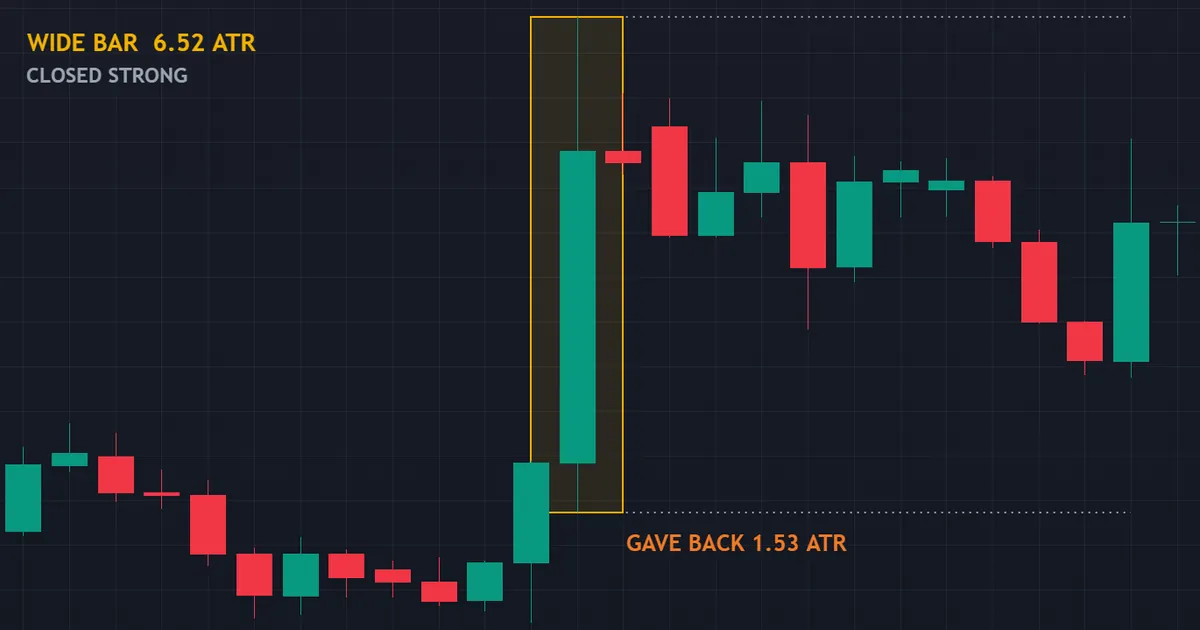
The chart above shows USDMXN on four-hour bars during 5 June 2026. One bar spans about 6.52 ATR, with roughly 63 percent of that range filled by the body, and it closes near its extreme.
What the Wide Bar Did Next
Here the honest detail matters more than the drama. Over the bars that followed, price gave back about 1.53 ATR of that move.
So a strong close carried no promise about direction. Anyone who paid a wide spread to join late met a reversal rather than a continuation.
Spreads widen during exactly these moments, which compounds the problem. Our note on why spreads widen explains the liquidity mechanics behind it.
The Practical Lesson
Volatility hurts market orders twice over. The spread grows, and the distance travelled between your click and your fill grows with it.
Checking recent range before you click takes a few seconds. Our volatility indicators archive collects tools that put that reading on your chart automatically.
Sessions Change the Arithmetic
The clock matters as much as the calendar. London and New York overlap for a few hours each day, and that window carries the deepest book of the session.
Late in the New York afternoon the picture reverses. Fewer participants quote, spreads drift wider, and the same click costs measurably more.
Traders who cannot avoid quiet hours can still adjust. Smaller volume, wider stops and fewer discretionary entries all soften the execution penalty.
Download the complete indicator database
Put these concepts on your charts. One email unlocks the full library of 1,380+ indicators with compiled MT4 and MT5 files, plus my TradingView scripts. No paywall, no spam, unsubscribe any time.
Get free access to my indicator database
One email unlocks 1,380+ free MT4, MT5 and TradingView indicators — the complete library. No single-tool download; you get the whole database.
Common Mistakes and How to Fix Them
Five habits turn an ordinary execution choice into an expensive one. The panel below sets the two competing priorities side by side.
Clicking Into a Scheduled Release
Liquidity thins out in the minute around a data print. Wait for the book to refill, or accept that your fill price becomes close to a lottery.
Chasing a Move That Already Ran
Fear of missing out and market orders make a costly pair. Set your level in advance instead, then let a resting order do the waiting for you.
Forgetting the Exit Costs the Same
Traders plan the entry carefully and then dump the position at market. Both sides cross the spread, so both sides deserve the same thought.
Sizing Before Checking Conditions
A wide spread turns a normal position into an oversized one in cost terms. Work your volume from stop distance with our position size calculator before the ticket opens.
Treating Every Bad Fill as Malpractice
Slippage during fast trade reflects a moving market, not a broker trick. Persistent one-directional slippage in calm conditions tells a different story, so log your fills and judge the pattern rather than the incident.
Using One Order Type for Everything
Plenty of traders never open the pending-order tab at all. That habit hands the market a small toll on every entry, purely out of convenience.
Learning two more order types takes an afternoon. The saving repeats on every trade you place afterwards.
Market Orders and Position Size
Execution and sizing look like separate topics. In practice they arrive together, because your fill price sets your actual risk.
Slippage Quietly Changes Your Risk
Suppose you plan a thirty-pip stop and slip three pips on entry. Your real distance to the stop now reads twenty-seven pips, so the position risks less than intended.
Slip the other way and the arithmetic reverses. Thirty-three pips of distance means the trade carries more risk than your plan allowed.
Neither outcome ruins an account on its own. Repeat it a few hundred times without noticing, though, and your average risk drifts away from the number you believe you are using.
The Fix Costs Nothing
Set the stop from the filled price rather than the intended one. Most platforms let you adjust within seconds of the fill arriving.
Then size from that real distance. Traders who skip this step end up with a plan on paper and a different plan on the account.
Quick Reference: When to Send One
Keep this table beside your platform. It answers the question faster than any rule of thumb.
| Situation | Sensible choice | Reason |
|---|---|---|
| Getting out of a losing position | Market order | Certainty of exit beats a better price you may never see |
| Entering at a level you marked earlier | Resting order | The level does the work, so nobody pays up |
| Seconds after a scheduled release | Wait | Thin books widen spreads and stretch fills |
| Sunday reopen | Wait | Early quotes move fast and rarely reflect real depth |
| A break you planned to trade | Stop order | It converts to a market order only once your level trades |
| A pullback you planned to buy | Limit order | Your price or better, with the risk of no fill at all |
The Worst Case: A Gap That Skips Your Level
Nothing exposes execution risk like a market that reopens somewhere else. Weekends produce the clearest examples.
What Happened at the Reopen
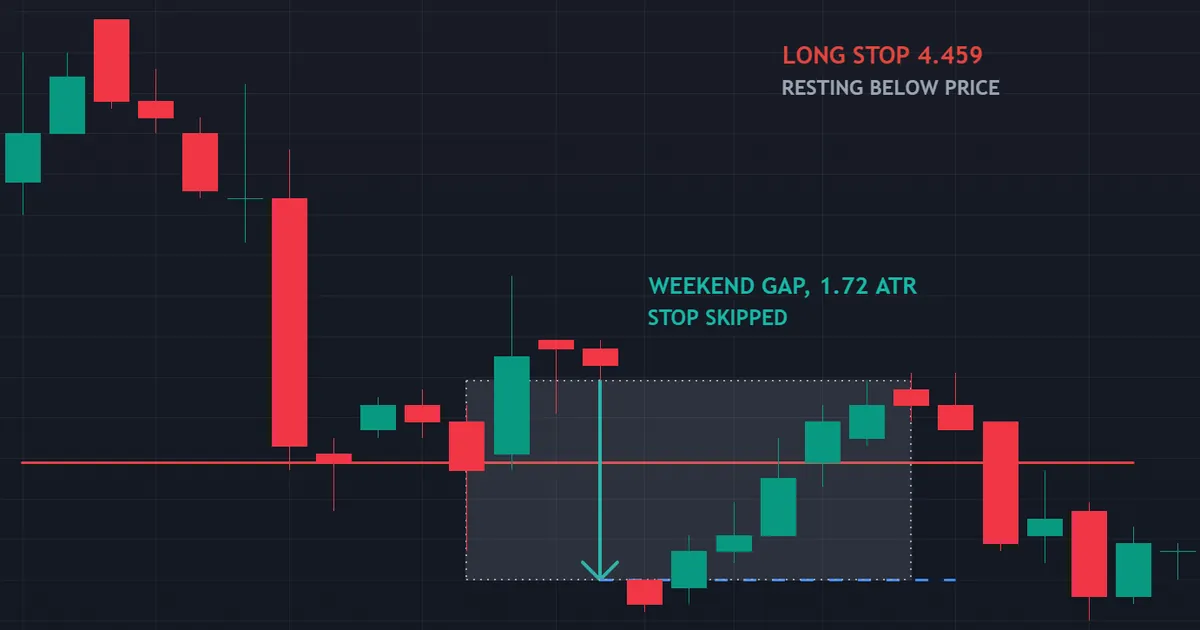
Above sits the ten-year Treasury yield on four-hour bars at the reopen on Sunday 14 June 2026. Trading resumed roughly 0.049 lower, a jump of about 1.72 ATR, straight through a long position’s stop level at 4.459.
No trade occurred at 4.459 that night. The market simply printed its first price on the far side of it.
Why Your Stop Became a Market Order
A stop is not a price you will receive. Once touched or skipped, it turns into a market order and fills wherever the book stands.
That single mechanic explains most stop-loss complaints. Our guide on how to use a stop loss works through the implications for placement and sizing.
What You Can Control
Gaps arrive whether you prepare or not. Position size decides whether one costs you a bad afternoon or a bad quarter.
Carrying smaller risk over a weekend remains the only reliable defence. Read our piece on the weekend gap in forex for the seasonal pattern behind these events.
Writing the Rule Down Before You Need It
Execution decisions arrive at the worst possible moment. Deciding them in advance removes the improvisation.
One Line per Situation
Your plan needs very little here. A single line per scenario covers the whole topic, and it takes ten minutes to draft.
Write something like this: exits at market, entries at planned levels, nothing sent within two minutes of a scheduled release. Then follow it.
Simplicity does the work. A rule you can recall under pressure beats a detailed policy you never read again.
Test the Rule Against Your Own History
Pull your last fifty trades and mark which ones used an immediate fill. Then ask whether a resting order would have caught the same move.
Some will show that patience never got filled, which justifies the click. Others will show a pullback you could easily have bought at a better level.
Counting the two groups settles the argument with evidence. Opinions about execution rarely survive contact with a spreadsheet.
Revisit After Any Change of Market
Broker changes, account-type changes and new instruments all reset the arithmetic. Spreads differ, depth differs, and the model behind the account may differ too.
Treat each change as a reason to re-measure. Thirty fresh trades give you a workable read on the new conditions.
Market Orders Next to the Other Order Types
Order types answer one question each. Knowing which question you face makes the choice obvious.
Against a Limit Order
A limit fills at your price or better, and it may sit there forever. A market order fills now, at a price the book decides.
Pick the limit when the level carries your idea. Pick the market when participation carries it.
Against a Stop Order
A stop order waits above or below the current price, then becomes a market order the instant it trades. So it inherits every slippage property described here.
People treat stops as protective and market orders as aggressive. In execution terms they behave identically, because one becomes the other.
Against a Stop-Limit Order
A stop-limit adds a second condition. Once the stop price trades, the order becomes a limit rather than a market order, so it will not accept a price beyond your ceiling.
That protects you from a terrible fill. It also lets the move leave without you, which is the exact risk a market order removes.
Choosing between them means choosing which failure you prefer. Bad price, or no position at all.
Building Execution Into Your Routine
Order choice deserves the same attention as entry logic. Two habits cover almost all of it.
Log the Requested Price and the Filled Price
Record both numbers for a month. Average the difference by session, by pair and by whether news landed nearby.
Patterns appear quickly. Most traders discover that a single hour of the day accounts for the bulk of their execution cost.
Pick Your Moments
Reserve market orders for the situations where delay costs more than price does. Everything else can rest as a pending instruction.
That habit alone shifts a portion of your trading cost from the market’s pocket back to yours. Small edges accumulate, and execution remains one of the few areas fully under your control.
Use a Deviation Setting Where Your Platform Offers One
MetaTrader lets you cap the acceptable deviation on a market order. Set a tolerance in points, and the platform rejects anything worse.
The setting behaves like a safety valve rather than a shield. A tight tolerance means more rejected orders during fast trade, which is precisely when you probably wanted the fill.
Pick a number that reflects your normal spread. Two or three times the typical figure keeps out the truly ugly fills without blocking ordinary ones.
Review Once a Month, Not Once a Trade
Single fills tell you nothing worth acting on. Thirty of them, sorted by hour and by instrument, tell you plenty.
Look for the outliers rather than the average. One or two dreadful fills usually explain more of the total cost than every ordinary one combined.
FAQ
Does a market order always fill?
Almost always, in a liquid currency pair during normal hours. Extreme conditions can still leave part of an order unfilled if the book runs dry, and very large volumes may fill across several prices. For a retail-sized ticket on a major pair, a fill of some kind is close to certain.
Why did I get a worse price than the one I clicked?
Because the price on your screen described the past. Between the click and the match, other traders kept dealing, so the best available price moved. That difference carries the name slippage, and it grows with volatility and shrinks with liquidity.
Is a market order ever the right choice for an entry?
Yes, when being in the trade matters more than a pip or two. Momentum traders and anyone exiting a position that has turned against them both fall into that group. Traders working from marked levels usually do better with a resting order.
How do market and limit orders differ in one sentence?
A market order chooses certainty of participation, and a limit order chooses certainty of price. That single trade-off explains every other difference between them, including the different ways each one disappoints you.
What happens to my market order over a weekend gap?
Nothing, because a market order never survives the click. Attached stops and targets do survive, and those become market orders themselves once touched or skipped. A gap through your stop level fills you at the first available price on the other side, which explains the occasional exit far worse than the level you set.
Does account size change how much slippage I see?
Yes, once your volume grows large enough to matter. Retail tickets on a major pair usually fill at one price, while institutional size walks up the book and averages several. Traders scaling up often notice execution costs rising before they notice anything else changing.
Can I cancel a market order after sending it?
Realistically, no. The instruction reaches the matching engine within milliseconds, so no cancel request travels fast enough. Treat every click as final, which is a good reason to check volume before you press anything.
Do market orders cost more than limit orders?
On entry, usually yes, because you cross the spread rather than waiting for price to reach you. Add occasional slippage and the difference grows over hundreds of trades. That said, a limit order that never fills has its own cost, since the trade you wanted simply did not happen. Judge execution over a long sample rather than by any single ticket. Results are not guaranteed; past performance is not indicative of future results.
External references
- For background on this concept, see Market Order at BabyPips Forexpedia.
- For broader market context, see Market Order at Corporate Finance Institute.

About the author
Written by Dominic Walsh, a Forex trader and MT4/MT5 indicator, Expert Advisor and script developer. Every tool on forexmt4systems.com is tested on live charts before release and ships with ready-to-use compiled MT4 (.ex4) and MT5 (.ex5) files. Learn more about the trader and developer behind this site.
How we build, test and correct every tool: Editorial & Testing Policy. Trading carries risk; see the disclaimer.