
A weekend gap in forex is the jump in price between Friday’s close and the market’s reopen on Sunday evening. Because the market shuts for two days while the world keeps turning, price can restart at a very different level. So a chart that looked calm on Friday may open Sunday with a visible hole between the bars.
This guide explains the weekend gap in forex in plain terms, from why it forms to how a gap fill often plays out. By the end, you will know when the market closes, why news over the weekend moves price, and how traders handle the risk. So let us start with the mechanics of the closed market.
What The Weekend Gap in Forex Is
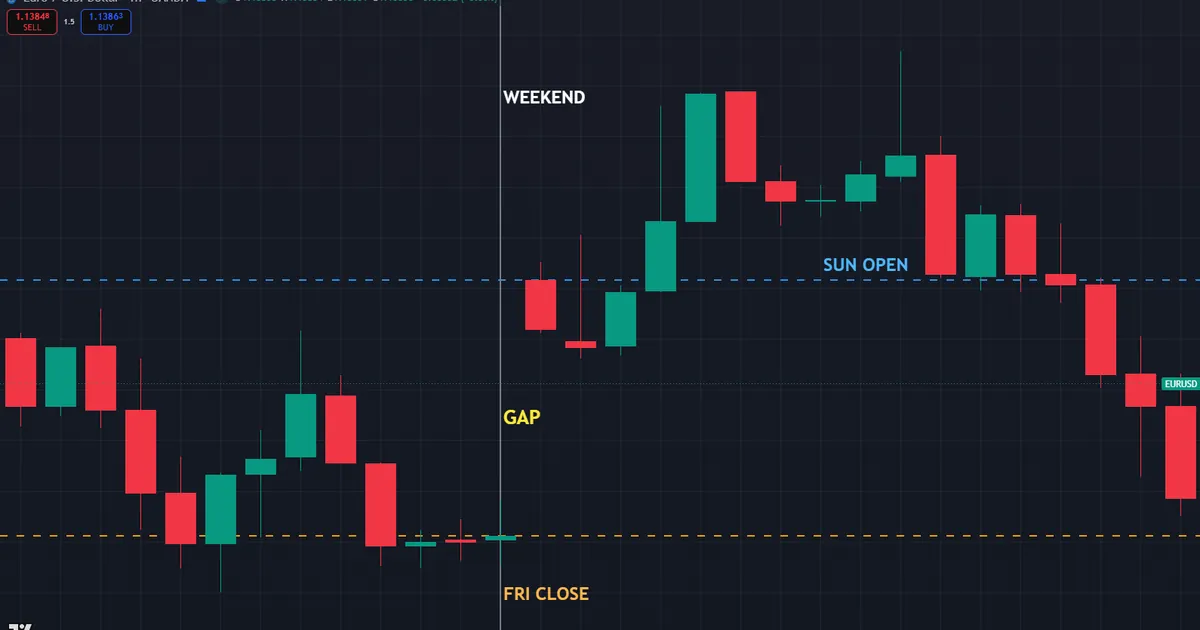
A gap is a space on the chart where no trading took place. The last Friday candle ends at one price, then the first Sunday candle begins at another, and the empty space between them is the gap. So the market skipped every price in that range while it was shut.
Forex is one of the few markets that runs around the clock on weekdays. It only truly closes once a week, from Friday evening until Sunday evening in New York time. Because that pause is the sole break, the weekend is the main moment a gap can appear.
Gaps in forex tend to stay smaller than the ones in stocks. Currencies trade in vast size, and the major pairs draw deep flow, so the reopen usually lands close to the Friday close. Yet a surprise over the weekend can still open a wide hole on the chart.
Size also depends on the pair you watch. A deep major like EUR/USD rarely gaps far, since so much flow steadies it. By contrast, a thin exotic pair can gap widely on the same news, because fewer orders sit ready to absorb the shock.
When The Market Closes And Reopens
The trading week ends near 17:00 New York time on Friday. At that hour, New York shuts, and the last major centre steps away for the weekend. So the final Friday price becomes the reference that every gap is measured against.
The week restarts near 17:00 NY on Sunday, when Sydney opens the new session. Because Sydney sits far ahead in time, its Monday morning is still Sunday evening in New York. So the first fresh quotes of the week arrive from the Pacific.
To line those hours up with your own clock, our free forex market hours tool shows exactly when the market closes and reopens. So you can spot the weekend window even when daylight saving shifts the hour.
Gap Up And Gap Down
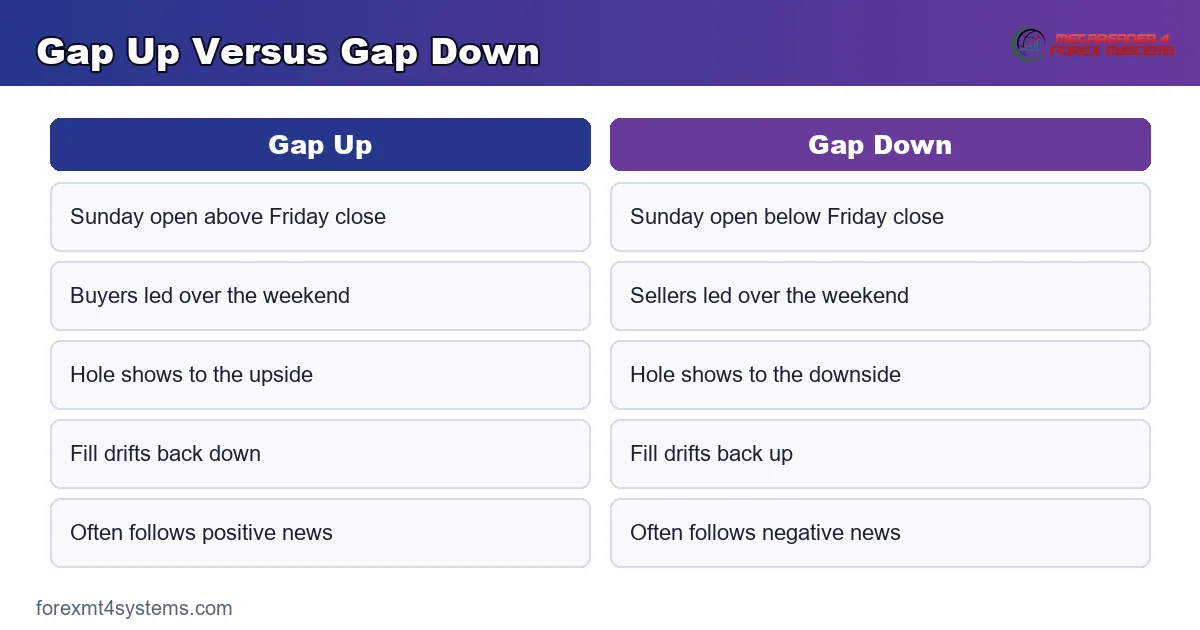
A gap up means the Sunday open sits above the Friday close. Buyers pushed the fresh price higher while the market slept, so the chart shows a jump to the upside. So a gap up hints that positive news broke over the break.
A gap down flips that picture. The Sunday open lands below the Friday close, which leaves a hole to the downside. Because sellers took control over the weekend, the market restarts lower than it finished.
Both types share the same cause, which is fresh information. Whether the news cheered or scared the market, price simply adjusts to it at the reopen. So the direction of the gap tells you which way the weekend headlines leaned.
Size matters as much as direction. A tiny gap of a few pips barely registers and often vanishes within minutes. By contrast, a gap of fifty pips or more signals a real weekend event, so it demands more caution before you trade around it.
Traders label the gap the moment quotes appear. A quick glance at the Friday close and the Sunday open tells you which type you face. So the first task each Monday is simply to measure the gap and note which way it points.
How A Weekend Gap Forms
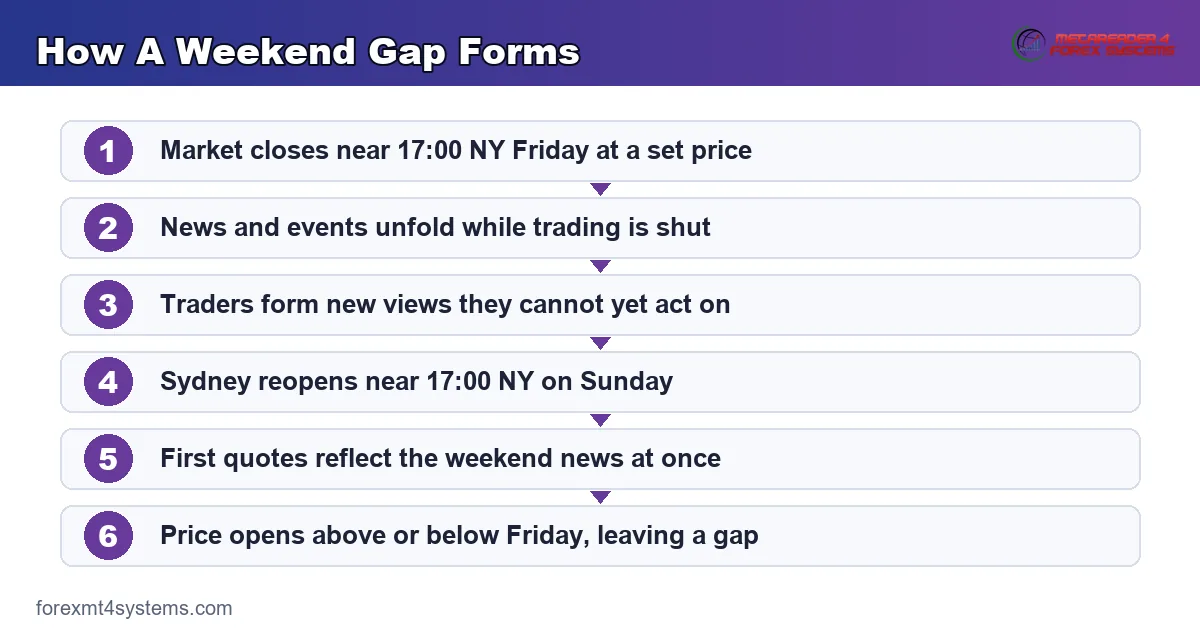
A gap follows a clear sequence, so the mystery fades once you trace it. Events over the closed weekend feed straight into the Sunday open. So here is the weekend gap broken into simple steps.
- The market closes near 17:00 NY on Friday at a set price.
- News, data, or events unfold while trading is shut.
- Traders form new views they cannot yet act on.
- Sydney reopens near 17:00 NY on Sunday.
- The first quotes reflect all the weekend news at once.
- Price opens above or below Friday, leaving a gap.
Read those steps as pressure that builds behind a closed door. So the weekend stores up every reaction until the door opens on Sunday. Because all that reaction lands in one instant, the reopen can jump rather than drift.
Compare that with a normal weekday move. On a Tuesday, price adjusts to news tick by tick, so it slides smoothly to a new level. Because the weekend removes that smooth path, the same amount of news arrives as a single leap instead of a gentle drift.
Why Weekend News Drives Gaps
Markets hate a vacuum, yet the weekend forces one. Elections, central bank comments, and geopolitical events do not wait for Monday. So when a major headline breaks on Saturday, traders can only plan, not trade, until Sunday.
That stored demand releases the moment quotes return. Because everyone acts at once at the reopen, the first price leaps to where the news pushed it. So the size of the gap reflects how big the surprise was.
Some weekends carry known risk in advance. A scheduled election, a central bank meeting, or a trade summit all sit on the calendar days ahead. So a prepared trader marks those dates and treats the following reopen with extra care.
Other weekends surprise everyone. A sudden geopolitical event can break with no warning on a Saturday, so no calendar could have flagged it. So even a quiet-looking weekend deserves a smaller position than a busy weekday would.
Scheduled risk events raise the odds of a gap. A weekend election or a summit can move a currency hard, so traders watch the calendar closely. Our free economic calendar flags the events that often spark a Monday jump.
The Gap Fill Explained
A gap fill happens when price returns to the Friday close. After the Sunday jump, the market often drifts back to cover the empty space on the chart. So traders watch the Friday level as a magnet the price may seek.
Picture a gap up on EUR/USD. The pair closes Friday near 1.1400, then a calm weekend leaves the Sunday open near 1.1420, a twenty-pip gap up. So the chart shows a small hole between the two prices.
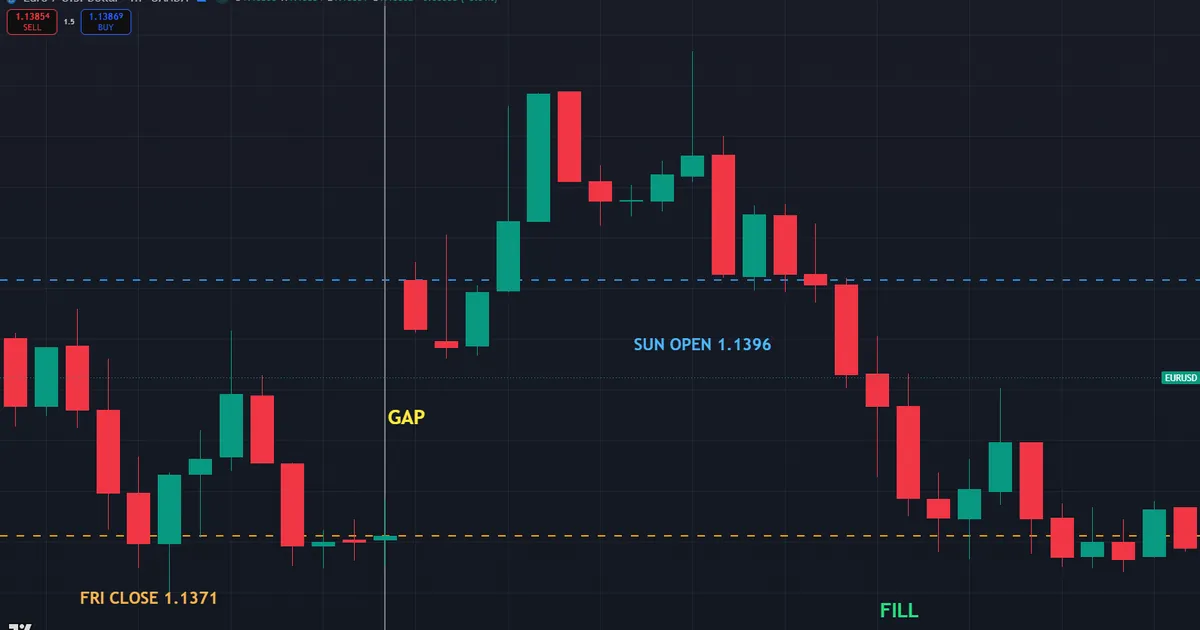
Now the fill may begin. Because the move rested on thin weekend flow rather than fresh Monday buying, price often eases back toward 1.1400. When it touches the Friday close, the gap is filled, and the hole on the chart closes.
Measure the risk before you act on it. A twenty-pip gap gives a clear target at the Friday close and a natural stop just beyond the Sunday open. So the setup frames itself, which is why some traders like the simplicity of a small gap.
Yet a fill is a tendency, not a rule. When strong news drives the gap, price can keep running instead of turning back. So a trader treats the fill as a likely path, never a certainty, and always guards the trade with a stop.
Why Gaps Tend To Fill
The pull toward a fill has a simple logic behind it. A weekend gap often rests on thin flow rather than heavy Monday buying, so the move lacks real backing. Because the crowd has not yet confirmed the jump, price slips back toward the last agreed level.
That last agreed level is the Friday close. Traders remember it, orders cluster near it, and the market treats it as fair value. So price gravitates back to it once the thin opening flow fades and normal volume returns.
Time of day plays a part too. Because Sunday and early Monday run quiet, the gap forms in the shallowest hours of the week. So as London and New York join with real depth, they often carry price back to close the hole.
Download the complete indicator database
Put these concepts on your charts. One email unlocks the full library of 1,380+ indicators with compiled MT4 and MT5 files, plus my TradingView scripts. No paywall, no spam, unsubscribe any time.
Get free access to my indicator database
One email unlocks 1,380+ free MT4, MT5 and TradingView indicators — the complete library. No single-tool download; you get the whole database.
Common Mistakes With Weekend Gaps
Gaps tempt traders into rash moves, and the same errors repeat every Monday. Most come from treating a fill as a sure thing or from ignoring the wider spread at the open. So the fixes start with respect for the reopen.
Assuming Every Gap Fills
The fill is common, yet it is far from certain. When real news drives the gap, price can extend for days without looking back. So never bet the account on a fill; trade it with a stop like any other setup.
Trading The First Seconds
Spreads run wide in the opening minutes of the week. Because liquidity is still thin at the Sunday reopen, a market order can fill far from the screen. So let the first few minutes settle before you place a trade.
Holding Blindly Over The Weekend
A position left open on Friday faces the full gap risk. When the market jumps against it, price can leap straight past the stop. So size any weekend trade with that jump in mind, or close it before the break.
Ignoring The Weekend Calendar
A quiet weekend rarely gaps, while a weekend election often does. A trader who skips the calendar walks into Monday blind. So check for scheduled risk before you decide whether to hold through the close.
Chasing The Gap
A big gap tempts a rushed entry in its direction. Yet the move may already be spent, so a late chase buys the top of a spike. So wait for a clear signal rather than leaping in on the jump alone.
Forgetting Stops Can Slip
A stop is a request, not a promise, across a gap. When price leaps over your level, the broker fills you at the next available price instead. So a wider gap can hand you a larger loss than the stop alone implied.
How To Handle The Weekend
Traders take different paths into the weekend, so pick the one that fits your nerve and your plan. Some flatten everything by Friday, while others hold with care. So there is no single right answer; there is only the choice that lets you sleep.
The Flat-By-Friday Approach
Many traders close all positions before the weekend. Because a flat account cannot gap, they trade the fresh week with a clean slate. So this cautious path trades a little missed upside for full peace of mind.
Short-term traders favour this route most. A scalper or day trader rarely needs to hold across two days anyway, so closing out costs them little. So flat by Friday fits a style that lives inside single sessions.
The habit also clears the mind for the week ahead. Because no open trade weighs on the weekend, a flat trader rests and plans without worry. So the small cost of missed moves buys a calmer, sharper Monday at the open of the fresh week, which many traders count as a fair trade.
The Hold-With-Care Approach
Swing traders often carry positions through the weekend. Because their trades ride multi-day moves, closing every Friday would cut into the plan. So they manage the gap risk with smaller size and wider stops instead.
Reduced exposure is the key habit here. By trimming the position before the close, a trader shrinks the damage a bad gap could do. So the trade survives the weekend without betting the account on a calm reopen.
The Gap-Trade Approach
A few traders trade the gap itself on Monday. They watch for a small gap on thin news, then position for a fill back to the Friday close. Because the fill is only a tendency, they keep the stop tight and the target modest.
This approach demands strict rules. A gap trader skips the wide, news-driven gaps and trades only the small, quiet ones. So the edge comes from patience and selection, not from trading every jump the market offers.
Position size stays small for this style too. Because the reopen runs choppy and thin, a modest stake keeps a bad fill from doing real harm. So the gap trade rewards a light touch far more than a bold one, and it quietly punishes anyone who oversizes the opening play into thin flow.
Quick-Reference: Weekend Gaps At A Glance
Keep this short list beside your chart. A quick check here keeps the weekend in view, so run through it before Friday’s close.
- The market closes near 17:00 NY Friday, reopens near 17:00 NY Sunday.
- A gap up opens above Friday; a gap down opens below.
- Weekend news drives the size of the gap.
- A gap fill returns price to the Friday close, but not always.
- Spreads run wide in the first minutes of the week.
- Stops can slip across a gap, so size for the jump.
Edge Cases And Pitfalls
Even a calm weekend can spring a surprise. Major political events top the list. When an election or a referendum lands on a Sunday, a currency can gap hard at the reopen. So a normally quiet weekend can produce the week’s biggest move.
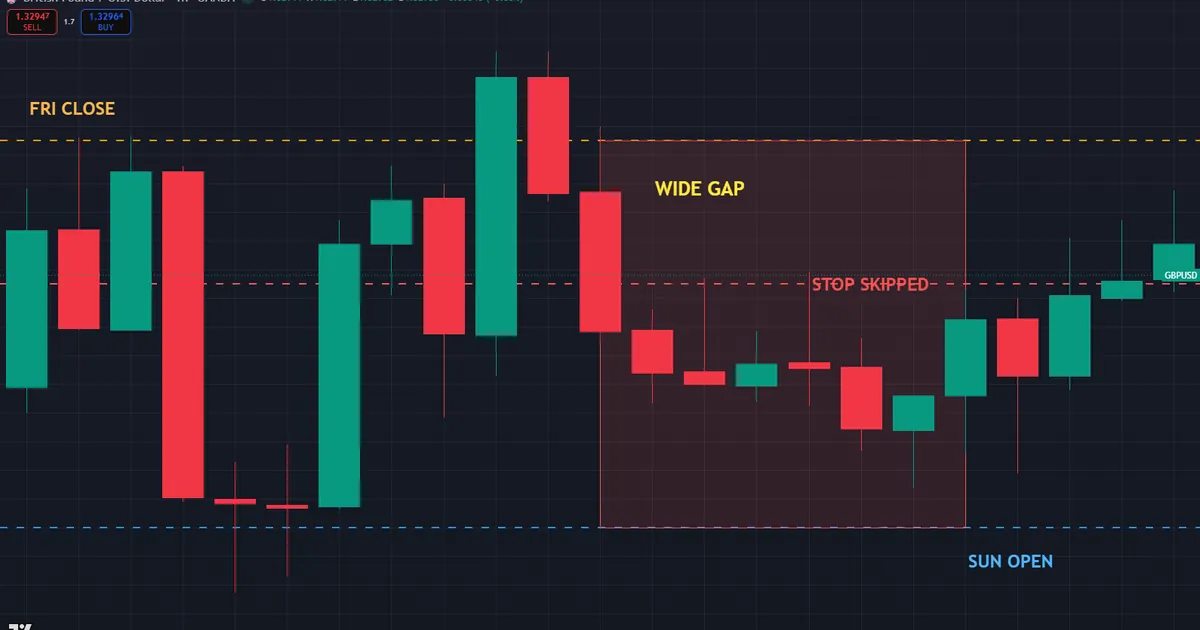
Watch the chart below for a wide gap in action. Price closes Friday at one level, then opens Sunday far below it after a shock headline. Because the market skipped every price in between, any stop inside that range fills at the open, not the level.
Thin Holiday Weekends
A long holiday weekend deepens the risk. When a Monday holiday keeps a major centre shut, liquidity stays thin even longer. So the reopen can gap wider and stay choppy until full flow returns.
Summer and year-end weeks add the same effect. Because many desks run light staff, the reopen lacks its usual depth. So a gap in these quiet weeks can take longer to fill, or may not fill at all.
Central bank surprises deepen the risk further. When a policymaker speaks over the weekend, a currency can gap and then trend for days. So a holiday weekend paired with a policy shock can produce one of the sharpest opens of the year.
When The Gap Keeps Running
A news-driven gap can trend rather than fill. When a weekend event truly shifts the outlook, Monday buyers or sellers pile in behind the jump. So the gap becomes the start of a move, not a level to fade.
Reading the cause helps you tell the two apart. A gap on thin, quiet news often fills, while a gap on a real shock often runs. So judge the headline behind the jump before you decide to trade the fill.
Partial Fills And False Starts
Not every fill is clean or complete. Sometimes price closes half the gap, stalls, then turns back the other way. So a trader who expects a full fill can sit through a partial one and watch the edge fade.
False starts add another trap. Price may dip toward the Friday close, tempt a trade, then jump back in the gap’s direction. Because the reopen is choppy, these fake moves catch anyone who acts on the first flicker. So patience through the opening hour pays here.
Related Concepts To Study Next
The weekend gap connects to a web of basics, and a few deserve your next reading hour. Start with the full rhythm of the week by reading our guide to the forex trading sessions, which shows how the market opens and closes. Then learn why the reopen costs more with our guide to why spreads widen.
Two more guides round out the picture. Because Sydney opens the fresh week, read how those first hours behave in our guide to the Asian trading session. Then see how the American close ends the trading week with our guide to the New York trading session. So the weekend stops being a blind spot and starts reading as a known risk.
FAQ
What is a weekend gap in forex?
A weekend gap in forex is the jump in price between Friday’s close and the Sunday reopen. Because the market shuts for two days, price can restart at a different level once fresh quotes return. The empty space on the chart between the two prices is the gap.
Why do weekend gaps happen?
They happen because news, data, and events unfold while the market is closed. Traders form new views over the weekend but cannot act until Sunday. When quotes return, everyone reacts at once, so price leaps to reflect the weekend news in a single move.
What time does the forex market close and reopen?
The market closes near 17:00 New York time on Friday and reopens near 17:00 NY on Sunday, when Sydney starts the new week. Daylight saving can shift the exact hour, so confirm the current times with a live market-hours tool before you rely on them.
Do weekend gaps always get filled?
No, a gap fill is a tendency rather than a rule. Gaps built on thin, quiet news often drift back to the Friday close. Yet a gap driven by a real shock can keep running for days, so never treat a fill as certain.
How can I protect against gap risk?
You can close positions before the weekend, or hold with smaller size and wider stops. Checking the weekend calendar for elections or summits also helps. Remember that stops can slip across a gap, so size the trade for the possible jump.
Is trading the Monday gap a good strategy?
Some traders fade small gaps toward the Friday close, but the approach carries real risk. Because a news-driven gap can extend instead of filling, a tight stop and a modest target matter. Judging the news behind the gap is often more useful than the gap size alone. Results are not guaranteed; past performance is not indicative of future results.
External references
- For background on this concept, see Weekend effect on Wikipedia.
- For broader market context, see Playing the Gap at Investopedia.

About the author
Written by Dominic Walsh, a Forex trader and MT4/MT5 indicator, Expert Advisor and script developer. Every tool on forexmt4systems.com is tested on live charts before release and ships with ready-to-use compiled MT4 (.ex4) and MT5 (.ex5) files. Learn more about the trader and developer behind this site.
How we build, test and correct every tool: Editorial & Testing Policy. Trading carries risk; see the disclaimer.