
Understanding why forex spreads widen protects you from one of the sneakiest costs in trading. The spread looks tiny most of the time, yet it can balloon in seconds and swallow a trade whole. So a beginner who ignores it often loses money without ever knowing where it went.
This guide explains why forex spreads widen, when the widening strikes hardest, and how to trade around it. It walks through the real causes, from news to thin liquidity, and gives you a simple plan to stay clear of the worst spikes.
Why Forex Spreads Widen at Key Moments
A spread is the gap between the bid, where you sell, and the ask, where you buy. Banks and other liquidity providers quote both prices, and the gap between them pays for their service. So the spread reflects how eager the market is to trade with you right now.
When many banks compete to quote, that gap shrinks. Their prices stack tightly, and you buy and sell for almost the same number. So deep, busy markets carry the tightest spreads of the day.
When banks pull back, the gap stretches. Fewer quotes mean the best bid and the best ask drift apart, and your cost to enter jumps. So a widening spread simply signals that liquidity has thinned or that risk has risen.
Here sits the core idea. A spread widens whenever the people quoting prices grow cautious or scarce. Everything below is just a specific version of that one rule.
Look at a concrete frame first. The chart shows EURUSD on the five-minute timeframe running near 1.14 with a calm 0.4-pip spread. Then a news candle prints, and the spread jumps hard as banks step away.
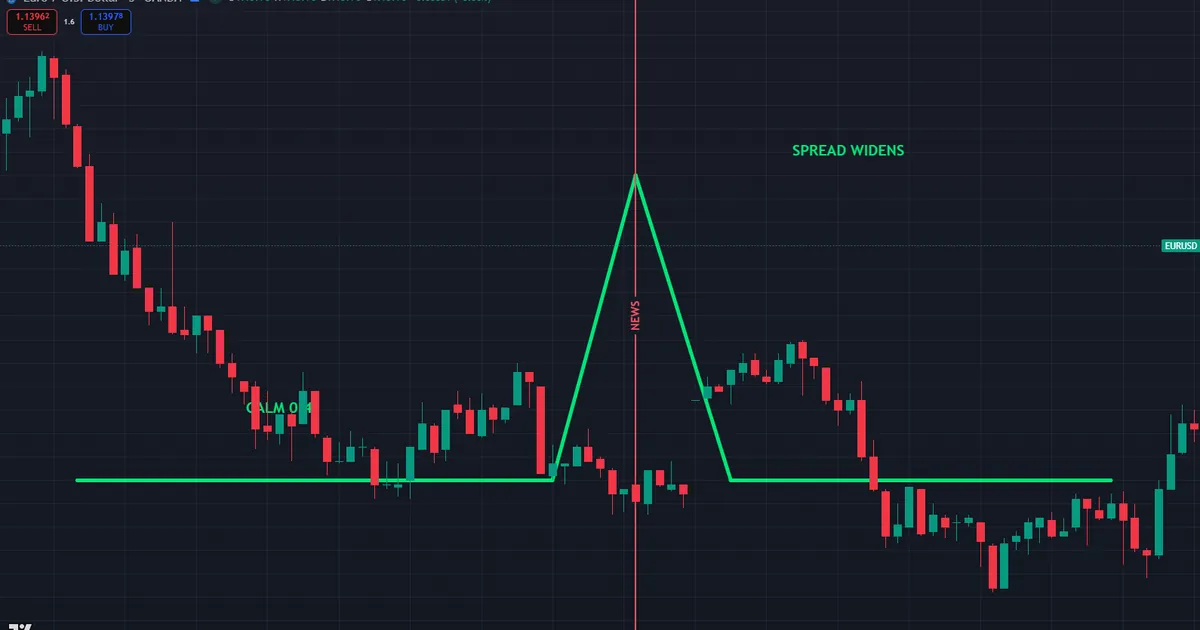
Trace that picture across the release. Before the number, the spread hugs its tight floor while price drifts quietly. At the instant of the news, the gap widens sharply and price gaps through several levels. So the spike and the widening arrive together, not by accident.
Why does this matter so much? A stop placed just beyond price can trigger on the widening alone, before the market even moves your way. So knowing when spreads widen keeps your stops and entries out of harm’s reach.
The Main Causes of a Widening Spread
Four forces drive almost every spike you will ever see. Learn them once, and a widening spread stops surprising you.
- High-impact news. Around a rate decision or a jobs report, liquidity providers pull their quotes to avoid pricing a fast, uncertain market. Fewer quotes means a far wider gap for a minute or two.
- Thin liquidity and session gaps. During quiet hours and between sessions, fewer banks sit at their desks. So the order book thins, and the spread drifts wider even without any news.
- The daily rollover. Around 5 p.m. New York time, banks briefly step back as the trading day rolls over. Liquidity dips for a few minutes, and spreads on many pairs widen through that window.
- Raw volatility. When price swings violently, the risk of quoting a stale price rises. So banks widen the gap to protect themselves, and the spread stays elevated until the storm passes.
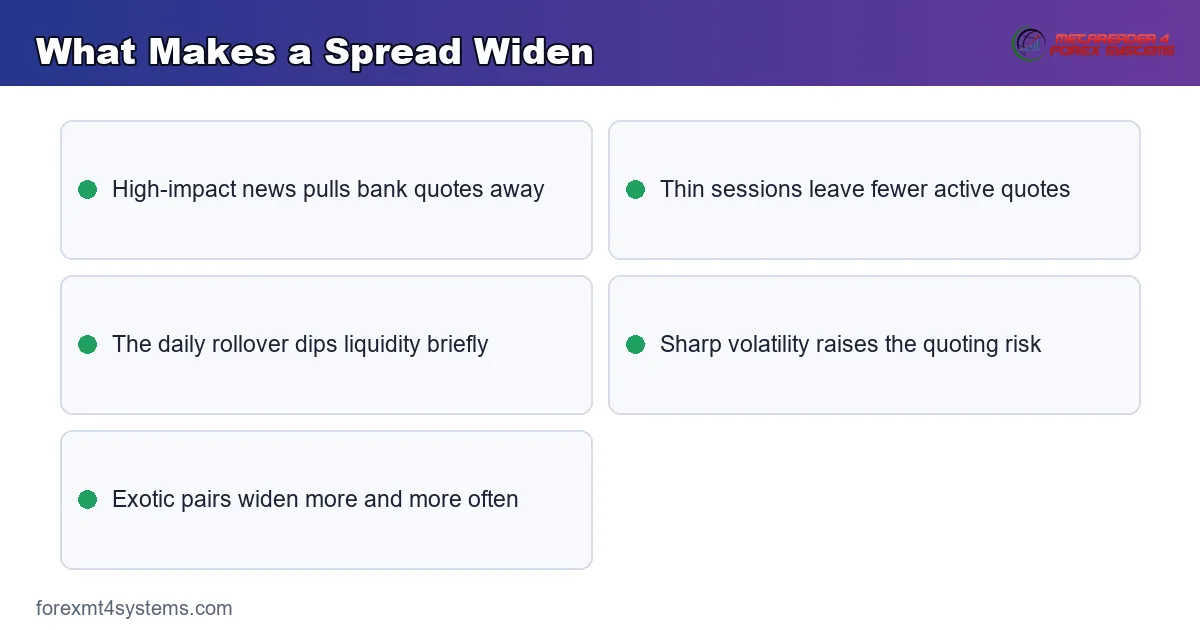
So a spike usually traces to news, thin hours, rollover, or volatility. The concept graphic below lines up these four causes at a glance.
News and Data Releases
Scheduled news causes the sharpest widening of all. Before a major release, the market holds its breath, and quotes grow scarce. So the spread can leap from a fraction of a pip to many pips within a single second.
The calendar names the worst offenders. Central-bank rate decisions, inflation prints, and monthly jobs reports rank at the top. Because these numbers move whole currencies, banks refuse to quote a tight price into the uncertainty.
Timing makes the danger sharper still. The widening often begins a few seconds before the scheduled minute and lingers after. So a trader who enters right on the release meets both a wild price and a stretched spread at once.
Thin Liquidity and Session Gaps
Liquidity is simply the number of willing buyers and sellers standing ready. It rises and falls with the clock, since traders around the world work different hours. So the spread breathes in and out across the day.
The quiet windows show it clearly. Late in the New York afternoon and through parts of the Asian session, fewer major banks quote actively. Their absence widens the gap on many pairs, even when nothing dramatic happens.
The weekend gap is the extreme case. When the market reopens on Sunday evening, few banks quote at first, so spreads can start very wide before settling. Because that thin open catches many traders, it deserves real respect and a lighter trade size. You can see how these quiet and deep windows line up across the day in our free forex market hours tool.
The Rollover Window
Every trading day rolls over at a set moment, usually 5 p.m. New York time. Around that instant, banks reconcile the day’s positions and briefly pull back from quoting. So liquidity dips for a few minutes right at the turn.
That dip shows up as a spread bump. On many pairs the gap widens noticeably at rollover, then settles once the new day gets moving. Because the bump repeats every single day, a night trader learns to expect it.
Rollover also carries the swap charge, a separate overnight cost. So the same window that widens the spread also decides your interest debit or credit. A trader who scalps across 5 p.m. New York meets both effects together.
The bump is usually brief. Within a few minutes of the turn, banks return and the spread eases back toward its normal level. So a trader who simply waits out the window sidesteps the worst of the cost.
Raw Volatility
Sometimes the market simply moves fast without a scheduled cause. A surprise headline, a large order, or a cascade of stops can send price flying. So banks widen the spread to guard against quoting a price that is already stale.
This kind of widening feels random, yet it follows the same rule. Higher risk to the quoting bank means a wider gap to compensate. Because the storm can pass quickly, the spread often snaps back once calm returns.
Gold shows this vividly. On XAUUSD near 4100, a sharp swing can push an already wide spread far wider still. So a volatile instrument compounds every other cause, and its spread deserves extra caution around any fast move.
Why Liquidity Sits at the Heart of It
Every cause above reduces to one idea: liquidity. When plenty of banks quote, the market absorbs orders easily and the spread stays tight. When they step aside, the same order moves price further and the gap grows.
Think of liquidity as the depth of a pool. A deep pool barely ripples when you jump in, while a shallow one splashes hard. So a deep market shrugs off a large order, and a thin one lurches, widening the spread as it goes.
This lens simplifies everything. Instead of memorising a long list of triggers, ask one question before any trade. Is the market deep or thin right now? Because that single answer predicts the spread better than any other.
A Worked News Example
Numbers make the risk concrete. Picture a trader who buys GBPUSD near 1.34 seconds before a rate decision, hoping to ride the move.
Watch the spread react. In the calm minute before, the gap sits near 0.6 pips, so the trade looks cheap. At the release, banks vanish and the spread leaps to 9 pips as price whips both ways. The chart below marks that spike on the news candle.
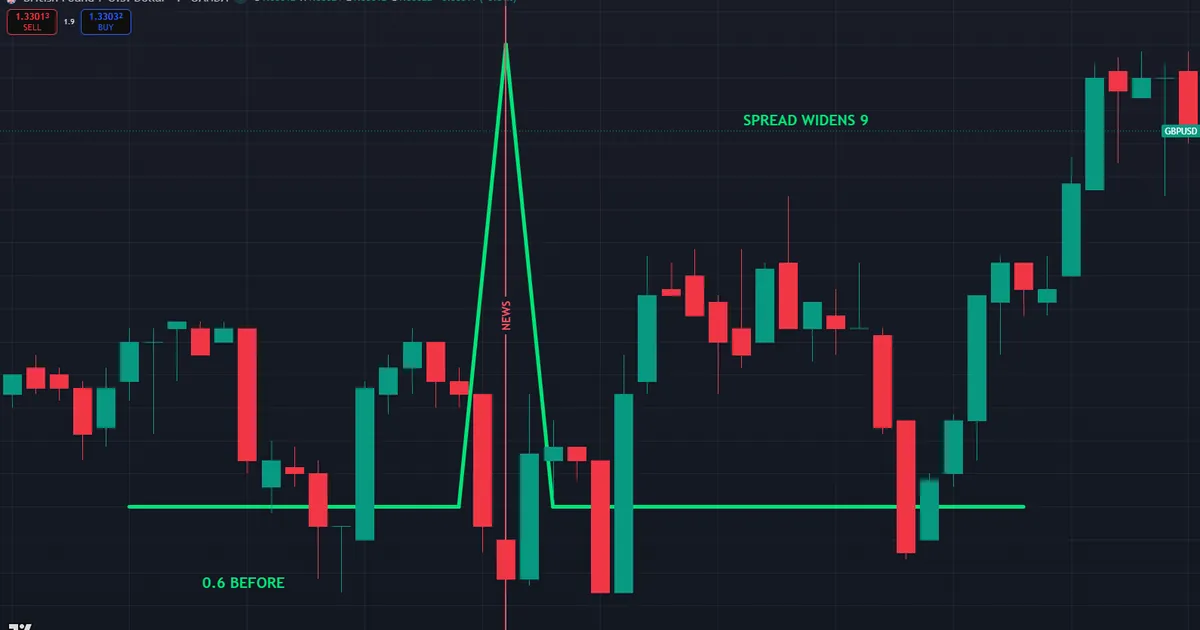
Now count the damage. The 9-pip spread means price must travel more than 9 pips just to break even, before any real move. If the trader placed a tight stop, the widening alone could close the trade at a loss on a bar that never went against the idea.
Put the cost in plain money. On a standard lot of GBPUSD, one pip runs near 13 USD, so a 9-pip spread costs about 117 USD to enter and exit. The same trade at a calm 0.6-pip spread would have cost under 8 USD. So the widening multiplied the entry cost more than tenfold.
So the lesson lands hard. Entering into a scheduled release exposes you to both a wild price and a stretched spread. Because the two arrive together, the safest edge is often to wait until the spread settles back to normal.
There is a calmer way to trade the same event. A patient trader waits a few minutes for liquidity to return, lets the spread tighten, and enters once the direction looks clearer. So the widening becomes a signal to pause rather than a trap to fall into.
How to Trade Around a Widening Spread
Knowledge only helps if it changes your behaviour. So turn the causes above into a few simple habits that keep you clear of the worst spikes.
Check the calendar first. Before any session, mark the high-impact releases for your pairs and note their exact times. Because news drives the sharpest widening, this single step avoids most of it.
Then respect the quiet hours. Trade the deep London and New York overlap when the spread runs tightest, and treat the late Asian drift and the Sunday open with caution. So your entries land when liquidity works for you, not against you.
Give Your Stops Room
A stop sits at real risk during a spike. Place it too close to price, and a brief widening can trigger it before the market truly turns. So build a small buffer into every stop, especially near the rollover window.
Size the buffer to the pair and the hour. A major pair in calm hours needs little, while gold or a cross near news needs far more. Because the spread varies so much, a one-size stop distance invites trouble.
Watch the Spread Before You Click
Most platforms show the live spread on the chart or in the market window. Glance at it before every entry, since a number far above normal warns of thin liquidity. So a quick check saves you from paying a spike you never noticed.
Compare that live number against the pair’s usual floor. When the spread sits at three or four times its calm level, wait. Because the widening usually passes, a short pause often lets you enter at a fair cost instead.
Build the habit into your routine. Note the calm spread for each pair you trade, and keep those numbers where you can see them. So a glance tells you instantly whether the current gap is normal or stretched, and you never guess in the heat of a fast market.
Download the complete indicator database
Put these concepts on your charts. One email unlocks the full library of 1,380+ indicators with compiled MT4 and MT5 files, plus my TradingView scripts. No paywall, no spam, unsubscribe any time.
Get free access to my indicator database
One email unlocks 1,380+ free MT4, MT5 and TradingView indicators — the complete library. No single-tool download; you get the whole database.
Common Mistakes and How to Fix Them
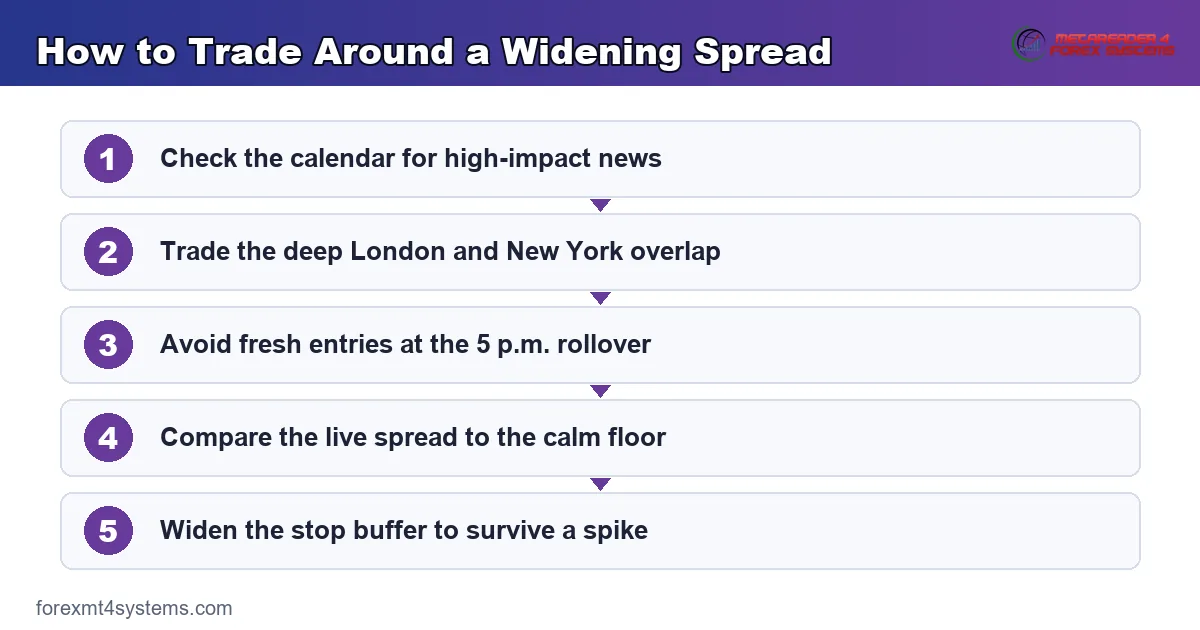
A widening spread punishes the same errors again and again. Most trace back to ignoring the clock or the calendar, and the fixes follow beneath the graphic.
Trading Right Into a Release
Entering on the exact minute of major news meets the widest spread of the day. The cost alone can sink the trade. So wait for liquidity to return, then enter once the spread settles and the direction clears.
Placing Stops Too Tight at Rollover
A tight stop near 5 p.m. New York can trigger on the rollover bump alone. The market never moved against you; the spread did. So widen the buffer or avoid fresh entries through that short window.
Scalping the Sunday Open
The market reopens thin, so spreads start wide and prices gap. A scalper who dives in at the open pays dearly for the low liquidity. So let the first hour settle before you trade the new week.
Blaming the Broker for Every Spike
A widening spread often reflects the real market, not a cheating broker. Banks genuinely pull quotes on news and in thin hours. So learn the normal pattern first, and only question a broker whose spreads stay wide when the market is deep.
Ignoring the Spread on Exotic Pairs
Exotic and minor pairs widen far more, and far more often, than the majors. A trader used to EURUSD can get shocked by a cross. So check the typical spread of every pair before you trade it.
Counting the Spread as a One-Off Cost
A wide spread on a scalp repeats on every trade, not just once. A day trader who takes many entries pays the widening again and again. So a spread that looks small on a single ticket can dominate a high-volume day. Total the cost across your real trade count, and a spike stops looking harmless.
Forgetting That the Spike Passes
A widening spread rarely lasts long. Panic-chasing a fill during the spike locks in the worst cost of the whole move. So treat the spike as a short storm, wait a few minutes, and let the gap settle before you commit. Patience turns a costly entry into a fair one.
Quick-Reference Spread Checklist
Run this short list before every entry. A few seconds here saves a spike you would rather avoid. So tick each item, and let a failed check keep you flat.
- Economic calendar checked for high-impact news on your pairs.
- Current session noted, with thin hours treated carefully.
- Rollover window near 5 p.m. New York avoided for fresh entries.
- Live spread compared against the pair’s calm-hour floor.
- Stop buffer widened to survive a brief spike.
- Exotic and minor pairs given extra room.
- Entry delayed when the spread sits far above normal.
Pitfalls and Edge Cases
Study the trap as hard as the rule. Here is a common one. A trader sees a clean breakout forming seconds before a jobs report and jumps in, sure the move is starting.
Then the spread betrays the plan. The gap leaps to 10 pips at the release, the entry fills far worse than the chart showed, and a tight stop closes the trade on the widening alone. The chart below marks that spike swallowing the entry.
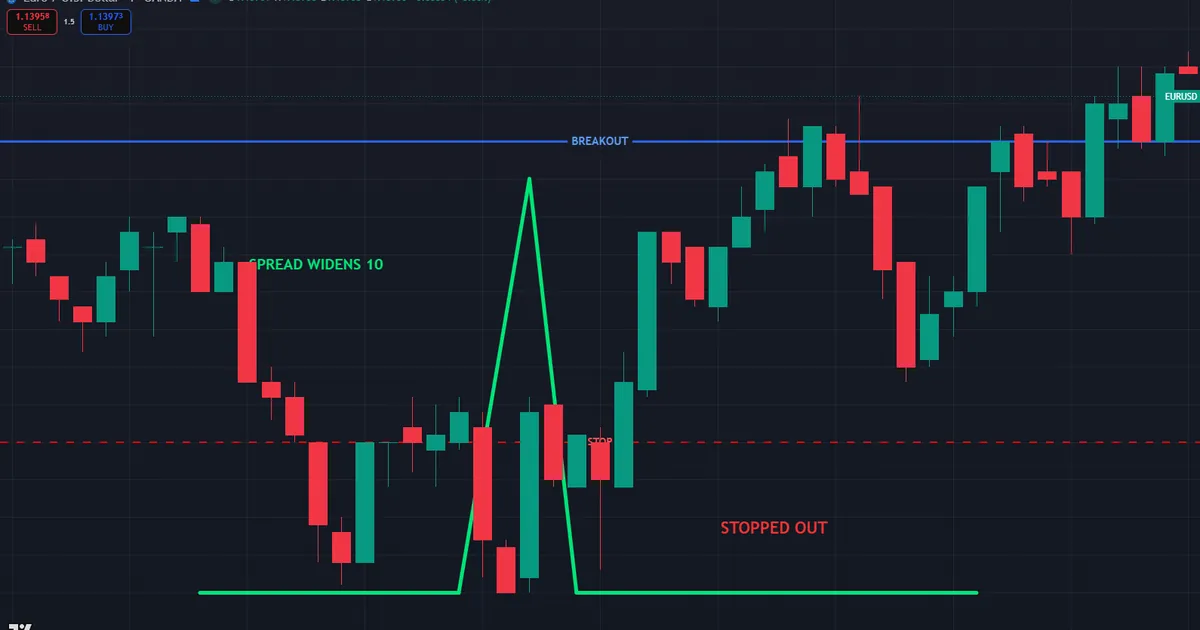
So what went wrong? The trader read the price setup but ignored the liquidity behind it. A perfect chart pattern means little when the spread is about to explode. Hence the rule that limits the damage: never enter into a scheduled release, however clean the setup looks.
A second edge case catches the overnight holder. A position left open across rollover pays the swap and meets the widened spread if it needs adjusting at the turn. Because both costs land at once, a late trade near 5 p.m. New York deserves a second thought.
Both traps share one root. Each trader watched price and forgot the liquidity that prices it. So read the clock and the calendar alongside the chart, and the widening loses most of its bite.
Holiday Sessions Widen Too
Be honest about the calendar beyond news. Bank holidays in London or New York thin the market for a whole day, so spreads drift wider than usual even in normal hours. So check for holidays before you assume a quiet, deep market.
Fixed Spreads Hide the Widening
Remember that a fixed-spread account does not remove the underlying thinness. The broker holds the quote steady but may reject your order with a requote in a fast market. Because the widening simply changes shape, a stable spread never means a stable market.
Related Concepts to Study Next
The widening spread connects to a web of basics, and a few deserve your next reading hour. Start with our guide to the spread in forex, since it explains the bid-ask gap that widens in the first place. Then read our breakdown of fixed vs variable spread to see which account type spikes and which holds flat.
Two more guides round out the picture. Because liquidity rules the spread, study our guide to the forex trading sessions to learn when the market runs deep. Then review the bid and ask price to see the two quotes whose gap the widening stretches. To sanity-check a broker, our forex spread comparison tool lines up typical spreads side by side.
FAQ
Why do forex spreads widen during news?
Around major news, liquidity providers pull their quotes to avoid pricing a fast, uncertain market. Fewer quotes means the best bid and ask drift apart. So the spread can jump from a fraction of a pip to many pips within a second of the release.
What time of day do spreads widen most?
Spreads widen most in thin hours: the late New York afternoon, parts of the Asian session, and the rollover near 5 p.m. New York time. The Sunday reopen also starts wide. So the deep London and New York overlap carries the tightest spreads.
Is a widening spread a sign of a bad broker?
Not usually, since spreads widen with the real market on news and in thin hours. A fair broker simply passes that gap through. Question a broker only when its spreads stay wide during deep, busy hours with no news to explain it.
How can I avoid paying a wide spread?
Check the economic calendar, trade the deep session overlap, and skip the rollover and Sunday open for fresh entries. Glance at the live spread before every click, and wait when it sits far above the pair’s calm floor. Patience avoids most spikes.
Do exotic pairs widen more than majors?
Yes, and by a wide margin. Exotic and minor pairs draw fewer bank quotes, so their spreads sit wider and spike more often than the majors. So budget a larger cost, and give your stops more room, on any pair beyond the main ones.
Does a fixed spread stop the widening?
A fixed spread holds the number steady, but it does not deepen the market underneath. In fast conditions the broker may reject your order with a requote instead of widening the quote. So the thinness still affects you; it just changes shape. Results are not guaranteed; past performance is not indicative of future results.
External references
- For background on this concept, see Market maker at Corporate Finance Institute.
- For broader market context, see Liquidity risk on Wikipedia.

About the author
Written by Dominic Walsh, a Forex trader and MT4/MT5 indicator, Expert Advisor and script developer. Every tool on forexmt4systems.com is tested on live charts before release and ships with ready-to-use compiled MT4 (.ex4) and MT5 (.ex5) files. Learn more about the trader and developer behind this site.
How we build, test and correct every tool: Editorial & Testing Policy. Trading carries risk; see the disclaimer.