
Choosing between fixed fractional position sizing and a fixed lot is one of the first real decisions a trader makes. The choice quietly shapes how your account grows and how deep your drawdowns run.
This guide compares fixed fractional position sizing against the fixed lot approach in plain terms. You will see how each one sets trade size, where each shines, and which suits a growing account best.
What Is Fixed Fractional Position Sizing
Fixed fractional position sizing risks the same percentage of your equity on every trade. As the account grows, the money at risk grows with it. As the account shrinks, the risk shrinks too.
The fixed lot method works the opposite way. You trade the same lot size on every position, no matter what the balance does. So a half lot today is a half lot after a win and after a loss alike.
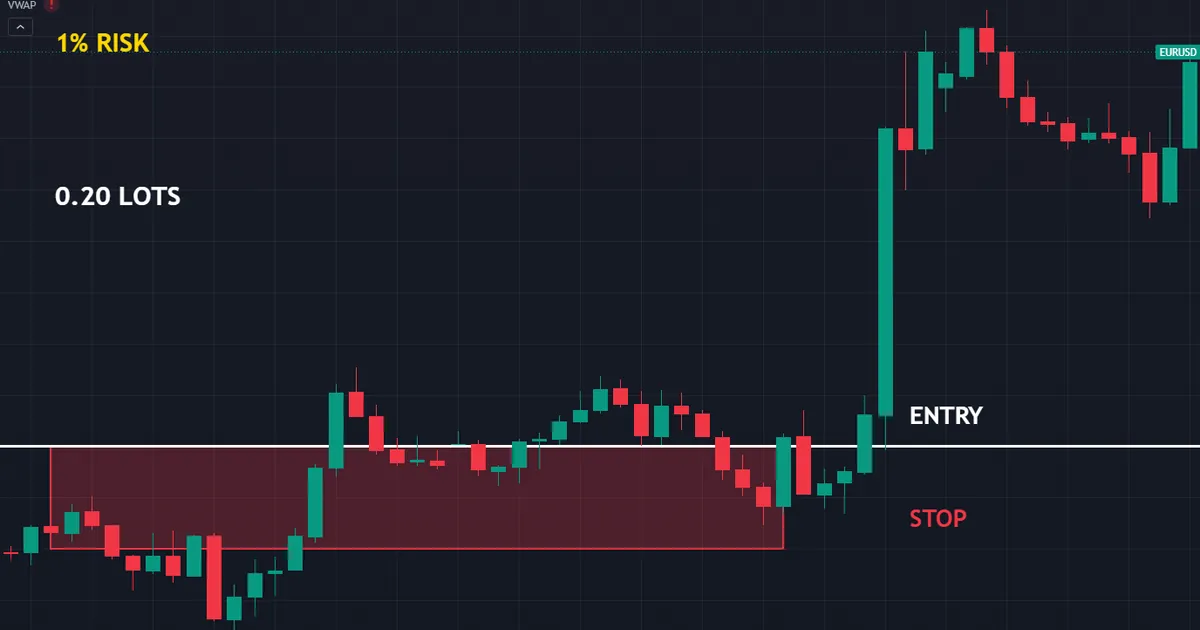
The difference sounds small, yet it changes everything over time. One method scales with your results, while the other stays frozen. That single trait drives most of the contrast below.
The Formula in One Line
Fixed fractional sizing follows a clean rule. Risk per trade equals your equity times a fixed percentage. So a two percent risk on a ten thousand account puts two hundred at stake.
From that risk figure, the lot size follows the stop distance. A wider stop means a smaller lot, and a tighter stop means a larger one. So the percentage stays fixed while the lot flexes to fit each trade.
How Each Method Works
Walk through the mechanics of both, step by step. The contrast becomes clear once you see how each one reacts to a changing balance. Both aim to size a trade, yet they answer the question differently.
- Fixed fractional, step one. Read your current equity before the trade.
- Fixed fractional, step two. Multiply that equity by your chosen percentage.
- Fixed fractional, step three. Convert that risk into a lot using the stop distance.
- Fixed lot, step one. Pick a single lot size once, in advance.
- Fixed lot, step two. Trade that same lot on every position, whatever the balance.
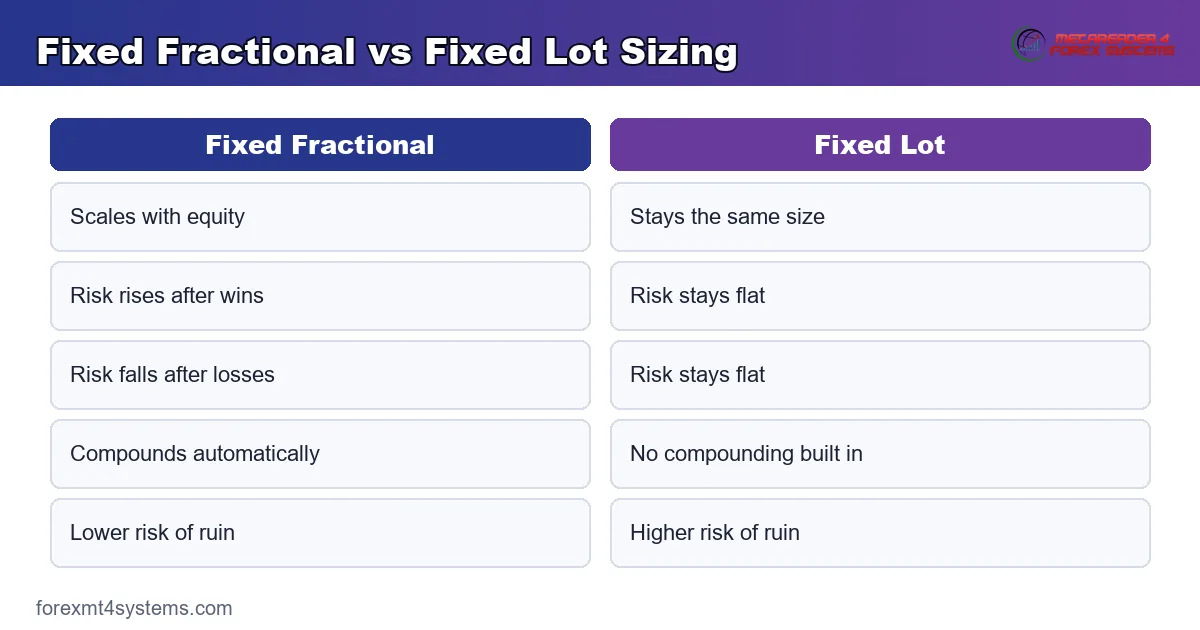
Notice the key gap between the two. Fixed fractional recalculates the size from live equity each time. The fixed lot never changes, so it ignores whether the account grew or shrank.
That gap has real consequences. With fixed fractional, a losing streak automatically trims your size. With a fixed lot, the same streak keeps risking the same money on a smaller account.
The Two Methods Side by Side
A direct comparison lays out the trade-offs at a glance. Read the table below, and the character of each method comes into focus. Neither is perfect, yet one fits a growing account far better.
| Trait | Fixed Fractional | Fixed Lot |
|---|---|---|
| Trade size | Scales with equity | Stays the same |
| After a win | Risk rises with the account | Risk stays flat |
| After a loss | Risk falls with the account | Risk stays flat |
| Compounding | Built in automatically | None on its own |
| Risk of ruin | Lower, since size shrinks in a slump | Higher, since size never adapts |
| Simplicity | Needs a quick calculation | Very simple to apply |
The table shows the core split in one view. Fixed fractional adapts, compounds, and defends against a deep slump. The fixed lot wins only on raw simplicity, which fades once you use a calculator.
A Worked Sizing Example
Numbers make the contrast stick, so follow two accounts. Both start at ten thousand, and both risk trades with a fifty pip stop. One uses two percent fixed fractional, the other a flat fixed lot.
The fractional trader risks two percent, or two hundred, on the first trade. That works out to a lot near point four zero on this stop. The fixed lot trader also picks point four zero to start, so the two match on day one.
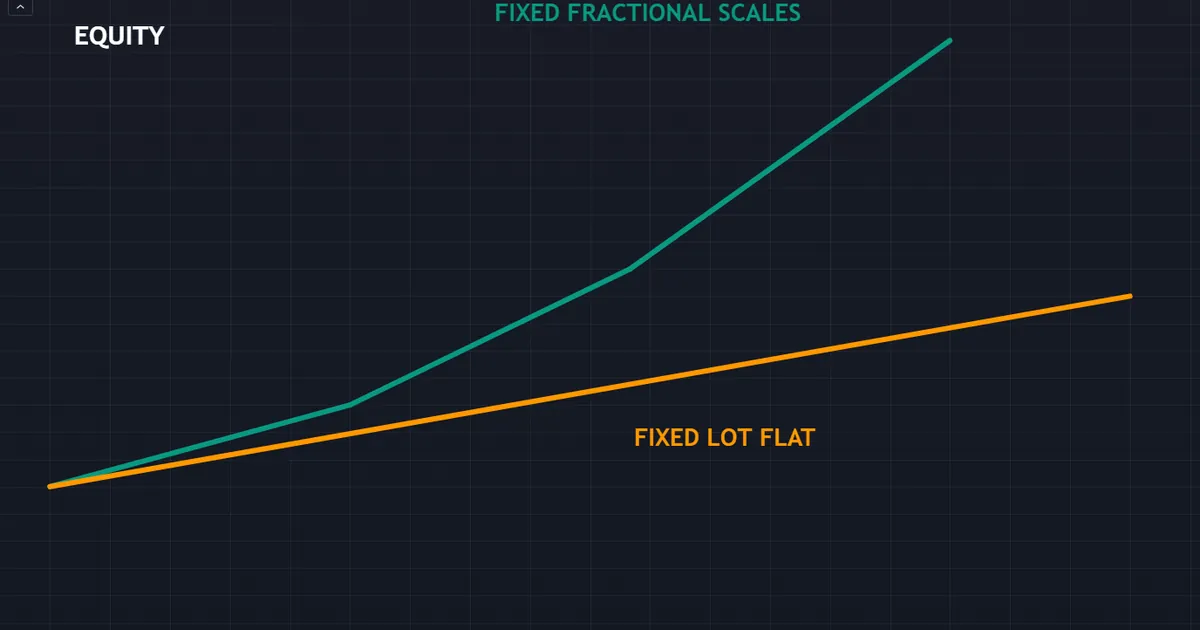
Now let both accounts grow to twenty thousand. The fractional trader still risks two percent, which is now four hundred. So the lot doubles toward point eight zero, and the risk keeps pace with the larger account.
What Happens After a Losing Streak
Reverse the story and let both accounts fall to five thousand. The fractional trader now risks two percent of five thousand, just one hundred. So the lot shrinks to point two zero, and the smaller account faces smaller trades.
The fixed lot trader keeps trading point four zero throughout. On a five thousand account, that same lot risks a much larger share. So the fixed lot quietly raises the real risk exactly when the account can least afford it.
Why Fixed Fractional Scales With You
The scaling trait is the heart of fixed fractional sizing. Your risk always tracks the account, up and down. So the method grows aggressive in good times and cautious in bad ones, without a single manual change.
This built-in reflex is hard to match by hand. A fixed lot trader must remember to resize after every swing. Fixed fractional does that work for you on every trade.
Compounding Comes for Free
Growth feeds on itself under fixed fractional sizing. Each win lifts the equity, which lifts the next trade’s size. So a run of gains compounds, because the size climbs alongside the balance.
A fixed lot leaves that compounding on the table. Your account may double, yet your trade size stays frozen. So the fixed lot earns the same dollars on a large account as it did on a small one.
Download the complete indicator database
Put these concepts on your charts. One email unlocks the full library of 1,380+ indicators with compiled MT4 and MT5 files, plus my TradingView scripts. No paywall, no spam, unsubscribe any time.
Get free access to my indicator database
One email unlocks 1,380+ free MT4, MT5 and TradingView indicators — the complete library. No single-tool download; you get the whole database.
Common Position Sizing Mistakes and Fixes
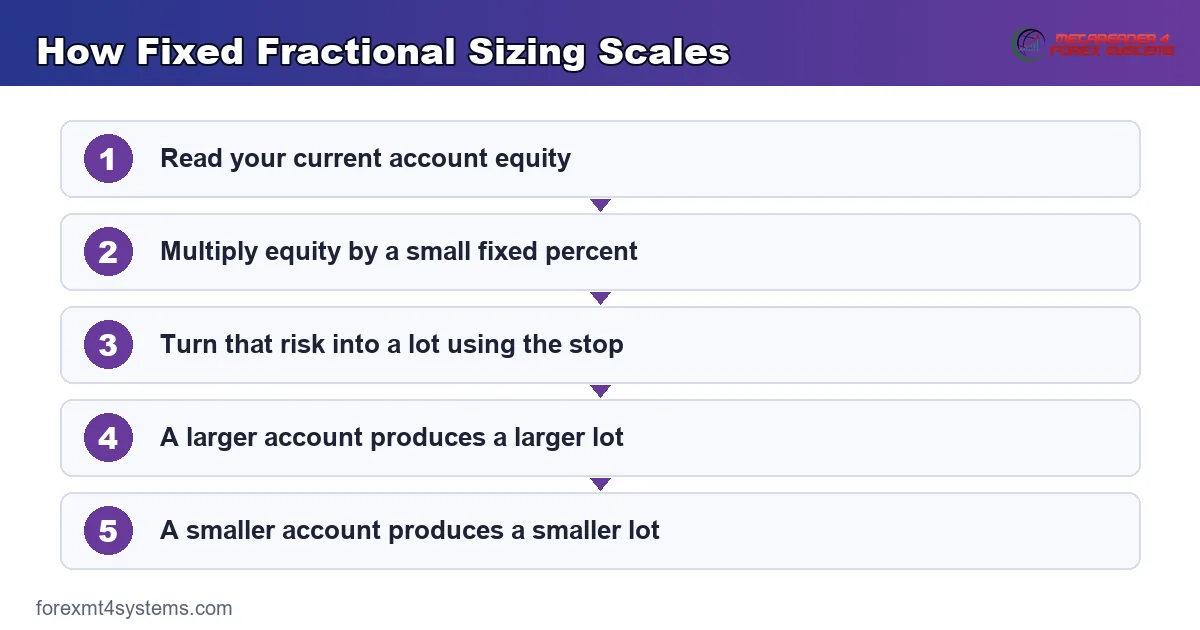
Both methods invite their own slips, and the same errors recur. Nearly all of them come from a percentage set too high or a lot left unmanaged. The diagram below shows how fixed fractional sizing scales as equity moves.
Setting the Fraction Too High
A large percentage turns fixed fractional sizing into a fast road to ruin. Risking ten percent a trade can halve an account in a short streak. So keep the fraction small, often one or two percent, where the math stays survivable.
Trading a Fixed Lot Too Large for the Account
A fixed lot that suits a big account can crush a small one. The same half lot risks far more on five thousand than on twenty. So match the lot to the smallest balance you expect, not the largest.
Forgetting to Resize a Fixed Lot
The fixed lot’s simplicity becomes a trap after a big swing. A lot chosen months ago may no longer fit the account. So review the size regularly, and adjust it when the balance moves a long way.
Ignoring the Stop Distance
Both methods need the stop distance to size a trade correctly. A fixed percent still buys a huge lot behind a tiny stop. So always let the stop set the final lot, whichever sizing method you follow.
When a Fixed Lot Still Makes Sense
Fixed fractional wins most comparisons, yet the fixed lot has its place. Its plain, unchanging nature suits a few clear situations. So do not dismiss it entirely, because simplicity carries real value.
A brand-new trader may want one less thing to calculate. A steady fixed lot keeps the focus on entries and exits. So the fixed lot can serve as training wheels while the basics settle in.
Small, Stable Accounts
A tiny account barely changes size over many trades. On such a balance, the two methods produce almost identical lots. So a beginner on a small, steady account loses little by starting with a fixed lot.
The gap only widens as the account swings. Once the balance climbs or falls sharply, fixed fractional pulls ahead. So the fixed lot fits a narrow window, then hands the advantage back.
Prop Firm Rules and Fixed Sizing
Some funded programs prefer a simple, consistent lot. A steady size makes your risk easy to check against their limits. So a fixed lot can suit the strict rules of a funded account, at least at first.
Even there, a percentage mindset helps you stay safe. You can hold the lot steady while watching the percent it risks. So a blend of both ideas often serves a funded trader best.
Blending the Two Approaches
The choice is not strictly one or the other. Many traders borrow the best of each method. So a thoughtful blend can capture the scaling of fixed fractional with the calm of a steady lot.
One common blend adjusts the lot in steps rather than on every trade. You hold a fixed lot until the account crosses a round number, then bump it up. So the size scales in clear stages, without a fresh calculation each time.
Stepped Sizing in Practice
Picture a trader who raises the lot every time the account gains a set amount. The size climbs in stairs, not a smooth ramp. So the account still compounds, yet the trader avoids recalculating on the fly.
This stepped approach keeps the risk roughly proportional. Each step nudges the lot back toward the target percent. So the blend delivers much of fixed fractional’s benefit with fixed lot’s ease.
Choosing the Blend That Fits You
Your temperament should guide the final choice. A numbers-minded trader may embrace full fixed fractional sizing. A simpler soul might prefer stepped lots that change only now and then.
Either path beats a frozen lot on a swinging account. The key is that your size responds to your equity somehow. So pick the version you will actually follow, and let it adapt as you grow.
Fixed Fractional Sizing and Your Drawdowns
The sizing method you pick shapes every drawdown you face. Fixed fractional sizing softens a slump by trimming size as equity falls. So each loss in a streak risks a little less than the one before.
This gentle taper matters more than it first appears. A fixed lot keeps carving the same dollar loss into a shrinking account. So the fixed lot deepens a drawdown just when you most need it to ease.
The Taper That Protects the Account
Follow a six-trade losing streak under fixed fractional sizing. Each loss shrinks the base, so the next risk figure drops with it. So the streak costs less than six flat losses would, because the size falls along the way.
The same streak under a fixed lot lands harder. Every loss takes the same bite from a smaller balance. So the fixed lot turns a manageable dip into a steeper valley.
Why the Taper Speeds Recovery
A shallower drawdown always climbs back faster. Fixed fractional sizing keeps the hole smaller, so the recovery gain stays modest. So the method helps you both fall less and rise sooner.
How the Two Methods Feel Day to Day
Beyond the math, the two approaches feel different at the screen. Fixed fractional sizing asks a quick calculation before each trade. A fixed lot skips that step, which some traders prefer.
The calculation is light once you use a tool. A position size calculator turns equity and stop into a lot in seconds. So the small effort buys the scaling and the safety that follow.
The Comfort of a Steady Number
A fixed lot offers a certain calm. You always know the size before you look. So a trader who values routine may find the fixed lot soothing, at least early on.
That comfort carries a hidden cost, though. The steady number stops reflecting the account after a big swing. So the calm of a fixed lot can lull you into risking too much or too little.
The Confidence of Adaptive Sizing
Fixed fractional sizing builds a different kind of confidence. You trust that the size always matches the account. So a good run and a bad run both meet a size that already fits.
This trust frees your attention for the trade itself. You stop second-guessing the lot on every entry. So the method quietly removes one more decision from a busy moment.
Setting Up Fixed Fractional Sizing
Putting fixed fractional sizing to work takes only a short setup. You need a percentage, a stop rule, and a way to read equity. With those three, every trade sizes itself from the same logic.
Start by choosing a percentage you can hold through a slump. One or two percent suits most traders well. So the figure should feel almost too cautious on a good day.
Reading Equity, Not Balance
Size from equity, which counts open trades, rather than the settled balance. An open loss lowers your true capital right now. So sizing from equity keeps the next trade honest about what you actually hold.
This habit matters most during an active streak. The balance can look healthy while trades bleed underneath. So reading equity first stops you from oversizing on a mirage.
Letting a Tool Do the Math
A calculator removes every excuse to skip the step. Enter the equity, the percent, and the stop, and it returns the lot. So the whole method collapses into a few seconds of typing.
The tool also guards against a rushed mistake. A clear number leaves less room for a hopeful guess. So a quick check keeps your size tied to the plan, trade after trade.
Which Method Suits Your Stage as a Trader
Your experience should weigh on the choice as much as the math. A raw beginner and a seasoned trader sit in different places. So the right method can shift as your skill and account grow.
Early on, simplicity has real value while habits form. Later, the scaling of fixed fractional sizing earns its keep. So many traders begin with a steady lot and graduate to a percentage rule.
Growing Into Fixed Fractional Sizing
Treat the move to fixed fractional sizing as a milestone. Once you trust your stops and your discipline, the scaling rewards you. So the switch often marks the point where an account starts to compound in earnest.
There is no rush to make the leap. A steady lot on a small account loses little in the meantime. So change methods when the account and your confidence are both ready.
Position Sizing Quick Reference
Keep this short list beside your platform. Run through it before you size any trade.
- Fixed fractional risks a set percent of current equity.
- A fixed lot trades the same size no matter the balance.
- Fixed fractional scales up in good times and down in bad.
- Compounding is built into fixed fractional sizing.
- Keep the fraction small, often one or two percent.
- Match any fixed lot to your smallest expected balance.
- Let the stop distance set the final lot every time.
Pitfalls and Edge Cases
A few wrinkles bend the clean comparison, so keep them in view. The chart below shows one shrinking account traded two ways, and how the real risk diverges.
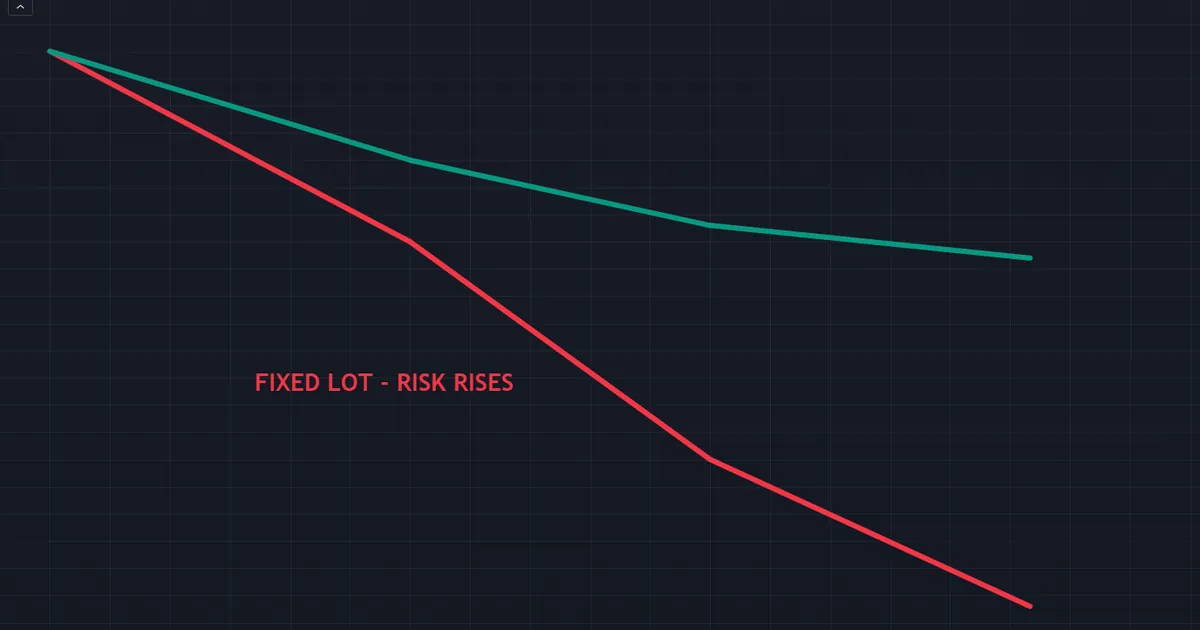
Picture an account sliding from ten thousand toward five. The fixed fractional risk falls steadily with the balance. The fixed lot risk, by contrast, climbs as a share of the shrinking account.
Tiny Accounts Hit Lot Limits
Fixed fractional sizing can call for a lot below the broker’s minimum. On a very small account, two percent may not buy even a micro lot. So a tiny balance sometimes forces a fixed minimum lot, whatever the theory says.
Rounding Distorts the Percentage
Brokers trade in lot steps, so the exact percent rarely lands cleanly. Rounding the lot nudges your real risk a little each time. So check the risk after rounding, and accept the small drift it creates.
A High Fraction Undoes the Benefit
Fixed fractional only protects you when the fraction stays small. Set it too high, and the scaling amplifies losses instead of taming them. So the method’s safety depends entirely on a modest percentage.
Related Concepts to Study Next
Position sizing connects to a wider web of risk ideas, and a few deserve your next reading hour. The percent you risk on each trade sets both your growth and your drawdown. Compounding then turns steady sizing into a rising equity curve over time.
Start with our guide on position sizing for the fundamentals, then read about risk per trade to set the percentage right. See how growth builds in our guide to compounding in forex. To size any trade in seconds, use our free position size calculator, project a growing account with the compounding calculator, and fit it all into a plan on our forex trading strategies hub.
FAQ
What is fixed fractional position sizing?
Fixed fractional position sizing risks a set percentage of your equity on every trade. As the account grows, the money at risk grows with it, and it shrinks in a slump. The lot then follows from that risk and the stop distance.
How is a fixed lot different?
A fixed lot trades the same size on every position, whatever the balance does. It never scales up after wins or down after losses. So it is simple to apply but blind to how the account changes.
Which method is better for a growing account?
Fixed fractional sizing usually fits a growing account best. It compounds gains automatically and trims risk during a slump. A fixed lot leaves that compounding unused and can risk too much on a shrunken balance.
Does fixed fractional sizing prevent large losses?
It cannot remove risk, yet it softens deep slumps by shrinking size as equity falls. That shrinking lowers the odds of a ruinous run compared to a frozen lot. The protection only holds when the fraction stays small.
Can I combine the two methods?
Yes, and many traders do exactly that. A common blend holds a fixed lot until the account crosses a round number, then steps it up. So the size scales in stages without a fresh calculation on every trade.
What percentage should I risk with fixed fractional sizing?
Most traders keep the fraction between one and two percent per trade. A small percent keeps drawdowns shallow and the account durable. Push it much higher, and the scaling starts to amplify losses. Results are not guaranteed; past performance is not indicative of future results.
External references
- For background on this concept, see Kelly Criterion at Corporate Finance Institute.
- For broader market context, see Bankroll on Wikipedia.

About the author
Written by Dominic Walsh, a Forex trader and MT4/MT5 indicator, Expert Advisor and script developer. Every tool on forexmt4systems.com is tested on live charts before release and ships with ready-to-use compiled MT4 (.ex4) and MT5 (.ex5) files. Learn more about the trader and developer behind this site.
How we build, test and correct every tool: Editorial & Testing Policy. Trading carries risk; see the disclaimer.