
Deciding how much to risk per trade is the most important number a beginner ever sets. It quietly controls how long your account survives, far more than any entry signal or indicator ever will.
This guide answers how much to risk per trade with plain rules and real numbers. You will learn the one-to-two percent standard, the survival math behind it, and a simple way to turn a percent into an exact position on any pair. Master this one habit, and the rest of your trading grows steadier around it.
How Much to Risk Per Trade, in Plain Terms
Risk per trade is the money you accept losing if a single trade fails. It is fixed before you enter, and it never depends on how confident you feel about the setup.
The widely taught standard is one to two percent of the account balance. So a trader with a five thousand dollar account risks fifty to one hundred dollars on any one trade. Because the figure is small, no single loss can do lasting harm.
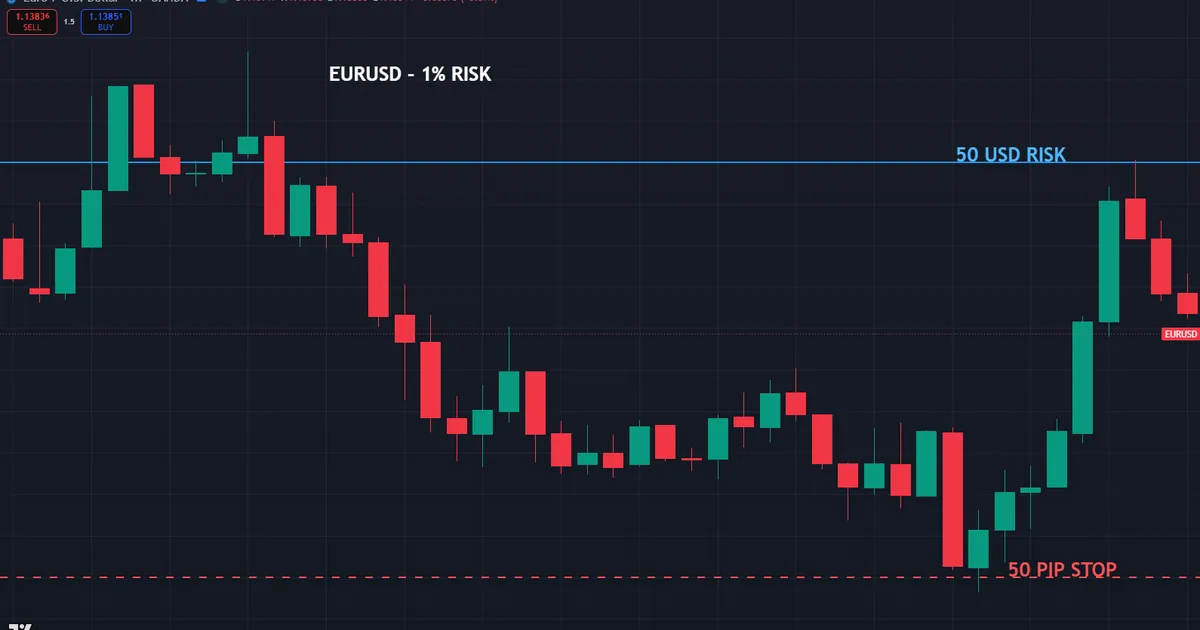
This rule shows up everywhere for a reason. Trading schools, funded-account firms, and veteran traders all point to the same narrow band. So the agreement is not fashion; it reflects the hard math of surviving a losing streak.
Notice that the rule is about loss, not size. You do not pick a lot and hope; you pick a loss and size to it. Because the loss leads, your position always fits the account rather than your mood.
Why a Percent, Not a Fixed Dollar Amount
Risking a percent keeps your exposure steady as the account changes. A one percent risk grows with wins and shrinks with losses, all on its own. So the rule scales the position to whatever balance you now hold.
A fixed dollar risk lacks that self-correction. It stays large after a drawdown, exactly when you can least afford it. Because the percent adjusts by itself, it protects the account harder in the moments that matter most.
Why One to Two Percent Works
The band is not random; it comes from how losing streaks behave. Every trader, however skilled, hits runs of consecutive losses. So the risk per trade must be small enough to absorb those runs without breaking.
Picture ten losses in a row, which happens more often than beginners expect. At one percent each, the account still holds more than eighty percent of its value. Because the damage stays shallow, the trader simply keeps going.

Now raise the risk to ten percent and run the same streak. Ten losses at that size erase most of the balance. So the very same unlucky run turns from a passing dip into an account-ending event.
The Recovery Trap
Large losses hurt twice, because the recovery is not symmetric. Lose ten percent, and you need about eleven percent to get back to even. Lose fifty percent, and you need a full one hundred percent gain to recover.
The math grows crueler as losses deepen. So a small risk per trade does more than cap one bad day; it keeps every recovery within easy reach. Because the climb back stays gentle, your edge has room to work over time.
Account Survival Over a Streak
The clearest way to feel the rule is to trace an account through a bad run. Small differences in the percent lead to wildly different endings after the same string of losses.
Follow a ten thousand dollar account through eight straight losses. The percent you chose decides how much survives the run and how hard the climb back becomes.
- Half a percent risk. Eight losses shave off roughly four percent, leaving the account almost whole and easy to recover.
- One percent risk. The same run costs near eight percent, a mild dip that a few winners can repair.
- Two percent risk. Losses now reach about fifteen percent, a real setback but still far from danger.
- Five percent risk. The account drops around a third, and the recovery starts to strain.
- Ten percent risk. Eight losses erase more than half, and the climb back needs the account to double.
Read down that list, and the pattern jumps out. The low percents treat a losing streak as weather, not disaster. Because the small figures keep every dip shallow, the trader simply waits and trades on.
Turning a Percent Into a Position
A percent means nothing until it becomes a lot on the platform. The bridge is a short calculation that starts with your risk and ends with a size you can trade.
Walk through a full trade to see it. You hold a five thousand dollar account, and you follow a one percent rule. So your risk in money is fifty dollars on this trade.
Next, read the stop off the chart. Your EURUSD idea near 1.14 places a sensible stop fifty pips away. Divide the fifty dollar risk by the fifty pip stop, and you need one dollar a pip.
From Pip Value to Lot
Finish by turning that pip value into a lot. On a dollar pair, one dollar a pip points to a 0.10 lot. So the correct size here is 0.10, and a full stop loss costs the planned fifty dollars.
Check the loop once. At 0.10 lots the pip value is one dollar, and fifty pips at one dollar is fifty dollars. The numbers agree, which confirms the size fits the rule.
A Second Worked Example
Change the risk percent and watch the position follow. You keep the same five thousand dollar account, yet you choose a bolder two percent this time.
Set the risk first. Two percent of five thousand is one hundred dollars, so the loss ceiling doubles. Your GBPUSD chart near 1.34 places the stop forty pips from the entry.

Now run the size. Divide the one hundred dollar risk by the forty pip stop, and you need two and a half dollars a pip. On a dollar pair that points to a 0.25 lot.
Compare the two trades side by side. The higher percent and the tighter stop both pushed the lot up. So the size reacted to both inputs, while the method behind it never changed.
Download the complete indicator database
Put these concepts on your charts. One email unlocks the full library of 1,380+ indicators with compiled MT4 and MT5 files, plus my TradingView scripts. No paywall, no spam, unsubscribe any time.
Get free access to my indicator database
One email unlocks 1,380+ free MT4, MT5 and TradingView indicators — the complete library. No single-tool download; you get the whole database.
Choosing Your Own Risk Percent
The one-to-two band is a guide, not a law, so pick a figure you can hold through a bad week. Many new traders start nearer one percent while they learn the market’s rhythm.
Your choice should reflect two things: your experience and your nerves. A tested strategy with a clear edge can carry the upper end of the band. So a raw beginner is usually better served by the lower end.
When to Risk Less Than One Percent
Some situations call for an even smaller figure. A brand-new strategy without a track record deserves caution, so half a percent lets you gather data cheaply. Because the stakes stay tiny, the lessons cost little.
Volatile conditions also argue for less. Around major news the market can swing hard and gap past stops. So trimming the risk into those windows guards the account when the fills turn unpredictable.
Keeping the Percent Consistent
Whatever figure you choose, apply it the same way on every trade. A steady percent turns your results into honest feedback about the strategy. Because the risk holds constant, the balance curve reflects the edge and not random bet sizing.
Random risk hides the signal in noise. When one trade risks half a percent and the next risks five, the account tells you little. So a fixed percent is what makes your trading history worth studying at all.
Adjusting Risk as the Account Grows
A percent rule adjusts your size automatically, yet you still choose the percent itself. As an account grows and a strategy proves out, some traders nudge the figure toward the upper band. So the risk rises only after the evidence earns it.
The reverse also holds during a rough patch. After a string of losses, trimming the percent for a while eases the pressure. Because the smaller figure shrinks each loss, it buys calm and time to find your footing again.
Risk Per Trade Across Account Sizes
The percent rule fits a tiny account and a large one alike, because it works in proportions. One percent means five dollars on a five hundred dollar account and five hundred on a fifty thousand dollar one. So the method scales without any change to the steps.
What shifts is the position you can actually place. A very small balance may need a micro lot to keep the risk in bounds. A large one reaches comfortably for standard lots at the same percent.
Sizing a Small Starter Account
On a three hundred dollar account, one percent is only three dollars of risk. A fifty pip stop then needs six cents a pip, which sits below a single micro lot. So the smallest tradable size may already risk more than the target percent.
The honest fix is patience, not force. Accept a slightly higher percent for now, or grow the balance before trading live. Because chasing sizes below the broker floor only breeds errors, many traders wait until a micro lot fits their chosen risk.
Sizing a Larger Account
On a fifty thousand dollar account, one percent is five hundred dollars of risk. A fifty pip stop then supports ten dollars a pip, a full standard lot. So the very same rule now points at a much larger position.
Here the danger flips toward oversizing. A standard lot moves the balance fast, so stop discipline matters even more. Because the numbers feel big, a calm percent guards against the pull to trade beyond the plan.
Pairing Risk With Reward
Risk per trade sets the loss, yet the loss only pays off next to a reward. A small, steady risk still needs winners large enough to cover the losers. So the percent and the target work as a team, never alone.
Think in terms of reward against risk on each trade. Risk fifty dollars to make one hundred, and you can lose more often than you win and still profit. Because the winners outrun the losers, the account grows even with a modest hit rate.
This is why the risk percent alone never tells the whole story. A tiny risk with poor targets still bleeds slowly over time. So set the loss with the percent rule, then pair it with a target that makes each win worth the risk.
The two settings also steady your nerves together. A capped loss removes the fear of ruin, while a clear target gives each trade a purpose. Because both numbers are fixed in advance, you trade the plan instead of the emotion of the moment.
Risk Rules on Funded Accounts
Funded-account and prop-firm programs make the case for small risk in hard numbers. They hand a trader capital, then enforce loss limits that punish oversizing directly.
Most programs set a daily loss cap and a total loss cap. A common pair is around five percent in a day and ten percent overall. So a trader who risks five percent per trade can breach the daily limit with a single loser.
The math forces a low percent per trade. Risk one percent, and it takes several bad trades in one day to threaten the cap. Because the small figure leaves room to be wrong, it keeps you inside the rules on the worst sessions.
Why the Limits Mirror Good Sense
These caps are not arbitrary hurdles; they copy what careful traders already do. A firm wants its capital to survive, so it enforces the same defense you would choose. So passing an evaluation and trading your own account reward the same habit.
Treat the limits as training even without a funded account. Set a personal daily loss cap and a total drawdown line, then respect them. Because the rules hold whether or not a firm watches, they build discipline you carry into every account you ever trade.
Common Risk Per Trade Mistakes
The rule is simple, yet the same errors trip up new accounts. Most come from letting a feeling override the fixed percent, and the fixes sit under the graphic below.

Raising the Risk After Losses
The urge to win back a loss fast is powerful. Doubling the risk to recover only doubles the danger. So hold the percent steady after a loss, and let the edge play out across many trades.
Sizing by Confidence
A setup that feels certain tempts a bigger bet. Yet confidence is a poor guide, since the market ignores how sure you feel. So keep the percent the same on every trade, however strong the signal looks.
Forgetting Open Trades
One percent on each of five trades can mean five percent at risk at once. Sizing each alone hides that stacked total. So add up the risk across all live trades before you decide the percent on the next.
Ignoring the Stop Distance
Some traders fix a lot and forget the stop, which lets the real risk drift. A wide stop on a fixed lot quietly risks far more than planned. So always size from the stop, not from a favorite lot number.
Risking Money You Need
Trading with rent or bills on the line warps every decision. The pressure pushes you to oversize and to cut winners early. So fund the account with money you can lose, and let the percent rule work in peace.
Risk Per Trade Quick Reference
Keep this short list beside the platform. Run through it before you size any new trade.
- Pick a risk percent, usually between one and two percent.
- Risk in money equals the balance times that percent.
- Place the stop on the chart before you size the trade.
- Divide the risk in money by the stop distance in pips.
- Turn that pip value into a lot for the pair you trade.
- Add up open risk, and keep the total inside a sensible cap.
Pitfalls and Edge Cases
A few situations bend the clean rule, so keep them in view. The chart below shows how a heavy risk per trade punishes an ordinary losing streak.
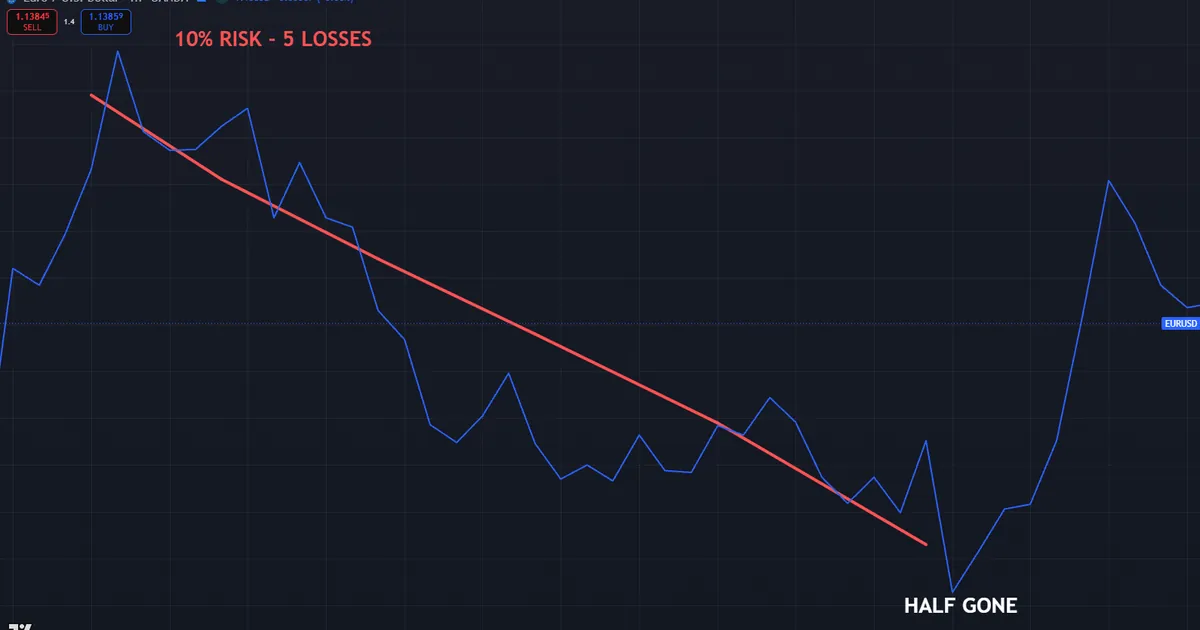
Picture five losses in a row at ten percent each. The account falls by nearly half, and the recovery turns steep. That single image is the strongest case for a small, steady percent.
Small Accounts Hit the Lot Floor
A tiny balance sometimes cannot risk as little as it wants. One percent of two hundred dollars is only two dollars, which may sit below one micro lot. So very small accounts sometimes must accept a slightly higher percent or wait to grow.
Slippage Nudges the Loss Higher
Your stop can fill a little past its level in fast markets. So the real loss sometimes edges above the planned figure. Leave a small buffer in the risk, and treat the calculated loss as a floor rather than a ceiling.
Correlated Trades Multiply the Risk
Two trades on linked pairs behave like one larger bet. Sizing each at one percent then risks closer to two on the same driver. So when trades share a theme, count them together and split the budget between them.
Streaks Are Random, Not Rare
A long losing run is normal, not a sign the strategy is broken. Even a solid edge produces clusters of losses by pure chance. So set the percent for the worst streak you can imagine, and the ordinary ones become easy. To see how a risk level shapes long-run survival, our risk of ruin calculator puts a number on it.
Related Concepts to Study Next
Risk per trade is one gear in a larger machine, and a few neighboring ideas make it click. The wider framework of risk management sets the context, position sizing turns the percent into a lot, and risk of ruin shows the long-run stakes.
Start with our guide on risk management in forex for the full framework. Then read position sizing to convert your percent into an exact lot, and risk of ruin to see how the percent shapes survival. To watch a drawdown build, study drawdown in trading, and size any live trade with our position size calculator.
FAQ
How much should I risk per trade as a beginner?
Most beginners do well risking around one percent of the account on a single trade. That figure keeps a normal losing streak survivable while you learn. You can move toward two percent once a strategy shows a steady edge.
Why not risk more to grow the account faster?
A larger risk speeds gains but also speeds losses, and losses compound against you. Ten losses at ten percent each erase most of the balance. So the faster path often ends at zero rather than at wealth.
How do I turn a risk percent into a lot size?
Multiply the balance by your percent to get the risk in money. Divide that by the stop distance in pips to find the pip value you need. Then convert the pip value into a lot for the pair you trade.
Should my risk percent change with the setup?
Keeping a fixed percent on every trade is the cleaner habit. Sizing by how strong a setup feels invites bias and inconsistency. A steady percent lets your results reveal whether the strategy truly works.
What if one percent is below the minimum lot?
On a very small account, one percent can fall under a single micro lot. You then either accept a slightly higher percent or grow the balance first. Many traders wait until the account can support the smallest lot at their chosen risk.
Will risk per trade stop me from losing money?
No, it only limits how much any single trade can cost you. Losses are a normal part of trading, and streaks will still arrive. Set a small percent, apply it on every trade, and manage each position with care. Results are not guaranteed; past performance is not indicative of future results.
External references
- For background on this concept, see The 2% Rule at Investopedia.
- For broader market context, see Risk appetite on Wikipedia.

About the author
Written by Dominic Walsh, a Forex trader and MT4/MT5 indicator, Expert Advisor and script developer. Every tool on forexmt4systems.com is tested on live charts before release and ships with ready-to-use compiled MT4 (.ex4) and MT5 (.ex5) files. Learn more about the trader and developer behind this site.
How we build, test and correct every tool: Editorial & Testing Policy. Trading carries risk; see the disclaimer.