
A record nobody reads costs you time and returns nothing. Knowing how to review your trades turns a pile of rows into one change you can actually make.
This guide sets out the loop. A fixed cadence, three groupings that pay, an honest word about small samples, and a single rule change at the end.
How to Review Your Trades Week by Week
Reviews fail for one reason above all others. Traders open the record, feel vaguely bad, and close it again.
Structure fixes that. Four steps, forty minutes, and the same order every Sunday.
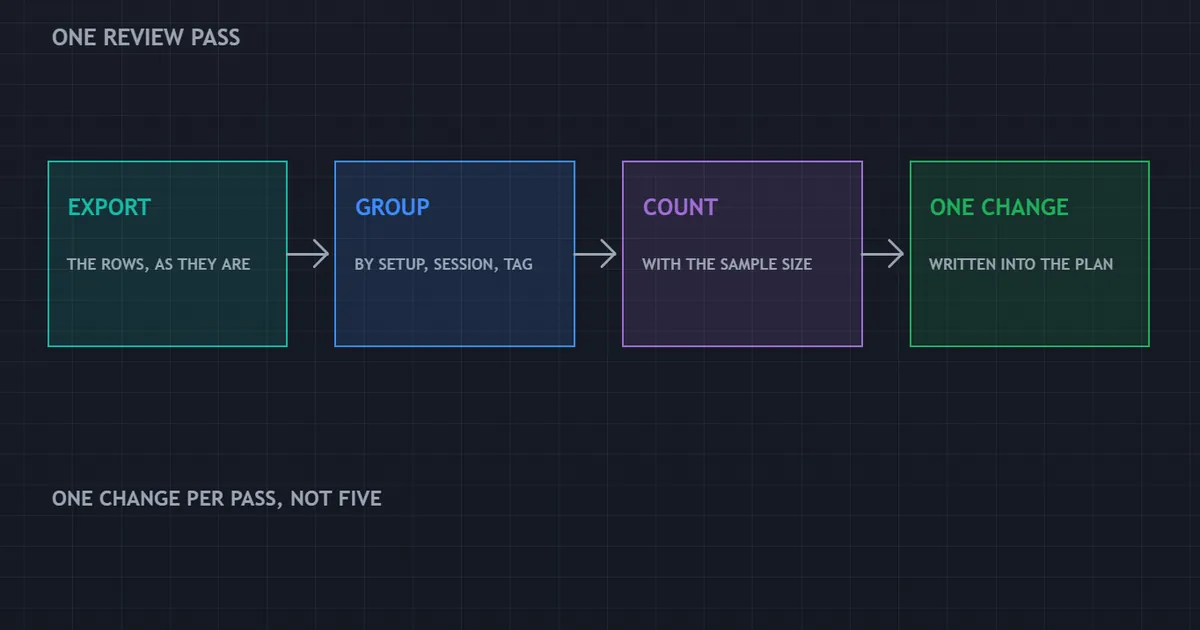
Above sits the whole workflow on one panel. Export, group, count, change, and nothing else competes for the time.
The Four Steps
Export first. Pull the rows into one sortable place so the reading never depends on scrolling through screenshots.
Group second, count third. Both steps happen mechanically, which keeps opinion out of the part that should stay arithmetic.
Change last, and only once. One rule change per review keeps the next review readable.
Why Weekly and Not Daily
Daily reading tells you about the last trade, which is rarely the useful question. Emotion also runs highest within hours of a loss.
A week supplies enough rows to group. Five to twenty entries fit on one screen and separate cleanly by setup and session.
Forty Minutes, Booked in Advance
Put the review in your calendar like an appointment. Sunday evening works for most traders, and any fixed slot beats a floating intention.
Protect the slot on bad weeks especially. Losing weeks hold the highest information, and they attract the strongest urge to skip.
Four Rhythms, Four Questions
Different intervals answer different questions. Asking a monthly question of a single day produces noise dressed up as insight.
- Nightly, two minutes. Did I follow the plan today? Nothing else.
- Weekly, forty minutes. Which setups did I take, and where did execution slip?
- Monthly, ninety minutes. What do the counts say by setup, session and tag?
- Quarterly, half a day. Does the method still deserve the capital behind it?

Keep the questions apart. Judging a method on a single week is the most common way traders talk themselves out of something workable.
The Nightly Two Minutes
Read only the execution column. Count the trades that followed the plan and the ones that did not.
Ignore profit entirely at this stage. Nightly profit tells you about the market, and nightly execution tells you about you.
The Weekly Forty Minutes
Sort by setup name, then by session. Read the tags, and note anything that appears more than twice.
Finish by writing one sentence. That sentence becomes the rule change, or it records that nothing warranted one.
The Monthly Count
Now the numbers begin to carry weight. Forty to eighty rows support real proportions rather than impressions.
Our guide to the R multiple covers why the results column has to sit in R for any of this arithmetic to hold.
The Quarterly Question
Once a quarter, ask the hard one. Does this method still justify the risk, the screen time and the cost?
Answer it from counts rather than from feeling. Three months of complete records makes the question answerable, and three weeks does not.
Set the criteria before the quarter starts. Deciding afterwards what would change your mind rarely works, because by then the answer already sits in front of you.
Keep the Cadence Fixed
Moving the review day around kills it quietly. Same evening, same length, same order, week after week.
Consistency also makes reviews comparable. Two weeks read the same way sit neatly side by side, and two read differently do not.
What to Group By
Grouping does the real work of a review. Three columns repay the effort, and most others do not.
By Setup Name
Start here every time. Setup grouping shows which ideas you actually trade, as opposed to which ones live in your plan.
Traders regularly find a setup they never take. They also find one they take constantly that appears nowhere in writing.
Both findings arrive within a month. Neither shows up any other way.
By Session
Sort the same rows by hour of the day. Costs, volatility and your own attention all shift across a session.
Look for clusters rather than averages. Off-plan entries in particular tend to bunch into one predictable hour.
By Mistake Tag
Tags convert habits into counts. Six late entries in a month reads very differently from a vague sense of impatience.
Read the tag column before the results column. Habits sit upstream of outcomes, and they respond to rules far more reliably.
By Instrument, Once You Trade Several
Traders running four or five instruments should add a fourth grouping. Costs and behaviour differ enormously between a major pair and a metal.
Keep it out of the weekly read though. Instrument grouping belongs in the monthly count, where the buckets hold enough rows to mean something.
Two Groupings That Waste Time
Grouping by day of the week rarely helps. Five buckets from twenty trades leaves four rows each, which supports no conclusion at all.
Grouping by profit does even less. A pile sorted by outcome simply reproduces the market’s opinion, and you already had that.
What Twenty Trades Can and Cannot Tell You
Sample size decides which questions a review can answer. Most disappointment here comes from asking the wrong one.
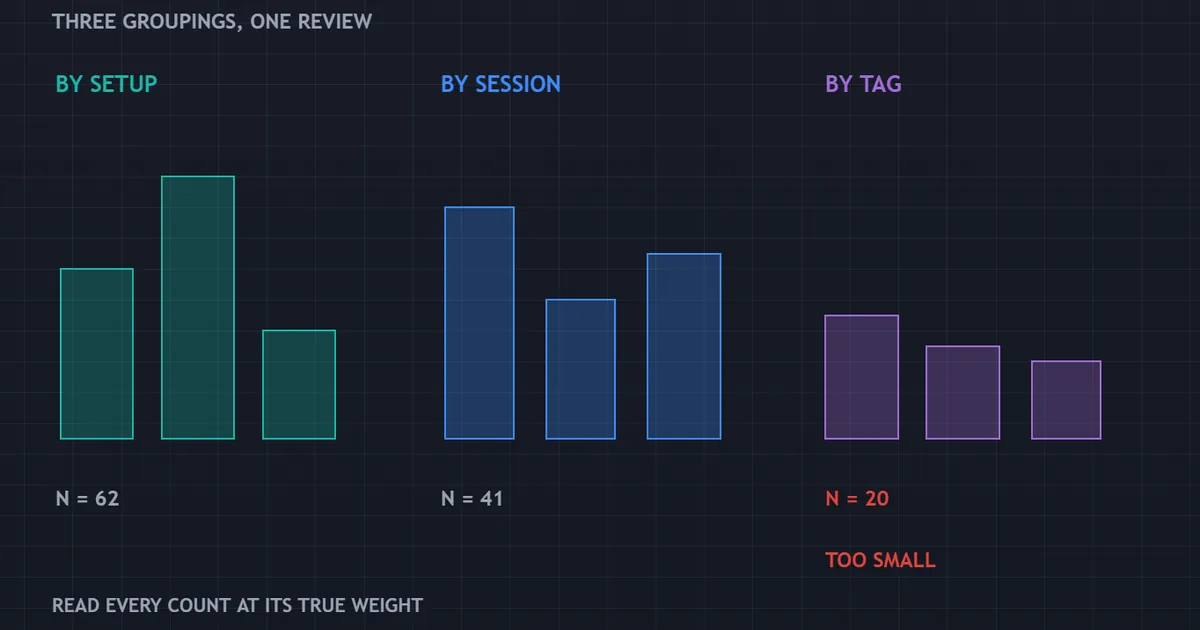
What Twenty Trades Do Show
Behaviour shows up fast. Twenty rows reveal whether you follow your own rules, which setups you gravitate toward, and when you break discipline.
Costs show up quickly too. Twenty fills give a fair picture of your typical slippage and spread burden.
What They Cannot Show
Twenty trades say almost nothing about the edge itself. A run of losses at that size happens routinely under any reasonable method.
Strike rate stays especially unstable. Six wins from twenty and eleven wins from twenty sit closer together than they look.
So resist judging the method here. Judge the execution, and let the method wait for a larger pile.
How Many Rows Before Judging a Method
Nobody can hand you a magic number. Roughly a hundred trades of one setup starts to mean something, and several hundred means considerably more.
Until then, treat results as provisional. Our expectancy calculator turns a column of R results into one figure, and that figure keeps moving while the sample stays small.
Streaks Look Like Signals
Random sequences produce runs that look purposeful. Six losses together feel like evidence and usually reflect ordinary variance.
Count occurrences rather than reading sequences. Order carries almost no information at small sample sizes, and it carries enormous emotional weight.
Splitting Makes It Worse
Every extra filter shrinks the pile. Forty trades split by setup, session and direction leaves five rows in each bucket.
Pick one split at a time. Sequential grouping beats stacking filters, because stacked filters manufacture patterns from thin air.
Download the complete indicator database
Put these concepts on your charts. One email unlocks the full library of 1,380+ indicators with compiled MT4 and MT5 files, plus my TradingView scripts. No paywall, no spam, unsubscribe any time.
Get free access to my indicator database
One email unlocks 1,380+ free MT4, MT5 and TradingView indicators — the complete library. No single-tool download; you get the whole database.
Turning a Finding Into One Rule Change
Reviews only pay when something changes afterwards. One change, written down, tested for a quarter.
Where Rule Changes Come From
Good changes come from repeated tags, never from single trades. Three occurrences of one tag justify a rule, and a single bad afternoon does not.
Look for the tag appearing across two consecutive reviews. Persistence over weeks separates a habit from a bad day.
Write It as an If-Then
Vague resolutions evaporate. “Be more patient” survives about four days, while a written trigger survives the quarter.
Try this shape instead. If the setup appears after eleven in the morning, then no entry without a written second reason.
Any rule you can score at review works. Any rule you cannot score belongs in a diary rather than in a plan.
One Change, One Quarter
Changing three rules at once teaches you nothing about any of them. Results shift, and the cause stays hidden.
So change one thing and leave the rest alone. Patience here costs a few weeks and saves a great deal of confusion.
How to Tell If It Worked
Score the rule, not the profit. Count how often you followed it and how often the tag it targeted still appeared.
A rule followed twenty times with the tag gone counts as a success. Whether the account grew that quarter answers an entirely different question.
When to Revert
Some rules cost more than they save. A filter that removes two bad trades and four good ones deserves reversal without embarrassment.
Write the reversal down as well. A record of what you tried and dropped stops you circling back to it next year.
A Worked Weekly Review
Abstract steps only travel so far. Here sits one week of twenty rows, grouped the way the loop describes.
The Counts That Came Out
| Grouping | Count | What it suggested |
|---|---|---|
| Plan followed | 16 of 20 | Execution held for most of the week |
| Off-plan entries | 4 of 20 | All four came straight after a loss |
| Pullback setup | 11 trades | The idea actually getting traded |
| Range rejection | 3 trades | In the plan, rarely taken |
| Breakout | 6 trades | Never written into the plan at all |
| Tag: late | 5 occurrences | Four of the five after eleven o’clock |
| Skipped setups | 7 logged | Five failed the same spread rule |
Reading That Table Honestly
Twenty rows cannot judge any of those setups. What the table does settle is behaviour, and the behaviour reads clearly enough.
Six breakout trades appear nowhere in the written plan. That single line matters more than any profit figure from the same week.
The One Change That Followed
Our trader wrote one sentence. If a breakout setup appears, then no entry until the plan describes it in writing.
Nothing else changed. The late tag stayed on the list for the next review, and the spread rule stayed exactly as written.
What the Next Review Checked
Only two things. How often the new rule got followed, and whether breakout entries dropped out of the record.
Scoring stayed that narrow on purpose. A review checking one rule finishes inside forty minutes and produces an answer.
Reviewing the Setups You Passed Over
Most reviews only read the trades that happened. Skipped setups sit in the same file and answer a different question entirely.
Are Your Filters Too Tight
Count the skips beside the fills. Twenty skips against six trades suggests filters that shut almost everything out.
Then read the reasons. Five skips for one reason points at a rule worth revisiting, while five skips for five reasons points at nothing.
Are Your Filters Doing Anything
Two skips against forty trades raises the opposite question. Filters that never trigger supply comfort rather than protection.
Check what happened after each skip as well. A rule that occasionally costs a winner still earns its place, provided it removes more harm than it costs.
Turning Counts Into a Simple Scorecard
Numbers scattered through a file resist comparison. One small scorecard fixes that, and it takes five minutes a month.
Four Lines Are Enough
Plan-followed percentage, trades taken, most frequent tag, and the rule currently under test. Four values per month, one row each.
Twelve rows then fit on a single screen. Trends in behaviour turn visible with no charting at all.
What Not to Put on It
Leave profit off the scorecard entirely. Its presence drags every reading back toward outcome, which is exactly what the card exists to avoid.
Track equity separately if you want it. Two documents keep two questions apart, and mixing them defeats both.
Common Review Mistakes
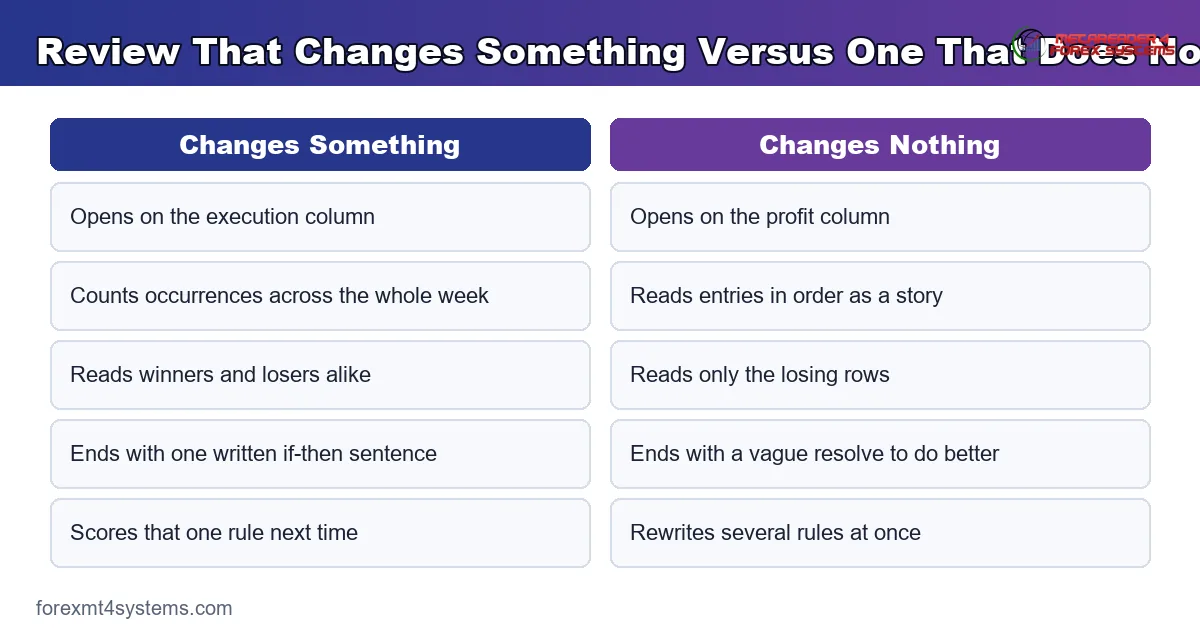
Five habits turn a review into an hour of quiet self-criticism. The panel sets a review that changes something against one that changes nothing.
Reading the Profit Column First
Outcome pulls attention away from process every time. Open on the execution column, and read results only after the behaviour makes sense.
Reviewing Only the Losers
Winners hide just as many broken rules. An oversized position that paid out still counts as an oversized position.
Changing Everything After a Bad Month
Wholesale rewrites feel decisive and destroy your comparable history. One change, then wait for the next count.
Skipping the Review After a Loss
Losing weeks carry the most information and attract the most avoidance. Book the slot in advance so the decision never gets made on the day.
Confusing a Story With a Count
Reading entries in order produces a narrative, and narratives always find a villain. Sort and count instead, then read the notes for context.
Reviewing Without a Written Output
A review that produces no sentence produces nothing. End every session with one line, even when that line reads “no change this week”.
Quick Reference: The Weekly Loop
Forty minutes, five stages, same order every time. Print it and work down the list.
| Stage | Time | What you do | Output |
|---|---|---|---|
| Export | 5 minutes | Pull the week’s rows into one sortable place | A clean sheet |
| Execution read | 10 minutes | Count plan-followed against off-plan trades | Two numbers |
| Group by setup | 10 minutes | Sort by setup name and count each bucket | Which ideas you actually trade |
| Group by session and tag | 10 minutes | Sort by hour, then by mistake tag | Where behaviour clusters |
| Write the change | 5 minutes | One if-then sentence, or a note saying no change | A rule to score next week |
Our free trade journal handles the export and the grouping, which leaves the forty minutes for reading rather than for spreadsheet work.
When the Review Gets Skipped
Plenty of traders log faithfully and never read a row. That combination costs the most, because it pays the price of logging without the return.
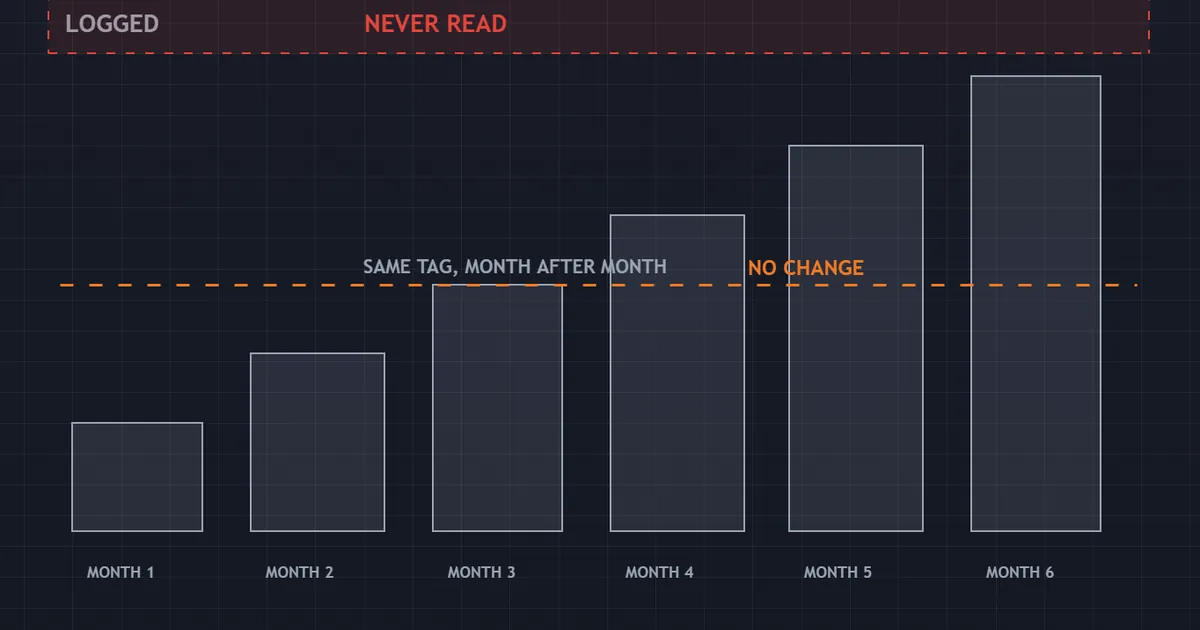
What the Panel Shows
Months of records pile up unread. The same tag repeats across the whole period, and nothing in the plan ever moves.
Six months of that produces a beautiful archive of an unchanged problem. The record worked perfectly and the loop never closed.
Why Reading Gets Skipped
Reviews carry an emotional cost that logging avoids. Writing an entry takes thirty seconds, while reading twenty of them means facing the pattern.
Our note on trading psychology covers the avoidance that shows up here more than anywhere else in the process.
Shrink the Review Instead of Skipping It
Ten minutes beats zero comfortably. Read only the execution column and the tags, then close the file.
Full reviews can resume when the week allows. Habits survive on reduced versions and rarely survive a clean break.
Make the Output Visible
Keep the rule change somewhere you see it daily. A sticky note beside the screen outperforms a line buried in last month’s file.
Score it at the next review. Our guide on becoming a disciplined trader covers why visible rules hold better than remembered ones.
Reviewing With Another Trader
Solo reviews drift toward the story you already tell yourself. A second reader breaks that habit quickly.
Swap Counts, Not Opinions
Send the four scorecard lines rather than the trades. Numbers invite questions, while screenshots invite advice nobody asked for.
Ask one question of each other. Which count looks strangest, and what single rule would you test next?
Keep It Short and Regular
Fifteen minutes a month beats a long session twice a year. Short and regular keeps both parties honest without drifting into coaching.
What a Review Cannot Fix
Be straight about the ceiling. Reviewing cannot repair a strategy with no edge, however carefully you group the rows.
What it does instead is faster and less comfortable. A hundred honest entries expose a broken method in months rather than years.
So a quarter of clean execution alongside falling equity points at the method, not at the trader. That finding hurts and saves considerable money.
Our note on drawdown covers how to size the exploration so a wrong answer stays survivable.
Related Guides Worth Reading Next
Two neighbours complete the loop. Take whichever half currently works less well.
If the rows themselves look thin, start with how to keep a trading journal. Reviews can only read what the logging captured.
If you want to see completed entries first, our trading journal examples show a winner, a loser and a setup passed over with every field filled.
And if sorting keeps demanding a clean-up, our comparison of the best trading journal format covers the column constraints that make grouping work.
FAQ
How often should I review my trades?
Weekly for behaviour, monthly for counts, quarterly for the method. A two-minute nightly glance at the execution column adds value on top. Each interval answers a different question, and mixing them is how traders end up judging a strategy on four days of data.
What should I look at first in a review?
The execution column, always. Count how many trades followed the plan and how many did not, before profit enters the picture at all. Behaviour sits upstream of results and responds to rules, while results respond to the market.
Is twenty trades enough to judge my strategy?
No, though twenty trades say plenty about your discipline. A losing run of that length happens routinely under any reasonable method, and strike rate stays wildly unstable at that size. Judge execution now and leave the method until the pile runs to a few hundred rows.
How many changes should come out of one review?
One. Changing several rules at once makes the next review unreadable, because you cannot attribute any shift to a particular cause. Write the change as an if-then sentence you can score, then leave everything else alone for a quarter.
Should I review winning trades too?
Yes, and most traders skip them. Winners hide broken rules just as often as losers do, and an oversized position that paid out remains an oversized position. Reviewing only the red rows teaches you to fear outcomes rather than to correct behaviour.
What if the review shows nothing worth changing?
Write that down and stop. A week where execution held and no tag repeated deserves a one-line note saying so, which builds a useful record of stable periods. Manufacturing a change to feel productive is how good rules get discarded.
Will reviewing my trades make me profitable?
Reviewing improves what you can see and what you correct, which is a narrower claim. It reduces repeated mistakes, exposes setups you take without meaning to, and shows your real costs. Whether the underlying method carries an edge stays a separate question, and a review simply answers it sooner. Results are not guaranteed; past performance is not indicative of future results.
External references
- For background on this concept, see After Action Review on Wikipedia.
- For broader market context, see Attribution Analysis at Investopedia.

About the author
Written by Dominic Walsh, a Forex trader and MT4/MT5 indicator, Expert Advisor and script developer. Every tool on forexmt4systems.com is tested on live charts before release and ships with ready-to-use compiled MT4 (.ex4) and MT5 (.ex5) files. Learn more about the trader and developer behind this site.
How we build, test and correct every tool: Editorial & Testing Policy. Trading carries risk; see the disclaimer.