
Almost every trader starts a journal, and most stop within a month. Learning how to keep a trading journal has far less to do with templates than with when you write in it.
This guide covers the habit rather than the layout. Three moments a day, ten minutes total, and one change that keeps the record honest.
How to Keep a Trading Journal in Ten Minutes a Day
Ten minutes sounds small for something people abandon so readily. Time was never the real problem.
Journals collapse because the writing lands at the wrong moment. Move the writing and the habit survives on its own.

Above sits the whole daily routine on one timeline. Two short stops during the session, one slightly longer stop at the end.
The Three Moments
First comes the pre-trade note, written while the order waits. Three lines, roughly thirty seconds, and it never gets edited afterwards.
Second comes the exit line, added when the position closes. Result in R, an execution score, and a tag if one applies.
Third comes the end-of-day pass. Five minutes to fill gaps, log the setups you passed over, and close the day.
Why the End-of-Day Pass Stays Short
Five minutes covers gaps and skipped setups. Anything longer usually means you left too much undone during the session itself.
Treat a growing evening pass as a warning. It signals that the pre-trade note keeps slipping, and the fix belongs in the morning rather than at night.
What Ten Minutes Buys
Ten minutes a session builds roughly two hundred complete entries a year. That sample supports real counting rather than impressions.
Compare that with a Sunday write-up. An hour on Sunday produces a story about your week, and stories bend toward whatever you already believe.
The Part Everyone Gets Backwards
Most traders treat the journal as a report. Reports arrive after the event, which puts every note downstream of the outcome.
Treat it as an instrument instead. An instrument records conditions as they happen, and that ordering carries the whole value of the exercise.
Log Before the Entry, Not After the Exit
Here sits the difference between a journal that teaches and one that flatters. Write the reason before you click, every time.
What the Pre-Trade Note Holds
Three lines cover it. The setup name from your fixed list, one sentence of reasoning, and the price that ends the idea.
Nothing else belongs in that moment. Prices, sizes and timestamps arrive in your platform export, so typing them now steals attention you owe the order.
Write it in the same words each time. Consistent phrasing turns into a column you can group later, and freehand prose turns into noise.
Why Hindsight Rewrites the Reason
Memory quietly edits motive to match outcome. After a winner your reasoning sounds sharper than it felt, and after a loss it sounds careless.
Neither version happened. Both get written with total sincerity, which makes the effect impossible to spot from the inside.
A note saved before the result exists sidesteps all of that. It carries no knowledge of what came next, so it cannot bend toward it.
Thirty Seconds Beats Thirty Minutes
Traders resist pre-trade writing because it feels like a delay. Thirty seconds rarely costs a setup worth taking.
Setups that cannot survive thirty seconds of writing deserve a second look anyway. Urgency and edge rarely travel together.
The Sequence in Order
Follow the same five steps on every trade. Repetition removes the decision about whether to log at all.
- Setup spotted. Name it from your fixed list before doing anything else.
- Pre-trade note written. Reason and invalidation, thirty seconds, no editing later.
- Order placed. Size worked back from the stop distance you just recorded.
- Exit line added. Result in R, execution score, tag if one applies.
- End-of-day pass. Gaps filled, skipped setups logged, day closed.

Step two carries the weight. Drop it and the other four steps produce a statement rather than a journal.
The Three Lines, Word for Word
Abstract advice about recording your reasoning helps nobody at nine fifteen. Here sits the actual wording.
A Note That Works
Setup: pullback to prior day high. Reason: level marked Sunday, four-hour trend up, London open adds volume. Invalid eighteen pips below, under the swing low.
Twenty-four words, thirty seconds, and every clause sorts into a column later. Nothing in it depends on what happens next.
A Note That Fails
“Looks strong, going long, feels like a runner.” Same effort, same sincerity, and no part of it survives a review.
Vague notes also shield you from evidence. A reason nobody can test never turns out wrong, which feels comfortable and teaches nothing.
Wording That Sorts Versus Wording That Does Not
| Field | Sorts cleanly | Sorts into nothing |
|---|---|---|
| Setup name | Pullback to prior day high | Nice setup on the majors |
| Reason | Level marked Sunday; trend up; session open | Looked strong |
| Invalidation | Eighteen pips, under the swing low | Will cut it if it goes wrong |
| State | Calm | Bit frazzled after this morning |
| Tag | Late | Should have waited a little longer really |
Read that middle column aloud. Every phrase repeats word for word on the next trade, which explains why it counts.
How Long It Actually Takes
Traders overestimate the cost badly. Measure it once and the objection usually disappears.
Timing Your Own Entries
Run a stopwatch across ten trades. Most people land between ninety seconds and three minutes for a complete record.
Then multiply by your real frequency. Four trades a day at two minutes each comes to eight minutes, plus a five-minute close.
Where the Time Actually Goes
Typing numbers eats most of it. Prices, lots and commissions all export automatically, so hand-typing them wastes half your budget.
Judgement fields cost almost nothing. Reason, score and tag take seconds because you already know the answers.
The Hidden Cost of Switching Windows
Attention costs more than keystrokes. Every hop between platform and journal drags your focus off the chart for longer than the typing itself takes.
Keep both windows visible at once. Split screen, second monitor, or a notebook on the desk all solve the same problem.
Cutting the Cost Without Cutting the Record
Constrain the columns. Dropdown lists on setup name and tag remove typing and improve your counts at the same time.
Our free trade journal arrives with those lists in place, so the ten-minute figure holds from your first session.
What Changes Once the Log Exists
Nothing changes in the market. What changes sits entirely on your side of the screen.

Reading the Panel Above
The marker shows where routine logging began on one account. Same method on both sides of that line, and the difference lives in behaviour rather than in signals.
Off-plan trades usually fall first. Writing “off-plan” in a column you will read on Sunday makes the trade feel expensive before you take it.
The Observation Effect
Measuring a habit changes it. Knowing that a tag awaits removes a surprising share of impulse entries within two weeks.
That effect fades if nobody reads the record. Logging without reviewing decays into typing, which explains a lot of abandoned journals.
The First Pattern Most Traders Find
Two or three weeks in, one finding turns up again and again. Off-plan trades cluster into the same hour of the day.
Late morning, after a loss, or right before the session ends. The exact hour varies, and the clustering rarely does.
That finding costs nothing to act on. Block the hour, or require a written reason before any entry inside it.
What It Does Not Change
Your strategy stays exactly as good or as bad as it was. A log measures execution, and execution sits upstream of results without controlling them.
Our note on overtrading covers the behaviour that logging exposes fastest.
Download the complete indicator database
Put these concepts on your charts. One email unlocks the full library of 1,380+ indicators with compiled MT4 and MT5 files, plus my TradingView scripts. No paywall, no spam, unsubscribe any time.
Get free access to my indicator database
One email unlocks 1,380+ free MT4, MT5 and TradingView indicators — the complete library. No single-tool download; you get the whole database.
Common Logging Mistakes
Six habits kill journals that started well. The panel sets the before-entry approach against the after-exit one.

Writing Everything at the Weekend
Saturday notes describe a story you have already told yourself. Capture during the session and keep Saturday for reading, not writing.
Recording Feelings Instead of Decisions
Long emotional passages feel honest and count into nothing. One word for your state and one sentence for your reasoning does more work.
Logging Only the Trades You Took
Passed setups carry your cleanest thinking, because nobody defends a position that never opened. Log the skips beside the fills.
Adding Fields After a Bad Week
Losses tempt traders into building. Extra columns raise the daily cost exactly when your motivation sits at its lowest.
Chasing a Perfect Streak
One missed day convinces people the record no longer counts. Gaps happen, and a journal with four missing entries still beats no journal at all.
Never Reading It Back
Writing without reading turns the habit into paperwork. Book the review before you start logging, and our guide to reviewing your trades explains what each cadence delivers.
Quick Reference: The Ten-Minute Routine
Pin this beside your platform. Three stops, fixed times, no decisions required.
| Moment | Time | What you write |
|---|---|---|
| Before the order | 30 seconds | Setup name, one-sentence reason, invalidation price |
| Immediately after entry | 10 seconds | Risk in percent, planned target in R |
| At the exit | 30 seconds | Result in R, execution score, tag if one applies |
| Setups you passed over | 20 seconds each | Setup name, why you passed, what happened next |
| End of day | 5 minutes | Fill gaps, attach screenshots, close the day |
| End of week | Reading only | Nothing new written; the record gets read instead |
Notice the last row. Friday adds no writing at all, which keeps the daily cost honest.
Why Journals Get Abandoned
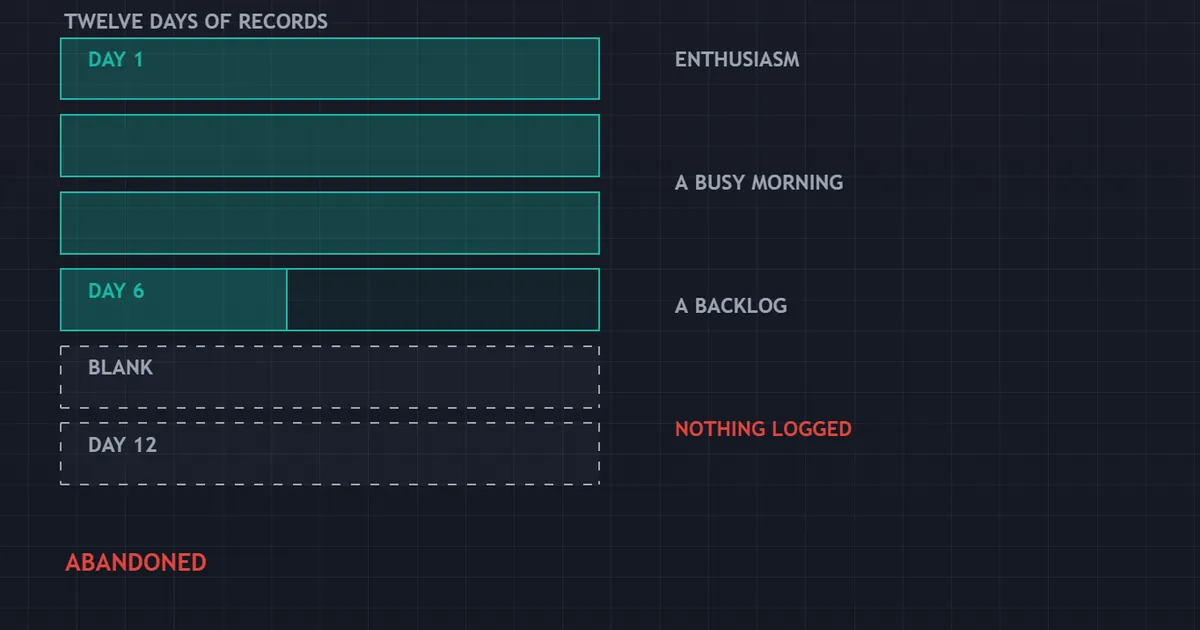
Abandonment follows a pattern, and the pattern repeats across almost every trader who quits. The panel shows how it unfolds.
The Usual Timeline
Day one arrives with enthusiasm and twenty-eight columns. Day six brings a busy morning and two blank rows.
Day twelve arrives with a backlog, and backlogs feel like debt. Somewhere around day fifteen the file stops opening.
The Real Causes
Three causes explain most of it. Too many fields, writing at the wrong moment, and no scheduled read-back.
None of those causes involves willpower. Each one has a mechanical fix, which is genuinely good news.
Restarting After a Gap
Never backfill. Draw a line, mark the restart date, and log forward from today with a shorter field list.
Backfilled rows carry hindsight into your record and poison the count. A clean restart beats a reconstructed month every time.
The Two-Line Emergency Version
Some weeks leave room for almost nothing. Keep two lines going anyway: setup name and invalidation price.
Two lines take eight seconds and hold the habit open. Restarting from a thin record costs far less effort than restarting from nothing.
Shrink the Record Before You Quit It
When logging starts slipping, cut fields rather than promising harder. Three rows kept daily beat eleven rows kept occasionally.
Reason, invalidation and tag survive every trim. Our worked trading journal examples show how much those three carry on their own.
Logging When the Session Turns Busy
Calm mornings make logging easy. Busy ones decide whether the habit lasts.
Three Positions at Once
Write the setup name and the invalidation only. Reason and score can wait for the evening pass, provided those two hard facts land immediately.
Order matters more than completeness here. A half entry written at the right moment beats a full one written after the close.
Fast Markets and Wide Spreads
Add one word: conditions. Wide, thin or fast tells your future self why a fill landed badly, with no further explanation needed.
Costs cluster in exactly those sessions. A conditions column repays the effort the first time you sort by it.
Trading Away From the Desk
Voice notes work well. Say the three lines aloud, then type them up during the evening pass while the memory still holds shape.
Screenshots work too. A phone photograph of the chart at entry carries most of the context a sentence would have given you.
A Two-Week Starter Plan
New habits fail on ambition. Start smaller than feels reasonable, then let the record grow.
Week One: Three Fields Only
Setup name, reason, invalidation. Nothing else, not even the result.
Leaving the outcome out sounds strange and does something useful. It proves to you that the pre-trade half stands on its own.
Week Two: Add the Exit Line
Now add result in R and an execution score. Five fields, still under two minutes, and a first real count becomes possible.
Read the ten rows at the end of that week. Ten entries settle nothing about your method and plenty about your consistency.
Week Three Onward: Grow Slowly
Add one field a fortnight, and only when a review actually wanted it. Fields added out of enthusiasm come back out within a month.
Stop at nine. Beyond that the daily cost climbs faster than the insight does.
Making the Habit Automatic
Habits attach to cues, not to intentions. Give the log a fixed cue and your motivation stops mattering.
Attach It to Something You Already Do
Open the journal at the same time you open your platform. One window beside the other, every session, no separate decision.
Put the end-of-day pass against an existing marker. The close of your session, the end of a shift, or the moment you shut the laptop.
Make Skipping Visible
Mark missed days on a calendar. Seeing two blank days beside eight filled ones works better than any reminder app.
Count those blanks monthly. A rising blank count usually predicts a drop in discipline elsewhere, and our guide on becoming a disciplined trader covers what usually follows.
Reward the Logging, Not the Result
Tie any sense of a day well spent to the record rather than to the profit. Ten complete entries counts as a good day, whatever the numbers did.
That swap sounds soft and works surprisingly hard. Results sit outside your control, while entries sit entirely inside it.
Use the Checklist as the Trigger
A pre-trade checklist and a pre-trade note fit together neatly. Finish the checks, write the three lines, then place the order.
Our pre-trade checklist ends on exactly that step, so the two habits reinforce each other.
Keeping the Record Honest
A journal only helps while it tells the truth. Three rules protect that, and none of them costs a thing.
Never Edit an Old Note
Wording written before the entry stays exactly as written. Improving it later feels tidy and destroys the one property that made it valuable.
Add a second line instead. Date that addition, and your future self can still see which thought came first.
Write Down the Trades You Regret
Off-plan entries carry the strongest urge to skip logging. Log those first, before the urge finds itself a reason.
Missing entries never scatter randomly. They cluster on your worst days, which bends every count you later draw from the record.
Mark Uncertainty Where It Existed
Some setups qualify cleanly and others scrape through. One extra character, a question mark beside the setup name, records that difference in no time at all.
Sort by that mark after fifty trades. Marginal setups often behave very differently from clean ones, and nothing else in the record would show it.
What Logging Cannot Do
Set expectations honestly here. A journal cannot repair a strategy with no edge, however faithfully you fill it in.
What it does instead is uncomfortable and useful. Forty complete entries reveal a broken method in weeks rather than after a year of hoping.
So a month of clean losses counts as information rather than as failure. Execution scored full marks across a losing run points at the method itself.
Keep the position size small enough that discovery stays cheap. Our position size calculator works the lots back from your stop in seconds.
Related Guides Worth Reading Next
Two neighbours pair naturally with this habit. Take whichever gap looks wider.
For the underlying case, our explainer on what a trading journal is covers what the record can and cannot claim.
Setup names have to come from somewhere, and our indicator library covers the tools most traders end up naming in that column.
FAQ
When should I write in my trading journal?
Before the order goes in. A note written while the position waits carries no knowledge of the outcome, so hindsight cannot bend it. Add the exit line when the trade closes, then spend five minutes at the end of the day filling gaps and logging the setups you passed over.
How long does keeping a journal take each day?
About ten minutes for most retail traders. Roughly two minutes per trade plus a five-minute close covers a normal session. Time yourself across ten trades rather than guessing, because the estimate people carry in their heads usually runs double the real figure.
What do I do after missing a week?
Draw a line and log forward from today. Never backfill, because reconstructed rows carry hindsight into the record and quietly corrupt every count you draw from it. Mark the gap, shorten the field list, and treat the restart as a fresh sample.
Do I need to log trades I did not take?
Yes, and twenty seconds covers each one. A pass counts as a decision, so leaving skips out hides half your judgement. Skipped setups also produce the calmest notes you will ever write, since nobody feels defensive about a position that never existed.
Should I record how I felt during the trade?
One word suffices. Calm, rushed, tired or frustrated all sort into a column and count properly at review. Longer emotional passages feel productive, resist grouping, and usually disappear first once the week turns busy.
Should I log demo trades the same way?
Log them identically, then read them with a caveat. Demo fills skip slippage and carry none of the emotional weight of real money, so execution scores there run flatter than they will live. The habit still transfers, and building it before real risk arrives costs you nothing at all.
Will keeping a journal make me profitable?
It will not, and any claim otherwise deserves suspicion. A journal measures what you do, which usually reduces off-plan trades once you know a tag is coming. Whether the underlying method has an edge stays a separate question, and the record simply answers it sooner. Results are not guaranteed; past performance is not indicative of future results.
External references
- For background on this concept, see Self-Monitoring on Wikipedia.
- For broader market context, see Trade Blotter at Investopedia.

About the author
Written by Dominic Walsh, a Forex trader and MT4/MT5 indicator, Expert Advisor and script developer. Every tool on forexmt4systems.com is tested on live charts before release and ships with ready-to-use compiled MT4 (.ex4) and MT5 (.ex5) files. Learn more about the trader and developer behind this site.
How we build, test and correct every tool: Editorial & Testing Policy. Trading carries risk; see the disclaimer.