
Most journal guides hand over a blank template and wish you luck. These trading journal examples take the opposite approach, because every field below carries a real answer rather than a placeholder.
Three entries follow. One winner, one loser, and one setup passed over on purpose, each with the same eleven rows completed end to end.
Trading Journal Examples: The Fields Every Entry Uses
An entry splits neatly into two halves. You write the first half before the order goes in, and the second half after the position closes.
That split does most of the work. It protects your reasoning, because the market cannot edit a note you already saved.
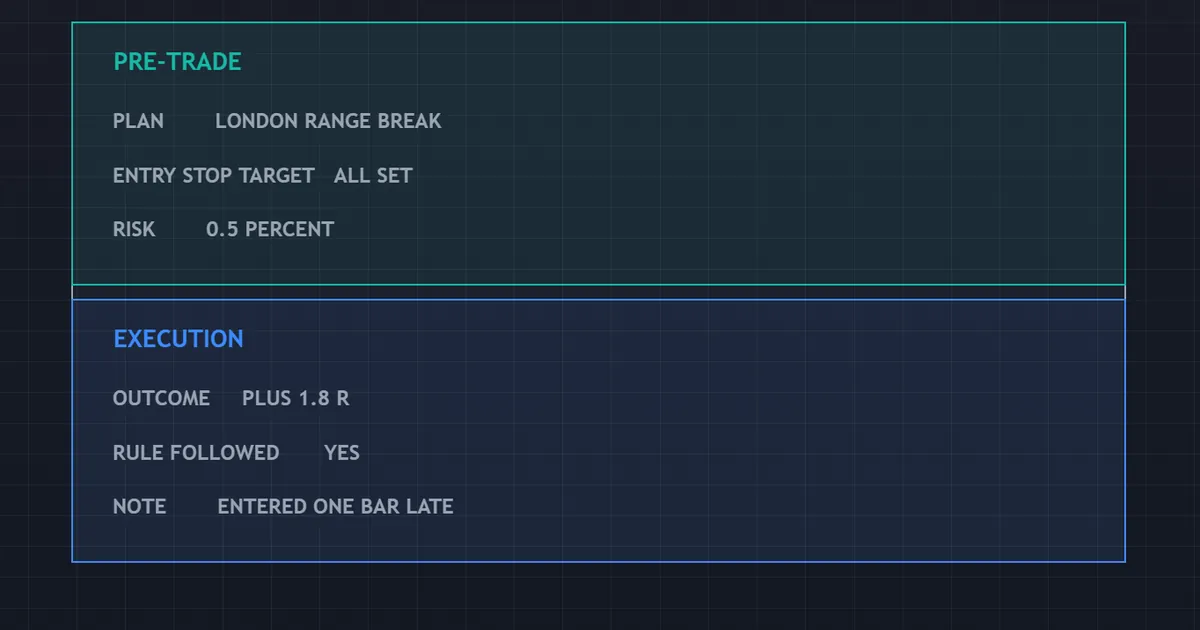
Above sits one finished entry with every line populated. Nothing sits blank, and nothing waits for a second pass later in the week.
The Pre-Trade Half
Six lines cover it. Date and time, instrument, setup name, the reason you took the position, the invalidation price, and the size that follows from that stop.
Two minutes handles all six. Longer than that and the habit will not survive a busy Tuesday.
The Post-Trade Half
Five lines close the record. Planned target, result in R, an execution score, a mistake tag, and one short note.
Keep that closing note tight. A single sentence about what you actually did beats three paragraphs about how you felt at the time.
The Three Rows That Do the Work
Eleven rows sounds like plenty. In practice three of them carry the review, and the other eight simply give those three context.
Reason, invalidation and mistake tag form that core. One captures your thinking, one captures your risk, and the last captures any gap between them.
Fill those three on your worst day and the entry still earns its place. Everything else can wait for a weekend tidy-up.
A Word on These Examples
Read the tables below as worked illustrations of the fields. They show structure and wording rather than a report of live fills, so copy the shape and not the numbers.
Our companion guide on what a trading journal is covers why the record exists at all. This page stays on the entries themselves.
How to Read the Three Entries
Every example uses the same eleven rows, so you can compare them line by line. Differences live in the notes rather than in the structure.
- Read the pre-trade block first. It tells you what the trader expected before any outcome existed.
- Check the invalidation line. A stop written as a price beats a stop written as a feeling.
- Look at the result in R. One number compares trades across instruments and across account sizes.
- Read the execution score on its own. A sound process can still produce a loss, and the score records that separately.
- Finish on the mistake tag. An empty tag on a losing trade carries real information.
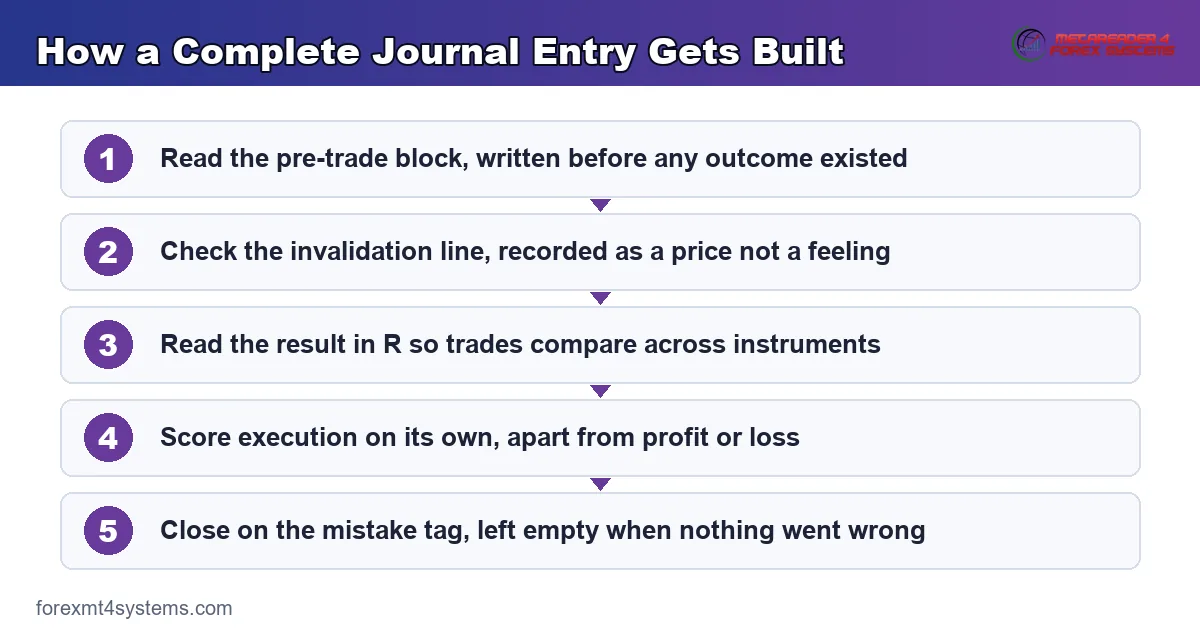
Work down that list for each table. After three or four entries the pattern turns automatic, and a full read takes seconds.
Reading Time, Not Writing Time
Writing an entry takes about two minutes. Reading one back takes about twenty seconds, and that ratio should shape every field you add.
A row nobody reads costs you twice. First when you type it, then again when it clutters the column you actually wanted.
So judge each field by the question it answers at review. If no question needs it, cut the row without ceremony.
Example One: A Winner That Followed the Plan
Tuesday morning, London hours, a pullback setup on a major pair. Our trader marked the level on Sunday evening and simply waited for price to arrive.
| Field | What the entry says |
|---|---|
| Date and time | Tuesday, 09:15 London |
| Instrument | EURUSD |
| Setup name | Pullback to prior day high |
| Reason, written pre-entry | Level marked Sunday; four-hour trend up; London open adds volume |
| Invalidation | Eighteen pips below the level, under the last swing low |
| Risk | Half a percent of the account |
| Planned target | 2R, at the prior week high |
| Result | Plus 2.0R, target reached |
| Execution score | 5 of 5, plan followed exactly |
| Mistake tag | None |
| Note | Fill landed two pips worse than planned; spread widened into the open |
What This Entry Records
Notice how little of the record deals with the profit. Nine rows describe the decision, and only one row reports the outcome.
That ratio matters. Over fifty entries you end up with a picture of your process, not a scoreboard.
What the Reason Line Locks Down
Three clauses sit in that reason line. A level marked in advance, a higher timeframe direction, and a session that brings participation.
Each clause fails independently. Come the review, you can sort by any of the three and count how those trades behaved.
Vague wording removes that option. A reason reading “looked good” sorts into nothing at all, however honest it felt at the time.
The Line That Earns Its Place
Look at the note about the fill. Two pips of slippage on one trade sounds trivial, and across two hundred trades it stops sounding trivial.
So the note gets written even on a winner. Cost data only accumulates when you record it during the good days as well as the bad ones.
Example Two: A Loser With Nothing Wrong In It
Wednesday afternoon, New York hours, a range setup on a second major. Price rejected the level, then reversed and took the stop out cleanly.
| Field | What the entry says |
|---|---|
| Date and time | Wednesday, 14:40 London |
| Instrument | GBPUSD |
| Setup name | Range low rejection |
| Reason, written pre-entry | Range intact for six sessions; low tested twice; daily trend flat |
| Invalidation | Twenty-six pips, just under the range floor |
| Risk | Half a percent of the account |
| Planned target | 2R, at the opposite side of the range |
| Result | Minus 1.0R, stop hit |
| Execution score | 5 of 5, plan followed exactly |
| Mistake tag | None |
| Note | Range broke on the third test and kept going; nothing here to fix |
Why This Entry Reads as Clean
Every pre-trade line matches the plan. Size, stop and target all came from written rules, and the trader held the position until price resolved it.
Then the market disagreed. Ranges break, and a losing trade with a full mark for execution belongs in the record as firmly as any winner.
The Mistake Tag Stays Empty on Purpose
Many traders want to write something in that field after a loss. Resist the urge, because inventing a fault teaches your future self a lesson that never happened.
An empty tag beside a minus sign carries a specific message. It says the process ran correctly and the outcome went the other way.
Our guide to R multiples explains why one number lets losers and winners sit in the same column.
How This Entry Reads in a Monthly Count
One clean loss tells you almost nothing. Twelve clean losses in the same setup tell you a great deal.
That signal only appears when execution scores sit in their own column. Mixing process and outcome hides the pattern under a pile of red numbers.
Count the two columns apart each month. Trades that followed the plan go in one pile, and the off-plan ones go in another.
Example Three: The Setup You Passed Over
Thursday morning, a breakout continuation on gold. The setup qualified on structure, and a release fifteen minutes away failed the timing rule.
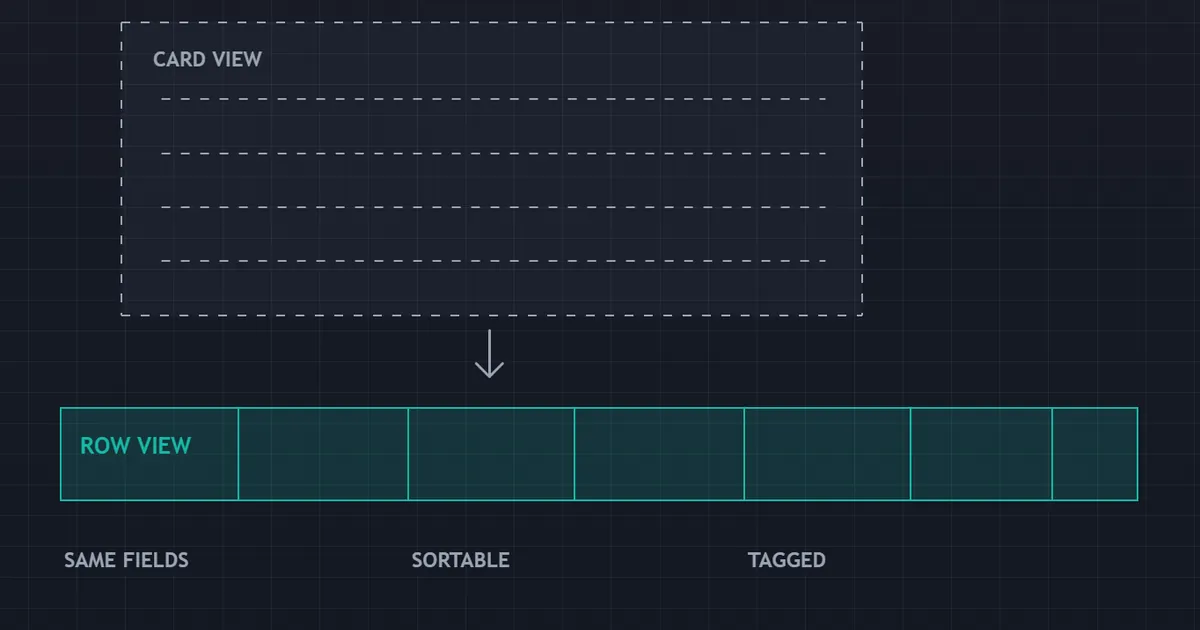
| Field | What the entry says |
|---|---|
| Date and time | Thursday, 08:05 London |
| Instrument | XAUUSD |
| Setup name | Breakout continuation |
| Reason, written pre-entry | Structure qualified; prior session high cleared on volume |
| Invalidation | Planned at forty pips, back inside the range |
| Risk | Not taken |
| Planned target | 2R, measured from the range height |
| Result | Skipped: release due in fifteen minutes, spread above the limit |
| Execution score | 5 of 5, rule respected |
| Mistake tag | None |
| Note | Later ran two pips past the stop, then reversed to target; rule stands |
Why Skipped Setups Belong in the Record
A skip counts as a decision. Leaving it out means your journal only ever holds the trades you took, which quietly hides half of your judgement.
Also, skips carry the cleanest lessons. Nobody feels defensive about a position that never existed, so the note tends to stay honest.
What the Skip Column Shows Later
Count your skips at the end of each month. Twenty skips against eight trades suggests filters that shut out almost everything.
Two skips against forty trades suggests the opposite problem. Neither number damns you on its own, and both point at something worth examining.
Note the final line in that third table. Price ran two pips past the planned stop before turning, so the rule cost this trader a winner and still stays correct.
Download the complete indicator database
Put these concepts on your charts. One email unlocks the full library of 1,380+ indicators with compiled MT4 and MT5 files, plus my TradingView scripts. No paywall, no spam, unsubscribe any time.
Get free access to my indicator database
One email unlocks 1,380+ free MT4, MT5 and TradingView indicators — the complete library. No single-tool download; you get the whole database.
The Three Entries Side by Side
Put the three records next to each other and the shape of a good journal appears. Same rows, same wording style, three very different stories.
| Field | Winner | Loser | Skipped |
|---|---|---|---|
| Setup name | Pullback to prior day high | Range low rejection | Breakout continuation |
| Session | London open | New York | Pre-London |
| Risk | Half a percent | Half a percent | Not taken |
| Result | Plus 2.0R | Minus 1.0R | No position |
| Execution score | 5 of 5 | 5 of 5 | 5 of 5 |
| Mistake tag | None | None | None |
| What it teaches | Costs at the open | Ranges break | Rules cost you winners |
The Column That Stays Constant
Execution reads five out of five across all three rows. Results range from plus two R down to nothing at all, and the process never wavered.
That contrast carries the whole argument for a journal. Outcome swings wildly across three trades, while the behaviour you control stays flat and measurable.
Where the Stories Diverge
Look at the bottom row instead. Each entry leaves behind a different lesson, and none of those lessons comes from the profit column.
Collect enough bottom-row notes and themes surface. Slippage at the open, third tests failing, timing rules costing you the occasional good trade.
A Fixed Tag Vocabulary
Mistake tags only work when the list stays short and frozen. Free-typed tags splinter into forty near-duplicates and count into nothing.
Pick six words and stop there. Most traders find these six cover the ground.
- Early — entered before the trigger condition completed.
- Late — chased the move after the level had already gone.
- Oversized — risked more than the plan allows on this setup.
- Moved stop — widened or shifted invalidation after entry.
- Off-plan — the setup never appears in your written plan.
- Revenge — opened straight after a loss, outside the routine.
Why Six and Not Twenty
Six tags produce counts you can read at a glance. Twenty tags produce a scatter with one or two entries in each bucket.
Add a seventh only after a real pattern refuses to fit. Growth in that list should follow evidence rather than enthusiasm.
Tagging the Winners Too
An oversized position that made money still gets a tag. The label describes what you did, and the market’s answer belongs in a different column entirely.
Traders who only tag losses build a record that punishes bad luck and forgives bad habits. Our list of trading discipline rules covers the behaviours worth naming.
Naming Setups So the Entries Sort
Setup names decide whether your record ever adds up. Two words, always spelled the same, beat a fresh description on every row.
Pick the Names Before You Trade Them
Write the list once, inside your plan. Pullback, range rejection, breakout continuation and session open fade cover most retail systems between them.
Then use only those names. A record with nine spellings of one idea produces nine buckets of a single trade each, which counts for nothing.
Keep the Name Apart From the Reason
Setup name identifies the family, while the reason line describes this particular instance. Blending the two turns both fields into free text.
Look again at example one. Setup name reads “pullback to prior day high”, and the reason adds the trend, the level history and the session.
When a Name Stops Fitting
Sometimes a trade genuinely sits outside your list. Tag it off-plan rather than inventing a category, then decide at the monthly review whether it deserves a place.
New names should earn entry through repetition. Three or four similar trades justify a label, and one interesting outlier does not.
Common Mistakes in Filled-In Entries
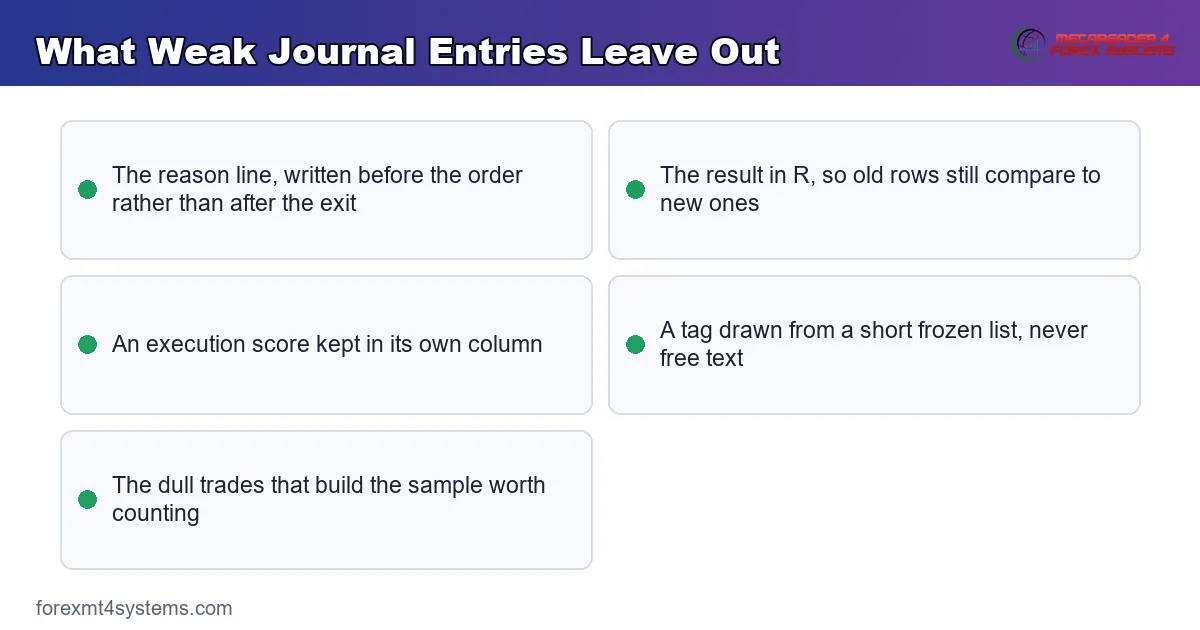
Six habits turn a useful record into a diary nobody reads. The panel collects what weak entries leave out.
Writing the Reason After the Exit
Hindsight rewrites motives without asking permission. Fill the reason line before the order goes in, then leave that wording alone forever.
Recording Money Instead of R
Cash amounts move with your account size, so a column of them tells you very little. Record the result in R and comparisons hold across years.
Skipping the Execution Score
Outcome and process deserve separate columns. Without that split you cannot tell a good decision from a lucky one, and both look identical in a profit column.
Free Text Everywhere
Long paragraphs feel productive and sort into nothing. Keep tags short and repeated, then your monthly count actually works.
Logging Only the Interesting Trades
Dull entries build the sample that matters. Skip them and your record turns into a highlight reel, which flatters you and teaches nothing.
Leaving Entries for the Weekend
Memory decays fast, and a Saturday write-up captures a story rather than a decision. Fill the pre-trade half at the moment of the order, every time.
Quick Reference: One Complete Entry
Print this list and keep it beside your platform. Eleven rows, in order, every single time.
| Row | When you write it | Example wording |
|---|---|---|
| Date and time | Before entry | Tuesday, 09:15 London |
| Instrument | Before entry | EURUSD |
| Setup name | Before entry | Pullback to prior day high |
| Reason | Before entry | Level marked Sunday; trend up; session open |
| Invalidation | Before entry | Eighteen pips, under the swing low |
| Risk | Before entry | Half a percent |
| Planned target | Before entry | 2R at the prior week high |
| Result in R | After exit | Plus 2.0R |
| Execution score | After exit | 5 of 5 |
| Mistake tag | After exit | None, or one word from your fixed list |
| Note | After exit | One sentence, under twenty words |
Our free trade journal already carries these rows, so you can start with the structure rather than build it.
When an Entry Collects Too Much
Traders often answer a bad month by adding fields. That instinct feels responsible and usually kills the habit within a fortnight.
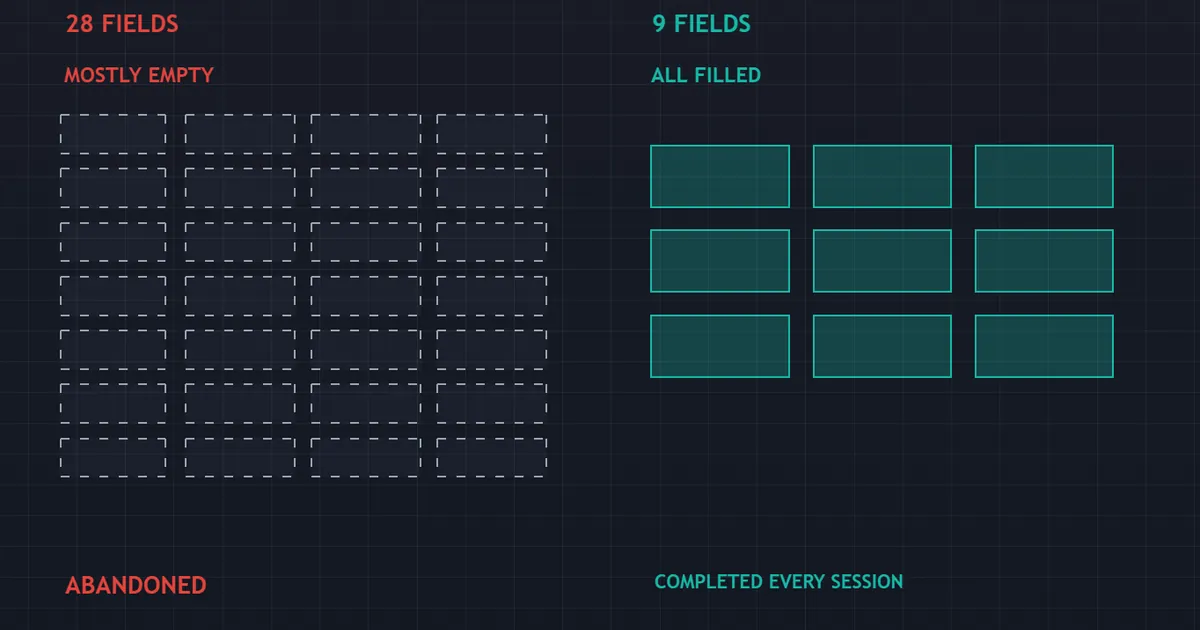
The Twenty-Eight Field Form
Above sits a bloated entry beside a short one. Most cells in the long version stay empty, because nobody fills twenty-eight boxes with an order waiting.
Partial records then poison the review. You cannot count a column that only holds data for a third of your trades.
What to Cut First
Drop anything your platform already stores. Entry price, exit price, lot size and commission all export automatically, so retyping them wastes the minutes you actually need.
Cut mood scales next. One word for state of mind does the job, and a five-point emotional scale rarely survives contact with a live position.
The Two-Column Compromise
Some traders want depth without the drag. Split the record into a fast core and an optional block, then fill the second half only on trades that surprised you.
That arrangement keeps the daily cost near two minutes. It also leaves your review a small set of rich entries beside a complete set of thin ones.
What to Keep Even When Tired
Three rows survive every trim. Reason, invalidation, and the mistake tag carry more weight than the rest of the record combined.
Fill those three on a bad day and the entry still works. Our note on trading psychology covers why tired traders cut corners in exactly this order.
What These Entries Cannot Do for You
Be clear about the limit. A journal cannot repair a strategy with no edge, and no amount of tidy record keeping will change that.
What it does instead runs faster and less comfortably. Thirty honest entries expose a broken idea in weeks rather than in years.
So treat a run of clean losers as evidence rather than as a failure of discipline. Execution scored five out of five across a losing month points at the method, not at the trader.
Size the positions so that discovery stays affordable. Our position size calculator works the lots back from your stop distance in seconds.
Related Guides Worth Reading Next
Two follow-ups pair naturally with these examples. Pick whichever gap feels larger.
If the layout question still nags at you, our comparison of the best trading journal format weighs spreadsheets against notebooks and platform exports.
If filling entries feels easy and reading them back does not, start instead with how to review your trades. Records only pay you back at the review, never at the point of writing.
For the wider picture, our indicator library shows which tools produce the setup names you will end up tagging.
FAQ
How many fields does a trading journal entry really need?
Eleven rows cover almost every use, and three of them do the heavy lifting. Reason, invalidation and mistake tag give you enough to review honestly. Everything else adds detail, and detail costs time you may not spend on a busy morning.
Should I record the trades I decided not to take?
Yes, and most traders skip this. A pass counts as a decision, so leaving it out hides half your judgement from the review. Skipped setups also produce the calmest notes, since nobody defends a position that never opened.
Why record results in R rather than in money?
R normalises everything. A result of plus two R means the same thing whether you risked a tenth of a percent or a full percent, and whether the account grew or shrank. Cash columns drift with account size, so old entries stop comparing to new ones.
What goes in the mistake tag when the loss was not a mistake?
Leave it empty. An empty tag beside a loss says the process ran correctly and price disagreed, which happens constantly. Inventing a fault trains you to distrust a rule that worked exactly as intended.
Can I just use my broker statement instead?
A statement records fills, not reasoning. It shows entry, exit, size and cost, and it says nothing about why you clicked or what would have ended the idea. Export the statement for the numbers, then add the four judgement rows by hand.
Will these examples improve my results?
They improve your visibility, which is not the same thing. A complete record shows you which setups you actually trade, how often you break your own rules, and what your costs really run to. Acting on that takes separate work, and the record only ever tells you where to point it. Results are not guaranteed; past performance is not indicative of future results.
External references
- For background on this concept, see Bookkeeping on Wikipedia.
- For broader market context, see Audit Trail at Investopedia.

About the author
Written by Dominic Walsh, a Forex trader and MT4/MT5 indicator, Expert Advisor and script developer. Every tool on forexmt4systems.com is tested on live charts before release and ships with ready-to-use compiled MT4 (.ex4) and MT5 (.ex5) files. Learn more about the trader and developer behind this site.
How we build, test and correct every tool: Editorial & Testing Policy. Trading carries risk; see the disclaimer.