
The Kelly criterion in forex is a simple formula that turns your edge and your reward-to-risk ratio into a suggested position size. It answers one question directly: what fraction of the account gives the fastest long-run growth without courting ruin?
This guide explains the Kelly criterion in forex for a trader who wants a sizing rule grounded in math. You will meet the core formula, see why the full number runs too hot for real trading, and learn why most professionals trade a fraction of it. Worked examples on real pairs tie every step to a lot you can place.
What Is the Kelly Criterion in Forex
The Kelly criterion is a formula that picks the bet size which maximizes the long-run growth rate of your capital. It was born in information theory and later crossed into gambling and markets. So it is not a forex invention, yet it fits any repeatable edge with a known payoff.
At its heart the formula compares two things: how often you win and how much you win versus lose. When both are favorable, Kelly points toward a larger fraction. When your edge is thin, it pulls the fraction down toward zero.
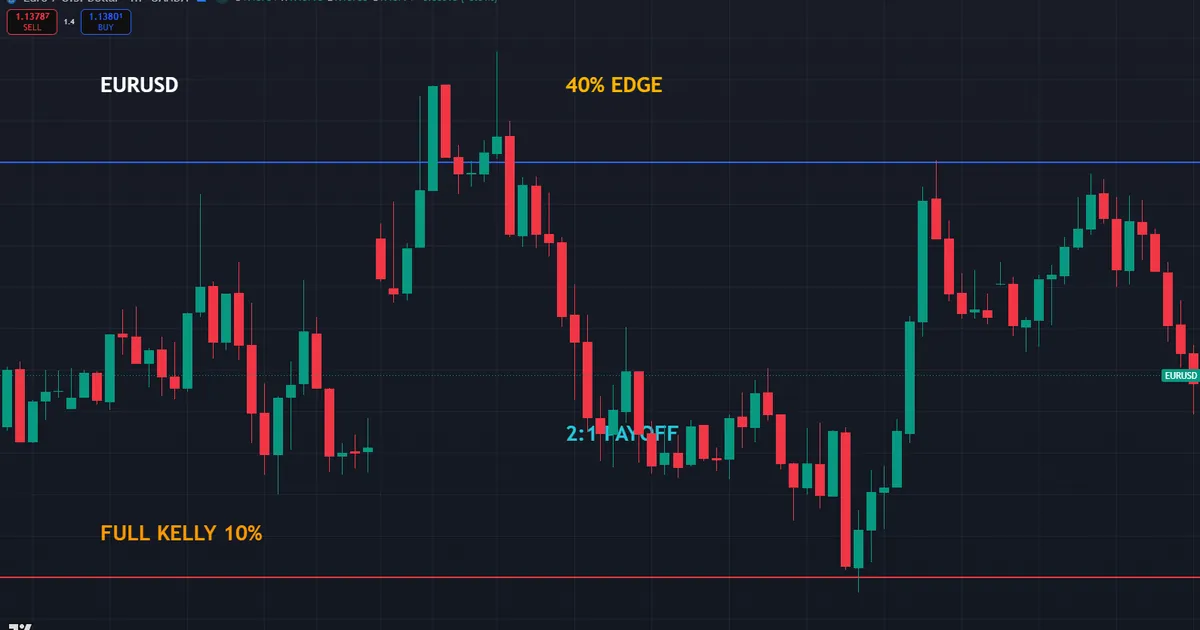
Think of it as a growth optimizer, not a safety rule. Kelly chases the steepest compounding path, and that path runs closer to the edge of danger than most traders can stomach. Because of that tilt, the raw number almost always needs tempering before it reaches a live order ticket.
Edge Over Odds in Plain Words
The cleanest way to read Kelly is as edge divided by odds. Your edge is the average profit you expect per unit staked, and the odds are the reward you collect when a trade wins. Divide one by the other, and you get the fraction to risk.
So a fat edge on generous odds still yields a modest fraction. That surprises newcomers who expect a strong system to justify huge bets. Yet the division built into Kelly keeps even a strong edge honest about size.
The Kelly Formula and Its Inputs
The trading form of Kelly needs just two inputs, and you already track both. Each one comes from your own record of closed trades rather than from a guess.
- Win probability. The share of trades that finish profitable, written as a decimal such as 0.40 for forty percent.
- Reward-to-risk ratio. The average winner divided by the average loser, such as two when winners run twice the size of losers.
- The output fraction. The percent of the account Kelly suggests you risk on the next trade of that system.
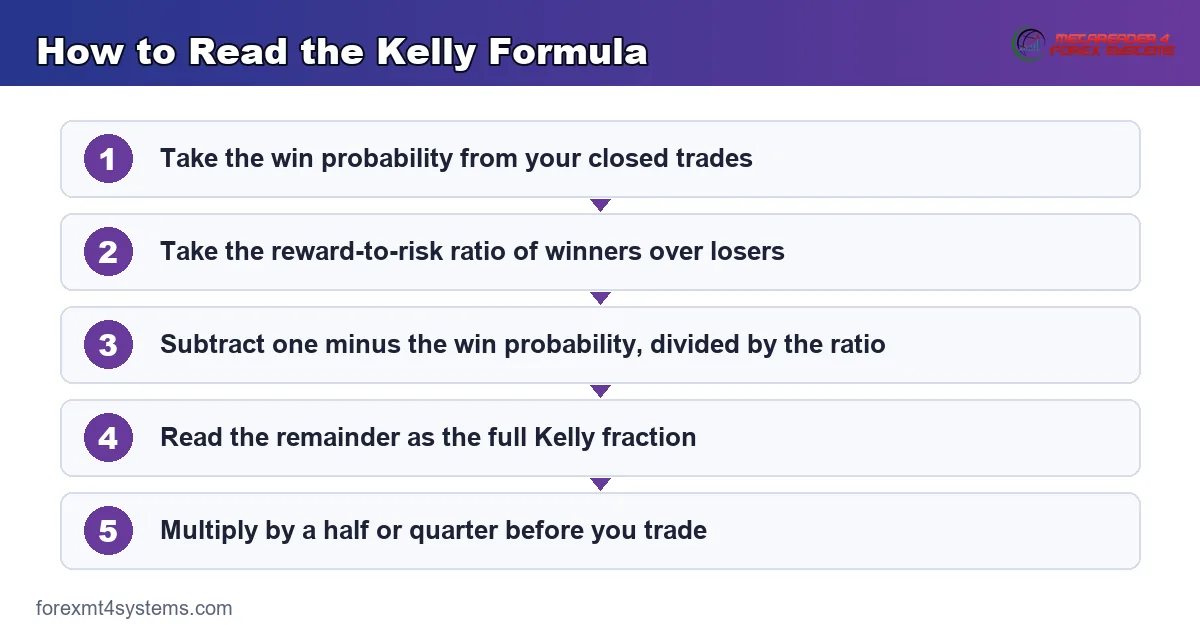
The formula reads f equals W minus one minus W divided by R. Here W is the win probability and R is the reward-to-risk ratio. So you subtract your scaled loss rate from your win probability, and the remainder is the Kelly fraction.
Reading Each Term
The first term rewards accuracy, since a higher hit rate lifts the fraction. The second term punishes a poor payoff, because small winners against large losers shrink it fast. Between them, the two terms balance how right you are against how well you get paid.
Notice what happens when the terms cancel. If your losses scaled by the payoff equal your wins, Kelly returns zero. That zero is a warning that the system carries no growth edge worth staking.
A First Worked Kelly Example
Numbers make the formula concrete, so walk one through. Suppose your EURUSD system wins forty percent of the time near 1.14, and your winners average twice your losers.
Set W to 0.40 and R to 2. The scaled loss term is one minus 0.40, all divided by two, which is 0.30. Subtract that from 0.40, and Kelly returns 0.10.
So full Kelly here suggests risking ten percent of the account on the next trade. That figure sounds bold, and it is. Ten percent per trade would swing a balance violently across any normal losing streak.
Turning the Fraction Into a Lot
Convert the fraction the same way you size any trade. On a five thousand dollar account, ten percent is five hundred dollars of risk. A fifty pip stop then supports ten dollars a pip, which lands near a full standard lot on EURUSD.
Compare that to a steady one percent rule, which would risk fifty dollars and about 0.10 lots. The gap is tenfold, which shows how aggressive raw Kelly runs. Our Kelly criterion calculator runs this math from your own win probability and payoff in one entry.
Why Full Kelly Runs Too Hot
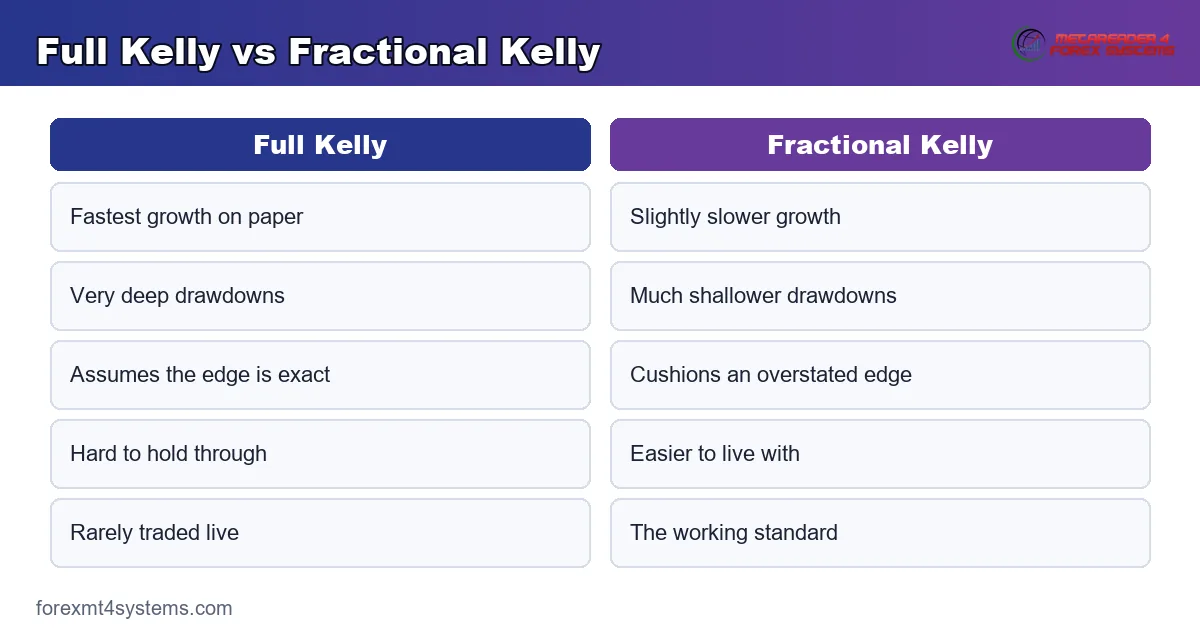
Full Kelly maximizes growth on paper, yet it ignores how a real trader feels and how a real edge drifts. The math assumes your inputs are exact and stable forever. Live trading breaks both assumptions at once.
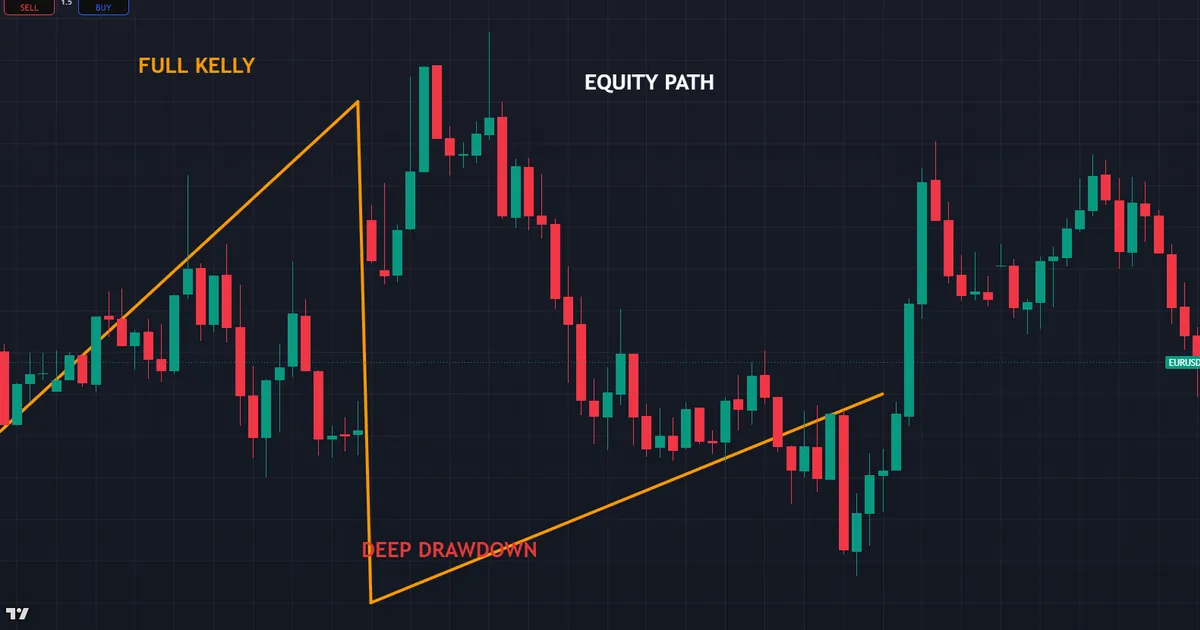
The first problem is drawdown. At the growth-optimal fraction, deep equity dips are not rare accidents but a built-in feature. A full-Kelly account can routinely give back half its value before recovering, which few traders can hold through.
Your Edge Is an Estimate
Your win probability and payoff come from a sample, not from certainty. So the true edge may sit below what your history shows, especially after a lucky run. When you feed an inflated edge into Kelly, it oversizes every trade at once.
This estimation error compounds the danger. Betting full Kelly on an overstated edge does not just slow growth; it can tip the account toward ruin. Because the inputs wobble, prudent traders treat the raw fraction as a ceiling they never actually reach.
Volatility Grows Faster Than Return
Push size past the Kelly peak, and growth falls while wildness keeps climbing. Even sitting exactly at the peak, the ride is brutally choppy. So the theoretical best rarely equals the practical best once nerves and mortgages enter the picture.
The trade-off is not symmetric either. Trading at half the Kelly fraction keeps most of the growth while cutting the swings sharply. That lopsided deal is the reason fractional Kelly has become the working standard.
Download the complete indicator database
Put these concepts on your charts. One email unlocks the full library of 1,380+ indicators with compiled MT4 and MT5 files, plus my TradingView scripts. No paywall, no spam, unsubscribe any time.
Get free access to my indicator database
One email unlocks 1,380+ free MT4, MT5 and TradingView indicators — the complete library. No single-tool download; you get the whole database.
Fractional Kelly for Real Accounts
Fractional Kelly means staking a set portion of the full figure, most often a half or a quarter. You compute the raw fraction, then multiply it down before trading. So half Kelly on our ten percent example becomes five percent, and quarter Kelly becomes 2.5 percent.
The appeal is a gentler equity curve for a small growth sacrifice. Half Kelly captures about three quarters of the compounding while roughly halving the drawdown depth. That bargain suits anyone who must live with the account day to day.
Choosing Half or Quarter
Pick the fraction by how much you trust your numbers. A long, stable record earns a half; a short or noisy one deserves a quarter or less. So the shakier your edge estimate, the deeper you should shrink the raw Kelly output.
Many forex traders shrink it further still. After moving from full to quarter Kelly, our example falls to 2.5 percent, and many cap it near one or two percent anyway. That final cap keeps a single bad estimate from doing lasting harm.
A Second Worked Example
Try a GBPUSD system near 1.34 that wins half its trades with a smaller payoff. Set W to 0.50 and R to 1.5, so the loss term is 0.50 divided by 1.5, near 0.333. Subtract that from 0.50, and full Kelly returns about 0.167.
Full Kelly here says risk almost seventeen percent, which is plainly too hot. Take a quarter, and the figure drops near 4.2 percent. Trim that toward a firm two percent cap, and the system finally sizes like a trade you can repeat for years.
Building Your Kelly Inputs the Right Way
The formula is only as good as the two numbers you feed it. So the real work sits in measuring your win probability and payoff honestly. Sloppy inputs turn a sound rule into a fast route to trouble.
Both numbers live in your trade journal, not in your memory. Memory rounds winners up and losers down, which flatters every input. A written record keeps the math grounded in what actually happened.
Gathering a Deep Trade Sample
Start with enough trades to trust the average. Thirty trades barely hint at a hit rate, while a few hundred begin to pin it down. So resist the urge to compute Kelly after a single good week.
Depth also smooths out lucky and unlucky runs. A cluster of quick wins can lift a small sample far above the truth. Because a large record dilutes those flukes, it hands the formula a steadier edge to work from.
Separating Systems Before You Measure
Different setups carry different edges, so blending them muddies the inputs. A trend system and a range system rarely share a win probability or a payoff. So measure each strategy on its own before you size it.
This split keeps one strong method from masking a weak one. When you pool them, a profitable setup can hide a losing sibling inside a single Kelly number. Treating each system alone shows you exactly where the real edge lives.
Refreshing the Numbers Over Time
Markets shift, and a payoff that held last quarter may fade this one. So revisit your inputs every few dozen trades rather than freezing them. A living edge deserves a living estimate.
Keep the update conservative when the sample is thin. If recent trades disagree with the long record, lean toward the cautious figure. That habit stops a hot streak from quietly inflating your next size.
Kelly Against a Flat Percent Rule
Most beginners meet a flat percent rule long before they meet Kelly. Risking one percent on every trade is simple, steady, and hard to break. So it helps to see how the two approaches relate rather than compete.
A flat rule ignores your edge entirely and treats every trade the same. Kelly, by contrast, leans harder into stronger setups and lighter into weaker ones. Because Kelly reads the edge, it can grow faster when the numbers are sound.
What the Flat Rule Gets Right
Simplicity is the flat rule’s quiet strength. It needs no win probability, no payoff, and no journal to run. So a newcomer can apply it on day one and still keep risk in check.
The flat rule also forgives bad estimates, since it never trusts your edge in the first place. A trader who overrates a system pays no extra price under a fixed percent. That built-in humility suits anyone still learning their own numbers.
Where Kelly Adds Value
Kelly earns its keep once your record is deep and stable. With trustworthy inputs, it channels more size toward your best edges and less toward marginal ones. So an experienced trader can compound faster while still respecting the odds of ruin.
In practice many traders blend the two. They compute a fractional Kelly figure, then cap it at a flat one or two percent ceiling. That hybrid keeps Kelly’s edge-awareness while borrowing the flat rule’s discipline.
Common Kelly Mistakes and Fixes
The formula is short, so most errors come from bad inputs or a skipped haircut. Each slip below has a plain fix, and the graphic sums them up.
Trading the Full Fraction
The headline mistake is staking full Kelly because the math endorses it. That path ensures stomach-churning drawdowns and punishes any overstated edge. So treat full Kelly as the absolute maximum, and trade a fraction of it instead.
Feeding In an Inflated Hit Rate
A short sample or a hot streak flatters your hit rate. Plugging that number into Kelly oversizes everything downstream. So use a long record, and lean toward the conservative end of your estimate.
Ignoring Reward-to-Risk Drift
Payoffs shift as market conditions change, yet many traders freeze an old ratio. A stale R can double the fraction Kelly suggests. So refresh both inputs regularly from recent closed trades.
Reworking Size Mid-Trade
Some traders recompute Kelly after every tick and resize on the fly. That habit turns a growth rule into a nervous reflex. So set the fraction before entry, and leave the position alone until the trade closes.
Skipping the Sanity Cap
Even quarter Kelly can suggest an uncomfortable size on a strong edge. Trading it blindly ignores your own risk tolerance. So cap the final figure near one or two percent, whatever the formula prints.
Kelly Across Several Open Trades
One trade is easy to size, yet a real book often holds several at once. So the single-trade fraction needs a second look when positions overlap. The classic formula quietly assumes each bet stands alone.
When trades are truly independent, you can spread the Kelly fraction across them. Two unrelated setups might each take half the suggested size. Because their outcomes do not move together, the combined risk stays near the single-trade target.
The Correlation Trap
Correlated trades break that neat split. Two long euro pairs tend to win and lose together, so they act like one larger bet. Sizing each at its own Kelly fraction then doubles the true exposure without you noticing.
The honest fix is to treat linked trades as a single position. Add their risk before you size, and let the pair share one Kelly fraction. So the account never carries a hidden double bet dressed up as two small ones.
Capping Total Kelly Risk
Even independent trades add up, so a total cap keeps the book sane. Many traders limit the combined open risk near five or six percent of the balance. Once the running total reaches that line, they size no new trade until one closes.
This ceiling turns Kelly from a per-trade rule into a portfolio rule. It also nudges you toward your strongest setups when the budget runs low. Because the cap is finite, it rewards patience over the urge to hold every position at once.
Kelly Criterion Quick Reference
Keep this short list beside your journal. Run through it before you size any Kelly-based trade.
- Pull the win probability and reward-to-risk from your closed trades.
- Compute f as W minus one minus W divided by R.
- Read the result as the full, most aggressive fraction.
- Multiply by a half or a quarter for a livable ride.
- Cap the final number near one or two percent of the account.
- Convert the percent into a lot from your stop and pip value.
Pitfalls and Edge Cases
A few situations bend the clean formula, so keep them in view. The chart below contrasts a full-Kelly path with a fractional one over the same trades.
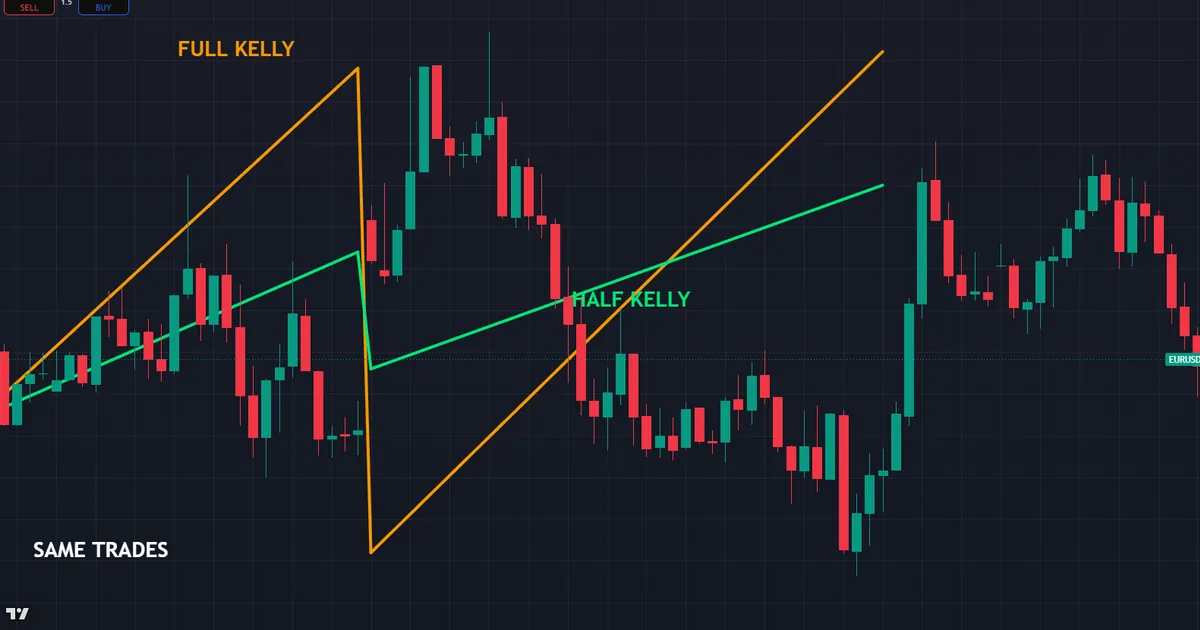
Read the two equity paths side by side. The full-Kelly line climbs faster in good runs yet plunges far deeper in bad ones. That single picture explains why growth alone is a poor guide to size.
A Negative Kelly Result
If Kelly returns a negative number, the system has no edge to stake. The math is telling you to skip the trade, not to reverse it. So rebuild the strategy before you risk another dollar on it.
Correlated Positions Break the Math
Kelly assumes each bet is independent, yet two euro longs move together. Sizing each at its own Kelly fraction stacks a hidden double bet. So split the fraction across correlated trades, or treat them as one position.
Thin Samples Fool the Formula
Fifty trades cannot pin down a true win probability. A handful of lucky wins can inflate the fraction badly. So wait for a deep sample, and shrink the fraction while the record is young.
The safest stance early on is deep humility about your edge. Treat every raw Kelly figure as a loose upper bound rather than a target. So a young record calls for a heavier haircut and a firm percent cap on top.
Related Concepts to Study Next
The Kelly criterion sits inside a wider risk toolkit, and a few nearby ideas make it usable. The percent you actually risk grounds the output, the odds of ruin explain why you shrink it, and position sizing turns the fraction into a lot.
Start with our guide on how much to risk per trade to set a sensible cap. Then read risk of ruin to see the danger Kelly guards against, and study position sizing to convert any fraction into lots. For the broader framework, see risk management in forex, and stress-test your own edge with our expectancy calculator.
FAQ
What is the Kelly criterion in forex?
The Kelly criterion in forex is a formula that suggests the position fraction with the fastest long-run growth. It reads your win probability and reward-to-risk ratio and returns a percent to risk. Most traders then trade a fraction of that number rather than the whole.
How do I calculate the Kelly fraction?
Take your win probability as W and your reward-to-risk ratio as R. Compute f as W minus the quantity one minus W divided by R. The result is the full Kelly fraction, which you then trim before trading.
Why is full Kelly considered too aggressive?
Full Kelly maximizes growth but tolerates very deep drawdowns along the way. It also assumes your edge is exact, which live trading never grants. So an overstated edge at full Kelly can push an account toward ruin.
What is fractional Kelly?
Fractional Kelly means staking a set portion of the full figure, usually a half or a quarter. Half Kelly keeps most of the growth while roughly halving the swings. Many forex traders shrink the result further and cap it near one or two percent.
Can I use Kelly with a small sample of trades?
A small sample makes the win probability and payoff unreliable, so Kelly can oversize badly. Wait for a deep record before you lean on the formula. Until then, shrink the fraction hard and treat the output as a rough ceiling.
Does a bigger Kelly number always mean more profit?
No, pushing past the Kelly peak lowers growth while raising volatility sharply. Even sitting at the peak, the equity swings are severe. Trade a fraction of Kelly instead, and manage every position with care. Results are not guaranteed; past performance is not indicative of future results.
External references
- For background on this concept, see Gambling and Information Theory on Wikipedia.
- For broader market context, see Expected Value at Corporate Finance Institute.

About the author
Written by Dominic Walsh, a Forex trader and MT4/MT5 indicator, Expert Advisor and script developer. Every tool on forexmt4systems.com is tested on live charts before release and ships with ready-to-use compiled MT4 (.ex4) and MT5 (.ex5) files. Learn more about the trader and developer behind this site.
How we build, test and correct every tool: Editorial & Testing Policy. Trading carries risk; see the disclaimer.