
Trading psychology for prop firm challenges differs from ordinary trading psychology in one important way. The pressure here comes from the rule book, not only from your own head.
An evaluation sets a fixed target, a hard loss floor, a paid fee and a clock. Trading psychology for prop firm challenges therefore means understanding how each rule bends behaviour, and what to do about it.
Why the Pressure Is Structural
Most advice tells you to stay calm and follow your plan. That advice ignores where the pressure actually comes from.
A challenge builds the pressure into the terms you accepted. So the same trader who behaves well on a personal account starts rushing inside a week.
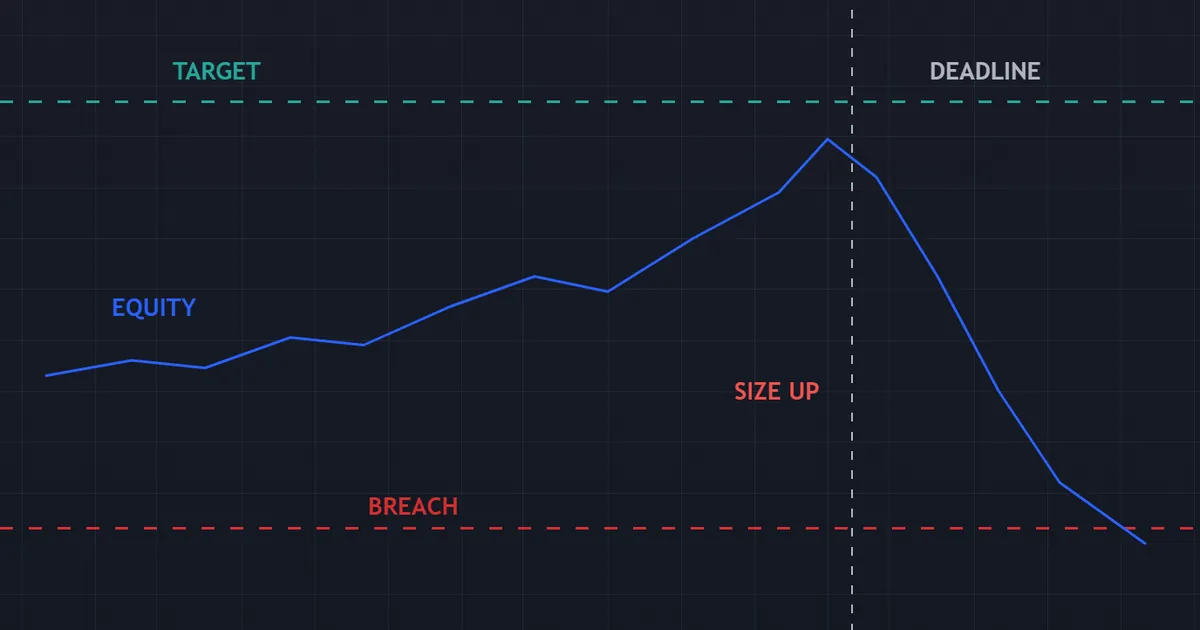
The equity curve above shows the usual shape. Progress looks steady, then the slope steepens near the deadline, and one heavy session ends the attempt.
Nothing exotic happened in that picture. A normal losing day met an abnormal position size, and the floor did the rest.
Four Rules, Four Distortions
Each rule creates a specific pull on your decisions. The target pulls you toward speed, while the floor pushes you toward caution.
Those two forces work against each other all day. So a trader who fails to rank them ends up switching between both, which produces the worst of each.
The Fee Changes How You Think
You paid for the attempt before placing a single trade. Economists call that money sunk, and they treat it as irrelevant to your next decision.
Your mind disagrees loudly. Because the fee feels like an investment to protect, stopping early feels like waste rather than sense.
A Clock You Did Not Choose
Some programs run without a time limit, and many still apply one. Even an open-ended attempt carries a private deadline, because nobody wants to trade the same evaluation for a year.
So the clock exists whether the rule book prints it or not. That invented urgency then does the same damage as a real one.
The Rules Are Not the Enemy
None of this argues that evaluations treat traders unfairly. A firm putting capital behind you needs hard limits, and those limits protect both sides.
So the aim involves working with the structure rather than resenting it. Because the rules stay fixed, the only movable part of the system happens to be your behaviour.
Simulated Money, Real Consequences
The balance on screen belongs to nobody. The rules, though, behave exactly as they will on a funded account.
So treat the demo figure as your own capital from day one. Because habits transfer and balances do not, a sloppy pass teaches you the wrong reflexes.
How the Rules Bend Behaviour
The distortion follows a predictable sequence. Learn it once, and you can interrupt it at any point.
- A dated target compresses your normal trading plan.
- Position size creeps upward to fit the shorter timeline.
- One ordinary losing session now meets a hard floor.
- The fee you already paid argues against stopping.
- A rushed recovery attempt ends the account outright.
Every step looks reasonable from inside. So the chain runs to the end unless a written rule cuts it early.
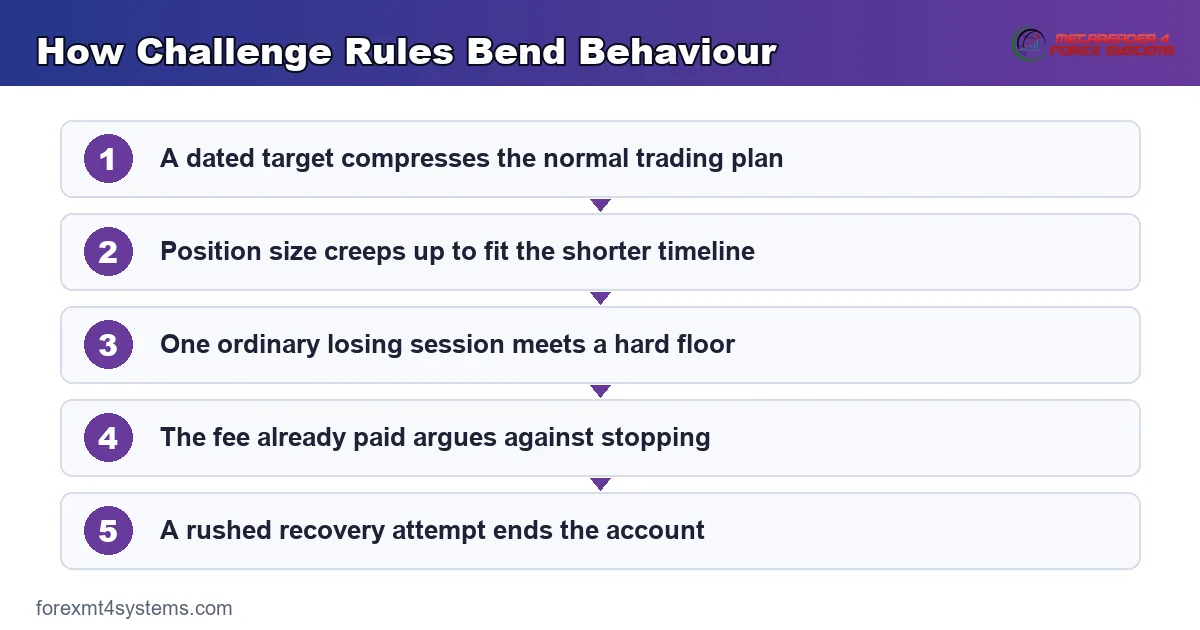
The flow diagram above puts the sequence in one panel. Step two carries the most weight, because size decides how much damage step three can do.
Fix the sizing, and the later steps lose most of their force. Our guide on why traders fail prop challenges covers the mechanical side of the same chain.
Each Rule and the Distortion It Creates
Before the detail, here is the whole map on one page. Every line pairs a clause you agreed to with the behaviour it tends to produce.
| The clause | The pull it creates | Where it shows up |
|---|---|---|
| Fixed profit target | Speed over survival | Larger lots than your normal plan |
| Deadline or minimum days | Manufactured urgency | Marginal setups taken to stay busy |
| Daily loss limit | All-or-nothing thinking | A third trade sized to fix the morning |
| Trailing drawdown floor | Fear of giveback | Winners closed at a fraction of target |
| Non-refundable fee | Sunk cost reasoning | Another attempt bought the same week |
| Consistency requirement | Dilution hunting | Extra sessions nobody planned |
Find the row you recognise most. That row names the discipline worth building first.
Trading Psychology for Prop Firm Challenges, Rule by Rule
Six rules appear in nearly every evaluation. Each one produces its own distortion and needs its own counter-discipline.
Read them as a set. They interact, and a fix for one usually helps another.
The Profit Target
A target turns trading into a project with a finish line. That framing invites you to work backwards from the goal.
So a trader divides the target by an expected gain per trade, then picks a size that gets there quickly. The loss limit never enters that sum.
The counter-discipline reverses the arithmetic. Start from the daily loss cap, divide by the number of losses you want to survive, and let the answer set your risk. Our prop firm position size calculator turns those percentages into lots.
One ratio also tells you a lot before you buy. Divide the profit target by the overall loss limit, and the answer shows how much room the program really gives.
The Daily Loss Limit
A daily cap resets every session, which makes it easy to forget. Traders watch the overall drawdown and lose track of the day.
The distortion here shows up as tilt. After two quick losses the day already feels ruined, so the third trade grows to fix it.
So set a personal daily stop below the program line. Because your own cap fires first, the firm’s rule becomes a backstop you never test. Our note on tilt in trading covers the warning signs.
Check where the day gets measured from as well. Some programs count from the balance at reset, others from equity, and the reset hour varies.
The Trailing Drawdown Floor
Many programs move the loss floor upward as your equity makes new highs. Traders who learned on a static floor miss this completely.
The behavioural effect looks strange at first. A rising floor punishes giveback, so traders start closing good trades early to protect a number rather than a plan.
The counter-discipline runs on paper. Note your equity and the current floor before the first trade, then size against the gap. Read our guide to trailing drawdown at prop firms for the exact variants.
The gap between equity and floor becomes your real budget. So a good week shrinks that budget, which sounds backwards until you watch it happen.
The Paid Fee
The fee is the most underrated pressure in the whole model. It converts a trading decision into a personal loss you can point at.
Sunk cost reasoning then takes over. Traders push on with a broken plan, or buy a fresh attempt immediately, purely to avoid writing off the first one.
So decide the reset rule before you buy. Write down what would make you stop for a month, and treat the fee as spent the moment it leaves your account.
A budget helps more than a promise. Decide how many attempts you will fund in a year, then hold that number when the urge arrives.
The Consistency Rule
Many programs cap the share of total profit that any single day may contribute. The rule exists to filter out one lucky session.
It also creates an odd distortion. Traders who have a strong day start hunting extra days of profit to dilute it, which adds trades nobody planned.
So spread risk evenly across sessions from the start. Our consistency rule calculator shows how much a single day may contribute, and our guide to the prop firm consistency rule explains the wording.
Watch the wording carefully here. Some programs apply the test at payout rather than during the evaluation, which changes when the pressure lands.
Minimum Trading Days
A minimum-days clause stops a single session passing you. It also creates a trap at the finish line.
Traders reach the target early, then keep trading at full size to fill the clause. The gain they already earned goes back to the market.
So drop to a fraction of normal size once the target lands. Because the rule counts days rather than volume, tiny positions satisfy it at almost no cost.
Read the clause before you rely on that trick. A few programs add a minimum size or a minimum holding time to close the gap.
A Worked Example of Deadline Pressure
Take a fifty thousand dollar evaluation with an eight percent target and a five percent overall floor. Two weeks remain on the clock.
The trader sits at three percent, so five percent still needs finding. That gap creates the whole problem.
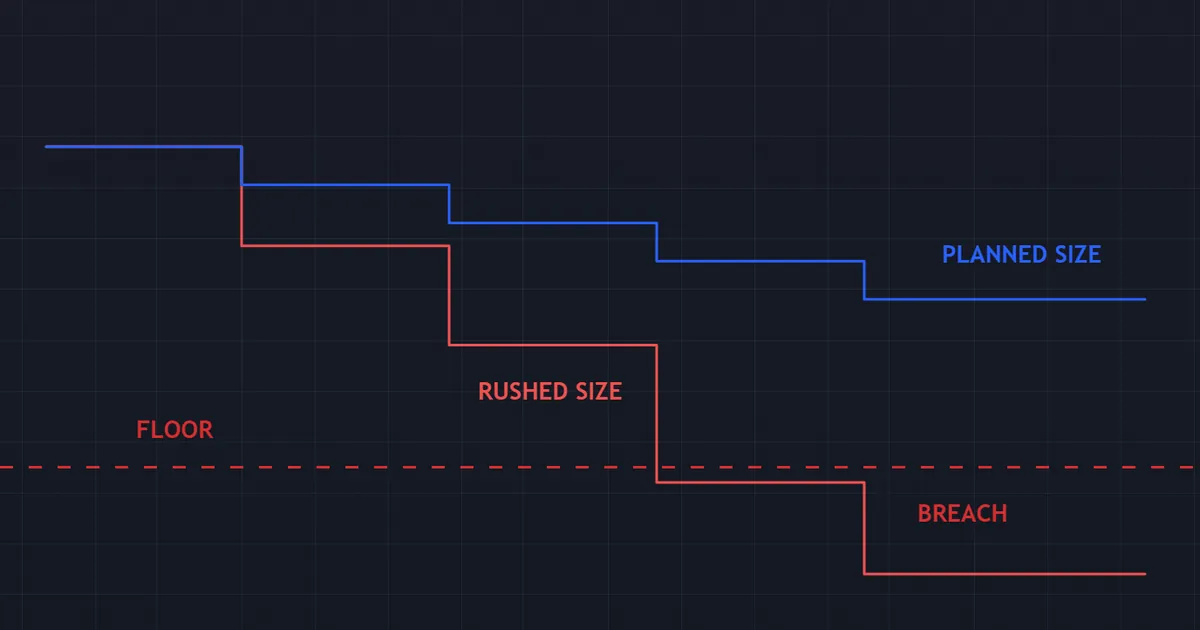
At half a percent risk per trade, the remaining gap needs a solid run of good trades. That feels slow, and slow feels like failure with a deadline in view.
So risk doubles to one percent. A perfectly ordinary run of four losses now costs four percent, which leaves almost no room above the floor.
What the Slower Version Looks Like
Keep risk at half a percent and the same four losses cost two percent. You finish the fortnight short of target with a working account.
Many programs allow you to continue, and some restart the clock instead of the account. So the slow version costs time, while the fast version costs the attempt.
Compare those two outcomes honestly. Time you can replace, and a breached account you cannot.
The example also shows where the decision really sat. Nothing went wrong during those four losses, because the damage was set two weeks earlier when the size changed.
So the useful review question concerns the sizing choice, not the losing trades. Traders who review only the losses keep repeating the same fortnight.
Download the complete indicator database
Put these concepts on your charts. One email unlocks the full library of 1,380+ indicators with compiled MT4 and MT5 files, plus my TradingView scripts. No paywall, no spam, unsubscribe any time.
Get free access to my indicator database
One email unlocks 1,380+ free MT4, MT5 and TradingView indicators — the complete library. No single-tool download; you get the whole database.
Mistakes the Rules Encourage
These five errors come directly from the structure. Each one feels like effort at the time.
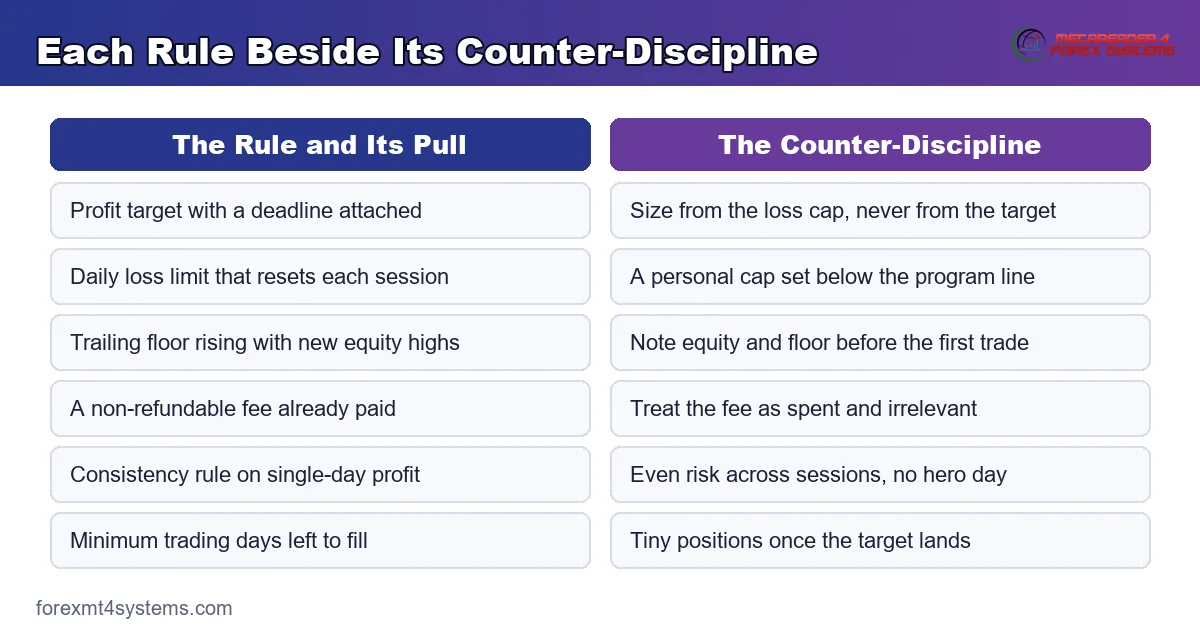
The comparison graphic above sets every rule beside the discipline that offsets it. Keep it beside the platform during an attempt.
Trading Bigger After a Reset
A failed attempt plus a new fee creates real urgency. Traders then start the fresh account at larger size to recover both.
So the second attempt fails faster than the first. Because the fee belongs to the past, the only sensible response involves smaller size, not larger.
Chasing a Red Morning
A losing morning inside an evaluation feels like a deadline breach. That urgency is invented, since the market runs tomorrow as well.
So write a hard stop at two losing trades. Our note on revenge trading explains why the rule needs writing while you feel calm.
Trading More Because Nothing Is Happening
Quiet markets create a different pressure. With a clock running, patience starts to feel like laziness.
So traders take marginal setups to feel productive. Read our guide to overtrading, then count your trades per week against your own average.
Protecting the Number Instead of the Plan
Once the floor sits close, traders start managing the balance rather than the trade. Winners get cut at a fraction of their target.
So the average gain collapses while the average loss stays the same. Because that arithmetic ends attempts quietly, it deserves as much attention as a breach.
So keep the exit rule fixed while the floor sits close. If the room genuinely feels too tight, cut position size instead of cutting targets.
Watching the Balance All Day
A live balance beside a hard floor invites constant checking. Every refresh renews the pressure and adds nothing useful.
So set the platform to show the chart rather than the account. Check the figure at fixed points instead, such as the session open and the session close.
Reading the Rules Once and Trusting Memory
Two programs can print the same percentages with different mechanics. A habit that survived one attempt breaches the next.
So read each rule book fresh, and note the reset hour, the floor type and the news clause. Our overview of the prop firm challenge lists the clauses worth checking.
Hiding the Attempt From Everyone
Secrecy sounds harmless and works badly. A trader who tells nobody about an evaluation also tells nobody about a third fee.
So name one person who knows the plan and the budget. Because an outside view arrives without the urgency, it catches the spiral earlier than you will.
A Four-Week Plan for the Next Attempt
Most traders buy an evaluation and start trading the same hour. A short run-up costs nothing and removes most of the pressure.
- Week one: trade your own account at the exact risk the evaluation will allow.
- Week two: add the daily cap and the floor as if they applied, and log every breach on paper.
- Week three: fix the single habit that produced the most paper breaches.
- Week four: repeat week two, and only continue if the paper breaches reach zero.
- Then buy the attempt, with the same size and the same rules you just proved.
The plan looks slow next to a fee and a fresh account. It also removes the two biggest causes of failure before any money changes hands.
So the first real trade becomes a repeat of something you already did. Because nothing new happens on day one, the deadline loses much of its grip.
Pre-Session Discipline Checklist
Run this list before the first trade of the day. It takes two minutes and prevents most self-inflicted failures.
- Write today’s equity and the current drawdown floor on paper.
- Size every trade from the daily cap, never from the profit target.
- Set a personal daily stop below the program limit.
- Stop trading for the day after two losing trades.
- Check the calendar and mark any high-impact release.
- Keep daily risk even, so no single session dominates the result.
- Cut size to a fraction of normal once the target lands.
- Log each trade with its risk and its distance from the floor.
None of those items require willpower in the moment. That is the point, because willpower fades exactly when the pressure peaks.
Pitfalls and Edge Cases
A few wrinkles bend the clean picture, so keep them in view. The equity curve below shows the sunk-fee spiral across two attempts.
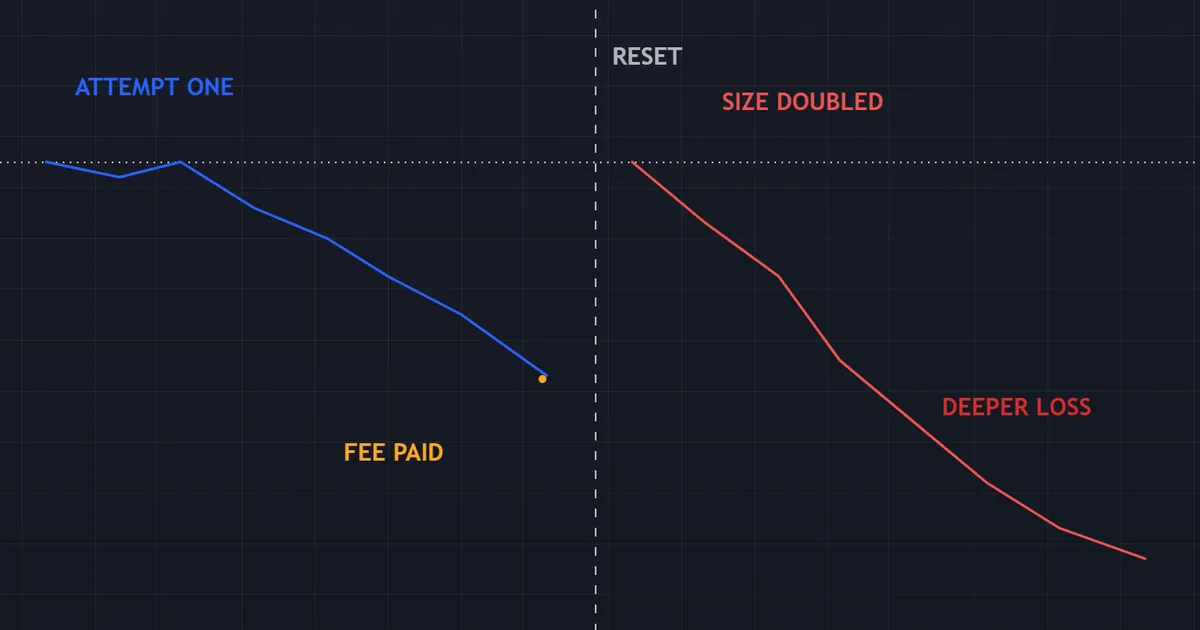
Notice how the second path starts steeper than the first. Nothing about the method changed, and only the trader’s urgency did.
Passing Badly
A reckless attempt can still pass. Traders then carry the same habits onto a funded account with real payout consequences.
So judge the attempt by the process, not only by the outcome. Because the funded stage applies similar rules, a lucky pass simply delays the problem.
So score each attempt on rule adherence as well as result. A passed attempt with three near-breaches deserves a serious review, not a celebration.
Several Attempts at Once
Running two or three evaluations together multiplies both cost and pressure. Correlated trades across accounts behave like one oversized position.
So treat parallel accounts as a single exposure. Many programs also restrict copying between accounts, which turns a convenience into a rule breach.
The mental load matters too. Three sets of floors and reset hours will not fit in your head during a fast session.
The Floor Moves While You Sleep
Swaps, weekend gaps and open positions all count against your room. A trader can wake up closer to the floor without placing a trade.
So check the floor again before the session rather than trusting yesterday’s figure. Our guide to daily drawdown at prop firms covers how the measurement works.
Rules That Change Mid-Attempt
Terms occasionally change between the day you buy and the day you trade. Traders then plan against a version that no longer applies.
So check the current rule book at the start of each attempt. A screenshot of the terms on purchase day also settles later disputes quickly.
When the Pressure Grows Beyond Trading
Evaluations can stop being a project and start being a compulsion. Repeated fees, hidden attempts and lost sleep all point that way.
If the process affects your sleep, your finances or your relationships, step away and seek qualified professional support. That decision matters far more than any account.
Related Concepts to Study Next
Rule pressure and risk control sit on the same shelf, because a written sizing rule removes most of the room these distortions need. Start with our overview of prop firm rules, then read about setting a daily loss limit so your own cap fires first.
FAQ
Why do evaluations feel harder than a personal account?
Because the rules add pressure your own account never applies. A fixed target, a hard floor and a paid fee push in different directions at once. So the same method produces different behaviour, even when the charts look identical.
How do I stop the deadline pushing my size up?
Set your risk from the daily loss cap before the attempt starts, then write it down. Treat that figure as fixed for the whole evaluation, regardless of how much time remains. If the target needs a size you would not use normally, the program does not suit you. Checking that ratio before purchase saves far more than any mid-attempt discipline.
Should I buy another attempt straight after a failure?
Usually not, and certainly not on the same day. The fee you already spent cannot come back, so it gives you no reason to hurry. Take a week, review the log, fix the one habit that ended the attempt, and only then decide. A written attempt budget for the year makes that pause much easier to hold.
How do I handle a strong day under a consistency rule?
Plan for it in advance rather than reacting to it. Keep daily risk even from the first session, so no single day dominates the total. If one day still runs hot, reduce size afterwards rather than adding trades to dilute it. Adding trades to fix a rule problem creates a second problem on top of the first.
Is trading psychology different once the account is funded?
The rules stay similar, and the emotional weight changes. Payouts, scaling and a longer horizon replace the deadline, so patience matters more than speed. Traders who rushed through an evaluation often struggle most at that stage. So the habits you build during the attempt decide how the funded phase goes.
Can good psychology on its own pass an evaluation?
No, because discipline still needs a method with a positive expectancy behind it. Psychology decides whether that method gets executed as written, and a sound edge traded inconsistently is not an edge. Work on both, and expect the process to improve before the equity does. Results are not guaranteed; past performance is not indicative of future results.
External references
- For background on this concept, see Escalation of Commitment on Wikipedia.
- For broader market context, see Sunk Cost Fallacy at Investopedia.

About the author
Written by Dominic Walsh, a Forex trader and MT4/MT5 indicator, Expert Advisor and script developer. Every tool on forexmt4systems.com is tested on live charts before release and ships with ready-to-use compiled MT4 (.ex4) and MT5 (.ex5) files. Learn more about the trader and developer behind this site.
How we build, test and correct every tool: Editorial & Testing Policy. Trading carries risk; see the disclaimer.