
Daily drawdown in prop firms works as a one-day circuit breaker on a funded account. It caps how far your account may fall between one reset and the next, and crossing that cap stops your trading for the session.
This guide explains daily drawdown in prop firms without naming any firm, and it stays neutral throughout. You will learn what the cap measures from, when it resets, how floating losses count at some firms, and how to plan a trading day that never comes close to the line.
What Daily Drawdown in Prop Firms Measures
The rule sounds simple and hides two important details. It caps a one-day loss, yet firms disagree on where the day starts and on what counts as a loss.
Every program fixes a reference at the reset moment. Your cap then sits a set distance below that reference until the next reset arrives.
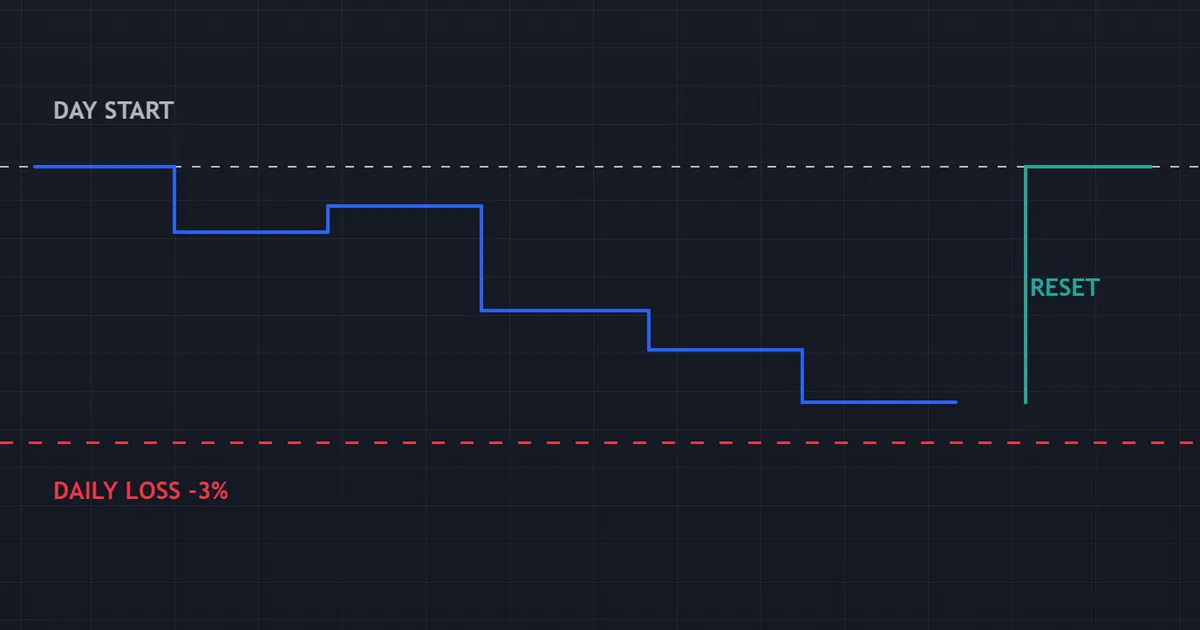
The distance usually comes as a percentage of the account. Convert it into money once, because a figure in your own currency stays useful when a trade moves against you.
The rule then runs on autopilot. Once your account touches the line, the platform closes open trades and blocks new orders until the reset.
The Reference Point at the Start of Day
Most firms take a snapshot at the reset. That snapshot becomes the number your cap hangs beneath for the whole session.
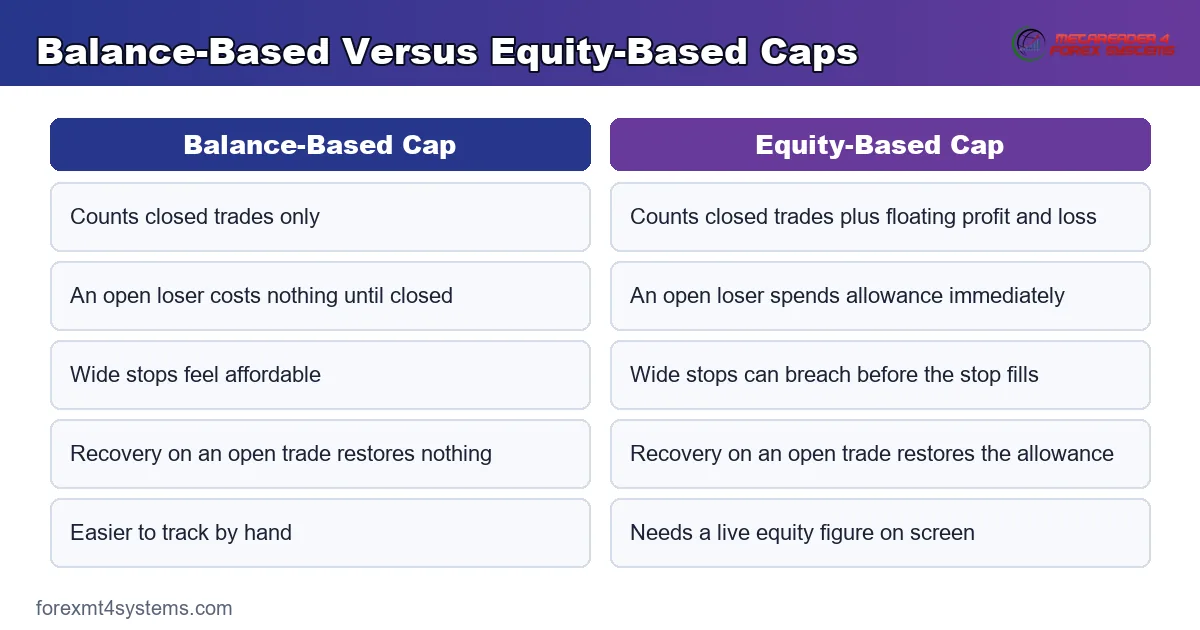
Some use the day’s opening balance, so only closed results matter. Others use the day’s opening equity, which folds in any floating profit or loss you carried across the reset.
Balance and Equity Inside the Day
The second detail matters even more. A firm can watch your closed balance through the session, or it can watch live equity tick by tick.
Equity monitoring bites much sooner. Because an unrealised loss counts the moment price moves, a trade that later recovers can still end your session.
Why the Cap Resets
A daily cap exists to break a losing sequence, not to punish one trade. So the counter clears each day and hands you a fresh allowance.
That reset makes the rule survivable. Because yesterday cannot follow you into today, one rough session costs you a day rather than the account.
The Cap and the Maximum Floor Together
A funded account carries two floors at once. One rule governs a single session, while the maximum drawdown governs the whole program.
The daily cap almost always sits closer. So it acts as your working boundary, and the maximum floor only comes into play after a string of maximum-loss days.
Read both numbers together each morning. Because the tighter one decides your position size, a quick comparison tells you which rule you are actually trading against today.
Why Firms Set a Daily Cap
The rule can feel like an insult after two unlucky trades. From the firm’s side it prevents the single worst outcome in their whole book.
It Stops One Session Ending an Account
Traders rarely lose an account slowly. Most damage arrives in a single session, when frustration meets a larger position size.
A daily cap interrupts that sequence mechanically. Because the platform locks the account before the damage compounds, the firm keeps a trader who might otherwise be finished.
It Also Protects the Trader
Read the rule honestly and it looks like sound risk practice. Plenty of experienced traders set a personal daily stop on their own accounts without any firm asking.
So the cap enforces a habit worth keeping anyway. Because a bad day tends to breed a worse one, an automatic exit beats willpower on the days willpower fails.
How the Daily Limit Is Measured
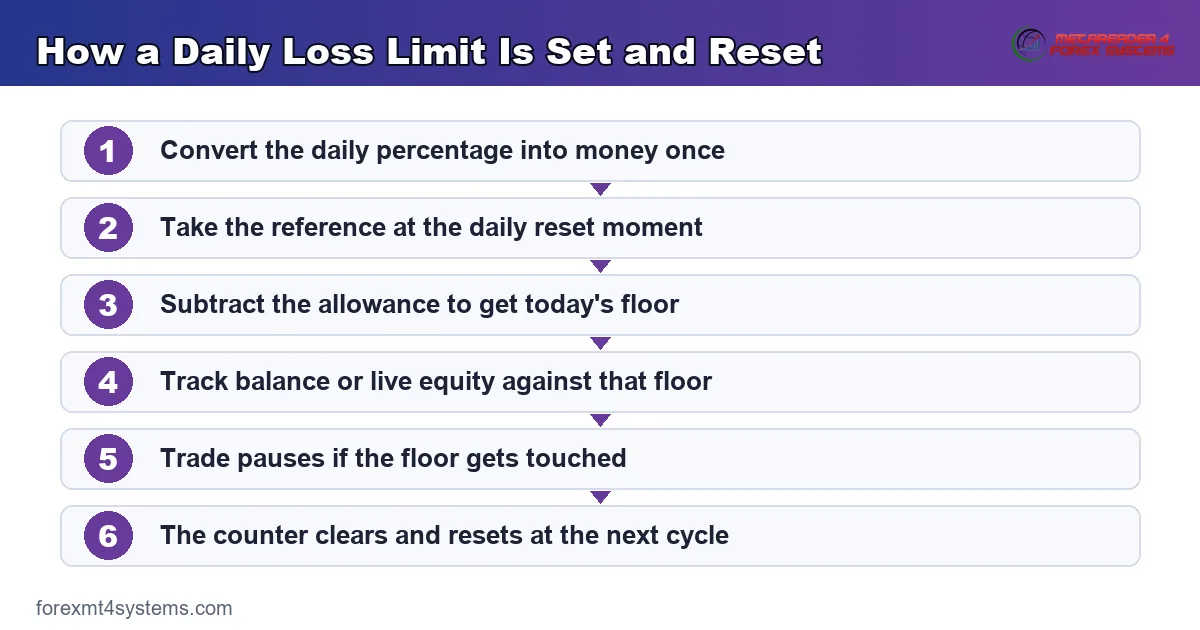
Six checks turn the clause into two numbers you can watch. Run them once on any new account.
Write the answers in the same notebook you keep your trade plan in. You will refer to them every morning for the life of the program.
- Convert the percentage into money. Apply the daily figure to the account size the terms specify.
- Find the reference. Note whether the day starts from your opening balance or your opening equity.
- Subtract to get the floor. The reference minus the allowance gives today’s hard line.
- Check what the firm monitors. Balance-only rules ignore floating losses, while equity rules count them instantly.
- Note the reset hour. Convert the firm’s server time into your own time zone.
- Confirm the consequence. Some breaches pause trading until reset, while others close the account.
Step four decides how the rule feels day to day. Because an equity rule reacts to unrealised moves, it turns every open position into a live claim on your allowance.
Commissions and swap charges usually count as well. So a scalping day with many round turns spends part of the allowance on costs before a single trade goes wrong.
Finding the Reset Hour
Firms set the reset on their own server clock. That hour rarely matches midnight where you live, and daylight saving shifts it twice a year.
Work out the local equivalent and write it down. Because a trade held across the reset straddles two allowances, that one hour changes how you manage overnight positions.
Check the hour again after every clock change. Servers and local time zones shift on different dates, so the gap between them moves twice a year without warning.
What Counts Toward the Cap
Realised losses count first and always. Costs follow, since commission and swap both reduce the account in exactly the same way.
Then come the firm-specific extras. A few programs count the loss on a hedged pair rather than the net figure, so read the wording if you run offsetting positions.
Floating Losses and the Cap
An open trade sitting fifteen hundred dollars underwater already spends fifteen hundred dollars of an equity-based allowance. Close the trade at breakeven later and the allowance returns, yet the risk was real while the position stayed open.
So an equity rule caps your total exposure rather than your realised losses. Because a wide stop can carry more floating loss than your allowance permits, position size and stop distance both need checking before you enter.
How the Cap Shapes a Trading Day
The rule works best as a planning tool rather than a warning light. Treat the allowance as a budget and the day organises itself.
Three checkpoints keep that budget honest. None of them takes longer than a minute.
The Morning Budget
Start by writing today’s floor and your distance to it. Then decide how much of that distance you are willing to spend before you stop.
Most experienced funded traders spend a fraction rather than the whole allowance. So a two-thirds ceiling leaves room for a surprise cost or a slipped fill.
The Midday Check
Pause once around the middle of your session. Compare your current equity against the floor and count the losses you can still absorb.
That count drives the rest of the day. Because a shrinking count should shrink your size, the check quietly enforces the discipline you planned in the morning.
The Stop-for-the-Day Rule
Decide your stopping point before the session, never during it. A fixed number of losses or a fixed money figure both work well.
Then honour it without debate. Because the reset hands the full allowance back tomorrow, walking away costs you almost nothing and protects everything.
Adjusting Size as Room Shrinks
Constant lot sizes make no sense against a shrinking allowance. A trade that risked a quarter of your room this morning risks half of it after two losses.
So step your size down as the room narrows. Halving the risk once you spend a third of the allowance keeps your slot count roughly stable through the session.
The habit also cools your decision making. Because a smaller trade carries less urgency, the shrinking size gently pulls you away from the line rather than toward it.
A Worked Example of Planning a Day Around the Cap
Numbers make the budget concrete, so plan one full session. Picture a hundred thousand dollar funded account with a three percent daily cap.
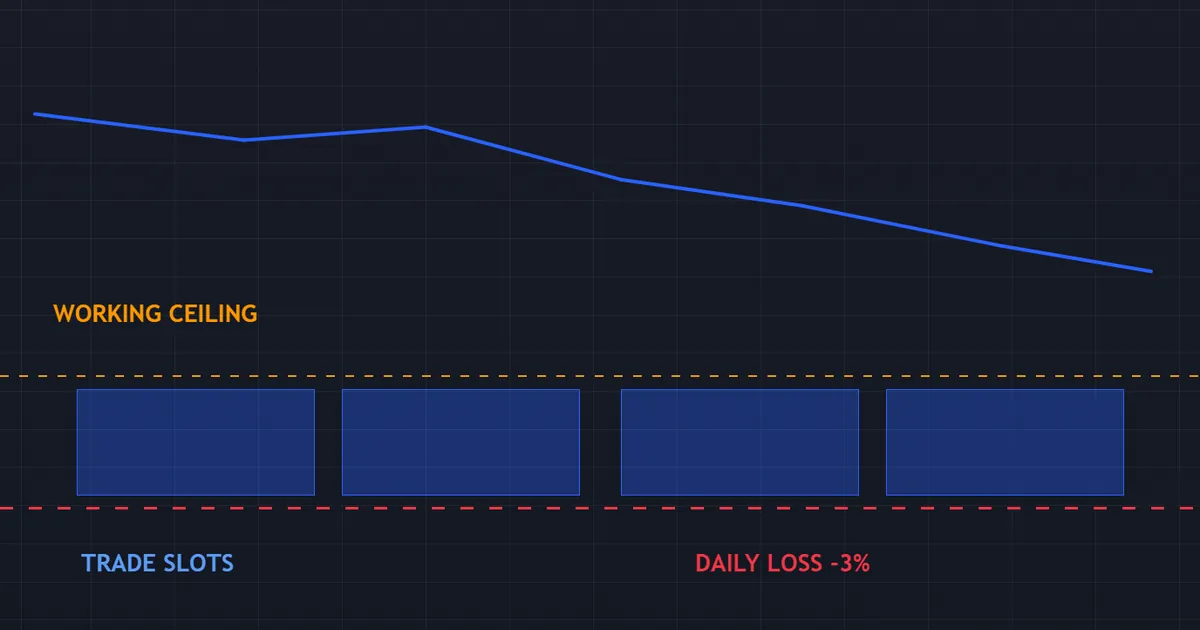
The account opens the day at a hundred thousand dollars. Three percent equals three thousand dollars, so today’s floor sits at ninety-seven thousand dollars.
Step One: Set a Working Ceiling
Never plan to spend the whole three thousand dollars. Take two thousand dollars as your working ceiling and keep the last thousand as untouched reserve.
That reserve absorbs the things you cannot forecast. Spread widening, a slipped stop and a swap charge all land in it rather than in your allowance.
Step Two: Divide Into Trade Slots
Risk half a percent per trade, which equals five hundred dollars. Two thousand dollars of working ceiling therefore buys four full-size losses.
Four slots suits most intraday plans comfortably. Because you know the count in advance, the fifth idea of the day never even reaches your platform.
Step Three: Set a Hard Stopping Point
Write the stopping point on the same line as the floor. Four losses, or two thousand dollars, whichever arrives first.
Then set an alert at the halfway mark. Because a thousand dollars of damage should change your behaviour, an alert at that level prompts you to trade smaller or stop early.
A Day That Goes Wrong
Two losses arrive early and cost a thousand dollars. Your third trade then runs against you and sits fifteen hundred dollars underwater without hitting its stop.
Under an equity rule your account now shows two thousand five hundred dollars of damage. So you sit five hundred dollars from the cap on a trade you never closed, and the sensible move is closing it yourself.
Under a balance rule the same day reads differently. Only the thousand dollars of closed losses counts, so the floating loss threatens nothing until you realise it.
Neither version makes the position safe. Because price does not care which rule your firm chose, the trade still needs closing on its own merits.
Turning the Budget Into Lot Sizes
Slots only help once they become lot sizes. Divide the money per slot by your stop distance, then convert with the pip value for the instrument.
Our prop firm position size calculator sizes a trade straight against a firm’s daily and maximum limits, while our position size calculator handles the same sum on a personal account.
Download the complete indicator database
Put these concepts on your charts. One email unlocks the full library of 1,380+ indicators with compiled MT4 and MT5 files, plus my TradingView scripts. No paywall, no spam, unsubscribe any time.
Get free access to my indicator database
One email unlocks 1,380+ free MT4, MT5 and TradingView indicators — the complete library. No single-tool download; you get the whole database.
Common Daily Drawdown Mistakes and Fixes
The same handful of errors accounts for most breached sessions. The compare graphic below sets a balance-based cap against an equity-based one.
Watching Balance on an Equity Rule
A trader with two small closed losses feels comfortable. Meanwhile an open position carries enough floating loss to breach the cap on its own. So confirm which figure your firm monitors, then watch that figure.
Forgetting the Reset Hour
Holding a trade across the reset splits its risk over two allowances. A position that looked safe at bedtime can breach the fresh cap within minutes of the new day. So flatten or trim before the reset.
Sizing for the Whole Allowance
Spending the full cap leaves nothing for costs or slippage. One widened spread then turns a planned stop into a breach. So keep at least a third of the allowance in reserve.
Revenge Trading After Two Losses
A bad start tempts traders into a larger recovery trade. That single decision converts a routine day into a closed session. So cut size after losses rather than raising it.
Ignoring Costs on High-Frequency Days
Fifty round turns pay fifty lots of commission. Those costs eat a real slice of the allowance before the market does anything at all. So count expected costs into the morning budget.
Trading Through a Major Release
High-impact news can gap price straight past your stop. One spike can spend the whole daily allowance while your order waits for a fill. So trade lighter around a busy calendar, or stand aside.
Averaging Into a Losing Position
Adding lots to a loser feels patient and behaves like leverage. Each addition spends allowance faster while moving your breakeven further away. So decide the full position size before you enter, then leave it alone.
Treating a Pause as a Failure
Some traders panic when the platform locks them out for the day. The pause simply does the job you should have done yourself. So use the time to review rather than to open a second account.
Daily Drawdown Quick Reference
Pin this list beside your platform. Work through it before the first order of every session.
- Convert the daily percentage into money.
- Note today’s reference: opening balance or opening equity.
- Write today’s floor and your distance to it.
- Confirm whether the firm monitors balance or live equity.
- Know the reset hour in your own time zone.
- Set a working ceiling at roughly two-thirds of the allowance.
- Divide that ceiling into a fixed number of trade slots.
- Fix your stopping point before the session starts.
- Count expected costs into the budget on busy days.
- Step your size down once a third of the allowance has gone.
What Trips the Daily Limit Most Often
Breached sessions rarely start with a wild trade. The chart below shows an intraday equity path that drifts into the daily line and stops the session.
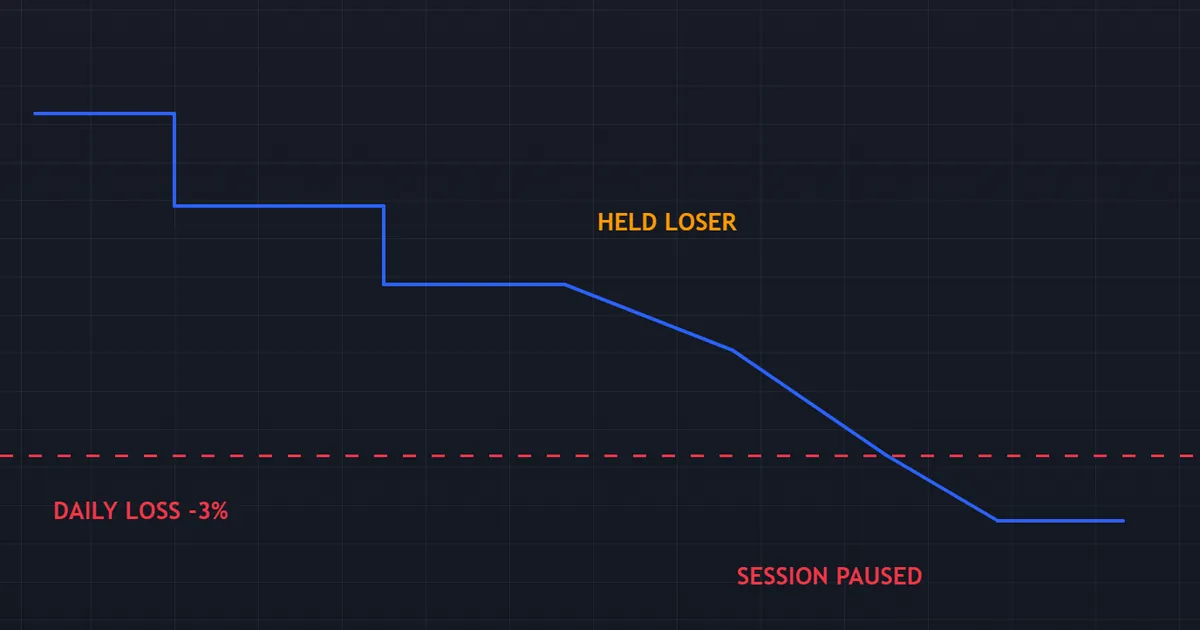
Follow the path across the session. Two ordinary losses tilt it lower, a held position drags it further, and a recovery attempt carries it through the line.
The Held Loser
An open trade left to breathe spends allowance every minute under an equity rule. So the position you refuse to close often does more damage than the ones you do.
The Size Creep
Traders who feel behind quietly raise their lots. Each larger trade spends more of a shrinking allowance, so the arithmetic accelerates against them.
The Correlated Cluster
Three trades on related instruments behave like one large trade. Because they lose together, a cluster can spend three slots in a single move.
The Session Overlap
Volatility jumps when two major sessions overlap. A stop that suited a quiet hour can slip badly in that window, so the same plan costs more than expected.
The Untracked Cost
Commission and swap rarely appear in a trading journal. Yet both reduce the account exactly as a losing trade does, so a busy day can spend allowance you never counted.
The Second Wind
A trader who stops, then returns an hour later, usually returns with the same frustration. So end the session properly and let the reset restore the allowance.
Reading the Daily Clause in a Rule Book
Firms word this rule in several ways, and the wording tells you everything. Two or three phrases settle the question.
Phrases Worth Spotting
Look for daily loss limit, maximum daily loss or daily drawdown, then read the sentence that follows. That sentence names the reference and the monitoring method.
Terms such as starting balance of the day point to a balance reference. Wording such as equity at the daily reset, or any mention of floating profit and loss, points to an equity reference instead.
Read the sentence twice where both words appear. Some clauses set the reference from the opening balance and then monitor live equity against it, which mixes the two styles in one rule.
Special Cases in the Fine Print
A few clauses only matter to particular traders. Skim them once so nothing surprises you later.
Some programs measure a partial day for your first session, since the account opens mid-cycle. Others suspend the cap during a weekend break and restore it at the first reset of the week.
Automated strategies attract extra wording too. Because a program can place many orders in seconds, some firms add a separate clause covering how quickly a cap can breach under automation.
Questions Worth Asking Support
Ask whether the dashboard shows your remaining daily allowance. Then ask whether that figure updates live or only after each closed trade.
Ask finally what happens on a breach. Because a pause and a closure carry very different consequences, that answer changes how much reserve you should keep.
Related Concepts to Study Next
A daily cap makes far more sense beside the other rules on a funded account. Three neighbouring guides finish the picture.
Map the whole rule set in our overview of prop firm drawdown rules, then read how the life-of-account floor can move in our guide to trailing drawdown. For the wider model, see our explainer on a funded trading account. Because the cap is applied risk management, our note on a daily loss limit covers the same idea on a personal account, and our guide to risk per trade sets the slot size.
FAQ
What is daily drawdown in prop firms?
Daily drawdown caps how far a funded account may fall within one trading day. The cap sits a set distance below a reference taken at the daily reset. Cross it and the platform stops your trading for the session.
Does the daily cap measure from balance or equity?
Firms split on this point, so check the terms. A balance reference counts closed trades only, while an equity reference includes floating profit and loss. Equity rules bite sooner and demand tighter position sizing.
When does the daily limit reset?
Most firms reset on their own server clock, often at midnight in the platform’s time zone. Convert that hour into your local time and note it. A trade held across the reset spreads its risk over two allowances.
Do floating losses count toward the daily limit?
At many firms they do. An open position sitting underwater spends allowance immediately under an equity rule, even if the trade later recovers. So treat an open loser as a real cost rather than a paper one.
What happens if I breach the daily limit?
Most firms close your open trades and lock new orders until the next reset. A minority treat a daily breach as a full account failure. So confirm which outcome applies before you trade near the line.
How much of the daily allowance should I use?
Plan around a fraction rather than the full figure, since costs and slippage need room too. Many traders cap themselves near two-thirds of the allowance and stop for the day at that point. Results are not guaranteed; past performance is not indicative of future results.
External references
- For background on this concept, see Mark to Market at Investopedia.
- For broader market context, see Equity in Finance on Wikipedia.

About the author
Written by Dominic Walsh, a Forex trader and MT4/MT5 indicator, Expert Advisor and script developer. Every tool on forexmt4systems.com is tested on live charts before release and ships with ready-to-use compiled MT4 (.ex4) and MT5 (.ex5) files. Learn more about the trader and developer behind this site.
How we build, test and correct every tool: Editorial & Testing Policy. Trading carries risk; see the disclaimer.