
Copy trading for beginners looks like the easy door into the market. You pick a trader, press follow, and your account mirrors their orders from that moment on.
The mechanics really are that simple. What follows the mechanics decides the outcome, and almost nobody explains that part before you fund the account.
Copy Trading for Beginners: What You Are Actually Buying
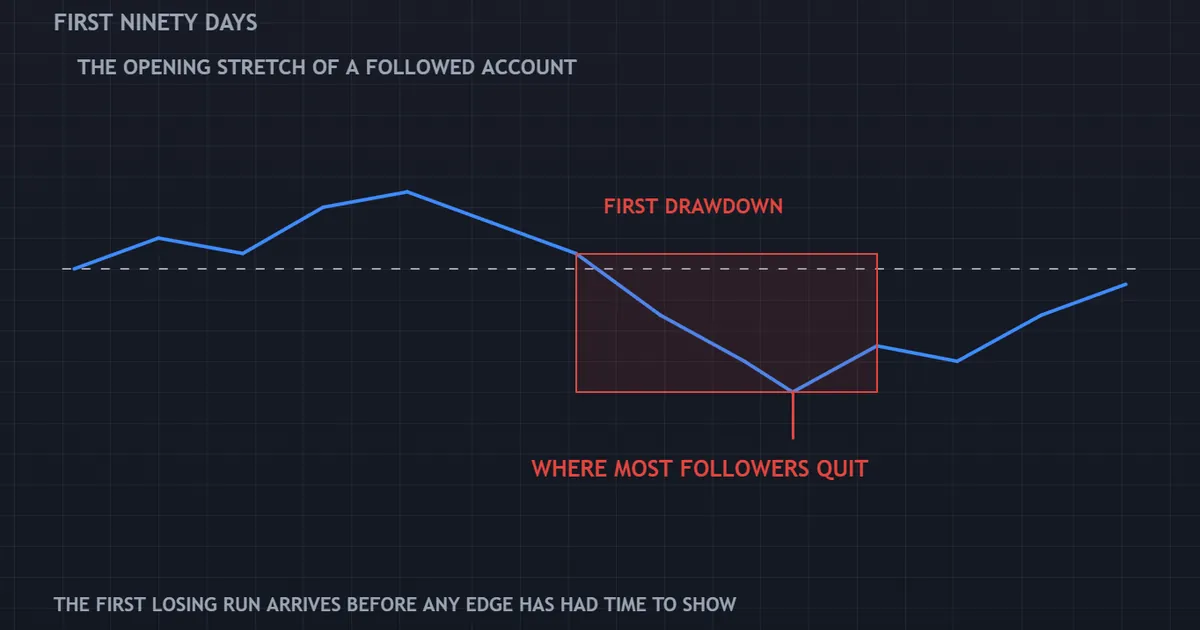
Read the panel above before anything else. It shows a follower’s first ninety days, with the first real drawdown marked at the point where most people quit.
That moment arrives for everybody. Planning for it beats reacting to it.
You Buy the Orders, Not the Judgement
A link copies entries, exits and sizes. It cannot copy the reason behind any of them.
Your source might close early because a data release approaches. You see the exit and never learn why, so you cannot repeat the thinking on your own.
Your Account Stays in Your Name
Copying leaves the funds with your own broker. You keep the login, the statements and the right to close anything by hand.
Our overview of what copy trading is covers the wiring in detail. The short version: the platform sends instructions, and your broker still fills them.
What the Platform Supplies
Platforms supply a list of traders, some statistics and a follow button. They rarely supply context, and context does most of the work.
Treat the leaderboard as a starting point. It ranks what already happened, under conditions that have since moved on.
Decisions to Make Before You Link Anything
Three questions come first. Answer them on paper, because answering them mid-drawdown never goes well.
How Much Money Goes In
Fund the account with an amount you could lose without changing your plans. That figure keeps every later decision calm.
Copying does not lower risk. It moves the decision to somebody else, and the exposure stays entirely yours.
How Long the Trial Runs
Pick a window in advance, then leave it alone. Three months gives you enough trades to judge behaviour without turning it into a career.
When You Would Stop
Write down the drawdown that ends the link. A number decided today beats a feeling decided halfway down.
Our note on risk per trade helps you set that figure sensibly.
How to Start Copy Trading Step by Step
Six steps take you from nothing to a live link. Do them in order, since each one removes a way of getting hurt later.
- Open an account with a regulated broker. Check the regulator on the regulator’s own register, not on the marketing page.
- Fund it with your trial amount. Nothing more, whatever the platform suggests.
- Shortlist three sources. Compare a long record, a stated worst losing run and a sizing habit you can live with.
- Set the sizing rule before you link. Choose a fraction of your equity rather than a copy of their lot.
- Link one source at the smallest size. The first month collects data, so profit stays beside the point.
- Log every trade in your own journal. Source price, your price, the delay and the outcome.
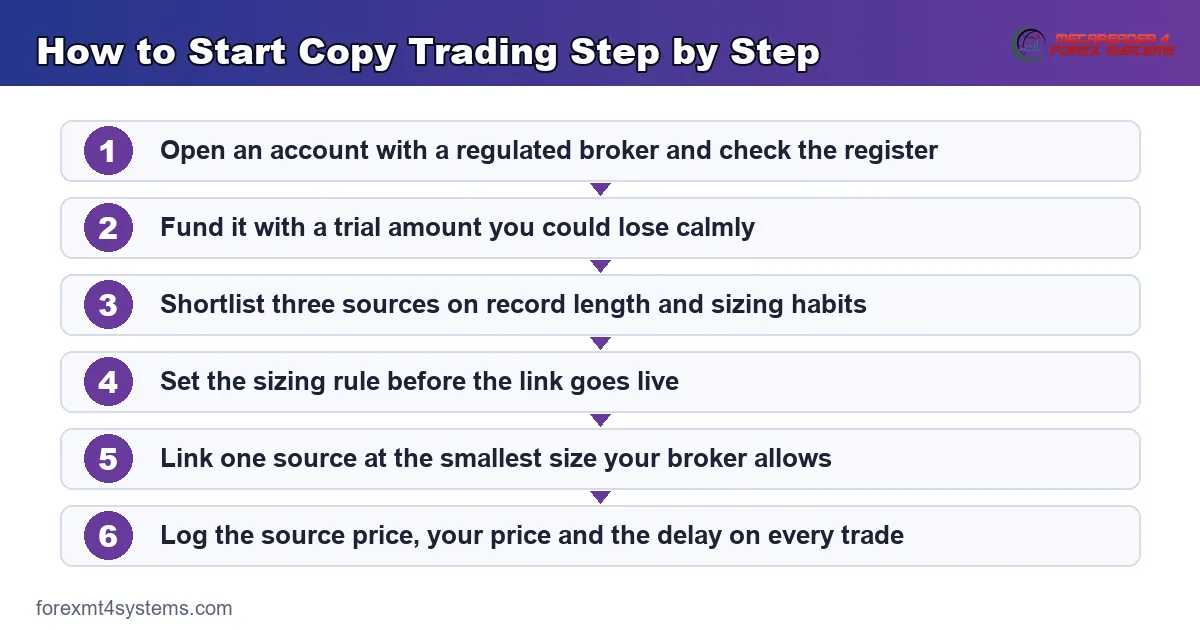
Step four carries most of the weight. Nearly every beginner blow-up traces back to a sizing rule nobody set.
Keep the log somewhere permanent. Our trade journal tool works well for this, and a spreadsheet works too.
Choosing a Source Without Guessing
Selection deserves an evening, rather than an afternoon of scrolling. Four things carry real information.
Length of the Live Record
Months matter more than percentages. A record spanning quiet markets and busy ones shows you far more than one strong quarter.
Shape of the Curve
Look for steady behaviour rather than a single vertical stretch. One enormous win inside an otherwise flat record tells you the trader got lucky once.
Consistency of Lot Size
Steady volume suggests a rule. Jumps in size after losses suggest somebody chasing, and that habit copies straight into your account.
Trading Hours and Instruments
Check when the source works and on what. A trader who operates in thin hours pays wider spreads, so you pay them as well.
Sizing Is the Step Beginners Skip
Two accounts can follow the same trades and finish miles apart. The difference usually starts with lot size.
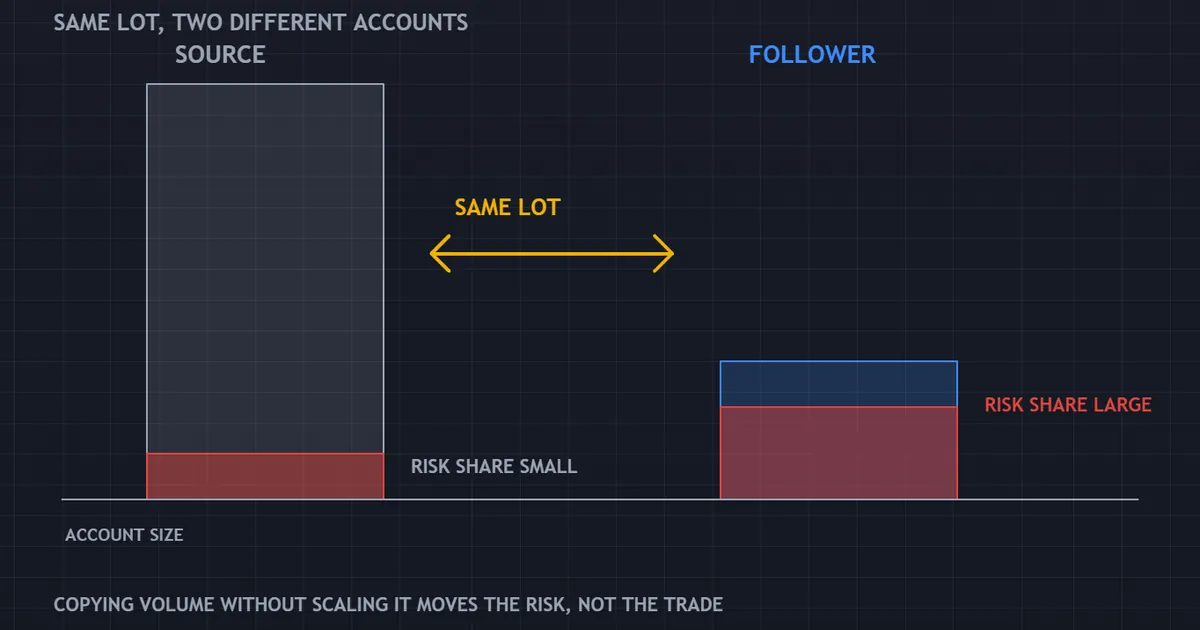
The panel above makes the trap visible. A large source account and a small follower account trade the same lot, so the follower risks a far bigger share of the balance on every position.
Fixed Lot Copying
This rule mirrors their volume exactly. It ignores the gap in balance, which is why it wrecks small accounts fastest.
Multiplier Copying
A multiplier scales their lot by a factor you pick. Half or a quarter suits most beginners, and the maths stays easy to check.
Equity Percent Copying
The steadiest option keeps your risk proportional to your own balance. When equity falls, lots fall with it, which slows a bad run.
Run the numbers through our position size calculator before you commit. A rule that sounds mild in words often looks severe once you convert it into lots.
Download the complete indicator database
Put these concepts on your charts. One email unlocks the full library of 1,380+ indicators with compiled MT4 and MT5 files, plus my TradingView scripts. No paywall, no spam, unsubscribe any time.
Get free access to my indicator database
One email unlocks 1,380+ free MT4, MT5 and TradingView indicators — the complete library. No single-tool download; you get the whole database.
How Platforms Charge for Copying
Charges arrive in three shapes, and most followers meet all three. Knowing which ones apply changes the arithmetic.
Spread and Commission
You pay your own dealing cost on entry and again on exit. A busy source therefore hands you a bill that grows with its activity.
Profit Share
Many platforms pay the source a slice of your gains. Ask whether a high-water mark applies, since without one you can pay twice for the same recovered ground.
Subscription
Some services charge a flat monthly amount. That cost runs through flat months and losing months alike, so it needs covering before anything else does.
The First Drawdown Decides Everything
Every source has losing runs. Yours will arrive early, because chance does not schedule itself politely.
Why It Feels Worse Than It Reads
A published curve compresses months into an image you scroll past in seconds. Living through the same stretch takes weeks of watching red numbers.
The emotional weight lands on you alone. Nobody else in the arrangement feels your balance moving.
The Trap of Quitting at the Bottom
Followers who unlink at the deepest point book the loss and miss whatever comes next. Then they pick a new source, meet its first drawdown, and repeat the pattern.
So decide the stopping rule in advance and stick to it. Consistency beats accuracy here.
The Opposite Trap
Some followers add money during a losing run to speed up recovery. That converts a survivable stretch into a serious one.
Nobody can tell whether a losing run ends tomorrow or continues for months. Sizing up into it assumes an answer nobody holds.
Why Your Result Differs From the Published One
Beginners expect their curve to match the provider page. It never quite does, and four causes explain the gap.
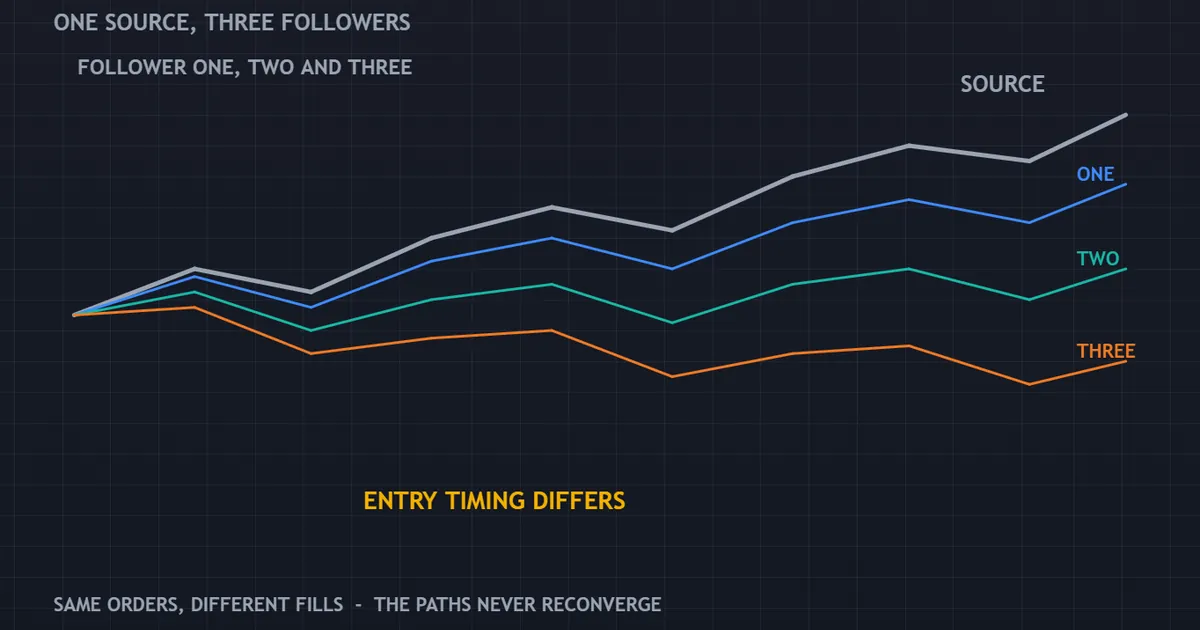
The panel above shows three followers of one source drifting apart. Entry timing alone separates them, before costs even enter the picture.
You Fill Later
The copier needs a moment to notice the trade and place yours. Price moves during that moment, usually against you.
You Pay Your Own Spread
Your broker sets your cost, not theirs. Two accounts on the same pair can pay noticeably different amounts.
Your Size Follows a Rule
Rounding turns their volume into yours. Small rounding differences compound across hundreds of trades.
Your Swap and Commission Apply
Overnight charges land on your account under your terms. Held positions therefore cost you something the published curve never shows.
What Copies Across and What Does Not
The clearest way to set expectations is a straight list of what transfers. Some things travel, and the important ones stay behind.
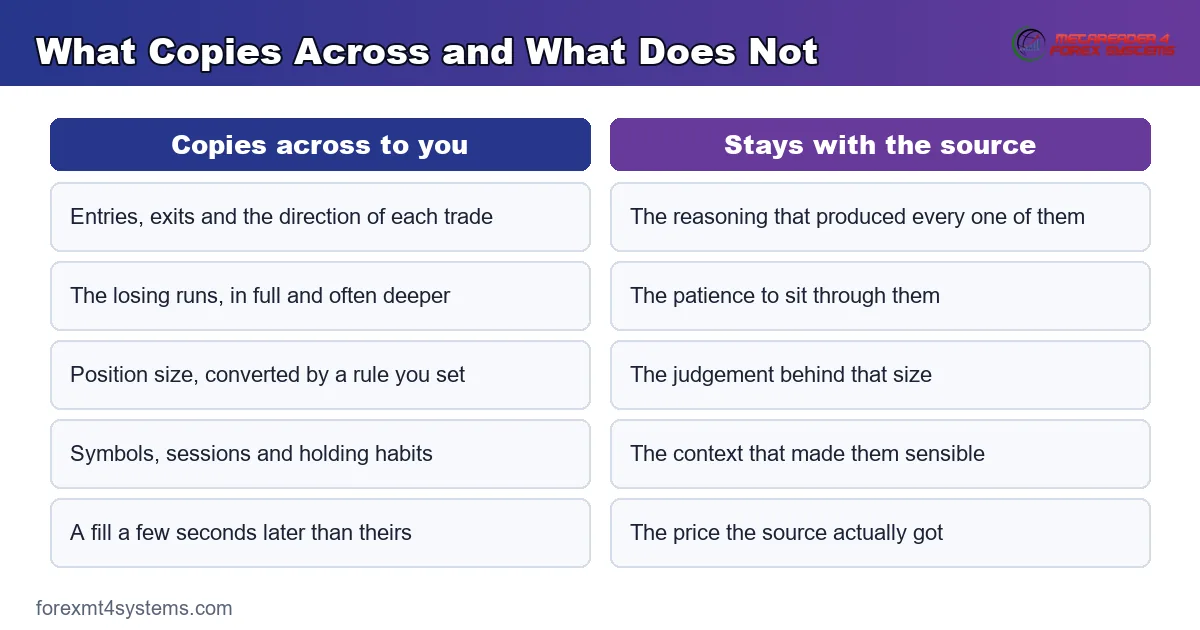
Look at the right column twice. Everything that would let you act independently sits over there.
Drawdown Travels
Losing runs copy across in full, and often land harder in percentage terms on a smaller account. The follower meets them later and at a worse average price.
Skill Does Not Travel
Following a trader for a year teaches you very little about trading. You watched outcomes, not decisions.
If learning matters to you, keep a parallel practice. Our guide to forex trading strategies gives you something to study while the link runs.
Reading a Provider Page Honestly
Provider pages rarely lie. They simply leave out the numbers that would let you judge the rest.
Check the Age of the Record
A record covering several months across changing conditions beats a spectacular quarter. Short windows hide the losing run entirely.
Find the Worst Stretch
Look for the deepest fall from a peak and how long the recovery took. That pair of numbers tells you more than the headline total.
Look at Trade Count and Hold Time
A source that trades constantly hands you a much larger cost bill. Frequency raises the hurdle rather than lowering it.
Treat History as History
Past results describe conditions that have gone. Nobody can promise the same behaviour next quarter, whatever the record shows.
Questions to Ask Before You Fund
Send these to support and keep the replies. A firm that answers slowly has told you something already.
- Which entity holds the funds? Ask for the licence number, then check it on the regulator’s own register.
- What happens to open trades when I unlink? That answer decides your exit.
- How do you work out my lot size? Ask for the formula, not a description of it.
- What does the source earn from my account? Profit share, a charge per lot, or both.
- Can I cap the size of a single trade? A hard cap protects you from one unusual position.
Keep every reply in writing. Written answers settle disputes that chat messages never will.
Demo First, Then Small
Two stages sit between reading and committing. Skipping either one costs money for no reason.
What a Demo Actually Tests
A demo link proves the plumbing works. Orders arrive, sizing behaves as configured, and you learn the platform without paying tuition.
It cannot test fills. Demo servers fill politely, so treat the prices there as friendly fiction.
What Minimum Size Tests
Live money at the smallest lot exposes the real spread, the real delay and your own reactions. Those three things decide the outcome later.
Stay small until the log holds thirty trades. Data beats confidence at this stage.
What Copying Cannot Fix
Copying solves one problem well, since it removes the need to decide each trade. Three problems survive it untouched.
An Account That Is Too Small
Minimum lot sizes set a floor under your risk. When that floor sits above your own rule, no source can rescue the arrangement.
A Habit of Interfering
Somebody who overrides trades by hand will override copied trades too. The link changes where the signal comes from, not the impulse.
An Unclear Reason for Trading
Followers without a plan drift between sources and blame each one in turn. Write the plan first, then pick the tool.
Mistakes Beginners Make in the First Month
Five errors account for most early losses. Each has a straightforward fix.
Following the Top of the Leaderboard
Leaderboards reward recent risk. The trader at the top frequently got there by sizing hard, and that sizing produces your first drawdown.
Copying Five Sources at Once
Five sources buying the same pair in the same session form one position. Check the overlap before calling it diversification.
Overriding Trades by Hand
Closing a copied position early breaks the process you paid to follow. Your record then describes neither their plan nor yours.
Ignoring the Fees
Per-trade costs and performance fees both bite. Our comparison of copy trading against pooled accounts sets out where each charge lands.
Confusing Signals With Copying
A signal service sends instructions you place yourself. Our page on forex signal services explains why the delay makes that model harder, not easier.
Copying Inside a Funded Account
Funded programmes treat copied orders carefully. Rules vary by firm and change regularly, so read your own rulebook rather than a forum post.
Categories of Restriction
Most rulebooks cover four areas: trading through news windows, copying between accounts, very fast execution, and consistency across days. Each one can end an evaluation on a technicality.
Why Copying Trips Them
A source trades to its own plan, never to your rulebook. It might enter during a release window, or place identical trades across many accounts, which some firms forbid outright.
So check the rules before you link anything to an evaluation account. A breach usually ends the account whatever the balance says at the time.
Setting Expectations You Can Live With
Beginners tend to picture a smooth climb. Real records look nothing like that picture.
Flat Months Happen
Long stretches produce very little in either direction. Nothing has broken during those weeks, and impatience causes more damage than the market does.
Recovery Takes Longer Than the Fall
Losses fall faster than gains climb, so a deep drawdown can eat months of progress in days. Check the recovery time on any record you study, not only the depth.
One Source Counts as One Position
Treat a single link as a concentrated bet rather than a portfolio. Size it that way and the rest of the plan becomes manageable.
A Ninety Day Plan You Can Follow
Structure keeps the trial honest. Work through the table below month by month.
| Period | What you do | What you must not do |
|---|---|---|
| Week one | Link one source at minimum size and log every fill | Add a second source because week one went well |
| Weeks two to four | Measure the delay and the spread you actually pay | Change the sizing rule mid-week |
| Month two | Compare your curve against the published one | Add money to speed up a recovery |
| Month three | Review the worst run and your own reaction to it | Unlink at the bottom on impulse |
| End of trial | Decide to continue, scale slowly, or stop | Scale up more than a small step at once |
Note what the plan never mentions. Profit gets no target, because ninety days cannot settle that question.
The trial answers something else instead. It tells you what the link really costs, how the source behaves under pressure, and whether you can leave a working process alone.
Those three answers carry forward to whatever you do next. A profit figure from one quarter carries almost nothing forward at all.
Keeping Records Worth Reading
A journal turns a vague impression into evidence. It takes two minutes per trade.
Record the Fill Gap
Write the source price, your price and the seconds between them. After thirty trades you hold a genuine cost figure.
Record Your Own Reactions
Note when you nearly intervened. Those moments predict the day you actually will.
Our guide on how to keep a trading journal covers a simple format that survives contact with a busy week.
When Copying Stops Making Sense
Three signals suggest the arrangement has run its course. None involves a single bad week.
The Source Changes Behaviour
A jump in lot size, a new symbol or a much longer hold time all mean the record you studied no longer describes the trader.
The Costs Eat the Move
If your curve trails the published one badly across many trades, the gap belongs to fills and fees. That gap rarely closes on its own.
You Stop Sleeping
Position size that keeps you awake runs too large, whatever the arithmetic says. Cut it or stop, then decide the rest calmly.
The Platform Changes the Terms
A new fee, a different sizing rule or a change of broker all alter the arrangement you agreed to. Read the notice properly when one arrives, then make the decision again from scratch.
FAQ
How much money do I need to start copy trading?
Enough to meet the platform minimum, and no more than you could lose without changing your plans. Small balances face a specific problem: the smallest lot your broker allows may already risk more of your account than your rule permits. Check that before funding anything, because it decides whether the arrangement can work at all. Platform minimums vary widely as well, and a higher minimum tells you nothing about the quality of the service behind it.
Is copy trading suitable for a complete beginner?
It suits a beginner who wants exposure without decisions, and it teaches very little about trading itself. You watch outcomes rather than reasoning, so the learning curve stays flat. Treat it as an allocation choice, and keep a separate practice going if you want to develop skill. Beginners who do both tend to last longer, because the reading and testing continue while the link runs quietly in the background.
Can I lose more than I put in?
On most retail accounts, protections limit your loss to the balance, and rules differ by regulator and by broker. Read the account terms before you fund it. Leverage still lets an account fall a long way in a short time, so the practical answer is that you can lose the balance.
How many traders should I follow at once?
Start with one, because a single link produces data you can actually read. Adding sources early makes it impossible to tell which one caused what. Later, check that any additions trade different pairs at different times, since overlapping positions concentrate risk instead of spreading it.
What happens to my open trades if I unlink?
Platforms differ. Some close every copied position immediately, while others leave them open and stop sending new orders. Find out which applies before you need it, because discovering the answer during a drawdown removes your options at the worst moment. Ask support in writing, then save the reply somewhere you can find it quickly.
Will a good track record continue?
Nobody can know that. A published record describes conditions that have already passed, and it carries no forecasting power however long it runs. Use it to understand how a trader behaves, then size the allocation so that a poor stretch stays survivable. Results are not guaranteed; past performance is not indicative of future results.
External references
- For background on this concept, see Trading Signals in the MQL5 Documentation.
- For broader market context, see Social Trading in the BabyPips Forexpedia.

About the author
Written by Dominic Walsh, a Forex trader and MT4/MT5 indicator, Expert Advisor and script developer. Every tool on forexmt4systems.com is tested on live charts before release and ships with ready-to-use compiled MT4 (.ex4) and MT5 (.ex5) files. Learn more about the trader and developer behind this site.
How we build, test and correct every tool: Editorial & Testing Policy. Trading carries risk; see the disclaimer.