
Plenty of people want market exposure without the screen time. That demand explains why so many newcomers ask what is copy trading before they ask anything else.
The mechanics are simple enough to explain in a paragraph. The risks take rather longer, and most promotional pages skip them entirely.
What Is Copy Trading in Plain Terms
Copy trading links your account to somebody else’s account. When they open a position, a matching position opens on yours, scaled to the size you chose.
Nothing predicts anything here. You are outsourcing the decision, not removing it.
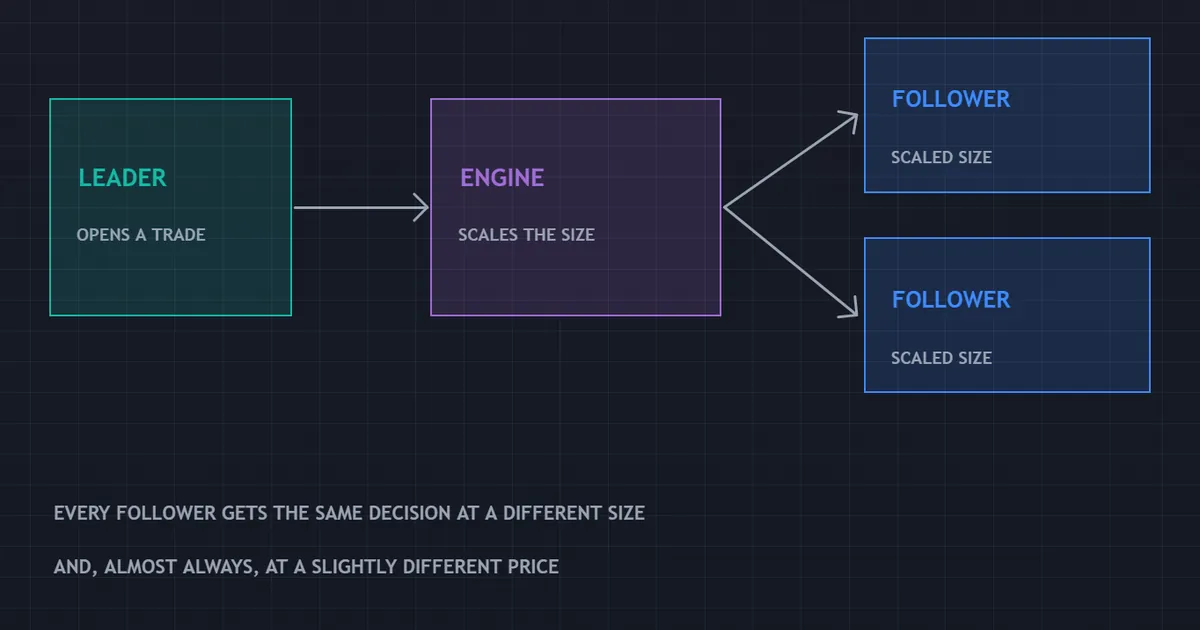
The panel above shows the shape of the arrangement. One leader account, an engine in the middle, and follower accounts receiving orders scaled to each balance.
The Three Roles
The leader trades their own account. They place every order, and their platform reports each action.
The engine sits in the middle. It watches the leader, applies your settings and sends instructions onward.
The follower holds the money. That is you, and every position lands in your own account under your own name.
What Copy Trading Is Not
It differs from handing money to a manager. The funds stay in your account, and you can stop the link whenever you want.
It also differs from running a robot. Our guide to expert advisors covers that route, where the logic sits on your machine and you can read every rule.
Here the logic sits in another person’s head. You cannot inspect it, and you rarely learn why any trade happened.
How a Copied Trade Reaches Your Account
Five steps carry an order from one account to another. Each step adds a little friction.
- The leader opens a position. They trade their own money on their own platform.
- The engine reads the order. Most systems notice within a second or two.
- Your allocation converts it. The rule you picked turns their size into your size.
- Your broker fills it. The price available to you decides your entry, not the price they got.
- Exits follow the same path. Closes, partial closes and stop moves all copy across with the same delay.
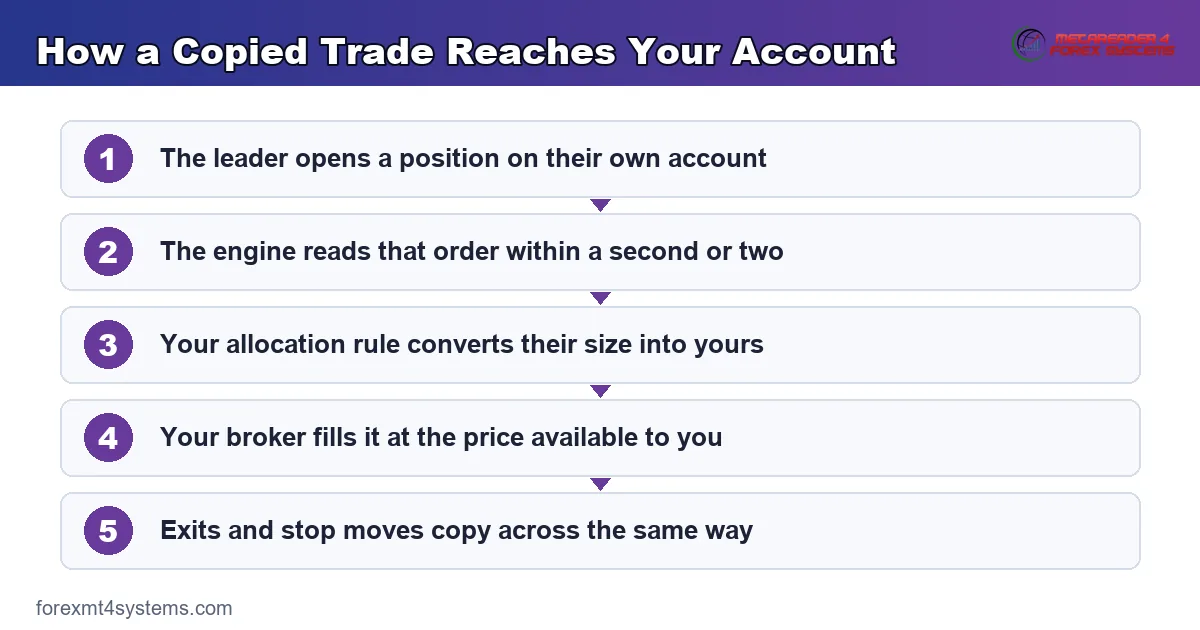
Step four explains most complaints. Two accounts almost never share the same fill, and the difference compounds over hundreds of trades.
Copying, Signals and Managed Accounts Differ
Three arrangements often collect the same name. They place the judgement in three different places.
A Signal Service Sends Instructions
You receive an alert and act on it yourself. The delay between the call and your click becomes a real cost, and the decision to act stays with you.
A Copy Service Mirrors an Account
Orders arrive automatically, scaled to your settings. You keep custody of the money, and you keep the choice of leader.
A Managed Account Hands Over Control
Somebody else trades on your behalf under a formal mandate. Rules, licensing and paperwork all differ, and the money often sits under a different structure.
Know which one you signed up for. The word copying gets used loosely, and the differences decide who carries which obligation.
How Allocation and Sizing Work
Allocation decides how much of their trade becomes your trade. Three modes cover nearly every platform.
Proportional Sizing
The most common mode scales by balance. If the leader risks a tenth of their account, you risk a tenth of yours.
That sounds fair, and it hides one thing. You inherit their risk appetite exactly, whatever your own tolerance happens to be.
Fixed Lot Mode
Here every copied trade uses the same volume, whatever the leader did. Small accounts often pick this to cap exposure.
The catch shows up on their bigger positions. A trade they sized as a conviction bet arrives on your account as an ordinary one, so your results drift from theirs quickly.
Fixed Risk Mode
Some platforms size from the stop distance instead. You set a percentage, and the engine works the volume from where their stop sits.
This mode behaves best when the leader always uses a stop. When they trade without one, the calculation has nothing to work from.
Choosing Your Mode
Match the mode to whatever worries you most. Proportional keeps you aligned with the leader, fixed lot caps the damage, and fixed risk respects your own limit.
Whichever you choose, write down what a bad week costs you. A mode you cannot explain in one sentence will surprise you later.
Why Your Fill Differs From Theirs
Four things separate the two fills. Delay, spread, broker pricing and lot rounding all take a small bite.
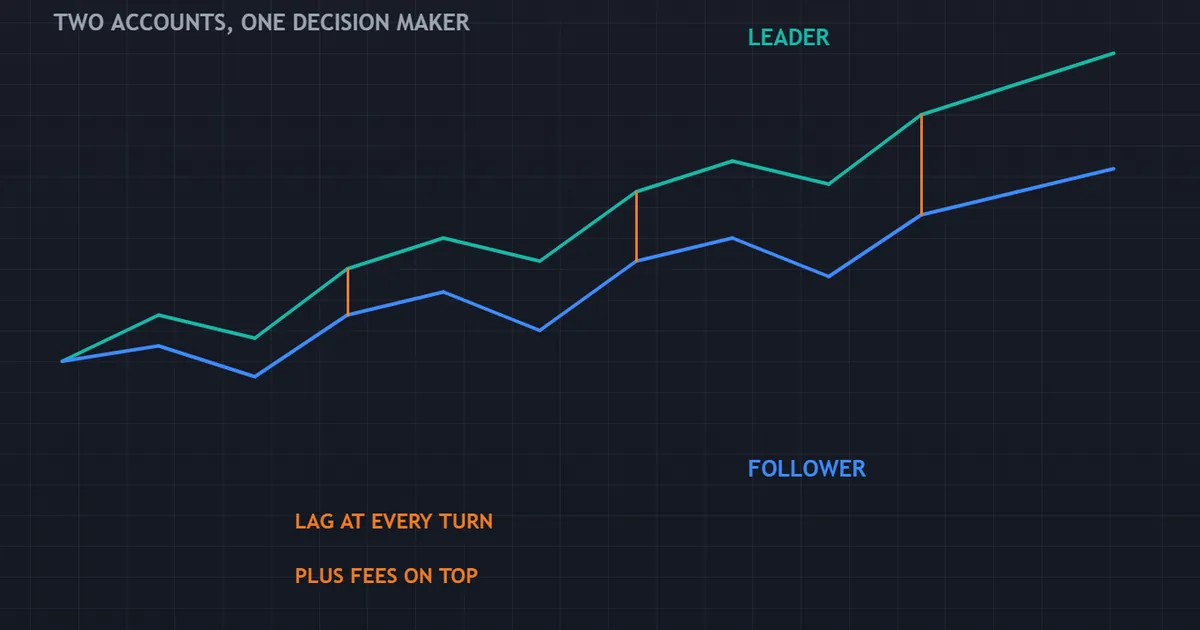
The panel above shows the usual result. A follower line that tracks the leader loosely and lags at every turn.
Work out your own volume before you allocate anything. Our position size calculator shows what a given percentage means in lots on your balance.
The Money Side: Fees and Costs
Copying is rarely free. Three charges appear, and only one of them is obvious.
Performance Fees
Most leaders take a share of the gains on your account. The share often applies above a high water mark, so you pay only on fresh progress.
Read how that mark resets. Some arrangements reset it monthly, which means you can pay a fee during a period when your balance fell.
Spread and Swap
Your broker charges you normally. Every copied trade pays your spread, your commission and your overnight rate.
A leader who trades a hundred times a month passes that cost through a hundred times. Frequency matters more here than it does in your own trading.
Currency and Rounding
Accounts held in different currencies add another gap. The engine converts sizes, and the conversion rarely lands on a clean lot.
Rounding then pushes you slightly above or slightly below the intended size. On a small balance that difference shows up quickly.
Download the complete indicator database
Put these concepts on your charts. One email unlocks the full library of 1,380+ indicators with compiled MT4 and MT5 files, plus my TradingView scripts. No paywall, no spam, unsubscribe any time.
Get free access to my indicator database
One email unlocks 1,380+ free MT4, MT5 and TradingView indicators — the complete library. No single-tool download; you get the whole database.
The Risks You Inherit
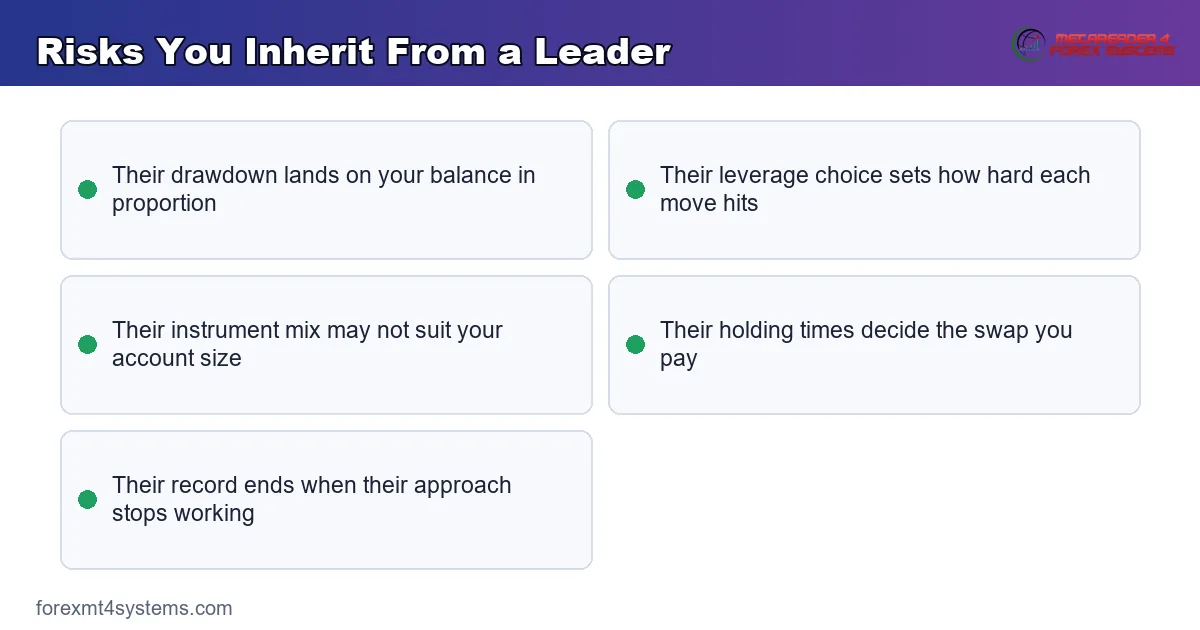
This section matters more than everything above it. Copying an account means copying its exposure, and that transfer runs deeper than most people expect.
Their Drawdown Becomes Yours
A losing stretch on their account lands on yours in proportion. You feel it in your own currency, on your own balance, with none of their context.
Our guide to drawdown in trading explains why the depth of that stretch matters more than any headline figure.
Their Leverage Becomes Yours
Leverage decides how hard each move hits. A leader comfortable with heavy size passes that comfort straight through to you.
Read our note on leverage in forex before you set an allocation. The number looks abstract until it lands on a balance you care about.
Past Results Do Not Transfer
A strong twelve months tells you what already happened. It says nothing about whether the same approach suits the next twelve.
Records also survive selectively. Leaders who blew up stop appearing in the rankings, so the visible list flatters the whole population.
The Leader Can Stop Trading
Accounts go quiet for ordinary reasons. Illness, a new job, or simply losing interest all end a record without warning.
Your capital then sits connected to nothing. Check the date of the last trade regularly, and set an alert if the platform offers one.
Concentration You Cannot See
Follow three leaders and you might hold nine positions. If all three trade the same pair in the same direction, you hold one large position wearing three costumes.
Check the combined exposure yourself. Nothing in most platforms warns you about it.
You Cannot See the Reasoning
A trade appears on your account with no explanation attached. You do not know whether it followed a plan or a hunch.
That gap bites during a losing run. Without the reasoning, you cannot tell a normal rough patch from an approach that stopped working.
Common Mistakes in Copy Trading
Six habits do most of the damage. Each one has a plain correction.
Picking by Headline Return
The top of any leaderboard rewards risk taking, not skill. Sort by the worst losing stretch instead, then read the trade history.
Joining After a Strong Run
Late arrivals meet the mean reversion. Our note on fear of missing out describes the pull, and it applies to leaders as much as to setups.
Allocating Too Much Too Soon
Start with an amount you would shrug at. Raise it only after you have watched a losing stretch and stayed calm.
Copying Several Similar Leaders
Three leaders trading the same style give you concentration, not diversification. Mix approaches or keep the count low.
Ignoring the Cost Stack
Performance fee, spread, commission and swap all stack up. Add them together before you judge any published figure.
Setting It and Forgetting It
Leaders change. They raise size, switch instruments or start trading news, and nothing announces the change to you.
Treating It as Passive Income
The phrase sets the wrong expectation. Someone still has to review the leader, watch the exposure and decide when to stop.
Budget an hour a month as a minimum. Arrangements that get no attention tend to end badly.
Where Copy Trading Gets Restricted
Permission matters as much as mechanics. Two sets of rules catch people out.
Funded and Prop Accounts
Many funded programmes ban copying outright. Others allow it only from your own accounts, which rules out following a stranger.
Read prop firm rules before you connect anything. A breach usually ends the account rather than earning a warning.
The reason is straightforward. A firm cannot judge your skill if somebody else supplies every decision.
Consistency and Lot Rules
Some funded programmes cap how much one day or one trade can contribute. A leader with uneven sizing can breach that cap even while the account grows.
Read those clauses closely. They catch far more people than the outright bans do.
Broker and Regional Limits
Some brokers restrict third party engines on their platform. Others require extra disclosure from anyone offering a copy service.
Rules also vary by country. Check what applies where you live rather than where the platform advertises.
Setting Up a Connection Safely
The technical setup takes minutes. The decisions around it deserve an evening.
Start on Demo
Most platforms let you copy into a demo account first. Two weeks there shows you the delay, the rounding and the trade frequency.
Demo also shows you your own reaction. Watching someone else lose your simulated money makes a useful rehearsal.
Set a Hard Limit
Decide the maximum loss you will accept before you connect. Write the number down, then check whether the platform can enforce it.
Some services offer a stop that disconnects at a set drawdown. Where none exists, put a reminder in your calendar and check manually.
Keep Records From Day One
Save the leader’s published statistics on the day you join. Six months later you will want to compare that page against what your own account received.
Log your own trades separately as well. Your account is the only record that reflects your fills, your fees and your currency.
A Checklist Before You Allocate
Run this list once per leader. It takes twenty minutes and prevents the expensive surprises.
| Check | What good looks like | Warning sign |
|---|---|---|
| Length of record | Many months of live trading, shown in full | A few strong weeks and no earlier history |
| Worst losing stretch | Published clearly, and shallow enough to sit through | The figure never appears anywhere |
| Trade behaviour | Stops on every position, steady size | Averaging into losses, sudden size jumps |
| Instruments traded | A small set you recognise | Exotic pairs with wide spreads |
| Fee structure | A clear share of gains above a high water mark | Fees that reset often or apply to turnover |
| Your allocation | An amount you could lose without changing plans | A figure that decides your month |
| Your permissions | Broker and firm both allow the connection | Assuming nobody checks |
Tick every row before you connect. Dull checklists prevent the losses that feel unfair afterwards.
When Follower and Leader Diverge
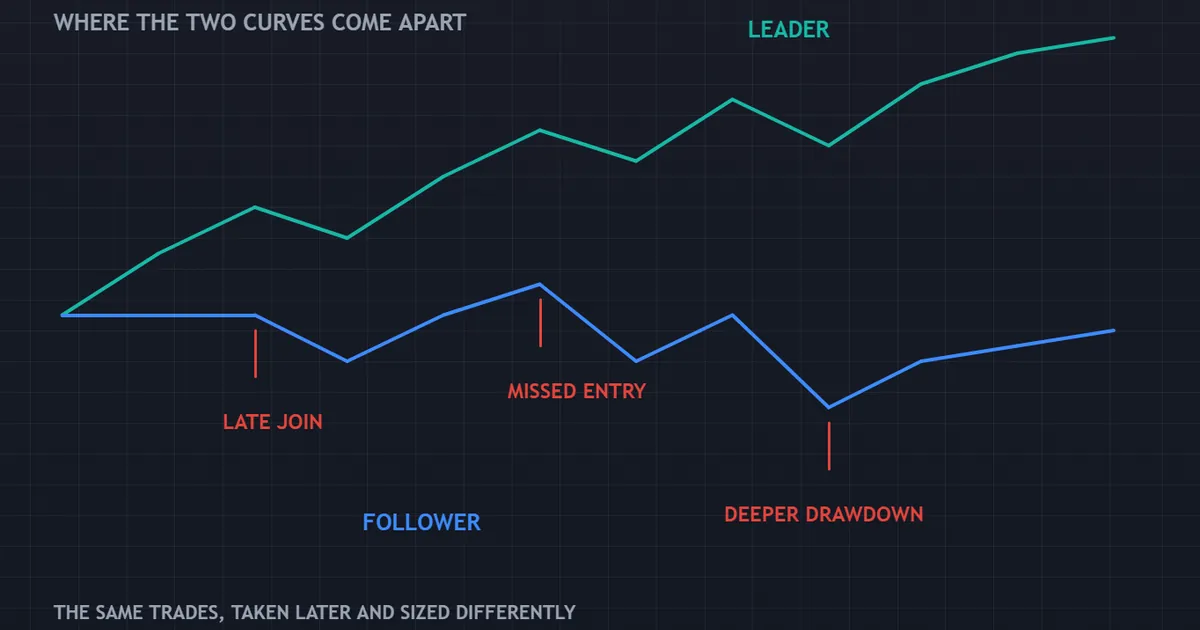
Two accounts following the same trades still end up different. The gap grows quietly, and it usually favours the leader.
The Late Join
You connect after a position already opened. Depending on the platform, you either miss that trade entirely or enter at a worse price.
Either way, your first month rarely matches the published curve. That mismatch is normal rather than a fault.
The Missed Entry
Sometimes the copy simply fails. Insufficient margin, a rejected volume or a symbol your broker does not offer will all block an order.
The leader still holds the trade. If it works out, your curve falls behind theirs through no decision of your own.
The Deeper Drawdown
Your losing stretch can run deeper than theirs. Rounding, spread and a slower fill each cost a fraction, and fractions add up across a bad run.
Check your own numbers monthly. Reading their published curve tells you about their account, and yours is the one that pays your bills.
Deciding When to Disconnect
Every connection needs an exit rule. Writing it early prevents a decision made in a bad week.
Three Triggers Worth Writing Down
The first trigger is a drawdown figure. Pick a depth on your own balance and disconnect if it arrives.
Behaviour supplies the second. Bigger positions, new instruments or trades without stops all count.
Silence supplies the third. A leader who stops publishing updates during a rough stretch has told you something.
Reconnecting Later
Disconnecting does not have to be permanent. Watch from the sidelines for a month, then decide with a clear head.
Keep the notes from the first run. They usually explain whether the problem sat with the leader or with your allocation.
Judging a Leader Like an Analyst
Most people judge a leader in ninety seconds. Twenty minutes of proper reading changes the odds considerably.
Read the Trade List, Not the Curve
Open the history and count. How many trades, over how long, and how big was the largest one relative to the rest?
A curve smooths everything. The trade list shows you the habits that produced it.
Look for Averaging Into Losses
Watch for several entries in the same direction as price moves against them. That pattern produces long calm stretches and one very bad day.
Our honest look at whether forex robots work covers the same trap in automated form. The behaviour matters more than the label on it.
Weigh the Trade Frequency
High frequency multiplies your costs and your fills. Every extra trade pays your spread again, and every extra fill adds another chance to slip.
Low frequency brings a different problem. Fewer trades mean a smaller sample, so the record proves less than it appears to.
Check the Instrument Mix
Exotic pairs carry wider spreads and thinner liquidity. A leader who trades them may do fine, while your copy of those trades costs more than theirs.
Ask which instruments your broker offers at a decent spread. Anything outside that list will drag on your results.
Ask What Happens in a Quiet Month
Every approach has a season it dislikes. A leader who cannot name theirs has probably not traded through one yet.
Look for a flat stretch in the record. Its absence tells you the record is short, not that the approach is special.
What Copying Teaches and What It Does Not
People often frame copying as a way to learn. It teaches some things well and other things not at all.
What You Do Pick Up
You see how often a working trader loses. That single observation corrects more beginner assumptions than any course.
Holding times, position counts and the weekly rhythm of a real account also come through clearly. Those patterns stay hard to imagine from a chart alone.
What Stays Invisible
You never see the setups they rejected. Nor do you see the reasoning, the doubt, or the moment they decided to cut a position early.
Skill lives in those decisions. Watching outcomes without reasons builds familiarity rather than judgement.
How to Learn Anyway
Keep a note beside every copied trade. Write what you would have done, then compare it later.
That habit turns a passive arrangement into an active one. It also tells you when you are ready to stop copying.
Related Guides Worth Reading Next
Copying sits inside a wider topic. One neighbour finishes the picture.
Compare it against building your own process from the ground up. Our library of forex trading strategies gives you material to test yourself, which builds the judgement no leaderboard can supply.
Then decide honestly which route suits you. Copying buys time and costs control, and that trade suits some people and not others.
FAQ
Is copy trading suitable for beginners?
It removes the need to analyse charts, and it does not remove the need to manage risk. Beginners still choose the leader, set the allocation and decide when to stop, and those three decisions drive the outcome. Treat it as a different set of decisions rather than as an absence of decisions.
Do I keep control of my money?
Yes, in the usual arrangement. The funds sit in your own brokerage account, positions open in your name, and you can disconnect at any time. Read the terms carefully, because a service that asks you to transfer funds elsewhere works on a very different basis.
Why does my account perform differently from the leader?
Several small gaps stack up. A delay of a second or two moves your entry, your broker quotes a slightly different price, lot rounding shifts your size, and any late join changes which trades you took at all. Across hundreds of trades those fractions become visible.
Can I copy trade on a funded account?
Often not. Many funded programmes prohibit copying another person outright, and others permit it only between accounts you own. Check the written rules before connecting anything, since a breach normally ends the account instead of triggering a warning.
How many leaders should I follow?
Fewer than most platforms encourage. Three leaders trading the same pairs in the same direction give you one concentrated position rather than a spread of them. If you follow more than one, check the combined exposure yourself, because the platform rarely does it for you.
How do I judge whether a leader is any good?
Start with the length of the live record, then look at the worst losing stretch and the trade list behind it. Steady size and a stop on every position tell you more than any headline figure. Even then, a strong history describes what already happened rather than what comes next, so allocate an amount you can afford to lose. Results are not guaranteed; past performance is not indicative of future results.
External references
- For background on this concept, see Mirror Trading at Investopedia.
- For broader market context, see Commodity Trading Advisor on Wikipedia.

About the author
Written by Dominic Walsh, a Forex trader and MT4/MT5 indicator, Expert Advisor and script developer. Every tool on forexmt4systems.com is tested on live charts before release and ships with ready-to-use compiled MT4 (.ex4) and MT5 (.ex5) files. Learn more about the trader and developer behind this site.
How we build, test and correct every tool: Editorial & Testing Policy. Trading carries risk; see the disclaimer.