
Ask ten traders do forex robots work and you will collect ten confident answers, most of them wrong in opposite directions. One camp treats automation as a shortcut, and the other treats it as a scam.
Neither camp looks at the evidence. This guide does, and the honest picture sits somewhere less exciting than either side wants.
Do Forex Robots Work? Start With a Better Question
The question as written has no answer. A robot describes a delivery method, not a strategy, so asking whether robots work resembles asking whether spreadsheets work.
Ask instead whether a specific rule has an edge. Then ask whether automating that rule helps or hurts.
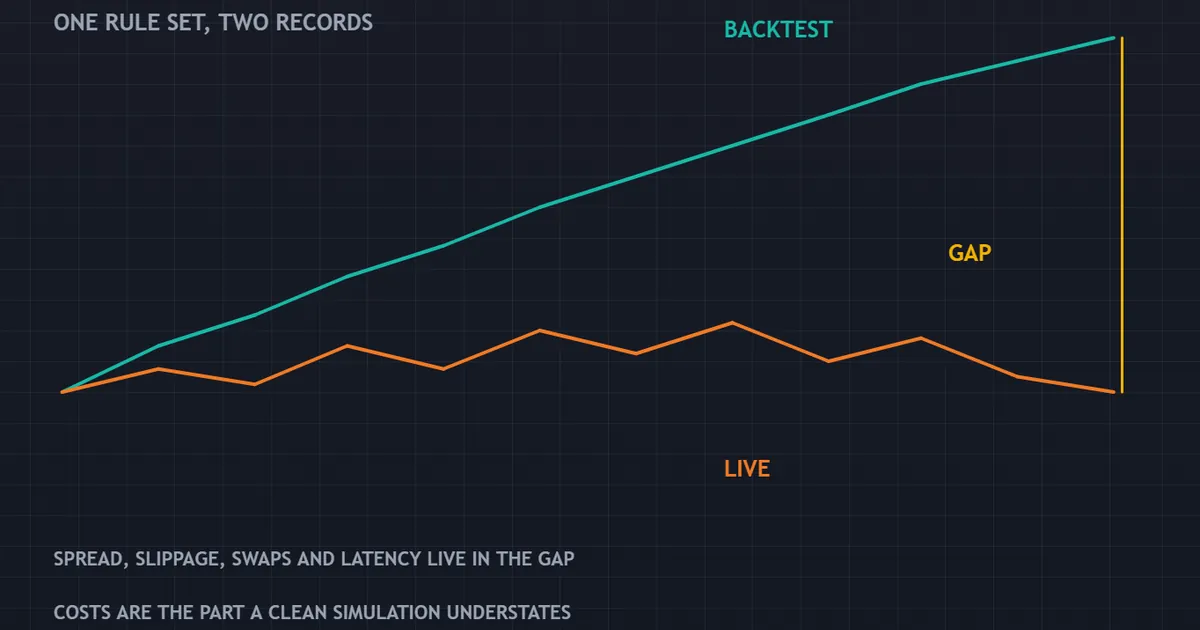
The panel above shows the pattern behind most disappointment. A simulated curve runs smooth, the live curve runs rougher, and the two separate as costs and execution do their work.
Treat a Backtest as a Hypothesis
This sentence deserves repeating until it sticks. A backtest is a hypothesis, not a result.
It tells you how a rule would have behaved on one stretch of history, under assumptions you chose. That statement has value, and it carries none of the authority people grant it.
A result comes from money moving under conditions nobody arranged in advance. Everything before that point counts as preparation.
What Working Would Even Mean
Define the claim before you test it. Working might mean a positive expectancy after costs, or it might mean a drawdown you can sit through.
Those two definitions pull in different directions. A rule with a strong average outcome can still deliver a losing stretch that ends your patience.
So write the definition down first. Vague claims survive any evidence, which is exactly why vague claims sell so well.
Nobody Can Assume Profitability
No robot deserves an assumption of profit, including one that tested beautifully. The market that produced the test data has no obligation to repeat itself.
That applies to programs we publish and to every program anyone else publishes. Our own guide to expert advisors makes the same point about what automation actually does.
The Two Questions That Do Most of the Work
Ask two things of any robot. First, what does the rule actually do? Second, on what data has anyone shown that it works?
Most claims fall apart at the first question. If nobody can state the rule in a sentence, nothing exists to test.
The second question resists dodging. A clear rule plus a clear data set gives you something you can check yourself.
How an Automated Rule Gets Tested Properly
Six steps separate a serious test from a marketing screenshot. Each one removes a way of fooling yourself.
- Fix the rule in writing. Entry, exit, stop, size and filters, all decided before a single test runs.
- Run it once in sample. One run on the first stretch of data, with no tuning afterwards.
- Test on unseen data. Apply the identical settings to a period the rule never met.
- Add realistic costs. Spread, commission and slippage all belong in the model, not in a footnote.
- Forward test on demo. Live prices expose session errors and symbol errors that history hides.
- Compare small live against demo. Two logs that disagree tell you more than any equity curve.
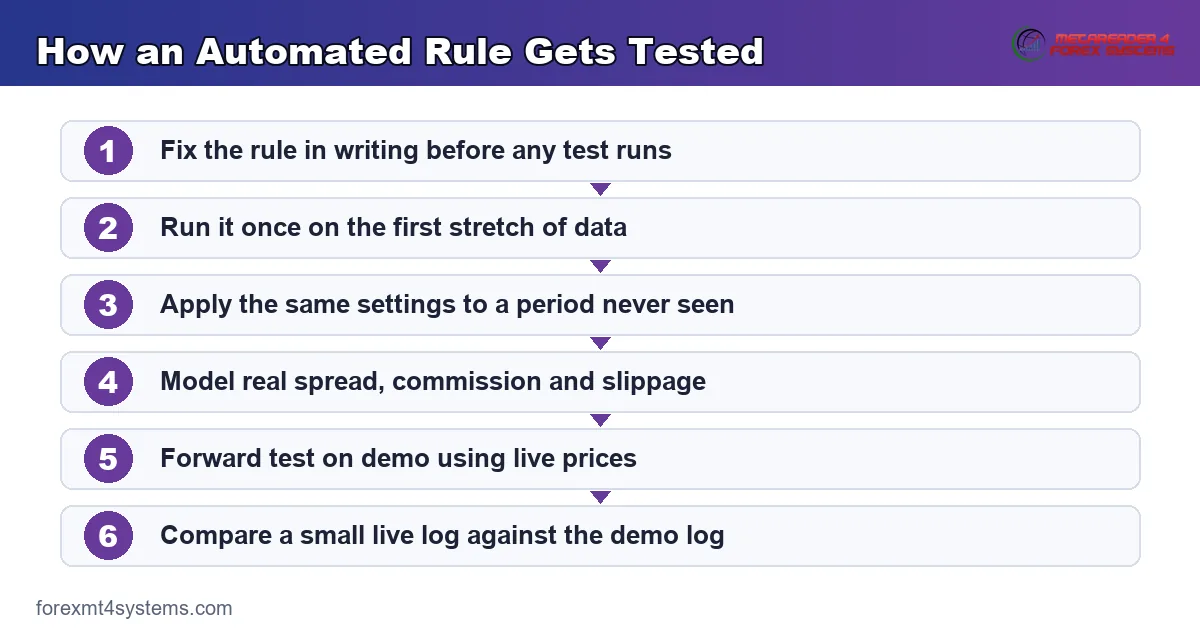
Step two carries the weight. Almost everybody skips it, because tuning until the curve looks good feels like research.
Why Backtests Flatter Themselves
Simulated results run better than live results for reasons that have nothing to do with dishonesty. Four causes explain most of the gap.
Curve Fitting
Try enough settings and one combination will look excellent on past data. That combination usually describes the noise in that data rather than anything durable.
The tell sits in the neighbours. If a moving average of fifty performs well while forty eight and fifty two perform badly, the rule found an accident.
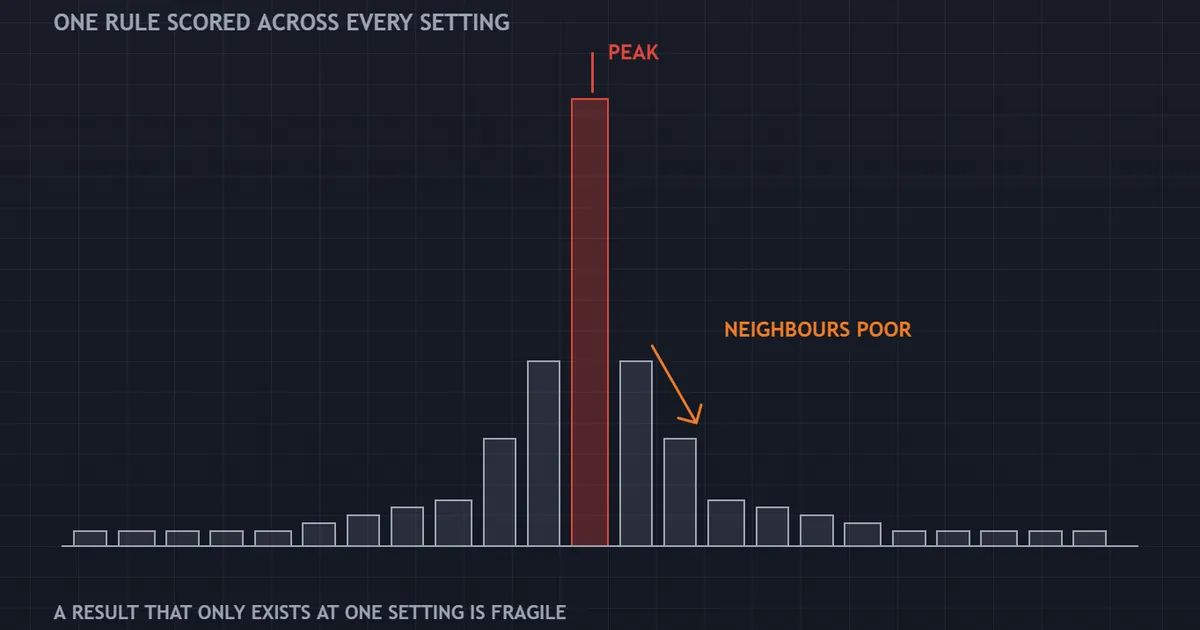
The panel above shows exactly that shape. One tall peak, poor results either side, and a claim that will not survive contact with new data.
A Small Worked Example
Take a simple rule. Buy when a fast moving average crosses a slow one, then exit after a fixed number of bars.
Test every fast length from five to fifty. Then test every slow length from twenty to two hundred. That produces thousands of pairs.
One pair will top the list. It always does, even on data with no pattern in it at all.
Now check the pairs next door. A robust rule leaves a broad patch of decent results around the top, while a fitted rule leaves a lonely spike.
Then run that top pair on the next two years. Most spikes fade the moment they meet fresh data.
Look Ahead Bias
Some tests use information the trader could not have held at that moment. A rule that reads the closing price of a bar and then enters at the open of that same bar looks brilliant and cannot happen.
Indicators that repaint cause the same problem. They redraw earlier signals once later bars arrive, so the history looks cleaner than the live experience ever will.
Spread and Slippage Assumptions
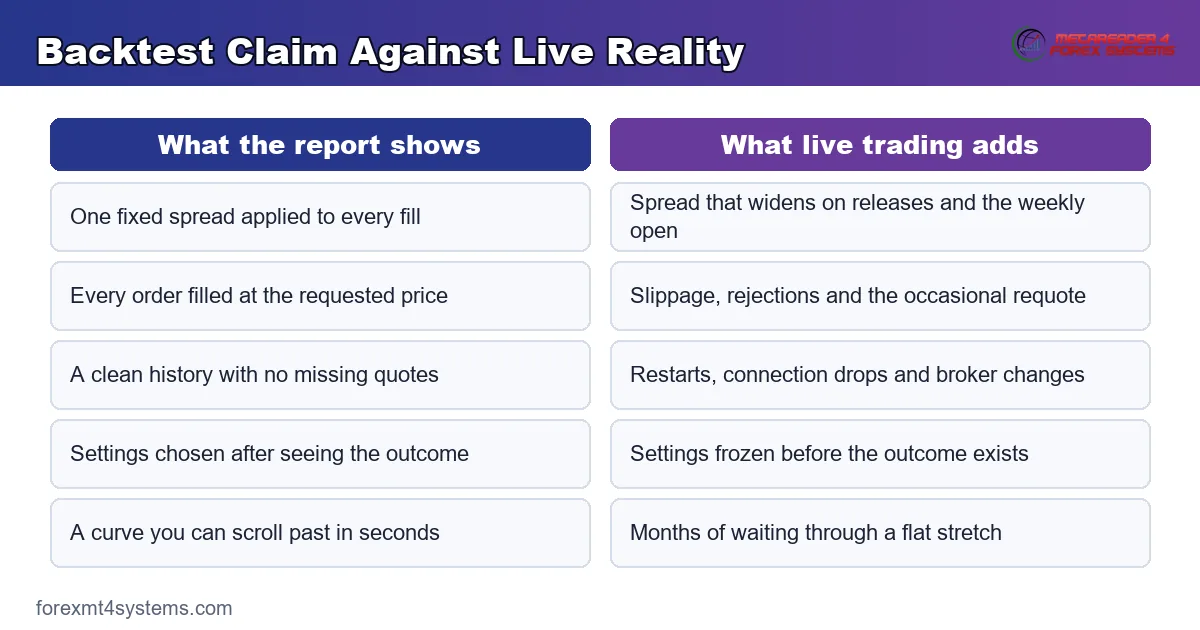
Many tests apply one fixed spread to every fill. Real spread widens around releases, at the weekly open and through thin hours.
Our note on why spreads widen covers the mechanics. The short version matters here: the cheapest hours in a test rarely match the hours a rule actually trades.
Slippage compounds it. Fast markets fill you away from the requested price, and fast markets tend to arrive exactly when a breakout rule fires.
Data Quality and Modelling
History arrives full of holes. Missing quotes, broker specific pricing and long weekend gaps all shape a simulated fill.
The tester also has to guess what happened inside each bar. That guess decides whether your stop or your target came first, and on many bars both prices printed.
One Bar, Two Prices
Here sits a small thing with a large effect. On many bars, price touches both your stop and your target.
The tester has to pick one of them. Most pick the worse case, and some pick the kinder one.
That single choice can flip a curve from good to poor. Check which setting the report used before you read a single number.
What Vendor Track Records Leave Out
Published records rarely lie outright. They simply omit the context that would let you judge them.
Survivorship
You see the programs that survived. The ones that blew up left the shelf quietly, and nobody publishes a page about them.
Run a hundred variations, publish the three that prospered, and the shelf looks remarkable. Nothing in that process requires deceit.
Selective Start Dates
Shift a start date by three months and many curves change character. A record that begins after a bad stretch tells you about the calendar rather than the rule.
Ask for the full history from the first live order. Anything shorter deserves scepticism.
The Missing Denominator
A screenshot of a strong month says nothing without the account size, the risk per trade and the number of months that came before. Those three numbers convert an impressive figure into an ordinary one surprisingly often.
Our guide to drawdown in trading explains why the depth of the worst stretch matters more than any headline total.
Download the complete indicator database
Put these concepts on your charts. One email unlocks the full library of 1,380+ indicators with compiled MT4 and MT5 files, plus my TradingView scripts. No paywall, no spam, unsubscribe any time.
Get free access to my indicator database
One email unlocks 1,380+ free MT4, MT5 and TradingView indicators — the complete library. No single-tool download; you get the whole database.
What Automation Genuinely Adds
The sceptical case runs long, so balance deserves a section of its own. Automation delivers three real benefits, and none of them involves prediction.
It Removes Hesitation
Manual traders skip valid signals. They skip them after a losing run, late in the session, or when the setup looks ugly on the screen.
A program takes every signal that qualifies. For traders whose problem lives in execution rather than analysis, that alone changes the record.
It Enforces the Rules You Wrote
Stops move to the right price at the right moment. Targets fire without a second thought, and position size follows a formula rather than a mood.
Our overview of trading psychology covers why that consistency matters. Most manual damage comes from deviation, not from a flawed plan.
It Produces a Clean Record
Every action lands in a log with a timestamp. Your review then works from data rather than recollection, which improves the quality of every decision that follows.
Manual journals suffer from selective memory. A program cannot forget the trade it would rather not discuss.
What Automation Costs Beyond the Spread
Costs arrive in three forms. Only one of them shows up in a test report.
Money
Spread and commission land on every trade. A robot trades more than you do, so it pays more of both.
Swap adds up as well. A rule that holds trades overnight pays or earns a rate that shifts with the market and with your broker.
Time
Setup takes an evening. Testing takes weeks, and watching a live account takes months of patience.
Most people quit during the flat stretch. Nothing goes wrong there, and nothing goes right either.
Attention
A running program still needs a keeper. Someone has to read the log, watch for broker changes and notice a stalled terminal.
Set aside a fixed slot each week. Fifteen minutes on a Sunday beats an hour of panic on a Thursday.
Common Mistakes When Judging a Robot
Six errors turn a reasonable evaluation into wishful thinking. Each one has a straightforward correction.
Reading the Equity Curve First
Open the report at the trade list instead. Trade count, holding time and the worst losing run describe behaviour, while the curve only summarises it.
Optimising Until It Looks Right
Every extra parameter you tune costs credibility. Fix the settings, then test once, and accept whatever the unseen period says.
Trusting a Short Live Record
Three good months prove very little. Randomness produces streaks constantly, and a short record cannot separate skill from luck.
Ignoring the Cost Model
Check what spread the test applied and whether commission appeared at all. A rule that only survives at zero cost was never viable.
Confusing Frequency With Edge
A program that trades forty times a day looks busy and pays forty spreads. Higher frequency raises the cost hurdle rather than lowering it.
Forgetting Where the Account Lives
Funded programmes restrict automation, and their limits often decide the outcome. Our study of why traders fail prop challenges shows how quickly a rule breach ends an account.
A Checklist Before You Trust Any Automated Rule
Work through this before you commit real size. It takes an afternoon and saves considerably more.
| Question | What good looks like | Warning sign |
|---|---|---|
| Was the rule fixed before testing? | Settings written down, then tested once | Dozens of optimisation passes behind the report |
| Did unseen data confirm it? | Similar behaviour on a period never tested | Only one long in-sample run exists |
| What costs were modelled? | Realistic spread, commission and slippage | Zero commission and a single fixed spread |
| How deep was the worst stretch? | A drawdown you could sit through calmly | The report never mentions the losing run |
| How long is the live record? | Many months, from the first live order | A screenshot of one strong quarter |
| Does a daily loss cap exist? | A hard limit the program obeys itself | Reliance on you to intervene manually |
Model the worst stretch against your own balance with our drawdown calculator. Seeing the number in your own currency changes how it feels.
The Honest Verdict
Here sits the answer, without decoration. Automation is a delivery mechanism, and the edge either exists in the rule or it does not exist at all.
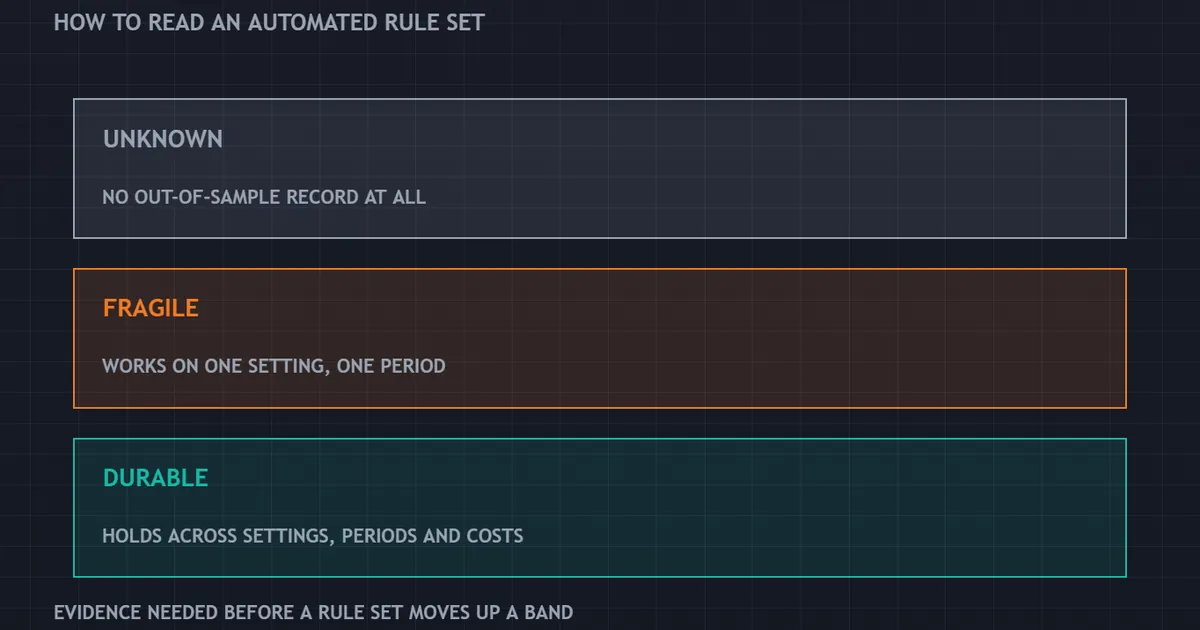
The verdict panel above sorts automated rules into three honest bands. Most sit in the first, because nobody has produced enough evidence to move them.
What Nobody Can Tell You
Nobody can tell you a program will make money. That claim requires knowledge of future conditions, and no test provides it.
Nobody can rank programs reliably either. Ranking assumes comparable records, comparable costs and comparable periods, and those rarely exist together.
We publish tools rather than promises for that reason. Browse the indicator library as raw material for your own process, never as a finished answer.
What You Can Establish
You can establish that a rule behaves as described. You can establish its trade count, its holding time and its worst historical stretch.
You can also establish how it performs on data it never met. That single test filters out most of what circulates online.
Finally, you can establish whether you will sit still through a flat month. That answer usually matters more than the statistics.
Where Automated Rules Fail in Live Trading
Failure rarely arrives as a crash. It creeps in through three ordinary doors.
The Market Changes Character
A rule built for calm ranges keeps firing when volatility doubles. The code notices nothing, because nothing in it measures the regime.
Trends replace ranges without an announcement. A mean reversion rule then collects a series of correct decisions and poor outcomes.
Costs Grind Away the Margin
Thin edges die from friction. A rule that clears its costs by a hair in testing tends to fall short once real spread and real slippage arrive.
Frequency makes it worse. Doubling trade count doubles the friction while leaving the underlying signal untouched.
The Trader Interferes
Most automated records end by hand. Someone disables the program during a drawdown, changes an input mid week, or closes a position early.
The result stops describing either process. Decide your stopping rule in advance, then let the log settle the argument.
The Broker Changes Something
Symbol names change. Minimum volumes change. Margin rules change, often with very little notice.
Each one can stop a program dead. The terminal keeps running, the chart keeps updating, and no order goes out.
Read the journal tab weekly. Errors surface there long before they surface in your balance.
Related Reading Worth Your Time
Two neighbouring topics complete the picture. Both change how you read any automated claim.
Start with following another trader instead of a program. Our guide to copy trading covers how allocation works and which risks travel across with it.
Then revisit your own testing habits. A month spent building an honest process beats a year spent hunting for a better file.
Reading a Sales Page Without Getting Fooled
Marketing follows patterns. Once you spot them, the rest of the page reads quickly.
Look for What Is Missing
Count what the page does not show. No trade list, no worst losing run, no start date and no cost model.
Absence carries meaning. Strong records get published in full, because nothing about them needs hiding.
Watch the Window of the Claim
A quarter proves little. A year proves more. Several years across changing conditions proves the most.
Short windows also hide the losing run. Ask when the worst stretch happened, and how deep it went.
Treat Screenshots as Anecdotes
An image of a good week tells you nothing about the weeks around it. Nor does it reveal the account size or the risk taken.
Ask for the whole record instead. If the answer arrives slowly, you already have your answer.
Does an Automated Rule Suit Your Account?
A rule can behave well and still suit you badly. Three checks settle that quickly.
Balance Against Trade Size
Some rules need room. If the smallest lot your broker allows already risks more than your limit, the rule does not fit your account yet.
Grow the balance or find a rule with tighter stops. Forcing the size is how small accounts end.
Drawdown Against Temperament
Look at the worst historical stretch, then double it. Ask whether you would keep the program running through that.
Most people say yes and then act otherwise. Test the honest answer on a demo account first.
Hours Against Your Life
A rule that trades the Asian session needs a server, not a laptop. A rule that trades one hour a day may need nothing extra at all.
Match the rule to your setup. Fighting your own schedule rarely lasts long.
Robots, Signals and Copy Services Differ
People lump these three together. They carry different risks, so keep them apart.
A Robot Runs Your Rules
The logic sits on your own machine. You can read the settings, change them and switch the thing off in one click.
A Signal Service Sends Instructions
Someone else decides, and you or a bridge places the order. Delay between the call and your fill becomes a real cost.
A Copy Service Mirrors an Account
Your account follows another account in proportion. You inherit their sizing habits and their drawdown along with their entries.
Each model moves the judgement to a different place. None of them removes it.
FAQ
Do forex robots actually make money?
Some accounts running automated rules do well, and many do not. Nobody can establish in advance which group a given program joins, because the evidence available before the fact cannot settle it. Treat any confident claim about future profit as marketing rather than analysis.
Why does live trading differ so much from the backtest?
Four causes stack up. Real spread widens when the test assumed a fixed figure, slippage moves fills away from the requested price, data quality shapes which of your stop or target the simulation chose, and settings tuned on history rarely suit fresh data. Each one is small, and together they explain most of the gap.
How long should I forward test before trusting a program?
Long enough to meet a losing run. That usually means several months rather than several weeks, since a short record cannot separate a genuine edge from an ordinary streak. Run demo first for the mechanical errors, then minimum live size for the execution reality.
Is curve fitting always obvious?
Rarely. The clearest test looks at neighbouring settings: if a rule performs well at one exact value and poorly on either side, the result probably describes noise. Robustness looks like a broad plateau of acceptable outcomes, not a single tall spike.
Does a longer backtest make the evidence stronger?
It helps, though only up to a point. Very old data describes a market with wider spreads, slower execution and different participants, so a rule can look excellent across twenty years and unsuited to the last two. Weight recent, unseen data more heavily than depth of history.
Should a beginner start with automation or with manual trading?
Manual first, in almost every case. Automating a process you have never executed by hand simply produces mistakes at speed, and you will lack the context to judge what the log tells you. Trade the rules yourself for a few dozen occurrences, then hand over the repetitive part once you understand what it should look like. Results are not guaranteed; past performance is not indicative of future results.
External references
- For background on this concept, see Overfitting at Investopedia.
- For broader market context, see Curve Fitting on Wikipedia.

About the author
Written by Dominic Walsh, a Forex trader and MT4/MT5 indicator, Expert Advisor and script developer. Every tool on forexmt4systems.com is tested on live charts before release and ships with ready-to-use compiled MT4 (.ex4) and MT5 (.ex5) files. Learn more about the trader and developer behind this site.
How we build, test and correct every tool: Editorial & Testing Policy. Trading carries risk; see the disclaimer.