
Understanding why traders fail prop firm challenges is cheaper than paying for another attempt. Most attempts end on a broken rule rather than a broken strategy.
This guide covers why traders fail prop firm challenges one habit at a time, and it stays firm-neutral throughout. Each section names the failure, then gives the fix you can apply on your next session.
What Actually Ends an Attempt
An evaluation sets two forces against each other. A profit target pulls you toward risk, while a loss limit pushes you toward caution.
So the account dies when the risk side wins. Almost nobody fails by running out of time with a flat balance.
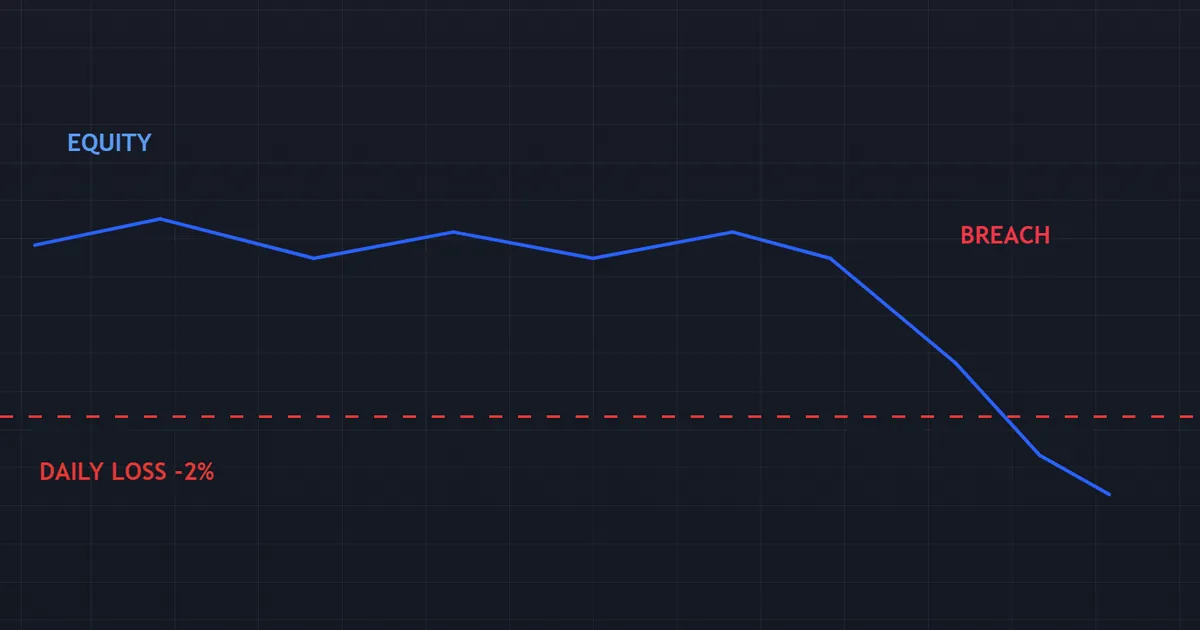
The chart above shows the classic ending. Equity drifts, one heavy session arrives, and the daily loss line breaks.
Notice how ordinary the losing day looks. It needs no crash and no shock headline. A normal bad session plus an oversized position does the whole job.
Rules Fail People, Not Targets
Traders picture failure as a missed target. In practice a drawdown rule ends the attempt long before the clock does.
So your first job is survival, not speed. Because the target waits patiently while the limits do not, protecting the floor beats chasing the goal. That single reorder fixes more attempts than any new setup.
The Cost of a Reset
A breach costs more than the fee. You lose the progress, the momentum, and often several weeks of work.
Then the next attempt starts from zero with a shaken trader at the keyboard. So each reset raises the pressure on the following run. Because that pressure feeds the very habits that caused the breach, the cycle repeats easily.
One Breach, No Appeal
A limit breach carries no discussion. The system flags it, and the account stops trading.
So there is no partial credit for a good month before the slip. Because the rule runs automatically, an apology and a strong record change nothing. That harshness sounds unfair until you remember whose money sits behind the account.
Simulated Money, Real Habits
An evaluation runs on simulated capital, which fools people into casual risk. The rules, though, behave exactly as they will on a funded account.
So treat the demo balance as if it were yours. Because habits transfer and balances do not, a sloppy evaluation teaches you the wrong reflexes even when it passes.
Why Traders Fail Prop Firm Challenges, Reason by Reason
Six habits account for most failed attempts. They overlap, and they usually arrive in the same order.
So read the list once, then check yourself against it after every session. Naming the habit early is most of the cure.
The Six Habits in Order
Here they are, ranked by how often they end an account.
- Oversizing for the target. Risk set to reach the goal quickly rather than to survive a losing run.
- Ignoring the trailing floor. Treating a moving drawdown line as if it stayed put.
- Revenge trading. Chasing a red morning with bigger, faster trades.
- Breaching the daily limit. Losing track of the day’s running total against the cap.
- Chasing minimum days. Trading on after the target arrives, purely to fill a clause.
- No plan for news. Holding through a release with a normal stop and normal size.
Every item on that list is a decision, not an accident. Because you control all six, your odds improve the moment you write them down.
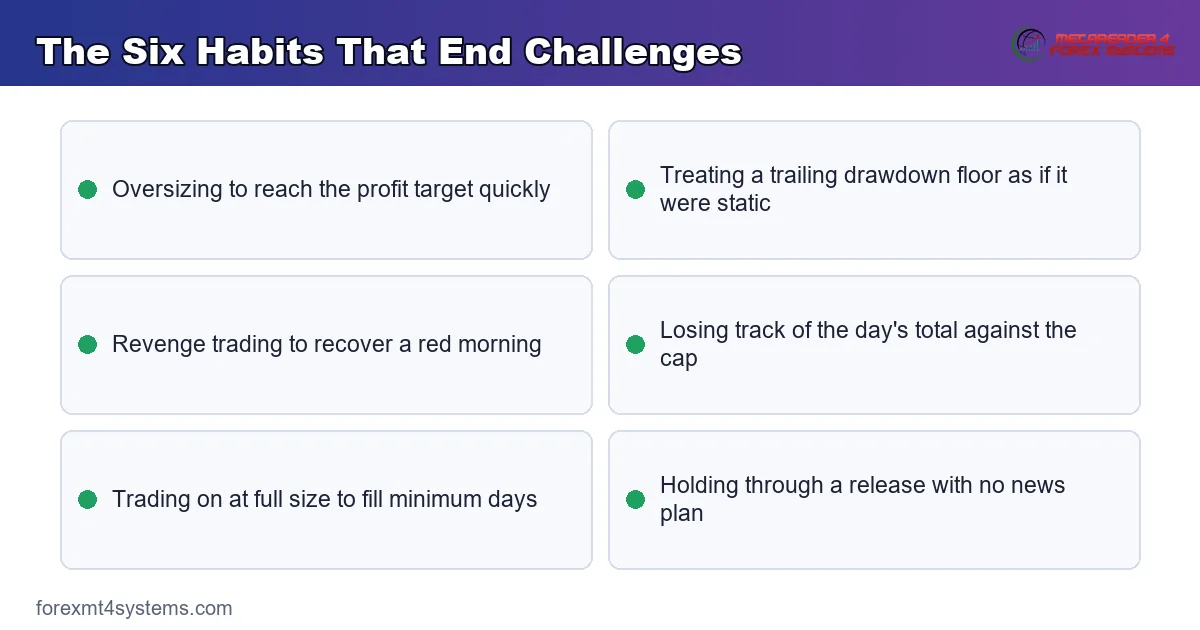
The keypoints graphic above puts the same six habits in one panel. Pin it beside the screen, and review it before the first trade of the day.
How the Habits Feed Each Other
The six rarely arrive alone. Oversizing produces a red morning, the red morning invites revenge trades, and those trades breach the daily cap.
So one fix upstream removes several failures downstream. Because sizing sits at the head of the chain, correcting it quietly disarms the rest. Start there, and the other habits lose most of their teeth.
Oversizing for the Profit Target
Oversizing ends more attempts than everything else combined. It hides inside a reasonable-sounding plan.
A trader reads the target, works out how many wins it needs, then picks a size that gets there quickly. The loss limit never enters that sum.
How the Rush Starts
Look at the arithmetic that tempts people. An eight percent target feels distant at half a percent risk per trade.
So the trader raises risk to two percent, and the target suddenly looks like four good trades. Because losing trades come in clusters, that same size turns three ordinary losses into a breach. The maths that shortened the path also shortened the runway.
Size From the Limit, Not the Target
Flip the calculation around. Start with the daily cap, divide by the number of losses you want to survive, and let that quotient set your risk.
So a two percent daily cap and a four-loss cushion gives half a percent per trade. Because that figure ignores the target entirely, it keeps you alive long enough to reach it. Our free prop firm position size calculator turns those percentages into lot sizes for you.
Check the Target-to-Limit Ratio First
Before you buy, divide the profit target by the overall loss limit. That single ratio tells you how much room the program really gives.
A target twice the size of your allowed loss demands a strong sequence of winners. So a closer ratio suits most traders far better. Because the ratio sets the difficulty, it deserves more weight than the advertised account size.
Ignoring the Trailing Floor
Many programs move the drawdown floor upward as your equity grows. Traders who learned on a static floor miss this entirely.
So a comfortable-looking balance can sit inches above the line. The cushion shrank while the account was winning.
Why the Floor Climbs
A trailing floor locks in part of every gain. Reach a new equity high, and the floor follows you up.
So a giveback measures against the new high rather than the starting balance. Because most traders still picture the opening figure, the breach arrives as a surprise. Some programs trail on every tick, while others move the line only at the daily close.
Track the Floor Every Morning
Write down two numbers before the session starts. Note your equity, then note the current floor.
The gap between them is your real room for the day. So size against that gap rather than against the balance. Because the gap changes after every good run, a quick morning check keeps your sizing honest.
Static and Trailing Behave Differently
A static floor sits at a fixed distance below your starting balance. It never moves, so a giveback is safe until it reaches that line.
A trailing floor rises with every new equity high. So the same giveback can breach it while you still show a profit for the month. Because two programs can use the same headline percentage with different mechanics, the wording decides your real cushion.
A Worked Case of the Same Losing Streak
One comparison explains most failed attempts, so walk it slowly. Take a fifty thousand dollar evaluation with a two percent daily cap.
Say the market hands you three losing trades in one session. That happens to everybody, and it says nothing about your method.
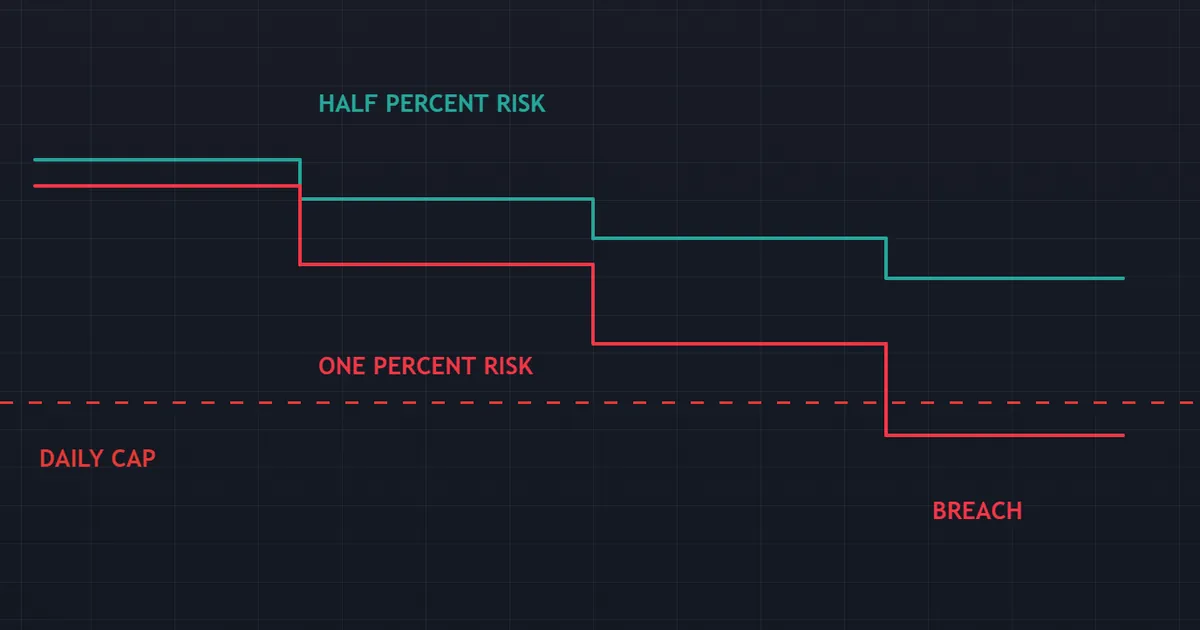
At half a percent risk, those three losses cost one and a half percent. You finish the day inside the cap, bruised but alive, and you trade again tomorrow.
At one percent risk, the same three losses cost three percent. The cap breaks on the second or third trade, and the attempt ends. So one sizing decision, made before the session, decided the whole outcome.
The Same Streak Against the Overall Limit
Now stretch the streak across a week. Six losses at one percent reach six percent, which pierces a five percent overall limit.
At half a percent, those same six losses cost three percent. So you keep two percent of room and a working account. Our risk reward calculator helps you check whether your targets justify the risk you take per trade.
What the Case Leaves Out
The example assumes clean fills and a calm trader. Real sessions add slippage, wider spreads and a racing pulse.
So the honest version needs more cushion, not less. Because those extras all push the same way, a size that looks safe on paper often runs tighter in practice. Leave a margin, and the surprises stop mattering.
Revenge Trading After a Red Day
A red morning creates an urge to fix it immediately. That urge, not the loss, ends the account.
The pattern runs the same way every time. One loss, a quick re-entry, a second loss, then a larger trade to catch up.
Why a Red Day Feels Urgent
A drawdown reads like a deadline, even though nothing forces you to act. The target sits in view, and the loss looks like a delay.
So the urge to catch up arrives dressed as diligence. Because the market runs tomorrow as well, that urgency is entirely invented. Naming it as invented takes most of its power away.
How Tilt Builds
Losses feel worse than equal gains feel good. That imbalance pushes people toward action rather than patience.
So a trader who would never risk two percent at breakfast does it by lunchtime. Because the goal has quietly changed from trading well to getting even, the sizing rules stop applying. The daily cap then does the job your discipline should have done.
Spot Tilt Before It Costs You
Tilt shows itself in small tells. You check the chart more often, you shorten your review, and you start typing a larger lot size.
So learn your own signs and write them down. Because the feeling arrives before the trade does, catching it early costs nothing. Stand up, walk away for ten minutes, and the urge usually fades.
Set a Hard Stop After Two Losses
Give yourself a rule the market cannot argue with. Two losing trades, and the platform closes for the day.
So the rule fires long before the firm’s cap does. Because you choose it in advance, it costs nothing emotionally when it triggers. Write it on paper, and treat it as part of the strategy rather than a punishment.
Download the complete indicator database
Put these concepts on your charts. One email unlocks the full library of 1,380+ indicators with compiled MT4 and MT5 files, plus my TradingView scripts. No paywall, no spam, unsubscribe any time.
Get free access to my indicator database
One email unlocks 1,380+ free MT4, MT5 and TradingView indicators — the complete library. No single-tool download; you get the whole database.
Breaching the Daily Loss Limit
The daily limit catches traders who watch only the overall figure. It resets each day, which makes it easy to forget.
So a session can breach the day rule while the overall drawdown still looks fine. The account closes anyway.
Where the Limit Measures From
Programs measure the day from different starting points. Some use the balance at the daily reset, others use equity, and the reset hour varies by firm.
So an open trade carried overnight can count against the new day. Because the wording differs, read it once and write the reset time down. Our guide to a daily loss limit covers the mechanics in detail.
Cap Your Day Below Their Cap
Set a personal daily stop tighter than the firm’s. If the program allows two percent, stop yourself at one and a half.
So slippage and spread never push you across their line. Because your own cap fires first, the firm’s rule becomes a backstop you never touch. That buffer costs you very little and saves whole attempts.
Chasing Minimum Trading Days
Many programs demand a minimum number of trading days. Traders who reach the target early then face an awkward wait.
So they keep trading at normal size to fill the clause. The gain they already earned goes back to the market.
Why the Clause Bites
The rule exists to stop one lucky session passing you. It works, and it also creates a trap at the finish line.
So the last few days carry more risk than the first. Because the account has already done its job, any loss now is pure downside. Traders who fail here often blame bad luck rather than the plan.
Fill the Days With Tiny Trades
Drop your size to a fraction of normal once the target lands. A minimal position still counts as a trading day at most programs.
So you satisfy the clause without risking the result. Because the rule counts days rather than volume, tiny trades cost almost nothing. Check the exact wording, since a few programs also set a minimum size or duration.
Trading Through News Without a Plan
High-impact releases move price faster than a stop can fill. A correct idea can still cost you the account.
So the danger sits in the mechanics rather than the direction. Slippage and gaps ignore the level you chose.
Why Releases Break Stops
Spreads widen sharply in the seconds around a release. Liquidity thins, so an order can fill far from the price you set.
So a small planned loss becomes a large real one. Because that single fill can clear a daily cap, one release can end an attempt outright. Some programs also restrict trading in a window around major numbers.
Write a News Routine
Check the economic calendar before every session, and mark the high-impact times. Then decide in advance what you will do.
Most traders do best by flattening beforehand or by cutting size hard. So the decision happens while you are calm rather than during the spike. Read your program’s news clause too, since breaking it can void a payout later.
Every Failure Mode Beside Its Fix
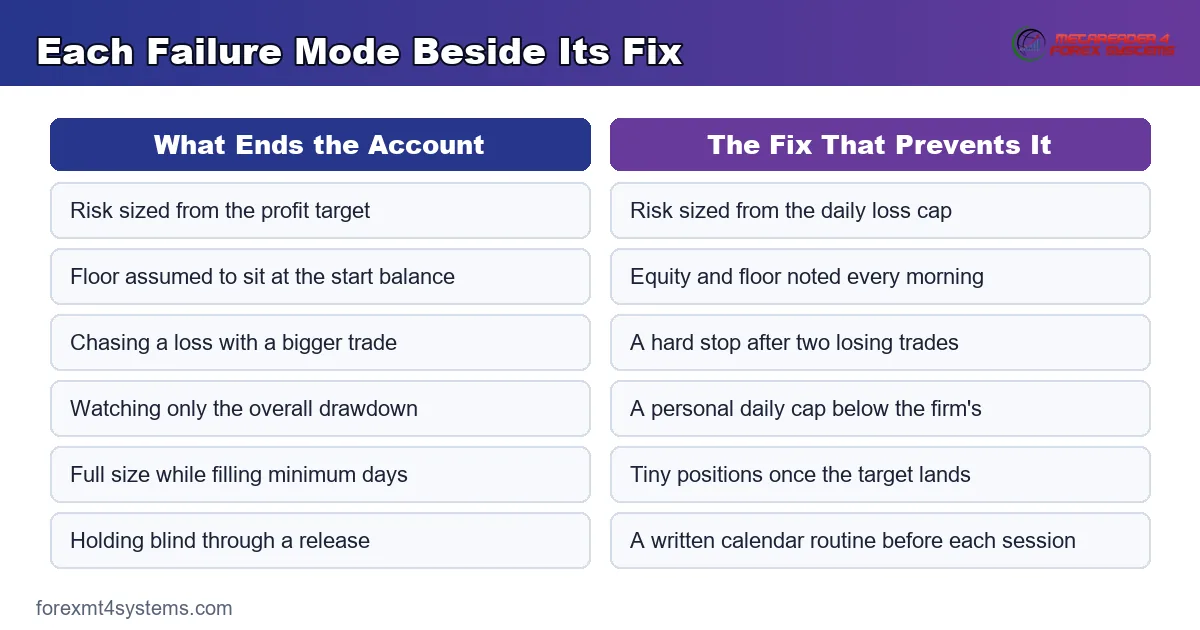
The habits above cover most attempts, and a few smaller ones finish the job. The comparison graphic below sets each failure beside the fix that prevents it.
Breaking an Automation Clause
Programs commonly restrict tick scalping, latency arbitrage and copy trading across accounts. Traders using tools often breach a clause without meaning to. So read the automation rules before you attach anything to a chart.
Holding Over a Weekend
Some programs forbid weekend or overnight exposure. A Friday position then ends the attempt on a technicality. So check the holding rules, and set a Friday alarm well before the close.
Adding to a Losing Position
Averaging down feels like patience and behaves like leverage. The combined loss then arrives all at once. So plan any scaling before entry, or keep one position per idea.
Trading Without a Journal
Traders who record nothing repeat the same breach. A short log exposes the pattern within a fortnight. So note every trade, its risk, and how close it came to a rule.
Failure-Proofing Quick Reference
Run through this list before each session. It takes a minute and prevents most resets.
- Note today’s equity and the current drawdown floor.
- Size each trade from the daily cap, never from the profit target.
- Set a personal daily stop tighter than the program’s limit.
- Stop for the day after two losing trades.
- Check the calendar and mark high-impact release times.
- Drop to tiny size once the profit target is reached.
- Log every trade and review the log weekly.
Pitfalls and Edge Cases
A few wrinkles bend the clean picture, so keep them in view. The chart below shows an account piercing a trailing floor that rose during the winning run.
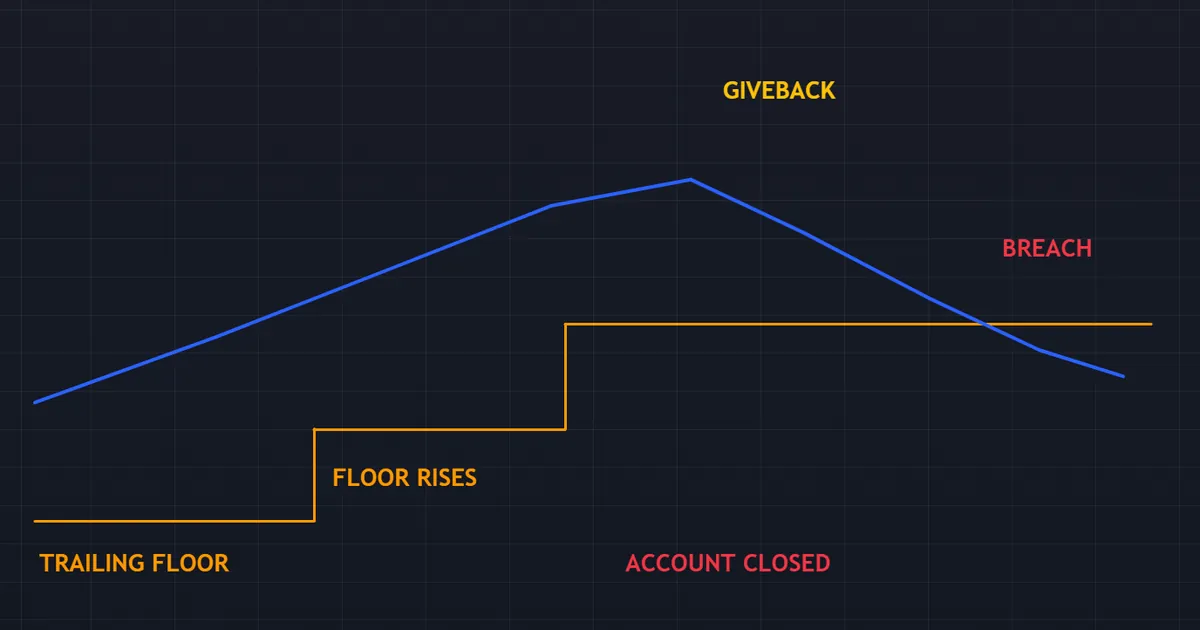
Picture the path from the trader’s side. Equity climbs, the floor climbs behind it, and then a modest giveback cuts straight through the risen line. The balance still looked healthy at the moment of the breach.
Correlated Trades Multiply Risk
Three positions in related pairs behave like one large position. Your recorded risk says one and a half percent, while the real exposure sits far higher. So group correlated trades and size them as a single idea.
Costs Eat the Cushion
Spreads, commissions and swaps all count against your drawdown. A high-volume week can drain room without a single bad call. So favour fewer, cleaner setups while a limit sits close.
Wording Changes Between Programs
Two programs can use identical percentages with different mechanics. So a habit that survived one attempt breaches the next. Read each rule book fresh, and never trade a new program from memory.
Platform and Connection Failures
A dropped connection during a live position removes your control. So place hard stops with the broker rather than relying on a chart alert. Because outages arrive unannounced, that habit protects the account when nothing else can.
Related Concepts to Study Next
Every failure above traces back to risk control, so a few neighbouring topics repay an hour of reading. Fix the sizing, and most of the other habits lose their power.
Start with our practical guide to passing a prop firm challenge, then read up on prop firm drawdown rules so the floor holds no surprises. For the honest odds, see what percentage of traders pass, and for the model itself, see what a funded trading account is or browse the wider prop trading library. Because sizing decides everything, finish with our note on risk per trade.
FAQ
Why do traders fail prop firm challenges most often?
Oversizing for the profit target causes the most failures. A position sized to reach the goal quickly turns an ordinary losing streak into a breach of the daily or overall limit. Sizing from the limit instead of the target fixes it.
Is it the profit target or the drawdown rule that ends attempts?
Almost always the drawdown rule. Missing a target simply means the attempt runs on, while breaching a limit closes the account immediately. So survival deserves priority over speed at every stage.
How do I stop revenge trading?
Write a hard stop before the session and hold to it. Two losing trades, and the platform closes for the day. Because you set the rule while calm, it costs nothing emotionally when it fires later.
What should I do about minimum trading days?
Once the target lands, drop your size to a fraction of normal. A minimal position still counts as a trading day at most programs, so the clause gets satisfied without risking the gain. Check the wording for any minimum size or duration.
Should I trade during high-impact news?
Many traders do better by flattening beforehand or cutting size hard. Spreads widen and fills drift, so a small planned loss can become a large real one. Some programs also restrict trading around major releases, so read that clause first.
Can I avoid failing altogether if I follow every fix?
No, because the market still decides the outcome of each trade. The fixes above remove the self-inflicted failures, which are the majority, and they leave you trading a normal edge under normal risk. That gives you a fair chance rather than a certainty. Results are not guaranteed; past performance is not indicative of future results.
External references
- For background on this concept, see Overconfidence Effect on Wikipedia.
- For broader market context, see Gambler’s Fallacy at Investopedia.

About the author
Written by Dominic Walsh, a Forex trader and MT4/MT5 indicator, Expert Advisor and script developer. Every tool on forexmt4systems.com is tested on live charts before release and ships with ready-to-use compiled MT4 (.ex4) and MT5 (.ex5) files. Learn more about the trader and developer behind this site.
How we build, test and correct every tool: Editorial & Testing Policy. Trading carries risk; see the disclaimer.