
Prop firm drawdown rules decide whether a funded account lasts a month or a morning. They place a hard floor under your account, and touching that floor closes it on the spot.
This guide walks through prop firm drawdown rules in plain terms, and it stays firm-neutral throughout. You will learn how a maximum drawdown differs from a daily loss limit, why some floors climb upward, and how to size trades so neither limit ever comes close.
What Prop Firm Drawdown Rules Actually Measure
A drawdown rule tracks the distance from a reference point down to your current account value. Each rule picks a different reference point, and that one detail changes how much room you really have.
Two limits sit at the heart of almost every program. One caps the total loss across the life of the account, while the other caps the loss inside a single trading day.
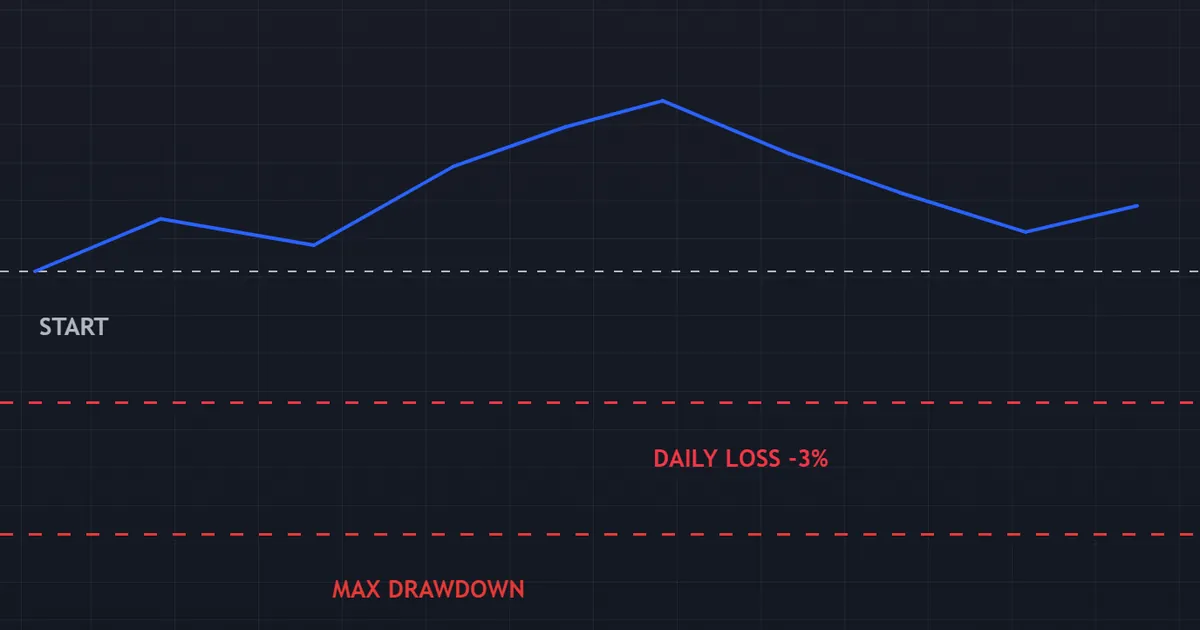
Most firms watch equity rather than closed balance. Equity folds in the running profit or loss on your open trades. So a deep dip on an open position can trip a limit long before you click close.
Neither limit asks why the loss happened. A slipped stop, a weekend gap and a mistaken click all count the same. Because the platform enforces the floor automatically, the number decides the outcome and nothing else does.
Balance, Equity and the Floor
Balance shows the cash from closed trades only. Equity adds the running result of everything still live. Because the two figures drift apart whenever a position breathes, you need to know which one your firm watches.
An equity rule bites earlier. Your floating loss counts the moment price moves against you, so a trade that later recovers can still end the account. Balance rules feel gentler, yet they let a losing position hide until you close it.
Why the Floor Never Bends
Firms code these limits into the platform itself. Once equity prints below the floor, the system flattens open trades and locks the login. So no phone call and no appeal follows.
That harshness serves a purpose. The firm carries the capital risk, so it wants a mechanical stop rather than a judgment call. Because the rule runs on code, it treats every trader identically.
The Reference Point Decides Your Room
Two firms can quote the same percentage and still offer very different room. The difference hides in the reference point each one measures from.
A floor anchored to the opening balance gives you the full allowance from day one. A floor anchored to your highest account value hands part of that allowance back every time you profit. So compare reference points rather than headline percentages.
The Two Rules Every Firm Sets
Read any rule book and the same pair appears. Learn the mechanics once, and every offer becomes easy to compare.
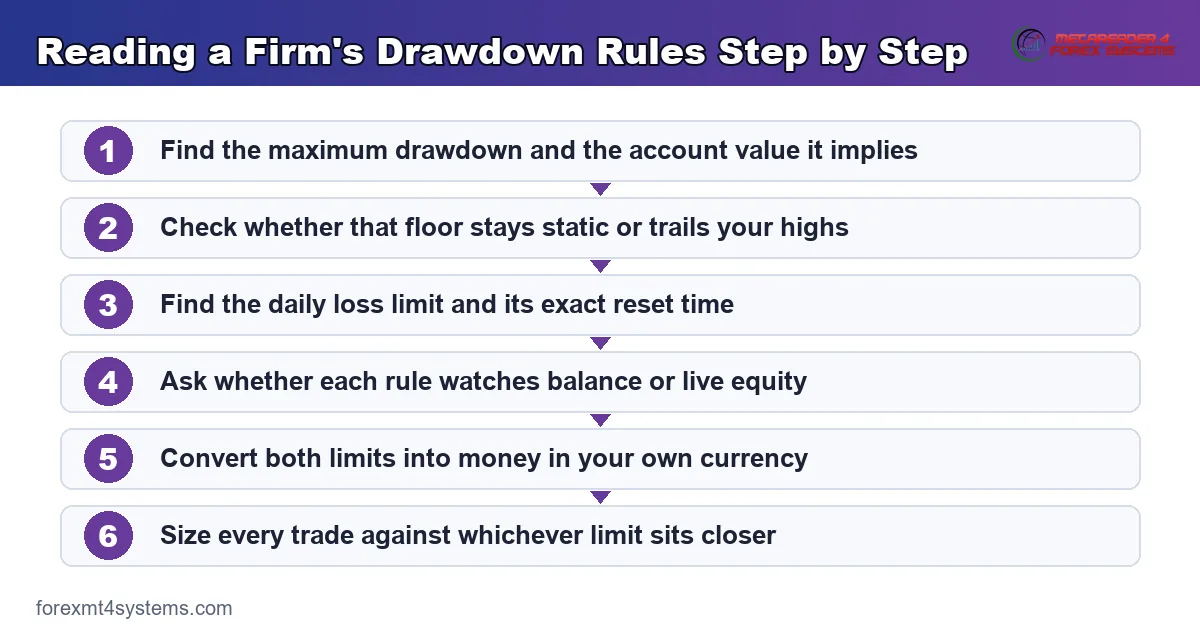
Work through the sequence below in order. Each step matches something you can check in a firm’s terms before you pay a fee.
- Find the maximum drawdown. Note the percentage of the starting balance, then work out the account value it implies.
- Check whether that floor moves. A static floor stays put, while a trailing floor climbs with each new account high.
- Find the daily loss limit. Note the percentage and the exact moment the clock resets each day.
- Ask what each rule watches. Balance rules ignore floating losses, while equity rules count them instantly.
- Convert both limits into money. Two figures in your own currency beat two percentages you must recompute mid-trade.
- Size every trade against the tighter figure. Whichever limit sits closer decides your risk for the session.
Notice how the last step drives the other five. Because one limit always sits nearer than the other, that nearer number sets your position size.
Firms differ on the details, though the shape holds everywhere. Some reset the daily clock at midnight in a server time zone, while others use a rolling window. So check the exact wording rather than assuming a standard.
Maximum Drawdown, the Life-of-Account Floor
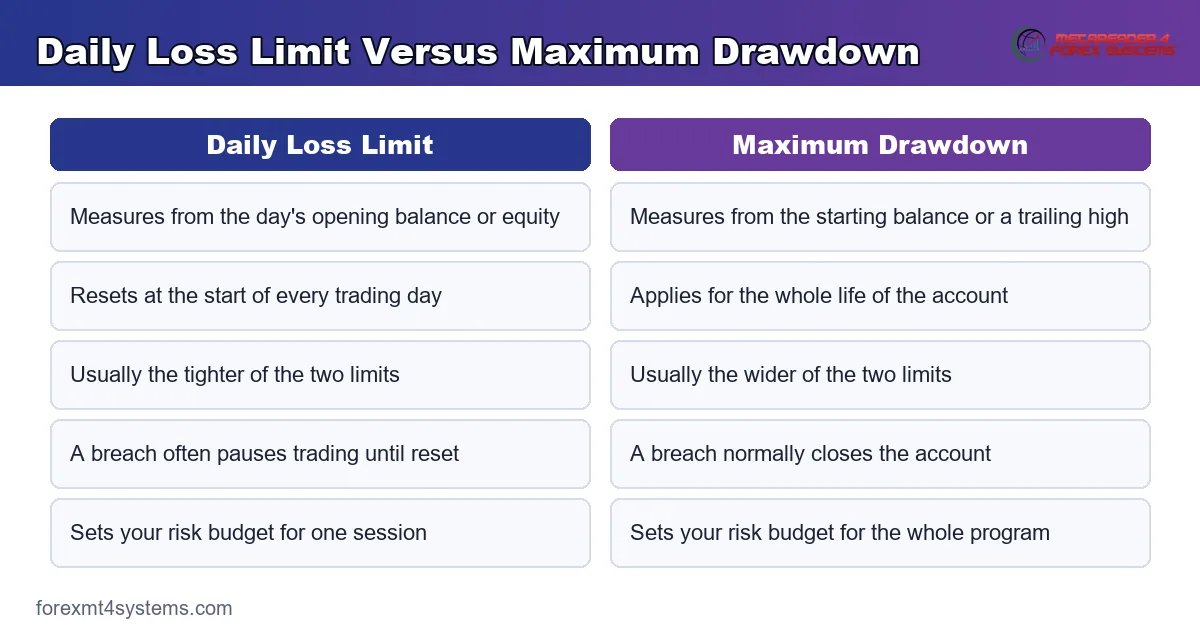
The maximum drawdown marks the lowest account value a firm will tolerate. Cross it once and the account closes for good. So this figure ranks as the single most important line in any rule book.
Typical programs allow roughly a tenth of the starting balance, though the range runs wide. Because the exact figure varies from firm to firm, read it rather than assuming a market standard exists.
Daily Loss Limit, the One-Session Floor
The daily loss limit caps how far your account may fall within one trading day. Breach it and most firms suspend trading until the reset, while a few close the account outright.
This limit usually sits tighter than the maximum drawdown. So it acts as the rule you brush against first, long before the life-of-account floor comes into play. Treat it as your working boundary every session.
Three Ways the Maximum Floor Behaves
The maximum drawdown comes in three common flavours. Firms rarely label them clearly, so learn to spot each one from the wording.
A static floor anchors to the starting balance and never moves. A trailing floor follows your highest account value upward and never comes back down. An end-of-day trailing floor recalculates only on the daily close, which spares you the intraday swings.
Many trailing programs also stop the climb at some point. Once the floor reaches the starting balance, or that balance plus a set buffer, it freezes there. So read the freeze condition carefully, since it decides how much long-term room you keep.
How Drawdown Rules Play Out in a Trading Week
Rules read cleanly on a web page. They feel very different once live trades push your equity around.
Follow a quiet week on a funded account with a three percent daily cap and a ten percent maximum drawdown. Nothing dramatic happens, yet the floors shape every decision.
Monday to Wednesday
Monday brings one loss of one percent. Your daily room shrinks to two percent, and your distance to the life-of-account floor narrows to nine percent. So you take one more measured setup and stop.
Tuesday returns two percent. The daily clock resets each morning regardless of yesterday, so Monday no longer limits you. Because your account now sits above the start, the maximum floor feels further away.
Wednesday runs flat. Nothing changes on either limit, which suits you perfectly. Quiet days protect the room you spent Tuesday rebuilding.
Thursday and Friday
Thursday hands you two losses of one percent each. You now sit two percent lower for the day with one percent of room left. So a third trade would put the daily limit within a single stop.
Stopping there costs you nothing real. Friday’s reset hands the full three percent back, and the week ends roughly flat. Because you honored the cap, the account survives to trade again.
Reading Both Floors Together
The two limits work as a pair, not as rivals. The daily cap rations your risk inside a session, while the maximum floor rations it across months.
Picture the pair as a short leash inside a long one. Small daily losses barely touch the long leash, yet a run of maximum-size days walks you straight to the end of it. So watch both numbers every morning.
Why Firms Set Drawdown Rules at All
The limits can feel arbitrary from the trader’s chair. From the firm’s side they simply replace a human risk desk with a line of code.
The Firm Carries the Capital Risk
A funded trader spends the firm’s money rather than their own. So the firm wants a stop that fires without debate, on every account, at every hour.
A drawdown floor does that job cheaply. Because the platform closes trades the instant equity crosses the line, one careless account cannot damage the wider book.
Manual oversight would cost far more. Since thousands of accounts trade at once, only an automatic floor scales to the job.
The Rules Also Filter for Consistency
Firms want traders who repeat modest gains, not traders who swing for a single jackpot. Tight floors make the jackpot approach fail quickly.
So the rule set doubles as a screening tool. Traders who survive it tend to size small and stop early, which happens to describe sound risk habits anyway.
That filter cuts both ways. A trader who dislikes tight floors can simply trade a personal account instead, where the only limits come from their own plan.
A Worked Example of Sizing to the Floor
Numbers settle the argument, so walk one case end to end. Picture a fifty thousand dollar funded account with a ten percent maximum drawdown and a three percent daily cap.
The life-of-account floor sits at forty-five thousand dollars. The daily floor on day one sits at forty-eight thousand five hundred dollars. So the daily limit binds first by a wide margin.
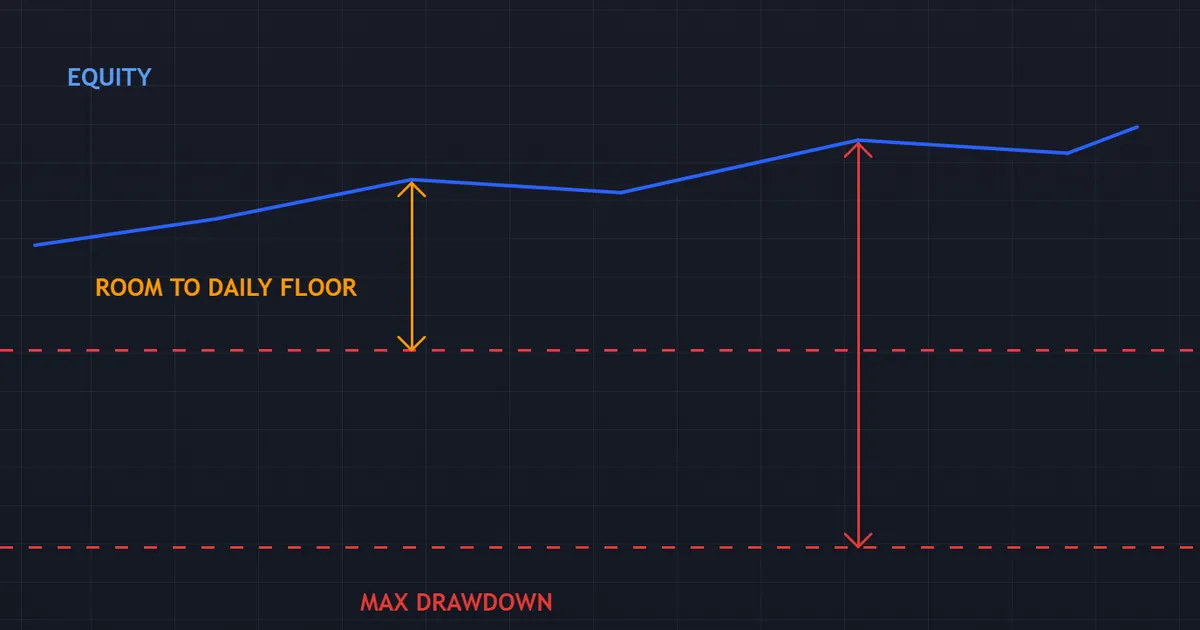
Now pick a risk per trade. Half a percent of the account equals two hundred and fifty dollars, so five straight losses would still leave the daily cap intact. That margin buys you room to be wrong.
Compare that with a two percent risk. A single stop costs one thousand dollars and leaves only five hundred dollars of daily room. So one more full stop breaches the cap outright.
Turning Percentages Into Lots
Percentages guide the plan, yet the platform wants lot sizes. Divide your risk in money by your stop distance in pips, then convert with the pip value for the instrument.
A calculator removes the arithmetic slips that creep in under pressure. Our prop firm position size calculator maps a position straight onto a firm’s drawdown limits, while our drawdown calculator shows what a losing run does to the floor.
Leaving a Buffer
Never plan to spend the whole allowance. Spreads widen, slippage bites and swap charges nibble overnight. So treat roughly eighty percent of each limit as your real ceiling.
That buffer also protects you from your own arithmetic. Because a rounding slip on lot size can cost more than the trade idea earns, a margin of error pays for itself quickly.
A Second Pass With a Trailing Floor
Rerun the same example with a trailing maximum floor. You grow the account to fifty-three thousand dollars, so the floor climbs to forty-eight thousand dollars.
Your room to the life-of-account floor now measures five thousand dollars rather than eight. Because the floor followed you up, the profit you just banked tightened the rule instead of loosening it. So a trailing program rewards steady growth and punishes round trips.
Checking the Room Each Morning
Start each session by writing two numbers down. The first shows your distance to today’s daily floor, and the second shows your distance to the life-of-account floor.
Then divide the smaller number by your usual risk per trade. That quotient tells you how many losses the day can absorb, which sets a natural stopping point before you place a single order.
Download the complete indicator database
Put these concepts on your charts. One email unlocks the full library of 1,380+ indicators with compiled MT4 and MT5 files, plus my TradingView scripts. No paywall, no spam, unsubscribe any time.
Get free access to my indicator database
One email unlocks 1,380+ free MT4, MT5 and TradingView indicators — the complete library. No single-tool download; you get the whole database.
Common Drawdown Rule Mistakes and Fixes
The rules read simply, yet the same handful of errors ends account after account. Most trace back to a misread limit rather than a poor trade idea. The compare graphic below sets the daily loss limit against the maximum drawdown.
Treating a Trailing Floor Like a Static One
A trailing floor climbs with every new account high. Traders who watch only the starting balance miss that climb, then give back profit and breach a floor they never saw move. So recheck the floor after every winning trade.
Ignoring Floating Losses
An equity rule counts an open loss immediately. Holding a deep loser in the hope of a bounce can trip the daily cap while you wait. So watch equity, not balance, once a trade runs against you.
Sizing for the Profit Target
Some traders size up to reach the target quickly. The floors then sit one bad session away, and the account rarely survives its first losing run. So size for the floor and let the target arrive slowly.
Forgetting the Reset Time
Daily limits reset on the firm’s clock, not on yours. A trade held across that reset can straddle two daily windows and surprise you twice. So learn the reset hour in your own time zone.
Holding Through the Weekend
Weekend gaps skip straight over stops. One gap can carve through a daily cap and reach the life-of-account floor in a single tick. So close or trim positions before the week ends.
Averaging Down Into the Floor
Adding to a loser feels like patience and behaves like leverage. Each new lot drags equity toward the floor faster than the last one did. So plan the full position before you enter, then leave it alone.
Trading On After a Warning
Some platforms flag you as room runs low. Traders who keep clicking at that point usually finish the job themselves. So treat the warning as a closing bell rather than a challenge.
Prop Firm Drawdown Rules Quick Reference
Keep this short list beside your platform. Run through it before your first trade on any new account.
- Write both limits in money rather than percentages.
- Confirm whether the maximum drawdown stays static or trails your highs.
- Confirm whether each rule watches balance or equity.
- Note the daily reset time in your own time zone.
- Size every trade against whichever limit sits closer.
- Keep roughly a fifth of each limit as an untouched buffer.
- Stop for the day once half the daily room has gone.
- Recheck the maximum floor after each winning run.
What Actually Ends Funded Accounts
Few accounts die from one catastrophic trade. Most bleed out through small, avoidable rule breaches. The chart below contrasts an equity path that respects the floor against one that pierces it.
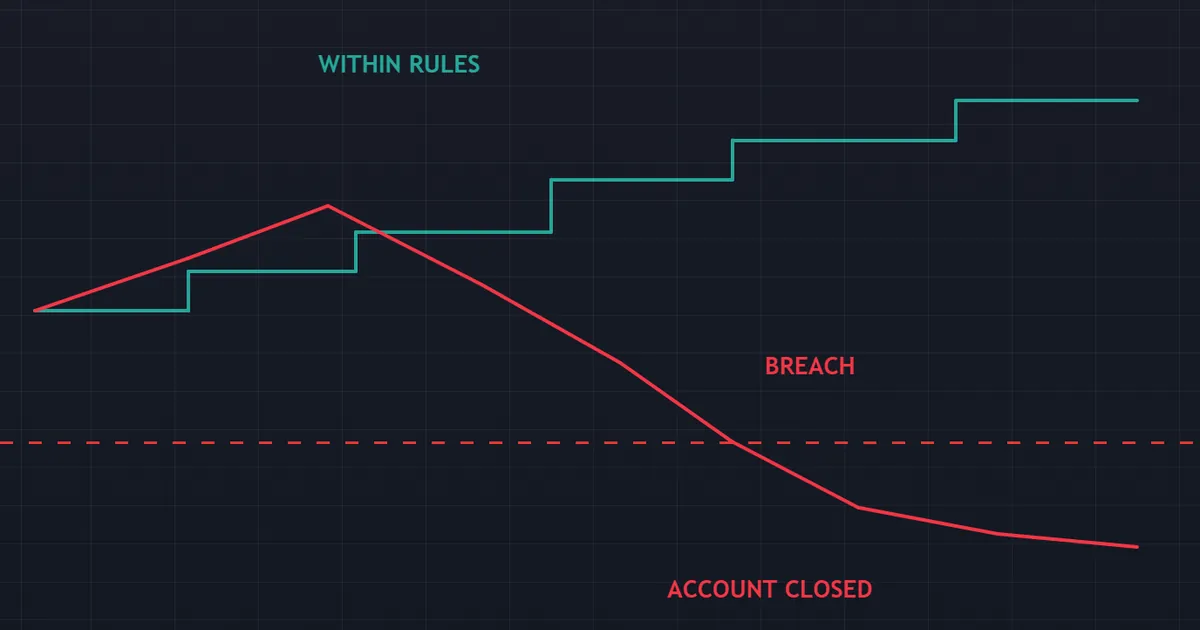
Study the two paths from the same start. One steps upward in small increments and keeps clear of the line, while the other lunges, stalls and then cuts through. That contrast sums up the whole discipline.
The Slow Grind Below the Start
A run of small losses can reach the floor without ever feeling dramatic. Because no single day looks alarming, traders often notice the danger far too late. So track your distance to the floor daily.
The Round Trip Under a Trailing Floor
Profit lifts a trailing floor permanently. Give that profit back and you breach a limit which once felt comfortable. So a trailing rule punishes round trips that a static rule would shrug off.
The Overnight Surprise
Swap charges, rollover gaps and thin liquidity all move equity while you sleep. A position sized for the daily cap can wake up outside it. So trim overnight exposure rather than trusting a stop.
The News Spike
High-impact releases can move price further than any stop allows. A single spike can clear the daily cap while your order still waits for a fill. So trade lighter around a busy calendar, or stand aside entirely.
The Revenge Session
A bad morning tempts traders into bigger trades. That instinct explains exactly why the daily limit exists. So close the platform and let the reset do its work.
Questions to Ask Before You Pay a Fee
A rule book answers most of these in a paragraph. Reading it first costs an hour, while skipping it can cost several fees.
About the Maximum Floor
Ask whether the floor anchors to the starting balance or trails your highs. Then ask whether a trailing floor freezes once it reaches breakeven. So you learn how much long-term room a winning streak really leaves you.
Ask next whether the firm measures the floor on equity or on closed balance. Because that choice decides whether an open loser can end the account, it matters more than the headline percentage.
About the Daily Cap
Ask what the daily figure measures from, since firms split between the day’s opening balance and its opening equity. Then confirm the reset hour and the server time zone.
Ask finally what a breach triggers. Some firms pause the account until the next session, while others close it and end the program. So the same percentage carries very different consequences.
About the Fine Print
Ask whether the firm counts swap charges and commissions toward the floors, since both quietly erode equity. Then ask how it treats a breach caused by slippage rather than by your own click.
Ask lastly whether the rules change once you reach a payout or a larger account. Because a scaling plan often shifts a floor, the version you signed up under may not last.
Related Concepts to Study Next
Drawdown rules simply put a hard edge on ordinary risk discipline. A few neighbouring ideas will sharpen how you trade inside them.
Start with the siblings in this cluster: read our guide to trailing drawdown, compare the rule types in static versus trailing drawdown, then study the one-session cap in daily drawdown in prop firms. For the wider model, see what a prop firm is. Because these floors are applied risk management, our note on risk per trade fixes your sizing, and our overview of drawdown in trading explains the curve behind the rule.
FAQ
What are prop firm drawdown rules?
Prop firm drawdown rules cap how far a funded account may fall. A maximum drawdown sets the life-of-account floor, while a daily loss limit caps a single session. Breaching either one usually ends or suspends the account.
How does maximum drawdown differ from a daily loss limit?
The maximum drawdown measures from a static or trailing reference across the whole account life. The daily limit measures from the start of each trading day and resets every session. So the daily cap binds first, while the maximum floor ends the account.
Do prop firms count floating losses?
Many of them do. Equity rules include the running loss on open trades, so a deep dip can breach a limit before you close anything. Balance rules count closed trades only, which feels gentler yet hides real risk.
What happens when a drawdown rule breaks?
The platform usually flattens open positions and blocks further trading. Some firms suspend the account until the daily reset, while others close it permanently. So check which outcome applies before you place a trade.
How should I size trades around these limits?
Convert both limits into money, then risk a small fraction of the tighter one per trade. Half a percent of the account keeps several losses inside a typical daily cap. So the floor, rather than the profit target, should set your position size.
Can a profitable account still breach a drawdown rule?
Yes, and it happens often under a trailing floor. Profit lifts the floor permanently, so handing that profit back can breach a limit which felt safe. Results are not guaranteed; past performance is not indicative of future results.
External references
- For background on this concept, see Risk Measure on Wikipedia.
- For broader market context, see Risk-Adjusted Return at Investopedia.

About the author
Written by Dominic Walsh, a Forex trader and MT4/MT5 indicator, Expert Advisor and script developer. Every tool on forexmt4systems.com is tested on live charts before release and ships with ready-to-use compiled MT4 (.ex4) and MT5 (.ex5) files. Learn more about the trader and developer behind this site.
How we build, test and correct every tool: Editorial & Testing Policy. Trading carries risk; see the disclaimer.