
Prop firm taxes confuse plenty of funded traders, and the confusion has one simple root. A payout rarely fits the income categories most tax systems were built around.
Read this page as general information, never as tax advice. Rules differ by country and by personal situation, so a qualified local tax professional should review your own case before you file anything.
How Prop Firm Taxes Actually Work
Start with the payment itself. You do not trade your own capital, so no market gain sits behind the money you receive.
The firm pays you a share of profit under a contract. That contract, rather than the market, creates the payment.
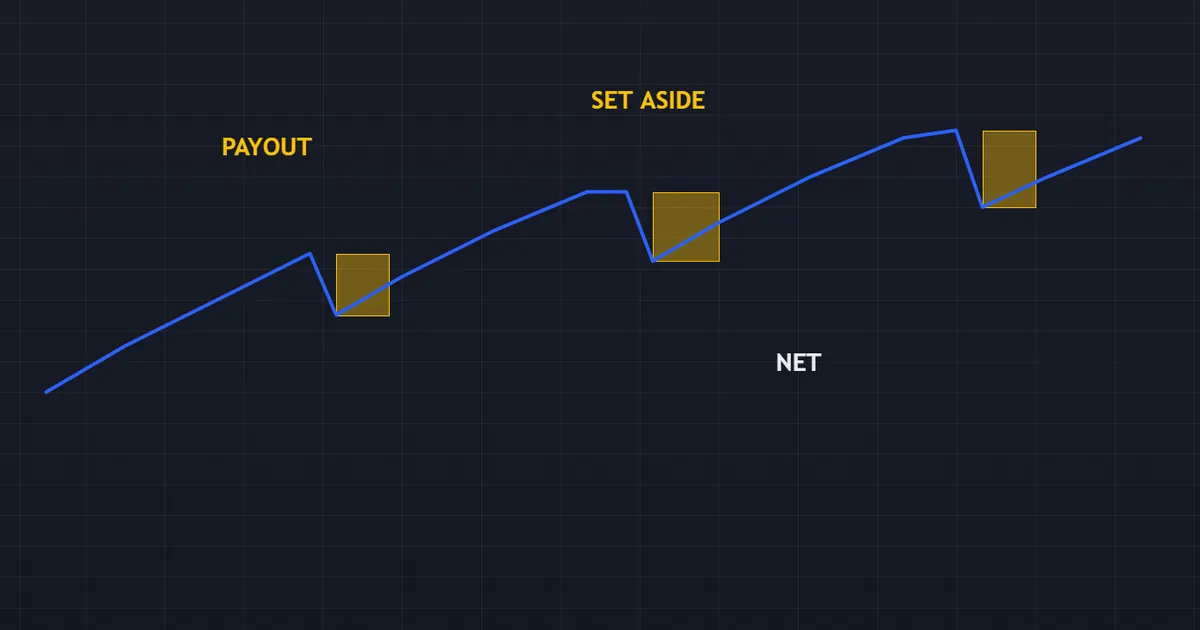
The panel above shows the habit that saves most of the pain. Each payout carries a slice set aside on the day it lands.
Notice how small each slice looks. Because the reserve grows quietly across a year, the discipline costs little at the time and saves a great deal later.
What the Payout Legally Is
Many firms describe the payment as a fee under a service agreement. Others call it a profit share, and a few use the word bonus.
Wording matters here. Because tax offices read contracts rather than marketing, the exact clause shapes the category your own return must use. So download the agreement and keep it.
Why Capital Gains Rules Often Miss
Capital gains rules usually cover assets you own. A funded trader owns no position, since the account belongs to the firm.
So many advisers point traders toward business or self-employed income instead. Because the payment looks like a fee for a service, that category tends to fit the facts better. Your own adviser may still reach a different view, and local rules decide the matter.
Gross Payments and Self-Reporting
Most firms pay gross, with nothing withheld. No payslip arrives, and no tax office receives a copy.
So the duty to report usually sits with you. Because nobody else files on your behalf, a missed payout can surface years later with interest attached.
The Questions You Must Answer
Every trader faces the same short list. Answer these five, and a professional can finish the job quickly.
Skipping one causes most of the trouble. So work through them in order.
The Five Questions
Write the answers down, because a paper trail beats a memory every time.
- What did you receive? Read how the firm names the payment in its own terms.
- Where do you live for tax purposes? Residence usually decides which rules apply.
- Which category fits? Business income, self-employed income and capital gains carry different rules.
- Must you self-report? Gross payments almost always place that duty on you.
- What can you deduct? Fees, data, platform costs and hardware may count.
None of those answers travel across borders. So a friend’s answer in another country tells you nothing about your own.
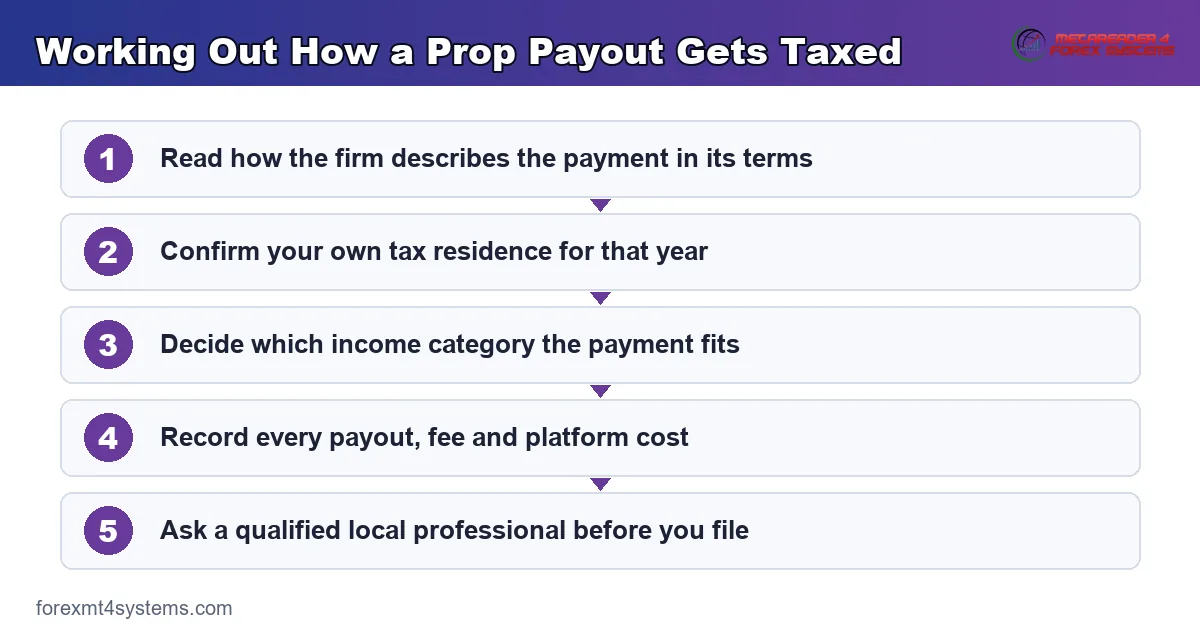
The flow graphic gathers the questions into one view. Work through it once a year, and the annual scramble disappears.
Why a Local Professional Matters Early
An accountant costs far less than a wrong return. One short meeting usually settles the category for good.
So book that meeting before your first payout, not after your fourth. Because a category set correctly at the start carries forward cleanly, early advice saves both money and worry.
What to Bring to That Meeting
Bring the firm’s agreement, your payout history, and your fee receipts. Add a short note describing what you actually do each day.
That last item helps more than traders expect. Because an adviser rarely knows this industry, a plain description of the model speeds the whole conversation up.
Where You Live Decides Most of It
Two traders can receive identical payouts and owe very different amounts. Location explains nearly all of that gap.
So treat every rule you read online as local to somebody else. Check your own position with someone qualified.
Residence Rather Than Nationality
Most systems tax you where you live, though a few tax citizens wherever they go. Day counts often decide residence.
So a year spent moving between countries complicates matters quickly. Because residence tests vary widely, a trader who travels should raise the point early with an adviser.
Cross-Border Payments and Treaties
Many firms sit in one country while paying traders in dozens of others. Treaties between countries can prevent the same money facing tax twice.
Those treaties rarely apply automatically. So the relief usually needs a claim on your return, and the paperwork differs for each pair of countries.
Currency and Timing
Payouts often arrive in a currency other than your own. Your return needs a value in local money at a defensible rate.
So note the rate on the day each payment lands. Our currency converter gives you a quick figure, and your bank statement gives you the rate that actually applied.
Deadlines Differ as Well
Filing dates vary by country, and so do the years they cover. Some systems run to December, while others end their year in spring.
So check both dates before your first payout. Because a missed deadline can cost more than the tax itself, the calendar entry matters as much as the sum.
How Different Income Categories Behave
Tax systems sort money into buckets. Each bucket carries its own rate, its own forms and its own deductions.
Four buckets come up most in this conversation. Your own system may well name them differently.
Business or Self-Employed Income
This bucket suits people who work for themselves. Costs usually reduce the taxable figure, and filings often run yearly or quarterly.
Many advisers place funded payouts here. Because the money arrives under a service contract, the fit tends to look natural. Social charges may apply as well, so ask about those too.
Employment Income
Employees receive wages with tax already deducted. A funded trader almost never fits that pattern.
No firm hires you, and no wage arrives. So the label rarely appears, though local rules can sometimes reclassify a long relationship.
Capital Gains
Gains rules cover assets you buy and sell. You hold none of that on a funded account.
So the bucket usually misses. Because traders assume otherwise, this single point causes more wrong returns than anything else in the industry.
Other or Miscellaneous Income
Most systems keep a catch-all bucket for odd receipts. Some advisers park a first payout there while they research the model.
That choice can work as a stopgap. Because catch-all buckets often block deductions, a settled category usually serves you better.
A Worked Example of the Bookkeeping
Numbers make the routine concrete, so walk one plain year. Picture four payouts across twelve months, each of one thousand dollars.
Total receipts come to four thousand dollars. Against that sit two evaluation fees of two hundred dollars each, plus a data feed at fifteen dollars a month.
Costs therefore reach five hundred and eighty dollars for the year. Your net figure lands at three thousand four hundred and twenty dollars before any tax.
That net figure forms the starting point for most business-income calculations. Because deductible costs vary by country, treat the arithmetic as a shape rather than as a rule.
Setting Money Aside as You Go
Move a slice of every payout into a separate account. Traders commonly reserve somewhere between a quarter and a half, then adjust once an adviser confirms the rate.
So the bill arrives against money you already hold. Because a reserve removes the worst surprise in this business, the habit matters more than the exact percentage.
What the Example Cannot Tell You
The arithmetic above states no rate, and it names no country deliberately. Rates, thresholds and deductible items differ everywhere.
So use the structure and drop the numbers. Because your own figures depend on local law, only a qualified local professional can finish this calculation for you.
Download the complete indicator database
Put these concepts on your charts. One email unlocks the full library of 1,380+ indicators with compiled MT4 and MT5 files, plus my TradingView scripts. No paywall, no spam, unsubscribe any time.
Get free access to my indicator database
One email unlocks 1,380+ free MT4, MT5 and TradingView indicators — the complete library. No single-tool download; you get the whole database.
Records Worth Keeping From Day One
Good records turn a stressful week into a short afternoon. They also protect you if anyone ever asks questions.
Keep everything in one folder, sorted by year. Cloud storage works, and so does a plain box file.
Payment Records
Save the payout confirmation, the bank credit, and the date each one cleared. Note the currency and the rate applied.
Firms close accounts and change platforms. So download statements as they appear, because a closed dashboard takes its history with it.
Cost Records
Keep receipts for evaluation fees, resets, platform charges, data feeds and hardware. Add the share of your internet bill if local rules allow it.
Those costs reduce the figure your return starts from. Because traders forget the small ones, a running log beats an annual memory test. Our trade journal keeps the trading side in one place while your folder handles the money side.
Dashboard Exports
Most programs show your profit history inside a dashboard. Export that history each month while the account still works.
A closed account takes its dashboard with it. So a trader who breaches a rule in March can lose the record of January and February at the same moment. Because the payments still belong in your return, that loss creates real work later.
Contract Records
Store the funded-account agreement and every version that follows it. Programs revise terms often, and the wording drives your category.
So date each copy as you save it. Because a rewritten clause can change how the money looks, the old version proves what applied at the time.
Building a Simple Tax Routine
A routine beats willpower. Three short habits cover almost everything.
None of them take long. All of them save hours later.
Every Month
Download the month’s statements and file them by year. Log each payout with its date, its currency and its rate.
Then move the reserve across. So the money leaves your spending account before you notice it.
Every Quarter
Add up the payouts and the costs. Compare the total against your reserve, then adjust the slice if the gap widens.
Some systems ask for payments on account through the year. So a quarterly check stops those deadlines from arriving cold.
Every Year
Send the folder to your adviser well ahead of the deadline. Include the current agreement and any version that changed.
Then read the return before you sign it. Because you carry the duty, the final check belongs to you rather than to anyone else.
Working With an Adviser New to This Model
Most accountants have never met a funded account. That gap costs you nothing if you explain the model well.
Bring facts rather than jargon. A clear description does far more than a printout of forum posts.
How to Describe the Model
Say that a company gives you access to its own capital under a contract. Say that you place trades inside its rules, and that it pays you a share of any profit.
Add that no capital of yours sits in the account. So the adviser can see at once why gains rules may not apply.
What to Ask
Ask which category fits, which costs you may deduct, and when the income counts. Ask what records they want, and in which format.
Then ask about payments on account. Because timing rules catch many first-year traders, that one question prevents a nasty letter.
Signs You Need a Second Opinion
An adviser who guesses quickly deserves a second look. So does one who refuses to write the reasoning down.
Ask for the answer in writing. Because a written view protects you if rules or staff change later, the request costs nothing and settles a lot.
Common Prop Firm Tax Mistakes and Fixes
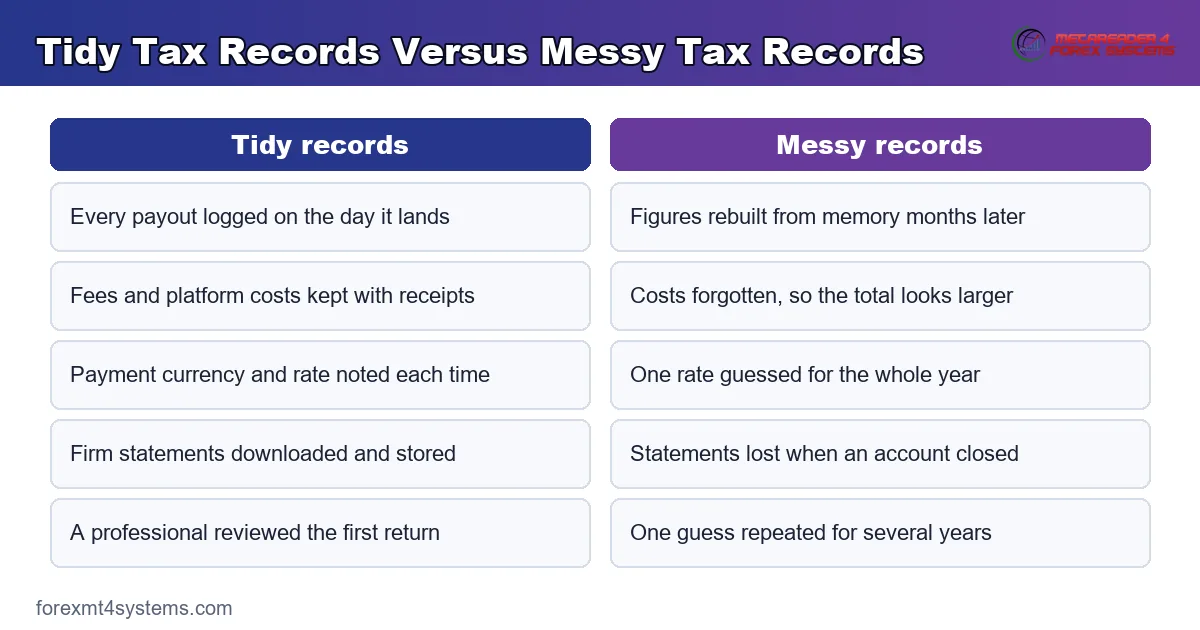
The same errors repeat across funded traders everywhere. The graphic below sets tidy records beside messy ones.
Assuming Capital Gains Rules Apply
Traders reach for the familiar category by habit. You own no position, so that route often fails. So ask an adviser which category fits before your first return.
Waiting Until the Deadline
A late start turns a simple job into a scramble. Statements vanish, and rates get guessed. So book the advice early and keep records monthly.
Spending the Whole Payout
Money that arrives gross feels entirely yours. Part of it usually is not. So reserve a slice on the day each payment lands.
Forgetting Deductible Costs
Evaluation fees, resets and data feeds add up fast across a year. Traders who ignore them overstate their income. So log every cost with a receipt attached.
Copying Advice From a Forum
A confident post from another country answers nothing about your own. Rules differ, and so do the penalties. So treat forum answers as background reading only.
Ignoring Small Payouts
A single small payment feels too minor to report. Tax offices rarely agree with that logic. So record every payout, whatever its size.
Mixing Business and Personal Accounts
Payouts that land in a household account blend with everything else. The year-end sort then takes an evening rather than an hour. So open one plain account for trading money and route every payment through it.
Prop Firm Taxes Quick Reference
Keep this short list beside your records folder. Run through it once a quarter.
- A payout usually arrives as contract income rather than a market gain.
- Most firms pay gross, so the duty to report tends to sit with you.
- Your tax residence decides which rules apply to the money.
- The firm’s own wording shapes the category your return should use.
- Evaluation fees, resets and platform costs may reduce the taxable figure.
- Note the currency and the rate on the day each payment clears.
- Reserve a slice of every payout in a separate account.
- A qualified local professional settles the category faster than any forum.
- Download every statement while the account still works, not afterwards.
- Check your local filing deadline and the dates your tax year covers.
- Keep one sheet covering every firm you trade with.
Pitfalls and Edge Cases
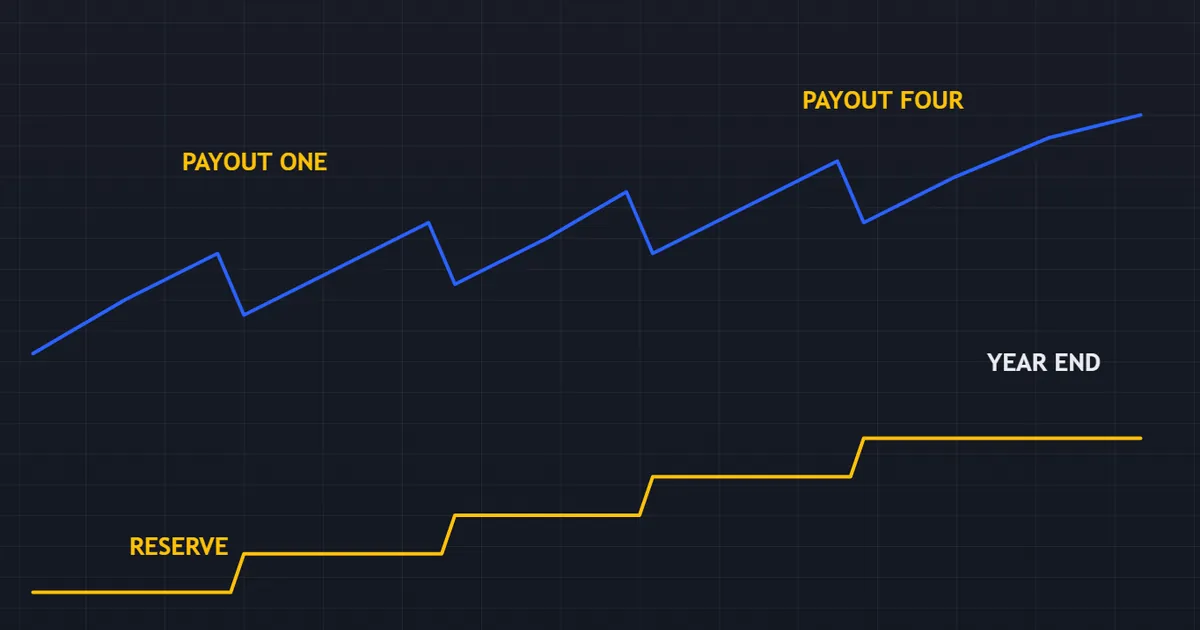
A few wrinkles bend the clean picture. The chart below shows a large late payout with nothing reserved against it.
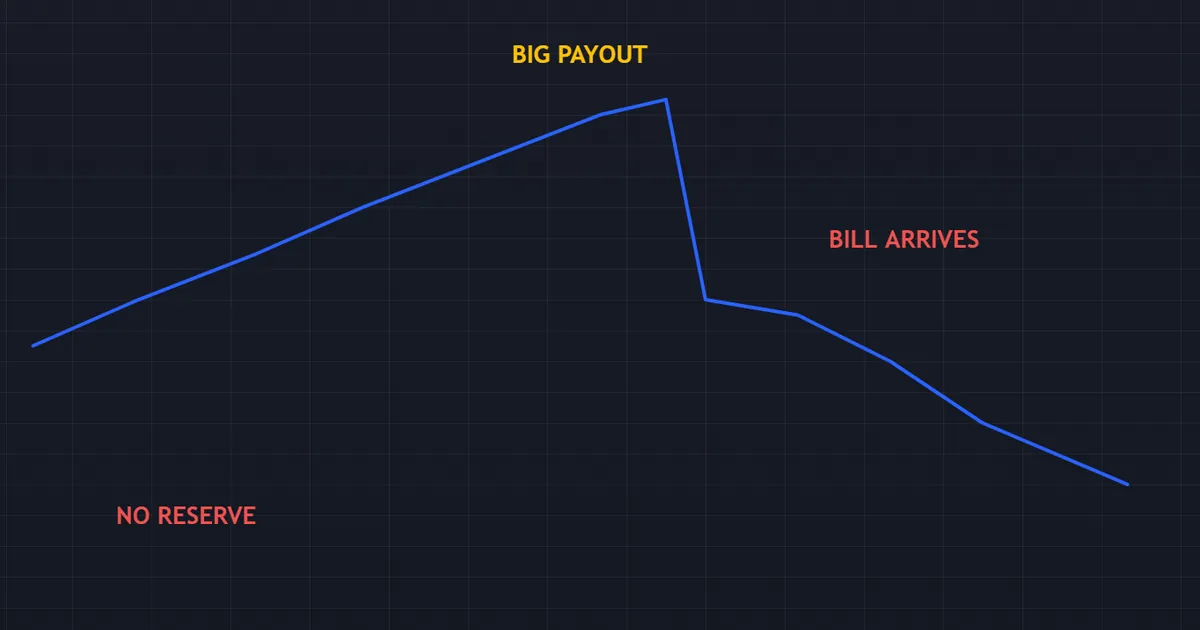
Picture the sequence from the trader’s side. A strong quarter produces one big payment, the money funds a car, and the bill arrives eight months later. Nothing remains to meet it.
Trading Through a Company
Some traders route payouts through a company for structure or liability reasons. That choice creates its own filings, costs and duties.
So weigh it with an adviser rather than with a video. Because a company suits some situations and harms others, the answer depends entirely on scale and location.
Losses and Failed Evaluations
Fees for failed challenges feel like losses, and in a business sense they often behave that way. Whether you may deduct them depends on local rules and on how you file.
So keep the receipts either way. Because you cannot claim what you cannot prove, the record matters more than the theory.
Payments in Crypto
Several firms settle in stablecoins or other tokens. Many systems treat a token receipt as income at its value on the day, then track later movement separately.
So record the value at the moment of receipt. Because a second event can follow when you convert, two entries may end up in your books.
Refunded Fees and Credits
Some programs return the evaluation fee with a first payout. That refund can change the cost you already claimed.
So flag any credit in your records at the time. Because a deduction and a later refund cancel each other out, an unrecorded credit can leave your figures out of step.
Moving Country Mid-Year
A relocation can split your year between two sets of rules. Payouts before and after the move may face different treatment.
So flag the move to an adviser in advance. Because split-year rules get technical fast, early notice prevents an expensive correction.
Payment Rails and Missing Trails
Money sometimes travels through a wallet or a third-party processor. The trail then breaks between the firm and your bank.
So screenshot each step while it happens. Because a broken trail looks odd to any reviewer, your own record fills the gap neatly.
Multiple Firms and Many Small Payments
Traders with several funded accounts collect payments from several sources. Each one belongs in the same annual total.
So keep one sheet covering every firm. Because scattered records invite omissions, a single list keeps the picture honest.
Related Concepts to Study Next
Tax sits at the far end of the funded-account chain, so the earlier links repay a read. The money you keep depends on how the whole model works.
Start with our guide to prop firm payouts, then read our honest look at prop firm trader income. For the business behind the payment, see how prop firms make money and our explainer on the funded trading account itself. Traders planning ahead should also read about prop firm scaling plans, since larger accounts change the size of every question above. Our note on forex trading costs covers the deductible side.
FAQ
How do prop firm taxes usually work?
In most cases the firm pays you gross under a contract, with nothing withheld. The money then enters your own return, commonly as business or self-employed income rather than as a capital gain. Local rules decide the category, so confirm yours with a qualified professional.
Do I owe tax on a payout I never withdraw?
Possibly, and the answer turns on local timing rules. Some systems count income when you gain the right to it, while others count it when the money reaches you. Ask an adviser which basis applies to you before your first year ends.
Can I deduct evaluation fees?
Often yes, where you file as a business or as self-employed. Fees, resets, data feeds and platform costs usually sit in the same bucket. Keep every receipt, because a deduction you cannot prove rarely survives a review.
Does the firm report my payouts to a tax office?
Usually not, and that surprises many traders. A gross payment leaves no payslip and no automatic filing. So the reporting duty tends to fall on you, whatever the size of the payment.
What if I trade through several firms?
Add every payment to one annual total, whatever the source. Keep a single sheet listing the firm, the date, the currency and the amount. Scattered records cause omissions, and omissions cause corrections later.
How much should I set aside from each payout?
Enough to cover the rate your adviser expects, plus a small margin. Traders commonly reserve somewhere between a quarter and a half until they know the figure. Adjust the slice once your first return confirms the real rate.
Should I set up a company for this?
Sometimes, though the answer depends on scale, location and your wider situation. A company brings filings and costs of its own, so the benefit needs to outweigh those. Speak to a qualified local professional before you decide, and remember that payouts themselves stay uncertain. Results are not guaranteed; past performance is not indicative of future results.
External references
- For background on this concept, see Self-Employment on Wikipedia.
- For broader market context, see Taxable Income at Corporate Finance Institute.

About the author
Written by Dominic Walsh, a Forex trader and MT4/MT5 indicator, Expert Advisor and script developer. Every tool on forexmt4systems.com is tested on live charts before release and ships with ready-to-use compiled MT4 (.ex4) and MT5 (.ex5) files. Learn more about the trader and developer behind this site.
How we build, test and correct every tool: Editorial & Testing Policy. Trading carries risk; see the disclaimer.