
Forex trading costs quietly shape every result you post, yet many new traders barely notice them. Each trade you place carries a small toll, and over hundreds of trades that toll adds up fast. So a clear grasp of these costs can be the line between a plan that works and one that leaks money.
This guide breaks down forex trading costs into four plain parts: the spread, the commission, the swap, and slippage. By the end, you will know where each one hides, how to measure it, and how to keep it as low as sensible. So let us start with the whole picture before we split it apart.
What Forex Trading Costs Are
Forex trading costs are the charges you pay to open, hold, and close a trade. Some show up on your statement, while others hide inside the price you see. So the true cost of a trade is rarely the round number a beginner expects.
Your broker earns from these charges, which is fair, since it provides the platform and the market access. The catch is that costs vary widely from broker to broker. Because two accounts can charge in very different ways, comparing them properly takes a little care.
Costs also scale with your activity. A scalper who trades many times a day pays the toll far more often than a swing trader who holds for a week. So the same charge that feels tiny on one trade can dominate the results of another style.
Think of costs as friction on your edge. A strategy might win more often than it loses, yet the toll drags every result down a notch. Because that drag never rests, controlling it lifts your bottom line as surely as a better entry does.

Visible Versus Hidden Costs
Some costs sit in plain view. A commission lands on your statement as a clear line, so you can add it up at a glance. Because it is easy to see, many traders judge a broker by this number alone.
Other costs stay hidden inside the quote. The spread never appears as a separate charge, yet you pay it the instant you enter. So a broker that boasts zero commission may simply fold its fee into a wider spread.
Slippage hides in a third way, showing up only when the market moves fast. It does not appear on any fee schedule, since it comes from the gap between your click and your fill. So a full view of costs must count the visible, the hidden, and the occasional together.
This split explains a lot of beginner confusion. A trader picks a zero-commission account, feels clever, then wonders why the results still lag. Because the fee simply moved into the spread, the money left the account all the same. So learning to spot hidden costs is the first real skill in cost control.
The Four Main Trading Costs
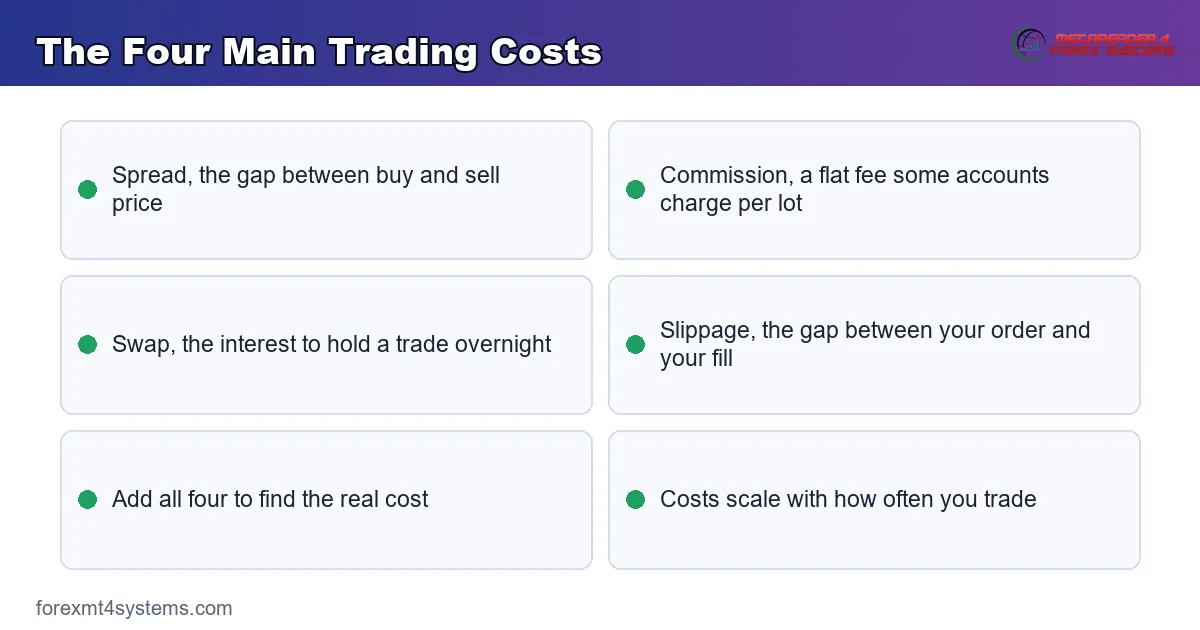
Break the toll into four parts, and it stops feeling vague. Each part answers a different question about how you trade. So here are the four costs that decide what a trade really charges you.
- The spread, the gap between the buy and sell price.
- The commission, a flat fee some accounts charge per lot.
- The swap, the interest you pay or earn to hold overnight.
- Slippage, the small gap between your order price and your fill.
Read these four as a checklist for any account. So before you fund a broker, you can ask how it charges on each line. Because the four together decide your real cost, judging one alone can mislead you badly.
The Spread
The spread is the difference between the bid and the ask price. When you enter a trade, you cross that gap at once, so you start a fraction below breakeven. Because you pay it on every trade, the spread is the most common cost of all.
Spreads move with the market. In the busy London and New York hours, deep flow tightens them, so majors like EUR/USD trade at their cheapest. When liquidity thins overnight or around news, the gap widens instead. Our guide to why spreads widen covers those swings in detail.
Measure a spread in pips, then translate it into money. A spread of one pip on a standard lot costs about ten dollars, since each pip is worth roughly that on the majors. So a tighter spread saves real money once your trade count climbs.
The Commission
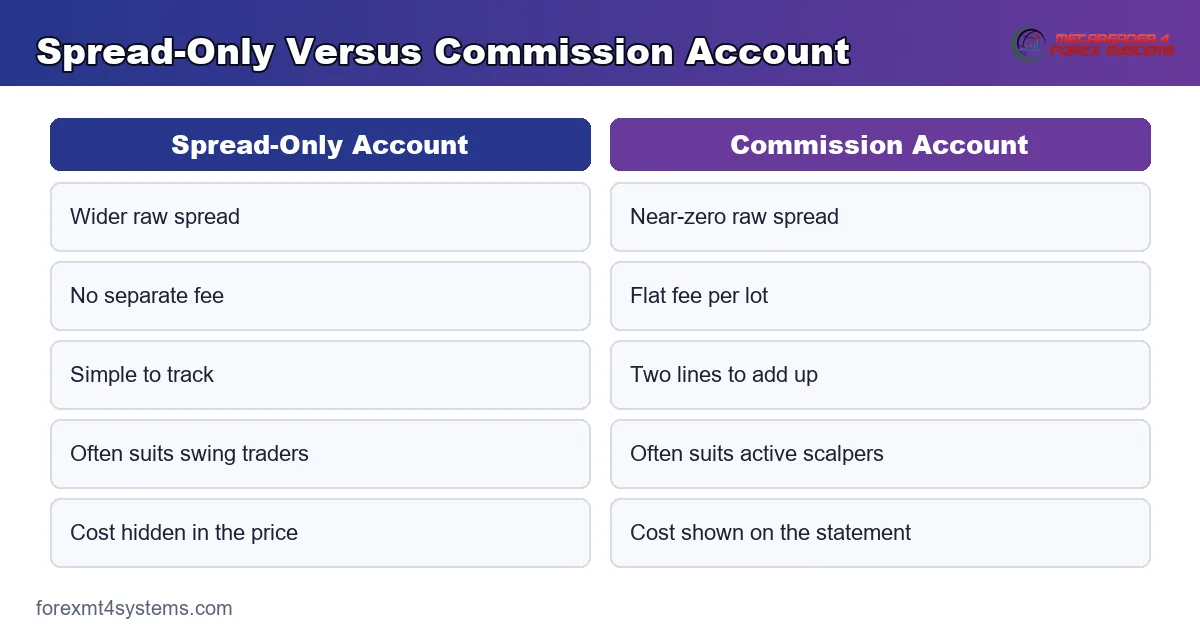
A commission is a flat fee charged per lot traded. Raw-spread accounts often pair a near-zero spread with a commission of around seven dollars per standard lot for a round turn. So you trade a wider spread for a clear, fixed fee.
Commission accounts can work out cheaper for active traders. Because the raw spread runs tighter, a scalper who trades often may pay less overall despite the fee. So the better choice depends on how, and how much, you trade.
Always compare the full package, not one half. A zero-commission account with a wide spread can cost more than a raw account with a fee. So add the spread and the commission together before you decide which looks cheaper.
The Swap
The swap is the interest you pay or earn for holding a position overnight. It reflects the rate gap between the two currencies in the pair. Because central banks set those rates, the swap can run in your favour or against you.
Hold a trade past the daily rollover, and the swap applies. Keep it for several nights, and the charges stack up, so a long hold can owe a meaningful sum. Our guide to the swap in forex explains how brokers work it out.
To see the nightly figure before you commit, our free swap calculator estimates the charge for a given pair and size. So you can weigh the cost of a multi-day hold against the reward you expect.
Slippage
Slippage is the gap between the price you clicked and the price you got. In calm markets it stays tiny, yet fast moves can push your fill several pips away. So slippage can help or hurt, though it tends to bite hardest around news.
Order type shapes your exposure to it. A market order takes the next available price, so it may slip in a rush. By contrast, a limit order fills only at your price or better, which caps the downside but risks a miss when price runs away.
Slippage cuts both ways, which surprises many beginners. Positive slippage can fill you at a better price when the market gaps your way. So the honest view treats it as a two-sided risk, larger around news and small in calm conditions.
A Worked Example Of Total Cost
Numbers pull the four costs together, so picture one trade. You buy a standard lot of EUR/USD on a raw account, where the spread sits near zero and the commission runs seven dollars for the round turn.
The spread cost stays small here, perhaps two dollars for a fifth of a pip. Add the seven-dollar commission, and your entry and exit together cost about nine dollars. So the trade starts nine dollars below breakeven before price even moves.
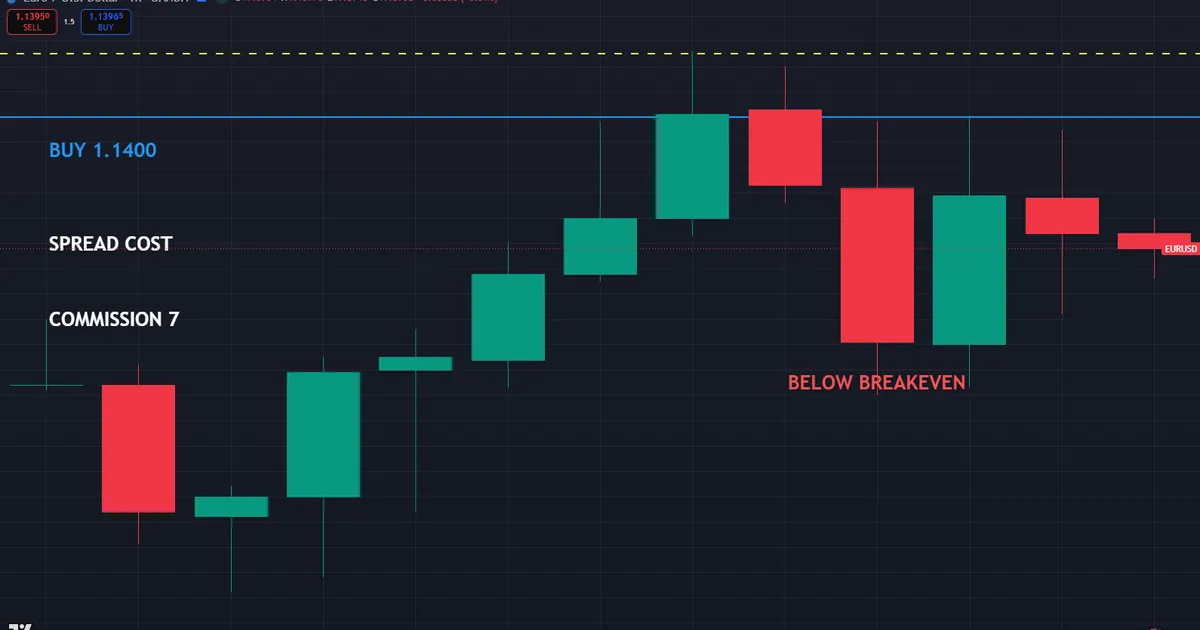
Now hold the trade overnight. Suppose the swap charges you three dollars for the night on this pair. Add that to the nine, and the full toll reaches about twelve dollars for a one-night trade.
Then imagine news hits as you exit. A one-pip slip on the close adds another ten dollars, so the total climbs toward twenty-two. So a trade that looked nearly free on paper carried a real cost once every part was counted.
Scale that toll across a busy month, and the point lands hard. Twenty dollars of cost on a hundred trades reaches two thousand dollars over thirty days. So a trader who trims even a few dollars per trade keeps a large sum that would otherwise leak to the broker.
Compare the same trade on a standard account for contrast. There the commission disappears, yet the spread widens to perhaps one full pip, which costs about ten dollars. So the structure changes where the money goes, though the total often lands in a similar place.
Download the complete indicator database
Put these concepts on your charts. One email unlocks the full library of 1,380+ indicators with compiled MT4 and MT5 files, plus my TradingView scripts. No paywall, no spam, unsubscribe any time.
Get free access to my indicator database
One email unlocks 1,380+ free MT4, MT5 and TradingView indicators — the complete library. No single-tool download; you get the whole database.
Common Mistakes About Trading Costs
Costs trip traders in predictable ways, and the same errors show up again and again. Most come from watching one charge while ignoring the rest. So the fixes start with counting every line, not just the obvious one.
Judging A Broker By Spread Alone
A tight spread looks cheap, yet it tells only half the story. When a hidden commission or a wide swap sits behind it, the real cost can be higher. So add every charge together before you crown one account the cheapest.
Ignoring The Overnight Swap
A swing trader who forgets the swap gets a nasty surprise. Because the charge repeats each night, a week-long hold can quietly erode the profit. So check the nightly figure before you leave any trade open past the rollover.
Overtrading And Stacking Spreads
Each extra trade pays the spread again. A trader who churns the account for the thrill of it hands the broker a fee on every click. So fewer, better trades often beat a flurry of small ones once costs enter the sum.
Trading Illiquid Hours
Spreads widen when the market thins. A trade placed in the quiet gap between New York and Tokyo pays a wider spread for no extra reward. So favour the deep London and New York hours when the majors trade cheapest.
Confusing Cost With Value
The cheapest broker is not always the best fit. A rock-bottom fee means little if the platform freezes or the fills run poor. So weigh reliability and execution alongside the raw cost before you choose.
Forgetting Costs In The Plan
A strategy tested without costs can look far better than it trades. When you finally add the spread and fees, a thin edge can vanish. So build the full toll into any plan before you trust its numbers.
How To Lower Your Trading Costs
You cannot erase costs, yet you can trim them with a few habits. Small savings on each trade compound into real money over a year. So treat cost control as part of the edge, not an afterthought.
Match The Account To Your Style
A scalper leans toward a raw account with a tight spread and a clear fee. A swing trader may prefer a simple spread-only account with no commission to track. So pick the structure that fits how often you trade.
Trade The Liquid Hours
Spreads run tightest when volume peaks. By focusing on the London and New York sessions, you pay the smallest gap on the majors. So timing your trades well saves money before you even pick a direction.
Use A Rebate Where It Fits
Some programs return part of the spread or commission as a rebate. For a high-volume trader, those small refunds add up over a month. Our free forex rebate calculator shows how much a given rate could return.
How Costs Change By Trading Style
The same charge weighs very differently across styles, so your approach decides which cost matters most. A frequent trader lives and dies by the spread, while a long-term trader watches the swap. So no single cost rules for everyone.
Scalpers And The Spread
A scalper opens many trades for a few pips each. Because the spread applies to every one, it eats a large share of a small target. So a scalper hunts the tightest spread and the deepest liquidity, since a wide gap can swallow the whole edge.
Commission matters just as much for this style. When targets run tiny, a fixed fee per lot becomes a real drag on results. So a scalper counts the spread and the fee together on every quick trade, then trades only when both stay low.
Day Traders And The Balance
A day trader sits in the middle. Trades last hours rather than minutes, so the spread stings less per trade than it does for a scalper. Because positions close before the rollover, the swap rarely enters the sum at all.
Execution quality still counts for this style. A day trader who enters on news faces slippage, so order type and timing matter. So the day trader balances a fair spread against reliable fills rather than chasing the very lowest number.
Swing Traders And The Swap
A swing trader holds for days, which changes the maths. The spread barely registers across a large multi-day move, yet the swap repeats every night. So the overnight charge becomes the cost that deserves the closest watch.
Direction of the swap can even help here. When a trade earns a positive swap, a long hold collects a small nightly credit. So a swing trader sometimes favours the side of a pair that pays rather than charges to hold.
Quick-Reference: Trading Costs At A Glance
Keep this short list beside your platform. A quick check here keeps costs in view, so run through it before you fund an account.
- The spread is the buy-sell gap you pay on every trade.
- The commission is a flat fee some accounts charge per lot.
- The swap is the interest to hold a trade overnight.
- Slippage is the gap between your order and your fill.
- Add every charge together to find the real cost.
- Trade the liquid hours to pay the tightest spreads.
Edge Cases And Pitfalls
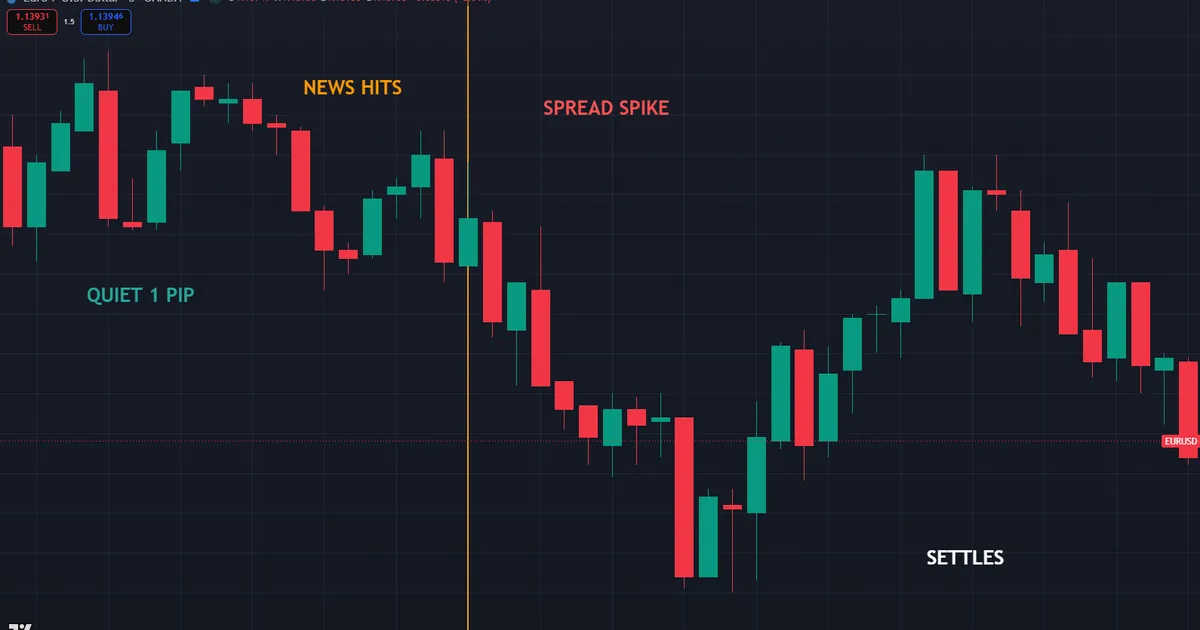
Even a well-planned cost budget bends on special days. News releases come first. When data drops, spreads can blow out for a few seconds, so a market order fills far from the screen. So a trade placed into the print can pay several times the usual toll.
Watch the chart below for that spread spike in action. A quiet one-pip gap balloons the moment the number lands, then settles once the dust clears. Because the widening lasts only seconds, a patient trader waits it out rather than chasing the first tick.
Weekend And Triple Swap
Brokers often charge a triple swap on Wednesday to cover the weekend. Because the settlement calendar skips Saturday and Sunday, the extra nights land midweek. So a trade held through that day can owe three times the usual overnight charge.
Weekend gaps add another wrinkle. When the market reopens on Sunday, price can jump, so a trade held over the break faces both gap risk and stacked swaps. So weigh the full weekend cost before you carry a position through it.
Exotic pairs carry a heavier toll all round. Because a currency like the lira or the rand trades thinner, its spread runs wide and its swap can bite hard. So a beginner usually starts on the cheap, liquid majors before straying into pricier corners of the market. Because the extra cost buys no extra edge, the majors remain the sensible home for most trading plans. So save the exotics for the day when a clear reason justifies their higher price and wider spread.
Costs even shape which strategies make sense at all. A high-frequency plan needs razor-thin charges to survive, while a patient trend plan can absorb a wider spread. So the toll you pay quietly steers you toward the styles that fit your account.
Fixed Versus Variable Spreads
Some accounts quote a fixed spread that never moves, while others float with the market. A fixed spread brings certainty, yet it often sits wider on average. Our guide to fixed versus variable spread weighs the trade-off in full.
Related Concepts To Study Next
Trading costs connect to a web of basics, and a few deserve your next reading hour. Start with the charge you pay most often by reading our guide to the spread in forex, which shows how the bid-ask gap works. Then compare live accounts side by side with our free forex spread comparison tool.
One more guide rounds out the picture. Because the language of costs can confuse a beginner, brush up on the key words with our glossary of forex trading terms. So the toll on each trade stops feeling like a mystery and starts reading as a line you can plan for.
FAQ
What are forex trading costs?
Forex trading costs are the charges you pay to open, hold, and close a trade. The main four are the spread, the commission, the swap, and slippage. Some appear on your statement, while others hide inside the price, so the true cost is often higher than it first looks.
Is the spread a trading cost?
Yes, the spread is the most common cost of all. It is the gap between the buy and the sell price, and you pay it the instant you enter a trade. Because it applies to every trade, a tighter spread saves real money as your trade count grows.
What is the difference between spread and commission?
The spread is the built-in gap between bid and ask, while the commission is a separate flat fee per lot. A raw account pairs a tight spread with a commission, and a standard account folds the fee into a wider spread. Adding both together reveals the real cost.
Do I pay a cost to hold a trade overnight?
Yes, holding past the daily rollover triggers the swap, the interest on the rate gap between the two currencies. It can run for or against you, depending on the pair. Over several nights the charge stacks up, so a long hold owes a meaningful sum.
How can I reduce my trading costs?
Match the account type to your style, trade the liquid London and New York hours for tight spreads, and avoid overtrading. Checking every charge before you fund an account also helps. Small savings on each trade compound into real money over a year.
Are cheaper brokers always better?
Not always, since a rock-bottom fee means little if the platform freezes or the fills run poor. Weigh reliability and execution alongside the raw cost before you choose. A slightly higher cost with dependable fills can serve you better. Results are not guaranteed; past performance is not indicative of future results.
External references
- For background on this concept, see Transaction Costs at Investopedia.
- For broader market context, see Transaction cost on Wikipedia.

About the author
Written by Dominic Walsh, a Forex trader and MT4/MT5 indicator, Expert Advisor and script developer. Every tool on forexmt4systems.com is tested on live charts before release and ships with ready-to-use compiled MT4 (.ex4) and MT5 (.ex5) files. Learn more about the trader and developer behind this site.
How we build, test and correct every tool: Editorial & Testing Policy. Trading carries risk; see the disclaimer.