
Few things confuse new traders as fast as the pips vs points question, because the two words sound alike yet mean different sizes. A pip is the standard move most traders talk in, while a point is the smallest step a platform can quote, and mixing them up can throw your stops off by a factor of ten.
This guide settles the pips vs points debate in plain terms. By the end, you will know the exact size of a pip, a pipette, and a point, why MetaTrader counts in points, and how to convert between them so your risk math never slips.
Pips vs Points, Explained
A pip is the standard unit of price movement on a currency pair. On most pairs it is the fourth decimal, or 0.0001, and on yen pairs it is the second decimal, or 0.01. Traders quote almost every move in pips.
A point is different. In MetaTrader, a point is the smallest price change the broker quotes, which is the very last decimal on the screen. On a five-digit EURUSD price like 1.14005, that final digit is one point.
So the two units live at different scales. On a modern five-digit broker, one pip equals ten points, because the pip sits at the fourth decimal and the point sits at the fifth. That ten-to-one ratio is the heart of the confusion.
Look at the contrast on the chart below. One marker spans a move of one pip, and a second marker shows the same distance broken into ten smaller point steps. The labels make the ten-to-one relationship easy to see.
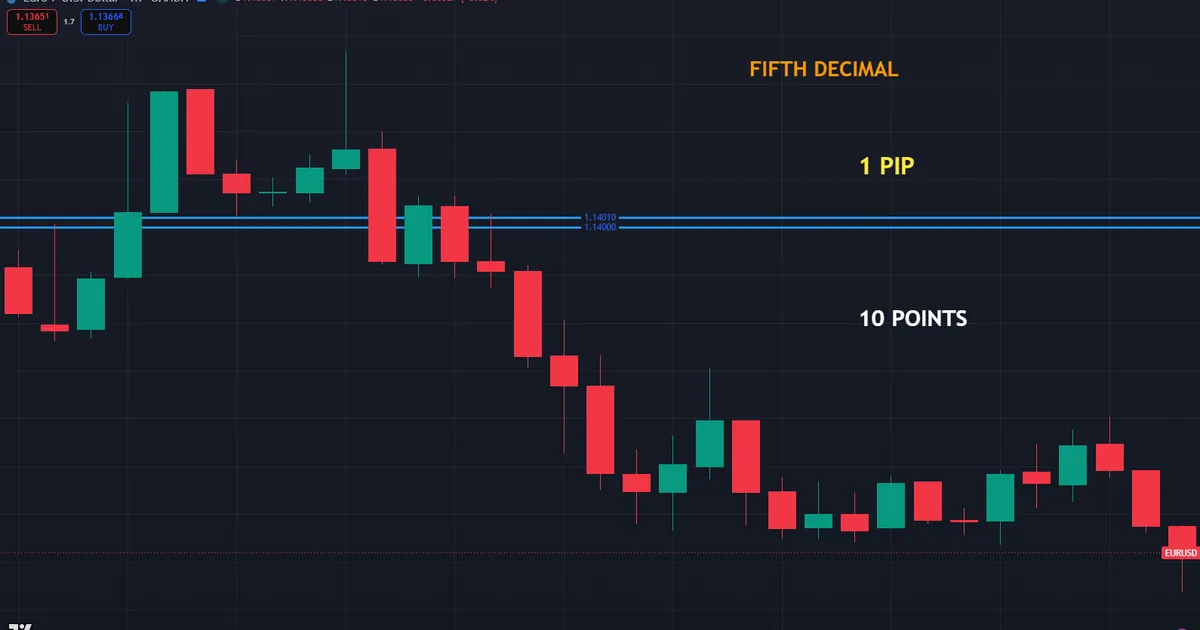
Now add the pipette to the picture. A pipette is another name for that fifth-decimal step, so a pipette and a MetaTrader point are the same size on a five-digit broker. Because of that, ten pipettes also make one pip.
So three words describe two sizes. The pip is the big, familiar unit, while the point and the pipette both name the tiny fractional step beneath it. Keeping that map in mind clears up most of the muddle at once.
Say the three sizes out loud once. A pip is the everyday move you discuss with other traders. A point and a pipette are the fine print, the smallest twitch the price can make. Because the fine print is a tenth of the everyday unit, the two never trade places.
Why the Fifth Decimal Exists
Brokers added the fifth decimal to price more precisely. With an extra digit, they can quote a spread of 0.8 pips rather than rounding to a whole pip. So that fifth decimal, the point, lets pricing sit between whole pips.
See the benefit as a trader. Tighter, more exact quotes usually mean a slightly lower cost to enter. Because the point makes those finer quotes possible, the very digit that causes the naming confusion also works in your favor at the entry.
Where the Confusion Starts
The trouble begins with everyday speech. Many traders loosely say points when they mean pips, especially those who came from stocks or indices. So you hear someone claim a pair moved fifty points when they really mean fifty pips.
MetaTrader then adds its own strict meaning. The platform’s code uses a point as the smallest quoted step, which is a pipette on a five-digit feed. So an expert advisor that asks for a stop in points wants a number ten times larger than the same stop in pips.
Blend the two meanings and trouble follows. A trader hears fifty points in a video, thinks fifty pips, then types fifty into a strict points box. Because the casual and the strict meanings collide, the stop ends up ten times smaller than the video ever intended.
Keep the two worlds apart. In casual talk, point often just means pip, so read it by context. In any MetaTrader setting or input box, a point is strict and small, so treat it as one tenth of a pip every time.
How the Units Compare
Laying the units side by side removes the last of the doubt. Here is how a pip, a pipette, and a point line up on a standard five-digit broker, from largest to smallest.
| Unit | Size on a standard pair | Decimal place | Relationship |
|---|---|---|---|
| Pip | 0.0001 | Fourth decimal | The standard unit traders quote |
| Pipette | 0.00001 | Fifth decimal | One tenth of a pip |
| Point (MetaTrader) | 0.00001 | Fifth decimal | Same as a pipette, one tenth of a pip |
So the table shows one clean rule. A pip is ten times a point on a five-digit broker, and a point matches a pipette exactly. The diagram below stacks the same three units so the ten-to-one gap is impossible to miss.
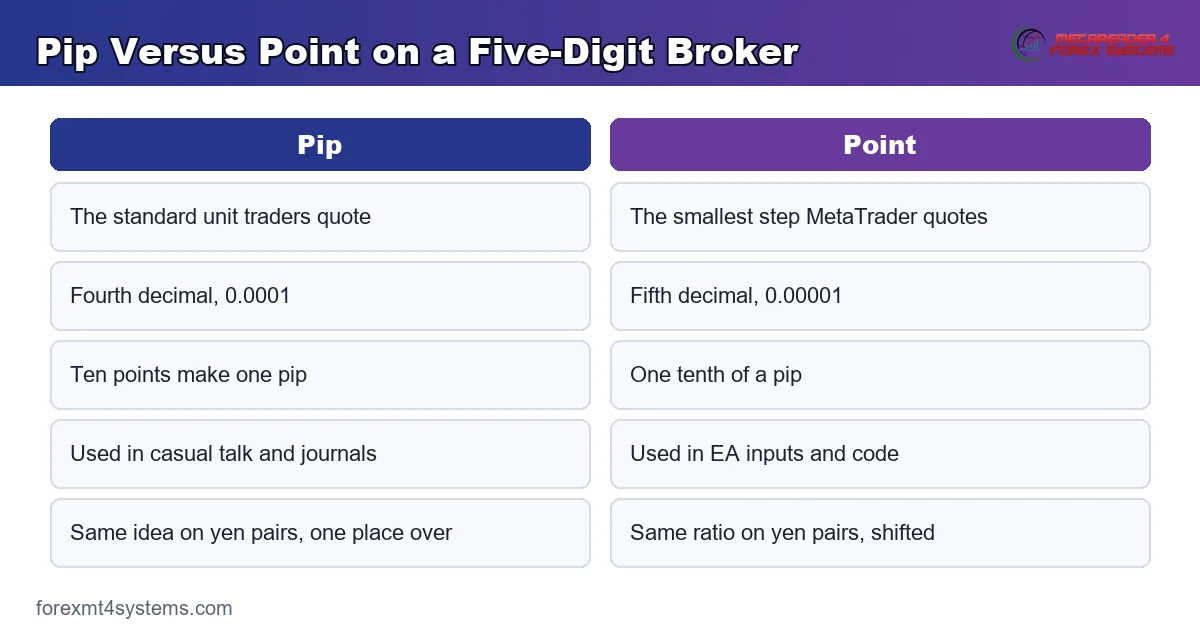
One caveat keeps the table honest. Older four-digit brokers quote no fifth decimal, so on those a point equals a whole pip instead. Because most brokers now run five digits, the ten-to-one rule holds in nearly every case you will meet.
Yen Pairs Shift the Decimals
Yen pairs move every unit one place to the left. There a pip is the second decimal, or 0.01, and a point is the third decimal on a three-digit yen feed. So a pip still equals ten points, just at a different spot in the price.
Read a yen quote with that shift in mind. On USDJPY at 162.005, the pip is the 0 in the second decimal and the point is the 5 in the third. Because the ratio stays ten to one, your conversions work exactly as they do on other pairs.
Do not let the different decimals rattle you. The yen simply carries fewer places because one dollar buys many yen. So the pip and point slide left together, and the gap between them holds at exactly ten just like everywhere else.
Spotting the Units on Your Screen
The fastest way to end the confusion is to read the price itself. Count the decimals your broker shows, and the unit sizes fall into place at once. A five-digit price tells you a point is a tenth of a pip.
Look at a standard pair first. On EURUSD your broker likely shows five decimals, such as 1.14005. The fourth decimal is the pip, and the fifth, the small trailing digit, is the point. So the two units sit right there in the quote.
Counting Decimals Quickly
Make the decimal count a reflex. Five decimals on a standard pair means five-digit pricing and the ten-to-one rule. Four decimals means an older feed where a point equals a pip. So a single glance at the price settles which rule applies.
Apply the same glance to yen pairs. Three decimals there signal a five-digit-style feed shifted for the yen, so the pip is the second decimal and the point is the third. Because the pattern repeats, you never have to memorize each pair on its own.
What Your Platform Displays
Notice how platforms often style the pip digit larger. Many show the pip in a bigger or bolder font, with the point shrunk beside it. So the display itself hints at which digit carries the move you usually talk about.
Lean on that visual cue when you read fast. The large digit is your pip, and the small one riding beneath is your point. Because the styling is built for exactly this reason, it quietly reinforces the ten-to-one gap every time you glance at the ticket.
Converting Between Pips and Points
Most real mistakes happen during conversion, so a simple routine protects your risk. The math is short once you fix the ten-to-one ratio in your head.
- Pips to points. Multiply pips by ten. A twenty-pip stop becomes two hundred points on a five-digit broker.
- Points to pips. Divide points by ten. A five hundred point target is fifty pips.
- Check the digits. Confirm the broker is five-digit before you apply the rule. A four-digit feed makes a point equal a pip.
- Mind the yen. The ratio holds on yen pairs too, just shifted one decimal place.
- Value it. Convert to money using pip value, since ten points equal one pip of cost.
So a stop set in the wrong unit is off by ten times, which is a serious error. Our free pip value calculator turns any pip figure into a money value, so you can sanity-check a stop before it goes live.
Build a habit around the tenfold gap. Whenever a number looks strange, ask whether you have slipped a decimal by mixing the units. Because the error is always a clean factor of ten, spotting it becomes quick once you expect it.
A Worked Conversion
Picture a EURUSD trade near the current 1.1400 area with a planned twenty-pip stop. In pips your stop is twenty. In MetaTrader points, that same stop is two hundred, since you multiply by ten.
Now imagine typing the wrong number. If you enter twenty into a points box, your stop becomes just two pips, a tenth of what you intended. So the trade risks far less room than planned and gets stopped out almost at once.
Flip the mistake the other way too. Type two hundred into a pips field, meaning to set points, and your stop balloons to two hundred pips. Because the error runs in both directions, a quick unit check protects you whether the number ends up too big or too small.
The chart below contrasts both stops. A twenty-pip stop sits at a sensible distance, while a twenty-point stop hugs the entry far too tightly. The labels show how the same number means very different room on the chart.
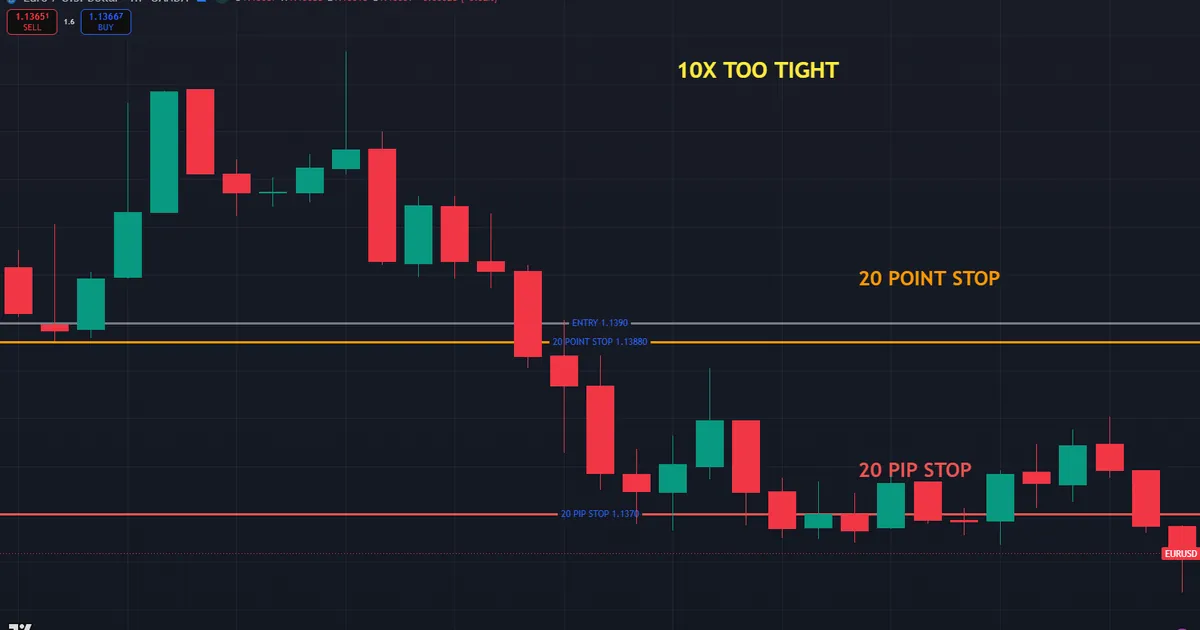
So always confirm the unit an input box expects. A quick check of pips against points keeps your risk exactly where you set it. Our guide to pip in forex covers the pip side of that math in full detail.
Download the complete indicator database
Put these concepts on your charts. One email unlocks the full library of 1,380+ indicators with compiled MT4 and MT5 files, plus my TradingView scripts. No paywall, no spam, unsubscribe any time.
Get free access to my indicator database
One email unlocks 1,380+ free MT4, MT5 and TradingView indicators — the complete library. No single-tool download; you get the whole database.
Common Pips and Points Mistakes
The two units are simple once mapped, yet the same slips recur across trading platforms. Most come from treating a point as a pip inside MetaTrader, and the fixes sit under the graphic.
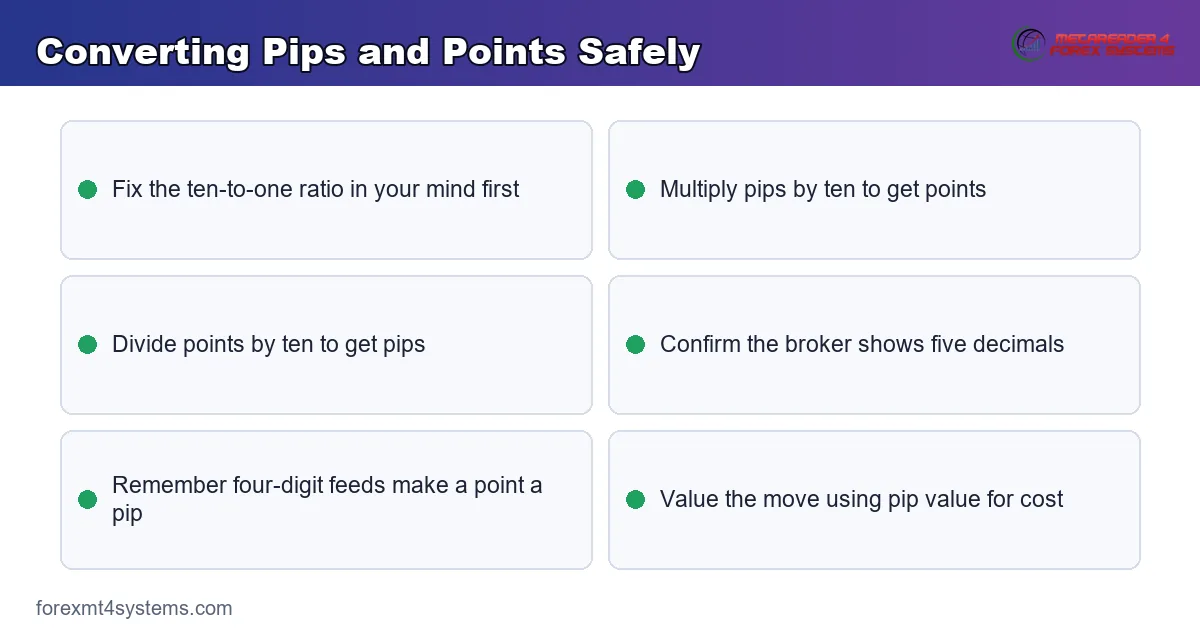
Setting a Stop Ten Times Too Tight
The classic error is typing a pip figure into a points input. A planned twenty-pip stop becomes twenty points, a tenth as wide. So the trade dies on normal noise, and the fix is to multiply pips by ten before entering points.
Reading an EA Setting Wrong
Expert advisors usually take stops and targets in points. Feeding them pip numbers shrinks every distance tenfold. Instead, read the input label carefully, and convert your pip plan into points before you load the robot.
Assuming a Four-Digit Broker
Some traders learned the rule that a point equals a pip on old four-digit feeds. That breaks on a five-digit broker, where a point is a tenth of a pip. So check the number of decimals your broker shows before you trust any point value.
Mixing Units in a Trade Journal
Logging some trades in pips and others in points ruins your records. The numbers stop comparing, and your stats mislead you. So pick one unit, almost always pips, and record every trade in it for a clean history.
Pips vs Points Quick Reference
Run through this short list whenever a unit question comes up. A few seconds here keeps your stops and targets at the size you meant. So keep it nearby, and let it settle any doubt before you click.
- Pip: the standard unit, the fourth decimal on most pairs.
- Point: the smallest quoted step, the fifth decimal in MetaTrader.
- Pipette: the same size as a MetaTrader point.
- One pip equals ten points on a five-digit broker.
- Pips to points: multiply by ten.
- Points to pips: divide by ten.
- Four-digit brokers make a point equal a pip.
When the Difference Bites
Study the case where the pip-point mix-up costs real money, since it catches beginners often. Picture a trader who plans a fifty-pip stop but types fifty into a MetaTrader points field by mistake.
Watch the result unfold. The stop lands at just five pips, a tenth of the plan, so it sits well inside normal price noise. The next small swing clips the stop, and the trade closes for a loss the trader never intended to take.
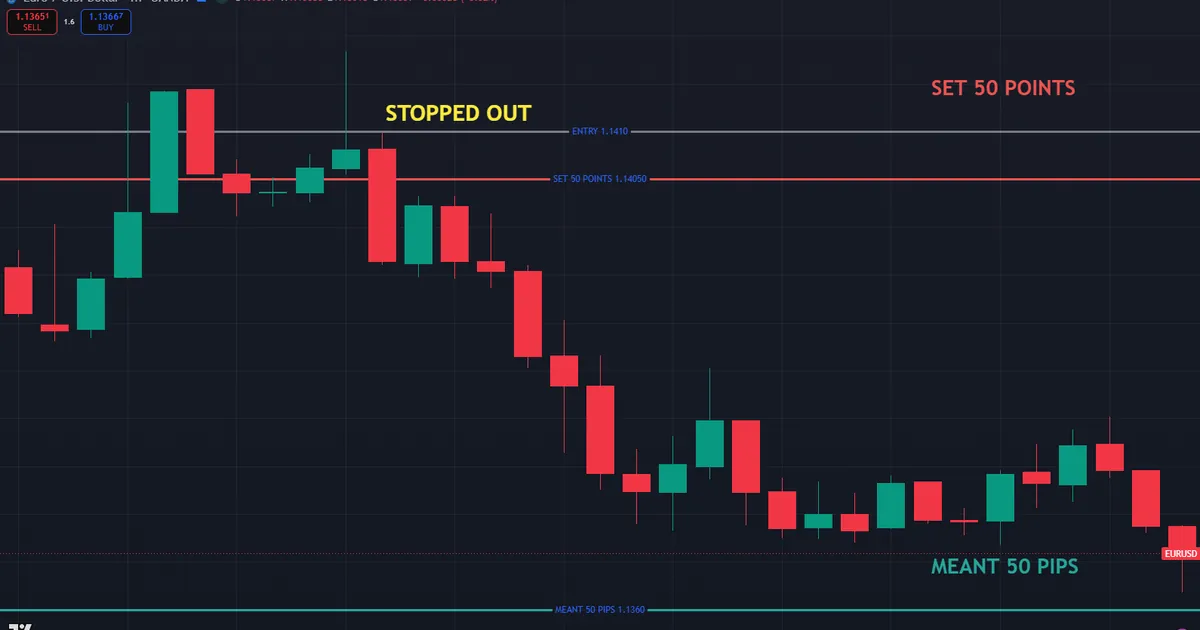
So a single wrong unit turned a sound plan into a quick loss. The guard is simple: read every input label and convert with the ten-to-one rule before you confirm. That one habit keeps a points field from quietly shrinking your carefully chosen stop.
Add one more safeguard before you commit. Glance at where the stop line actually sits on the chart after you set it. Because a mispriced stop looks obviously too tight or too wide, your own eyes catch the error even when the number slips past you.
Why Traders Still Talk in Pips
Despite the point living in the code, traders keep speaking in pips. The pip is a comfortable size, big enough to picture and small enough to be precise. So a fifty-pip run means something instantly, while fifty points sounds oddly tiny by comparison.
Follow the crowd here for good reason. Because almost every trader, chart, and forum quotes pips, your notes and conversations line up when you do the same. So reserve points for the moments a platform forces them, and think in pips the rest of the time.
Set your own default clearly. Decide that pips are your working unit and points are a translation you make only when asked. So every plan, journal entry, and target starts in pips, and the point stays a quiet helper rather than a source of confusion.
Ticks and Other Names
You will also meet the word tick, which adds one more label. A tick is simply the smallest price change an instrument can make, so on a five-digit forex feed a tick equals a point. Different markets favor different words for the same idea.
Treat all these names as a small glossary. Pip is the standard unit, while point, pipette, and tick all describe the tiny step beneath it on forex. Because the words vary by market and platform, always confirm the size behind a term before you size a trade on it.
Keep the glossary short and clear. When a new term appears, ask only one question: how big is it against a pip. So the moment you place any label on the ten-to-one map, its meaning stops being a mystery and becomes a number you can use.
Points in Automated Trading
Automation raises the stakes on this mix-up. An expert advisor repeats the same point setting on every trade, so a wrong unit multiplies the error across dozens of positions. Our position size calculator helps you translate a point stop into the right lot so the whole plan stays consistent.
Indices and Other Markets
The word point means something else again outside forex. On a stock index, a point is a full unit of the index level, which is far larger than a forex point. So when you trade several markets, never carry the forex meaning of point across without checking it first.
Picture the gap in scale. A single point on a major index can be worth more than a hundred forex points on a currency pair. Because the same word covers such different sizes, a habit of checking the unit per market keeps your risk from drifting badly off target.
Related Concepts to Study Next
The pip-point split connects to the wider mechanics of pricing a trade, and a few ideas build on it directly. The pip itself deserves a deeper read, and the spread that you measure in pips ties the units to real cost. Both sharpen the way you size a position.
For the cost side, our guide to spread in forex shows how those pips price your entry. Then our calculate pip value guide turns a pip or point move into an exact money figure for any pair. For the wider plan, the forex trading strategies hub ties these units into full setups you can trade with a clear head.
FAQ
What is the difference between pips and points?
A pip is the standard unit of movement, the fourth decimal on most pairs. A point, in MetaTrader, is the smallest quoted step, the fifth decimal. So on a five-digit broker, one pip equals ten points. Casual speech sometimes uses point to mean pip, which adds to the confusion.
Is a point the same as a pipette?
Yes, on a five-digit broker a MetaTrader point and a pipette are the same size, both the fifth decimal, or 0.00001. Each is one tenth of a pip. So ten points and ten pipettes both equal one full pip on a standard pair.
Why does MetaTrader use points?
MetaTrader defines a point as the smallest price change the broker quotes, so its code can work on any instrument. That is why expert advisor inputs for stops and targets are usually in points. On a five-digit feed, you multiply your pip plan by ten to get the point value.
How do I convert pips to points?
Multiply pips by ten on a five-digit broker. A twenty-pip stop is two hundred points, and a fifty-pip target is five hundred points. To go the other way, divide points by ten. Always confirm your broker shows five decimals before applying the rule.
Do four-digit brokers change the rule?
Yes, a four-digit broker quotes no fifth decimal, so a point there equals a whole pip. The ten-to-one rule only applies to five-digit feeds. Because most brokers now use five digits, the pip equals ten points rule holds in nearly every modern case.
Which unit should I use for my stops?
Plan and record your trades in pips, since that is the standard traders share. Convert to points only when a platform or expert advisor asks for them. That keeps your journal consistent and your risk math clear. Results are not guaranteed; past performance is not indicative of future results.
External references
- For background on this concept, see Basis point at Investopedia.
- For broader market context, see Pip at Corporate Finance Institute.

About the author
Written by Dominic Walsh, a Forex trader and MT4/MT5 indicator, Expert Advisor and script developer. Every tool on forexmt4systems.com is tested on live charts before release and ships with ready-to-use compiled MT4 (.ex4) and MT5 (.ex5) files. Learn more about the trader and developer behind this site.
How we build, test and correct every tool: Editorial & Testing Policy. Trading carries risk; see the disclaimer.