
Learning how to calculate pip value turns a vague trade into a set of clear numbers. Once you know what a single pip is worth, you know the exact cost of every move for and against you.
This guide shows how to calculate pip value step by step, in plain beginner terms. You will meet one simple formula, then apply it to dollar pairs, yen pairs, and crosses with worked numbers you can copy on your own trades.
How to Calculate Pip Value, Step by Step
Pip value measures how much money one pip of movement adds or removes from a position. It depends on two things only: the size of your trade and the currencies in the pair.
The whole idea rests on one short formula. Pip value equals the pip size times the number of units you trade, measured in the quote currency. After that, you convert the result into your own account currency.
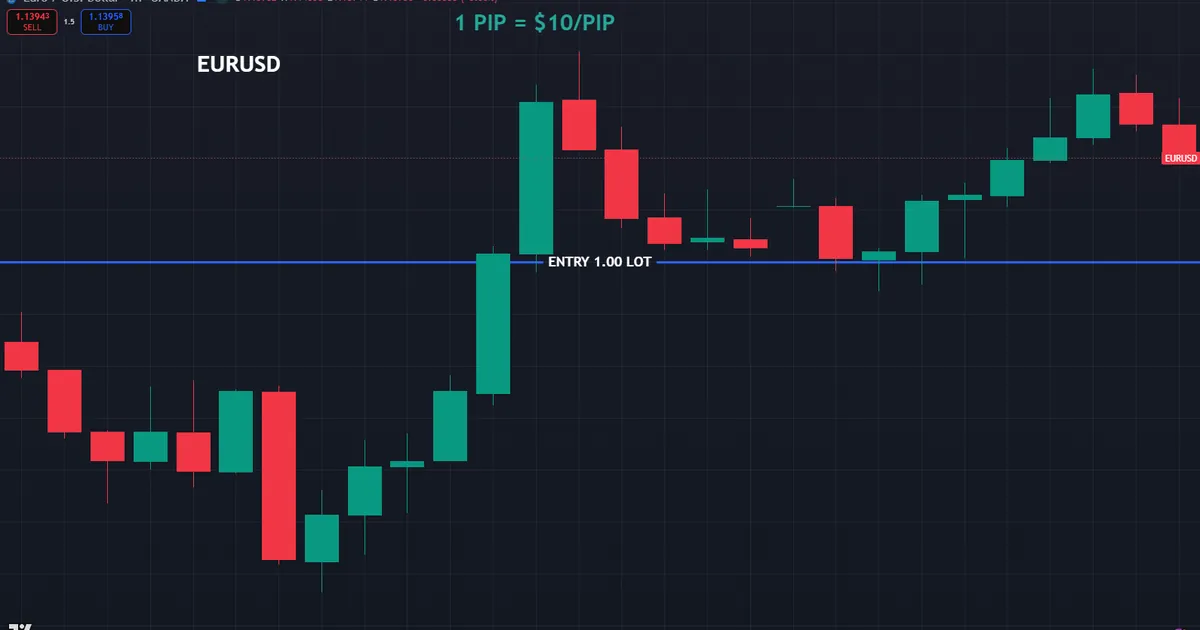
A pip is the standard smallest move on most pairs, which is 0.0001. On yen pairs a pip is 0.01, since those pairs quote to two decimals. So the pip size changes only between ordinary pairs and yen pairs, and nothing else.
The Core Formula in Three Steps
Break the calculation into three plain steps, and it never feels hard.
- Find the pip size. Use 0.0001 for most pairs, or 0.01 for any pair that ends in the yen.
- Multiply by the units. Multiply the pip size by your position in units. A standard lot is 100,000 units, a mini lot is 10,000, and a micro lot is 1,000.
- Convert to your account currency. The result sits in the quote currency, so convert it into your account currency using the current rate.
That third step is the one beginners forget. When the quote currency already matches your account, you can skip it. Otherwise a quick conversion keeps the figure honest, and our free pip value calculator handles it for any pair at once.
Why the Quote Currency Rules the Math
The quote currency is the second one in the pair. For EURUSD the quote is the dollar, and for EURGBP it is the pound. Because a pip moves the quote currency, that currency is where the raw pip value first appears.
So the pair splits the world into three neat cases. Sometimes the quote is your account currency, sometimes the base is, and sometimes neither currency touches your account. Each case needs the same formula, with a different final conversion, as the sections below show.
Why This Number Is Worth Mastering
Pip value is the bridge between the chart and your balance. A move of thirty pips means nothing until you attach a value to each pip. Once you do, that same move turns into a clear figure in your own currency.
The number also drives every sizing decision you make. You cannot pick a sensible lot until you know what one pip costs. So the pip value is not a side detail, it is the hinge that the whole risk plan swings on.
Case One: The Dollar Is the Quote Currency
This is the simplest case, and it covers many popular pairs. Think of EURUSD, GBPUSD, and AUDUSD, where the dollar sits second in the pair.
Run the formula on EURUSD at a standard lot. The pip size is 0.0001, and the units are 100,000, so the pip value is 0.0001 times 100,000. That gives ten units of the quote currency, which is ten dollars.
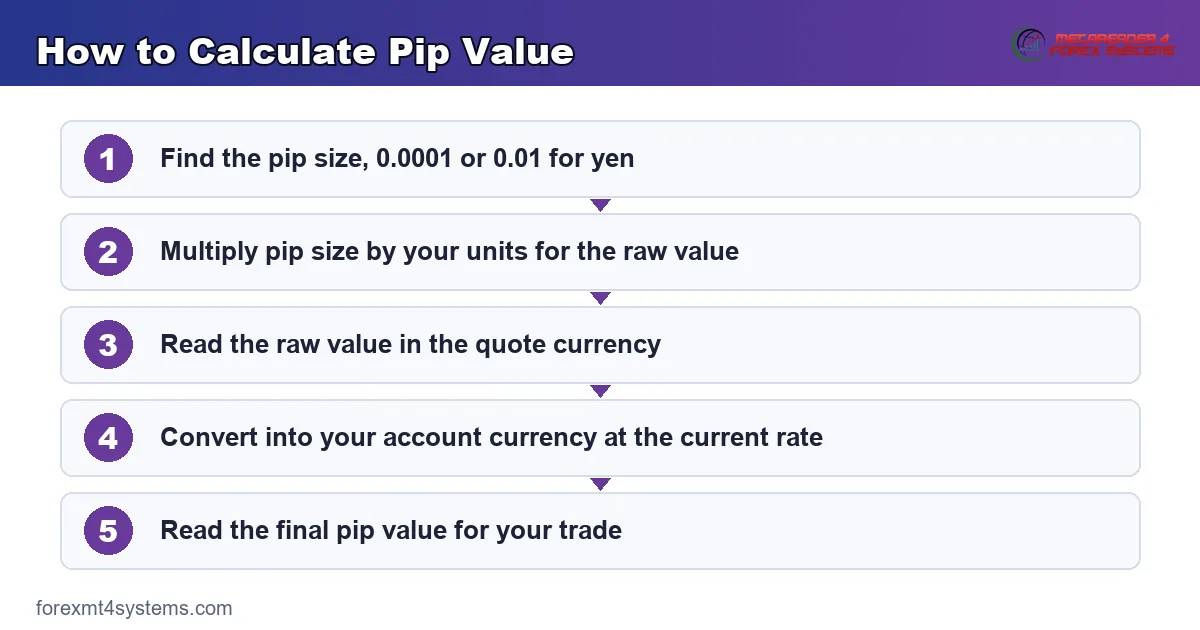
Because the quote is already the dollar, a dollar account needs no conversion. So the pip value stays at ten dollars for a standard lot, one dollar for a mini lot, and ten cents for a micro lot. It holds steady whatever the price does.
Why This Case Never Moves
Notice a handy quirk here. When the dollar quotes the pair, the pip value does not drift with the exchange rate. A standard lot is worth ten dollars a pip whether EURUSD trades near 1.14 or near 1.20.
That stability makes dollar-quoted pairs the friendliest place to start. You can memorize the ten, one, and ten-cent figures and reuse them all day. So many beginners trade these pairs first, precisely because the pip value never surprises them.
Case Two: The Dollar Is the Base Currency
Now flip the pair around. On USDJPY, USDCHF, and USDCAD the dollar sits first, so the quote currency is the yen, the franc, or the Canadian dollar. Here the pip value does move with the price.
The formula still starts the same way. You find the pip value in the quote currency, then convert it back into dollars. Because the quote-to-dollar rate is simply one divided by the pair price, that conversion becomes a single division.
A Yen Pair Worked Example
Work through USDJPY near 162.00 at a standard lot. The pip size is 0.01, and the units are 100,000, so the pip value is 0.01 times 100,000. That gives 1,000 yen per pip, before any conversion.
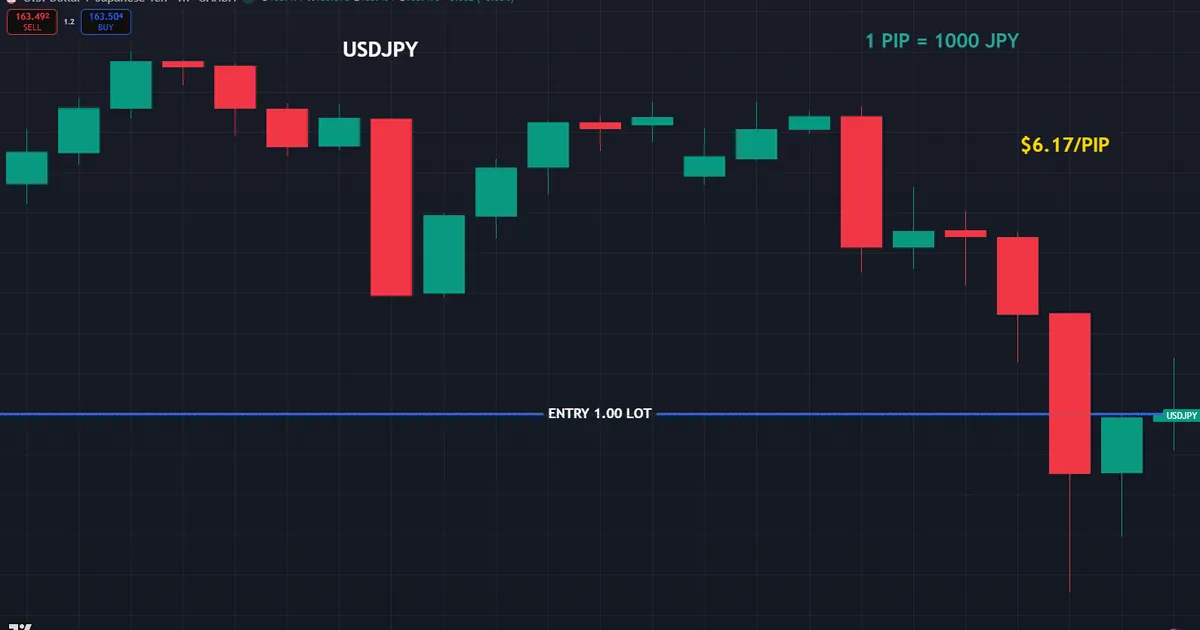
Now convert the 1,000 yen into dollars. Divide 1,000 by the price of 162.00, and you get about 6.17 dollars per pip. So a standard lot on USDJPY is worth roughly six dollars and seventeen cents a pip, not ten.
Scale that down for smaller lots. A mini lot on the same pair is worth about sixty-two cents a pip, and a micro lot about six cents. Because the figure depends on the price, it drifts a little as USDJPY moves through the day.
Download the complete indicator database
Put these concepts on your charts. One email unlocks the full library of 1,380+ indicators with compiled MT4 and MT5 files, plus my TradingView scripts. No paywall, no spam, unsubscribe any time.
Get free access to my indicator database
One email unlocks 1,380+ free MT4, MT5 and TradingView indicators — the complete library. No single-tool download; you get the whole database.
A Dollar-Base Example on the Loonie
Try USDCAD near 1.37 for a second pass. The pip size returns to 0.0001, and a standard lot is 100,000 units, so the raw pip value is ten Canadian dollars. That figure sits in the quote currency, the Canadian dollar.
Divide those ten Canadian dollars by the price of 1.37, and you land near 7.30 dollars per pip. So the same standard lot swings about seven dollars and thirty cents a pip here. The method matched the yen pair exactly, only the numbers changed.
Case Three: A Cross Pair With No Dollar
Some pairs skip the dollar entirely, such as EURGBP or EURJPY. These crosses need one extra hop, since neither currency matches a dollar account. The formula, though, does not change at all.
Start with EURGBP at a standard lot. The pip size is 0.0001, and the units are 100,000, so the pip value is ten pounds. That result sits in the quote currency, the pound, which is not your dollar account.
Converting the Cross Into Dollars
Take the ten pounds and convert them using GBPUSD. If GBPUSD trades near 1.34, then ten pounds is ten times 1.34, which comes to about 13.40 dollars. So a standard lot on EURGBP is worth roughly thirteen dollars and forty cents a pip.
The rule generalizes cleanly. Find the raw pip value in the quote currency, then multiply by that currency’s rate against your account currency. Because a cross always leaves the value in a third currency, that final conversion is never optional.
A Yen Cross Example on EURJPY
Yen crosses blend both twists into one trade. Take EURJPY near 183.00 at a standard lot. The pip size is 0.01, and the units are 100,000, so the raw pip value is 1,000 yen, exactly as on USDJPY.
Now convert the 1,000 yen into dollars through USDJPY near 162.00. Divide 1,000 by 162.00, and you land near 6.17 dollars a pip once more. So a yen cross behaves much like a plain yen pair, since the yen still sits as the quote.
How Pip Value Feeds Your Lot Size
Pip value does not sit alone; it decides the size you can trade. Once you know what one pip costs, you can work backward from a risk limit to a lot. So the pip value is the middle link in the sizing chain.
Picture a fifty dollar risk on a fifty pip stop. Divide the risk by the stop, and you need a pip value near one dollar. That points straight at a mini lot on a dollar-quoted pair, since a mini lot is worth about a dollar a pip.
The Same Chain on a Yen Pair
Watch how the yen figures change the answer. Suppose you again want a one dollar pip value on USDJPY near 162.00. A standard lot there is worth about 6.17 dollars a pip, so a single mini lot lands near sixty-two cents.
So you would size a little above one mini lot to reach a dollar a pip. Because the pip value differs from the dollar-quoted case, the lot that matches your risk differs too. The chain stays the same, yet the yen pip value bends the final size.
Letting a Tool Close the Loop
You can run this chain by hand once you trust the steps. Still, a tool saves time and guards against a slip on live trades. So many traders calculate a pip value to learn, then lean on a calculator to confirm it before they click.
The habit blends understanding with speed. You keep the judgment that comes from knowing the math, while the tool handles the arithmetic. Because both work together, you size a lot faster without losing the feel for where the number comes from.
Common Pip Value Mistakes
The formula is short, yet the same slips appear on trade after trade. Most come from skipping a step or reusing the wrong number, and the fixes sit under the graphic below.
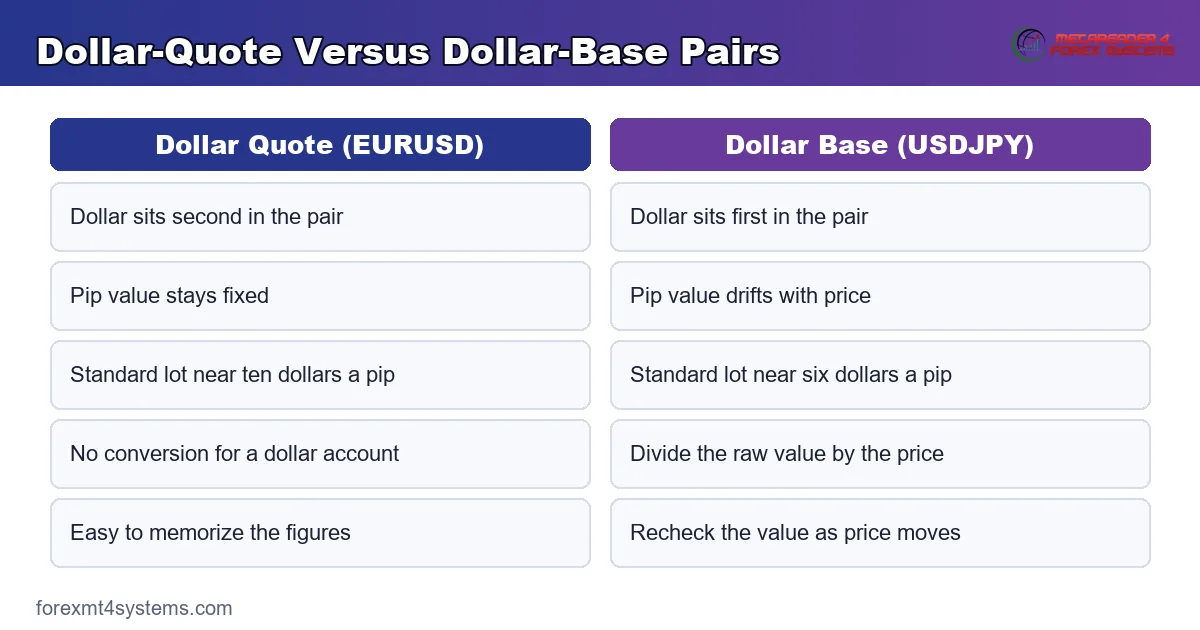
Assuming Ten Dollars on Every Pair
The ten dollar figure only fits dollar-quoted pairs at a standard lot. A trader who borrows it for USDJPY overstates the pip value by more than a third. So confirm the quote currency first, and only reuse ten dollars when the dollar quotes the pair.
Forgetting the Yen Pip Size
Yen pairs use a pip of 0.01, not 0.0001. A beginner who plugs in the wrong pip size lands ten times off the true value. So check the pair for a yen quote before you pick the pip size, and let that guide the math.
Skipping the Conversion Step
On a cross the raw value sits in a third currency, not your account. Reading it as dollars quietly misstates the risk. So always finish with the conversion, and never treat the mid-formula number as your final pip value.
Mixing Up Pips and Pipettes
Many brokers quote a fifth decimal, called a pipette, which is a tenth of a pip. A trader who counts pipettes as pips inflates the move tenfold. So read the price carefully, and count the fourth decimal as the pip on most pairs.
Reusing a Stale Yen Figure
Pip values on dollar-base pairs drift as the price moves. A USDJPY figure from last week may not fit today. So refresh the value when the pair has traveled far, rather than trusting an old number on a fresh trade.
Pip Value on a Non-Dollar Account
Many traders hold an account in euros, pounds, or another currency. That choice adds a conversion to every pair, even the dollar-quoted ones. So the friendly ten dollar figure needs one more hop before it fits a euro account.
The formula still holds without change. You find the raw pip value in the quote currency, then convert it into your own account currency at the end. Only the final rate differs, since your account currency is no longer the dollar.
A Euro Account on EURUSD
Take a euro account trading EURUSD at a standard lot. The raw pip value is ten dollars, exactly as before. Now convert those ten dollars into euros using EURUSD near 1.14, which means dividing by 1.14.
Ten dollars divided by 1.14 comes to about 8.77 euros a pip. So the same standard lot that a dollar account reads as ten dollars, a euro account reads as roughly nine euros. The trade is identical, only the account currency reframes the number.
Keeping the Account Currency Straight
The safest habit is to run every calculation in your real account currency. A dollar trader can lean on the ten, one, and ten-cent figures directly. A euro or pound trader should convert each one before trusting it, since the defaults assume a dollar account.
So decide your account currency once, then stick to it in every pip value you compute. Because the conversion is easy to forget, a fixed routine keeps your risk figures honest across every pair you trade.
Pip Value Quick Reference
Keep this short list handy while you size a trade. It captures the whole method in a few lines.
- Pip size is 0.0001 on most pairs, or 0.01 on yen pairs.
- Raw pip value equals pip size times your units.
- Dollar-quoted pairs need no conversion for a dollar account.
- Dollar-base pairs divide the raw value by the pair price.
- Cross pairs multiply the raw value by the quote currency’s rate.
- A standard lot on a dollar-quoted pair is near ten dollars a pip.
Pip Value Pitfalls and Edge Cases
A few situations bend the simple formula, so keep them in mind. The chart below marks one common trap for a beginner on a yen pair.
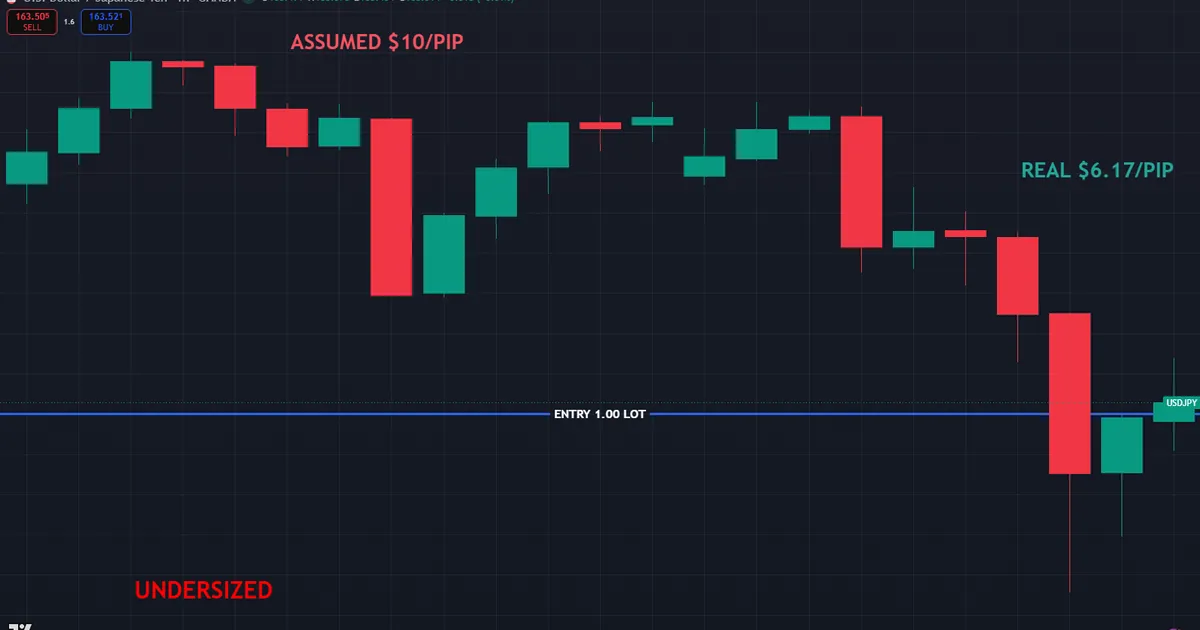
Picture a trader who sizes a USDJPY trade as if each pip were worth ten dollars. The real figure near 162.00 is closer to six, so the position ends up smaller than intended. The trade then risks far less than the plan called for, which quietly caps the reward too.
A reverse error hurts even more. Suppose a trader assumes six dollars on a dollar-quoted pair, where the true value is ten. That mistake oversizes the trade by more than half, so a wrong pip value can push risk either way. Only the correct figure keeps the whole plan intact and the loss inside its limit.
Pip Value Drifts on Dollar-Base Pairs
On USDJPY or USDCAD the pip value shifts as the price moves. A figure you calculated in the morning can differ by lunch. So recheck the pip value when a dollar-base pair has traveled far, rather than trusting a stale number.
Account Currency Changes Everything
These examples assume a dollar account, yet many traders hold euros or pounds. A different account currency adds its own conversion to every pair, even EURUSD. So run the math in your real account currency, not in dollars by default.
Metals and Indices Break the Pattern
Gold, silver, and index products define their own contract sizes and pip conventions. The forex formula does not carry over cleanly to them. So read the instrument’s specification first, and see our guide on gold pip value for the metals case.
The Spread Eats the First Pips
Pip value tells you what a pip earns, yet the spread takes a few pips up front. A trade starts slightly negative because you pay that gap on entry. So factor the spread into your target, since the first pips only cover the cost of getting in.
Related Concepts to Study Next
Pip value connects to the wider math of sizing a trade, and a few ideas deserve your next reading hour. The pip itself is the natural starting point, since everything here rests on it. Turning a pip value into a lot is the practical skill that follows, and it ties the numbers to real risk.
Begin with our guide on the pip in forex to lock in the basics. Then read how to calculate lot size in forex and review lot size in forex to see where the pip value leads. To turn any risk limit into a live size, our free position size calculator does the full chain for you.
FAQ
How do I calculate pip value?
Multiply the pip size by the number of units you trade to get the raw value in the quote currency. Use 0.0001 for most pairs and 0.01 for yen pairs. Then convert the result into your account currency using the current rate.
What is the pip value of a standard lot?
On a dollar-quoted pair such as EURUSD, a standard lot is worth about ten dollars a pip for a dollar account. A mini lot is worth about one dollar, and a micro lot about ten cents. Other pairs shift a little once you add the conversion step.
Why is the pip value of USDJPY not ten dollars?
On USDJPY the dollar is the base, so the raw pip value sits in yen and must convert back. Near a price of 162.00, a standard lot works out to about 6.17 dollars a pip. The figure also drifts as the pair moves through the day, so a fresh check beats an old number. Recompute it whenever the price has traveled a long way from your last reading.
How do I find pip value on a cross pair?
Start with the raw value in the quote currency, then multiply by that currency’s rate against your account currency. For EURGBP the raw value is ten pounds a pip on a standard lot. Multiply by GBPUSD near 1.34, and you get about 13.40 dollars. The same two-step method fits any cross once you know the quote currency’s rate.
Does pip value change with the lot size?
Yes, pip value scales directly with the number of units. A standard lot is worth ten times a mini lot, which is worth ten times a micro lot. So halving your lot halves the pip value on the same pair. The pair and its currencies decide the base figure, and the lot then scales it up or down to fit your trade.
Do I always need to convert the pip value?
You skip the conversion only when the quote currency already matches your account currency, such as EURUSD on a dollar account. Every other pair needs the final step to land in your real currency. Run the math in your account currency, and manage risk on every single trade with care. Results are not guaranteed; past performance is not indicative of future results.
External references
- For background on this concept, see Pip explained at Investopedia.
- For broader market context, see Basis point on Wikipedia.

About the author
Written by Dominic Walsh, a Forex trader and MT4/MT5 indicator, Expert Advisor and script developer. Every tool on forexmt4systems.com is tested on live charts before release and ships with ready-to-use compiled MT4 (.ex4) and MT5 (.ex5) files. Learn more about the trader and developer behind this site.
How we build, test and correct every tool: Editorial & Testing Policy. Trading carries risk; see the disclaimer.