
Trading without a stop loss sounds bold, and plenty of traders swear by it for a while. So why does trading without a stop loss carry such a bad name among people who last in this game? The short answer is simple: one bad trade can undo months of careful work.
This guide lays out the honest case for skipping a hard stop, then weighs it against the real dangers. So by the end, you will see why the tactic can survive many trades yet still ruin an account on a single day.
Trading Without a Stop Loss, in Plain Terms
A stop loss is a resting order that closes a trade once price reaches a set level. Trading without a stop loss means you skip that order and rely on something else to protect the account.
That something else is usually a mental note, a hedge, or a very wide margin buffer. So the position stays open with no automatic exit, and you carry the full move until you act by hand or the broker steps in.
Here is the key point most beginners miss. Removing the stop does not remove the risk; it only removes the automatic brake. So the loss still builds tick by tick, yet nothing halts it on your behalf.
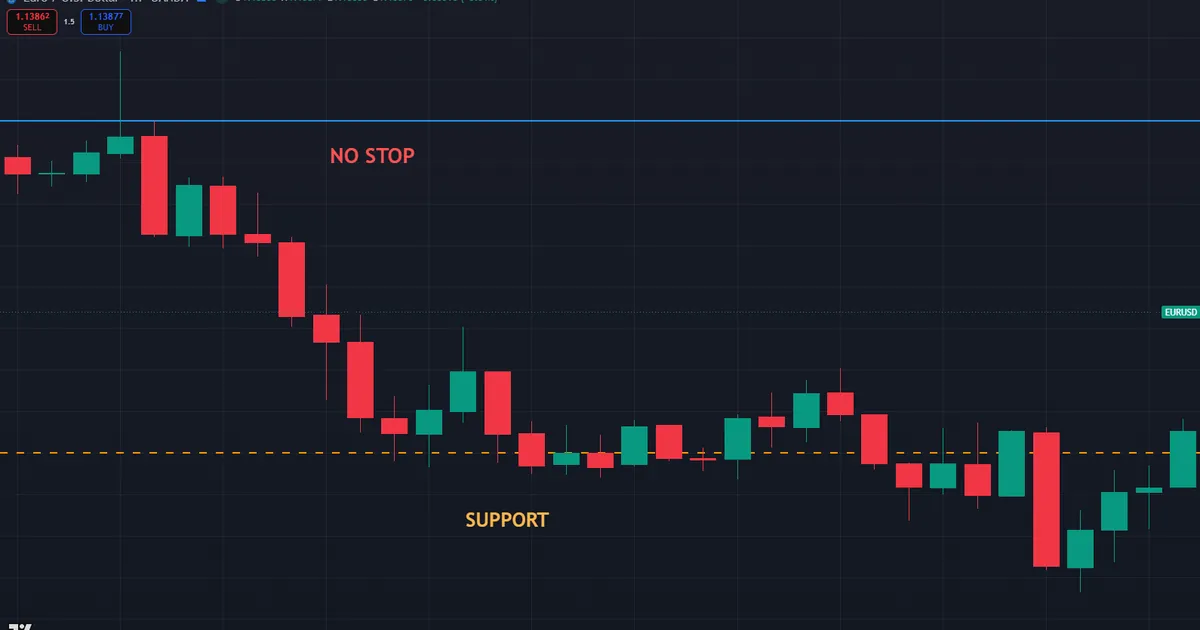
Notice how the danger hides in plain sight. A trade with no stop can drift against you quietly, then lurch fast when news hits. Our free drawdown calculator shows how quickly an unchecked loss eats into equity.
Why Some Traders Skip the Stop
The case is not pure folly, so hear it out first. Many traders complain that a hard stop gets hit by a brief spike, only for price to snap back the way they wanted. So they feel the market hunts their exact level.
Others argue that a fixed stop forces them out of a good idea too soon. They would rather watch the screen and judge each moment. So they trade the position by feel, not by a resting order.
The Three Common Substitutes
People who drop the hard stop rarely trade with no plan at all. Instead they lean on one of three crutches, and each has a hidden flaw. The numbered list below sets them out before we test each one.
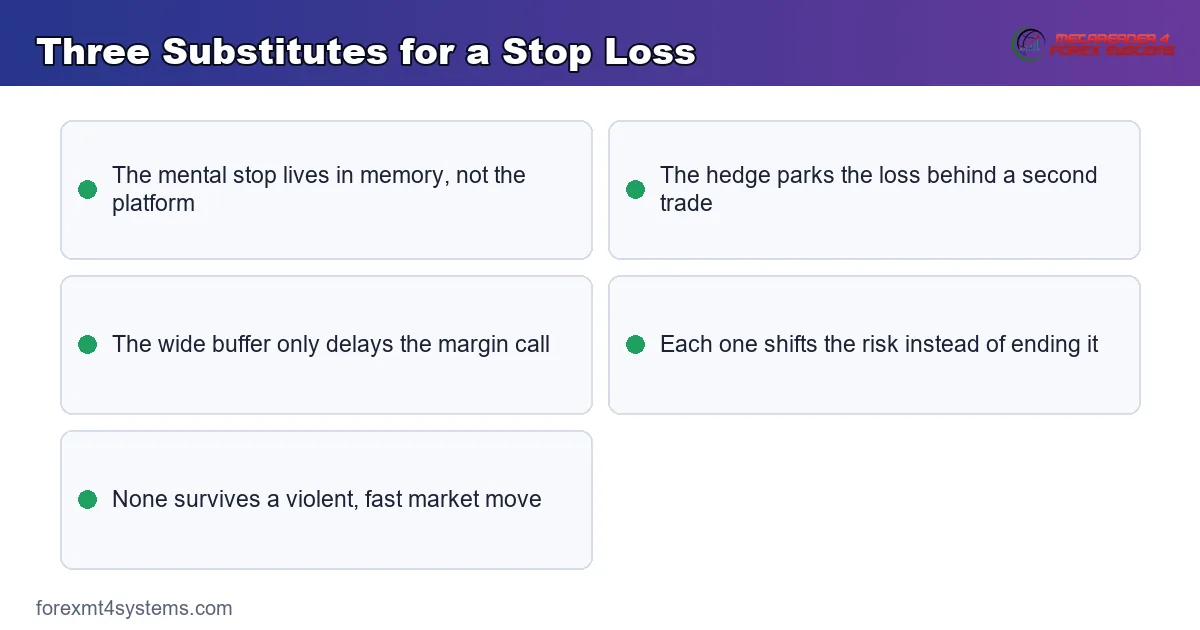
So the substitute matters as much as the missing stop. A mental exit needs iron discipline. The hedge needs a second correct decision. Meanwhile a wide buffer needs a calm, funded account. Each one shifts the risk rather than removing it.
How Traders Try to Replace the Stop
Let us walk through the three substitutes in order, since each fails in its own way. The mechanics look reasonable on paper, yet they lean on human nerves or on luck.
- The mental stop. You pick an exit level in your head and promise to close the trade there. So the plan lives in memory, not in the platform.
- The hedge. You open an opposite position to freeze the loss once a trade turns sour. So a second trade caps the first, at the cost of extra spread and complexity.
- The wide margin buffer. You keep the account far from a margin call, hoping price returns before the buffer runs dry. So a fat balance stands in for a real exit.
Each substitute can work on a calm day, so the trader gains false confidence. Yet none of them survives a violent move. Because the market does not warn you, the crutch tends to fail on the worst possible bar.
Where the Mental Stop Breaks
A mental stop asks you to act against your own hope. Price reaches your level, and now you must book a real loss on purpose. So the very emotion that a stop removes comes flooding back at the worst moment.
Most people hesitate, then move the level lower to buy a little room. That small slip repeats, and a modest loss grows into a large one. So the mental stop often becomes no stop at all.
Where the Hedge Breaks
A hedge freezes the loss, yet it also freezes the problem. Now you hold two trades and owe spread on both. So you have doubled the decisions without fixing the first mistake.
Then you must unwind the hedge at the right time, which is a fresh guess. Get it wrong, and the loss can widen on either leg. Because two hard calls replace one, the hedge rarely simplifies the trade.
Where the Wide Buffer Breaks
A wide buffer looks like the safest crutch of the three. You keep the balance far from a margin call, so an ordinary swing never threatens the account. So the trade seems to breathe with plenty of room.
Yet the buffer only buys time, not safety. A long adverse run still eats the cushion pip by pip, and the forced close waits at the far end. Because the exit arrives at the worst level rather than a chosen one, the buffer trades a small planned loss for a large surprise.
There is a quieter cost too. A trade sitting open for days ties up margin you could use elsewhere. So the buffer method locks your capital while it drifts, which drags on the rest of the account.
Trading Without a Stop Loss With Real Numbers
Numbers make the danger concrete, so walk one through with care. Say you buy one standard lot of EURUSD near 1.14 with two thousand dollars in the account.
Each pip on that lot is worth about ten dollars. So a fifty pip drop costs five hundred dollars, or a quarter of the balance. A stop would cap the pain right there.
Now remove the stop and let the trade run. If price falls two hundred pips over a rough session, the loss reaches two thousand dollars. So the account is gone, wiped by a single move that a stop would have trimmed to a fraction.
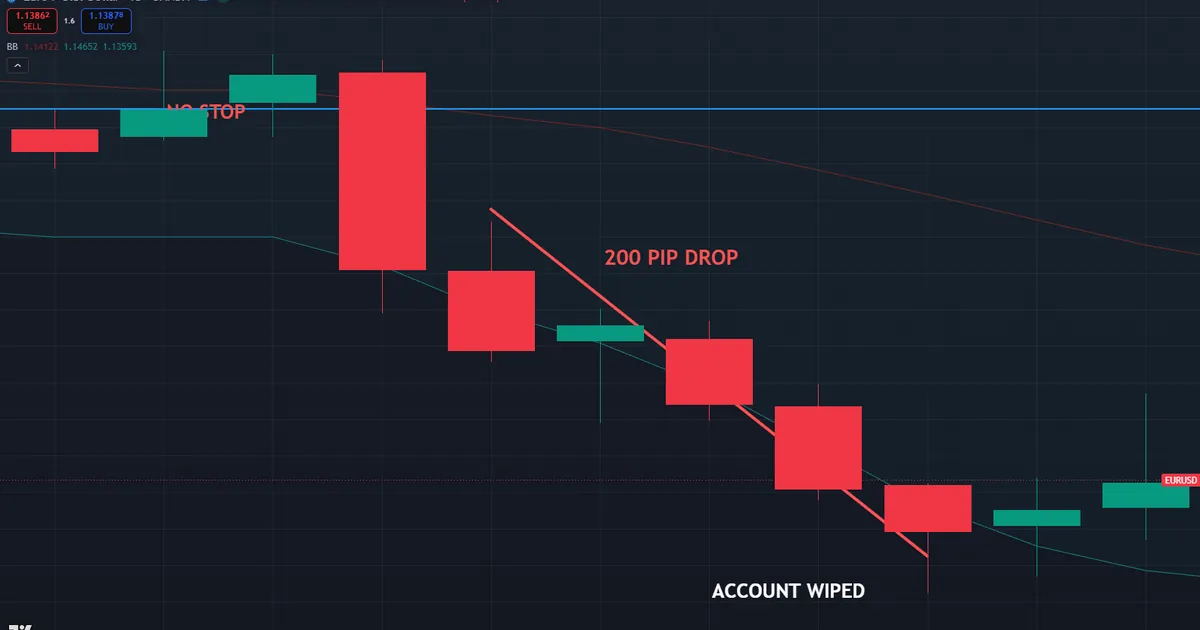
Then picture a gap. Price closes Friday near 1.14 and reopens Sunday near 1.12 on a weekend shock. No stop can fill inside that gap, so the loss lands in full the instant the market opens. Our position size calculator helps you cap that exposure before you ever click buy.
Compare that with a stopped version of the same trade. You place the exit twenty pips below entry, so the worst case is a two hundred dollar loss. So the gap still hurts, yet the account survives with room to trade again.
The difference is not luck; it is structure. A sized, stopped trade turns a scary event into a manageable one. Because the cap was set in advance, the shock finds a limit already in place.
The Math of One Bad Day
The cruel part is the speed of the damage. A careful trader might grind out small gains for weeks. So the equity curve climbs in gentle steps.
Then one un-stopped trade drops through a key level and keeps falling. Because the loss has no cap, it can erase every one of those small wins at once. So months of patience vanish in an afternoon.
Why the Odds Look Fine, Then Fail
Here lies the trap that fools smart people. Most trades never reach a disaster level, so a no-stop style wins again and again. So the trader reads a long streak as proof the method is safe.
Yet the rare huge loss is baked into the approach, not removed from it. When it lands, it dwarfs the pile of tiny wins. So a run of easy success hides a risk that only shows up once.
Comparing a Stop With No Stop
Set the two styles side by side to see the trade-off clearly. A hard stop books many small, known losses across a year of trading. So the account bleeds a little often, yet it never bleeds out.
The no-stop style flips that pattern. It wins more often, since most trades never reach a disaster level. Yet its losses have no ceiling, so a single event can dwarf a year of gains.
Because the rare loss decides the outcome, the average trade tells you almost nothing. So judge a method by its worst plausible day, not by its win count. That habit alone steers most traders back toward a simple, defined stop.
What a Defined Stop Buys You
A defined stop hands you three gifts at once. First, it caps the loss at a number you chose in a calm moment. So the damage from any trade stays within a slice you can afford.
Second, it lets you size the position with real math. You divide your risk limit by the stop distance, and the lot size falls out. So the stop and the account limit work together to keep each bet sane.
Third, it frees your attention. With the exit resting in the platform, you need not watch every tick in fear. So you trade calmer, and a calmer trader makes fewer rash errors.
Download the complete indicator database
Put these concepts on your charts. One email unlocks the full library of 1,380+ indicators with compiled MT4 and MT5 files, plus my TradingView scripts. No paywall, no spam, unsubscribe any time.
Get free access to my indicator database
One email unlocks 1,380+ free MT4, MT5 and TradingView indicators — the complete library. No single-tool download; you get the whole database.
Common Myths About Skipping the Stop
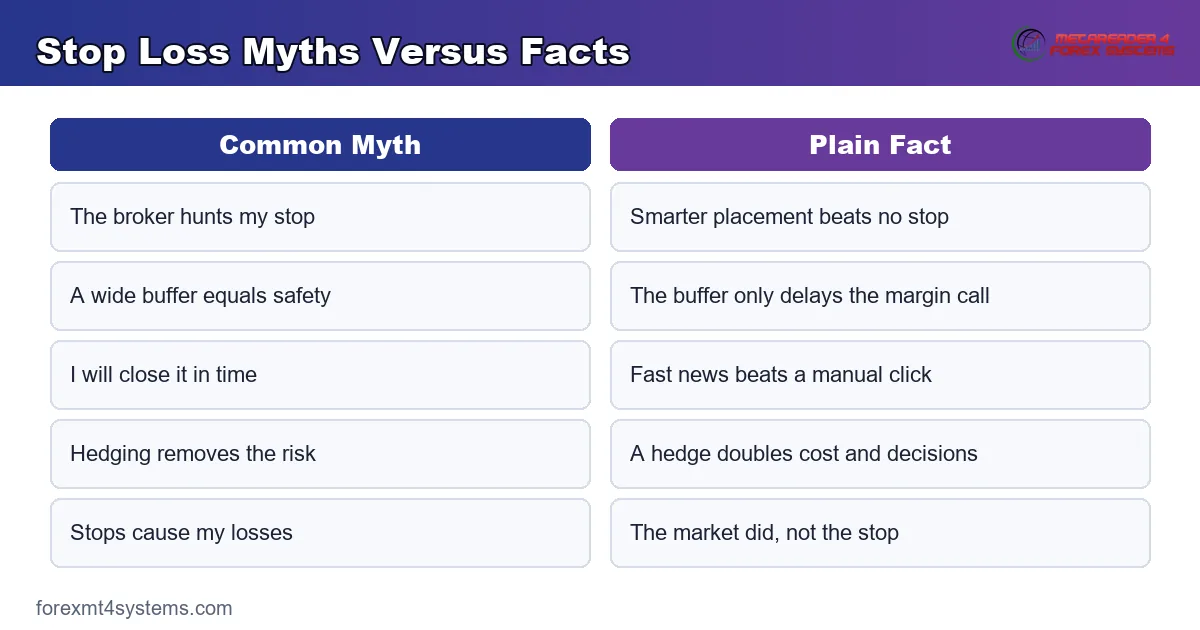
Several beliefs keep this habit alive, and each one crumbles under a close look. The concept graphic below sets the myths against the plain facts, and the fixes follow beneath it.
Myth: The Broker Hunts My Stop
Many traders blame stop hunting for their exits. Sometimes price does spike into a cluster of obvious stops near round numbers. Yet the fix is smarter placement, not a missing stop. So set the level beyond the noise, below real structure, where a spike is unlikely to reach.
Myth: A Wide Buffer Equals Safety
A large balance feels like armor, so the account survives many bad moves. Yet the buffer only delays the margin call; it never cancels it. So a long adverse run still drains the cushion, and the forced close arrives at the worst level of all.
Myth: I Will Close It Myself in Time
Confidence in your own reflexes is the costliest myth. In calm markets you might exit on cue. Yet during fast news, spreads widen and prices leap, so your manual click lands far past the level you wanted. Because emotion peaks exactly then, the plan to exit by hand tends to fail when it matters most.
Myth: Hedging Removes the Risk
A hedge feels like a safety net, yet it merely parks the loss. You still owe the difference plus the extra costs. So instead of one clean decision, you face two tangled trades and a widening bill. The cleaner path is a single stop that ends the risk outright.
Myth: Stops Cause My Losses
It is tempting to blame the stop for a red trade. Yet the stop only reports a loss the market already handed you. So removing it does not erase the loss; it just hides it until the number grows larger. A stop turns a small, known cost into a fixed line you can plan around.
No-Stop Risk Quick-Reference
Keep this short list beside your platform while the habit forms. A few seconds of reading here can spare a costly lesson later. So glance at it before every entry until the math feels natural, and treat it as a pre-trade ritual.
- A missing stop removes the brake, never the risk.
- A mental stop only works if you always obey it.
- One standard lot of EURUSD loses about ten dollars per pip.
- A two hundred pip run with no stop can erase a small account.
- No stop fills inside a weekend gap, so the full move lands at once.
- A wide buffer delays the margin call; it does not cancel it.
- Size every trade from a known stop distance, then place the order.
Edge Cases That Catch Traders Out
Study the sharp corners as hard as the smooth path, because they do the real damage. Here is the classic one. A trader skips the stop, wins for weeks, and starts to believe the market owes them nothing.
Then a scheduled release blows price through a level in seconds. The un-stopped position keeps sinking, and the broker closes it by force near the low. The chart below marks that case, where a NO STOP position runs into a MARGIN CALL after a sharp move.
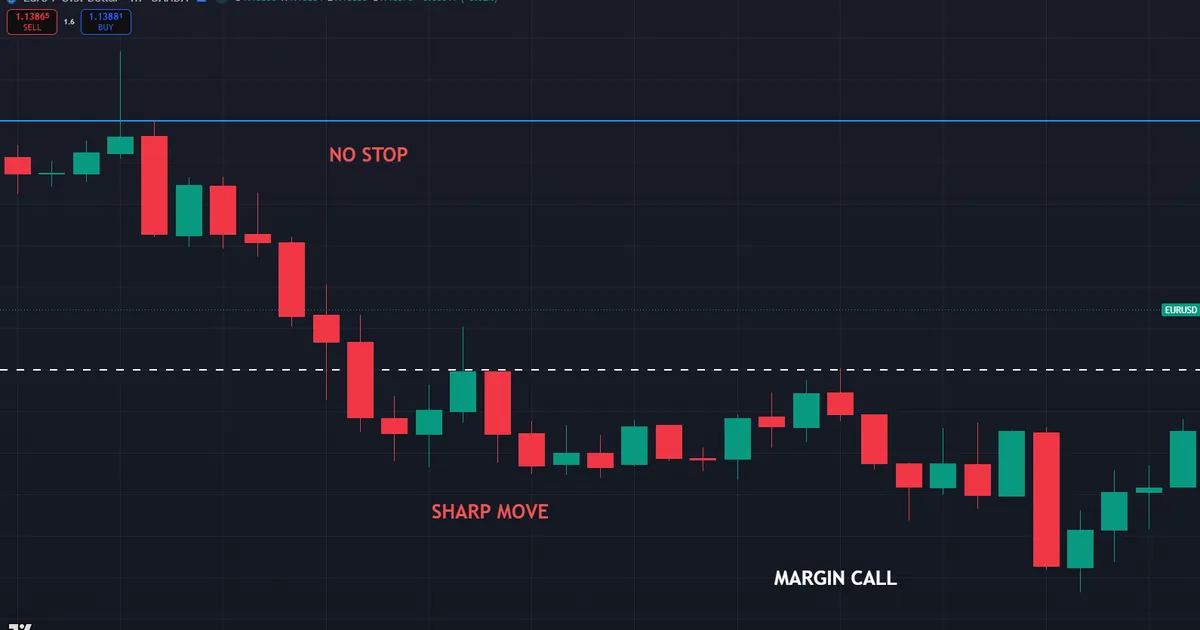
So what went wrong? The trader read a run of wins as proof of safety. Because the position had no cap, a single fast move drained the free margin. Our guide to risk of ruin shows how one oversized loss lifts the odds of wiping the account.
The lesson repeats across nearly every blown account you will ever read about. A method can look flawless for a long stretch, then hand back everything in one bad session. So the win count flatters you right up until the very day it fails you.
Guard against that day rather than admire the streak. A defined stop caps the worst trade, so no single event can end the run. Because survival comes first, the stop protects the very account that lets you keep trading through the next chance.
Un-Stopped Trades Around News
Respect the calendar when a trade has no cap. Around a central-bank decision, price can jump many pips in a heartbeat. So a position that felt safe in quiet hours can lurch hard the moment the words hit the wire.
Give yourself a real exit before scheduled news, then. A resting stop at least closes the trade at a defined level. Because these bursts pass quickly, a capped loss usually beats a wild manual scramble.
The Averaging-Down Spiral
A no-stop trade often tempts a second sin. Price falls, so the trader adds more to lower the average entry. So a losing position grows larger instead of closing.
Then a further drop hits a bigger size, and the loss compounds. Because each add-on raises the stake, the account can empty faster than a single trade ever would. A stop on the first entry stops that spiral before it starts.
When No Stop Meets High Leverage
Leverage and a missing stop form a brutal pair. High leverage means a small deposit backs a large position, so each pip lands hard. Remove the stop, and a modest move can swallow the whole deposit.
So the two habits multiply each other rather than add up. A capped loss keeps leverage useful; an uncapped one turns it into a trap. Trim size and keep the stop, and the leverage stays a tool rather than a threat.
Thin Liquidity and Slippage
Quiet hours hide a special danger for an un-stopped trade. Late in the trading week, the book thins out and spreads widen. So a modest order can push price further than it would in busy hours.
Then a manual exit slips well past your intended level. Because the crowd has gone home, there is little on the other side to fill you. So the loss you meant to take grows in the gap between click and fill.
A resting stop does not escape slippage entirely, yet it acts the instant price arrives. So it usually beats a human who must first notice, decide, and click. That head start matters most when the market is thin and fast.
Related Concepts to Study Next
Trading without a stop sits inside a small family of risk topics, and a few reward your next reading hour. The proper way to place a stop comes first, and the wider habit of risk control sits right beside it. Both build directly on the ideas you just met.
For the fuller view, our guides to how to use a stop loss and to broader risk management in forex place the stop inside a complete plan. It also pays to see the bigger picture of survival, so our note on forex trading strategies shows where a stop fits a whole method. So master the stop first, then let each partner idea sharpen how safely you trade.
FAQ
Is trading without a stop loss ever a good idea?
For most traders, no. A missing stop removes the automatic brake while leaving the full risk in place. So a single fast move, gap, or news spike can drain an account that a stop would have protected. A few very well-funded professionals manage bare positions with strict rules, yet the tactic ruins far more accounts than it helps.
What happens if I trade with no stop and price gaps?
A gap is the clearest danger. Price can close on Friday and reopen far lower on Sunday, so no order fills inside the empty space. The full loss lands the instant the market opens. A stop cannot prevent every gap loss, yet a sized position keeps that loss survivable.
Is a mental stop as good as a hard stop?
Rarely. A mental stop asks you to book a real loss on purpose, at the exact moment hope screams to wait. Most traders hesitate and slide the level lower, so the loss grows. A resting order removes that emotion and closes the trade for you.
Does hedging replace a stop loss?
Not cleanly. A hedge freezes the loss, yet it doubles your decisions and your costs. You still must unwind the hedge at the right time, which is a fresh guess. So instead of one clean exit, you juggle two trades and a wider bill.
How do I stop getting spiked out of trades?
Place the stop beyond the noise, not inside it. Set the level below real structure or past a recent swing, where a brief spike is unlikely to reach. Then size the trade so that wider stop still risks only a small slice of the account. Smarter placement beats no stop every time.
How much should I risk per trade instead?
A common guide is a small, fixed share of the balance, often around one percent. You find the lot size by dividing that risk by the stop distance in pips and the pip value. So the stop and the risk limit set the size together. Results are not guaranteed; past performance is not indicative of future results.
External references
- For background on this concept, see Stop-Loss Order at Corporate Finance Institute.
- For broader market context, see Stop-Loss vs Stop-Limit Orders at Investopedia.

About the author
Written by Dominic Walsh, a Forex trader and MT4/MT5 indicator, Expert Advisor and script developer. Every tool on forexmt4systems.com is tested on live charts before release and ships with ready-to-use compiled MT4 (.ex4) and MT5 (.ex5) files. Learn more about the trader and developer behind this site.
How we build, test and correct every tool: Editorial & Testing Policy. Trading carries risk; see the disclaimer.