
What is lot size in forex? It is simply the amount of currency a single trade controls, counted in units of the base currency. Get this one number right, and every other risk figure on your platform falls neatly into place.
This guide explains what is lot size in forex in plain, beginner terms. You will learn the four standard sizes, see how each one sets your pip value, work through a real trade, and read a lot size on your own screen with confidence.
What Is Lot Size in Forex, Explained
Lot size answers one simple question. How many units of the base currency does a single trade buy or sell? A larger lot moves your balance faster, while a smaller lot moves it more gently.
Brokers group lot sizes into named tiers so traders share one language. Each tier sits ten times above the one below it. So the jump from micro to mini to standard stays easy to follow once you know the units.
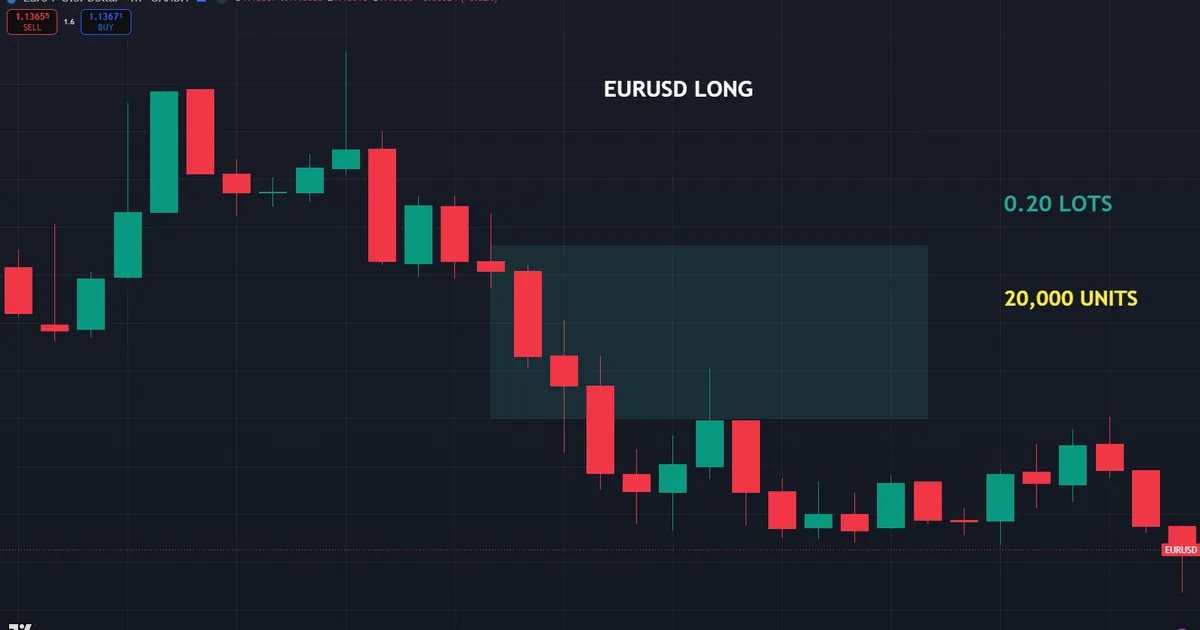
The base currency is the first one in the pair. For EURUSD the base is the euro, so a lot buys or sells euros against the dollar. For GBPUSD the base is the pound, and the same logic holds. Because the lot counts base-currency units, the euro or the pound is what you are truly sizing.
The Four Standard Lot Sizes
Four sizes cover almost every retail trade. The list below shows the units behind each name, from the largest down to the smallest.
- Standard lot. One standard lot equals 100,000 units of the base currency. Traders write it as 1.00 lots on the platform.
- Mini lot. One mini lot equals 10,000 units, or 0.10 lots.
- Micro lot. One micro lot equals 1,000 units, shown as 0.01 lots.
- Nano lot. One nano lot equals 100 units, where a broker offers it. Not every broker does.
Notice the pattern here. Each step multiplies the units by ten, so the sizes line up neatly. Because the platform shows a decimal form, 0.20 lots simply means twenty micro lots, or 20,000 units.
Why Lot Size Deserves Your Attention
Beginners often obsess over the entry price and skip the lot size. Yet the lot decides how much money each pip moves, so it drives the real outcome of a trade. A perfect entry on too large a lot can still empty an account.
Think of the lot as the volume dial on your risk. Turn it up, and every win and every loss grows louder. Turn it down, and both soften. So the dial, not the entry alone, sets how a single trade feels on your balance.
This is why professionals size before they think about targets. They know the entry may be right or wrong, yet the lot decides how badly a wrong call stings. So they set the size to survive a losing streak, and let the winners take care of themselves.
How Lot Size Sets Your Pip Value
Lot size and pip value travel together as a pair. The bigger your lot, the more each pip is worth, so the two numbers rise and fall in step.
A pip marks the standard smallest move on most pairs, equal to 0.0001. On a dollar-quoted pair such as EURUSD, one pip on a full standard lot is worth ten dollars. Scale the lot down, and that figure scales with it.
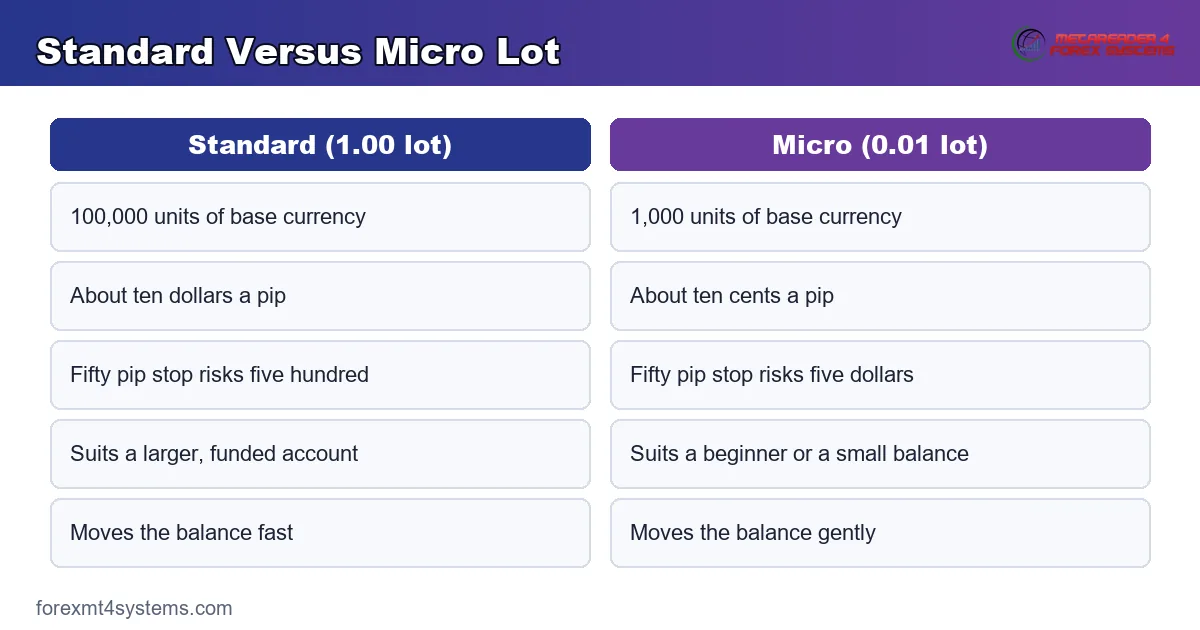
The reason is direct arithmetic. Pip value equals the pip size times the number of units. For a standard lot that is 0.0001 times 100,000, which comes to ten units of the quote currency. When the dollar is the quote, those ten units are simply ten dollars.
Pip Value by Lot Size
Here is how the pip value falls as the lot shrinks, using a dollar-quoted pair for a clean example.
- Standard lot. One pip is worth about ten dollars.
- Mini lot. One pip is worth about one dollar.
- Micro lot. One pip is worth about ten cents.
- Nano lot. One pip is worth about one cent.
These figures hold whenever the dollar is the quote currency. For other pairs the pip value shifts a little, so our free pip value calculator works it out for any pair in a second. To learn the math yourself, read our guide on how to calculate pip value.
How the Platform Shows Your Lot
Most trading platforms label the size field as volume or lots. You type a decimal there, such as 0.05 or 1.00, and the platform reads it as lots. So 0.05 means five micro lots, or 5,000 units of the base currency.
Watch that decimal closely before you confirm. A slip from 0.10 to 1.00 multiplies your risk tenfold in one keystroke. Because the field sits right beside the buy button, a careful glance there saves many painful surprises.
A Worked Lot Size Example
Numbers make the idea concrete, so walk through one trade. You decide to buy EURUSD near 1.14, and you choose a lot size of 0.20.
First, translate the lot into units. A size of 0.20 lots equals 20,000 units of the euro, since 0.20 times 100,000 gives 20,000. That is your position, marked on the chart below.
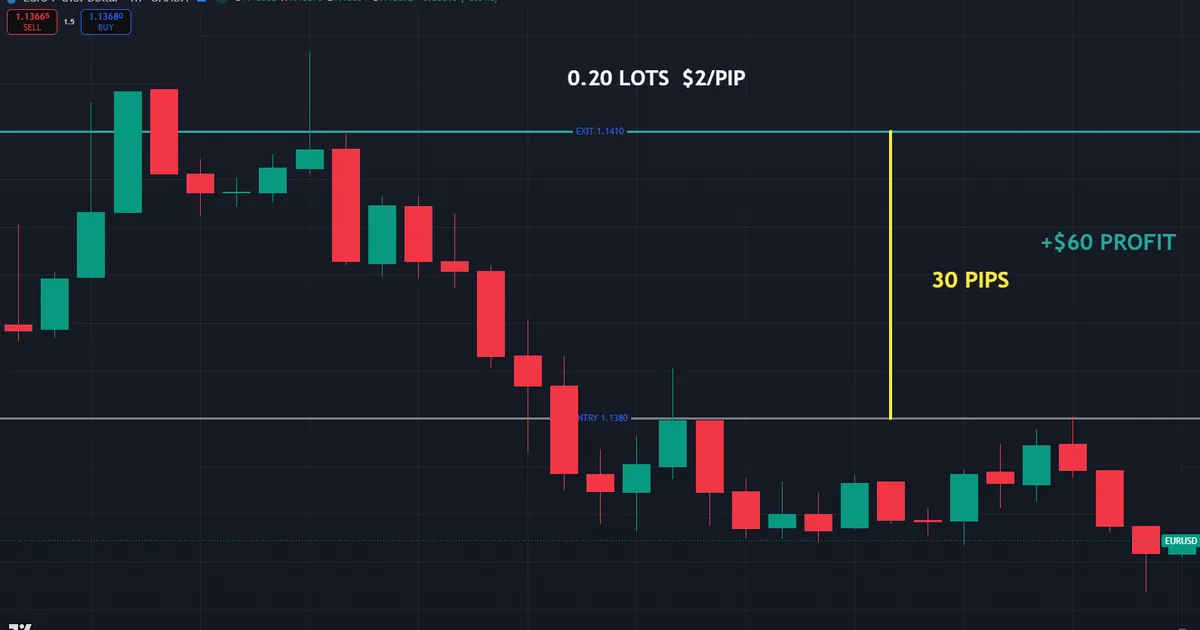
Next, find the pip value. At 0.20 lots the pip value is 0.20 times ten dollars, which comes to two dollars per pip. So a move of thirty pips in your favor earns sixty dollars, while the same move against you costs the same amount.
Now stretch the example. Suppose the trade runs fifty pips your way before you close it. At two dollars per pip, fifty pips returns one hundred dollars. Meanwhile a fifty pip loss would cost that same hundred, which is why the stop distance matters as much as the lot.
Reading the Notional Size
The lot also fixes your notional exposure, meaning the full value of the position. Multiply the 20,000 units by the price near 1.14, and the trade controls about 22,800 dollars of currency.
That gap matters for a beginner. You may post only a small deposit, yet you still control the whole 22,800 dollars. Our guides on leverage in forex and margin in forex show how that small deposit controls such a large position.
Scaling the Same Trade Up or Down
Change only the lot, and the whole risk picture shifts. At 0.10 lots the same thirty pip move earns thirty dollars, not sixty. At 0.40 lots it earns one hundred and twenty. The entry and the stop stay identical, yet the money swings with the size alone.
So the lot is your lever for tuning risk to your balance. A larger account can carry a larger lot for the same comfort, while a small account needs a small one. Because the lever is so direct, sizing well is often what separates a steady beginner from a stressed one.
Lot Size and Your Risk Percent
Good sizing works backward from risk, not forward from a hunch. You first decide how much of the balance a single trade may lose. Then you pick the lot that keeps the loss inside that limit.
Most careful traders risk a small slice per trade, often around one percent. The lot size simply translates that percent into a position that fits your stop. So the size is a result of the math, never a random pick.
Working From Risk to Lot
Take a plain example on a five thousand dollar account. A one percent limit allows a fifty dollar loss on the trade. Your stop sits fifty pips away, so you need a pip value near one dollar to keep the loss at fifty.
A pip value of one dollar points straight at a mini lot, since a mini lot is worth about one dollar a pip. So the correct size here is 0.10 lots. Change the stop or the balance, and the lot changes with it, which is exactly the point.
Why the Stop Distance Matters
The stop and the lot pull against each other. A wider stop needs a smaller lot to hold the same dollar risk, while a tighter stop allows a larger one. So you cannot choose a lot sensibly until you know where the stop sits.
This link trips up many beginners. They set a fixed lot and then move the stop wherever the chart suggests, which quietly changes the risk on every trade. Instead, fix the dollar risk first, place the stop on the chart, and let those two numbers decide the lot.
A Second Example on a Micro Lot
Try the same idea on a smaller account for contrast. You hold one thousand dollars and risk one percent, so ten dollars is the limit for the trade. Your GBPUSD stop sits twenty pips away near 1.34.
Divide the ten dollar risk by the twenty pip stop, and you need about fifty cents a pip. That points to five micro lots, or 0.05, since each micro lot is worth about ten cents a pip. So the small account trades a small size, exactly as it should.
Notice how the method never changed. The same three inputs, balance, risk percent, and stop, produced the lot both times. Because the recipe stays fixed, you can size any trade on any pair the moment you know those three numbers. So the skill you build on one trade transfers cleanly to the next one.
Download the complete indicator database
Put these concepts on your charts. One email unlocks the full library of 1,380+ indicators with compiled MT4 and MT5 files, plus my TradingView scripts. No paywall, no spam, unsubscribe any time.
Get free access to my indicator database
One email unlocks 1,380+ free MT4, MT5 and TradingView indicators — the complete library. No single-tool download; you get the whole database.
Common Lot Size Mistakes
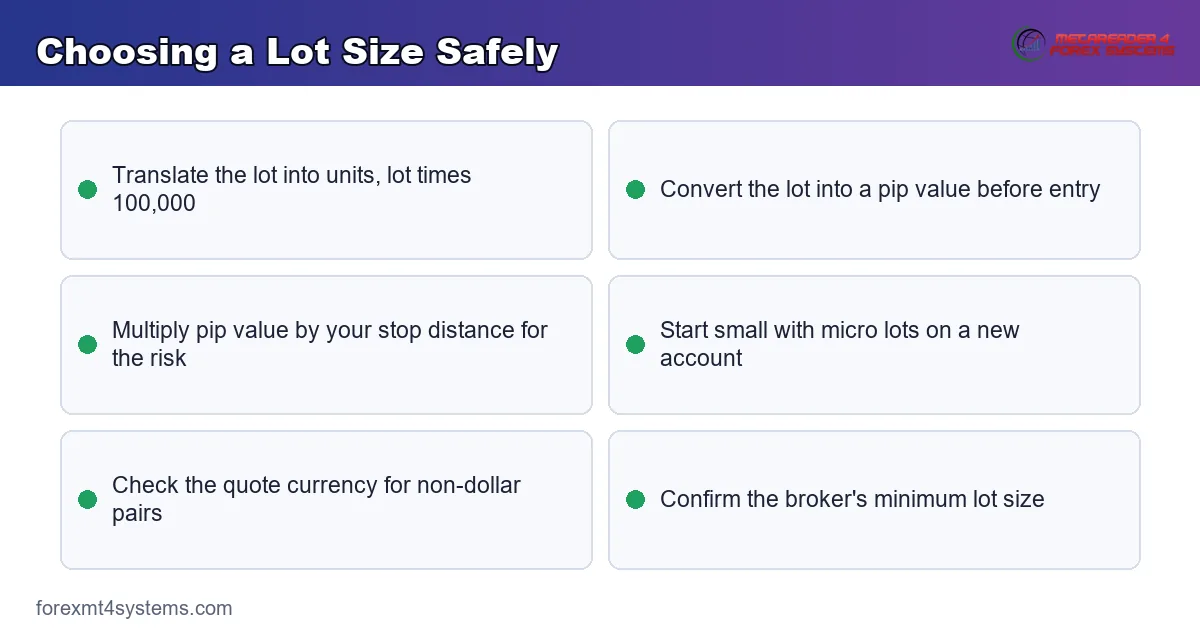
The concept is simple, yet the same errors trip up new traders again and again. Most come from choosing a size before checking the risk, and the fixes sit under the graphic below.
Trading Too Large for the Account
The classic slip is picking a full standard lot on a small balance. One pip then swings ten dollars, so a routine fifty pip stop puts five hundred at risk. Instead, start with micro lots, and let the account grow before you size up.
Ignoring the Pip Value
Many beginners set a lot size without knowing what each pip is worth. So a loss lands far harder than expected. Always convert your lot into a pip value first, and then you know the cost of every move before you click buy.
Copying Someone Else’s Lot Size
A size that suits a large account can wreck a small one. Because risk depends on your own balance, borrowing another trader’s lot rarely fits. Size from your own numbers instead, never from a screenshot online.
Forgetting the Quote Currency
Pip values shift when the dollar is not the quote currency. A trader who assumes ten dollars on every pair can misjudge the risk on a cross or a yen pair. So check the quote currency, and let a calculator settle the exact figure.
Adding to a Position Without Recounting
Traders often add a second lot to a winner and forget the total. Two 0.20 lots together behave like a single 0.40 lot, with double the pip value. So sum every open lot on the pair, and read the combined size as your true exposure.
Lot Size Quick Reference
Keep this short list beside your platform. Run through it before you set the size on any new trade.
- Standard lot equals 100,000 units, near ten dollars a pip.
- Mini lot equals 10,000 units, near one dollar a pip.
- Micro lot equals 1,000 units, near ten cents a pip.
- Nano lot equals 100 units, near one cent a pip.
- Lot times 100,000 gives the units behind the trade.
- Pip value times your stop distance gives the money at risk.
- Sum every open lot on a pair for your real exposure.
Lot Size Pitfalls and Edge Cases
A few situations bend these simple rules, so watch for them. The chart below marks one of the most common traps for a beginner.
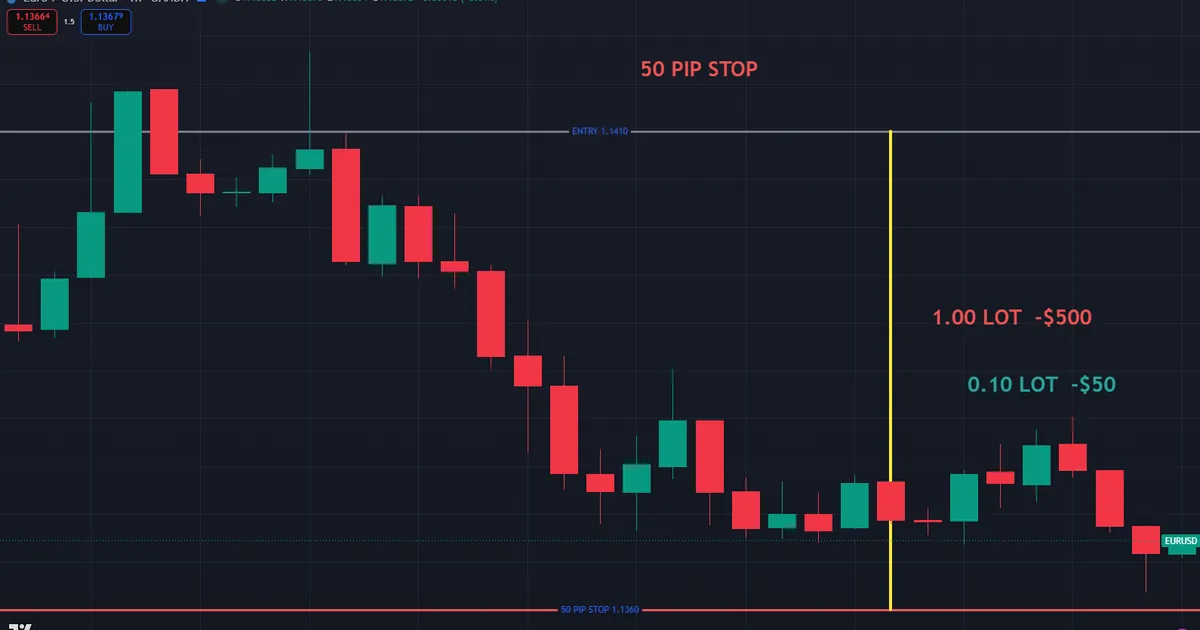
Picture two traders on the same fifty pip loss near 1.14. One holds a full standard lot and drops five hundred dollars, while the other holds a mini lot and drops fifty. Same chart, same stop, yet very different pain.
The lesson lands hard. Neither trader read the market better, and both took the identical loss in pips. Only the lot size decided who lost fifty dollars and who lost ten times that. So the size, chosen before entry, quietly wrote the outcome.
Fractional Lots and Broker Limits
Not every broker allows every size. Some set a minimum of 0.01 lots, while others go smaller with nano accounts. So check the minimum before you plan a tiny position, since the broker sets the floor.
Lot Size on Non-Dollar Pairs
The ten dollar pip rule only holds for dollar-quoted pairs. On a yen pair or a cross, the pip value changes with the exchange rate. So treat ten dollars as a starting point, and then confirm the real figure with a tool.
Contract Size on Gold and Indices
Lots work differently away from spot forex. On gold a standard lot is often 100 ounces, not 100,000 units, so the pip value math changes. Because each market defines its own contract, always check the instrument’s specification before you size a trade on it.
Weekend and Gap Risk
A lot that feels safe midweek can bite over a weekend. Prices can gap past your stop when the market reopens, so the fill may land worse than planned. Because the gap ignores your stop level, a smaller lot leaves more room for that shock.
So treat news events and weekends with extra care. Trim the lot before a major release if you plan to hold through it. That habit keeps a single gap from turning a routine loss into a heavy one.
How Lot Size Differs by Account Type
The lot names stay the same, yet the account you hold shapes which ones you can use. A cent account, a micro account, and a standard account each set a different practical floor. So the same 0.10 you type can feel very different across them.
Standard accounts usually start at 0.01 lots and step up in hundredths. Micro and cent accounts let you trade far smaller stakes, which suits a first live account. Because the tiers scale cleanly, the pip value math never changes, only the size you are allowed to enter.
Demo Versus Live Sizing
A demo account tempts you toward oversized lots, since the money is not real. Yet that habit carries over badly once real funds arrive. So size your demo trades exactly as you would size live ones, and practice the discipline as much as the strategy.
Match the demo balance to your planned live balance too. A demo funded with a hundred thousand teaches nothing about sizing a two thousand dollar account. Because habits form fast, a realistic demo builds the muscle memory you actually need.
Sizing as the Account Grows
Your lot should track the balance, not stay frozen. As the account grows, a fixed one percent risk supports a slightly larger lot on the same stop. So a size that fit last month may sit a touch small after a good run.
The reverse holds after a drawdown. When the balance dips, the same percent limit calls for a smaller lot, which protects what remains. Because the lot follows the balance, your risk stays steady while the dollar figures breathe.
Related Concepts to Study Next
Lot size sits at the center of a small web of sizing ideas, and a couple deserve your next reading hour. The pip value behind each lot is the natural next stop, since the two numbers work as a pair. Turning a risk limit into the right lot is the practical skill that follows, and it ties every idea together.
Start with our guide on how to calculate lot size in forex to turn a risk amount into a size. Then size any live trade with our free position size calculator, which does the math for you. Master the manual method first, and let the tool simply confirm a number you already trust.
FAQ
What is lot size in forex?
Lot size in forex is the number of base-currency units a single trade controls. Brokers group it into tiers: a standard lot is 100,000 units, a mini lot is 10,000, a micro lot is 1,000, and a nano lot is 100. The size you choose sets how much each pip is worth.
How many units is one lot?
One full standard lot is 100,000 units of the base currency. On the platform it shows as 1.00 lots. Smaller sizes scale down by tens, so 0.10 is a mini lot and 0.01 is a micro lot.
What lot size should a beginner use?
Most beginners start with micro lots at 0.01, where one pip is worth about ten cents. That small size keeps the money at risk low while you learn. You can scale up slowly as the balance and your confidence grow.
How does lot size affect pip value?
Pip value scales directly with lot size. On a dollar-quoted pair, a standard lot is worth about ten dollars a pip, a mini lot about one dollar, and a micro lot about ten cents. Double the lot, and you double the pip value.
Is a mini lot or a micro lot better for a new trader?
A micro lot usually suits a new trader better because it risks the least per pip. The smaller size lets you test a method with real money and modest losses. Move up to mini lots only once your account can absorb the larger swings. Patience here protects the balance while your skill catches up.
Can I trade less than a micro lot?
Some brokers offer nano lots of 100 units, where one pip is worth about one cent, but many do not go below a micro lot. Check your broker’s minimum before you plan a very small trade. Size every position from your own balance, and manage the risk on each one carefully. Results are not guaranteed; past performance is not indicative of future results.
External references
- For background on this concept, see Lot at BabyPips.
- For broader market context, see Round lot at Investopedia.

About the author
Written by Dominic Walsh, a Forex trader and MT4/MT5 indicator, Expert Advisor and script developer. Every tool on forexmt4systems.com is tested on live charts before release and ships with ready-to-use compiled MT4 (.ex4) and MT5 (.ex5) files. Learn more about the trader and developer behind this site.
How we build, test and correct every tool: Editorial & Testing Policy. Trading carries risk; see the disclaimer.