
Few messages rattle a new trader like a margin call in forex, yet the event is simpler than it sounds. It is your broker’s way of saying your account no longer holds enough cushion to keep every trade open. Catch it early and you stay firmly in control of the outcome.
This guide explains a margin call in forex and the stop out that can follow, all in plain steps. So by the end, you will know what each level means, how a broker closes trades, and the habits that keep your account far from either line.
What a Margin Call in Forex Means
A margin call is a warning, not the end of the world. It fires when your equity falls close to the margin locked behind your open trades. At that moment the broker flags to you that your cushion has worn dangerously thin.
So the call marks a threshold, and that threshold uses margin level. Recall that margin level equals equity divided by used margin, times 100. Many brokers set the margin call near 100 percent, where equity has slipped to match the locked margin.
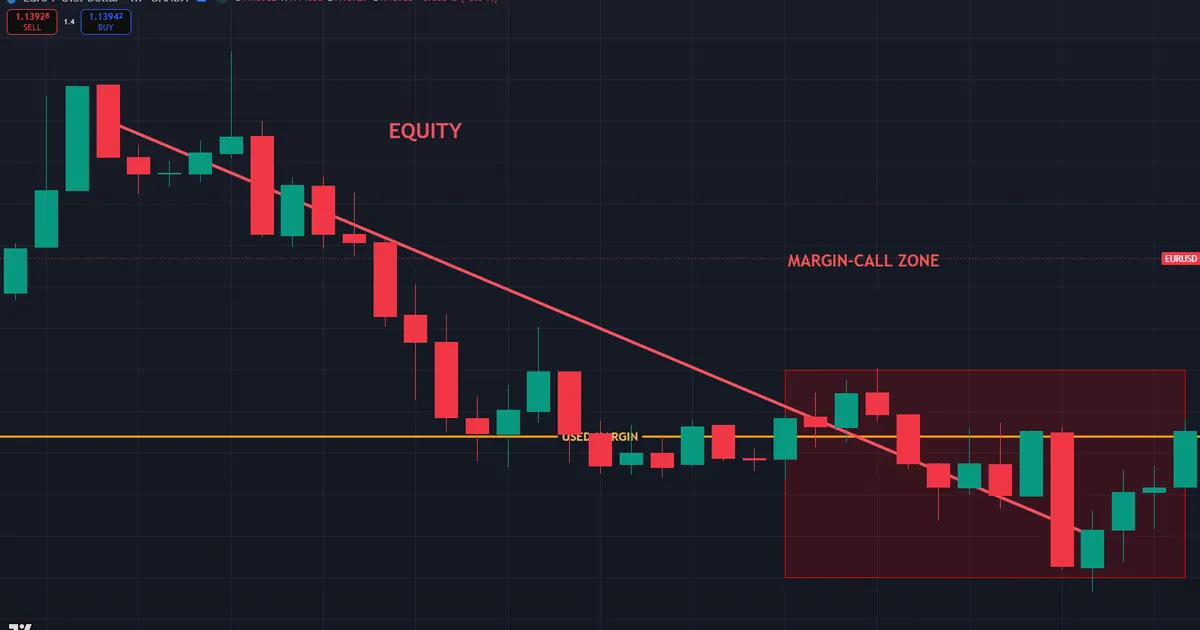
Here is the plain picture. As losses grow, your equity falls while used margin holds steady. So the margin level slides lower with each losing tick, and once it touches the call level, the warning lands on your screen. The chart below marks that slide with equity dropping into the MARGIN-CALL ZONE.
Treat the call as a smoke alarm. It does not put out the fire, yet it gives you time to act before real damage spreads. Our plain guide to margin level in forex covers the exact percentage that sets off this alarm.
Margin Call Level Versus Margin Call
Two similar phrases confuse many beginners, so split them cleanly. The margin call level is the threshold your broker sets, such as 100 percent. The margin call itself is the event that happens when your account reaches it.
So one is a line on the map, and the other is the moment you cross it. Because the level stays fixed while your account moves, you can watch the gap close in real time. That gap, not the call itself, is the real number worth guarding closely.
Why the Cushion Wears Thin
A cushion shrinks for two plain reasons. Floating losses pull your equity down, and fresh trades lift your used margin. Either one lowers the margin level and edges you toward the call.
So both over-trading and a bad run can spark the same warning on your account. A trader who opens too many positions at once can hit a call even without a single huge loss on any one of them. Because size and losses both matter, guarding the cushion means watching both at once.
How a Margin Call Works Step by Step
The process follows a clear order, so learn the sequence once. Each stage gives you a little more warning before the next, which is exactly why early action pays.
- Losses mount. Your open trades move against you, so floating losses drag equity down tick by tick.
- Margin level falls. As equity drops toward used margin, the margin level slides toward the call threshold.
- The call fires. Once the level reaches the broker’s mark, often 100 percent, the platform flags a margin call.
- New trades lock up. Many brokers block fresh positions at this point, so you cannot add risk.
- The clock ticks toward stop out. If losses keep growing, the margin level heads for the lower stop-out line.
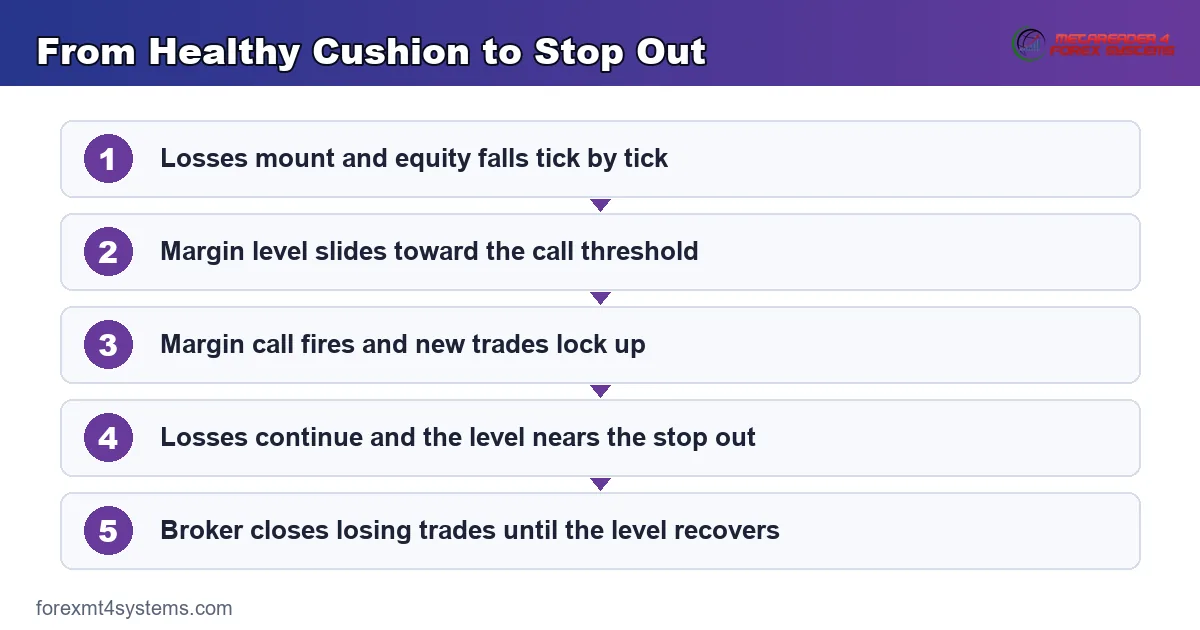
So a margin call is a stage, not the finish. The concept flow below traces the account from a healthy cushion, through the call, and on to the stop out if nothing changes.
One point gives you real power here. Because the call arrives before the stop out, it hands you a window to respond. So a trader who reacts at the call rarely meets the harsher line that waits below. That single window, used well, is the difference between a scare and a serious loss.
The Warning You Can Act On
A margin call asks for one of two simple moves. You can add funds to lift equity, or you can close a trade to cut used margin. Both push the margin level back up and away from danger.
So the call is a prompt, not a punishment. Because you still hold the choice at this stage, calm action beats panic every time. A trader who plans these two moves in advance handles the warning calmly and without any real stress.
The Stop Out Level Explained
The stop out is the harder line, and it removes your choice. It sits below the margin call, often near 50 percent, though it varies by broker. Once your margin level reaches it, the broker steps in directly.
So where a call warns, a stop out acts. The broker starts closing your open trades to lift the margin level back above the danger zone. That protects the broker from an account slipping into the negative.
Which Trades Close First
Brokers do not close everything at once. Most shut the largest losing position first, since that frees the most margin and lifts the level fastest. Then they check whether the account has recovered enough to stop.
So the stop out closes trades one by one until the margin level climbs clear. Because each close lifts the percentage, a single position may be enough to settle things. Still, a deep loss can force several to close in a row.
Partial Closes and the Recovery
A stop out often works in pieces rather than all at once. As the broker closes one losing trade, the used margin drops and the margin level jumps. So the process can pause the moment the account climbs back above the line.
This means a stop out need not empty your account. Because each close buys a little breathing room, a modest recovery can leave some trades still running. So the final state depends on how deep the loss ran before the closes began.
Why Brokers Force the Close
The stop out protects both sides, oddly enough. It stops your account falling past zero and into debt, which many regions now prevent by rule. It also shields the broker, who lent you the bulk of each position.
So the forced close is a safety valve, not a penalty. Because it caps the damage before an account goes underwater, it can save a trader from a far worse outcome. Even so, meeting the stop out means the market, not you, chose the exit. That loss of control is the real reason traders work so hard to stay well above the line.
Margin Call and Stop Out at a Real Broker
Numbers make the two lines concrete, so walk one through. Say you hold 5,000 dollars and open trades that lock 1,000 dollars of used margin near 1.14 on EURUSD.
At the start, your margin level reads 500 percent, a healthy cushion. Now the trades move against you. A 4,000 dollar loss cuts equity to 1,000 dollars, exactly the used margin, so the level hits 100 percent and the margin call fires.
Push the loss further and the stop out looms. A 4,500 dollar loss drops equity to 500 dollars, so the margin level reaches 50 percent. At that mark the broker begins closing trades. The chart below marks that moment as the STOP OUT triggers and positions close.
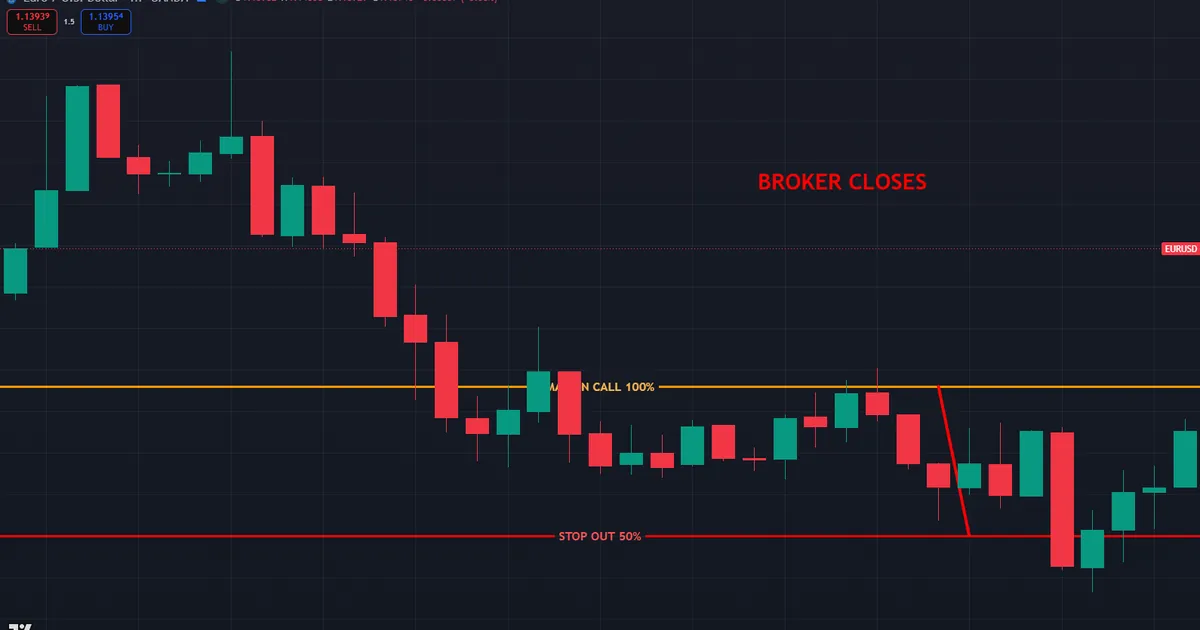
Notice the small gap between the two lines. Only 500 dollars of extra loss separated the call from the stop out here. So a fast market can carry you from the warning to a forced close in a matter of minutes. To test these levels for any pair and lot, our free margin calculator runs the numbers in a second.
A Second Worked Case
Try a heavier position to see how the gap tightens. Say the same 5,000 dollar account locks 2,500 dollars of used margin instead. Now the margin level starts at just 200 percent, far closer to the call.
So a smaller loss triggers the warning. A 2,500 dollar loss brings equity to 2,500 dollars, and the level hits 100 percent right there. Because the position was large, the same account reached the call twice as fast. Our position size calculator helps you keep the starting cushion wide.
Download the complete indicator database
Put these concepts on your charts. One email unlocks the full library of 1,380+ indicators with compiled MT4 and MT5 files, plus my TradingView scripts. No paywall, no spam, unsubscribe any time.
Get free access to my indicator database
One email unlocks 1,380+ free MT4, MT5 and TradingView indicators — the complete library. No single-tool download; you get the whole database.
Common Margin Call Mistakes to Avoid
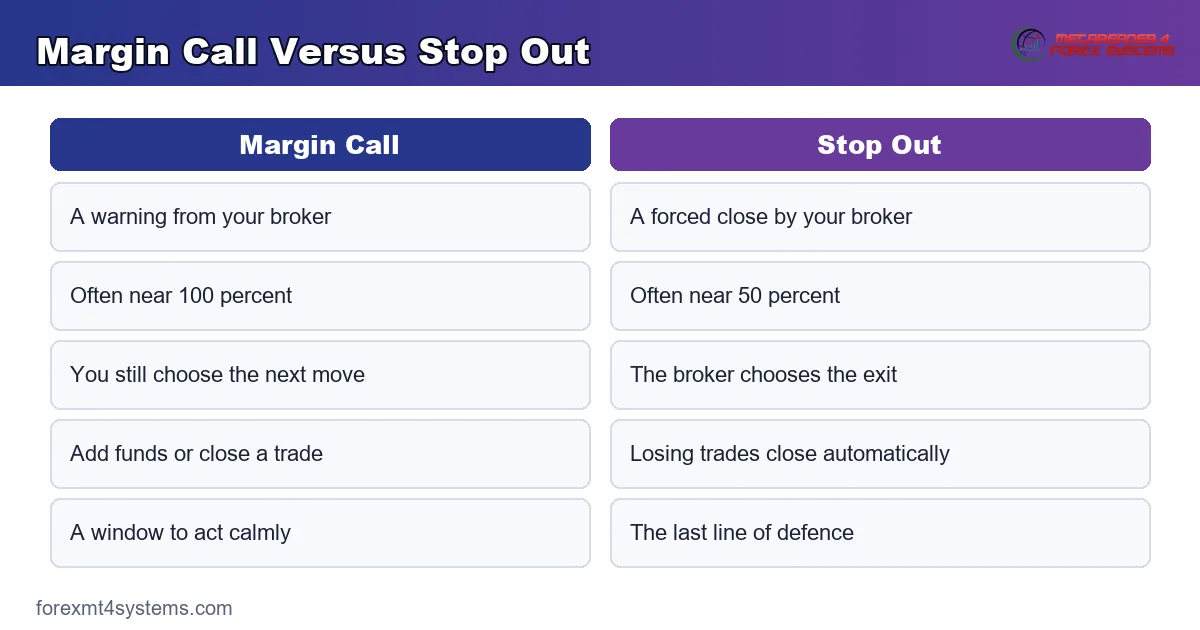
The idea is simple, yet the same errors sink new accounts. Most grow from ignoring the warning or from sizing so large that the call arrives early. The graphic below sets the margin call and stop out side by side, and the fixes follow beneath it.
Ignoring the Warning
Some traders freeze when a margin call lands and do nothing. The losses then roll on toward the stop out. So treat the call as a call to act, and choose to add funds or close a trade the moment it appears.
Adding Funds to a Losing Idea
Others rush to deposit more cash and keep a broken trade alive. That can throw good money after bad. So add funds only when the idea still holds, and lean toward closing when the market has clearly turned against you.
Sizing So Large the Call Comes Early
A big position sets a low starting margin level, so a small loss triggers the call. Many traders learn this the hard way. Instead size each trade so the account begins with a wide cushion above both lines.
Assuming Every Broker Uses 50 Percent
Stop-out levels differ from firm to firm, and some act well above 50 percent. A trader who assumes one number can be caught out early. So read your own broker’s call and stop-out levels, and manage the account against those exact figures.
Relying on a Stop Out as a Stop Loss
A stop out is not a risk plan, it is a last resort. Leaning on it means the broker picks your exit at the worst moment. So set your own stop loss on every trade, and let the stop out stay a line you never reach.
Forgetting Weekend and News Gaps
Prices can jump when markets reopen or when news hits, so equity can leap past the call in one move. A gap can even skip straight to a stop out. So trim size before big events, and never assume the two lines arrive in gentle order. A single gap can turn a comfortable cushion into a forced close before you reach the screen.
Trading Without Watching the Level
Some traders never open the account summary while a trade runs. They see only the price and miss the falling cushion beneath it. So keep the margin level in view, and let it warn you long before the broker ever has to.
Margin Call Quick-Reference Numbers
Keep this short list near your platform while the habit forms. A few seconds of checking here spares a costly surprise later. So read each line before you commit real cash, and glance at it until the figures feel familiar.
- Margin level equals equity divided by used margin, times 100.
- A margin call often fires near 100 percent, where equity matches used margin.
- A stop out often triggers near 50 percent, though brokers differ.
- At stop out, the broker closes trades, usually the largest loser first.
- A larger position sets a lower starting level and an earlier call.
- A personal warning line above the call gives you time to act.
- A real stop loss on every trade keeps the stop out out of reach.
Edge Cases That Catch Traders Out
Study the sharp corners as hard as the smooth path. Here is one that stings. A trader loads a heavy position, ignores a margin call during a quiet hour, and steps away from the screen.
Then a fast move deepens the loss. The margin level plunges through the stop-out line, and the broker closes the position at a poor price. The chart below marks that moment, where the STOP OUT fires and the trade closes without the trader’s say.
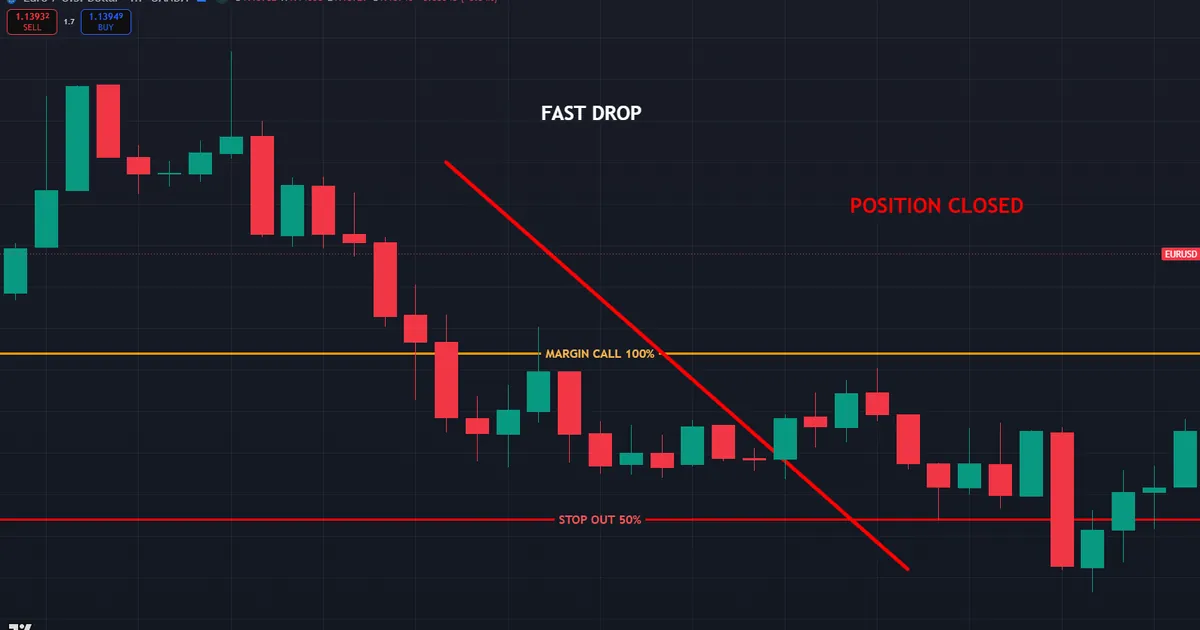
So what went wrong? The trader treated the call as noise rather than a cue. Because nothing changed after the warning, the market carried the account straight to the forced close. Our note on equity in forex shows how the falling figure at the top of the sum drives this whole slide.
Fast Markets and Slippage
A stop out does not promise a clean exit price. In a fast market, the closing trade can fill worse than the stop-out level implies. So the final loss can run a little past what the percentage suggested.
Plan for that slippage, then. Because a violent move can widen the gap, a wide starting cushion matters even more around volatile news. So a trader who sizes small leaves room for the messy fills that fast markets bring.
Leverage Sharpens Both Lines
High leverage pulls both the call and the stop out closer. A large position on a small deposit sets a low starting margin level, so a modest move reaches the warning fast. So the ratio you choose shapes how much room you begin with.
Lower your used leverage to widen that room. Because a smaller position starts at a higher margin level, it grants a longer runway before either line. Our guide to leverage in forex shows how the ratio and these lines connect.
How to Stay Clear of a Margin Call
Prevention beats any cure here, and the habits are simple. A margin call rarely surprises a trader who watches size and cushion together. So build these routines early and the warning stays a rare event.
Size Every Trade From Risk
Start each trade by deciding the most you will lose if the stop hits. Then pick a lot size that keeps that loss to a small slice of the account. Because the size flows from the risk, the starting margin level stays wide and the call stays distant.
Keep a Cash Buffer
Hold back a share of your balance rather than committing it all. A spare cushion absorbs a rough patch without dragging the margin level to the call. So an account with room to breathe rides out swings that close a fully loaded one.
Use a Stop Loss on Every Trade
A stop loss caps the damage long before the broker ever steps in. It closes a trade at a price you chose, not at the stop-out line. So a real stop keeps the margin call and stop out as lines you read about, rather than lines you meet.
Check the Account Before You Add a Trade
Before each new position, glance at where the margin level will land once it opens. If the figure would sit close to the call, skip the trade or trim the size. Because a quick check costs nothing, it spares you the stress of a warning later.
Related Concepts to Study Next
The margin call sits inside a small family of account terms, and a few reward your next reading hour. The percentage that triggers it comes first, and the deposit that sets your starting cushion sits right beside it. Both decide how close a call ever gets.
For the wider view, our guides to margin in forex and to broader forex trading strategies place these lines inside real risk control. So master the call and stop out first, then let each partner term sharpen how safely you size and hold every trade you take.
FAQ
What is a margin call in forex?
A margin call in forex is a warning that your account no longer holds enough cushion to keep every trade open. It fires when your margin level falls to the broker’s threshold, often near 100 percent. At that point you should add funds or close a trade before the account slides further.
What is the difference between a margin call and a stop out?
A margin call is a warning you can act on, while a stop out is a forced close. The call usually lands near 100 percent, and the stop out often near 50 percent, though brokers differ. So the call gives you a window, and the stop out removes your choice.
What happens at the stop out level?
Once your margin level reaches the stop-out line, the broker starts closing your open trades to lift it back up. Most brokers close the largest losing position first, then check whether the account has recovered. They keep closing trades until the margin level climbs clear of the danger zone.
Can I avoid a margin call?
Yes, with a wide cushion and modest size. Keeping your margin level well above the call, using a real stop loss, and avoiding oversized positions all help. So a margin call is far more a sign of over-trading than of bad luck.
Will a stop out close all my trades?
Not always. The broker closes trades one at a time, usually the largest loser first, and stops once the margin level recovers enough. A single close can be enough, though a deep loss can force several. So the exact number depends on how far the account fell.
How much time do I have after a margin call?
It depends on the market and the broker. In a calm market you may have hours to add funds or close a trade, while a fast move can carry the account to the stop out in minutes. So the safest plan is to act at once rather than count on having time.
Does a margin call cost extra money?
The call itself carries no separate fee, but the losses that caused it are real. If the account reaches a stop out, the closing trades lock in those losses at market prices. So the true cost is the loss on the trades, which careful sizing and a stop loss help you contain. Results are not guaranteed; past performance is not indicative of future results.
External references
- For background on this concept, see Margin call at Investopedia.
- For broader market context, see Margin call at BabyPips.

About the author
Written by Dominic Walsh, a Forex trader and MT4/MT5 indicator, Expert Advisor and script developer. Every tool on forexmt4systems.com is tested on live charts before release and ships with ready-to-use compiled MT4 (.ex4) and MT5 (.ex5) files. Learn more about the trader and developer behind this site.
How we build, test and correct every tool: Editorial & Testing Policy. Trading carries risk; see the disclaimer.