
Sound forex risk management strategies decide whether an account survives its first rough patch. The entry signal matters far less than most beginners think. What keeps you in the game is the discipline that sits behind every order.
This guide lays out forex risk management strategies as a short, practical checklist. You will size each trade by a fixed slice of the account, demand a minimum reward, guard your stops, cap correlated bets, and set a hard daily line. None of it is fancy, and all of it compounds.
What Forex Risk Management Strategies Really Do
Risk management does one job. It keeps any single trade, or any single day, from doing lasting damage. So the goal is survival first and growth second.
Beginners chase the perfect entry. Yet even a strong edge loses trades in clusters. A losing streak arrives sooner or later, and only your sizing decides whether that streak stings or ruins you.

Think of these strategies as guardrails on a mountain road. They will not drive the car for you. But they stop one bad moment from sending the whole trip off the cliff.
The best part is how little they ask. You do not need a rare talent or a secret indicator to apply them. You need only the patience to set each rule once and the discipline to keep it when a trade tempts you to bend.
So the strategies below are rules you set before the trade, not decisions you make during it. That timing is the whole point. Calm rules written in advance beat panicked choices made while money moves.
Why Survival Beats Prediction
Most beginners pour their energy into predicting the next move. That effort feels productive, yet the market humbles even sharp forecasts. So a plan built on being right often cracks the first time it is wrong.
Risk management flips the focus. It asks a calmer question: how do I stay solvent when I am wrong. Answer that well, and a modest edge has room to compound over years rather than blow up in weeks.
Consider two traders with the same signals. One risks ten percent a trade, and the other risks one. A rough streak barely dents the careful trader while it wipes out the reckless one. So the rules, not the signals, split their outcomes.
The Core Forex Risk Management Strategies
Seven habits carry most of the load. Read them once, then keep them beside your platform. Each one is simple, and together they form a full plan.
- Fixed percent risk. Risk the same small share of the account on every trade, often one percent.
- Reward-to-risk minimum. Skip any setup that pays less than your floor, such as one-to-1.5.
- Stop discipline. Every trade gets a stop before entry, and you never widen it.
- Correlation caps. Treat correlated pairs as one bet, and limit that combined exposure.
- Daily loss limit. Stop trading for the day once losses hit a set line.
- Scaling with equity. Grow position size as the balance grows, and shrink it when it falls.
- Journaling. Record every trade so the numbers, not your mood, guide the next change.

Notice what the list ignores. It says nothing about indicators or entry timing. That silence is deliberate, because risk rules work no matter which signal you trade. A trend follower and a range trader can share the very same plan and both benefit.
Fixed Percent Risk
Start here, since sizing carries the most weight. You pick a small percent of the account to risk per trade. Most traders land near one percent, and few good ones go past two.
Say the balance sits near ten thousand units of your currency. One percent risk caps the loss at one hundred units per trade. So a run of five losses costs about five hundred units, a dent rather than a wound.
The stop distance then sets the position size, not the other way round. Our position size calculator turns your risk percent and stop into an exact lot size in seconds. Feed it the numbers, and the sizing guesswork disappears.
Why one percent rather than a flat lot size? Because a flat lot risks wildly different amounts as your balance and stop change. So a fixed percent keeps every trade the same weight, whether the account grows or the stop runs wide.
Reward-to-Risk Minimum
Next comes a floor on reward. You refuse any trade whose target pays too little for the risk. A common floor sits near one-to-1.5, and many swing traders ask for one-to-two.
This filter quietly raises quality. It throws out cramped setups where the target sits just past the spread. So you take fewer trades, and the ones you take carry a fairer payoff.
Check the math before entry with our risk reward calculator. Enter the stop and target distance, read the ratio, and reject anything under your floor. The rule only works if you honor it every time.
Stop Discipline
Now the stop, the single most abused tool in trading. Every trade needs one, placed before you click buy. The stop marks the price where your idea was simply wrong.
The cardinal sin is widening a stop to dodge a loss. That move turns a small planned loss into a large surprise one. So set the stop with intent, then leave it alone and let the trade breathe.
Place the stop where structure says your idea has failed. A level below the recent swing low often works for a long. So the market, not a round number of pips, decides where the stop belongs.
Trailing the Stop
Once a trade runs your way, a trailing stop can lock in gains. You slide the stop up behind price as the move extends. So a winner that reverses still closes green rather than round-tripping to your entry.
Keep the trail loose enough to survive normal noise. A stop pinned too tight snaps out on a routine pullback. So give the trade room, and let the trend, not a twitch, decide when you exit.
Putting the Strategies to Work
Rules on paper change nothing. The payoff comes when you run them on real trades, in order, every session. So walk through a normal setup and watch the strategies stack.
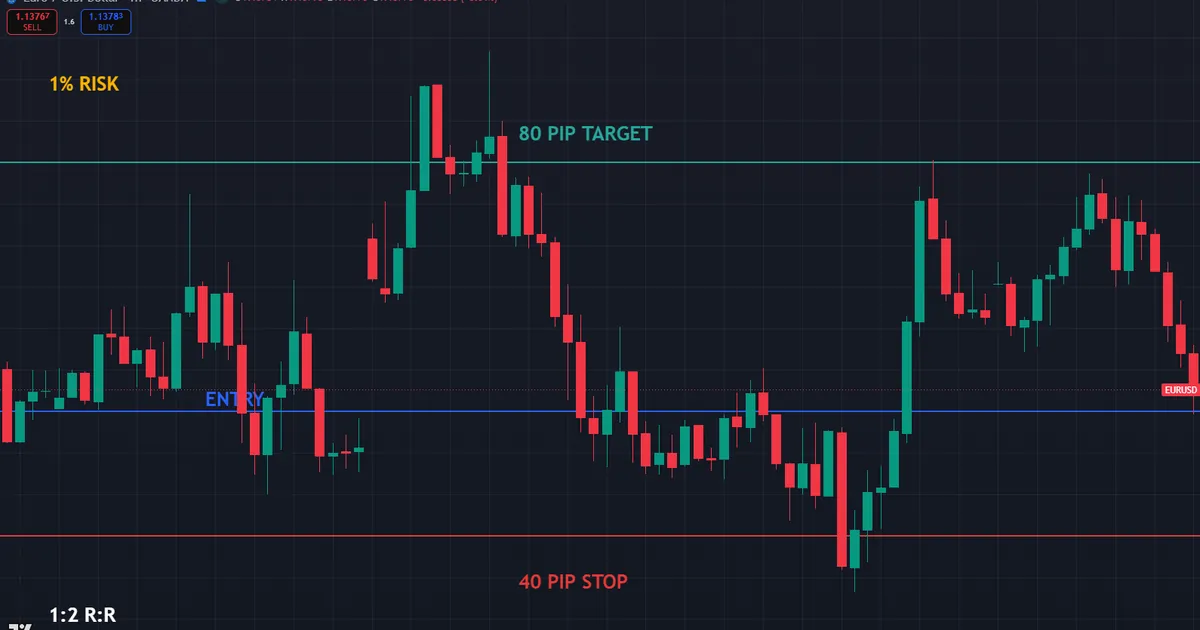
You spot a long on EURUSD near 1.14. Structure suggests a stop forty pips below entry and a target eighty pips above. That target-to-stop reading gives a clean one-to-two, which clears your reward floor.
Sizing the Trade
Your balance sits near ten thousand units, and you risk one percent. So the trade may lose one hundred units if the stop hits. A forty pip stop then fixes the lot size that keeps the loss at that line.
The calculator returns roughly a quarter of a standard lot for these inputs. You do not round up for a bigger thrill. The number is the number, and it holds your risk exactly where you planned.
Play the trade forward both ways. If the stop hits, you lose one hundred units and shrug, since the plan expected it. If the target fills, you gain two hundred units, twice the risk. So one winner covers two losers, which is the whole reason for the reward floor.
Notice how the rules chained together here. The reward floor screened the setup, structure set the stop, and the percent rule sized the trade. So each strategy handed off to the next, and no single decision rested on a gut feeling.
Now the correlation check. You already hold a long on GBPUSD, which often moves with EURUSD. So the two longs act like one larger bet on a weak dollar, and your caps must account for that overlap.
Capping Correlated Bets
Correlated pairs hide your true exposure. Two one-percent trades on pairs that march together behave like a single two-percent trade. So a quiet rule keeps combined risk on linked pairs under a set ceiling.
A simple ceiling works well. You might cap total risk on one currency, say the dollar, at two percent across all open trades. When a new setup would breach that line, you skip it or trim the older position first.
Negative correlation cuts the other way and can help. A long on one pair and a long on a pair that moves against it partly offset. So the pairing softens a single shock, though it also blurs your reward. Track both directions, and count the net rather than the raw number of trades.
Download the complete indicator database
Put these concepts on your charts. One email unlocks the full library of 1,380+ indicators with compiled MT4 and MT5 files, plus my TradingView scripts. No paywall, no spam, unsubscribe any time.
Get free access to my indicator database
One email unlocks 1,380+ free MT4, MT5 and TradingView indicators — the complete library. No single-tool download; you get the whole database.
The daily loss limit sits above every trade as a circuit breaker. You choose a line, often three percent of the account, and stop for the day once losses reach it. So a bad morning cannot snowball into a ruinous afternoon.
This rule fights the worst habit in trading, revenge. After two quick losses, the urge to win it all back roars up. A hard daily stop pulls you away from the screen before that urge runs the account.
Scaling and Journaling Over Time
The first strategies protect a single trade. The last two shape the account across months. So they matter most once the basics feel automatic.
Scaling With Equity
Fixed percent risk already scales for you, quietly and well. As the balance grows, one percent buys a larger position. As it shrinks, one percent buys a smaller one, which cools risk during a cold streak.
This gentle feedback loop compounds gains and cushions losses. You never set a raw lot size and forget it. Instead the account itself dials size up and down as your equity moves.
Some traders scale on equity milestones rather than every trade. They lift the base risk only after the balance clears a fresh high. So a good run earns a bigger footprint, while a drawdown holds size steady until the account recovers.
Either method beats a static lot. The static trader risks a huge share after a drawdown and a tiny share after a run, exactly backward. So let equity, not habit, steer the size of your bets.
Resist the urge to override the loop after a win. Doubling size on a hot streak feels shrewd and often ends badly. So let the percent rule scale you, and keep your hands off the dial.
Journaling Every Trade
A journal turns trading into data instead of memory. You log the setup, the size, the stop, the result, and a short note. Over time the log reveals patterns that your mind alone would blur.
Maybe your Monday trades lag, or wide stops drag your average down. The journal shows it plainly, so you fix a real leak rather than a guessed one. That is how a plan improves without wrecking what already works.
Turning the Strategies Into a Routine
Rules only help when they run on autopilot. So the aim is a routine you follow without debating it each session. A short checklist, read at the same points every day, builds that habit fast.
Before the Session
Open with a quick scan of the calendar and your open trades. Note any news that could gap a pair. Then confirm your daily loss line and the risk percent you will use, so both sit fixed before the first click.
This warm-up takes two minutes and saves far more. It catches a correlated position you forgot, or an event that argues for smaller size. So the session starts with a clear map rather than a blank stare.
During Each Trade
Run the same loop on every setup. Read the stop from structure, check the reward floor, then size the trade to one percent. Only after all three pass do you place the order.
Skip a step, and the plan quietly leaks. So treat the loop as a gate that every trade must clear. When a setup fails one check, you pass on it and wait for a cleaner one.
After the Session
Close the day by logging each trade while the details stay fresh. Record the setup, the size, the result, and one honest note. So the journal grows into the record that guides every future tweak.
Then step away, win or lose. A firm stop time protects your judgment as much as any stop loss. Rested decisions beat tired ones, and the market opens again tomorrow.
Common Risk Management Mistakes and Fixes
The rules are simple, yet the same errors sink new accounts again and again. Most come from breaking a rule under pressure, not from missing one. The checklist below pairs each habit with the fix that saves it.

Risking Too Much Per Trade
New traders often risk five or ten percent chasing fast gains. A short losing streak then guts the account. So drop to one percent, and let a long series of trades, not one lucky bet, build the balance.
Trading Without a Stop
Some traders skip the stop and watch the chart instead. Emotion tends to win that standoff, and a small loss becomes a huge one. So place a hard stop on every trade before entry, with no exceptions.
Ignoring Correlation
Loading three dollar pairs feels like diversifying. In truth it triples one bet, since the pairs move together. So track exposure per currency, and cap it, rather than counting open trades.
Skipping the Daily Limit
Without a daily line, one bad session can undo a month. Revenge trades pile up fast. So set a firm daily loss line, and close the platform the moment it triggers.
Never Reviewing the Numbers
A trader who never journals repeats the same leak forever. Memory flatters and forgets. So keep a simple log, and read it weekly to catch the habit quietly draining you.
Quick Reference Checklist
Keep this list within reach of the platform. Run through it before and after every session.
- Risk one percent, or less, of the account per trade.
- Reject any setup below your reward-to-risk floor.
- Place a stop before entry, and never widen it.
- Cap combined risk on correlated pairs.
- Stop for the day once losses hit your set line.
- Let fixed percent risk scale size with equity.
- Log every trade, and review the log each week.
Pitfalls and Edge Cases
A few wrinkles bend the clean rules, so keep them in view. The chart below marks a trade sized to one percent, with the stop and target that shape the plan.

Gaps Jump Your Stop
A stop caps risk in normal markets, not across a weekend gap. Price can leap past your level and fill worse. So trim size before major news or a Friday close, since a gap ignores the line you drew.
One Percent Can Still Feel Big
On a small account, one percent may be only a few units, which tempts oversizing. Resist it. The percent rule protects the account precisely because it stays small and boring while the balance is young.
Spreads Widen at the Worst Time
Costs are part of risk, and spreads balloon around news and rollover. A stop and target measured in calm hours can misprice a trade taken in a storm. So pad the target a touch, and treat thin liquidity as a reason to size down or stand aside.
Correlation Shifts Over Time
Pairs that track together this month may drift apart next month. So check the relationship now and then, rather than trusting a rule of thumb forever. A stale correlation map hides real risk.
Rules Only Work If You Keep Them
The finest plan fails the moment you override it in the heat of a trade. So write the rules down, and treat them as fixed law rather than gentle advice. Consistency is the strategy that powers all the others.
Related Concepts to Study Next
These strategies connect to a wider set of risk skills, and a few deserve your next reading hour. The foundation of the whole plan rewards a closer look. Your risk per trade then decides how hard any streak can hit.
Start with our overview of risk management in forex for the full framework. Then read how to set risk per trade and our guide to a firm daily loss limit. To sharpen the reward filter, study the risk reward ratio explained, learn to spread bets with portfolio heat, and see how it all fits together on our forex trading strategies hub.
FAQ
What is the most important forex risk management strategy?
Fixed percent risk carries the most weight, since sizing decides how hard a losing streak lands. Risk a small, steady share of the account, often one percent, on every trade. That one habit keeps any single loss from doing lasting harm.
How much of my account should I risk per trade?
Most disciplined traders risk one percent or less of the balance per trade. Two percent is a common ceiling for those with a proven edge. Smaller risk buys more staying power through the inevitable rough patches.
Do I need a stop loss on every trade?
Yes, a stop on every trade is the backbone of the whole plan. It caps the loss at a level you chose in advance. Watching the chart instead lets emotion turn a small loss into a large one.
What is a daily loss limit?
A daily loss limit is a hard line, often three percent, that ends your trading for the day. Once losses reach it, you close the platform. The rule stops a rough session from snowballing into a ruinous one.
Why does correlation matter for risk?
Correlated pairs move together, so several trades on them act like one larger bet. Counting open trades then hides your true exposure. Cap combined risk per currency to keep the real number in check.
Can these strategies promise profits?
No strategy promises profits, since markets stay uncertain on any given trade. These rules tilt the odds in your favor and, above all, keep you solvent through losing streaks. Size small, stay consistent, and let the edge play out over many trades. Results are not guaranteed; past performance is not indicative of future results.
External references
- For background on this concept, see Risk Management at Corporate Finance Institute.
- For broader market context, see Financial Risk on Wikipedia.

About the author
Written by Dominic Walsh, a Forex trader and MT4/MT5 indicator, Expert Advisor and script developer. Every tool on forexmt4systems.com is tested on live charts before release and ships with ready-to-use compiled MT4 (.ex4) and MT5 (.ex5) files. Learn more about the trader and developer behind this site.
How we build, test and correct every tool: Editorial & Testing Policy. Trading carries risk; see the disclaimer.