
Trading psychology books fill more shelf space every year, and most readers finish them unchanged. The ideas land, the highlighting looks impressive, then Monday arrives and nothing about the account moves.
This list covers nine titles that genuinely earn their place. For each one you get what the book actually argues, the single idea you can apply this week, and the kind of trader it suits.
What Trading Psychology Books Can and Cannot Do
A book supplies language and evidence. It cannot supply the written process that turns an insight into a rule your account can feel.
That gap explains the disappointment. Readers absorb a chapter about accepting risk, nod along, then size the next position exactly as before.

So treat every title below as raw material. The value appears when a sentence from the page becomes a numbered line in your plan.
Why Reading Alone Changes Nothing
Insight and behaviour live in different places. You can understand loss aversion perfectly and still move a stop under pressure, because the understanding arrives too slowly.
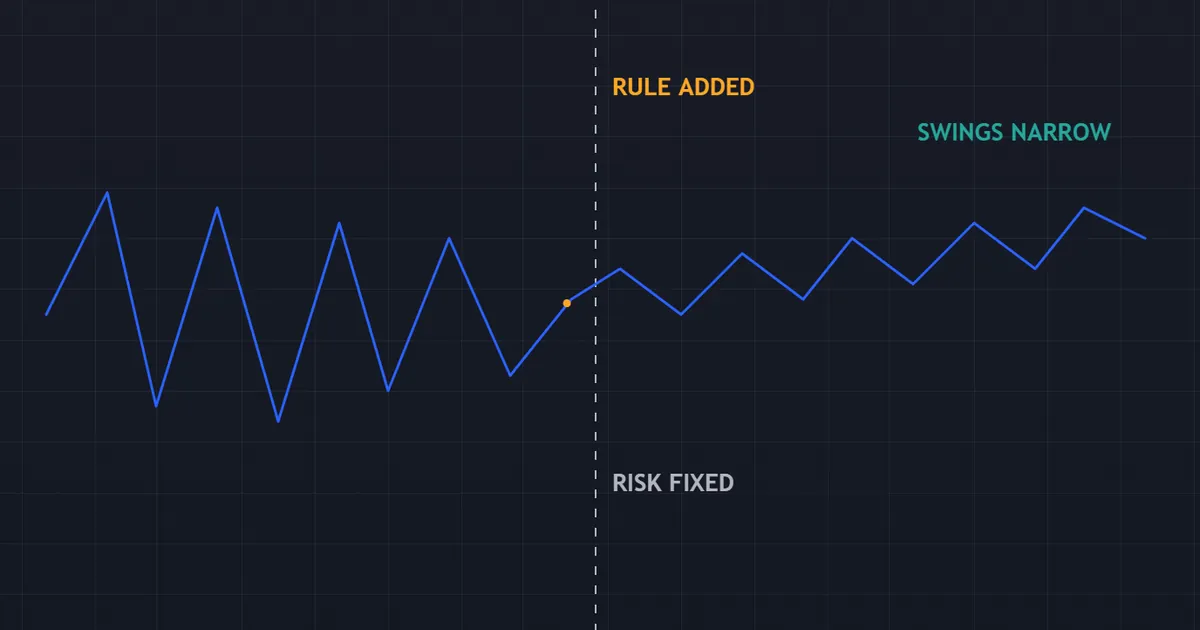
Rules work faster than insight. A written cap on risk fires before the argument starts, which is precisely why it survives a bad morning.
Read for the rule rather than the feeling. One usable rule beats fifty pages of agreement.
What a Good Book Genuinely Gives You
The right title does three things. It names a behaviour you recognise, explains the mechanism behind it, and suggests a concrete counter-move.
Naming matters more than people expect. A behaviour with a label becomes something you can spot in your own journal a week later.
Our overview of what trading psychology is sets out the wider map. Read it first if the field feels unfamiliar.
Books Beside Journals and Coaching
Each tool does a different job. A book supplies candidate ideas, a journal supplies evidence about your own behaviour, and a coach supplies accountability you cannot fake.
Traders often buy the cheapest of the three and expect all three results. So the shelf grows while the journal stays empty, and nothing measurable changes.
Pair every book with a record. Without one you cannot tell whether the new rule helped, hurt or did nothing at all.
How to Turn a Book Into a Written Rule
Five steps convert reading into behaviour. Run them once per book rather than once per chapter.
- Mark one idea. Choose the single passage that describes something you actually do.
- State it as a testable sentence. Vague wisdom cannot pass or fail, so write a rule with a number in it.
- Add it to the plan. Give the rule a line and a number beside your existing entries and exits.
- Trade twenty positions with it live. Small size, full attention, no adjustments partway through.
- Review and decide. Keep the rule, cut it, or adjust one variable, then run another twenty.
The process looks slow, and it is. It also produces the only version of a book that ever reaches your equity curve.

Nine Trading Psychology Books Worth Your Time
These nine cover the field from behavioural science to first-hand experience. Read them in any order, though the first two pair naturally.
Trading in the Zone by Mark Douglas
Published in 2000, this remains the most quoted title in the field. Douglas argues that consistency comes from a probabilistic mindset, since any single trade’s outcome carries a random element while the edge only appears across a series.
Apply this week: define your edge in one sentence, then commit to a block of twenty trades and judge the block rather than any trade inside it.
Who it suits: traders who already have a system and keep breaking it. Douglas targets execution rather than analysis.
The Disciplined Trader by Mark Douglas
Douglas published this a decade earlier, in 1990, and it introduced much of the industry to trading psychology as a subject. The argument runs deeper than the later book: markets carry no inherent structure beyond the beliefs traders bring to them, so the work involves rebuilding your own mental framework.
Apply this week: write down three beliefs behind your strategy, then mark which ones you have actually tested.
Who it suits: readers who found the later title useful and want the groundwork underneath it.
Thinking, Fast and Slow by Daniel Kahneman
This 2011 book sits outside trading entirely, which is part of its value. Kahneman separates fast, intuitive thinking from slow, deliberate reasoning, then shows how the fast system produces loss aversion, anchoring and a long list of predictable errors.
Apply this week: add a deliberate pause before every entry, with a three-question checklist that forces the slower system to answer.
Who it suits: anyone who wants the science underneath the trading advice. Our guide to cognitive biases in trading maps those errors onto the screen.
Market Wizards by Jack D. Schwager
Schwager interviewed a group of outstanding traders and published the results in 1989. No shared method emerges from the conversations, which is the finding itself: the participants trade in wildly different ways and agree almost entirely on risk control and discipline.
Apply this week: write your own one-page answer to the question every interviewee gets asked, namely how you cut a loss.
Who it suits: traders who need perspective rather than technique, especially early on.
Reminiscences of a Stock Operator by Edwin Lefevre
Lefevre published this in 1923 as a lightly fictionalised account based on the trader Jesse Livermore. A century later the behaviour on the page reads as completely current, which is the book’s quiet argument: markets change and human nature does not.
Apply this week: log every position you closed early, then compare the exit with where your plan said to leave.
Who it suits: readers who learn better from a story than from a framework. The prose alone carries most people through.
Trading for a Living by Dr Alexander Elder
Elder works as both a psychiatrist and a trader, and the 1993 book reflects that pairing. He frames trading around three elements he calls Mind, Method and Money, arguing that psychology, tactics and money management fail separately and only work together.
Apply this week: adopt his money rules as a starting frame, capping the risk on any single trade and stopping for the month once a set drawdown arrives.
Who it suits: traders who want psychology, analysis and sizing in one volume rather than three.
The Daily Trading Coach by Brett N. Steenbarger
Steenbarger built this 2009 book as 101 short lessons rather than an argument. Each lesson names a common problem, offers an approach drawn from brief therapy and coaching, then gives a specific exercise, so the reader learns to self-coach rather than depend on anyone.
Apply this week: pick one lesson, run its exercise every session for five days, and write what changed.
Who it suits: traders who want drills instead of theory. Dipping in beats reading it end to end.
Fooled by Randomness by Nassim Nicholas Taleb
Taleb published this in 2001 and spends it attacking one habit: reading skill into outcomes that chance produced. Survivorship bias, small samples and lucky runs all get the same treatment, and the message lands hard on anyone judging a method by three weeks of results.
Apply this week: add a decision-quality column to your journal and score each trade on process before you look at the outcome.
Who it suits: traders who over-read short runs, in either direction. Our free expectancy calculator shows why a sample of ten tells you almost nothing.
Best Loser Wins by Tom Hougaard
Hougaard trades at high stakes and wrote this 2022 book about mind management rather than method. His argument turns the usual advice around: normal thinking produces normal results, and most traders take profits too early while sitting with losses far too long.
Apply this week: practise holding one normal, planned loss to the stop without touching it, then write down exactly what the wait felt like.
Who it suits: traders who cut winners early and keep hoping on losers.
Choosing the Right Book for Your Actual Problem
Reading in order wastes months. Match the title to the behaviour your journal already shows and the shelf shrinks immediately.
If You Break Your Own Rules
Start with Douglas, either volume. Both books attack the gap between a plan you believe in and the execution that keeps drifting away from it.
Steenbarger suits the same problem from another angle. His drills give you something to practise rather than something to agree with.
If You Read Too Much Into Short Runs
Taleb handles this better than any trading author. After three weeks of green days, his chapters on survivorship and luck arrive at exactly the right moment.
Kahneman covers the same ground more formally. Together they explain why a small sample flatters and misleads in equal measure.
If You Cut Winners and Hold Losers
Hougaard aims squarely at this pattern. Lefevre describes the same behaviour from a century earlier, which makes the point rather hard to dismiss.
Read one, then check your own exits. The pattern usually shows up within twenty logged trades.
If You Have No Framework at All
Elder gives you psychology, method and money management in a single structure. Schwager then supplies the breadth, showing how differently successful traders reach the same discipline.
Those two together form a reasonable first year of reading. Everything else can wait until your journal names a specific problem.
A Worked Example: Turning One Book Into a Rule
Take the probability argument from Trading in the Zone. On its own it stays philosophical, so the reader agrees and changes nothing.
Now convert it. The table shows the same idea travelling from a sentence into something your journal can measure.
| Stage | What it looks like | Can you test it |
|---|---|---|
| The idea as written | Any single outcome is random; the edge shows over a series | No |
| Stated as a rule | Judge results in blocks of twenty trades, never one at a time | Partly |
| Made specific | No plan changes inside a block of twenty; risk fixed at half a percent | Yes |
| Tracked | Journal fields for block number, rules followed and block result | Yes |
Why the Last Two Rows Matter Most
Rows one and two feel satisfying and do nothing. The specific version bites, because it removes your ability to tinker after a bad Tuesday.
Tracking closes the loop. Without a record you cannot tell whether the rule helped, so the next book simply replaces it.
Our free trade journal gives you somewhere to hold those fields. Any spreadsheet works too, provided the columns stay fixed.
Applying the Same Conversion to Any Title
Every book on the list survives this treatment. Taleb becomes a decision-quality column, Elder becomes a hard risk cap, and Hougaard becomes a rule about touching stops.
Notice how small each result looks. A book of three hundred pages often reduces to a single line, and that line does the actual work.
Read our guide to R-multiples for a measurement frame that suits this approach. Results expressed in R make block comparisons far easier.
Download the complete indicator database
Put these concepts on your charts. One email unlocks the full library of 1,380+ indicators with compiled MT4 and MT5 files, plus my TradingView scripts. No paywall, no spam, unsubscribe any time.
Get free access to my indicator database
One email unlocks 1,380+ free MT4, MT5 and TradingView indicators — the complete library. No single-tool download; you get the whole database.
Common Mistakes When Reading Trading Books
Reading habits explain most of the wasted time. The panel below lists the ones that keep a shelf growing while the account stands still.
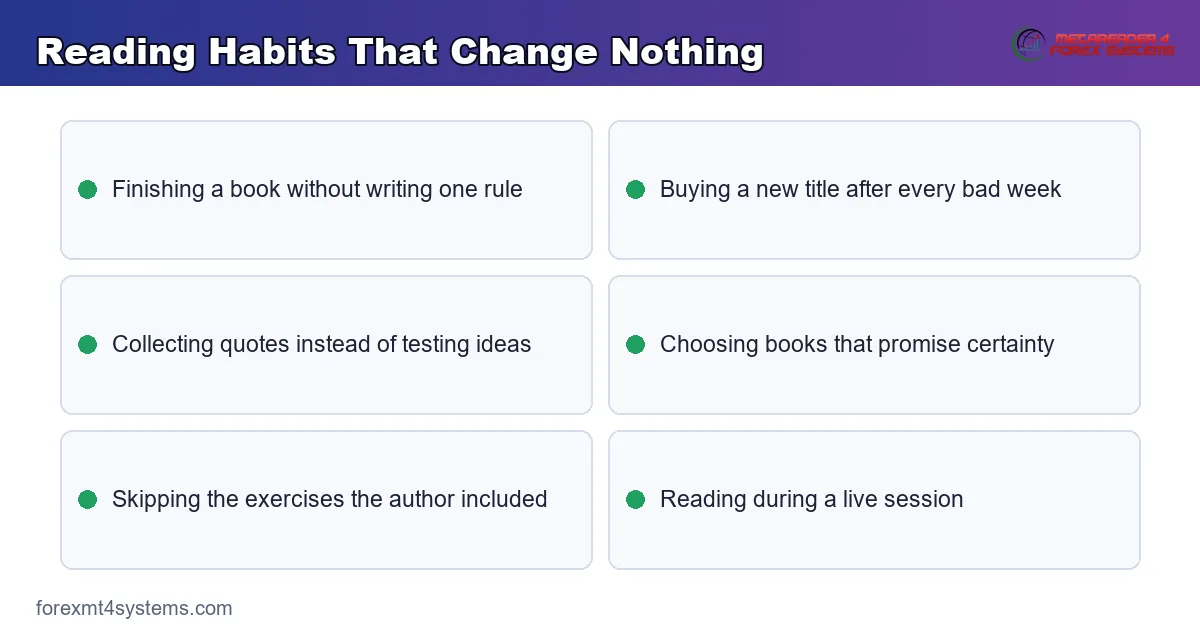
Finishing a Book Without Writing One Rule
Completion feels like progress. Unless a sentence moved into your plan, the session counted as entertainment rather than work.
Buying a New Title After Every Bad Week
A losing run creates the urge to find the missing piece. Because the piece rarely sits in a book, the habit turns reading into a form of avoidance.
Collecting Quotes Instead of Testing Ideas
Highlighted passages look productive and change nothing. Convert one passage per book, then close the file until the twenty trades finish.
Reading Three Books at Once
Parallel reading blurs the authors together, so no single idea reaches your plan intact. Finish one, apply its rule, and only then open the next.
Choosing Books That Promise Certainty
Titles offering a formula sell well and age badly. The nine above share an unusual honesty about randomness, which is exactly why they last.
Skipping the Exercises
Several of these authors include drills, and most readers skip them. The drills carry the behaviour change, while the prose only carries the argument.
Reading During the Session
A book open beside a live position splits your attention badly. Read after the close, then apply the rule the following day.
Quick-Reference Reading Checklist
Run this list as you close each book. Six answers decide whether the time paid for itself.
- Which single idea described something I actually do at the screen?
- Can I state that idea as a sentence containing a number?
- Where does the new rule sit in my written plan?
- How many trades will I run before judging it?
- Which journal field records whether I followed it?
- What would make me drop the rule again?
Question six protects you from clutter. A rule with no exit condition stays in the plan forever, useful or not.
Pitfalls of Building a Reading Habit
Reading can quietly replace trading practice. The equity panel below shows the pattern behind a growing shelf and a flat account.
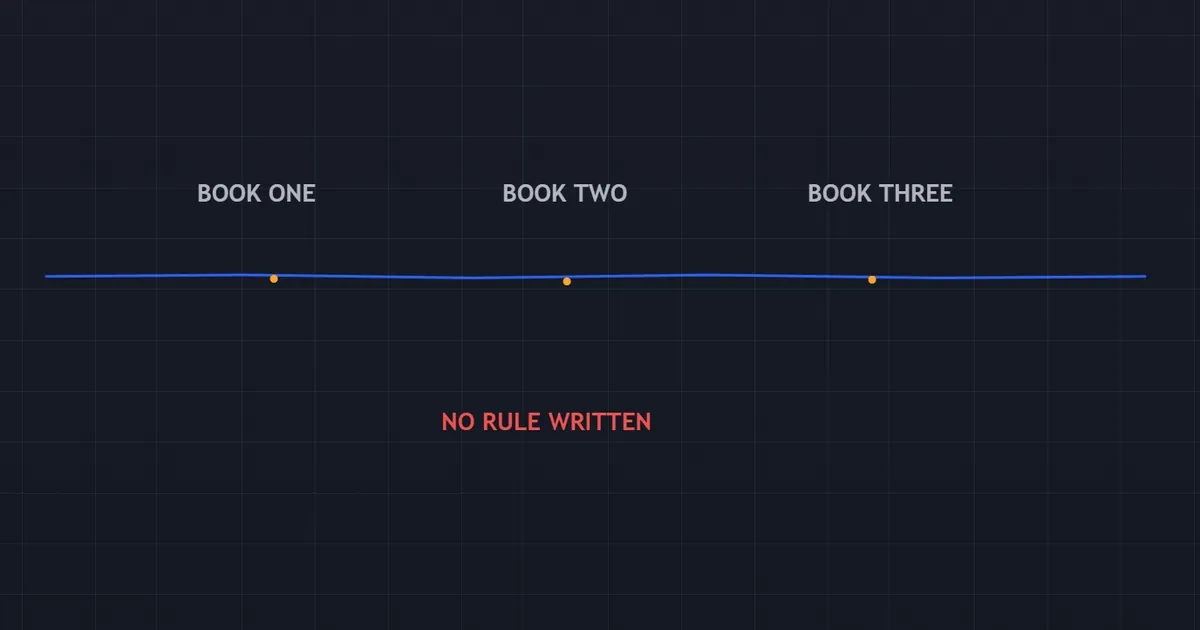
Stacking Rules From Different Authors
Nine books produce nine rules, and several will contradict each other. Add one at a time and keep the plan short enough to read aloud.
Reading Instead of Executing
Study feels safer than a live position, so hesitant traders read more and trade less. Our note on how to be a disciplined trader covers the execution habit that reading cannot replace.
Treating Interviews as Instructions
Market Wizards describes what worked for specific people in specific decades. Copy the risk discipline rather than the positions, since the methods rarely transfer.
Expecting a Book to Fix Sizing
No amount of reading rescues a position four times too large for your tolerance. Fix the size first, then let the psychology work on what remains.
Reading Summaries Instead of the Book
A summary hands you the conclusion without the argument. Because the argument is what convinces you to change a habit, the shortcut removes the useful part.
Use summaries to decide whether a title fits your problem. Then read the book itself when the answer comes back yes.
Ignoring the Publication Date
Older titles predate electronic execution, tight spreads and modern instruments. The behaviour still applies while the market mechanics often do not.
Reading Only About Psychology
A calm mind attached to no edge produces calm losses. Our guide to why traders lose money covers the costs and mechanics that sit beside the behavioural side.
The Honest Conclusion About Reading
Every title here rewards the time it takes. None of them changes anything on its own.
The Book Is Not the Intervention
Your written process is the intervention. The book supplies a candidate rule, and the plan, the journal and twenty live trades decide whether it stays.
Traders who own one worn copy and a two-page plan usually beat traders who own the whole shelf. That comparison sounds unfair, and it holds up remarkably well.
A Sensible Reading Pace
One book per quarter suits most people. That pace leaves room for the twenty trades each rule needs before the next idea arrives.
Reread the useful ones instead of hunting for new titles. Second readings tend to surface the practical passages you skipped the first time.
What to Do With the Rest of the Shelf
Keep three titles within reach and put the others away. A short row invites rereading, while a wall of spines invites browsing.
Write the rule each surviving book gave you on a card. That card becomes the summary you actually use, and it takes ten seconds to review before a session.
Traders who do this describe a strange effect. The shelf stops feeling like unfinished homework, and the reading turns enjoyable again.
Related Concepts to Study Next
These books make far more sense beside the practical guides that turn their ideas into rules. Start with the process material rather than more theory.
Build the written plan first, then let each book add one line to it. A short document you actually follow beats a long one assembled from nine authors.
Keep the risk side beside the reading as well. Sizing rules and a fixed loss limit remove most of the pressure these authors spend whole chapters describing.
Then revisit this list once a year. Your journal will have named a different problem by then, and a different title will suit it.
FAQ
Which trading psychology book should I read first?
Trading in the Zone by Mark Douglas remains the usual starting point, since it targets execution directly and reads quickly. If you prefer science to trading language, Thinking, Fast and Slow by Daniel Kahneman covers the same ground from underneath.
Do trading psychology books actually help?
They help when a specific idea becomes a written rule you then test over a block of trades. Read without that conversion, they change your vocabulary and leave your behaviour exactly where it was.
How many books should I read in a year?
Three or four suits most traders. Each rule needs roughly twenty live positions before the record says anything, so a faster pace simply stacks untested ideas on top of each other.
Are older trading books still relevant?
The behaviour described in a 1923 account still shows up in a modern journal. Treat the market mechanics in older titles carefully, though, because execution, spreads and instruments have all moved on.
Should I read about psychology or about strategy first?
Get a tested method and a fixed risk figure in place first. Psychology books work on the gap between your plan and your behaviour, so they need a plan to work on.
Are audiobooks as useful as printed copies?
They work well for the narrative titles and poorly for the practical ones. Anything with exercises needs a pen, so keep a printed copy of the drill-based books and save the audio for the stories and the interviews.
What should I do if a book contradicts my current plan?
Change one variable and test it, rather than rewriting the plan around a new author. Run twenty trades with the single change, compare the record, then keep whichever version your own journal supports.
Can a book replace working with a coach or a journal?
No, and none of these authors claims otherwise. A book supplies the idea, while the journal supplies the evidence and the process supplies the discipline. Results are not guaranteed; past performance is not indicative of future results.
External references
- For background on this concept, see Reminiscences of a Stock Operator on Wikipedia.
- For broader market context, see Prospect Theory at Corporate Finance Institute.

About the author
Written by Dominic Walsh, a Forex trader and MT4/MT5 indicator, Expert Advisor and script developer. Every tool on forexmt4systems.com is tested on live charts before release and ships with ready-to-use compiled MT4 (.ex4) and MT5 (.ex5) files. Learn more about the trader and developer behind this site.
How we build, test and correct every tool: Editorial & Testing Policy. Trading carries risk; see the disclaimer.