
So, can you trade forex without a broker? Technically yes, and in practice almost never. The routes that skip a retail account demand credit, size and legal paperwork that a private trader rarely holds.
This guide walks the plumbing instead of the marketing. It covers who sits between you and the bank market, what that party supplies, and which venues let you take currency exposure another way.
Can You Trade Forex Without a Broker? The Short Answer
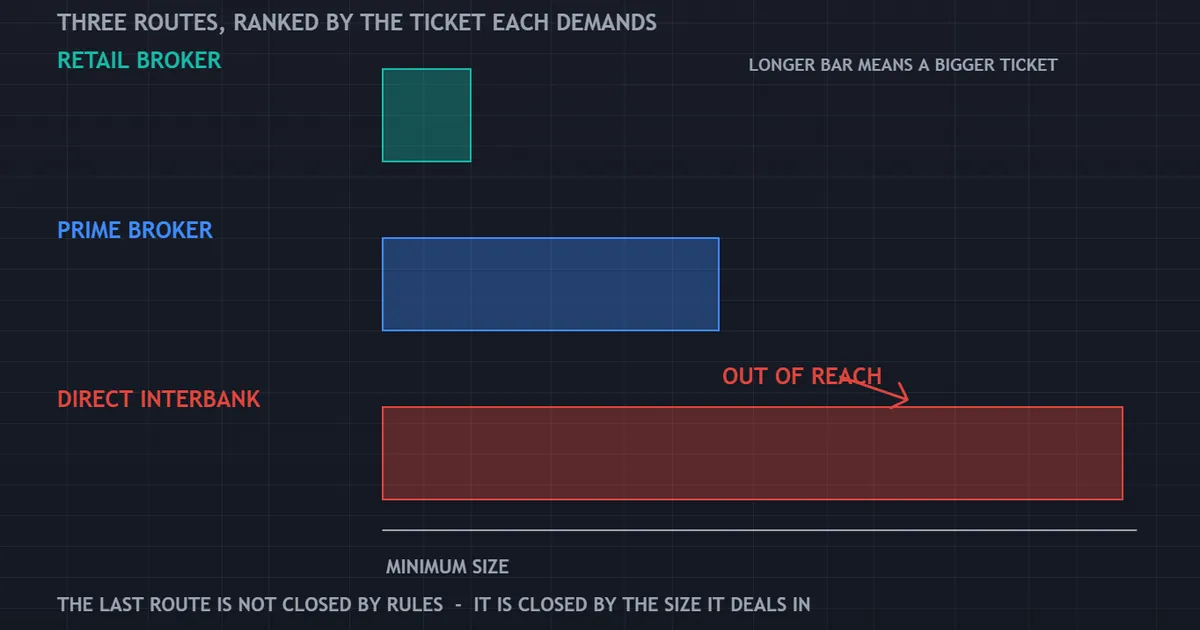
The panel above sets three access routes beside each other. Each route carries a minimum ticket size, and that size grows sharply as you move down the list.
A retail account trades in micro lots. A prime brokerage ticket starts in the millions. Direct bank dealing assumes a bank on both sides, so that last bar dwarfs the other two.
No Exchange to Walk Into
Spot forex has no central exchange. Trades happen over the counter, which means one party deals directly with another under a private agreement.
There is no public order book you can join by opening an app. Access depends on somebody agreeing to face you as a counterparty.
Two banks agree terms, then settle between themselves. Nothing in that process involves a queue you can stand in.
Access Runs on Credit
Banks deal with each other because they extend credit lines to each other. A line means one dealer accepts the risk of the other side failing to pay, up to an agreed amount.
Nobody extends a credit line to a person. That single fact explains most of what follows.
What the Bank Market Actually Is
People picture a trading floor, or a screen showing the one true price. Neither picture matches how currency dealing works.
Dealers Quote Each Other
Large banks quote two-way prices to clients and to rivals. Each quote reflects that dealer’s own book, its appetite for the currency and the credit it holds with the other side.
Two dealers can therefore show different prices at the same instant. No single official rate exists for spot currency, only a cloud of quotes that mostly agree.
Matching Platforms Sit in the Middle
Electronic platforms match dealer interest without naming either side. EBS and Refinitiv Matching grew into the main venues for that flow.
Membership demands a licence, spare capital and an operations team. Private traders never appear on those systems.
Size Decides Access
Wholesale tickets clear in millions of base currency units. A trader who wants a two thousand unit position has nothing that market wants.
Bundling small orders into wholesale size is, in effect, the retail broker’s business. Our note on how forex brokers work covers that bundling in detail.
How Your Order Reaches a Bank Quote
Follow one small order from click to fill. The chain has four links, and none of them is you.
Your Click Starts a Request
The terminal sends a request to your broker. It asks for a price on a set size, right now.
Nothing has left the firm yet. Your broker checks the margin first, then decides what to do with the order.
Your Broker Chooses a Path
One path keeps the trade in house. The firm takes the other side, then manages the net risk across all its clients.
The other path sends the order out. A pool of banks and trading firms then compete to fill it.
A Bank Quotes a Price
Each price maker streams quotes to the broker all day. Those streams already carry a spread, and the broker adds its own on top.
Your fill comes from the best stream at that instant. So the price on your screen began life inside a bank, two steps away.
The Trade Settles Later
Money moves days after the click, and not between you and a bank. It moves between the broker and its own counterparties.
Your side is a ledger entry. That entry is the thing a retail account really owns.
What a Retail Broker Actually Supplies
Removing the broker means replacing four separate services. Most people only count the first one.
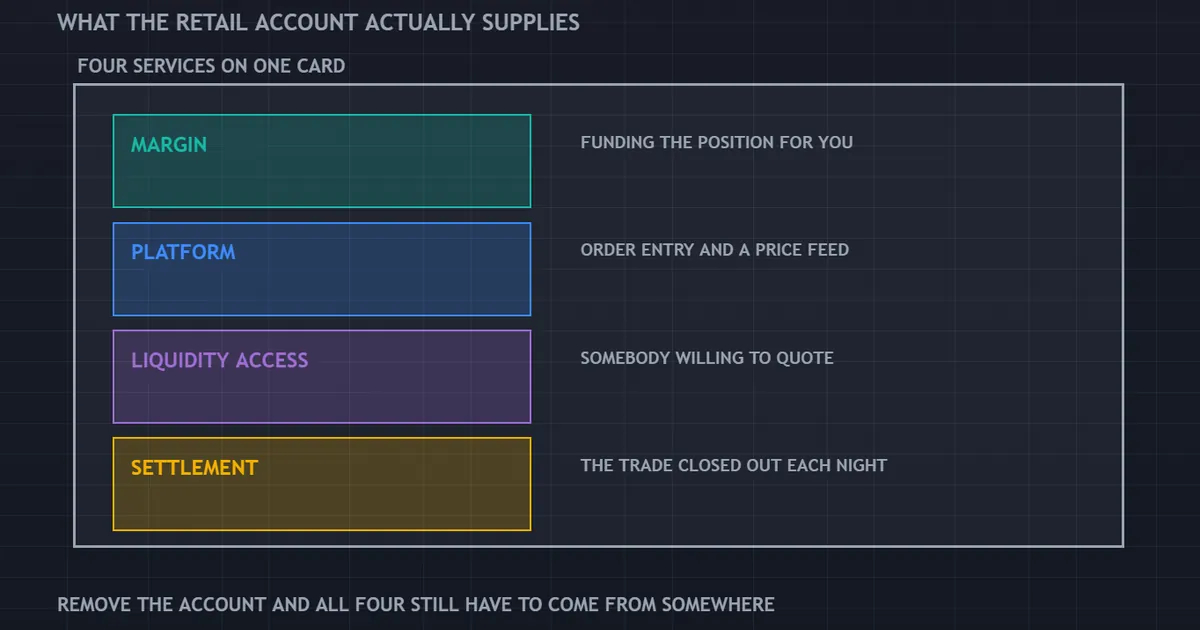
Margin and Leverage
A currency position needs funding. Your broker lends the difference between your deposit and the face value, then charges or pays a rate for holding it.
Without that facility you would fund the whole face value yourself. A single standard lot means one hundred thousand units of base currency, in full.
A Platform and a Price Feed
Charts, order tickets and history arrive bundled with the account. Big desks license those feeds on their own, and the bills run high each month.
Our MT4 indicator library exists because that platform ships free with a retail account. Remove the broker and the terminal goes with it.
Liquidity Access
Someone has to take the other side of your order. A broker either holds that risk itself or routes it to a pool of price makers.
The choice between those two models changes your fills. Our comparison of ECN and market maker models explains what each one does with your flow.
Settlement and Netting
Spot forex normally settles two business days after the trade. A retail position never settles, because the broker rolls it forward each night, which is where swap comes from.
Handle settlement yourself and you must deliver one currency and receive the other. Few private traders want a warehouse full of yen.
Why Retail Access Exists at All
Private traders had almost no route into currency dealing before the late nineties. The market served banks, funds and large firms.
Two Changes Opened the Door
Cheap internet arrived first. A trader at home could suddenly see live prices and send an order in a second.
Margin rules did the rest. A firm could hold a small deposit, lend the rest, then net the risk across many clients.
The Broker Is the Product
That bundle is what a retail account sells. Small size, live prices, credit and a platform, all in one place.
Take one piece away and the bundle breaks. So the real question is rarely whether to use a broker, but which kind to use.
Routes That Genuinely Skip a Retail Broker
Three routes exist for firms with balance sheets. Each one still involves a middleman, just a different species of one.
- A prime brokerage deal. A bank clears and settles your trades, extends credit and gives you access to its counterparties. Minimum account sizes usually start in the tens of millions, and the bank runs a full credit review before it agrees.
- Prime of prime. A mid-sized firm holds the prime brokerage deal and resells access to smaller funds. The barrier drops, though it still lands far above any personal account, and a legal agreement governs every ticket.
- A corporate dealing line. A company with real currency exposure agrees rates with its bank for hedging. That route serves an importer paying suppliers abroad, not a trader looking for a chart to trade.
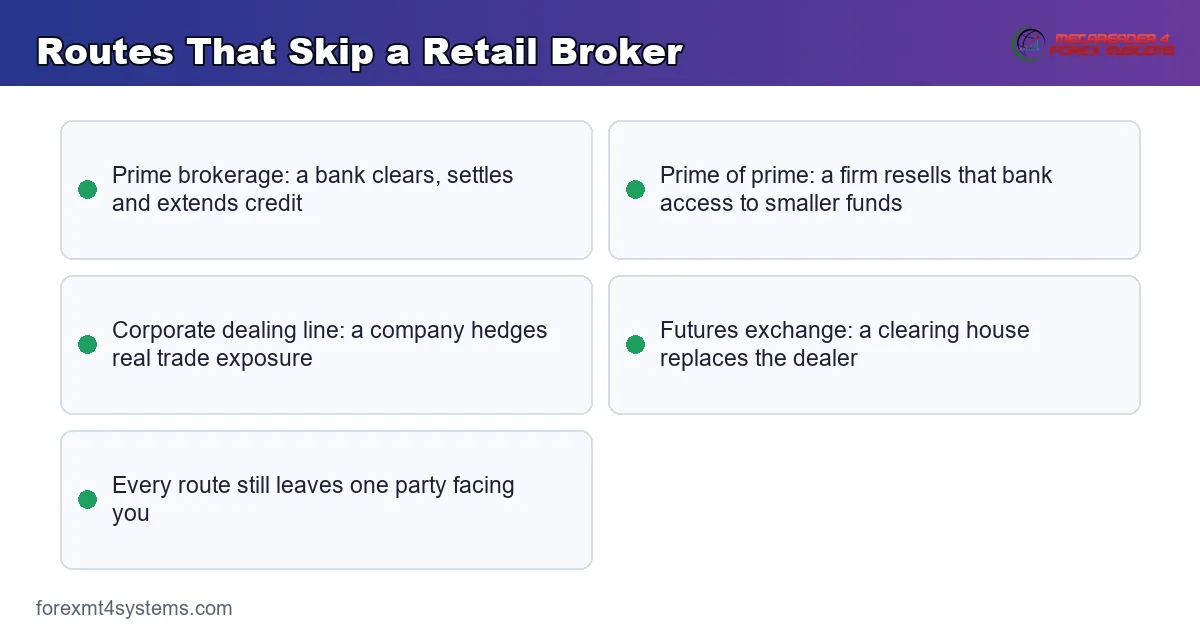
Notice what all three share. Somebody still faces you, still checks your credit and still charges for the service.
The Word Direct Gets Abused
Marketing loves the phrase direct market access. In currency dealing it usually means your order reaches a pool of bank quotes without a dealing desk in between.
That is a routing choice, not the removal of a middleman. The firm holding your money remains your counterparty for the position.
What Large Firms Do That You Cannot Copy
Wholesale traders enjoy real advantages. Most of them come from size, not from skill or from access alone.
They Net Their Flow
A big desk buys and sells the same pair all day. Only the leftover risk ever reaches the market, so the cost per ticket falls.
They Shop Many Venues
A desk can compare the same price across several pools at once. A retail order sees one route and takes it.
They Fund Cheaply
Banks borrow at rates no private trader will see. Carry costs then look very different on the same position.
They Spread Fixed Costs
Data, staff and systems cost the same whether a desk trades ten million or ten billion. Volume buries the bill.
They See the Client Flow
A dealer watches a steady stream of orders arrive from clients. That stream carries information, and collecting it costs nothing.
None of those four edges transfers with a wholesale account. They belong to size and to the seat, not to the label on the door.
What You Still Pay on Every Route
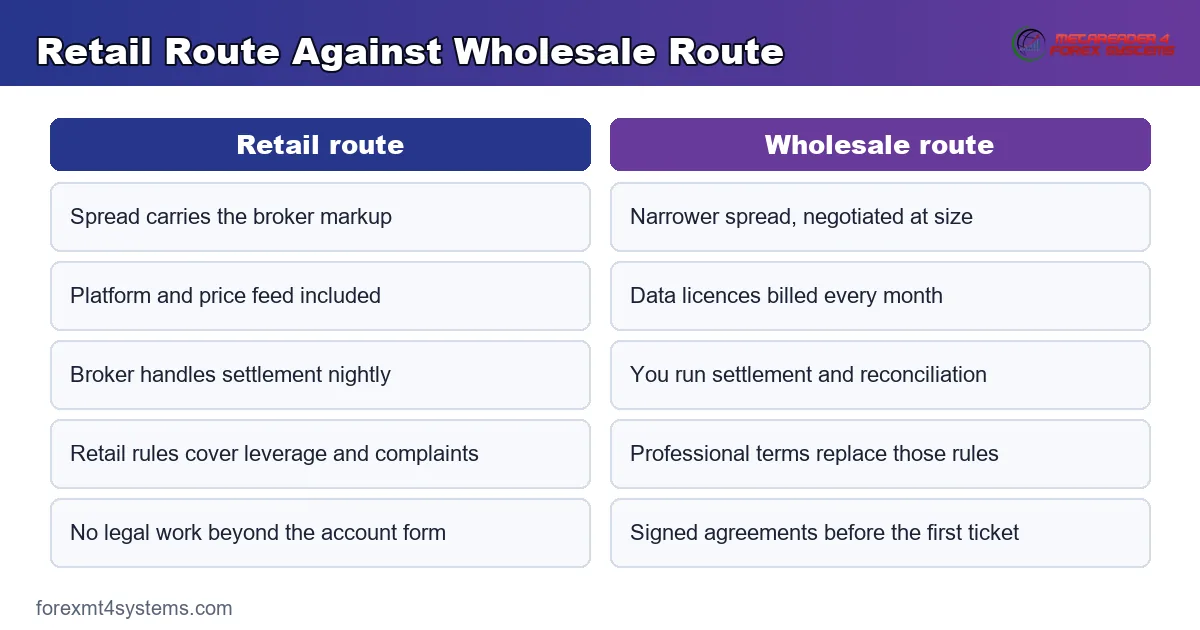
Skipping the retail layer trims one markup and adds several fixed costs. The arithmetic rarely favours a small account.
Spread Never Disappears
Every quote has a bid and an ask, including quotes between banks. The gap narrows at wholesale size, yet it never falls to zero.
Retail spread simply adds a markup on top of that wholesale gap. Compare what different structures charge with our spread comparison tool before you assume the wholesale route wins.
Funding Follows the Position
Holding a currency pair overnight means borrowing one currency and lending another. The rate gap lands on your account either way, whether a broker calls it swap or a bank calls it a forward point.
Run the numbers for a position you actually hold with our swap calculator. The cost of carry often beats the spread on a multi-week trade.
Systems Cost Arrives Instead
A wholesale route brings its own bills. Data licences, network links, a settlement system, legal review and compliance staff all cost money before a single trade prints.
Retail traders pay for those things quietly, inside the spread. Take the broker away and the invoices arrive addressed to you.
Other Venues for Currency Exposure
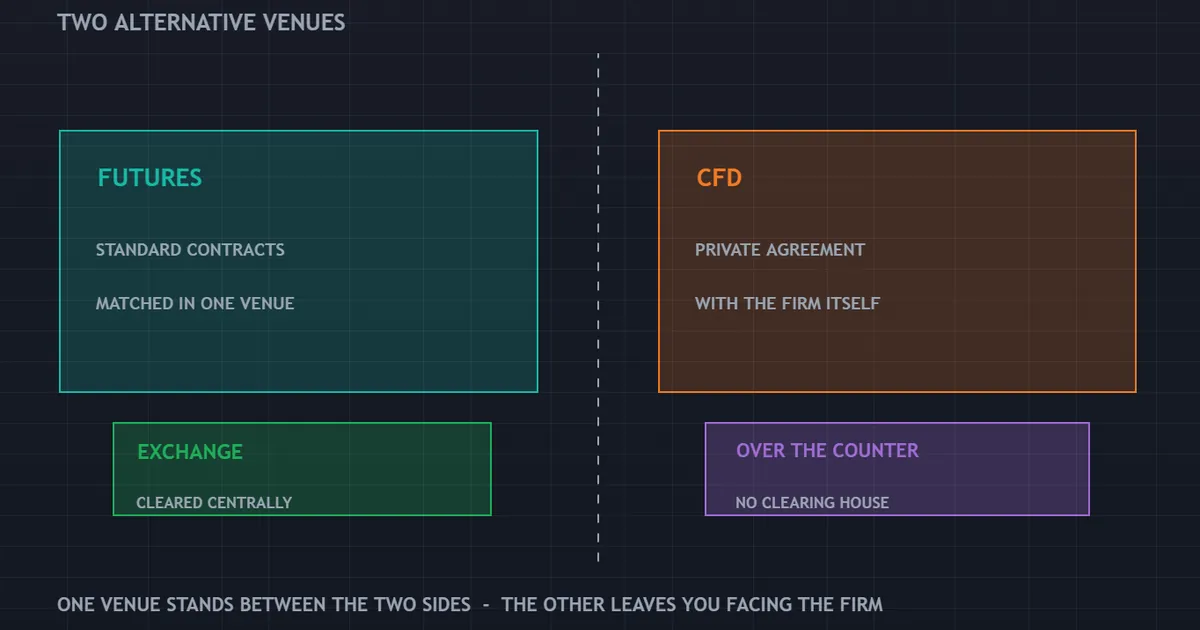
Plenty of traders reach for this question because they dislike the counterparty link rather than the broker itself. Two other venues answer that concern.
Currency Futures on an Exchange
Futures on major currencies trade on regulated exchanges, with a clearing house standing between buyer and seller. Prices print in public, contract sizes stay fixed, and the clearing house stands behind performance rather than a dealer.
You still need a futures broker to reach the exchange. What changes is the counterparty: the clearing house, not the firm holding your account.
Contracts for Difference and Rolling Spot
Retail forex in most of the world takes the form of a contract for difference or a rolling spot contract. Both settle in cash against a reference price, and both keep the broker as your counterparty.
That structure explains why the rules focus so heavily on the firm. Our guide to what regulated actually means covers the protections attached to it.
Funds and Options
Currency funds and options give exposure through a stockbroker instead. Fees differ, position sizing works differently, and intraday trading becomes clumsy.
For a long-horizon view on one currency, that clumsiness matters little. For a short-term rule, it usually rules the route out.
Spread Betting in Some Markets
In a few countries, currency exposure also arrives wrapped as a spread bet. Tax treatment differs, and the firm stays your counterparty just the same.
So the wrapper changes the paperwork, not the plumbing. Check what your own rules say before you treat it as a separate market.
Where Your Money Sits in Each Route
Follow the cash, not the label. Where your balance sits decides what you keep if the firm fails.
Inside a Retail Account
A regulated firm holds client money apart from its own. Rules differ by country, so read the ones that cover the entity on your contract.
Inside a Futures Account
Cash sits with a clearing member and margin sits at the clearing house. Any default there follows a written rulebook.
Inside a Wholesale Account
Cash and collateral sit under an agreement you signed yourself. Protection then depends on that contract, not on retail rules.
What Changes When the Broker Goes
Removing the retail layer removes protections along with the markup. Weigh both sides before you treat it as an upgrade.
Counterparty Risk Moves
Your money sits with whoever holds the account. A regulated retail broker keeps client funds apart and reports to a supervisor, while an offshore entity may do neither.
Large counterparties fail as well. Credit review exists precisely because big firms sometimes cannot pay.
Retail Protections Do Not Travel
Rules written for retail clients cover leverage caps, negative balance limits and access to a complaints route. Professional clients waive most of that by definition.
Our page on negative balance protection explains one such rule and where it stops applying.
The Back Office Lands on You
Reconciling trades, sending settlement instructions, answering margin calls and filing audited statements all become your job. A retail platform hides that machinery behind a single balance figure.
Most private traders underrate the workload. Then they discover that admin eats the hours they wanted for analysis.
Picking the Route That Fits the Account
Match the venue to the size and horizon of what you actually trade. The table below sets out where each route makes sense.
| Route | Realistic user | Main trade-off |
|---|---|---|
| Regulated retail broker | Private trader, small to mid account | Markup on the wholesale spread |
| Currency futures via a futures broker | Trader who wants a central counterparty | Fixed contract sizes and exchange fees |
| Currency funds through a stockbroker | Long horizon macro view | Clumsy for short-term rules |
| Prime of prime | Small fund or professional firm | Legal, capital and operations overhead |
| Prime brokerage | Fund with wholesale size | Credit review and very large minimums |
| Direct bank dealing | A licensed bank | Not available to anybody else |
Read that table from the top down. The first two rows cover almost every reader of this page.
Download the complete indicator database
Put these concepts on your charts. One email unlocks the full library of 1,380+ indicators with compiled MT4 and MT5 files, plus my TradingView scripts. No paywall, no spam, unsubscribe any time.
Get free access to my indicator database
One email unlocks 1,380+ free MT4, MT5 and TradingView indicators — the complete library. No single-tool download; you get the whole database.
A Simple Test Before You Chase Wholesale Access
Run three sums on your own trading. They settle the question faster than any article can.
Add Up a Month of Spread
Count your trades, then multiply by the typical spread you pay. That total is what a venue change could save at best.
Price the Other Side
Now list what a wholesale route would cost each month. Data, legal work and a settlement system all appear on that list.
Compare the Two Numbers
For nearly every private account, the second number wins by a wide margin. That answer holds until your size changes it.
Then Repeat the Sums Yearly
Accounts grow, and rules move. Run the same three sums once a year, rather than deciding once and forgetting.
Questions Worth Asking Before You Switch Venue
The venue question usually hides a different complaint. Name the complaint first, then pick the fix.
Is the Complaint About Cost?
Traders often blame the broker for a cost problem their own frequency created. Forty trades a day pays forty spreads, whatever venue supplies them.
Cutting trade count moves that number more than a venue change would. Our summary of forex trading costs breaks the parts apart.
Is the Complaint About Trust?
Then the answer is regulation and account structure, not cutting the middleman. Check the licence, the entity you actually contract with and where client money sits.
A futures route helps here too, since a clearing house replaces the dealer as counterparty. That change is real, and it costs you contract choice.
Is the Complaint About Fills?
Slow or slipped fills usually trace to the execution model and to volatility, not to the mere existence of a broker. Test the same rule at a quieter hour before you blame the venue.
Keep a record while you test. A written log of requested price against filled price settles the argument quickly.
Common Myths About Going Broker Free
Four claims circulate constantly. Each one falls apart on inspection.
Myth: Banks Trade for Free
Banks pay narrower spreads and huge fixed costs. Their cost per trade looks tiny only because their volume is vast.
Myth: The Bank Price Is the Real Price
There is no single bank price, merely competing quotes. Blended feeds show an average, which nobody must trade at.
Myth: Cutting the Middleman Improves Results
Lower costs help a rule that already works. They rescue nothing else, because a losing edge stays a losing edge on a narrower spread.
Myth: Peer to Peer Currency Swaps Replace a Broker
Matching services for currency conversion exist and serve businesses well. They convert money at a point in time, and they offer no leverage, no stops and no chart to trade.
FAQ
Can a person open an account directly with a bank for spot forex?
Banks do serve people for currency conversion and for hedging a real exposure, such as a property purchase abroad. Leveraged dealing is a different service, and it needs a credit line banks reserve for firms. So the practical answer for a private trader stays no.
Are currency futures a way of trading forex without a broker?
Not quite, because you still need a futures broker to reach the exchange. What changes is the counterparty risk: a clearing house stands behind every contract instead of the firm holding your account. That structural difference matters, and it arrives with fixed contract sizes and exchange fees.
What is prime of prime and could I use one?
A prime of prime firm holds a bank prime brokerage line and resells that access to smaller professional firms. Minimums drop compared with a direct prime broker, yet they still start far above a personal account, and clients sign heavy paperwork. In practice it serves small funds and brokers rather than people.
Does removing the broker cut my costs?
It removes one markup and adds data, network, settlement and compliance costs instead. For wholesale volume that swap makes sense, while for a private account the fixed costs dominate. Frequency and position size decide the answer, not the venue label.
Is peer to peer forex trading possible?
Two parties can agree a currency exchange privately, and businesses do exactly that through matching services. Nothing there provides leverage, margin, stop orders or a settlement promise, so it serves conversion rather than trading. Treat it as a payments product, not a market access route.
Do brokers trade against their clients?
Some firms hold client risk on their own book, which is a normal model rather than a scandal in itself. What matters is disclosure, the licence behind the entity and how client money sits. Read the execution policy, since it states plainly what the firm does with an order.
Which route should a small account use?
A regulated retail broker remains the realistic choice for most private traders, with currency futures as the alternative when central clearing matters more than flexibility. Focus on the licence, the entity you contract with and where client money sits, since those decide what happens if the firm fails. Results are not guaranteed; past performance is not indicative of future results.
External references
- For background on this concept, see Prime Brokerage on Wikipedia.
- For broader market context, see Electronic Broking Services in the BabyPips Forexpedia.

About the author
Written by Dominic Walsh, a Forex trader and MT4/MT5 indicator, Expert Advisor and script developer. Every tool on forexmt4systems.com is tested on live charts before release and ships with ready-to-use compiled MT4 (.ex4) and MT5 (.ex5) files. Learn more about the trader and developer behind this site.
How we build, test and correct every tool: Editorial & Testing Policy. Trading carries risk; see the disclaimer.