
Forex trading explained in plain terms is simply the buying of one currency while selling another, in the hope the first one rises. Strip away the jargon, and the whole market rests on that single, clear idea.
This guide gives forex trading explained from the ground up for a complete beginner. You will learn what forex is, how a single trade works, who trades it, and how a trader can profit whether a price rises or falls.
Forex Trading Explained, From the Start
Forex is the global market for exchanging one national currency for another. Every pair, like EURUSD, sets two currencies against each other. So a trade is a bet that one currency will strengthen against the other.
The market exists because the world needs to swap currencies constantly. A company paying a foreign supplier, a tourist buying local money, and a bank moving funds all trade currencies. Because that need never stops, forex is the largest and most liquid market anywhere.
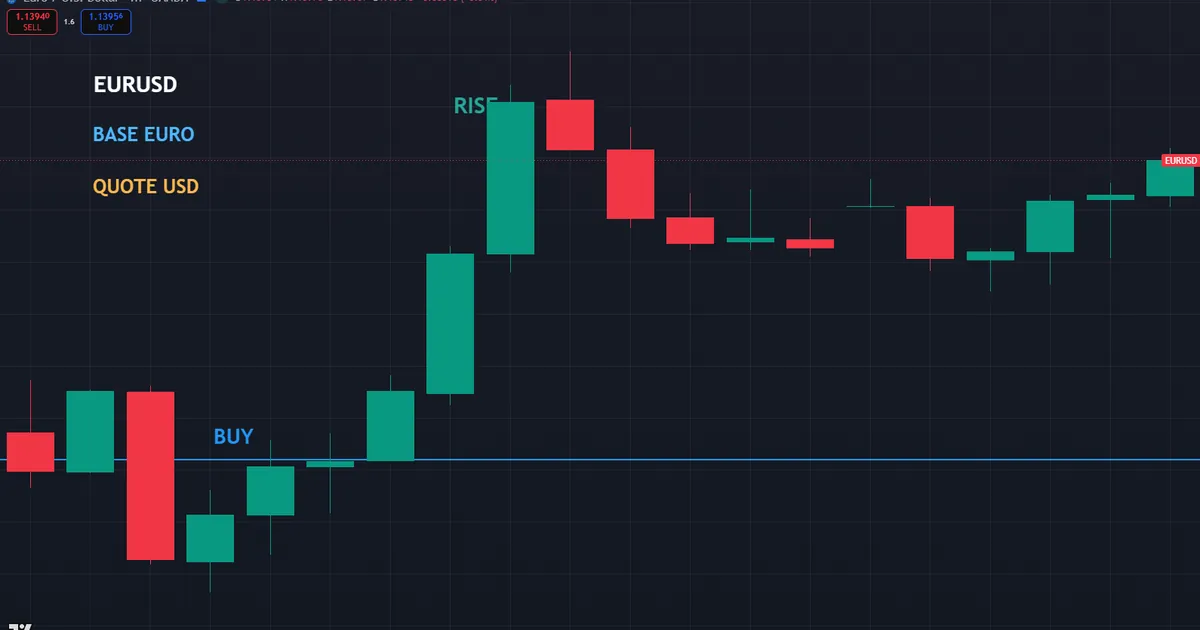
Trading it means taking part in that flow for profit. You buy a pair when you expect the first currency to rise, and sell it when you expect a fall. Because prices move every second, chances to trade appear all day long.
None of this requires a finance degree. A beginner needs a clear grasp of a few ideas and the discipline to manage risk. So the rest of this guide builds those ideas one careful step at a time.
What a Currency Pair Really Is
A pair ties two currencies into one price. The first currency is the base, and the second is the quote, so the price shows how much quote buys one unit of base. For EURUSD near 1.14, one euro is worth about one dollar and fourteen cents.
- Base currency. The first currency in the pair, the one you buy or sell.
- Quote currency. The second currency, in which the price is measured.
- The price. How many units of quote it takes to buy one unit of base.
- A rise. The base currency strengthening against the quote.
- A fall. The base currency weakening against the quote.
Notice how the base always leads. When you buy EURUSD, you buy the euro and sell the dollar in one move. Because the pair links the two, every trade is really a view on one currency against another.
Why the Market Moves
Currencies move for real economic reasons. Interest rates, inflation, and growth data all shift how much a currency is worth. Our guide on the major currency pairs shows which pairs carry the most of this flow.
Sentiment and events add shorter swings on top. A surprise headline can push a pair for hours before the dust settles. Because both slow forces and fast ones act at once, prices rarely sit still for long.
How a Single Trade Works
A trade has a simple life, from open to close. You choose a pair, pick a direction, set your risk, and enter. Then the trade runs until you close it or a preset level does it for you.
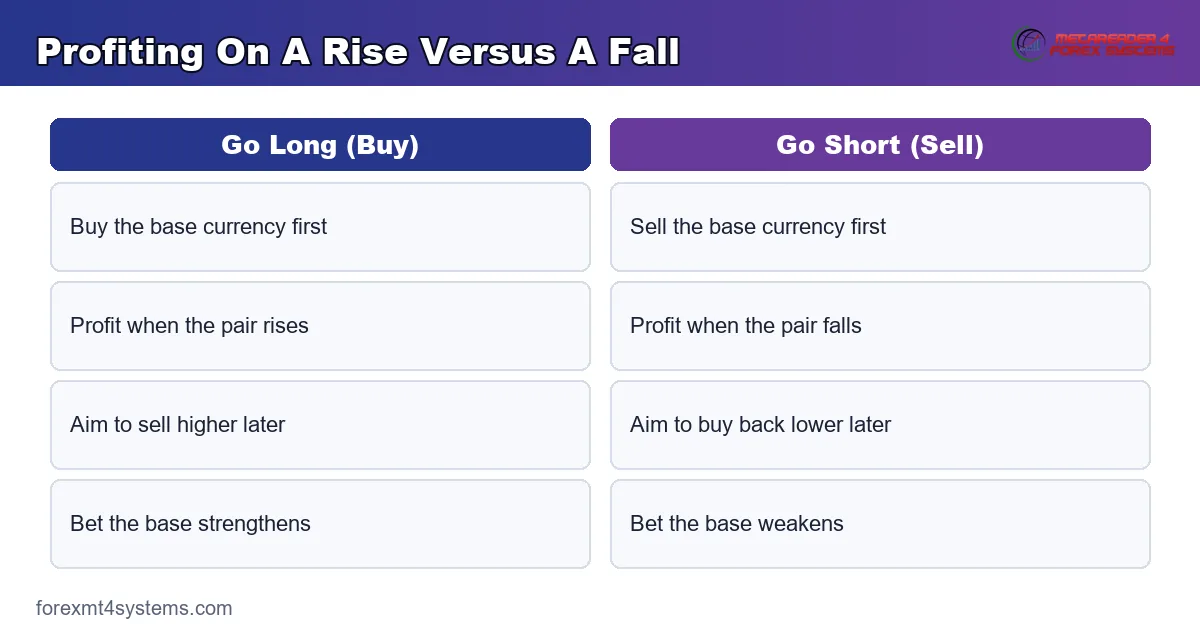
The direction is your core decision. Going long means buying the base in hope of a rise, while going short means selling it in hope of a fall. Because both are open, a falling market is still a chance, not a dead end.
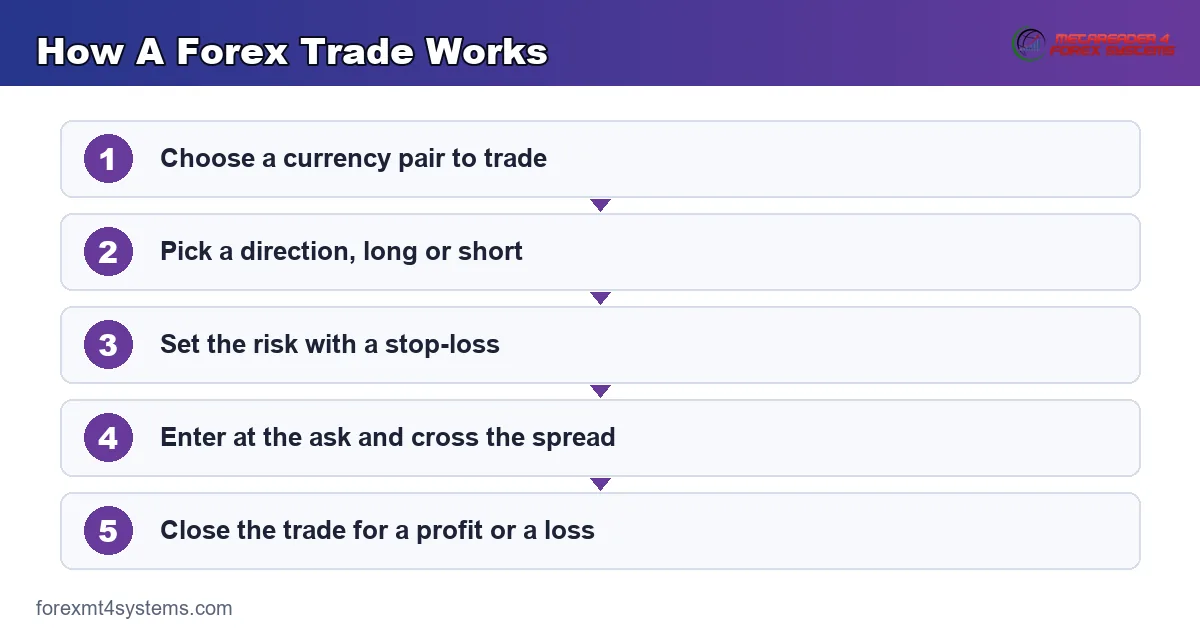
Your profit or loss comes from the price change times your size. If the pair moves in your favor, you gain, and if it moves against you, you lose. So the size you choose decides how much each pip of movement is worth.
Making Money on a Rise or a Fall
The two-way nature of forex is one of its strengths. In a rising market, you buy low and aim to sell higher. In a falling market, you sell high and aim to buy back lower.
Both paths earn from the same skill, reading direction. A short is not riskier than a long by nature, only the mirror of it. Because you can trade either way, no market condition locks you out entirely.
The Role of the Spread
Every trade starts at a small disadvantage called the spread. You buy at the ask and could sell at the bid, and the gap between them is your entry cost. So a trade must move past the spread before it turns a profit.
On liquid majors, the spread stays tight, which keeps the cost low. Our currency converter helps you translate a pair’s move into your home currency. Because a tight spread lowers the hurdle, beginners do well to favor deeply traded pairs.
A Worked Trade Example
Numbers make the idea concrete, so walk through one trade. You expect the euro to rise, so you buy EURUSD near 1.14 with a single micro lot.
A micro lot is 1,000 units, worth about ten cents a pip on this pair. So each pip the price climbs earns you ten cents, and each pip it falls costs the same. That small size keeps the risk gentle while you learn.
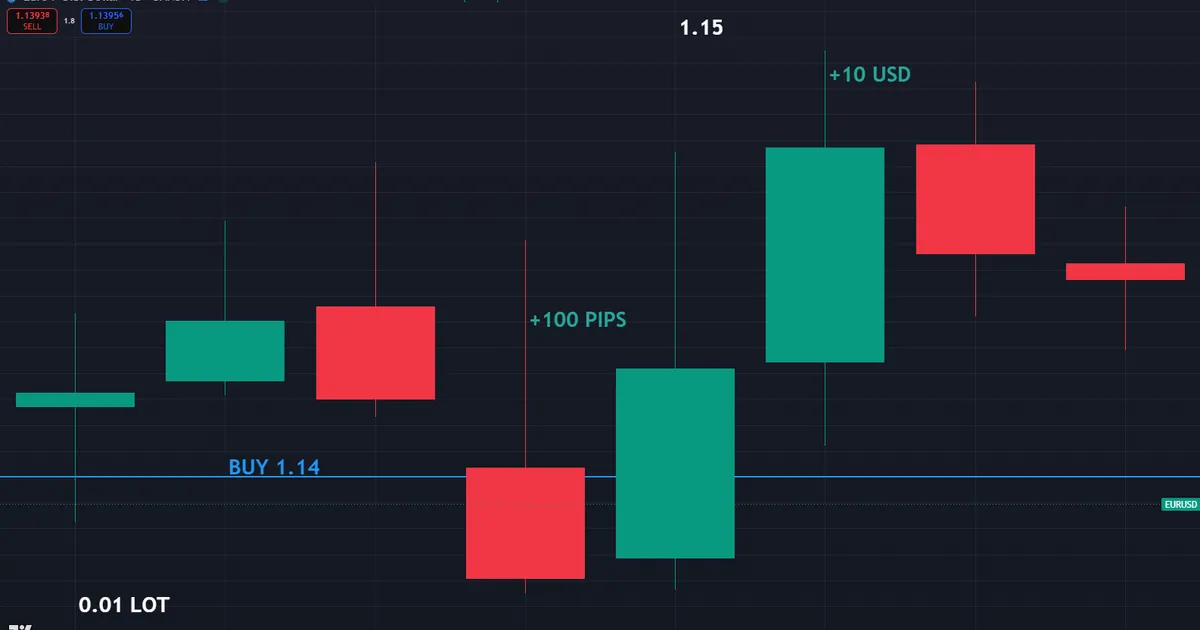
Now suppose the pair climbs to 1.15, a move of one hundred pips. At ten cents a pip, that hundred pip rise earns about ten dollars. Because you went long, the base currency strengthening is exactly what you wanted.
Flip the outcome to see the other side. If the pair had fallen one hundred pips instead, you would have lost about ten dollars. So the direction you chose and the size you set together wrote the result.
Scaling the Same Trade
Change only the size, and the whole result scales. At ten micro lots, or 0.10, the same hundred pip move earns about ten times as much. The entry and the direction stay identical, yet the money swings with the size alone.
This is why size deserves as much thought as direction. A right call on too large a size can still hurt if the trade first moves against you. So a beginner sizes small, survives the swings, and lets the method prove itself over time.
Reading the Profit in Terms
The worked trade quietly used several terms at once. It leaned on base and quote, pip, lot, pip value, and spread. Our guide to forex trading terms defines each one in a single clear line.
So a single trade is a small lesson in the whole vocabulary. Once the words click, the mechanics stop feeling abstract. Because every trade repeats the same terms, practice cements them faster than study alone.
Who Trades the Forex Market
Forex draws a huge and varied cast of players. Central banks, global companies, funds, and retail traders all take part. Because their reasons differ, the market blends real economic flow with pure speculation.
The largest players trade for business, not for a quick profit. A bank settling international payments moves currency because it must. So much of the daily flow reflects the real economy rather than short-term bets.
Where a Beginner Fits
A retail beginner is a small player in a vast market. That is not a weakness, since the deep liquidity means your orders fill smoothly. Because the majors trade in such volume, a small trader enters and exits without moving the price.
Your edge is not size but discipline. You can wait for your setup, cap your risk, and skip poor trades, freedoms the biggest players lack. So a patient beginner competes on habits, not on capital.
Leverage and Access
Leverage is what lets a small trader take a meaningful position. It allows a modest deposit to control a larger trade, which opens the market to beginners. Our guide on leverage in forex explains how it works and where its danger lies.
Yet leverage cuts both ways, so treat it with care. It magnifies losses just as fast as gains, which can end a small account quickly. So a beginner uses leverage lightly and keeps the position sized to a firm stop.
Download the complete indicator database
Put these concepts on your charts. One email unlocks the full library of 1,380+ indicators with compiled MT4 and MT5 files, plus my TradingView scripts. No paywall, no spam, unsubscribe any time.
Get free access to my indicator database
One email unlocks 1,380+ free MT4, MT5 and TradingView indicators — the complete library. No single-tool download; you get the whole database.
Common Beginner Misconceptions
A few false ideas cloud forex for newcomers, and the fixes sit under the graphic below. Most come from treating trading as a shortcut rather than a skill.
Thinking Forex Is Quick and Easy
Many beginners expect fast profits with little effort. Yet trading is a skill that takes months of practice to build. So treat it as a craft to learn slowly, not a switch that turns on income overnight.
Believing You Must Predict the Market
New traders often think success means forecasting every move. In truth, no one predicts the market reliably, and good traders simply manage risk well. So focus on capping losses and sizing trades, not on a crystal ball.
Ignoring the Spread and Costs
Some beginners forget that every trade carries a cost. The spread and any commission chip away at profit on each trade. So favor tight-spread majors and trade selectively to keep the costs from adding up.
Confusing Leverage With Free Money
Leverage lets a small deposit control a large position, which can feel like a gift. Yet it raises risk just as much as it raises reach. So size to your stop, and let leverage stay a tool rather than a temptation.
Skipping Risk Management
The gravest misconception is that risk control is optional. Without a stop and a size cap, one bad trade can undo many good ones. So set a stop on every trade, and cap the loss at a small percent of the balance.
Forex Basics Quick Reference
Keep this short list beside your platform. Run through it as you build your first trades.
- A pair sets a base currency against a quote currency.
- Buy the pair to profit on a rise, sell it to profit on a fall.
- The spread is your cost to enter every trade.
- Pip value follows from your lot size on the pair.
- Leverage controls a large position from a small deposit.
- A stop-loss caps the loss on any single trade.
- Risk a small, fixed percent on each trade.
Forex Pitfalls and Edge Cases
A few situations bend these simple ideas, so watch for them. The chart below marks a common trap, trading with no stop and no plan for the loss.
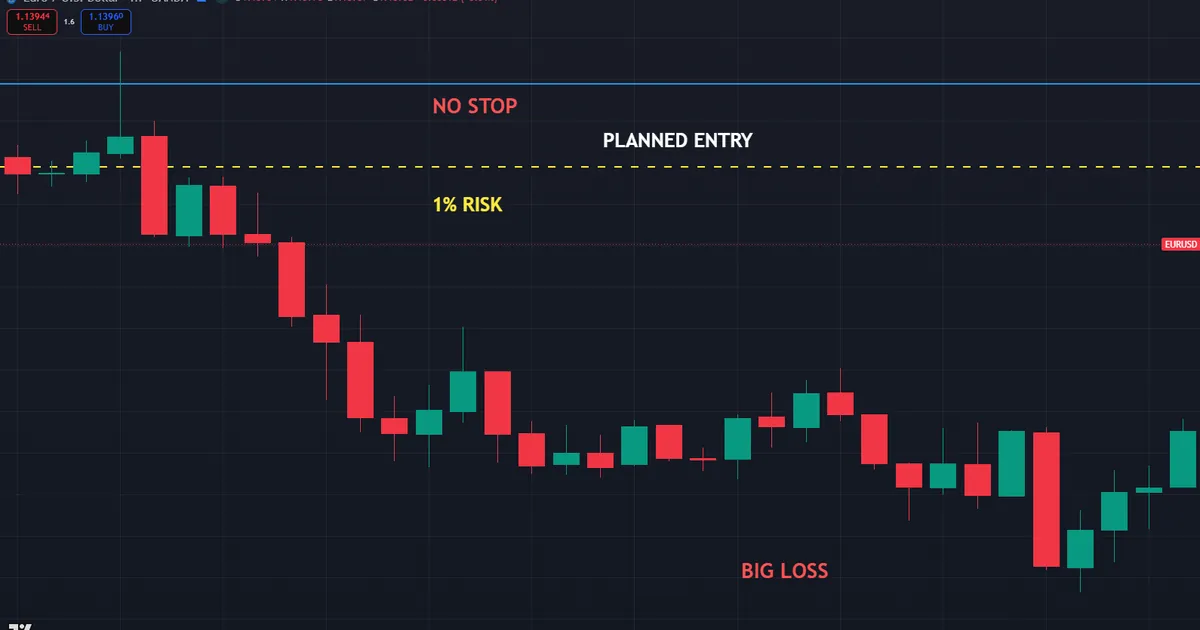
Picture two beginners on the same drop near 1.14. One entered with a stop and a one percent risk cap, so the loss stays small. The other entered with no stop, so a routine move erased a large share of the account.
The lesson lands hard. Both traders read the same market, yet only one controlled the loss. When the price fell, the plan protected the first trader while the second had no shield. So the plan, set before entry, decided the outcome.
Trading Around Major News
Big releases can move a pair fast and unpredictably. A stop may fill far from its level when the price gaps through it. Because the risk is hard to control, many beginners simply avoid trading through major news.
The Weekend Gap
Forex closes late Friday and reopens Sunday evening. Prices can gap over the break, so a stop set on Friday may fill worse on Monday. Because the gap ignores your stop level, a smaller size leaves room for that shock.
Non-Dollar Pairs
Pip value shifts when the dollar is not the quote currency. A beginner who assumes the same value on every pair can misjudge the risk. So learn the majors first, and confirm the pip value with a tool before trading crosses.
Emotional Trading
Fear and greed push beginners into poor choices. Fear closes winners too soon, while greed holds losers too long. Because a written plan removes much of the guesswork, following it steadies the emotions that trip new traders.
The Size and Shape of the Market
Forex dwarfs every other financial market in size. Trillions of dollars change hands each day across the globe, far more than any stock exchange. Because the volume is so vast, no single trader or firm can control the price for long.
That scale brings a real benefit to beginners. Deep volume means tight spreads and smooth fills on the major pairs. So a small trader enters and exits cleanly, without the slippage that thin markets can bring.
The market also has no central home. Instead of one exchange, forex runs through a global network of banks and brokers. Because the network spans every time zone, the market stays open around the clock through the trading week.
Why There Is No Single Exchange
Stocks trade on named exchanges, yet forex works differently. Currencies trade directly between banks and brokers in what is called an over-the-counter market. So the price you see is a blend of quotes from many sources rather than one official figure.
This structure keeps the market flexible and always open. When one financial center closes for the night, another opens to carry the flow. Because the baton passes around the world, trading never truly stops between Sunday evening and Friday night.
A Day in the Forex Market
The trading day moves with the world’s financial centers. Activity rises as London opens, peaks when New York overlaps with it, and quiets overnight. So the same pair can feel lively at one hour and sleepy at another.
Beginners often trade the busier hours on purpose. Tighter spreads and cleaner moves tend to arrive when volume is high. Because the quiet hours can drift, many new traders focus on the active sessions instead.
Sessions and Timing
Three broad sessions shape the day: Asia, London, and New York. Each brings its own pace, and the overlaps bring the strongest flow. So knowing when a session runs helps you choose when to trade and when to rest.
Timing also affects the pairs you pick. A pair tends to move most when its home session is active. Because a euro pair often stirs during London hours, matching the pair to the session can sharpen your entries.
Holding Trades Over Time
Not every trade is a quick in-and-out. Some traders hold positions for days or weeks, riding a longer trend. Because a held trade crosses the overnight boundary, it can gather a swap charge or credit each night.
The holding period shapes the whole approach. A short-term trader watches the fast moves, while a longer-term one leans on the broader trend. So a beginner should decide their style early, since it guides both the pairs and the timeframes they choose.
Building a First Plan
A simple plan turns understanding into action. It names the pair you watch, the direction you look for, and the risk you allow. Because the plan is written down, it keeps your trading steady when the market grows noisy.
Keep the first plan short and clear. One or two major pairs, a single setup, and a firm risk cap are plenty to start. So you avoid the overload that sinks many beginners in their first weeks.
Review the plan as you gain experience. A record of your trades shows which rules help and which need tuning. Because the plan grows with you, it turns scattered early trades into a steady, improving practice over time.
Treat the plan as the anchor of everything else you learn. Every term, every tool, and every worked example above serves the plan you carry to the chart. So a beginner who writes down a simple plan already trades with more discipline than one who does not. That discipline, more than any forecast, is what keeps a new account alive through the early learning curve. A plan you follow beats a hunch you chase, every single week. So write yours down before your next trade, and let it steer you when the market tempts you to drift.
Related Concepts to Study Next
This overview opens onto a few ideas worth your next reading hour. A clear, ordered path for placing a first trade turns the theory above into action. A firm grasp of the smallest price unit, the pip, sharpens every calculation you make.
Read our guide on how to trade forex for beginners to put these ideas into a real trade. Then study the pip in forex to master the unit behind every profit and loss. Together they carry you from understanding forex to actually trading it.
FAQ
What is forex trading in simple terms?
Forex trading is buying one currency while selling another, always in a pair. You profit when the currency you bought strengthens against the one you sold. Because prices move constantly, the market offers chances to trade all day long.
How do you make money in forex?
You make money by buying a pair before it rises or selling it before it falls. The profit is the price change times your position size, minus the spread. So both the direction you pick and the size you set shape the result.
Can you profit when a currency falls?
Yes, you can profit from a fall by going short, which means selling the base currency. If the pair then drops, you buy it back lower and keep the difference. Because forex trades in pairs, a falling market is a chance rather than a dead end.
Do I need a lot of money to trade forex?
No, many brokers let you start with a few hundred dollars on a micro account. Leverage lets a small deposit control a larger position, and micro lots keep the risk small. The account grows slowly, yet it survives long enough to learn.
What is a currency pair?
A currency pair ties two currencies into one price, such as EURUSD. The first is the base currency, and the second is the quote currency. The price shows how much quote it takes to buy one unit of base.
Is forex trading hard to learn?
The basic ideas are simple, yet building steady discipline takes many months. The mechanics of a trade can be grasped in a few study sessions. Keep the risk small, practice on a demo, and let the skill build at its own pace. Results are not guaranteed; past performance is not indicative of future results.
External references
- For background on this concept, see Getting Started in Forex at Investopedia.
- For broader market context, see Currency Pair at Corporate Finance Institute.

About the author
Written by Dominic Walsh, a Forex trader and MT4/MT5 indicator, Expert Advisor and script developer. Every tool on forexmt4systems.com is tested on live charts before release and ships with ready-to-use compiled MT4 (.ex4) and MT5 (.ex5) files. Learn more about the trader and developer behind this site.
How we build, test and correct every tool: Editorial & Testing Policy. Trading carries risk; see the disclaimer.