
Learning how to trade forex for beginners comes down to a short, ordered path, not a pile of jargon. Follow the steps in sequence, and your first real trade will feel calm rather than chaotic.
This guide lays out how to trade forex for beginners from the very first choice to the first closed trade. You will pick a pair, choose a broker, open a platform, place one careful trade, and manage the risk that comes with it.
How to Trade Forex for Beginners, Step by Step
Forex trading means buying one currency while selling another, always in a pair. When you buy EURUSD, you buy the euro and sell the dollar at the same time. So a trade is simply a bet on one currency rising against the other.
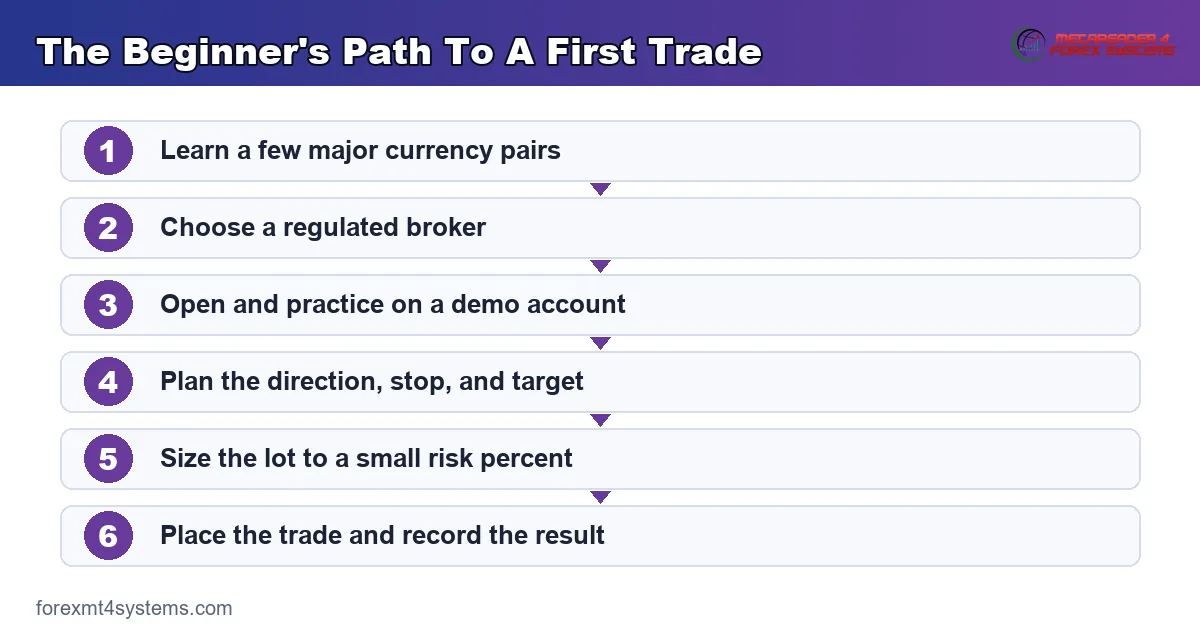
The whole process breaks into a handful of stages. You learn the pairs, open an account, load a platform, place a trade, and then manage it. Because each stage builds on the last, taking them in order keeps the learning curve gentle.
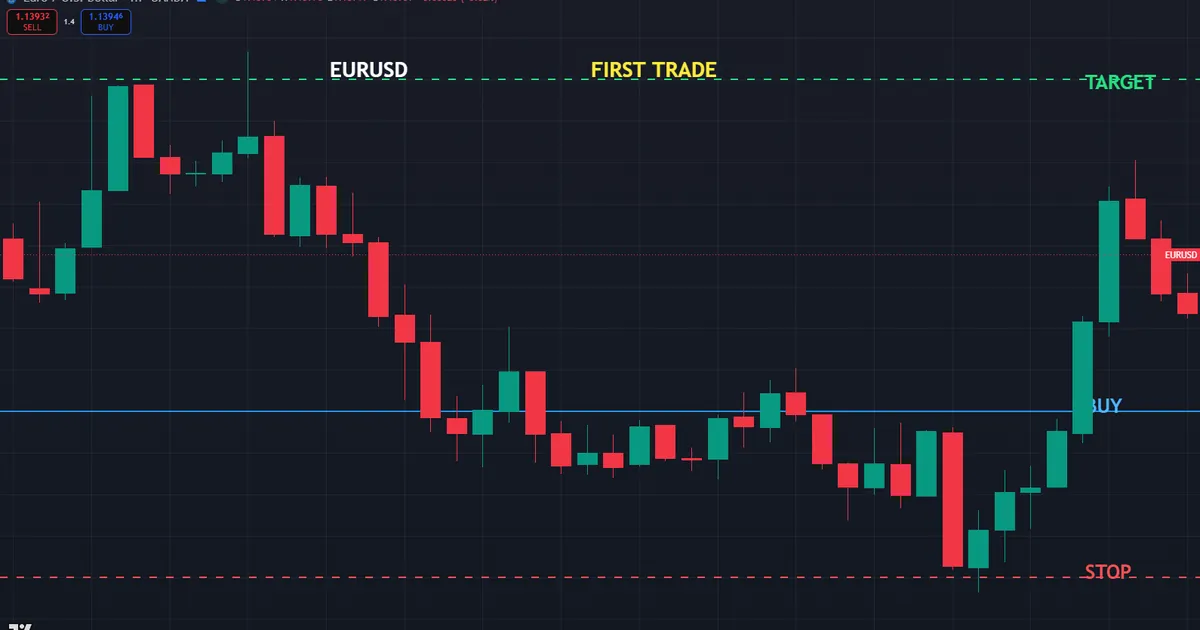
The good news is that none of the stages need deep math. A beginner needs clear rules and a little discipline far more than a clever forecast. So treat the path below as a checklist you repeat until it feels routine.
The Beginner’s Path in Order
Here is the full sequence, from your first decision to your first trade. Work through the steps one at a time, and skip nothing.
- Learn a few major pairs. Start with EURUSD and one or two others, since the majors move cleanly and cost less to trade.
- Choose a regulated broker. Pick a broker overseen by a known authority, with fair spreads and a solid platform.
- Open a demo account. Practice with virtual funds first, so early mistakes cost nothing.
- Load a trading platform. Install MetaTrader 4 or 5, or use the broker’s web platform, and learn the order window.
- Plan a single trade. Decide the pair, the direction, the stop, and the target before you click.
- Size the position. Set the lot so a losing trade costs only a small percent of the balance.
- Place and manage it. Enter the trade, let the stop and target do their work, and record the result.
Notice how planning comes before clicking. Beginners who reverse that order tend to trade on impulse and lose the thread. Because the plan sets the stop and the size, it quietly controls the risk on every trade you take.
Why Start With the Major Pairs
The major pairs are the friendliest ground for a beginner. They trade in huge volume, so the spread stays tight and the price moves in an orderly way. Our guide on major currency pairs shows which pairs make up the majors and why they suit new traders.
Exotic pairs tempt beginners with fast moves, yet they punish them with wide spreads. Because a wide spread raises the cost of every trade, the majors leave more room for a small account to survive. So learn one or two majors deeply before you wander further afield.
Choosing a Broker and a Platform
Your broker is the gateway to the market, so choose one with care. Look for regulation by a respected authority, clear pricing, and quick, honest support. A weak broker can undo good trading, while a solid one fades into the background.
The platform is where you actually trade. MetaTrader 4 and 5 remain the standard tools for retail forex, and most brokers support them. Because the platform holds your orders and charts, spend an hour learning its buttons before you risk a cent.
Take time to read the order window in particular. It shows the volume field, the stop-loss box, and the take-profit box, all beside the buy and sell buttons. So a slow, careful first look there prevents the costly slips that rush creates.
Demo First, Always
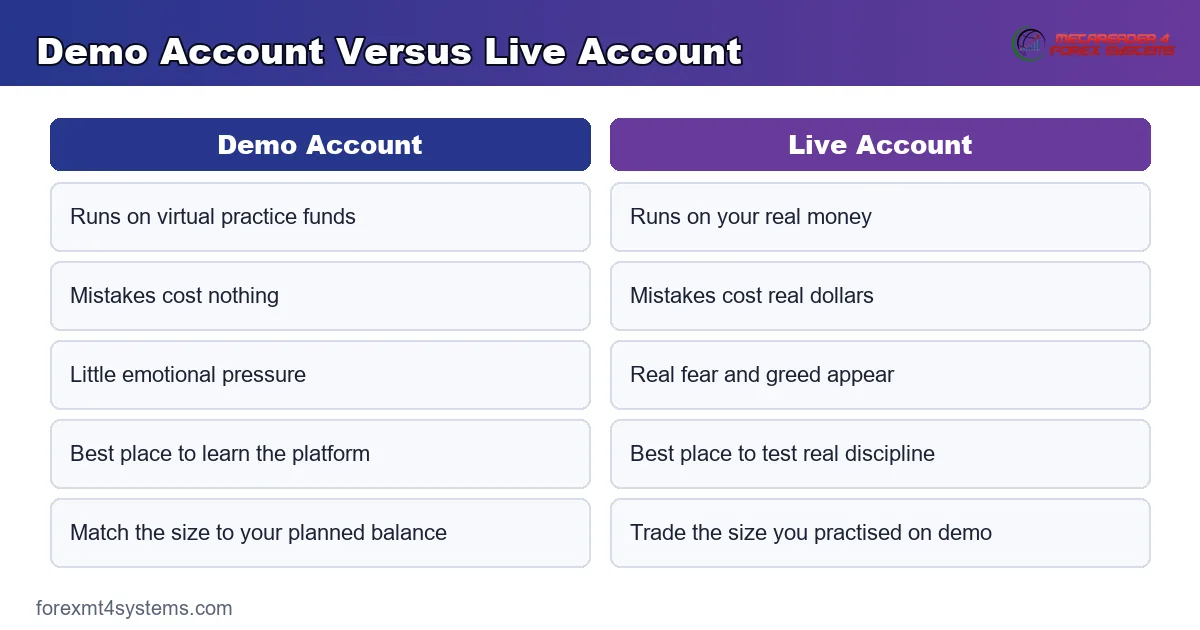
A demo account is the beginner’s best friend. It runs on live prices with virtual money, so you learn the platform without any real loss. Because the stakes are zero, you can make every rookie mistake safely and cheaply.
Treat the demo seriously, though. Trade the same sizes and follow the same rules you plan to use live. A demo funded far above your real balance teaches the wrong habits, so match it to the account you truly intend to open.
Understanding the Costs
Every trade carries a cost, and a beginner must know it upfront. The spread is the gap between the buy and sell price, and some brokers add a small commission. Because these costs repeat on every trade, they add up faster than new traders expect. Our guide on forex trading costs breaks down every fee a beginner meets.
So favor tight-spread majors and trade selectively while you learn. Frequent trading multiplies the cost, which quietly drains a small balance. A patient beginner who trades less often keeps more of the account working.
Placing Your First Trade
Numbers make the path concrete, so walk through one first trade. You hold one thousand dollars, and you plan to buy EURUSD near 1.14 because you expect the euro to rise.
Start with the plan, not the click. You set a stop twenty pips below the entry and a target forty pips above, which gives a one-to-two reward-to-risk shape. So a winning trade earns twice what a losing one costs.
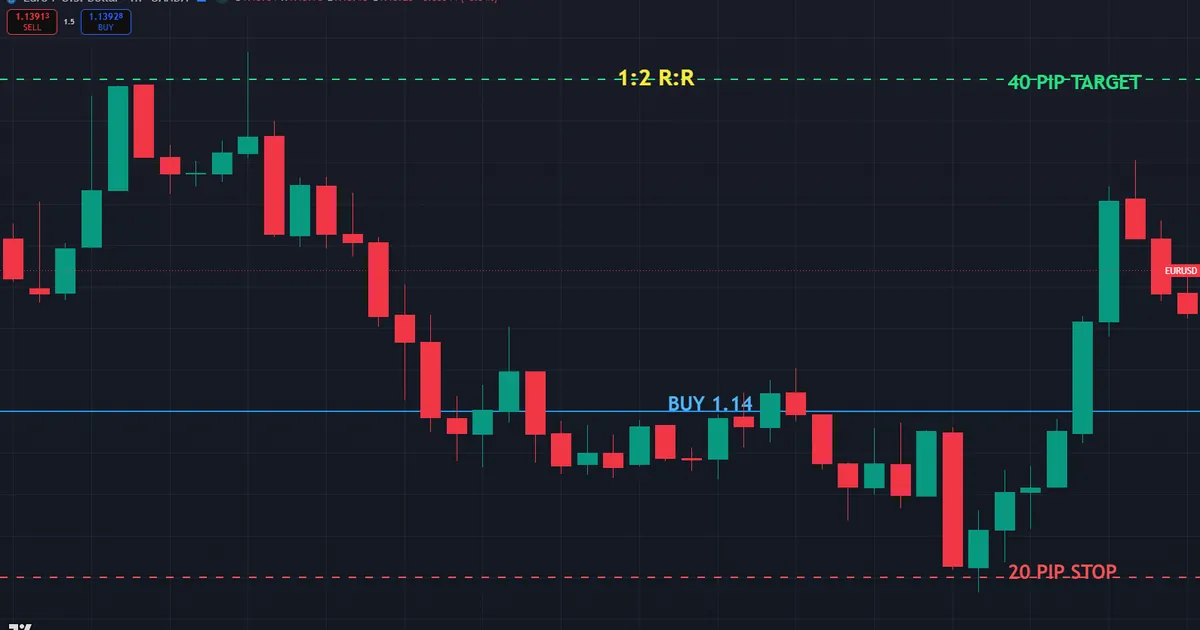
Next, size the position. One percent of one thousand dollars is ten dollars, and your stop is twenty pips away. Divide ten by twenty, and you need fifty cents a pip, which points to five micro lots, or 0.05.
Now read the outcome. If the stop is hit, you lose ten dollars, exactly one percent. If the target is reached, you gain twenty dollars, since the target sits twice as far away. Our position size calculator settles the lot for you in one step.
Entering and Managing the Trade
With the plan set, entering is the easy part. You type 0.05 in the volume field, set the stop and target prices, and click buy. Because you planned every number first, the click carries no drama.
After entry, let the trade breathe. The stop and the target now do the work, so you do not need to watch every tick. Beginners who hover over an open trade tend to close winners early and hold losers too long.
When the trade closes, record it. Note the pair, the direction, the stop, the size, and the result. Because a written record shows your habits over time, it teaches more than any single trade ever could.
Reading the Reward-to-Risk Shape
The one-to-two shape does quiet, powerful work. It means each win covers two losses, so you can be wrong more often than right and still hold ground. So the shape of the trade matters as much as the direction you pick.
Flip the shape, and the math turns against you. A trade that risks forty pips to make twenty needs a high strike rate just to break even. Because a poor shape demands near-perfect timing, beginners are wise to keep the reward larger than the risk.
Managing Risk as a Beginner
Risk control is the true skill behind trading, not forecasting. A beginner who caps the loss on every trade can survive a long learning curve. So the size and the stop matter far more than any single market call.
The habit is simple to state. Risk a small, fixed percent on each trade, often one percent or less. Then no single loss, and no short losing run, can threaten the account.
Always Use a Stop-Loss
A stop-loss is the seatbelt of every trade. It closes the position automatically at a set level, so a bad trade cannot run away. Because the market can move fast, a stop placed before entry protects you when attention slips.
Set the stop where the trade idea is clearly wrong, not at a random distance. Then size the lot to that stop, so the dollar risk stays inside your percent. So the stop and the size work together to fix the loss in advance.
Keep the Risk Percent Small
A small percent is what lets a beginner survive mistakes. At one percent, ten losses in a row trim the balance by roughly a tenth, not to zero. Because early trading is full of errors, that cushion buys the time you need to improve.
Resist the urge to raise the percent after a loss. Doubling the size to win it back only deepens the hole. So hold the percent steady, and let normal wins rebuild the account at a safe pace.
Download the complete indicator database
Put these concepts on your charts. One email unlocks the full library of 1,380+ indicators with compiled MT4 and MT5 files, plus my TradingView scripts. No paywall, no spam, unsubscribe any time.
Get free access to my indicator database
One email unlocks 1,380+ free MT4, MT5 and TradingView indicators — the complete library. No single-tool download; you get the whole database.
Common Beginner Mistakes
The path is simple, yet the same errors trip up new traders again and again. Most come from skipping the plan or the stop, and the fixes sit under the graphic below.
Trading Without a Stop-Loss
The gravest slip is entering with no stop at all. One runaway move can then erase a large share of the account. Always set a stop before you click, so the loss is capped no matter what the market does next.
Risking Too Much per Trade
Many beginners risk a big chunk of the balance on one idea. A single loss then stings badly, and a short run of them ends the account. Cap the risk at a small percent, and let the size follow that limit.
Skipping the Demo Stage
Some new traders rush to live trading before they know the platform. So they fumble the order window and lose money to simple slips. Spend real time on demo first, and carry the same rules across when you go live.
Chasing the Market
Beginners often jump into a fast move for fear of missing it. Yet chasing usually means entering late, near the end of the run. Wait for your planned setup instead, and let the trades that fit your rules come to you.
Overtrading the Account
The urge to always be in a trade leads to too many trades. Each one carries a cost, and the costs pile up on a small balance. Trade selectively, take only your best setups, and let patience protect the account.
Beginner Trading Checklist
Keep this short list beside your platform. Run through it before you place any new trade.
- Trade a major pair with a tight spread while you learn.
- Confirm the broker is regulated and the platform is loaded.
- Decide the direction, the stop, and the target before you click.
- Size the lot so a loss costs one percent or less.
- Set the stop-loss on every trade, without exception.
- Record each closed trade to track your habits.
- Practice on demo until the routine feels calm.
Beginner Pitfalls and Edge Cases
A few situations bend these simple rules, so watch for them. The chart below marks a common trap, chasing a fast move with no plan and no stop.
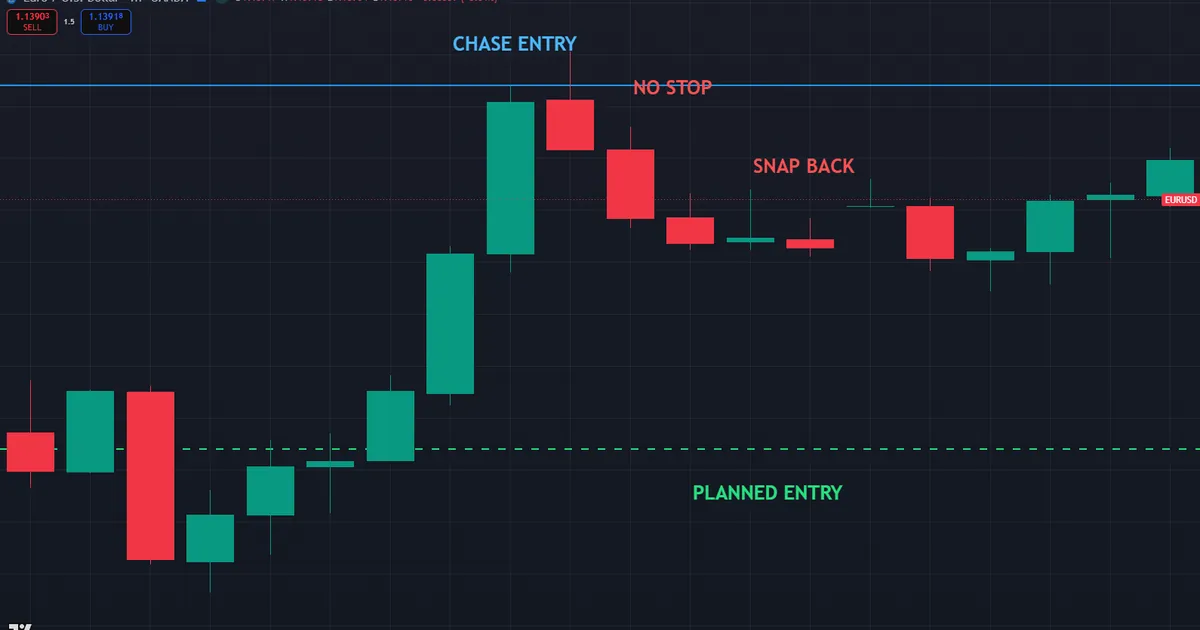
Picture two beginners on the same sharp rally near 1.14. One waits for a planned pullback, enters with a stop, and risks one percent. The other chases the top, enters late with no stop, and risks a tenth of the account.
The lesson lands hard. Both saw the same move, yet only the planner controlled the loss. When the price snapped back, the chaser gave up ground the planner never risked. So the plan, set before entry, decided who stayed safe.
Trading Around News Releases
Major news can move a pair fast and unpredictably. A stop may fill far from its level when the price gaps through it. Because the risk is hard to control, many beginners simply avoid trading through big releases. Our forex market hours tool shows when each session and its news flow is active.
Weekend and Gap Risk
Prices can gap over the weekend, opening away from Friday’s close. A stop set on Friday may fill worse on Monday if the market jumps past it. So a smaller size leaves more room to absorb that shock.
Emotional Trading
Fear and greed push beginners into poor decisions. Fear closes winners too soon, while greed holds losers too long. Because a written plan removes much of the guesswork, following it steadies the emotions that trip new traders.
Non-Dollar and Cross Pairs
Pip values shift when the dollar is not the quote currency. A beginner who assumes the same value on every pair can misjudge the risk. So learn the majors first, and confirm the pip value with a tool before trading crosses.
Reading a Forex Quote
A quote is the first thing a beginner sees, so read it well. Every pair shows two prices, the bid and the ask. The bid is where you sell, and the ask is where you buy, with the spread as the gap between them.
The pair name itself carries meaning. In EURUSD the euro is the base currency and the dollar is the quote currency. So the price tells you how many dollars one euro is worth, and the base is always what you buy or sell.
A rising quote means the base is gaining on the quote currency. When EURUSD climbs from 1.14 to 1.15, the euro has strengthened against the dollar. Because you can profit on a rise or a fall, you buy when you expect a climb and sell when you expect a drop.
Long and Short in Plain Terms
Going long means buying the base currency in hope of a rise. Going short means selling it in hope of a fall. Because forex always trades in pairs, a short is not exotic, it simply sells the base and buys the quote.
So a beginner can earn in either direction. A falling market is not a dead market, only a chance to go short. That two-way freedom is part of what draws new traders to forex in the first place.
Building a Simple Trading Routine
A routine turns scattered trades into steady practice. You pick a set time to study the charts, a short list of pairs, and a clear rule for entry. Because the routine repeats, your decisions grow calmer and more consistent over time.
Keep the routine light at first. Check a couple of major pairs, look for your one planned setup, and skip the rest. So you avoid the trap of forcing trades on days when nothing lines up.
A written plan anchors the whole routine. It names the pairs you watch, the setup you wait for, and the risk you allow per trade. Because the plan lives on paper, it steadies you when the market grows noisy and tempting.
Reviewing Your Trades
Review is where the real learning happens. Once a week, read back through your recorded trades and look for patterns. You may find you close winners early, or size larger after a loss, and both are fixable habits.
Score the process, not just the profit. A well-planned trade that lost is still a good trade, while a lucky win with no plan is not. Because good habits pay off over many trades, judge yourself on discipline first and results second.
Growing at a Steady Pace
Patience is the beginner’s real edge. A small account grows through many small, well-sized trades, not one lucky swing. So resist the pull to trade bigger before the habits are solid.
Let the size track the balance as it climbs. A rising account can carry a slightly larger lot for the same one percent risk. Because the risk stays fixed while the balance grows, the account can compound at a safe and steady pace.
Related Concepts to Study Next
The beginner path opens onto a small web of ideas worth your next reading hour. A firm grasp of what forex actually is deepens every step above. A clear glossary of the common terms removes the jargon that slows new traders down.
Read our guide on forex trading explained to see how a trade truly works from the ground up. Then keep our forex trading terms glossary handy while you learn. Together they turn the steps above from a checklist into real understanding.
FAQ
How do I start trading forex as a beginner?
Start by learning a few major pairs and opening a demo account with a regulated broker. Practice on the platform with virtual funds until the order window feels familiar. Then move to a small live account, risk one percent per trade, and always use a stop-loss.
How much money do I need to start trading forex?
Many brokers let you open a micro or cent account with a few hundred dollars. A small balance can trade single micro lots while you learn the ropes. The account grows slowly, yet it survives long enough for the practice to pay off.
Do I need a demo account before trading live?
A demo account is strongly advised before you risk real money. It runs on live prices with virtual funds, so early mistakes cost nothing. Trade the same sizes and rules you plan to use live, and the habits will carry over cleanly.
What is the safest way for a beginner to manage risk?
Cap the loss on every trade at a small, fixed percent of the balance, often one percent. Set a stop-loss before entry, then size the lot to that stop. Because the loss is fixed in advance, no single trade can threaten the account.
Which currency pairs should a beginner trade?
Beginners do best with the major pairs, such as EURUSD, since they move cleanly and cost less to trade. The tight spread leaves more room for a small account to survive. Learn one or two majors deeply before you explore crosses or exotics.
How long does it take to learn to trade forex?
Learning the basics takes weeks, while building steady discipline takes many months of practice. The pace depends on how carefully you trade and how honestly you review your results. Keep the risk small, record every trade, and let the skill build at its own speed. Results are not guaranteed; past performance is not indicative of future results.
External references
- For background on this concept, see Electronic trading platform on Wikipedia.
- For broader market context, see Avoiding Forex Mistakes at Investopedia.

About the author
Written by Dominic Walsh, a Forex trader and MT4/MT5 indicator, Expert Advisor and script developer. Every tool on forexmt4systems.com is tested on live charts before release and ships with ready-to-use compiled MT4 (.ex4) and MT5 (.ex5) files. Learn more about the trader and developer behind this site.
How we build, test and correct every tool: Editorial & Testing Policy. Trading carries risk; see the disclaimer.