
Your trading platform shows a percentage that quietly decides whether your trades stay open or close by force. That number is the margin level in forex, and reading it well is one of the simplest habits a new trader can build. It measures how much cushion stands between you and a forced close on your trades.
This guide makes the margin level in forex clear in plain steps. So by the end, you will know the exact formula, read the percentage with confidence, and recognise the levels where a broker starts to act on your account.
What the Margin Level in Forex Measures
Margin level compares two numbers you already track. It weighs your equity against the margin locked behind your open trades. The result comes out as a percentage that rises and falls with every tick.
So a high percentage means a thick cushion, and a low one means a thin cushion. When the figure sits high, your account holds plenty of spare value above the locked margin. When it slides low, that spare value shrinks toward zero.
Here is the plain picture. Equity is what your account is worth right now, and used margin is the cash held behind your trades. Margin level simply shows the first as a percentage of the second. The chart below marks a healthy reading with a MARGIN LEVEL callout.
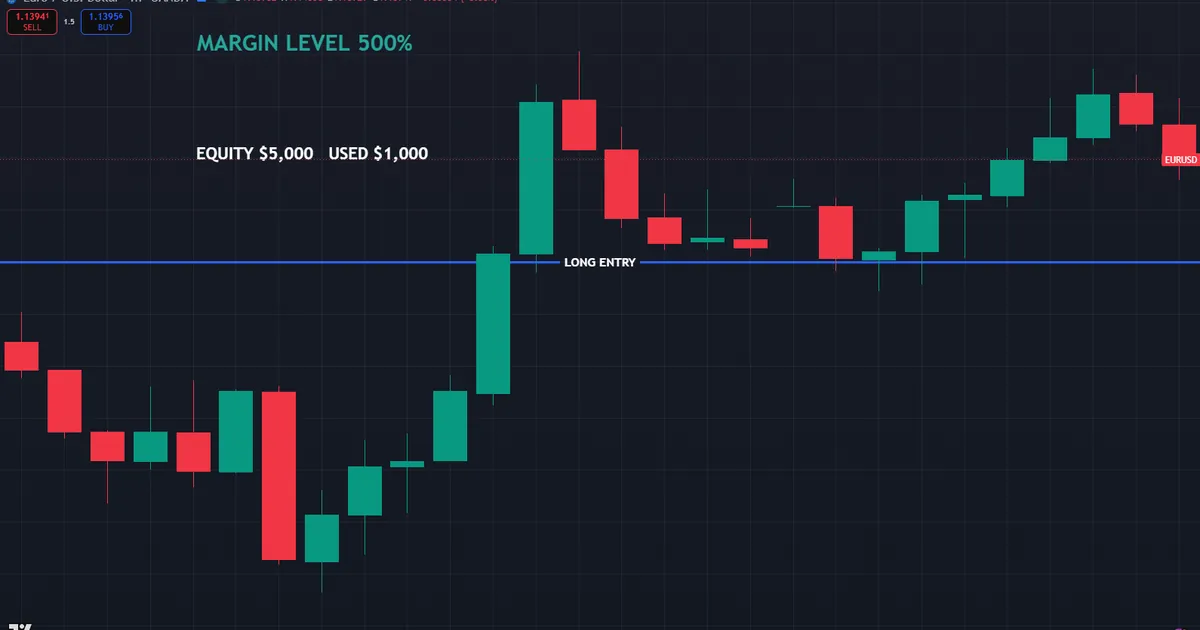
Think of it as a fuel gauge for risk. A full gauge lets a trade ride out a normal dip, while a near-empty one leaves no room at all. Our plain guide to margin in forex covers the used-margin side that feeds this figure.
A Simple Analogy
Picture a swimmer above the seabed. The water depth is your equity, and the seabed is your used margin. Margin level measures how far above the bottom you float, shown as a percentage.
So a deep reading means clear water beneath you. A shallow one means your feet nearly touch the bottom, where a broker steps in. Because a losing trade lowers the water, watching the depth warns you long before you run aground.
The Margin Level Formula
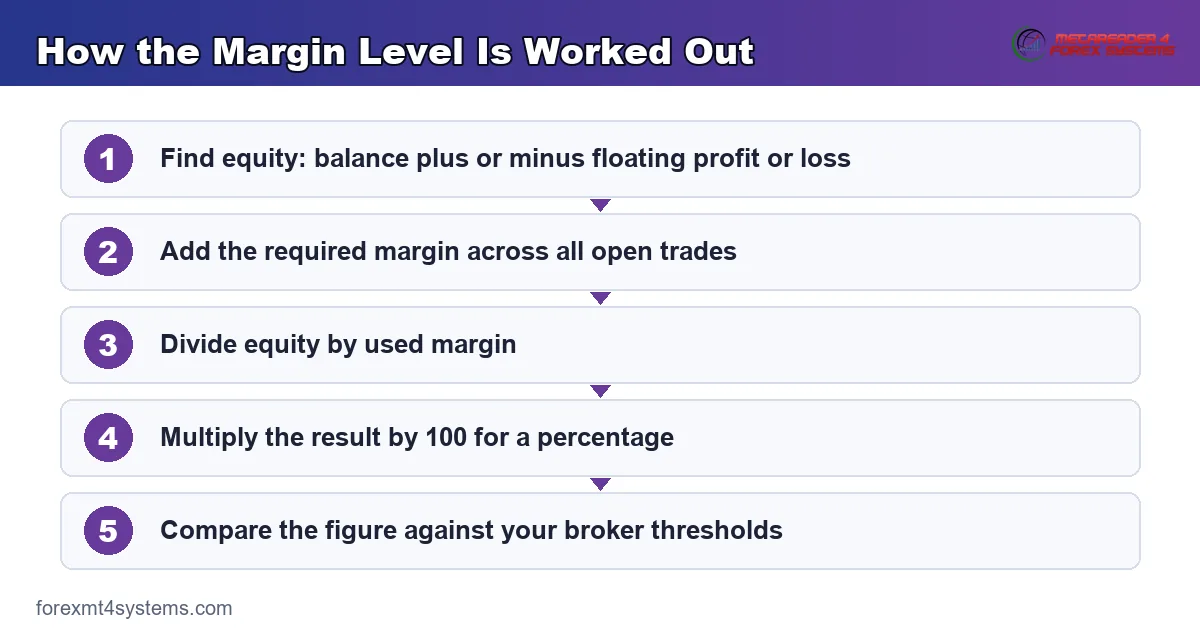
The math is short, so learn it once and keep it. Margin level equals your equity divided by your used margin, then multiplied by 100. That single line drives everything that follows.
- Find your equity. Equity equals your balance plus or minus the floating profit or loss on open trades. Say a 5,000 dollar account sits flat, so equity reads 5,000 dollars.
- Find your used margin. Add the required margin across all open positions. Say one trade holds 1,000 dollars of margin.
- Divide equity by used margin. Here 5,000 divided by 1,000 gives 5.
- Multiply by 100. That turns 5 into a margin level of 500 percent.
- Read the result. A 500 percent reading means your equity is five times the margin you have locked.
So the formula reads: margin level equals equity divided by used margin, times 100. Change either input and the percentage moves. The concept flow below traces the figure from equity down to the thresholds that matter.
One case surprises beginners. With no trades open, used margin reads zero, and you cannot divide by zero. So the platform simply shows a dash or a very large number until you open a position. Once the first trade goes live, the figure appears and starts to move with the market.
A Second Number Check
Try a different set of figures to lock in the method. Say an account holds 8,000 dollars of equity with 2,000 dollars of used margin across two trades. Divide 8,000 by 2,000 to get 4, then multiply by 100.
So the margin level reads 400 percent, a comfortable cushion. Now imagine a floating loss of 2,000 dollars. Equity falls to 6,000 dollars, and the level drops to 300 percent, since 6,000 over 2,000 is 3. So the same used margin plus a smaller equity sends the percentage lower in step.
Why the Percentage Moves
Margin level breathes with your open trades. Because equity shifts every tick, the top of the fraction changes constantly. So a winning trade lifts equity and pushes the percentage up, while a losing one drags both down.
Used margin can move too. Open a second trade and the locked margin grows, which lowers the percentage even if equity holds. So both a fresh position and a floating loss can pull your margin level toward the danger zone. Our note on equity in forex explains the live figure at the top of the sum.
Why the Margin Level Matters
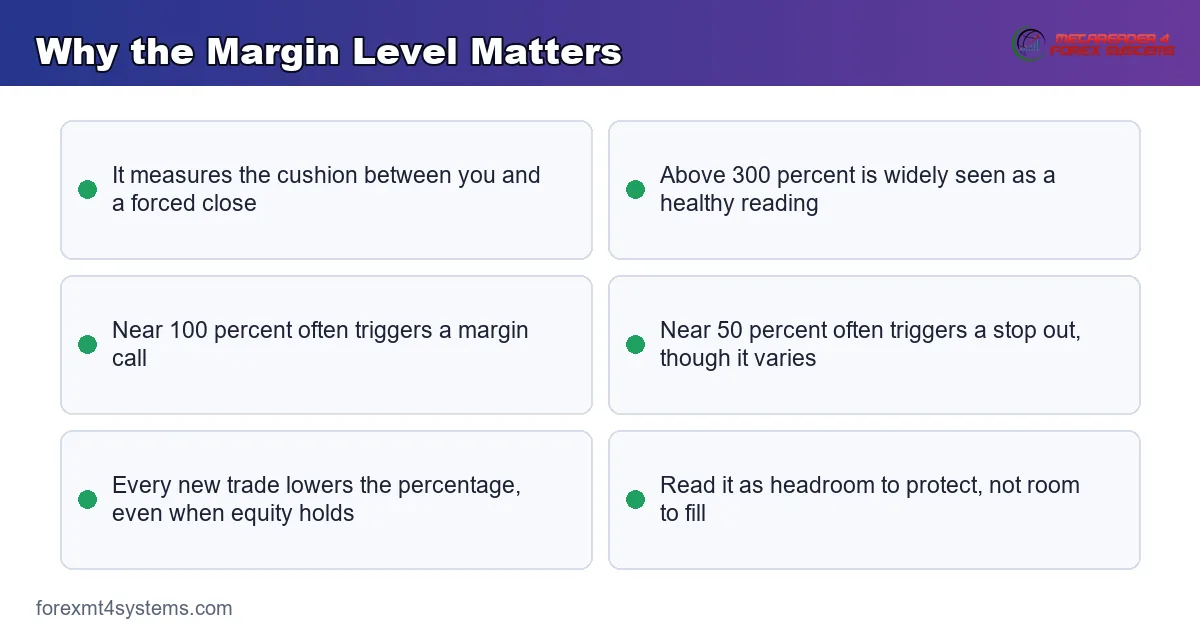
This one number guards your account from a forced close, so give it weight. Brokers watch it constantly, and they act when it falls past set thresholds. So the percentage is not decoration, it is an early-warning system.
Start with the healthy zone. A reading well above 100 percent means your equity comfortably covers the locked margin. Many traders treat 300 percent or higher as a healthy cushion, since it leaves plenty of room for a normal swing.
How Fast a Level Can Fall
A margin level does not slide at a steady pace. Because used margin stays fixed while equity moves, a large position can drag the percentage down quickly. So the same dollar loss that barely dents a lightly loaded account can gut a heavily loaded one.
Size sets the speed of the fall, then. A small position leaves a long runway before the figure reaches 100 percent. A large one shortens that runway sharply, which is why sizing and margin level work hand in hand.
The Levels Brokers Watch
Thresholds vary by broker, yet the pattern holds across most of them. A margin level near 100 percent means equity has fallen to match used margin. At that point many brokers issue a margin call and may block new trades.
Below that sits the stop-out level, often near 50 percent, though it differs by firm. Once the percentage reaches it, the broker starts closing positions to protect the account. So a falling margin level is a countdown you can watch in real time. Our guide to margin call and stop out walks through that closing process in detail.
A Cushion, Not a Target
Read margin level as headroom, never as something to spend down. A very high reading is a strength, not idle capital going to waste. So resist the urge to pile on trades just because the percentage looks large, since each one nibbles the cushion away.
Because each new position lowers the figure, discipline here keeps the cushion intact. A trader who guards a high margin level survives the rough patches that close out an over-loaded account and end its run early. So treat the number as protection you build, not room you must fill.
Margin Level at a Real Broker
Numbers land better inside a live account, so walk one through. Say you hold 5,000 dollars and open a single EURUSD trade near 1.14 that locks 1,000 dollars of margin.
At the start, equity reads 5,000 dollars and used margin reads 1,000. So the margin level lands at a healthy 500 percent, a genuinely comfortable cushion. The account holds five times the locked margin in equity, with room to spare for a normal swing.
Now let the trade move against you. If the position drops 2,000 dollars, equity falls to 3,000 dollars while used margin holds at 1,000. So the margin level slides to 300 percent, still healthy but lower. The chart below marks that slide as MARGIN LEVEL drops from 500 toward 150 percent.
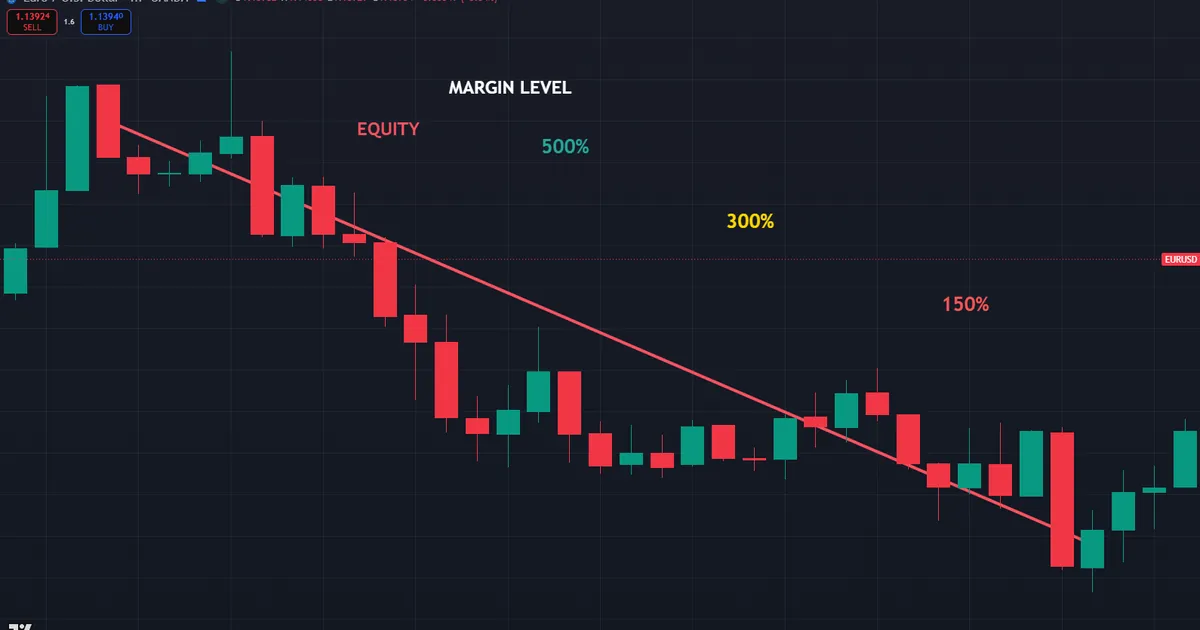
Push the loss further to see the danger. A 4,000 dollar loss cuts equity to 1,000 dollars, exactly the used margin, so the level hits 100 percent. At that point a margin call often lands, and the account enters real danger. To test these figures for any pair and lot, our free margin calculator runs the numbers in a second.
How Several Trades Share One Level
Your account shows a single margin level, not one per trade. The platform sums the used margin across every open position, then measures total equity against that pool. So one figure captures the health of the whole book.
This matters when you scale in. Each fresh trade adds to used margin and trims the percentage, even when the older trades sit in profit. So before you add a position, picture where the combined level will land, rather than judging the new trade alone.
Reading the Number in Real Time
Most platforms show margin level in the account summary, beside equity and free margin. So you never have to compute it by hand during a trade. Still, knowing the formula helps you predict where a new position will leave you.
Glance at the figure before and after every trade. Before, it confirms you hold enough cushion to open safely. After, it shows how much headroom the new trade left behind. Because the number updates tick by tick, it turns risk into something you can actually watch. Over time, that quick glance becomes second nature and stops most problems before they start.
Download the complete indicator database
Put these concepts on your charts. One email unlocks the full library of 1,380+ indicators with compiled MT4 and MT5 files, plus my TradingView scripts. No paywall, no spam, unsubscribe any time.
Get free access to my indicator database
One email unlocks 1,380+ free MT4, MT5 and TradingView indicators — the complete library. No single-tool download; you get the whole database.
Common Margin Level Mistakes to Avoid
The idea is simple, yet the same errors trip up new accounts. Most come from ignoring the figure until it is too late or from misreading what a low reading means. The graphic below sets the errors side by side, and the fixes follow beneath it.
Ignoring the Number Until It Is Low
Many traders never glance at margin level until a warning pops up. By then the cushion has nearly gone. So check the figure on every trade, and treat a falling trend as a signal to act while you still have choices.
Overloading a Healthy Account
A high reading tempts some traders to open trade after trade. Each new position quietly lowers the percentage. So resist filling the cushion, and keep the margin level well clear of the levels where a broker steps in.
Misreading a Falling Level as a Blip
A slide from 500 to 300 percent can feel harmless. Yet the same rate of loss carries the figure to 100 percent just as fast. So watch the speed of the drop, not only the current number, and size your trades for the trend.
Assuming Every Broker Uses the Same Levels
Margin call and stop-out levels differ from firm to firm. A trader who assumes 50 percent everywhere can be caught out by a broker that acts sooner. So read your own broker’s thresholds, and manage the percentage against those exact figures.
Confusing Margin Level With Free Margin
Free margin is a dollar figure, while margin level is a percentage. The two move together but answer different questions. So track both, and lean on the percentage when you want a quick read on how close a forced close really is.
Watching Only Winning Trades
It feels good to track the trades in profit, yet the losers set the margin level. A single deep loser can drag the whole percentage down while winners distract you. So watch the account figure, not the trade you most enjoy looking at.
Margin Level Quick-Reference Numbers
Keep this short list near your platform while the habit forms. A few seconds of checking here spares a costly surprise later. So read each line before you commit real cash, and glance at it until the figures feel familiar.
- Margin level equals equity divided by used margin, times 100.
- Equity equals balance plus or minus floating profit or loss.
- A reading above 300 percent is widely viewed as a healthy cushion.
- A reading near 100 percent often triggers a margin call.
- A reading near 50 percent often triggers a stop out, though it varies.
- With no open trades, used margin is zero and the level shows a dash.
- Every new trade lowers the percentage, even when equity holds.
- A personal warning line, such as 200 percent, prompts action early.
Edge Cases That Catch Traders Out
Study the sharp corners as hard as the smooth path. Here is one that stings. A trader holds several open positions, watches the price alone, and never checks the margin level as losses mount.
Then the percentage crosses 100 percent. A margin call lands, new trades lock up, and the figure keeps sliding toward the stop-out level. The chart below marks that crossing, where MARGIN LEVEL dips below 100 percent into the MARGIN-CALL ZONE.
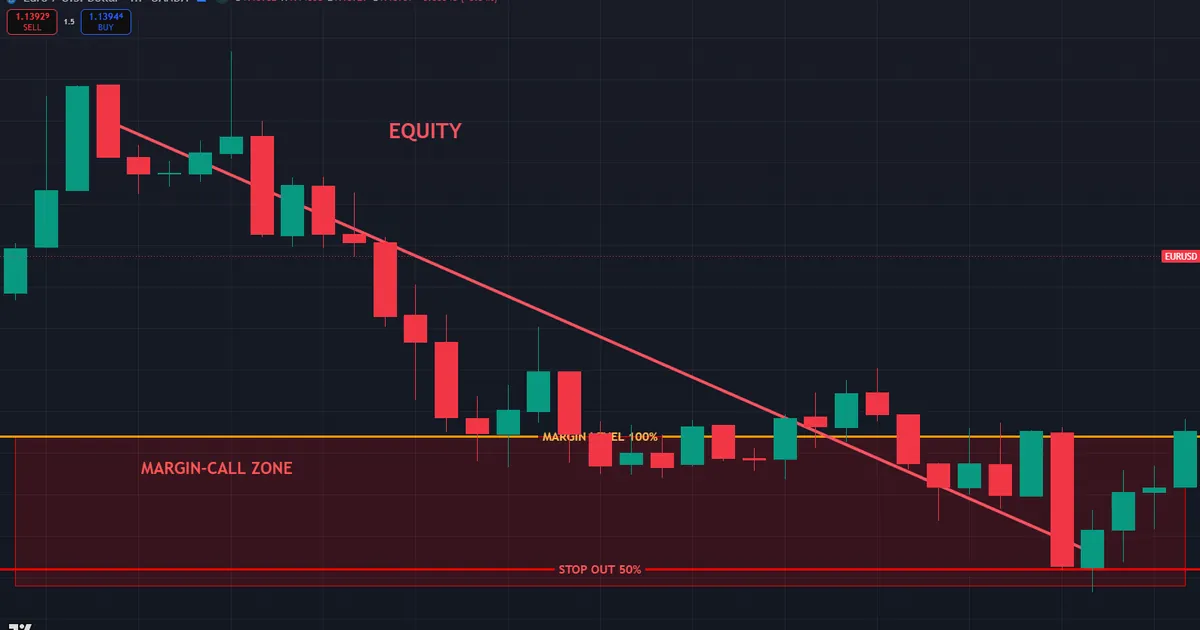
So what went wrong? The trader treated margin level as an afterthought. Because the figure fell unwatched, the first sign of trouble arrived as a forced action rather than a warning. To size trades so the cushion stays thick, our position size calculator keeps the risk per trade in check.
Set Your Own Warning Line
Do not wait for the broker’s threshold to act. Pick a personal warning level, say 200 percent, and treat it as your own line in the sand. So you respond well before a margin call ever appears.
When the figure touches your line, pause and review. Because you set the trigger above the danger zone, you keep the power to choose calmly rather than react under pressure. That habit turns margin level from a scary number into a simple, early cue.
Margin Level Around News
Respect the calendar when the percentage runs tight. Around a central-bank decision, prices can jump many pips in seconds. So a floating loss can deepen fast and drag the margin level down before you react.
Give yourself extra room before scheduled news, then. Trim size or add funds so a sudden swing does not push the figure toward a margin call. Because these bursts pass, a thicker cushion usually carries you through the release.
Adding Funds Versus Closing Trades
When margin level slides, you hold two clean levers. Adding funds lifts equity and raises the percentage at once. Closing a trade lowers used margin, which also lifts the figure.
So pick the lever that fits the moment. Add funds when the ideas still hold and only the cushion looks thin. Close a trade when the market has turned and you want less risk on the table. Either move buys back the headroom you need. So knowing both levers in advance keeps a slide from turning into panic.
Weekend and Overnight Risk
Margin level can shift while you sleep or over a closed weekend. A gap on the Monday open moves equity before any stop can fill, so the percentage may sit lower than you left it. Many traders trim exposure ahead of the weekend for this reason.
Check the figure first thing after a break, then. Because a gap can eat a chunk of your cushion in one move, an early glance lets you add funds or cut size before trouble builds. So treat the first look of the week as a quick health check on the whole account.
Related Concepts to Study Next
Margin level sits inside a small family of account terms, and a few reward your next reading hour. The deposit that feeds the bottom of the sum comes first, and the ratio that sets that deposit sits right beside it. Both shape the percentage you now know how to read.
For the wider view, our guides to leverage in forex and to broader forex trading strategies place margin level inside real risk control. The forced-close process that waits at the bottom of the scale deserves a close read too, since it decides what happens once the cushion runs out. So master this percentage first, then let each partner term sharpen how safely you size and hold every trade you take.
FAQ
What is margin level in forex?
Margin level in forex is a percentage that compares your equity to your used margin. You work it out by dividing equity by used margin and multiplying by 100. A high percentage means a thick cushion above your locked margin, while a low one means little room before a broker acts.
How do I calculate margin level?
Divide your equity by your used margin, then multiply by 100. If equity is 5,000 dollars and used margin is 1,000 dollars, the margin level is 500 percent. Your platform shows the figure live, but knowing the formula helps you predict where a new trade will leave you.
What is a healthy margin level?
Many traders treat a reading above 300 percent as a healthy cushion, since it leaves room for a normal swing. There is no single correct number, and it depends on your style and pairs. The key is to stay well clear of the levels where a broker issues a margin call.
What margin level triggers a margin call?
Thresholds vary by broker, but a margin call often lands near 100 percent, where equity matches used margin. Below that, a stop out often occurs near 50 percent, though firms differ. So always read your own broker’s exact levels and manage the percentage against them.
Why does my margin level keep changing?
Equity moves every tick with the floating profit or loss on your trades, so the top of the fraction shifts constantly. Opening or closing a position changes used margin at the bottom. Both cause the percentage to rise or fall in real time.
Is a higher margin level always better?
A higher reading means a thicker cushion, which lowers the chance of a forced close. In that sense, more room is safer. Yet a very high level can also mean your capital sits idle, so many traders balance a healthy cushion against putting money to work. The right balance depends on your plan and your risk limit.
Can I trade with a low margin level?
You can, but it leaves little room for error, and a small adverse move can trigger a margin call or stop out. Most brokers also block new trades once the figure nears 100 percent. So keeping a thick cushion is the safer habit for any account. Results are not guaranteed; past performance is not indicative of future results.
External references
- For background on this concept, see Maintenance margin at Investopedia.
- For broader market context, see Margin account at Corporate Finance Institute.

About the author
Written by Dominic Walsh, a Forex trader and MT4/MT5 indicator, Expert Advisor and script developer. Every tool on forexmt4systems.com is tested on live charts before release and ships with ready-to-use compiled MT4 (.ex4) and MT5 (.ex5) files. Learn more about the trader and developer behind this site.
How we build, test and correct every tool: Editorial & Testing Policy. Trading carries risk; see the disclaimer.