
Learning what is equity in forex shows you the true, live value of your account at any moment. Equity is your balance adjusted for every open trade, so it moves up and down with each tick while a position stays open. So a trader who watches only the balance misses the number that really decides their fate.
This guide explains what is equity in forex, how it differs from your balance, and why it feeds the margin level that keeps you in the market. It walks through the simple formula, a worked example, and the mistakes that catch beginners who confuse the two figures.
What Is Equity in Forex, in Plain Terms
Your account holds two closely linked numbers. The balance records the cash you have after all closed trades settle. It sits perfectly still while a trade stays open, since it only updates when you close a position.
Equity tells the fuller story. It takes your balance and adds every open trade’s floating profit or loss right now. So equity is the real-time worth of your account if you closed everything this second.
The link between them is simple. With no trades open, equity and balance match exactly. Open a position, and equity starts to drift above or below the balance as price moves. So the gap that appears between the two numbers is simply the sum of your open profit and loss.
Here sits the key point. The balance is a snapshot of the past, while equity is the living present. So equity, not balance, tells you how much your account is truly worth at any instant.
The Live Value of Your Account
Look at a concrete frame first. The chart shows EURUSD on the one-hour timeframe near 1.14, with one long trade open. As price ticks up, the floating profit grows, and the equity climbs above the steady balance.
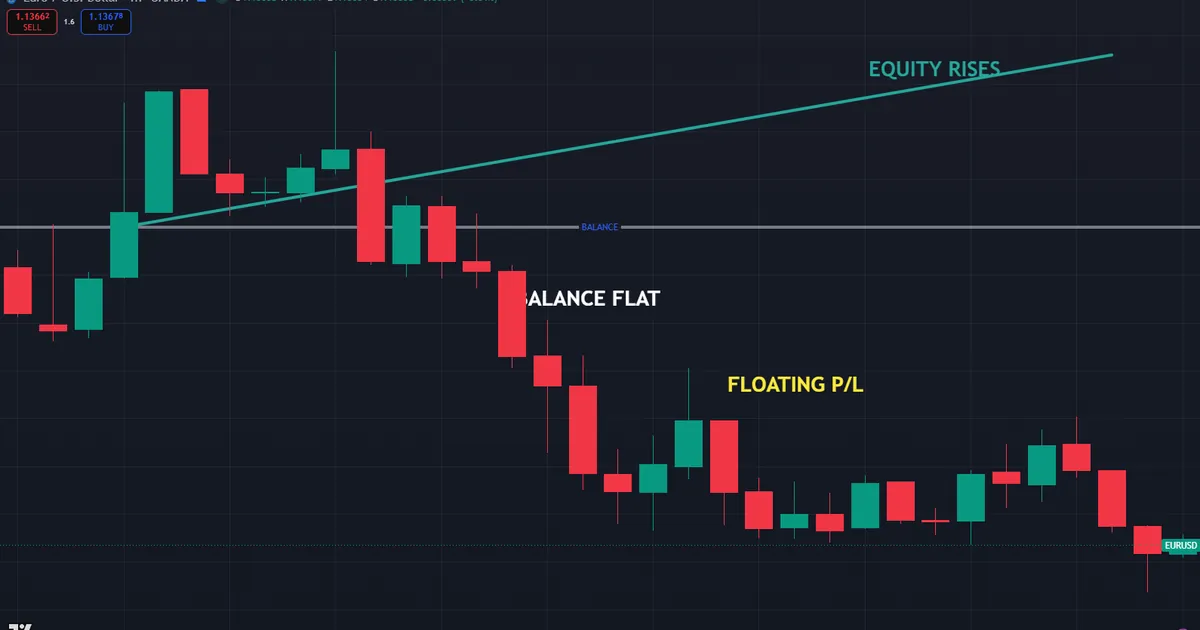
Trace the two lines side by side. The balance holds flat as a ruler because the trade stays open. Meanwhile the equity wanders up and down with every candle, tracking the floating profit and loss. So the gap between them is simply your open result.
Why does this matter so much? Your broker judges your account on equity, not balance, when it decides whether you can hold your trades. So a falling equity, even with a healthy balance, can put your positions at risk.
The Equity Formula and Its Parts
The math behind equity is small, so learn it once and reuse it forever. A few pieces explain the whole figure.
- Start with the balance. This is your settled cash after all closed trades. It changes only when you close a position or deposit funds.
- Add the floating profit. Every open trade in the green adds its current, unrealised gain to the equity. So a winning position lifts your equity above the balance for as long as it stays open.
- Subtract the floating loss. Every open trade in the red pulls its current, unrealised loss out of the equity. So a losing position drags the equity below the balance until you close or the price recovers.
- Include swap and commission. Overnight swap and any open commission adjust the floating result too. So a long hold on a negative-swap trade slowly trims the equity night after night.
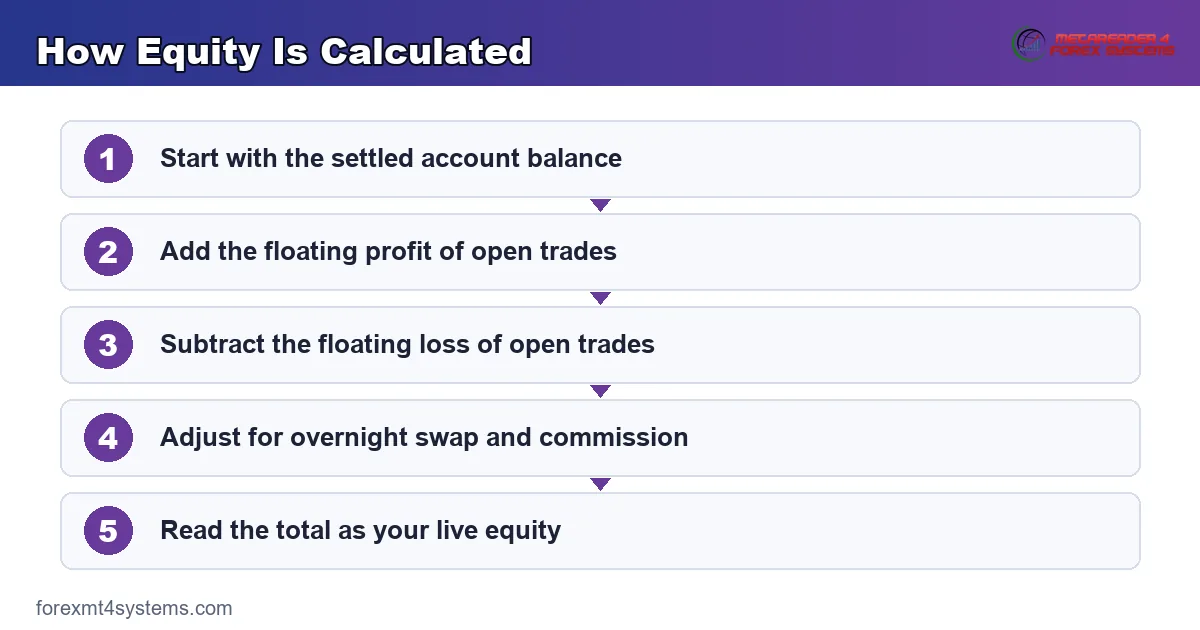
- Read the total. The sum is your equity, the live worth of the account if you closed every open trade at this instant.
So equity equals balance plus floating profit or minus floating loss. The concept graphic below lines up the pieces at a glance.
Equity Versus Balance
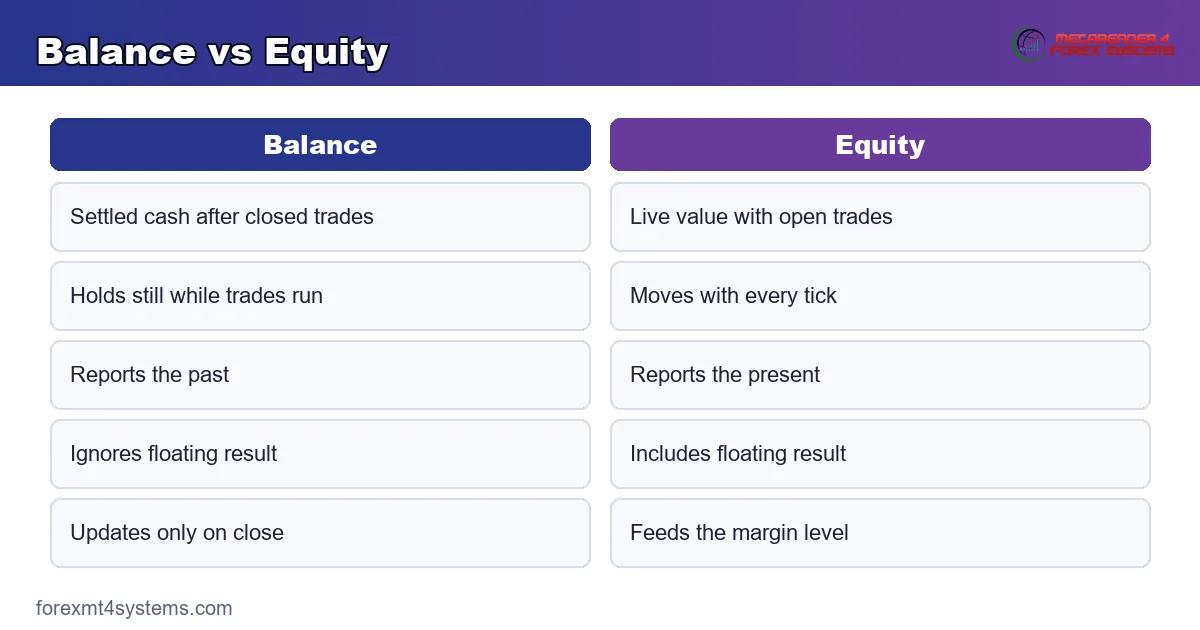
The clearest way to grasp equity is to hold it against balance. Balance answers a past question: how much cash have my closed trades left me? Equity answers a present one: how much is my account worth right now?
Picture a trader with a balance of 5,000 units of account currency and one open trade. If that trade floats 200 units in profit, the equity reads 5,200. If instead it floats 150 units in loss, the equity reads 4,850.
Close the trade, and the two numbers snap together. The floating result becomes real, the balance updates to match the equity, and the account rests until the next trade. So closing a position is the single moment when equity and balance reunite into one number again.
Reading Equity on Your Platform
Your trading platform shows equity right beside the balance. On most terminals, a panel at the bottom lists balance, equity, margin, free margin, and margin level together. So all five numbers sit in one glance once you know where to look.
Watch how they move as a set. Open a trade, and the used margin appears while the equity starts to float. Close it, and the margin frees up as the balance snaps to the new equity. Because the panel updates live, it turns the whole idea into something you can simply watch.
Make a habit of reading equity first. The balance draws the eye because it looks stable, yet the equity carries the real news. So train yourself to check equity and margin level the moment any trade runs, and the panel becomes an early-warning system.
How Equity Feeds the Margin Level
Equity does more than track your worth; it drives the margin level. The margin level equals your equity divided by the used margin, shown as a percentage. So equity sits right at the top of that fraction.
Because equity moves with every tick, the margin level moves too. A rising equity lifts the margin level and gives you room, while a falling equity drops it toward danger. So watching equity is really watching your safety cushion in real time.
This link explains the whole risk chain. Floating losses cut equity, a lower equity cuts the margin level, and a low enough margin level triggers a warning or a forced close. You can size trades to protect that cushion with our free margin calculator.
How Equity Works in Practice
Numbers make the idea concrete. Picture an account with a balance of 2,000 units of account currency and no open trades, so the equity also reads 2,000.
Now open one standard lot of EURUSD near 1.14. The used margin locks away part of the account, and the equity begins to float with price. So the moment the trade opens, equity and balance start to separate.
Watch the equity respond as price moves. A 30-pip gain in your favour lifts the floating profit, so the equity climbs toward 2,300 while the balance holds at 2,000. A 30-pip move against you pulls the equity down toward 1,700 instead. So the equity breathes with every pip while the balance sleeps.
Add a second trade to see the numbers combine. Open another lot that floats a small loss, and its red result joins the first trade’s green one. The equity now reflects the net of both open positions at once. Because every open trade feeds the same figure, the equity always shows your combined live result across the whole account.
A Worked Floating-Loss Example
Trace a losing spell to see the effect clearly. A trader holds one open position that slips steadily into the red through the session.
Follow the two numbers apart. The balance stays fixed, since nothing has closed, yet the equity sinks lower with each adverse tick. As the floating loss deepens, the equity drops well below the balance, and the margin level falls with it. The chart below marks the equity sliding as the floating loss grows.
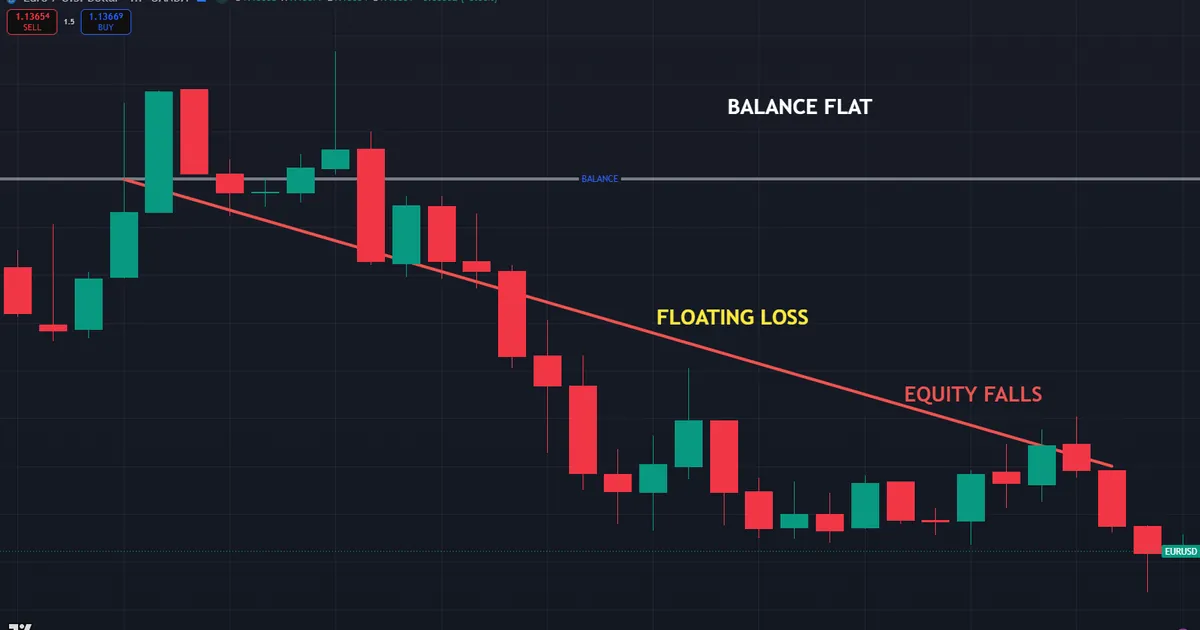
Now see why the broker cares. When the equity falls far enough, the margin level nears the broker’s stop-out threshold. If it crosses that line, the broker closes trades automatically to protect the account. So a shrinking equity is the earliest warning of a forced close, long before the balance ever reacts.
One habit keeps this in check. Watch the equity and margin level together, not the balance, whenever a trade runs against you. So you react to the number the broker actually acts on, well before it reaches the danger zone.
Managing Your Equity
Equity rewards a watchful eye. So build a few habits that keep the live number healthy rather than reacting only when it collapses.
Keep the equity comfortably above the used margin. A wide gap means plenty of free margin to absorb a swing and to open new trades. So size each position small enough that a normal adverse move barely dents the cushion.
Then treat a falling equity as information, not panic. A dip simply reports an open loss, which you planned for with a stop. Because the stop caps how far equity can fall on that trade, a planned dip never becomes a crisis.
Set a personal equity floor as well. Decide in advance how low the equity may fall in a day before you stop trading and step back. So a hard, pre-set line protects you long before the broker’s own stop-out ever comes into play.
Free Margin and Equity Together
Equity and free margin work as a pair. Free margin equals your equity minus the margin already used, so it is the cash still free to trade or to absorb losses. As equity rises, free margin rises with it.
Use that free margin as your true buying room. When it runs low, you have little cushion left and should add no new risk. So read free margin before every new trade, and let a thin figure keep you patient.
Why Equity Beats Balance for Decisions
Base your risk on equity, not balance, for a truer picture. A large balance can hide a stack of losing open trades that have already sunk the equity. So a trader who sizes new positions off the balance can take on far more risk than the live account can bear.
Flip the logic for a healthy account. When open trades float in profit, the equity sits above the balance, yet prudent traders still size off the more conservative figure. Because floating profit can vanish, leaning on equity keeps your risk honest.
Equity and the Drawdown Picture
Equity also draws the truest picture of drawdown. A drawdown is how far your account has fallen from its peak, and the equity curve captures that dip live, even before any trade closes. So the lowest equity point during a losing run reveals the real strain the account took.
Balance alone hides this strain. It steps down only when losses are booked, so it smooths over the deep floating dips in between. Because the equity records every wobble, it gives a franker measure of how much risk your account truly weathered.
Use that honesty to improve. Review your equity curve after a rough week, and note the deepest floating dips. So you learn whether your position sizing let the account swing too hard, and you can tighten it before the next run.
Download the complete indicator database
Put these concepts on your charts. One email unlocks the full library of 1,380+ indicators with compiled MT4 and MT5 files, plus my TradingView scripts. No paywall, no spam, unsubscribe any time.
Get free access to my indicator database
One email unlocks 1,380+ free MT4, MT5 and TradingView indicators — the complete library. No single-tool download; you get the whole database.
Common Mistakes and How to Fix Them
Equity trips up beginners in a handful of predictable ways. Most trace back to confusing it with the balance, and the fixes follow beneath the graphic.
Watching Balance Instead of Equity
A trader who stares at the steady balance misses the equity sliding beneath it. The account can near a stop-out while the balance still looks fine. So watch equity and margin level in real time whenever trades are open.
Sizing New Trades Off the Balance
A large balance can mask heavy floating losses that have already cut the equity. Sizing a fresh trade off that balance stacks risk on a weakened account. So base every new position on the live equity instead.
Mistaking Floating Profit for Cash
Floating profit lifts the equity, yet it is not real until you close. A trader who spends it in their head, or reloads on it, risks watching it evaporate. So treat unrealised gains as provisional until the trade closes.
Ignoring Swap’s Drag on Equity
Overnight swap quietly trims the floating result each night. A trader who forgets it sees the equity drift lower for no obvious price reason. So include swap in your view of the equity on any multi-night hold.
Panicking at a Normal Equity Dip
A small equity dip simply reflects a planned open loss inside your stop. Panicking and closing early turns a normal fluctuation into a real loss. So trust your stop, and let the equity breathe within the risk you set.
Quick-Reference Equity Checklist
Run this short list whenever you have trades open. A quick glance keeps the live number in view. So tick each item, and let a failed check tighten your risk.
- Equity read as balance plus or minus the floating result.
- Equity compared against the used margin for a healthy gap.
- Margin level checked as equity divided by used margin.
- Free margin confirmed before opening any new trade.
- Swap and commission included in the floating figure.
- New position size based on equity, not balance.
- Stop in place so the equity dip stays capped.
Pitfalls and Edge Cases
Study the trap as hard as the rule. Here is a common one. A trader sees a comfortable balance, opens several large trades at once, and glances only at that steady number.
Then the market turns. The open trades float deep into the red, the equity plunges while the balance holds, and the margin level slides toward the stop-out line without warning. The chart below marks the equity crashing while the balance sits flat.
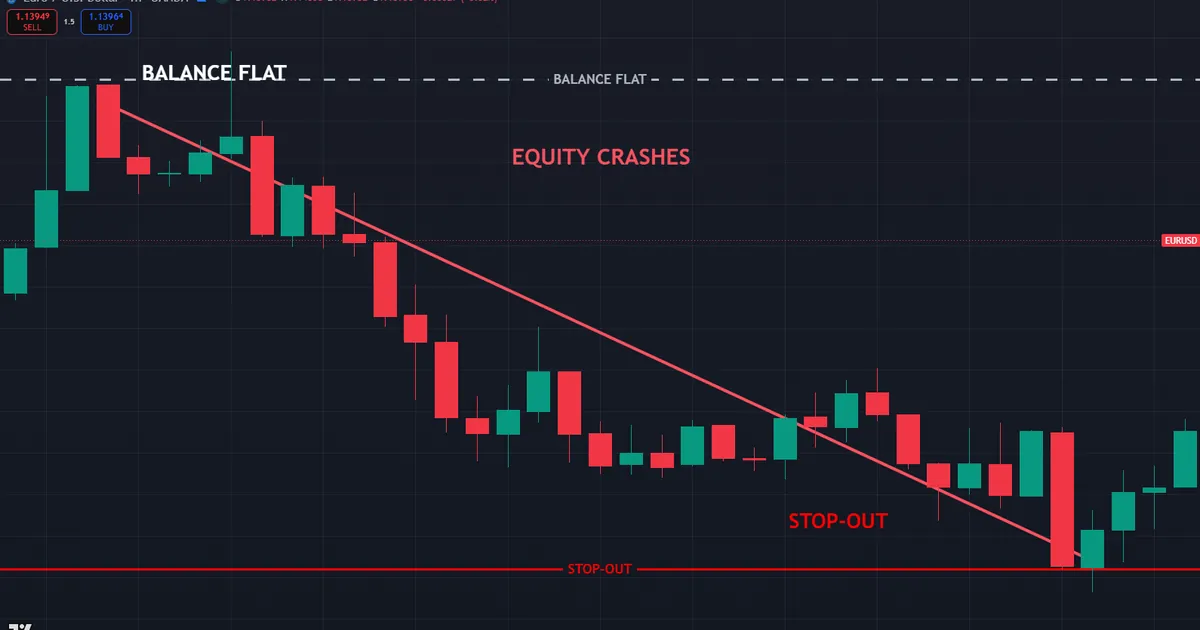
So what went wrong? The trader read the past number and ignored the present one. A healthy balance means nothing when floating losses have gutted the equity. Hence the rule that limits the damage: judge the account on equity and margin level, never on balance alone.
A second edge case catches the over-leveraged holder. A trader with many open positions has little free margin left, so even a small adverse move drops the equity into the danger zone fast. Because the cushion was thin to begin with, the forced close arrives far sooner than the trader ever expected.
Both traps share one root. Each trader trusted the balance and forgot that equity drives every margin decision. So read the live equity first, and the account holds no nasty surprises.
Equity Can Gap Over the Weekend
Be honest about the weekend. A position held from Friday into Monday can gap on the open, so the equity may jump or drop before you can react. Because the market moves while you cannot trade, a leveraged weekend hold carries extra risk to your equity.
Hedged Trades Still Move Equity
Remember that opposing trades do not freeze your equity. Each leg still floats its own profit and loss, and swap and spread apply to both. So a hedge locks the price gap in place but keeps chipping away at the equity through those ongoing costs.
A Deposit Lifts Both Numbers
Keep one more case straight. Adding funds raises the balance and the equity together, since new cash counts toward both. A withdrawal lowers them the same way. So a jump in equity from a deposit is not trading profit, and reading it as such flatters a weak account.
Separate the two sources in your mind. Trading changes equity through the floating result, while deposits and withdrawals change it through cash flow. Because only the first measures your skill, judge your progress on trading gains rather than a topped-up figure.
Related Concepts to Study Next
Equity connects to a web of basics, and a few deserve your next reading hour. Start with our guide to the margin level in forex, since equity sits at the top of that formula. Then read our breakdown of margin in forex to see the used margin that equity is measured against.
Two more guides round out the picture. Because a falling equity can force a close, study our guide to the margin call and stop out to see exactly when the broker steps in. Then review leverage in forex, since leverage decides how fast a move swings your equity. To size trades so your equity stays safe, our position size calculator works the risk out in seconds.
FAQ
What is equity in forex?
Equity is the live value of your trading account, equal to your balance plus the floating profit or minus the floating loss of all open trades. With no trades open, equity matches the balance. It updates with every tick while a position stays open.
What is the difference between equity and balance?
Balance is your settled cash after closed trades, and it holds still while a trade stays open. Equity adds the current open result, so it moves in real time. Balance reports the past, while equity reports the present worth of the account.
How does equity affect my margin level?
The margin level equals your equity divided by the used margin, shown as a percentage. Since equity sits at the top of that fraction, a falling equity drops the margin level toward the broker’s warning and stop-out thresholds. So watching equity means watching your safety cushion.
Why is my equity lower than my balance?
Your equity falls below the balance when open trades float in loss, since those unrealised losses subtract from the balance. Overnight swap and commission can add to the gap. Close the trades, and the balance updates to match the equity.
Should I base risk on equity or balance?
Base risk on equity, since it reflects the true live worth of the account. A large balance can hide heavy floating losses that have already weakened you. Sizing new trades off equity keeps your risk honest when positions are already open.
Does floating profit count as real money?
Floating profit lifts your equity, but it is unrealised until you close the trade. It can grow or vanish with the next tick. So treat it as provisional, and only count it as cash once the position closes and the balance updates. Results are not guaranteed; past performance is not indicative of future results.
External references
- For background on this concept, see Equity at Investopedia.
- For broader market context, see Margin trading at Corporate Finance Institute.

About the author
Written by Dominic Walsh, a Forex trader and MT4/MT5 indicator, Expert Advisor and script developer. Every tool on forexmt4systems.com is tested on live charts before release and ships with ready-to-use compiled MT4 (.ex4) and MT5 (.ex5) files. Learn more about the trader and developer behind this site.
How we build, test and correct every tool: Editorial & Testing Policy. Trading carries risk; see the disclaimer.