
Brokers advertise forex account types as tiers, and the labels rarely agree across two firms. One firm’s Standard looks like another firm’s Raw, so the badge on a sales page tells you very little.
Three things sit underneath that badge. The contract size you may trade, the way the broker charges you, and the rules your regulator applies to your client category. Sort those three, and the marketing collapses into a comparison you can run yourself.
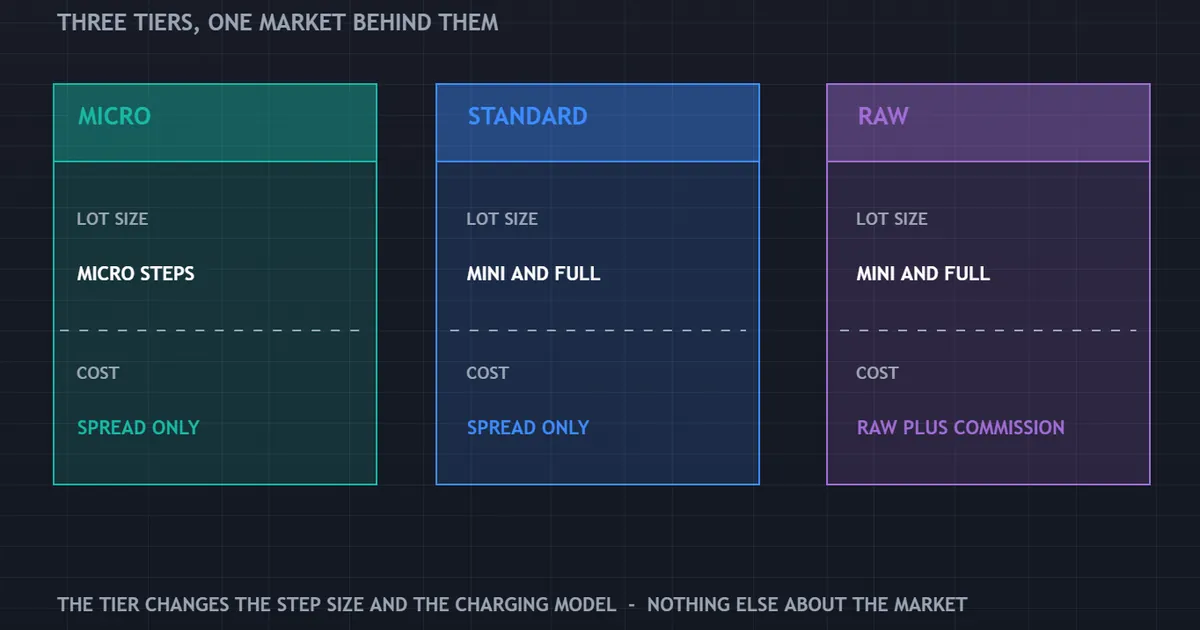
The panel above sets three tiers beside each other. Lot size and cost structure change, while the market you trade stays exactly the same.
What Forex Account Types Actually Change
A tier never changes the price of a currency pair. It changes what you pay to reach that price, and how small a position you may hold.
So read any offer as two numbers and one rulebook. Cost per round turn, then minimum volume, then the protections attached to your classification.
Contract Size Sets Your Smallest Risk
Volume decides everything downstream. If the smallest lot your broker allows already risks more than your limit, the account does not suit your balance yet.
Micro volume solves that problem for small balances. Standard volume suits larger ones, and nothing about the bigger tier improves the strategy behind it.
The Charging Model Sets Your Cost
Some accounts bundle the fee into a wider spread. Others quote a tighter spread, then add a commission per lot.
Neither model wins by default. Compare the total rather than the headline, because a raw spread with a heavy commission can cost more than a plain one.
Your Client Category Sets Your Protections
Regulators split clients into retail and professional. Retail clients under the FCA, CySEC or ASIC keep leverage caps and negative balance protection, while professional clients give both up.
That distinction outranks every tier name on the page. Our note on negative balance protection covers what the safeguard does and where it stops.
Spread Only or Raw Plus Commission
This choice creates more confusion than any other. Both models pay the same people, and only the packaging differs.
The Two Charging Models Side by Side
One model hides the fee inside the quote. The other splits it out, so you see the market spread and the broker fee as separate lines.
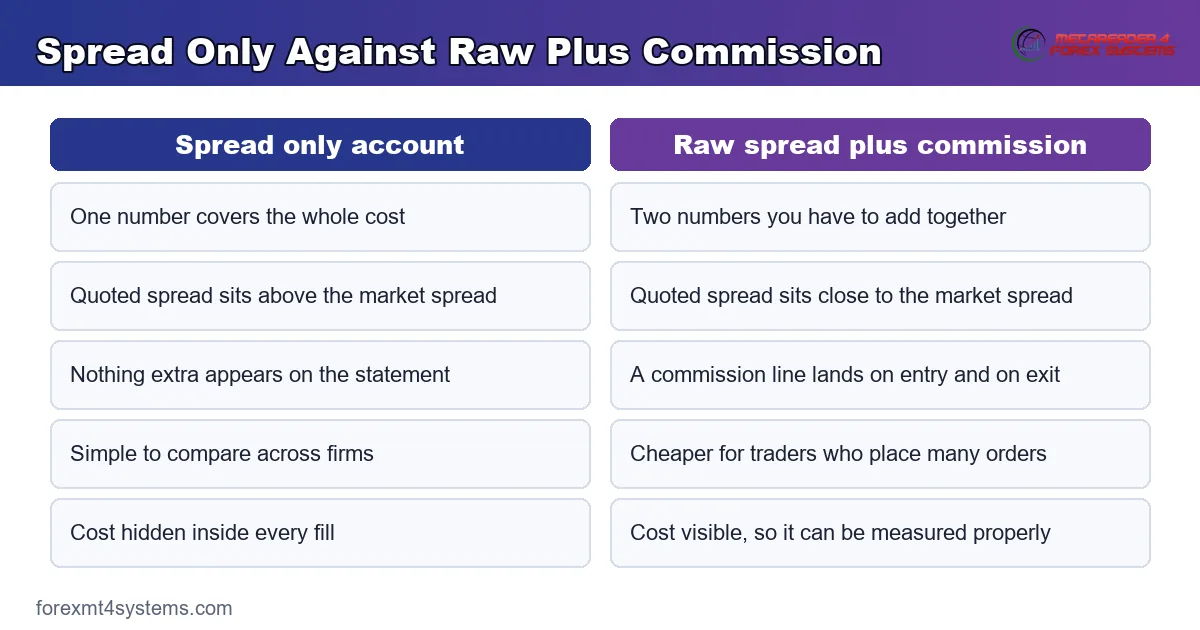
Add both costs together before you judge either one. A round turn on a raw account costs the spread plus commission on entry and on exit.
Where Each Model Fits
Frequent traders usually prefer raw pricing. Their edge lives in small moves, so a tighter quote matters more than a tidy statement.
Occasional swing traders rarely notice the gap. One extra fraction of a pip across four trades a month changes almost nothing.
Our guide to spread against commission works through the arithmetic in more detail. Run it on your own trade count before you switch tiers.
The Same Trade on Three Tiers
Cost is the only variable a tier controls, so a fair test holds everything else still. Same pair, same entry, same exit, three different pricing structures.
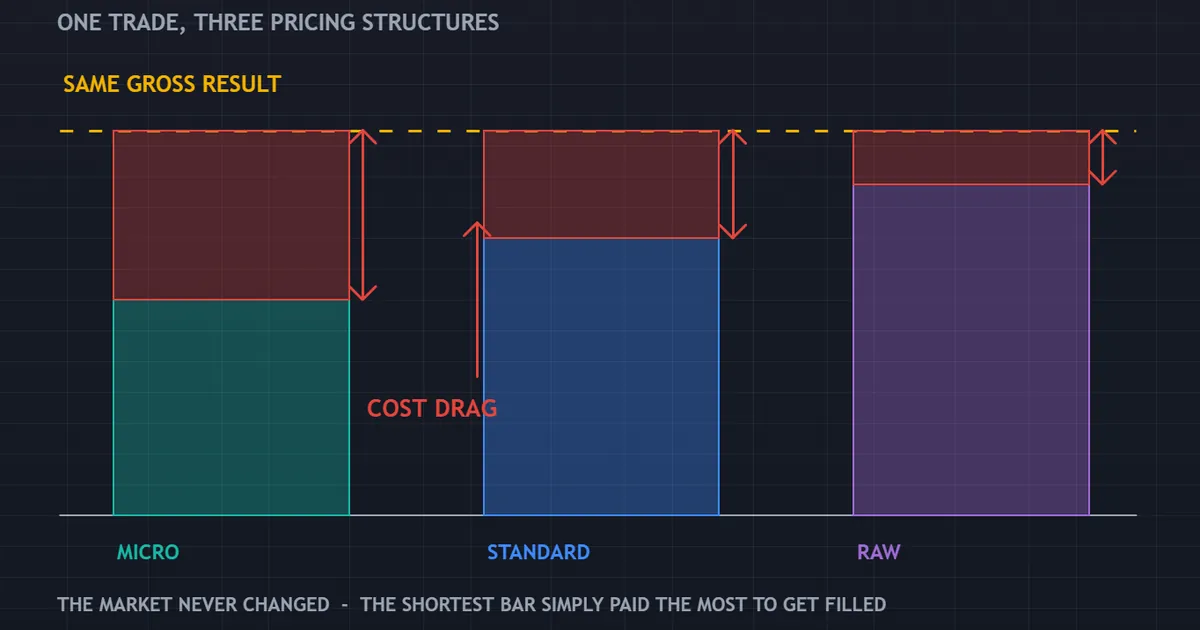
Three result bars, one market, and the whole difference comes from friction. The tier never touched the trade idea.
Why the Gap Widens With Frequency
A single trade shows a small gap. Two hundred trades turn that gap into the difference between a workable method and a tired one.
So multiply, always. Cost per round turn times expected trades per month gives you a figure worth comparing.
A Worked Comparison in Pips
Put two tiers beside each other for one month. Same pair, same rule, and forty round turns on the calendar.
The bundled tier quotes around one and a half pips, all in. Forty round turns then cost sixty pips, and nothing further lands on the statement.
The raw tier quotes a fifth of a pip and adds commission worth roughly six tenths of a pip per round turn. Call the pair of them eight tenths, so the same forty trades cost thirty two pips.
Raw comes out ahead by a wide margin there. Now run the identical sum on four trades a month, where the whole gap shrinks to under three pips and decides nothing.
So your trade count picks the tier, not the marketing. Count last month honestly, then do the arithmetic once rather than trusting a label on a sales page.
What to Total Before You Compare
- Spread on entry. The gap between bid and ask at the moment your order goes in, measured on your own platform rather than taken from an advert.
- Spread on exit. The same cost again when you close, because a round turn always crosses the spread twice on the same position.
- Commission both ways. Charged per lot on raw tiers, applied when a position opens and again when it closes, and quoted per side by some firms.
- Swap on every night held. A credit or a debit driven by the interest gap between the two currencies, plus whatever markup your broker adds to it.
- Conversion cost. Applied whenever the profit currency differs from your account base currency, and usually invisible until you read the statement closely.
What the Comparison Cannot Show
Advertised spreads describe calm conditions. Real spread widens around data releases, at the weekly open and through thin hours, and no tier protects you from that.
Slippage sits outside the tier as well. A raw account with poor execution can cost more than a wide-spread account with steady fills.
Lot Sizes, Cents and Fractional Volume
Volume names travel across brokers more reliably than tier names. Learn the four steps and you can read any offer quickly.
The Standard Volume Ladder
| Name | Units of the base currency | Rough pip value on a major pair | Typical fit |
|---|---|---|---|
| Standard lot | One hundred thousand | Around ten units of the quote currency | Larger balances and funded accounts |
| Mini lot | Ten thousand | Around one unit of the quote currency | Mid-sized balances building position size |
| Micro lot | One thousand | Around one tenth of a unit | Small balances and first live trades |
| Nano or cent volume | One hundred | Around one hundredth of a unit | Testing a live process at minimal exposure |
Cent Accounts Explained Plainly
A cent account displays your balance in cents rather than whole units. Deposit a small sum and the platform shows a number one hundred times larger.
Nothing changes about the risk. The display flatters the balance, and some traders then size up because the number looks generous.
Used carefully, though, the format helps. It lets a beginner run a real process with genuine fills at exposure that will not hurt.
Fractional Lots Matter More Than Tiers
Ask one question that most comparison pages skip. What is the minimum volume step, and can you trade a hundredth of a lot?
Fine steps let position sizing follow the stop distance properly. Coarse steps force you to round, and rounding up quietly raises risk on every trade.
Work the numbers with our position size calculator before you choose a tier. The volume step often decides the answer.
Why the Volume Step Beats the Spread
One sizing sum makes the point land. Say your plan allows ten units of the quote currency of risk per trade, and your stop sits twenty five pips away.
That pairing needs about four tenths of a mini lot. A tier trading in whole mini lots then rounds you up to one, which more than doubles the risk you chose for yourself.
No spread saving repairs that. A tenth of a pip off the quote counts for nothing beside a position two and a half times larger than the plan allowed.
So read the minimum step before the price list. A cheap tier you cannot size on stays the wrong tier, whatever the comparison table happens to say.
Swap Free and Other Special Accounts
Beyond the main ladder sit a handful of variants. Each one solves a narrow problem, and each carries a trade-off worth reading.
Swap Free Accounts
Swap free accounts, often labelled Islamic, remove the overnight interest adjustment. Firms offer them so clients whose faith forbids interest can still trade.
Costs rarely vanish, though. Many firms replace swap with a flat administration fee after a set number of nights, so long holds still cost something.
Check the replacement charge before you assume savings. Our swap calculator shows what an ordinary account would have charged over the same period.
Cent, Standard and Raw Under One Roof
Most firms let you hold several accounts at once under a single login. That helps more than it sounds.
Run your tested method on the main account. Keep a small second account for new rules, and never let the two share a balance.
Accounts With a Fixed Spread
Fixed spread accounts quote the same number in calm and busy conditions. Certainty has a price, so the fixed figure usually sits above the average variable one.
Requotes tend to replace widening. When the market moves fast, the platform asks you to accept a new price instead of stretching the quote.
Other Variants You Will Meet
- Cent accounts. Balance shown in cents so tiny volume looks tidy on the platform, with identical risk sitting behind the larger number on screen.
- Fixed spread accounts. One quoted number in calm and busy conditions, wider on average, with requotes replacing the widening you would otherwise see.
- Swap free accounts. Overnight interest removed for clients whose faith forbids it, often with an administration fee once a set number of nights passes.
- Professional accounts. Higher leverage granted after an eligibility test, with the retail safeguards removed as part of the same decision.
- Joint and corporate accounts. Extra paperwork and slower verification, though the trading conditions themselves rarely differ from a personal account.
- Managed accounts. Trading authority handed to a third party under a written mandate, with fees and revocation terms set out in that document.
Download the complete indicator database
Put these concepts on your charts. One email unlocks the full library of 1,380+ indicators with compiled MT4 and MT5 files, plus my TradingView scripts. No paywall, no spam, unsubscribe any time.
Get free access to my indicator database
One email unlocks 1,380+ free MT4, MT5 and TradingView indicators — the complete library. No single-tool download; you get the whole database.
Retail and Professional Classification
Here sits the part of the account decision with real legal weight. Regulators, not brokers, define these two categories.
What Retail Status Includes
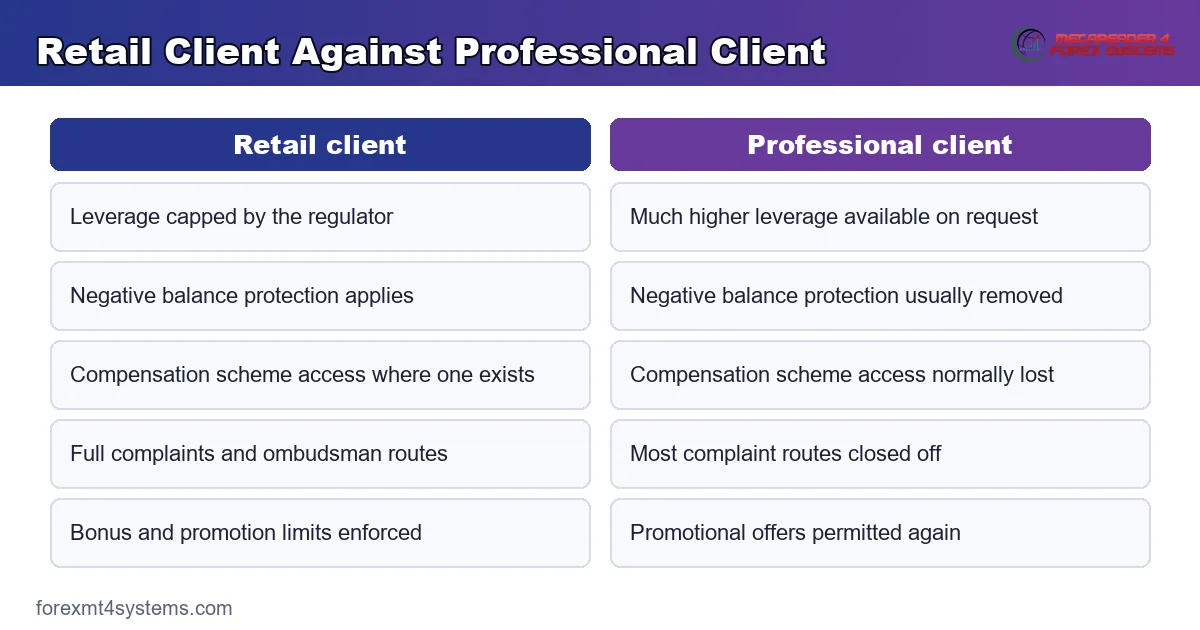
Retail clients receive the strongest package. Leverage caps, negative balance protection, restrictions on bonuses, and access to a compensation scheme where one exists.
The FCA, CySEC, BaFin and ASIC all apply versions of this. ESMA set the European template, and several regulators outside Europe copied the shape of it.
What Professional Status Removes
Professional clients trade with much higher leverage. In exchange they lose negative balance protection, lose most complaint routes, and usually lose compensation scheme access.
Firms must test eligibility before reclassifying anyone. Portfolio size, trade frequency and relevant work history all form part of that test.
Treat any invitation to upgrade with care. Higher leverage helps nobody whose position size already follows a stop distance.
How the Main Regulators Differ
- FCA, United Kingdom. Retail leverage capped, negative balance protection required, client money segregated, with a compensation scheme and an ombudsman route behind it.
- CySEC, Cyprus. The same European template under ESMA rules, plus an investor compensation fund and a public register of licensed firms.
- BaFin, Germany. European caps applied with extra national conditions, and a supervisory route for complaints against firms it licenses.
- ASIC, Australia. Leverage limits and negative balance protection for retail clients, with licence details listed on the regulator’s own register.
- CFTC and NFA, United States. A separate regime with tighter leverage, no hedging on the same pair, and firm records searchable through the NFA.
- Offshore registries. Company registration without meaningful conduct supervision, so a certificate on a website proves incorporation rather than protection.
Offshore Registration Differs From Regulation
Some groups run a regulated entity and an offshore entity behind one brand. The website looks identical, yet the protections attached to your money differ completely.
So check which legal entity appears on your account agreement. Then confirm that entity on the regulator’s own public register.
Our guide to what regulated actually means walks through the register check step by step.
Demo, Managed and Copy Accounts
Three further account labels sit outside the pricing ladder entirely. None of them describes a tier, and all three confuse newcomers.
Demo Accounts
A demo account trades simulated money against live prices. It teaches the platform well and teaches execution badly.
Fills arrive too kindly, and nothing about the emotional load transfers. Our comparison of demo against live results sets out where the gap comes from.
Managed and PAMM Accounts
A managed account hands trading authority to somebody else. Your money stays in your name, while the decisions leave your hands.
Regulatory treatment varies sharply by jurisdiction. Ask who holds the mandate, how fees work, and how you revoke authority in writing.
Copy and Social Accounts
Copy accounts mirror another trader’s orders in proportion to your balance. You inherit their drawdown along with their entries.
Following somebody does not transfer their judgement. Only their orders travel across, which is a much smaller thing than it sounds.
Base Currency, Platform and Leverage at Signup
Three signup choices outlast the tier you pick. Each sits in a dropdown that most people click past in seconds.
Base Currency
Your base currency decides where conversion costs land. Pick the currency you deposit and withdraw in, and most conversions simply disappear.
Changing it later usually means opening a fresh account. So spend a moment on that dropdown now.
Platform Choice
Most firms offer both MetaTrader platforms alongside a web version. Your tools decide the answer here more than the broker does.
Check which platform your indicators run on first. Our MT5 indicator library shows what carries across between the two.
Leverage Setting
Many brokers let you pick a leverage level at signup. Choose a modest one, because a lower ceiling costs nothing when position size follows a stop distance.
Higher settings only free up margin. They never improve an entry, and they make an oversized position easier to open by accident.
Signup Choices at a Glance
| Choice | What it decides | Sensible default |
|---|---|---|
| Base currency | Which conversions apply to profit, loss, swap and commission | The currency you deposit and withdraw in |
| Platform | Which charting tools, indicators and expert advisors you can run | Whichever platform your existing tools already target |
| Leverage level | How much margin an ordinary position ties up on the account | The lowest level that still allows your normal position size |
| Account tier | Minimum volume, plus the way the broker charges you per trade | The smallest tier that can trade your calculated volume |
| Bonus opt in | Whether trading conditions attach to your own deposited funds | Decline, unless the terms read cleanly and you have checked them twice |
Matching the Account Type to Your Balance
Now put the pieces together. Start from your balance and your risk limit, then work outward to the tier that fits.
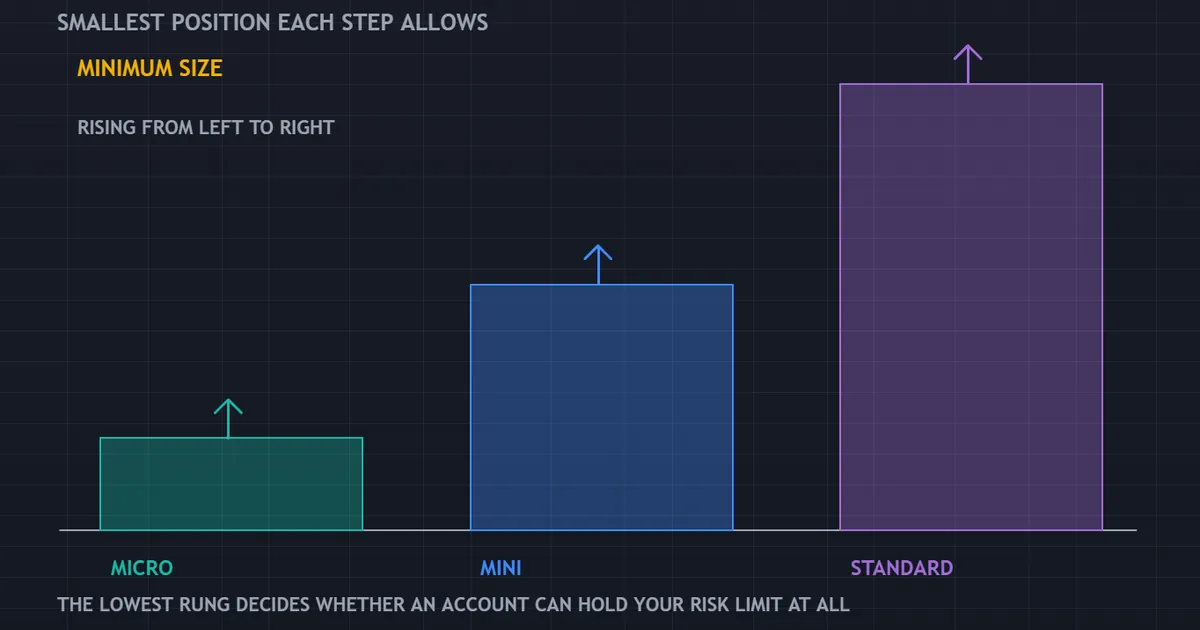
The ladder above shows the smallest position each step allows. Read it from the bottom whenever your balance sits at the smaller end.
A Four Step Selection
- Fix your risk per trade first. Decide the share of the balance you will expose before you look at any broker page.
- Find your smallest realistic stop. Convert that stop distance and risk figure into the volume you actually need to trade.
- Reject any tier that cannot trade that volume. If the minimum step forces you above your limit, the tier has already failed.
- Only then compare cost. Total the spread and commission across your expected monthly trade count, and choose the cheaper survivor.
Common Selection Errors
Traders choose the tier with the tightest advertised spread and discover the minimum volume too late. Others chase high leverage they will never use.
Bonus offers cause the most damage. Money credited with trading conditions attached can lock your own funds until a volume target arrives.
Read the leverage rules on the pillar page for leverage in forex if that part still feels loose. Leverage sets your ceiling, never your position size.
When to Move Up a Tier
Move when volume, not ambition, requires it. If your risk limit now needs half a standard lot, a micro account starts to look clumsy.
Stay put otherwise. Building a record on a tool library such as our MT4 indicator collection costs nothing extra on a smaller tier.
What Changes as the Balance Grows
Tiers matter differently once an account grows. Volume rises, so cost per round turn now carries real weight across a month of trading.
Two fresh questions arrive with that growth. Does the firm still fill your larger orders at one price, and does your payout route still suit the amounts you now move?
Depth answers the first one. An order that once took the best quote whole may start collecting two or three prices, which shows up as drift rather than as a fee.
Ask about both before you scale up. A tier chosen for a small balance rarely fails loudly, so the cost of staying with it too long surfaces only in the statement.
Signs Your Tier No Longer Fits
- Rounding up on most trades. Your calculated volume keeps landing between two allowed steps, so risk creeps above your limit without a decision.
- Bundled cost overtaking raw pricing. Trade count has grown enough that the wider spread now costs more than a raw tier plus its commission would.
- Margin pinching an ordinary position. Normal positions start bumping into free margin limits, which usually points at leverage settings rather than the tier itself.
- Payout routes that no longer match. Your deposit method has changed, and the account still forces payments back down the original route.
Questions to Ask Before You Open an Account
Support desks answer these quickly when the answer flatters them. Slow answers carry information too.
| Question | What a good answer looks like | Warning sign |
|---|---|---|
| Which legal entity holds my account? | A named company with a licence number you can look up yourself | A brand name only, with the entity buried in a page footer |
| What is the minimum volume step? | A clear figure, often a hundredth of a lot on the smaller tiers | Vague wording, or a step that forces you to round risk upward |
| How does commission work? | A stated amount per lot, per side, in a named currency | A figure that only surfaces once you have funded the account |
| Where do client funds sit? | Segregated accounts at named banks, described plainly in the terms | No mention of segregation anywhere in the account documents |
| How long do payouts take? | A stated working-day window, using the same route as the deposit | Case by case answers, with no published timescale at all |
| What happens if equity drops below zero? | A written negative balance policy covering retail clients | Silence, or a clause leaving you liable for the shortfall |
Read the Terms for Two Things
Skim the agreement for two clauses only. The withdrawal policy, then anything that attaches conditions to credited funds.
Those two clauses cause most later disputes. Our guide to broker withdrawal problems shows how the ordinary ones unfold.
A Short Recap
Start with your own numbers. Balance first, then the most you will risk on one trade.
Next, work out the smallest lot you need. If the tier cannot trade it, the tier is out.
Then add up what each trade costs. Spread, fee, swap, and any charge for a change of money.
Check the rules that come with your client type. Caps and cover matter far more than the badge on the page.
Read the terms once more before you send funds. Look for the payout clause and for any strings tied to credit.
And keep it dull. A plain tier that fits your balance beats a smart one that does not.
FAQ
Which account type suits a complete beginner?
A micro or cent account, in almost every case. Small contract sizes let you run a genuine live process with real fills while the exposure stays modest, and that combination teaches far more than a demo. Cost per trade matters less at this stage than the ability to size a position properly against a sensible stop.
Do raw spread accounts really cost less?
Sometimes, and the answer depends on your trade count. Add the commission on both sides to the quoted spread, then compare that total against the all-in spread of the standard tier. Frequent traders usually come out ahead on raw pricing, while a trader placing a handful of positions each month often will not notice any difference at all.
Is a cent account safer than a standard one?
Not inherently. A cent account simply displays your balance in smaller units, which lets you trade tiny volume without confusing decimals. Risk still follows position size and stop distance, so a trader who sizes up because the balance number looks large has removed the only advantage the format offered.
Should I accept professional client status for higher leverage?
Rarely, and never for the leverage alone. Professional status strips away negative balance protection, most complaint routes and compensation scheme access, which are the protections that matter when something goes badly wrong. Traders who size positions from a stop distance almost never reach the retail leverage ceiling anyway.
Does the account tier change the prices I see?
Only through the fee the broker adds on top. Underlying market prices arrive from the same liquidity sources whichever tier you hold, so a raw account shows a quote close to that feed while a standard account shows the same feed with the fee built in. Execution quality can still differ between tiers at some firms, which is a separate question worth putting to support directly.
Can I change account type later?
Usually yes, either by switching the existing account or by opening a second one under the same login. Ask about open positions first, because some firms require a flat account before a tier change, and check whether any bonus credit carries conditions that survive the move. Results are not guaranteed; past performance is not indicative of future results.
External references
- For background on this concept, see Margin Requirement in the BabyPips Forexpedia.
- For broader market context, see Islamic Banking and Finance on Wikipedia.

About the author
Written by Dominic Walsh, a Forex trader and MT4/MT5 indicator, Expert Advisor and script developer. Every tool on forexmt4systems.com is tested on live charts before release and ships with ready-to-use compiled MT4 (.ex4) and MT5 (.ex5) files. Learn more about the trader and developer behind this site.
How we build, test and correct every tool: Editorial & Testing Policy. Trading carries risk; see the disclaimer.