
Every broker site prints the letters ECN somewhere, and almost none of them explain what changes on your account. The term describes how your order travels, not how good the firm behind it happens to be.
So the ECN broker meaning comes down to plumbing. Your order joins a shared pool of prices from banks, funds and other traders, and the broker earns a fee for the introduction rather than from your loss.

ECN Broker Meaning in Plain Terms
Three letters, one idea. An electronic communication network matches orders from many participants inside a single pool.
What the Letters Stand For
ECN stands for electronic communication network. Banks, hedge funds, other brokers and retail flow all post prices into it.
At any moment the pool carries a best bid and a best offer. Your order meets whoever posted them.
Nobody sets a house price for you. Instead the pool sets it, and the pool changes several times a second.
The Network Sells Access
An ECN broker sells a connection rather than an opinion. It links your terminal to the pool, then charges for that link.
The charge arrives as a commission per lot traded. Meanwhile the price you trade on stays untouched.
So this model splits two things that other accounts blend together: the market price, and the broker’s income.
Why the Label Gets Stretched
No rule stops a firm from printing three letters on a web page. Marketing teams stretch the word until it seems to mean fast, or fair, or honest.
None of that follows from the plumbing. Read the account terms first, then judge the claim.
Our guide to how forex brokers work walks through the revenue lines sitting behind every model.
How an ECN Account Routes Your Order
Five steps carry a click from your screen to a filled trade. Nothing exotic happens in any of them.
- You send the order. The terminal packages instrument, direction and volume, then sends it on.
- The bridge receives it. Software at the broker aggregates quotes from every connected provider.
- The book gets checked. The system reads the best available price for your size right now.
- The match happens. A provider on the other side takes the trade, and the fill comes back.
- The commission posts. The broker adds its fee as a separate line on the ticket.

Matching, Not Quoting
A quoting broker invents a price and stands behind it. A matching broker finds someone who already posted one.
That difference matters more than speed. Under matching, nobody at the firm decides whether your order deserves a fill.
Your counterparty becomes a bank or a fund. The broker keeps the role of introducer.
When the Book Thins Out
Liquidity providers pull quotes during news and around the daily rollover. The pool gets shallow for a few seconds.
Then two things happen. The spread widens, and large orders walk down several price levels before filling.
Our note on slippage in trading explains how to measure that gap on your own fills.
What ECN Pricing Really Costs
Two numbers replace the single number most beginners look at. Add them before comparing anything.

The Raw Spread
Raw means untouched. The difference between best bid and best offer reaches you without a markup added on top.
On liquid majors during active hours, that difference gets very small. It never stays fixed, though, and it can jump hard.
Our explainer on the spread in forex covers why the quoted difference moves at all.
The Commission
Commission usually applies per lot, per side. So a round turn pays it twice, once entering and once leaving.
Some firms quote a round-turn figure instead. Check which convention a table uses before comparing two brokers.
The fee stays flat whatever the market does. Calm hours and violent hours cost the same in commission terms.
Adding the Two Together
Only the total matters. A raw spread with commission may cost more or less than a marked-up spread with no commission.
Frequency decides which structure wins. Our comparison of spread vs commission works the arithmetic through properly.
You can also line up typical costs with our forex spread comparison tool before opening anything.
ECN, STP and Market Maker Side by Side
Three model names circulate constantly. Each describes where your order ends up.
Straight Through Processing
An STP broker passes orders to one or more providers without a dealing desk. That sounds identical to ECN, and often it nearly is.
The usual difference sits in aggregation. A true network shows depth from many participants, while a simple STP route may use a handful.
Neither label carries a legal definition. Both describe intent rather than a certified pipeline.
The Dealing Desk Model
A market maker keeps the other side of your trade on its own book. It quotes you a price and manages the resulting exposure.
That model funds tight fixed spreads and small minimum deposits. It also creates a position where your loss becomes the firm’s gain.
Our side by side on ECN broker vs market maker covers the incentives in detail.
Hybrid Reality
Most large firms run both routes at once. Some client groups go out to the market, and others stay internal.
Account type usually decides which route you get. So the model belongs to the account, not to the company logo.
Download the complete indicator database
Put these concepts on your charts. One email unlocks the full library of 1,380+ indicators with compiled MT4 and MT5 files, plus my TradingView scripts. No paywall, no spam, unsubscribe any time.
Get free access to my indicator database
One email unlocks 1,380+ free MT4, MT5 and TradingView indicators — the complete library. No single-tool download; you get the whole database.
Depth of Market and What the Book Shows
Depth turns a single price into a ladder. Each rung carries a price level and the size available there.

Size Sits Behind Every Price
A quote covers a certain volume, never any volume. Beyond that, the next rung takes over at a worse level.
Small retail orders rarely reach the second rung. Larger ones do, and the average fill drifts as a result.
Reading the Ladder
Thick rungs near the middle suggest an orderly market. Thin rungs with wide gaps suggest the opposite.
Traders watch that shape around releases. When the ladder empties, sensible sizing matters far more than entry precision.
What Depth Cannot Tell You
The ladder shows one broker’s aggregated feed, not the whole market. Spot forex has no central exchange, so no complete book exists.
Orders also appear and vanish faster than a human can react. Treat the display as context, never as a forecast.
Who an ECN Account Suits
Cost structure follows trading style. Three groups gain most from raw pricing.
Frequent, Short-Hold Styles
Traders taking small targets pay the spread constantly. Shaving a fraction off each entry compounds quickly across hundreds of trades.
Commission still applies, of course. Run your own numbers before assuming the raw route costs less.
Automated Systems
A robot clicks far more than a human, so cost per trade dominates its results. Predictable pricing also makes testing more honest.
Our MT4 indicators library includes volatility measures that flag the hours when raw spreads misbehave.
Larger Positions
Bigger orders care about depth. Seeing size behind each level helps a trader split an order sensibly.
Smaller accounts gain less here. For them, the commission can outweigh the spread saving entirely.
What the ECN Label Does Not Promise
Three claims attach themselves to the label without any support. Strip them off early.
No Promise About Your Fill
Raw pricing does not mean a good fill. During news the pool thins, and your order takes whatever remains.
Market orders on any model meet the same empty book. The routing method changes nothing about that.
No Statement About Regulation
Routing and licensing answer different questions. A firm can route every order out and still hold no meaningful licence.
Check the register separately. Our guide to a regulated forex broker shows the verification steps.
No Effect on Your Method
Cheaper access improves a working method slightly. It cannot rescue one that loses money before costs.
Traders switch accounts hoping for a different outcome. The entries and exits stay the same, so the results usually do too.
How to Check What Your Account Actually Does
Marketing copy proves nothing. Four checks settle the question in about ten minutes.
Read the Contract Specification
Every broker publishes one per account type. It states execution model, commission, minimum stop distance and margin rules.
Anything absent from that document does not exist. Treat the page as the contract, because it is.
Watch the Spread Overnight
Sit and watch a major pair through the daily rollover. Raw pricing widens visibly, then settles.
A number that never moves suggests a fixed spread instead. Neither behaviour is wrong, but they are different products.
Count the Ticket Lines
Open a small trade and read the closed-position record. A separate commission line confirms the pricing structure quickly.
No commission line means the cost lives inside the spread. That answer arrives in under a minute.
Ask a Direct Question
Send support one sentence: does this account internalise any orders? A clear answer tells you plenty, and a vague one tells you more.
Costs That Sit Outside the Spread
Three other charges shape the annual bill. None of them relates to routing.
Overnight Swap
Holding a position past the daily cutoff triggers a credit or a debit. Rates differ by pair, by direction and by broker.
Long-term positions feel this more than the spread. Our guide to forex swap rates covers the triple charge midweek.
Conversion and Transfers
Profits in a currency other than your account currency get converted. Deposits and withdrawals may carry their own fees.
Small charges hide well. Read the funding page alongside the trading terms.
Dormancy Charges
Many firms deduct a monthly amount from inactive accounts. Traders who pause for a season often return to a smaller balance.
The trigger period varies widely, from three months to a year. Check it before stepping away, and withdraw rather than leave a balance idle.
Where the Network Model Came From
Retail forex borrowed the idea rather than inventing it. A little history explains why the term travels so badly.
Equities Went First
Electronic networks appeared in share dealing decades ago. Regulators wanted orders to meet each other directly instead of passing through a dealer every time.
The result cut costs sharply and made prices easier to audit. Traders could finally see who wanted what, and at which level.
Forex had no central exchange to reform, so the change arrived differently. Aggregation software stitched several bank feeds into something that behaved like a book.
Retail Arrived Late
For years the interbank market ignored small accounts. Minimum trade sizes sat far above anything a private trader could fund.
Then leverage, smaller contract sizes and cheap connectivity changed the maths. Brokers began aggregating quotes and reselling access in lots that ordinary people could afford.
That access came with a fee attached, which is exactly where commission-based pricing came from.
Why the Word Blurred
Once raw pricing sold well, everyone wanted the label. Firms applied it to any route that skipped an obvious dealing desk.
Today the word signals a pricing style more reliably than a venue. Judge the specification, not the vocabulary.
Order Types on a Raw Account
Routing changes how some orders behave. Four details catch traders moving over from a fixed-spread account.
Market Orders Float
Nothing gets promised in advance, so no requote box appears. Your order simply meets whatever the book currently offers.
Calm hours produce fills within a hair of the screen price. Fast minutes produce something looser, in either direction.
Stop Distance Shrinks
Many raw accounts allow stops very close to price, sometimes with no minimum at all. Fixed-spread accounts often enforce a wider buffer.
Closer stops help precise methods. They also fill more often, so tighten deliberately rather than by habit.
Partial Fills Appear
A large order can fill in pieces across two or three levels. Your platform then shows an average price rather than a single clean one.
Retail sizes rarely trigger this. Anyone trading several lots at once should expect it during thin hours.
Stops Still Convert to Market Orders
A protective stop becomes a market order the moment price touches it. Raw pricing offers no shelter there, and neither does any other model.
Gaps over the weekend prove the point. Nothing trades inside the hole, so the fill lands wherever the market reopens.
Testing an Account Before You Commit
Claims cost nothing to make. Four weeks of small trades settle the argument with evidence.
Start Small and Boring
Trade the smallest size your platform allows, on one major pair, during quiet hours. The aim is measurement rather than profit.
Keep the method identical across the test. Changing two things at once destroys the comparison.
Log Three Numbers Per Trade
Write down the price on screen when you clicked, the price on the ticket, and the commission charged. Add one word for conditions: calm, busy or news.
Twenty trades hint at a pattern. Fifty start to mean something.
Compare the Totals
Add spread cost and commission into one figure per trade. Then set that figure against the same trade priced on a marked-up account.
The winner often surprises people. Small, infrequent trades usually favour the all-in spread, while frequent trading favours raw pricing plus a fee.
Questions Worth Sending Support
Four short questions produce useful answers, and the tone of the reply matters as much as the content.
- Does this account internalise any orders, and under what conditions?
- Which liquidity providers feed the aggregated book?
- What is the minimum distance for stop and limit orders?
- Which entity holds the account, and which regulator licenses that entity?
Quick Reference
Keep this beside two account specifications while comparing them.
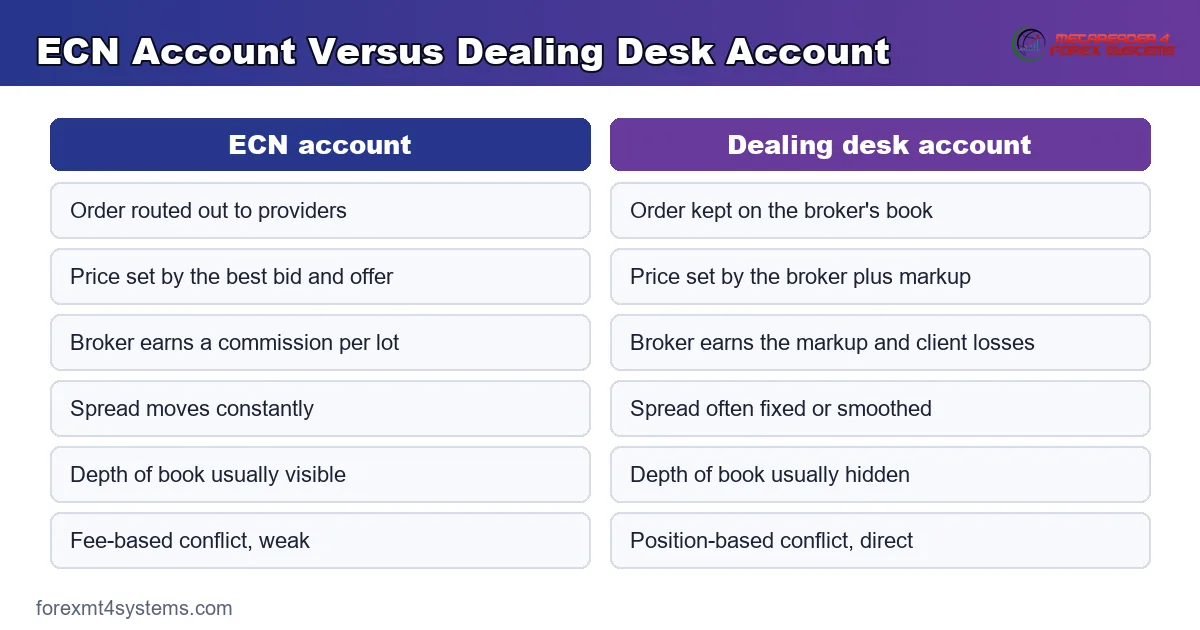
| Question | ECN account | Dealing desk account |
|---|---|---|
| Where does the order go? | Out to a pool of providers | Onto the broker’s own book |
| Who sets the price? | The best bid and offer in the pool | The broker, with a markup |
| How does the broker earn? | Commission per lot | Spread markup and client losses |
| Does the spread move? | Yes, constantly | Often fixed or heavily smoothed |
| Is depth visible? | Usually yes | Usually not |
| Conflict of interest? | Weak, fee-based | Direct, position-based |
Mistakes People Make When Switching
Moving to raw pricing looks simple, and four habits still cause trouble. Each fix takes a moment.
Comparing Spread Alone
A raw spread always looks smaller than a marked-up one, because part of the cost moved elsewhere. Comparing the two directly proves nothing at all.
Add the commission before drawing any conclusion. Then compare like with like, across the same pair and the same hours.
Sizing Up Because Costs Fell
Cheaper access tempts people to trade bigger or more often. Both changes raise risk faster than they raise expected return.
Keep position size tied to account risk, not to the cost of entry. That rule survives every account change.
Trading the Thin Hours
Raw pricing looks worst exactly when liquidity dries up. Late sessions and rollover minutes carry wider gaps than the marketing average suggests.
So judge an account during hours you actually trade. An average figure hides the moments that hurt.
Ignoring the Legal Entity
One brand often operates several companies under different licences. The routing model may match while the protections differ enormously.
Check which entity opens your account before funding it. That detail matters more than any three-letter label.
FAQ
What does ECN stand for?
Electronic communication network. It describes a venue where many participants post bids and offers, and orders match against each other rather than against a house price. The idea came from equity markets long before retail forex adopted the term. In forex the venue is an aggregated feed rather than a single exchange, so no two brokers show quite the same book.
Does an ECN account always cost less?
No. Raw pricing plus commission can total more than a marked-up spread, particularly for small or infrequent trades. Add both components across a realistic month of activity, then compare. The answer depends on your size and your trade count, not on the label.
Can an ECN broker trade against me?
Not on orders it routes out, because a provider takes the other side. Many firms run hybrid books, though, so some accounts stay internal while others go out. The contract specification tells you which one you hold. If the document stays vague on routing, treat that vagueness as the answer and ask support directly.
Does raw pricing make a strategy profitable?
No. Lower costs improve a method that already works and slow the decline of one that does not. The entries, exits and sizing rules do the heavy lifting, and account type only adjusts the bill at the end.
Why does my raw spread widen so much at rollover?
Liquidity providers step back around the daily cutoff and during major releases. Fewer quotes in the pool means a wider gap between best bid and best offer. The widening reflects the real market rather than a decision by your broker.
Do I need this account type to run an expert advisor?
No, though predictable pricing helps. Automated systems trade often, so cost per trade drives their results heavily. Check the minimum stop distance and any restriction on very short holding times before deploying anything.
How useful is depth of market for a retail trader?
Mildly useful as context, and misleading as a signal. The ladder shows one aggregated feed, not the whole of spot forex, and orders vanish faster than anyone can react. Use it to judge how thin conditions are, then size accordingly.
Is a bigger deposit required for raw pricing?
Often yes, though minimums have fallen over the years. Firms set higher entry points because commission-based accounts earn less per small trade. Compare the total cost rather than the deposit threshold. A larger deposit also tempts larger positions, so decide your risk per trade before the money lands.
How do I verify that orders really leave the building?
You cannot verify it directly, and any article claiming otherwise oversells. What you can do is read the account specification, ask support a direct question, watch how the spread behaves at rollover, and check the licence on the regulator’s own register. Those four checks give you evidence rather than marketing copy. Results are not guaranteed; past performance is not indicative of future results.
External references
- For background on this concept, see ECN Broker at Investopedia.
- For broader market context, see Straight-Through Processing on Wikipedia.

About the author
Written by Dominic Walsh, a Forex trader and MT4/MT5 indicator, Expert Advisor and script developer. Every tool on forexmt4systems.com is tested on live charts before release and ships with ready-to-use compiled MT4 (.ex4) and MT5 (.ex5) files. Learn more about the trader and developer behind this site.
How we build, test and correct every tool: Editorial & Testing Policy. Trading carries risk; see the disclaimer.