
Two accounts at the same firm can quote the same market and charge you in completely different ways. That is the spread vs commission question, and the answer depends far more on your habits than on the pricing table.
One structure hides the fee inside a wider quote. The other shows a near-wholesale quote and bills you separately per lot.

Spread vs Commission in One Minute
Both models recover the same thing: the broker’s cut of your trading. They differ only in where that cut appears.
The Spread-Only Model
A standard account quotes a wider bid and offer than the wholesale market shows. Everything the firm earns sits inside that gap, and your statement lists no separate fee.
The Raw Plus Commission Model
A raw or zero account passes through something close to the wholesale quote. A flat charge per lot then appears as its own line, usually applied on both entry and exit.
The Only Number That Matters
Add the two components together and compare the totals. Spread plus commission, converted into the same unit, tells you everything the marketing page will not.
Everything else in this guide follows from that single sum, so do it before reading a single review.
On one trade the two structures can land level, which is why the choice looks academic at first. Trade count is what pulls them apart.
Most comparisons stop before that conversion, which is exactly why they reach the wrong answer.
Reading a Spread-Only Account
Simplicity is the selling point here. One number covers the cost, and nothing else appears on the statement.
Where the Markup Sits
The firm aggregates quotes from its liquidity providers, takes the best bid and offer, then widens both sides. You see the widened version, and the underlying figure never reaches your screen.
What Moves It
Variable spreads breathe with liquidity. They tighten during the London and New York overlap, then widen at the daily rollover, around scheduled releases and at the Sunday reopen.
Fixed-spread accounts hold the number steady instead, and they hold it wider on average. Our comparison of fixed vs variable spreads covers what each one costs in practice.
Why Traders Like It
Nothing needs converting, and the risk calculation stays simple. A trader placing two or three positions a week barely notices the difference between structures anyway.
Reading a Raw Plus Commission Account
Transparency is the argument here. The wholesale price and the broker’s fee arrive as two separate figures.
How the Charge Applies
Commission usually attaches per lot per side. Open one standard lot and close it, and you pay twice, so the round turn is the number worth quoting.
Converting it into pips makes the comparison workable. On a standard lot of a major pair, a typical round-turn charge lands somewhere near seven tenths of a pip, though every firm sets its own scale.
What the Raw Quote Really Looks Like
Advertised raw spreads describe the best conditions of the calmest session. Real averages run wider, and they widen in exactly the same windows a standard account does.
Why Traders Like It
A stated fee can be audited, and a hidden markup cannot. Our explainer on what an ECN account means covers the routing that usually accompanies this pricing.
Putting Both on the Same Scale
Comparison only works in one unit. Pips per round turn does the job for most traders.

The Conversion
Take the commission per round turn, divide it by the value of one pip for that lot size, and add the result to the average spread. That single figure is your all-in cost.
A Worked Example in Pips
Suppose a standard account averages 1.6 pips on a major pair. Suppose the raw account at the same firm averages 0.2 pips and charges seven tenths of a pip round turn.
Totals land at 1.6 against 0.9. Per trade the gap looks tiny, and that is precisely how it hides.
Why Averages Beat Advertised Numbers
Record the live spread yourself at the hours you actually trade. Our forex spread comparison tool exists for that comparison, and a fortnight of samples beats any promotional figure.
Where Frequency Changes the Answer
One trade tells you almost nothing. Two hundred trades tell you everything.
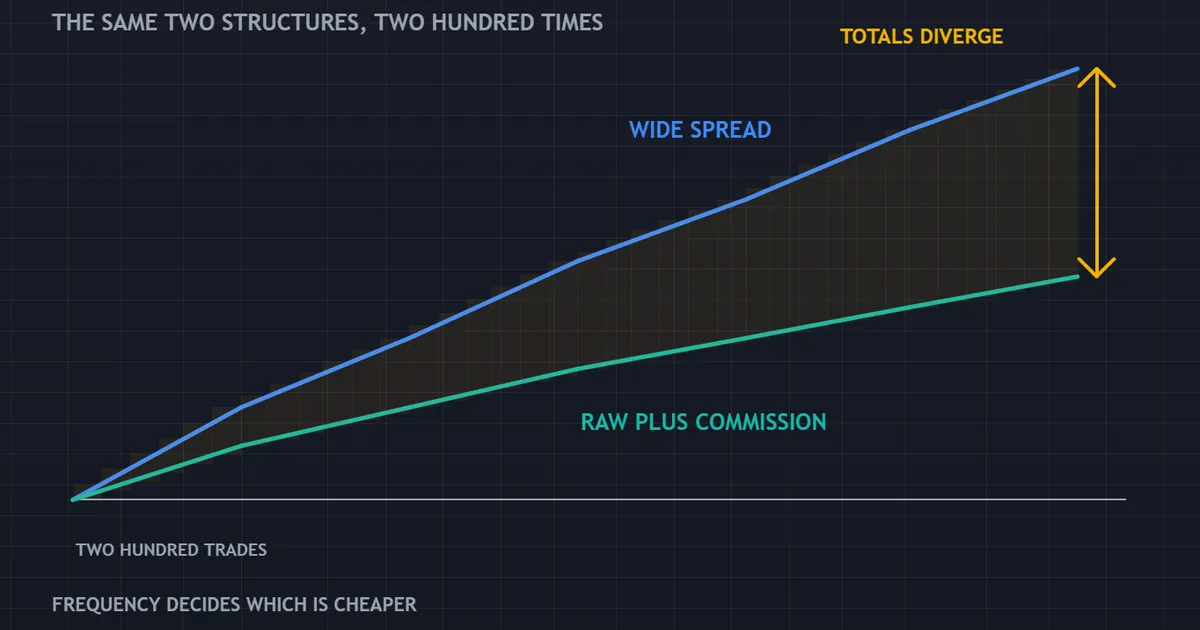
Scaling the Same Gap
Carry that 0.7 pip difference across two hundred round turns and it becomes 140 pips of cost. On a small account, that figure sits in the same range as a decent month.
The Low-Frequency Case
A position trader placing eight trades a month faces about 5.6 pips of difference over the same period. Against a target measured in hundreds of pips, the choice hardly registers.
Simplicity then wins on its own merits. Fewer moving parts means fewer mistakes in the risk calculation.
The High-Frequency Case
Short-term methods live inside the cost. Take the two figures above against a five pip target. The standard account swallows 1.6 of those five pips, so roughly a third of the target goes before the trade starts. The raw account swallows 0.9, which is under a fifth.
Our notes on scalping in forex work through how quickly cost dominates a short-horizon method.
Why Two Pricing Models Exist
Nobody designed this split on purpose. It grew out of how retail brokerage changed.
The Fixed-Spread Origin
Early retail firms quoted a fixed price and dealt against the client directly. A single wide number covered the risk of holding the other side, and no separate fee made sense.
The Arrival of Straight-Through Routing
Automated routing then pushed orders out to a pool of liquidity providers. Those providers quote very tight prices, so the broker needed another way to charge for access.
Commission solved that problem cleanly. The client sees the wholesale market, and the firm bills for the connection rather than for the price.
Why Both Survived
Different clients want different things. Some prefer one number and no arithmetic, while others want to know exactly what they pay and to whom.
Firms therefore keep both structures on the shelf, often with identical routing behind them. Our guide to forex account types covers what the account names usually signal.
What the Spread Actually Pays For
A spread is not purely a fee. Part of it compensates real risk, and understanding the split explains why it moves.
The Wholesale Component
Whoever quotes a two-sided price carries inventory risk between the two sides of the trade. That risk grows when prices move quickly, so the quoted gap grows with it.
The Broker Component
On top of the wholesale gap sits the firm’s own markup, applied in pips or as a percentage. This part alone is negotiable through tiers and rebates.
Why the Split Matters
A raw account removes most of the second component and leaves the first intact. So a raw spread still widens during news, and traders who expected a flat cost feel misled by their own assumption.
Neither structure can suppress the wholesale part. Only depth in the market does that, and depth arrives and leaves on its own schedule.
Cost Across Different Instruments
Comparisons usually run on one major pair. Your actual bill depends on what else you trade.
Majors
The most heavily traded pairs carry the tightest quotes and the smallest markups. Commission structures shine here, because the wholesale component is already tiny.
Minors and Crosses
Less liquid crosses carry wider wholesale gaps that no pricing model removes. A flat per-lot commission on those instruments often works out relatively cheaper than a proportional markup.
Exotics
Exotic pairs move the calculation entirely. The wholesale spread dwarfs any fee, so the pricing structure barely matters next to the instrument choice.
Metals and Indices
Many firms price these outside the standard commission schedule altogether. Check the specification sheet rather than assuming the account terms carry across, since contract sizes differ and the pip value calculation changes with them.
The Costs Neither Model Shows
Spread and commission are the visible half. Three more lines decide the real total.
Swap
Any position held past the daily rollover attracts an interest adjustment, and the firm adds a markup to it. Hold trades overnight and swap frequently outweighs the entire spread argument.
Slippage
The difference between your requested price and your fill counts as a cost, even though no line item names it. Slippage grows in the same windows that widen spreads, so the two compound.
Conversion
Trading an instrument quoted in a currency other than your account base means a conversion on every close. That conversion carries its own margin, and very few traders ever measure it.
Working Out Your Own Number
Broker comparisons published online age badly, because pricing changes and the writer usually earns a referral. Your own log does not have those problems.

What to Record
Log the spread at entry, the commission charged, the swap applied and the gap between your requested and filled prices. Add the hour of day beside each row.
How Long to Run It
Thirty trades give a rough picture and a hundred give a usable one. Split the sample into calm hours and event windows before drawing any conclusion.
What to Do With It
Total the cost, then express it as a share of your gross result for the period. A single percentage figure makes the next decision obvious.
Download the complete indicator database
Put these concepts on your charts. One email unlocks the full library of 1,380+ indicators with compiled MT4 and MT5 files, plus my TradingView scripts. No paywall, no spam, unsubscribe any time.
Get free access to my indicator database
One email unlocks 1,380+ free MT4, MT5 and TradingView indicators — the complete library. No single-tool download; you get the whole database.
Cost as a Share of Your Result
Absolute numbers mislead because they sound small. Proportions do not.

The Small Account Problem
Cost scales with lots traded, while your gross result scales with the same lots. So the ratio stays roughly constant, and only trade frequency really moves it.
Reading the Ratio
A method giving back a tenth of its gross result to costs has room to breathe. A method giving back half of it depends on pricing more than on analysis, and that is a fragile place to sit.
The Uncomfortable Case
Some methods only look viable at the lowest available cost. If shaving half a pip decides whether the approach survives, the approach itself deserves the scrutiny rather than the broker.
Which Structure Suits Which Trader
Habits decide this, not opinion. Find your row.
| Trading pattern | Round turns per month | Usually cheaper | Why |
|---|---|---|---|
| Position trading, weekly charts | Under 10 | Either; pick simplicity | Cost difference is small against the target size |
| Swing trading, daily charts | 10 to 40 | Slight edge to raw plus commission | Gap starts to accumulate but stays modest |
| Intraday, hourly charts | 40 to 150 | Raw plus commission | Cost becomes a visible share of the result |
| Scalping | 150 and above | Raw plus commission, clearly | Target size sits close to the cost itself |
| Automated systems | Varies | Whichever the backtest assumed | Testing at the wrong cost invalidates the result |
Notice the last row. A strategy tested on one structure and traded on the other is not the same strategy.
Rebates, Tiers and the Fine Print
Advertised pricing describes the entry level. Several mechanisms move the real figure.
Volume Tiers
Firms cut commission as monthly volume rises. The steps often begin lower than traders assume, so asking for the table costs nothing.
Rebates
Introducing brokers receive a share of what you generate, and some pass part of it back. Our forex rebate calculator shows how much that returns across a realistic trade count.
Minimums and Rounding
Watch how the firm rounds partial lots and whether a minimum charge applies. A trader working in micro lots can pay a surprisingly high effective rate once rounding enters the picture.
The Swap-Free Variant
Swap-free accounts remove overnight interest and recover it through a wider spread or an administration charge. Compare those on total cost too, using the same conversion.
Running a Fair Side-by-Side Test
Opinions about pricing outlast the pricing itself. A short experiment settles it for your own account.
Set Up Two Accounts
Open one of each structure at the same firm, funded small. Same entity, same platform, same instruments, so only the pricing differs.
Mirror Every Trade
Place identical positions on both, at the same moment and in the same size. Manual mirroring introduces a little noise, and a copier removes most of it.
Record These Fields
- Timestamp and instrument. Hour of day drives most of the variation you will see.
- Requested price and filled price. The gap between them belongs in the cost column even though no statement calls it a fee.
- Spread at the moment of entry. Screenshot it if the platform does not log it.
- Commission charged on each side. Note whether the firm rounds partial lots upward.
- Swap applied at rollover. Separate long and short, because the two rarely match.
Read the Result Honestly
Total each column after a hundred round turns. Where the difference lands inside the noise of your own fills, the pricing question was never the important one.
Mistakes When Comparing Cost
Five errors turn a simple sum into a wrong answer.
Comparing Spread Against Spread
A raw spread next to a standard spread tells you nothing until the commission joins the sum. That single omission drives most bad comparisons.
Using the Advertised Average
Marketing averages usually include the quietest hours and exclude the messiest ones. Measure at the hours you trade instead.
Ignoring the Side Count
Commission quoted per side halves the number people compare. Always work in round turns.
Forgetting Overnight Charges
A swing trader chasing a cheaper spread can lose the saving to swap in a single week. Our guide to forex swap rates covers the arithmetic.
Treating Cost as the Whole Question
Execution quality, withdrawal reliability and the regulator behind the entity all matter more than a tenth of a pip. Our overview of how forex brokers work puts pricing back into proportion.
Cost and the Break-Even Distance
Every trade starts underwater by the amount you paid to open it. That distance decides more than most traders realise.
The Hole You Start In
Buy at the offer and the position immediately shows the spread as an unrealised loss. Add commission and the market must travel that full distance before the trade reaches level.
Against a Small Target
A five pip target with a one pip all-in cost needs six pips of movement to deliver five. So the market has to travel twenty percent further than the plan assumed, on every single winner.
Halve the cost and the required distance falls to five and a half pips. Small in absolute terms, and material against a target that size.
Against a Large Target
The same one pip against a two hundred pip target changes almost nothing. Structure choice fades into irrelevance as the holding period lengthens, and swap replaces it as the dominant line.
The Practical Rule
Compare your all-in cost with your average target, expressed as a percentage. Under about two percent, pricing is a detail; above about ten percent, pricing is the strategy.
Fitting Cost Into a Method
Pricing belongs in the plan, not in a separate spreadsheet nobody opens.
Build It Into Expectancy
Subtract the all-in cost from every simulated trade before judging a method. A system that only works at zero cost has already failed.
Match the Test to the Account
Backtests default to a fixed spread and often ignore commission entirely. Set both to match the account you intend to trade, then run the numbers again.
Review It Quarterly
Pricing changes, tiers move and your own frequency drifts. Our library of forex trading strategies covers how method and cost structure fit together over time.
FAQ
Is a zero-commission account really free of fees?
No. The fee moves into the quote instead of appearing on the statement, so you pay it on every entry and every exit without seeing a line item. Convert the wider spread into the same unit as a commission and the two structures become directly comparable. Zero commission describes the invoice, not the cost.
How do I convert commission into pips?
Divide the round-turn charge by the value of one pip at the lot size you trade. On a standard lot of a major pair quoted against the dollar, one pip is worth ten units of the quote currency, so a seven-unit round turn works out at seven tenths of a pip. Add that figure to your measured average spread.
Which model is better for beginners?
Trade frequency answers this better than experience does. A new trader placing a handful of positions a week gains little from a raw account and benefits from the simpler arithmetic. Anyone trading intraday should run the conversion properly, because the difference compounds quickly at that pace.
Do brokers change these charges without warning?
Pricing schedules move, and firms usually reserve the right to revise them with notice in the client agreement. Promotional rates in particular expire on a date buried in the terms. Check your statement against the published schedule every quarter, since a quiet change to the commission tier or the markup will not announce itself on your platform.
Do tighter spreads mean better execution?
Not necessarily, and the two questions deserve separate answers. A tight quote for one lot means little if depth behind it disappears when your order arrives. Judge execution by the gap between your requested price and your fill across many trades, then judge pricing separately.
Why does my raw spread widen if it is meant to be wholesale?
Because the wholesale market itself widens, and no account structure changes that. Liquidity providers pull back around releases, at the daily rollover and at the weekend reopen, so every quote built from them widens together. A raw account removes the broker’s markup, not the market’s own pricing of risk.
Does commission apply to partial lots?
Yes, and the rounding rule matters more than the headline rate for small traders. Some firms charge proportionally down to a micro lot, while others apply a minimum per ticket. Ask for the exact rule if you trade small sizes frequently, because a minimum charge can multiply your effective cost several times over.
Should I switch accounts to save a pip?
Work out the annual saving at your real trade count first, then weigh it against everything else the account provides. A saving that arrives with worse fills or a weaker regulator is not a saving. Run both accounts side by side for a month with identical trades if you want evidence rather than an opinion. Results are not guaranteed; past performance is not indicative of future results.
External references
- For background on this concept, see How to Calculate the Bid-Ask Spread at Investopedia.
- For broader market context, see Transaction Cost in the BabyPips Forexpedia.

About the author
Written by Dominic Walsh, a Forex trader and MT4/MT5 indicator, Expert Advisor and script developer. Every tool on forexmt4systems.com is tested on live charts before release and ships with ready-to-use compiled MT4 (.ex4) and MT5 (.ex5) files. Learn more about the trader and developer behind this site.
How we build, test and correct every tool: Editorial & Testing Policy. Trading carries risk; see the disclaimer.