
The choice between a fixed vs variable spread decides how much every trade costs you before price even moves. Both terms describe the small gap between the buy price and the sell price, yet each one behaves in a very different way. So picking the wrong account type can quietly drain a beginner’s balance.
This guide clears up the fixed vs variable spread question in plain terms. It shows what each type really is, how brokers price them, and which one suits your style. By the end you can read a broker’s spread table with confidence.
Fixed vs Variable Spread in Plain Terms
A spread is the gap between the bid, where you sell, and the ask, where you buy. Traders measure it in pips. On EURUSD near 1.14, a bid of 1.1400 and an ask of 1.1408 give a spread of 0.8 pips.
A fixed spread stays the same size no matter what the market does. The broker holds it steady through calm hours and busy ones alike. So you see the same 2 pips at midnight and during a news release.
A variable spread moves with the market. It tightens when trading is deep and widens when liquidity thins out. Traders also call it a floating spread, and most modern accounts use it.
Here sits the key contrast. One type trades certainty for a slightly wider average, while the other trades a tiny, changing number for the risk of sudden spikes. So neither is simply better; each fits a different trader.
Look at a concrete frame first. The chart shows EURUSD on the one-hour timeframe with two accounts side by side. One line marks a steady 2-pip spread, and the other shows a floating spread that dips to 0.4 pips then jumps on news.
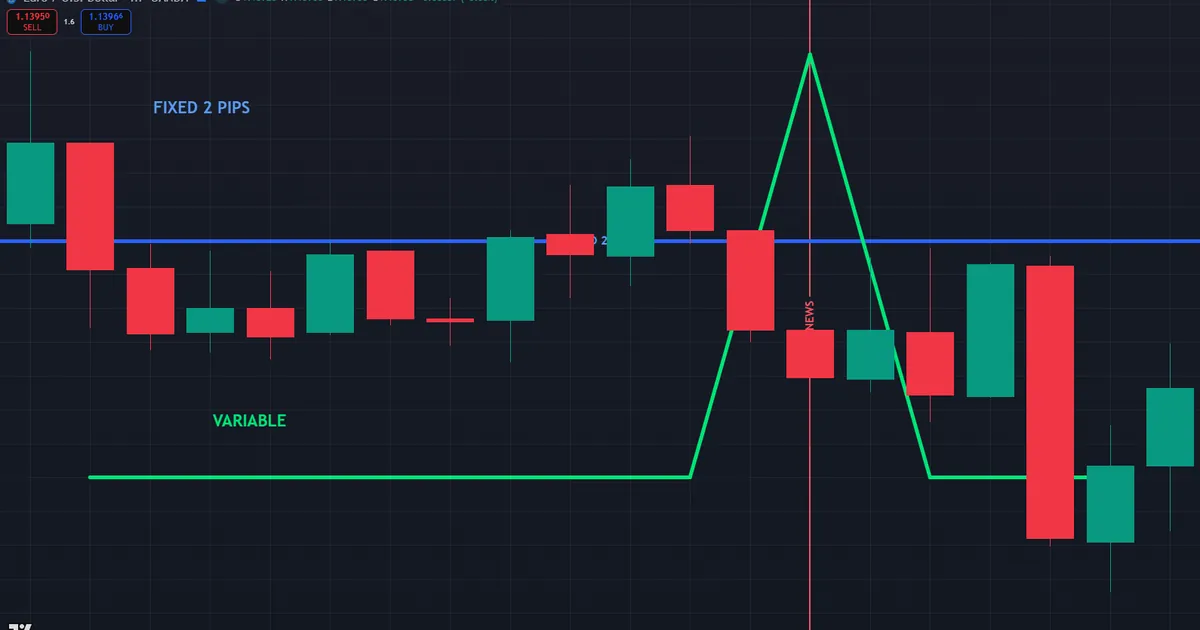
Trace that picture from left to right. During the quiet open, the floating spread runs far tighter than the fixed one. Then a news candle hits, and the floating spread widens sharply while the fixed line holds flat. So each type shines in a different moment.
How Brokers Price Each Spread
The pricing model behind your account explains everything. Learn it once, and every spread table starts to make sense.
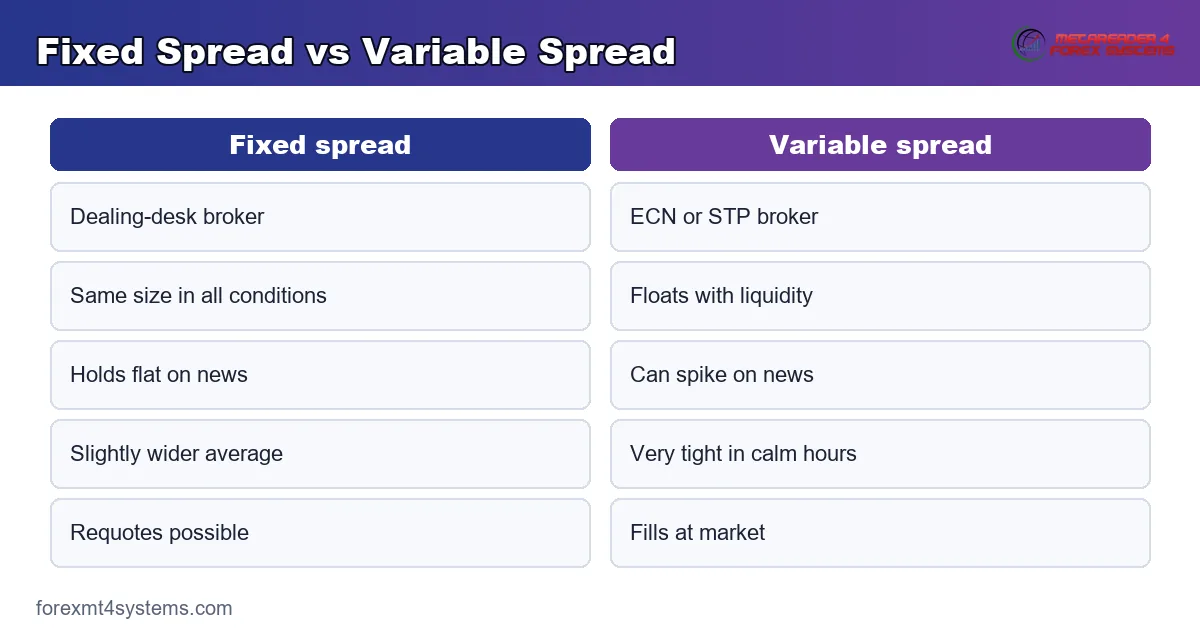
- Dealing-desk brokers set fixed spreads. A market-maker broker quotes its own price and often takes the other side of your trade. Because it controls the quote, it can promise a constant spread.
- No-dealing-desk brokers pass through variable spreads. An ECN or STP broker routes your order to a pool of banks and liquidity providers. It shows you their best prices, so the spread floats with that raw market.
- Liquidity drives the floating number. When many banks quote tight prices, the variable spread shrinks toward zero. When few of them quote, the gap stretches wide.
- Commission may replace the spread. Many raw-spread accounts show near-zero spreads but charge a separate commission per lot. So the true cost blends both parts.
- Requotes can shadow fixed spreads. A dealing desk that cannot hold its quote in fast markets may reject your order and ask you to accept a new price. That requote is the hidden cost of certainty.
So the label on your account tells you who prices your trades. The concept graphic below lines up the two models side by side.
Why the Spread Exists at All
The spread is how much of the market gets paid for standing ready to trade. A bank quotes a price to buy and a slightly higher price to sell, and it keeps the gap. So the spread rewards the party that provides liquidity.
Your broker sits between you and that market. Whether it holds a fixed margin or passes the raw gap through, it earns from the spread, the commission, or both. So the spread is never a fee your broker invented; it reflects the real cost of turning your order into a trade.
That truth explains why no spread ever hits zero for long. Someone must take the other side, and that someone wants a small edge. So a headline of zero pips always hides a commission or a wider figure somewhere in the fine print.
Where the Fixed Spread Comes From
A fixed-spread broker acts as the counterparty to your order. It builds a margin into the quote and keeps that margin constant. Because it warehouses the risk, it can offer a stable number even when the underlying market turns choppy.
That stability carries a trade-off. The steady spread usually sits wider than the average floating spread on a calm day. So you pay a small premium for knowing the cost in advance.
Where the Variable Spread Comes From
A variable-spread broker simply relays the market. It stacks the best bid and the best ask from its liquidity pool and shows you the difference. So the spread reflects real supply and demand at that instant.
During deep London and New York hours, that raw spread can drop to a fraction of a pip on major pairs. Yet the same pool thins out at rollover and on news, and the gap balloons. You can compare live examples with our free forex spread comparison tool.
Comparing the Two in Practice
Numbers make the difference concrete. Picture a scalper who takes twenty EURUSD trades a day on a standard lot, where one pip equals about 10 USD.
On a fixed 2-pip account, each round trip costs roughly 20 USD in spread, so twenty trades cost about 400 USD. On a variable account averaging 0.6 pips plus a small commission, the same day might cost far less during quiet hours. So a busy scalper often leans toward the tighter floating model.
| Feature | Fixed spread | Variable spread |
|---|---|---|
| Typical broker | Dealing desk / market maker | ECN / STP / no dealing desk |
| Cost in calm markets | Steady, slightly wider | Very tight, often lower |
| Cost on news | Holds flat | Can spike sharply |
| Requotes | Possible in fast markets | Rare, order fills at market |
| Best for | News traders, small accounts, planners | Scalpers, high-volume day traders |
A Worked News-Trading Case
Now switch to a trader who buys the news. Picture a GBPUSD release near 1.34 that sends price flying within seconds. On the variable account, the spread jumps from 0.5 pips to 8 pips as liquidity vanishes.
Watch the fixed account instead. Its 2-pip spread holds through the chaos, so the news trader knows the exact entry cost before the number prints. The chart below marks that steady gap against the spiking one.

So the same event rewards opposite choices. The scalper who never trades news prefers the tighter floating spread, while the news trader values the flat, predictable one. Because their habits differ, their ideal account differs too.
Reading a Broker’s Spread Table
Most brokers publish a spread table on their site. Read it with a careful eye, because the headline number often shows the best case, not the average. Look for a column labelled typical or average rather than minimum.
Check the account type beside each figure too. A raw or ECN column with a tiny spread almost always pairs with a commission, while a standard column folds the cost into a wider spread. So compare like with like before you judge one broker against another.
Watch for the pair and the timestamp as well. A table that quotes EURUSD at peak London hours flatters every broker. A fair comparison uses the same pair, the same hour, and the total cost per lot including any commission.
One caution rounds out the case. A fixed spread does not remove news risk; it only removes spread surprise. Price can still gap past your stop, so a steady spread never means a safe trade.
Choosing the Right Spread for Your Style
Your trading habits, not a marketing banner, should pick the spread model. So start with an honest look at how you actually trade. Count your average trades per week, note the hours you work, and mark whether you hold through news.
A high-frequency scalper feels every pip. Because the cost repeats dozens of times a day, even half a pip of savings compounds fast. So a tight variable spread on a raw account usually wins for this trader, as long as they avoid trading the news window.
A patient swing trader sits at the other end. Someone who holds a position for days barely notices a one-pip difference at entry. So the spread model matters far less here, and other factors like swap cost and platform quality take priority.
Match the Model to Your Session
The clock shapes the choice as much as the style. During the deep London and New York overlap, a variable spread on a major pair can sit near its tightest. So an overlap trader captures the best of the floating model.
The Asian session tells a different story. Liquidity thins on many pairs, and a variable spread drifts wider through those quiet hours. A trader who works that window might prefer the steadiness of a fixed quote, or simply trade the few pairs that stay deep.
So map your regular hours before you sign up. A trader who lives in the overlap and a trader who works the Asian open have different ideal accounts, even with the same strategy. Because the market changes character by the hour, the right spread does too.
Test Before You Commit Real Money
A demo account settles most of these questions cheaply. Open the account type you favour, then watch the spread across a full trading day. Note how it behaves at the open, through the overlap, and around a scheduled release.
Keep a simple log as you watch. Record the spread at three or four fixed times, plus one reading during news. After a week, the pattern speaks clearly, and the marketing headline fades next to your own data. So let that log, not a banner, make the final call.
Run the same test on a second broker too. Two demo accounts side by side reveal which one truly quotes tighter on your pairs and your hours. Because brokers differ far more than their banners suggest, this small effort often saves real money later.
Download the complete indicator database
Put these concepts on your charts. One email unlocks the full library of 1,380+ indicators with compiled MT4 and MT5 files, plus my TradingView scripts. No paywall, no spam, unsubscribe any time.
Get free access to my indicator database
One email unlocks 1,380+ free MT4, MT5 and TradingView indicators — the complete library. No single-tool download; you get the whole database.
Common Mistakes and How to Fix Them
The fixed versus floating debate breeds a handful of costly myths. Most trace back to reading one number in isolation, and the fixes follow beneath the graphic.

Chasing the Lowest Advertised Spread
A headline of zero pips rarely tells the whole story. Raw-spread accounts add a commission that the banner hides. So add the commission to the spread before you compare two brokers, and judge the total cost per lot.
Ignoring the Spike Risk on Variable Accounts
A tiny average spread can still spike tenfold on news. A trader who places tight stops near a release can get stopped by the widening alone. So widen your stop buffer, or stay flat, around major data.
Assuming Fixed Means Cheap
A steady spread feels safe, yet it usually runs wider than the floating average. Over hundreds of trades, that premium adds up. So match the model to your frequency rather than to a feeling of comfort.
Forgetting Requotes on Dealing Desks
A fixed spread can hide a requote in fast markets. The quote holds, but the fill may not. So test how your broker behaves in volatile hours before you commit real size.
Comparing Spreads at the Wrong Time
A spread checked at noon London looks nothing like the same spread at the Asian open. Judging a broker on one snapshot misleads you. So sample the spread across several sessions before you decide.
Judging Cost by Spread Alone
The spread is one line on a longer bill. Overnight swap, commission, and slippage all add to the true cost of holding and entering a trade. A trader who fixates on the spread can pick a broker that charges more elsewhere. So total the whole cost, not just the headline gap, before you rank two accounts.
Quick-Reference Cost Checklist
Run this short list before you open any live account. A few minutes here saves months of leaked cost later. So tick each item, and let a failed check push you to keep looking.
- Broker model identified as dealing desk or no dealing desk.
- Spread type confirmed as fixed or variable in writing.
- Commission per lot added to the raw spread for a true cost.
- Spread sampled across the Asian, London, and New York sessions.
- News behaviour tested, either by demo or by broker history.
- Requote and slippage policy read in the account terms.
- Total cost matched to your trade frequency and style.
Pitfalls and Edge Cases
Study the trap as hard as the benefit. Here is a common one. A new scalper picks a variable account for its tiny 0.3-pip average, then trades straight through a rate decision.
Then the cost arrives. The spread balloons to 12 pips at the release, several open trades close on the widening, and the tiny average never mattered. The chart below shows that spike against the earlier calm reading.
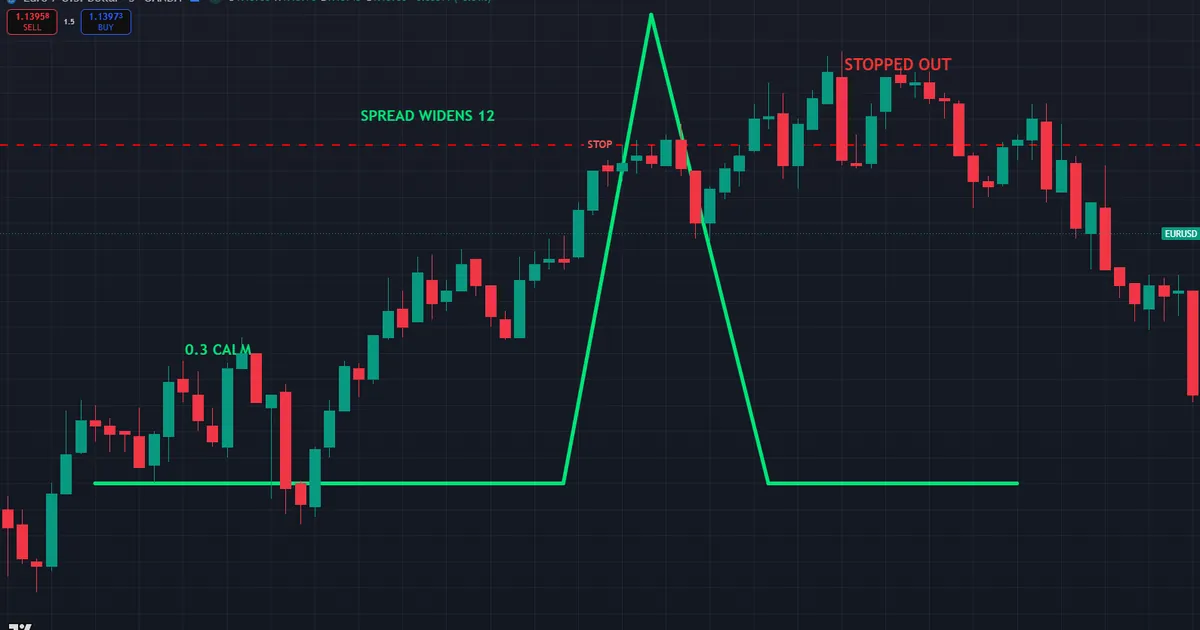
So what went wrong? The trader judged the account on its best-case number and ignored its worst case. A variable spread rewards calm hours and punishes chaos. Hence the rule that limits the damage: size your risk against the spike, not the average.
There is a mirror pitfall on the fixed side. A trader drawn to a steady 3-pip spread pays that premium on every quiet scalp, where a floating account would have charged a fraction. Because the wide fixed cost repeats on every trade, a high-volume style bleeds slowly.
Both traps share one root. Each trader matched the account to a headline rather than to their own behaviour. So map how often and when you trade first, then let that honest picture pick the spread model.
A third edge case catches automated traders. An expert advisor that scalps tiny moves depends on a stable, tight spread to stay profitable. When a variable spread widens, the same robot can bleed on every trade without warning. So test any automated system against real spread behaviour, not a flat assumption.
The Weekend and Holiday Gap
Be honest about thin markets. Both spread types behave worst around the Sunday open and bank holidays, when few banks quote. A variable spread widens hard, and a fixed broker may pause quoting or add requotes. So treat those thin windows with extra care whatever your model.
Slippage Sits Beside the Spread
Remember that the spread is only half the entry cost. Slippage, the gap between your requested price and your fill, rides alongside it. Because a fixed spread does nothing to stop slippage, a stable quote still lets a fast market fill you worse than you asked.
The Spread Changes by Pair
Do not assume one number covers your whole watchlist. Major pairs like EURUSD carry the tightest spreads on both models, since they trade the most. Minor and exotic pairs run far wider, because fewer banks quote them.
Gold widens the point further. On XAUUSD near 4100, the spread often sits many times wider than on a major pair, whether fixed or variable. So a strategy that hops between pairs must budget a different cost for each one.
Check every pair you trade before you settle on an account. A broker that shines on EURUSD may quote a poor spread on your favourite cross. So judge the account on the pairs you actually use, not on the headline major alone.
Related Concepts to Study Next
The spread question connects to a web of basics, and a few deserve your next reading hour. Start with our guide to the spread in forex, since it explains the bid-ask gap that both models charge. Then read our breakdown of why spreads widen to see exactly when a floating spread spikes.
Two more guides round out the picture. Because the spread lives inside the quote, study the bid and ask price to see where the two prices come from. Then review the major currency pairs, since the tightest spreads sit on the most traded pairs. For a plain measure of movement, our guide to the pip in forex shows how the spread turns into real cost.
FAQ
What is the difference between a fixed and variable spread?
A fixed spread stays the same size in all market conditions, since a dealing-desk broker holds it steady. A variable spread floats with real supply and demand, so it tightens in calm markets and widens on news. One offers certainty, and the other offers a lower average cost.
Which spread type is cheaper?
On average, a variable spread on a raw account runs cheaper during calm, liquid hours. Yet it can spike far above a fixed spread during news or thin sessions. So the cheaper choice depends on when and how often you trade.
Are fixed spreads safer for beginners?
A fixed spread removes one surprise, since you know the entry cost in advance. That predictability can help a new trader plan risk. Still, it usually runs wider than the floating average, so beginners should weigh certainty against the ongoing premium.
Why do variable spreads widen so much on news?
Liquidity providers pull their quotes around major releases to avoid fast, uncertain prices. Fewer quotes means a wider gap between the best bid and ask. So a variable spread can jump from a fraction of a pip to several pips within seconds.
Do fixed-spread brokers charge hidden costs?
Sometimes, and the main one is the requote. A dealing desk may reject an order in a fast market and ask you to accept a new price. That requote, plus a wider average spread, forms the real cost of a steady quote.
Which spread should a scalper choose?
A high-volume scalper usually prefers a variable raw-spread account, since the tight calm-hour cost compounds across many trades. A news scalper may prefer a fixed spread for its predictable entry. Match the model to your trade count and timing. Results are not guaranteed; past performance is not indicative of future results.
External references
- For background on this concept, see Spread at BabyPips.
- For broader market context, see ECN at Investopedia.

About the author
Written by Dominic Walsh, a Forex trader and MT4/MT5 indicator, Expert Advisor and script developer. Every tool on forexmt4systems.com is tested on live charts before release and ships with ready-to-use compiled MT4 (.ex4) and MT5 (.ex5) files. Learn more about the trader and developer behind this site.
How we build, test and correct every tool: Editorial & Testing Policy. Trading carries risk; see the disclaimer.