
Knowing how to set a stop loss with ATR turns stop placement from a guess into a measured decision. Instead of picking a round number of pips, you let the market’s own volatility set the distance for you.
The Average True Range reads how far a pair typically travels in one bar. So when you learn how to set a stop loss with ATR, your stop widens on wild days and tightens on calm ones. That single habit keeps normal noise from clipping good trades.
How to Set a Stop Loss With ATR Step by Step
The ATR is a volatility gauge built by Welles Wilder. It measures the size of recent price swings, not their direction. So a rising ATR means the market is moving harder, while a falling ATR means it is settling down.
Because the ATR tracks real movement, it makes a natural yardstick for a stop. You place the stop a set multiple of the ATR away from entry. Then the distance reflects what the pair is actually doing today, not a habit from last month.
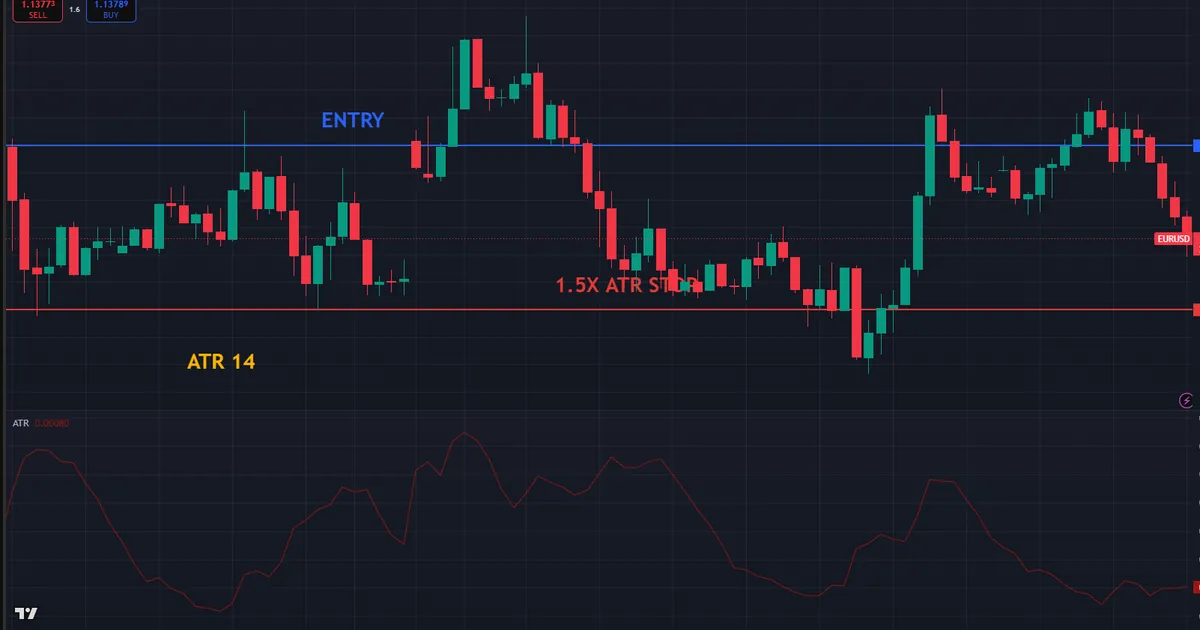
Most platforms show the ATR as a single line below the chart. The default look-back is fourteen bars. So the reading you see blends the last fourteen candles into one average range for that timeframe.
Say the ATR on EURUSD H1 reads eighteen pips. That number tells you the pair moves about eighteen pips in a typical hour. To clear that noise, you set the stop a little beyond it, using a chosen multiple.
Why the ATR Beats a Fixed Pip Stop
A fixed twenty pip stop treats every market the same. But a quiet range and a news-driven surge are not the same at all. So the same twenty pips can sit far outside the noise one day and right inside it the next.
The ATR fixes that mismatch. It shrinks the stop when the market calms and stretches it when the market rages. Because of that, an ATR stop stays outside the usual chop no matter which pair or session you trade.
What the True Range Actually Measures
The true range for one bar is the largest of three gaps. First, the high minus the low. Second, the high minus the prior close. Third, the prior close minus the low.
That third and second option catch overnight gaps that a plain high-low miss. So the true range counts the full jump, even when price leaps between sessions. Then the ATR averages those true ranges over fourteen bars.
How the ATR Smooths the Range
A single bar can be an outlier. One violent candle would throw off any stop built on it alone. So the ATR blends fourteen bars into a smooth average, which files down those sharp edges.
Because of that smoothing, the ATR shifts gradually rather than jumping tick to tick. Then your stop distance stays steady through the trade. A calm hour will not suddenly hand you a wild reading, which keeps the sizing sensible.
The Steps to Build an ATR Stop
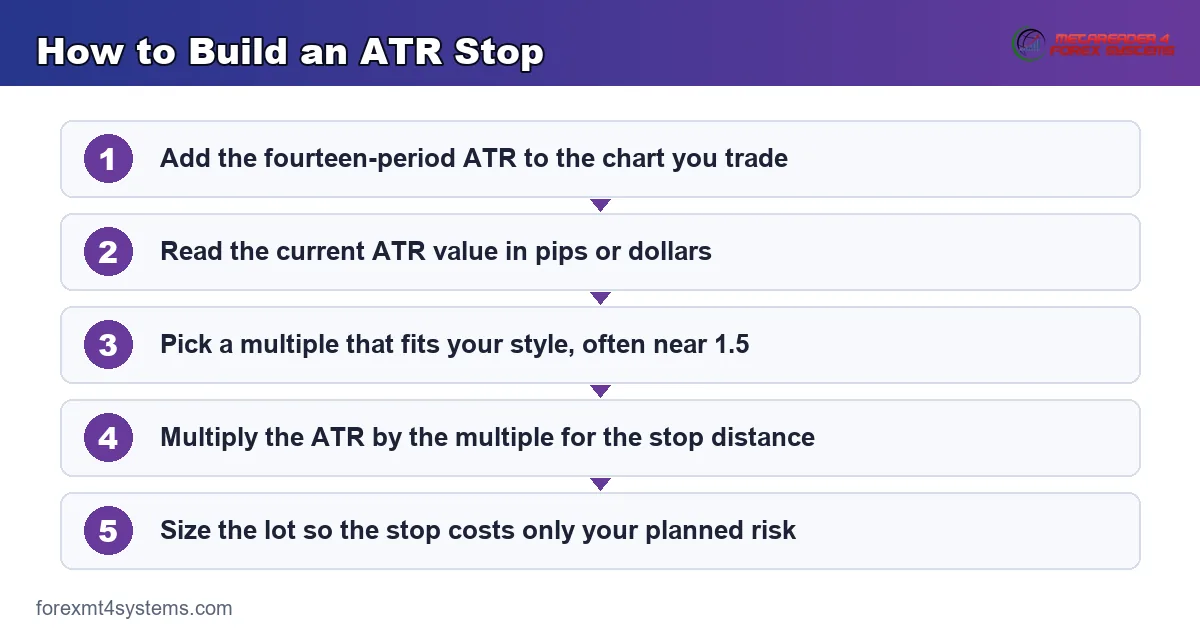
Setting an ATR stop follows a short, repeatable routine. Each step leans on the one before it, so the order matters.
- Add the ATR to your chart. Use the fourteen-period default on the timeframe you trade.
- Read the current ATR value. Note the range in pips, or in dollars for gold.
- Pick a multiple. A value near 1.5 suits many pairs, while a wilder market may want 2.
- Multiply for the stop distance. ATR times your multiple gives the pips to place beyond entry.
- Size the trade to that distance. Set the lot so the stop costs only your planned risk.
So the ATR sets the distance, and the lot size follows from it. Never reverse that order. The diagram below walks through the same flow in one glance.
This routine keeps every stop grounded in live volatility. Because you read the ATR fresh each time, the stop adapts on its own. Then you never have to guess whether twenty or forty pips is right for the day.
How to Choose the ATR Multiple
The multiple decides how much room you give the market. A larger multiple sits farther from price and survives bigger swings. A smaller one hugs the entry and gets hit more often.
Most traders start near 1.5 times the ATR for a swing trade. That distance clears routine noise while still keeping the loss modest. But a fast scalp may use one ATR, and a volatile position trade may use two or three.
Matching the Multiple to Your Style
A scalper wants a tight leash and quick exits. So a multiple near one keeps the stop close and the trade short. That fits a plan built on many small moves.
A swing trader needs room to ride a multi-day move. Because of that, a multiple of two often serves better. The wider stop rides out pullbacks that would shake a scalper out early.
Adjusting for the Pair and Session
Gold and some crosses swing far harder than a steady major. So the same multiple gives a very different stop on each. On a calm pair like EURUSD near 1.14, even 1.5 times the ATR stays snug.
The clock matters too. A stop set in the quiet Asian hours may sit too close once London opens. So read the ATR again when the session shifts, and let the fresh number reset the distance.
A Middle-Ground Multiple for Swings
Many traders settle on a multiple around 1.5 as a sensible middle ground. It gives more room than a scalper’s tight leash, yet stays snugger than a wide position stop. So it fits the swing trades that most people run.
Test the multiple on your own charts before you commit. Look back over recent trades and ask whether the stop would have survived the noise. Then nudge the number up or down until it clears the chop without bleeding too much on a loss.
How to Read the ATR on Your Platform
Adding the ATR takes only a moment on any modern platform. You open the indicator list, search for the Average True Range, and drop it onto the chart. It appears as one line in a pane below the price bars.
The default period of fourteen suits most trading. You can leave it there while you learn the tool. Later, a shorter period reacts faster, while a longer one smooths harder, so you can tune it once the basics feel natural.
Reading the Value in the Right Units
The ATR shows in the price units of the pair you trade. On EURUSD it reads in the fourth decimal, so a value of 0.0018 means eighteen pips. On gold it reads in dollars, so a value of twenty means twenty dollars of range.
Because the units differ, always convert the reading before you build the stop. A quick habit is to translate the ATR into pips or dollars first. Then the multiple you apply lands in the same units as the stop distance.
Watching the ATR Change Through the Day
The ATR is not a fixed number, so watch it drift as the day rolls on. It climbs into the busy London and New York hours and eases through the quiet stretches. So the same pair can hand you two very different stops in one session.
Glance at the line before every entry rather than trusting an old figure. A fresh read costs nothing and keeps the stop honest. Then you never build a distance on a market mood that has already passed.
An ATR Stop Worked Example
Walk through a live trade to see the math in action. You buy EURUSD near 1.14 on the hourly chart. The ATR line reads eighteen pips, and you choose a multiple of 1.5.
Multiply eighteen by 1.5, and the stop distance lands at twenty-seven pips. So you place the stop twenty-seven pips below entry, near 1.1373. That distance clears the pair’s typical hourly wiggle with a little margin.
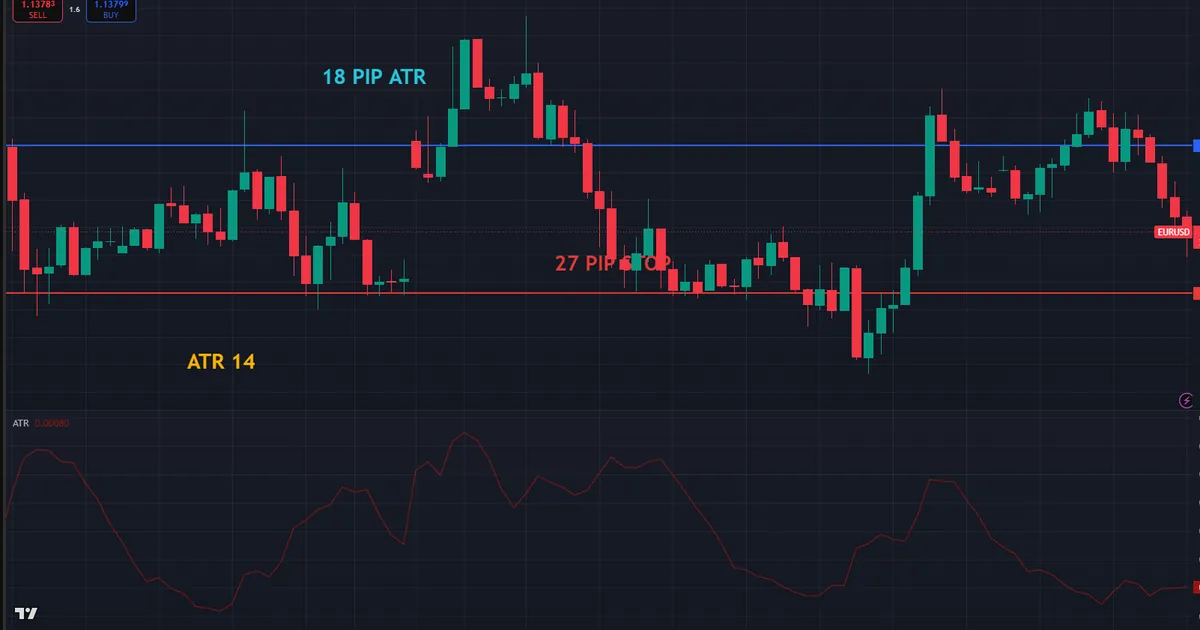
Now size the trade to that stop. You hold a five thousand dollar account and risk one percent, so fifty dollars. Divide fifty by twenty-seven pips, and you need about one dollar eighty-five a pip.
Then divide that pip value by the ten dollars a standard lot pays on a dollar pair. You land near 0.18 lots. So a twenty-seven pip stop-out costs the planned fifty dollars, whatever the trade does next.
The Same Method on Gold
Gold near four thousand one hundred moves in far bigger steps. Its hourly ATR might read twenty dollars rather than a handful of pips. So the same 1.5 multiple gives a thirty dollar stop distance.
Because gold swings hard, that wider stop is not reckless. It simply matches the metal’s own range. Then you shrink the lot to keep the dollar risk at fifty dollars, exactly as you did on the pair.
Download the complete indicator database
Put these concepts on your charts. One email unlocks the full library of 1,380+ indicators with compiled MT4 and MT5 files, plus my TradingView scripts. No paywall, no spam, unsubscribe any time.
Get free access to my indicator database
One email unlocks 1,380+ free MT4, MT5 and TradingView indicators — the complete library. No single-tool download; you get the whole database.
Why the Lot Shrinks as the Stop Widens
The stop and the lot pull against each other. A wider ATR stop needs a smaller lot to hold the same risk. So when volatility rises and the stop stretches, the position naturally gets lighter.
That trade-off is a feature, not a flaw. It quietly cuts your size in the very markets that punish oversized trades. Because the ATR reads the danger for you, your exposure falls when the market turns stormy.
Turning the ATR Stop Into a Target
Once the stop distance is set, the reward side follows easily. A target twice the stop distance gives a clean one-to-two trade. So a twenty-seven pip stop pairs with a fifty-four pip target on the same chart.
Because the stop rests on real volatility, the target inherits that grounding. It reflects a distance the pair can plausibly travel, not a wish. Then both ends of the trade share the same honest measure of movement.
Common ATR Stop Mistakes and Fixes
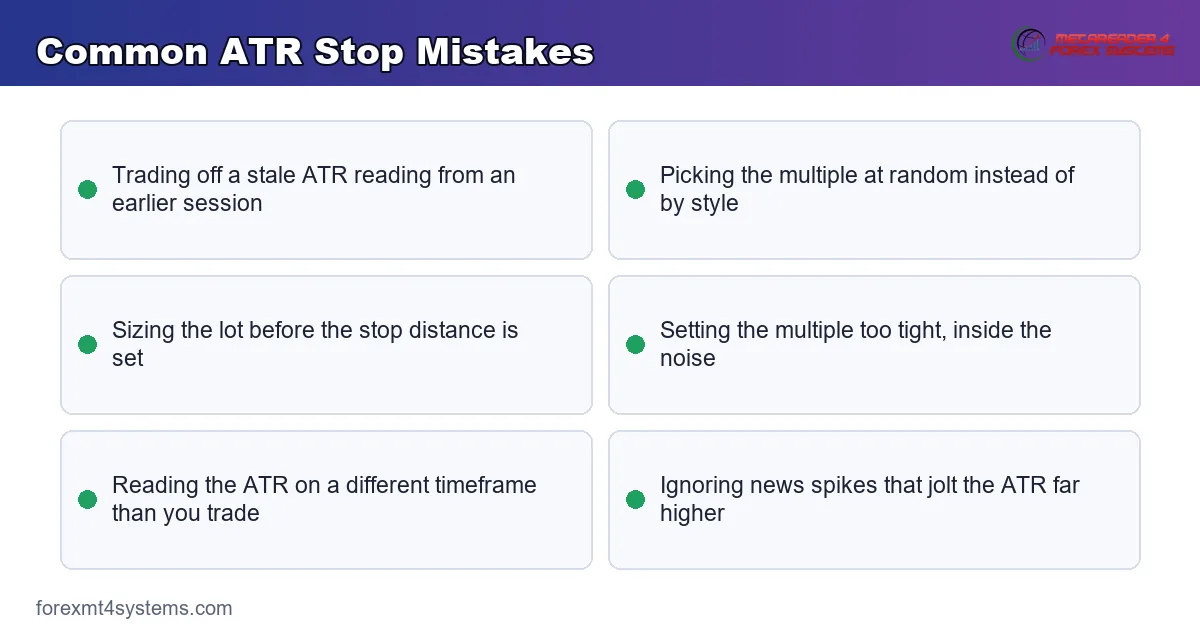
The ATR stop is simple, yet a few errors blunt it. Most come from ignoring the reading or forcing the size. The graphic below gathers the slip-ups worth memorizing.
Using a Stale ATR Reading
Volatility shifts through the day and week. A reading from yesterday may not fit today’s market. So check the current ATR before every trade, and let the live number set the stop.
Picking a Multiple at Random
A multiple chosen on a whim drifts back toward an arbitrary stop. Instead, tie the multiple to your style and hold it steady. Then your stops stay consistent from one trade to the next.
Sizing the Lot Before the Stop
Choosing a lot first reverses the logic. The stop distance sets the true risk, so it must come first. Place the ATR stop, then shrink the lot to fit your planned loss.
Setting the Multiple Too Tight
A multiple below one drops the stop inside the noise. Then routine chop sweeps the trade before the idea plays out. So keep the multiple at or above one, and give price the room it needs.
Ignoring the Timeframe of the ATR
An ATR on the five-minute chart reads far smaller than one on the daily. Using the wrong timeframe warps the whole distance. So read the ATR on the same chart you trade, never a mismatched one.
Fitting the ATR Stop Into a Risk Plan
An ATR stop works best as one part of a wider plan. It sets the distance, but your rules set the size and the frequency. So pair the tool with a firm cap on how much each trade may cost you.
Start every trade from a fixed risk, such as one percent of the account. Then let the ATR decide how far the stop sits, and let the two together decide the lot. Because the risk stays fixed, a wider stop simply means a smaller position.
Keeping the Dollar Risk Constant
The point of this pairing is a steady dollar risk across trades. A calm pair with a tight ATR lets you trade a larger lot. A wild pair with a wide ATR forces a smaller one, yet the money at stake stays the same.
That constant risk is what smooths your equity curve over time. No single trade towers over the rest, so one loss cannot undo a week of work. Then your results reflect the method rather than one oversized bet.
Reviewing Your ATR Stops Over Time
Log the ATR and multiple you used on every trade. Over a few dozen trades, a pattern appears in the record. You can see whether your stops sat too tight, too wide, or about right for each pair.
Use that feedback to refine the multiple you trust. Maybe gold needs two ATRs while a quiet major thrives on 1.5. Because the log shows the truth, you tune the tool to the markets you actually trade.
ATR Stop Quick Reference
Keep this short checklist beside the platform. Run through it before you place any trade.
- Add the fourteen-period ATR to the chart you trade.
- Read the current ATR value in pips or dollars.
- Pick a multiple that fits your style, often near 1.5.
- Multiply the ATR by the multiple for the stop distance.
- Place the stop that far beyond your entry.
- Size the lot so the stop costs only your planned risk.
- Reread the ATR when the pair or session changes.
Pitfalls and Edge Cases
A few situations bend the clean method, so keep them in view. The chart below sets a tight fixed stop against a wider stop measured at one and a half ATRs.
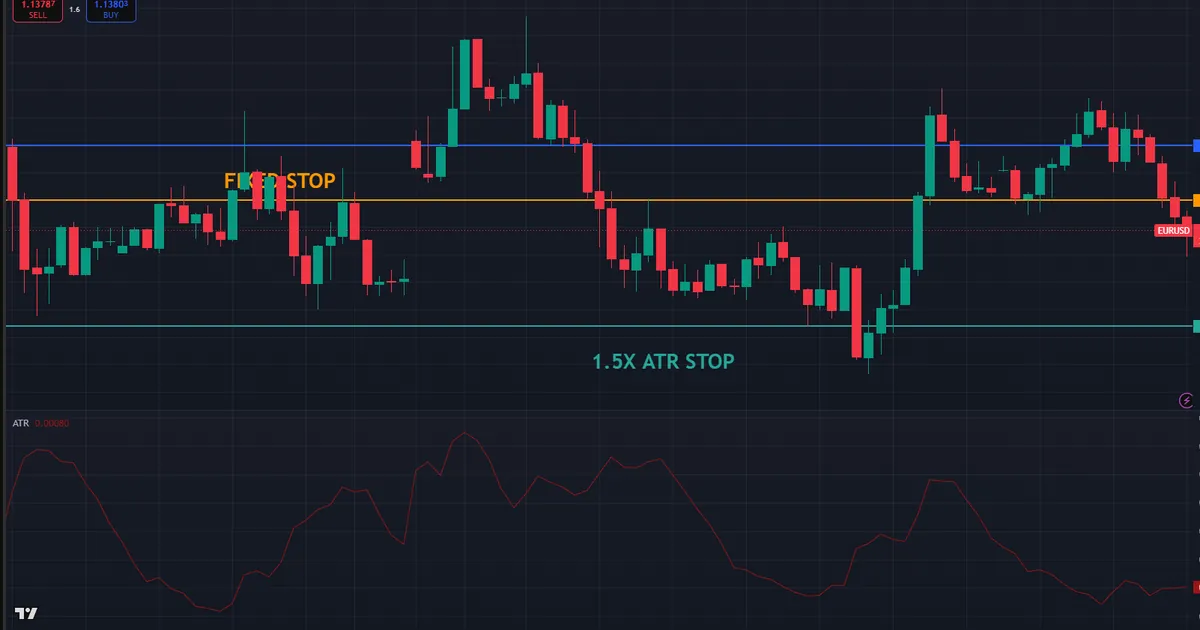
Picture the fixed stop sitting close to entry while the ATR stop rests one and a half ATRs beneath it. That wider distance comes straight from the volatility line, not a round guess. So the gap between the two lines is the whole point of an ATR stop.
News Can Spike the ATR
A big release can jolt the ATR far above its calm reading. A stop built on that spike may sit very wide. So consider standing aside through major news, or accept the wider stop with a smaller lot.
Very Low ATR Can Cramp the Stop
In a dead-quiet market the ATR shrinks toward nothing. Then even 1.5 times it can place the stop too close for comfort. So set a sensible floor, and skip trades where the range gives no room to work.
Gaps Can Jump the Stop
A stop closes at the next available price, not always your exact level. Over a weekend or a shock, price can gap past it. So keep the size modest, because an ATR stop cannot promise the exact fill.
Different Platforms May Smooth Differently
Not every platform builds the ATR the same way. Some use Wilder’s original smoothing, while others use a simple average. So the same pair can show slightly different ATR values on two charts.
The gap is usually small, yet it pays to know your tool. Stick with one platform and one setting for consistency. Then your multiples stay comparable, and a stop you trust on Monday still means the same on Friday.
The ATR Says Nothing About Direction
The ATR measures how far, never which way. It cannot tell you whether to buy or sell. So pair the ATR stop with a real entry signal, and let the two jobs stay separate. The ATR handles the distance, while your own setup handles the direction, and together they form one complete trade plan.
Related Concepts to Study Next
The ATR stop links straight into the wider craft of sizing and protecting a trade. A few ideas deserve your next reading hour. The distance you just measured feeds directly into how large a position you can carry.
Start with our guide to ATR position sizing, which turns the same range into a lot size. Then read the broader lesson on how to use a stop loss, and pin down your per-trade limit with risk per trade. For the indicator itself, see what ATR is in trading. To size a trade to its stop, use our free ATR position size calculator, then cross-check the lot with the position size calculator.
FAQ
How do I set a stop loss with the ATR?
Read the current ATR on the chart you trade, then pick a multiple such as 1.5. Multiply the ATR by that multiple to get the stop distance in pips. Place the stop that far beyond entry, and size the lot so the stop costs only your planned risk.
What ATR multiple should I use for a stop?
Many swing traders start near 1.5 times the ATR, which clears routine noise. A scalper may use one ATR for a tighter stop, while a volatile position trade may use two or three. Match the multiple to your style, then hold it steady across trades.
Which ATR period works best for stops?
The fourteen-period ATR is the common default and suits most timeframes. Read it on the same chart you trade, since a five-minute ATR is far smaller than a daily one. A consistent period keeps your stops comparable from trade to trade.
Does an ATR stop adjust for volatility on its own?
Yes, that is its whole point. The ATR rises when the market moves harder, so the stop widens to match. When the market calms, the ATR falls and the stop tightens, keeping you outside the usual noise.
Should the ATR set my position size too?
It can, and many traders let it. The ATR stop distance feeds straight into the sizing math, so a wider stop gives a smaller lot. That link keeps your dollar risk level even as volatility shifts.
Can an ATR stop still get hit by a spike?
Yes, no stop is immune to a sudden shock or a gap. A news spike can jump the ATR and even leap past the stop level. Keep your size modest so an occasional bad fill stays inside what you can absorb. Results are not guaranteed; past performance is not indicative of future results.
External references
- For background on this concept, see Average True Range at Corporate Finance Institute.
- For broader market context, see Average True Range at StockCharts ChartSchool.

About the author
Written by Dominic Walsh, a Forex trader and MT4/MT5 indicator, Expert Advisor and script developer. Every tool on forexmt4systems.com is tested on live charts before release and ships with ready-to-use compiled MT4 (.ex4) and MT5 (.ex5) files. Learn more about the trader and developer behind this site.
How we build, test and correct every tool: Editorial & Testing Policy. Trading carries risk; see the disclaimer.