
Tilt in trading describes the state where emotion takes the wheel after a bad loss. The plan stays on the desk while your hands keep clicking.
The word arrives from poker, and the borrowed meaning fits the screen almost perfectly. This guide covers the origin, the symptoms you can actually observe, and the circuit breakers that end a spiral before it costs a month.
What Tilt in Trading Actually Means
Tilt names a temporary state rather than a personality trait. Your decision quality drops sharply, yet your confidence often rises at the same moment.
Nothing about the market changed. Only your reference point moved, because the goal quietly switched from following a process to getting back to flat.

That switch explains everything else. Once recovery becomes the objective, larger size and looser rules start to look reasonable.
The Poker Origin of the Word
Poker players use tilt for the mental state that follows a bad beat. A player on tilt abandons the strategy that works and turns overly aggressive.
The term itself came from pinball. Shove the machine hard enough and it flashes TILT, then freezes the flippers, so the shove that felt satisfying ends the game.
Poker also recognises winner’s tilt. A run of good luck can loosen judgement just as effectively as a run of bad luck, which surprises most people.
Tilt Versus an Ordinary Bad Day
A bad day means losses arrived while you followed the plan. Tilt means the plan stopped governing your behaviour partway through.
Check the process, not the profit. If every trade matched a written rule, you had a losing day and nothing more.
But if the last four entries appeared nowhere in your plan, the label fits. That test takes ten seconds and settles the question honestly.
Why Tilt Feels Like Determination
Nobody experiences tilt as panic. It feels like focus, urgency and a refusal to quit, which is why the state defends itself so well.
Determination normally helps. Here it points at a target the market cannot deliver on demand, so effort turns into damage.
Notice the difference in the aim. Discipline aims at the next correct decision, while tilt aims at a number on the screen.
The Mechanism Underneath
Behavioural research offers a clean explanation. Losses register more heavily than equivalent gains, so a loss creates pressure that a matching win never relieves.
Arousal then narrows attention. Under stress the mind drops the wider context and locks onto the most vivid item on screen, which happens to be the red number.
Add a sunk-cost instinct and the trap closes. Because you already paid for the position, walking away feels like wasting the money rather than protecting the rest.
How a Tilt Spiral Escalates
The sequence repeats itself with remarkable consistency. Five stages cover almost every account blow-up that follows a single trade.
- The trigger. A loss lands harder than expected, often through slippage, a news spike or a stop placed too tight.
- The narrowing. Attention collapses onto the loss, and the rest of the plan fades from view.
- The size creep. The next position goes on larger, since a normal size would take too long to repair the damage.
- The rule bend. A filter gets skipped, a stop moves, or a trade opens with no setup at all.
- The repeat. The deeper loss restarts the cycle from stage one, now with less capital and more urgency.
Each stage looks small on its own. Together they turn a routine loss into the worst session of the quarter.

Stage One: The Trigger Matters Less Than You Think
Traders often blame the trade. In practice the trigger only needs to feel unfair, so a small loss can start the spiral while a large planned one does not.
Unfairness does the work. A stop clipped by two pips before price ran to target produces more tilt than a clean loss twice its size.
So catalogue your own triggers. Most traders find three or four repeat offenders, and naming them removes much of their power.
Stage Three: Why Size Always Creeps
Recovery arithmetic pushes the size up. A loss of two percent needs a two percent gain, and at your normal risk that takes several days.
Doubling the size promises to close the gap by lunchtime. The promise ignores the matching increase in the downside, which is precisely the point.
Lock the lot size before the session starts. Our free drawdown calculator shows how quickly a doubled position deepens the hole you already sit in.
Stage Four: Why Rules Bend Rather Than Break
Traders rarely tear up the plan in one move. They soften it clause by clause, and each softening carries a reasonable-sounding argument.
The stop moves because the level was always approximate. The filter gets skipped because conditions look different today. Nothing announces itself as a breach.
So write the plan in numbers wherever you can. A rule stated as twenty pips resists negotiation far better than a rule stated as sensible distance.
The Symptoms You Can Actually Observe
Feelings make poor evidence during a spiral. Behaviour makes excellent evidence, and every symptom below leaves a trace in your platform history.
Position Size Creeping Above the Plan
Compare the lot size of your last trade with your first of the day. Any increase after a loss counts as a warning, whatever justification came with it.
Set the check as a habit rather than a judgement. A number either matches the plan or it does not.
Rules Bending Quietly
Stops move further away. Filters that blocked an entry an hour ago suddenly seem optional, and the timeframe you trade drifts lower.
Each bend feels like a small adjustment. Read them together, though, and they describe a trader negotiating with the plan rather than following it.
Trades With No Setup at All
This symptom leaves the clearest fingerprint. You open a position and cannot name the pattern, the level or the trigger that produced it.
One such trade ends the session in a healthy routine. Our guide to revenge trading covers the version of this behaviour aimed squarely at a single lost trade.
Speed, Volume and Screen Behaviour
Clicks come faster. The number of instruments on screen grows, the chart timeframe shrinks, and the gap between trades collapses to seconds.
Count your trades per hour against a normal session. Our note on overtrading explains why that count predicts damage better than any indicator.
The Language You Use About the Market
Listen to your own words during a bad run. Tilt speaks about fairness, about owing, and about the market doing something to you personally.
A calm session sounds different. It describes levels, risk and probability, and it treats a loss as a cost rather than an insult.
Write one sentence about the last trade before you take the next. If the sentence blames anything, close the platform instead.
A Worked Example of a Tilt Session
One session shows the arithmetic better than any description. Picture a trader risking half a percent per trade on a normal day.
The morning starts with a stop clipped by a spread widening. That loss lands at half a percent, exactly as planned, yet it feels stolen.

What follows has nothing to do with the market. The table tracks the size, the rule and the running damage across four trades.
| Trade | Risk taken | Rule status | Running loss |
|---|---|---|---|
| One | 0.5 percent | Plan followed | 0.5 percent |
| Two | 1.0 percent | Size doubled | 1.5 percent |
| Three | 2.0 percent | No setup, stop widened | 3.5 percent |
| Four | 4.0 percent | Filter skipped entirely | 7.5 percent |
Reading the Damage Honestly
The first trade cost half a percent. The three that followed cost fourteen times that figure, and none of them belonged to the plan.
Notice where the account actually broke. It broke at trade two, when the size moved, rather than at trade four when the number turned ugly.
So the intervention point sits early. Catch the size creep and the rest never happens.
What Recovery Really Requires
A seven and a half percent hole needs roughly eight percent to return to flat. At half a percent risk and a modest reward, that means weeks of clean work.
Compare that against the ninety minutes it took to create. The asymmetry explains why circuit breakers beat willpower every time.
Our guide on how to handle a losing streak in trading covers the slower version of the same repair. Both rely on shrinking size while the record rebuilds.
Download the complete indicator database
Put these concepts on your charts. One email unlocks the full library of 1,380+ indicators with compiled MT4 and MT5 files, plus my TradingView scripts. No paywall, no spam, unsubscribe any time.
Get free access to my indicator database
One email unlocks 1,380+ free MT4, MT5 and TradingView indicators — the complete library. No single-tool download; you get the whole database.
Circuit Breakers That Stop Tilt
Rules written in advance beat judgement made during a spiral. The panel below collects the breakers that hold up when your mind stops cooperating.
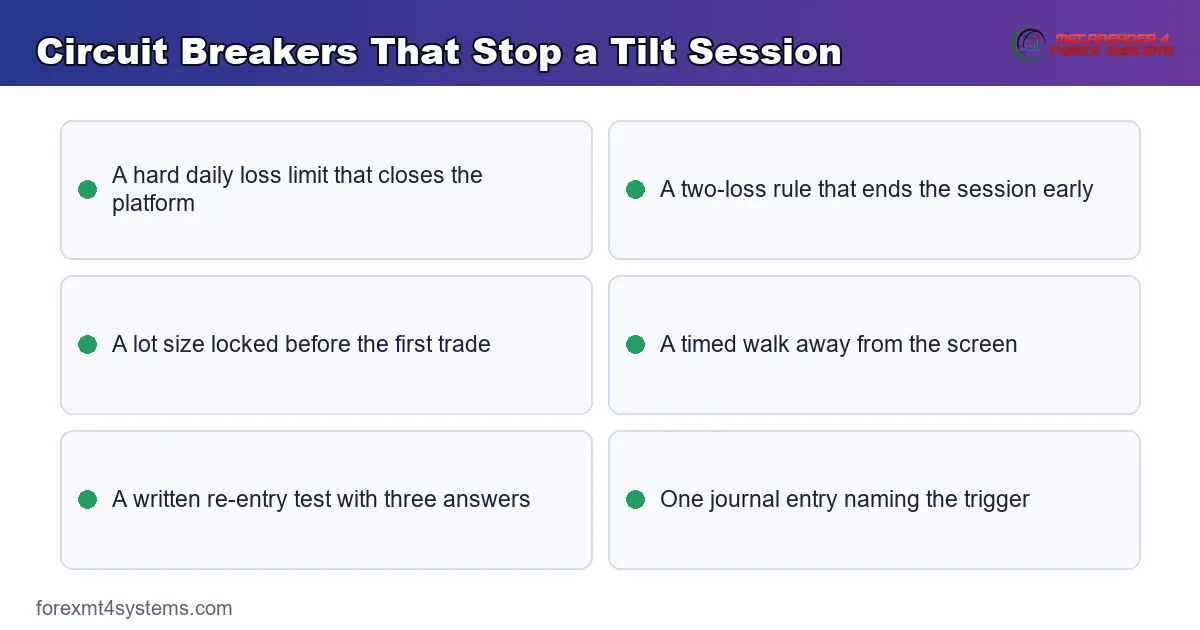
A Hard Daily Loss Limit
Pick a figure that ends the session automatically, then close the platform when it hits. Two percent suits many traders, though the exact number matters less than its firmness.
Make the limit mechanical wherever possible. Our guide to a daily loss limit explains how to set the figure and how to enforce it without arguing.
The Two-Loss Rule
Two consecutive losses end the day, regardless of the total. This breaker fires far earlier than a percentage limit, so it catches the spiral at stage two.
Some traders prefer three losses. Either version works, provided the number gets chosen before the session rather than during it.
A Locked Lot Size
Write the lot size on paper before the first trade. Any change during the session counts as a breach, even a change that seems well reasoned.
Because size creep drives the damage, this single rule prevents most of it. It also removes a decision you should never make while annoyed.
A Timed Cooling-Off Period
Step away for thirty minutes after any loss that stings. Leave the room, since staring at the chart from a chair does very little.
Physical distance works better than a promise. Traders who walk outside return with a noticeably different read of the same chart.
A Written Re-Entry Test
Before you trade again, answer three questions on paper. Name the setup, name the risk, and name the reason this trade exists.
Tilt cannot survive that test. A spiral trade never produces three clean answers, so the exercise sorts the two states apart.
Building a Tilt-Proof Session Routine
Breakers work best inside a routine that assumes a bad day will arrive. Three simple habits carry most of the weight.
Decide Everything Before the Open
Fix your lot size, your maximum trade count and your stopping figure while the screen sits quiet. Those three numbers then run the session without further input.
Print them or write them on paper beside the keyboard. Because a calm mind produced them, they hold more authority than anything you decide at speed.
Put Friction Between You and the Next Click
Add a deliberate delay after every loss. A two-minute timer, a walk to the kitchen or a written note each buy back the judgement that speed destroys.
Friction beats motivation here. The pause does not need to feel wise, since it only needs to exist.
Close the Session Deliberately
End the day at a fixed time or a fixed number of trades, whichever arrives first. An open-ended session invites one more attempt at recovery.
Then log the day before the platform closes. Two lines about size, rules and mood take a minute and save whole weeks later.
Common Mistakes When Handling Tilt
Most traders know the theory and still get caught. These six habits explain why the breakers fail when they matter.
Setting a Limit You Can Override
A limit you enforce yourself will lose to a mind determined to trade. Use platform settings, a broker-side cap or a second person where you can.
Judging Tilt by Feeling
The state feels like focus, so a self-check on emotion returns a false negative. Check size, rule breaks and trade count instead.
Trading Straight After a Break
Thirty minutes away helps only if you return to a plan. Coming back to hunt for the lost money simply restarts the cycle with fresh energy.
Treating a Recovery Trade as Proof
Sometimes a reckless trade works. That outcome teaches your brain to repeat the behaviour, which makes a winning tilt trade more dangerous than a losing one.
Blaming the Broker or the News
External causes explain the trigger and nothing after it. Our note on risk management mistakes covers the sizing errors that turn a trigger into a disaster.
Keeping No Record of the Episode
An unlogged spiral repeats within weeks. Write the trigger, the time and the size sequence while the memory stays sharp.
Tilt Quick-Reference Checklist
Keep this list beside the platform. Six answers tell you whether to keep trading or shut the screen.
- Is my current lot size the one I wrote down this morning?
- How many consecutive losses have I taken?
- Can I name the setup behind my last entry in one sentence?
- Have I moved or removed a stop in the past hour?
- How many trades have I taken today against my normal count?
- Am I trying to reach a number, or to follow a rule?
Question six decides most cases. Chasing a number means the session already ended, whatever the clock says.
Pitfalls That Restart the Spiral
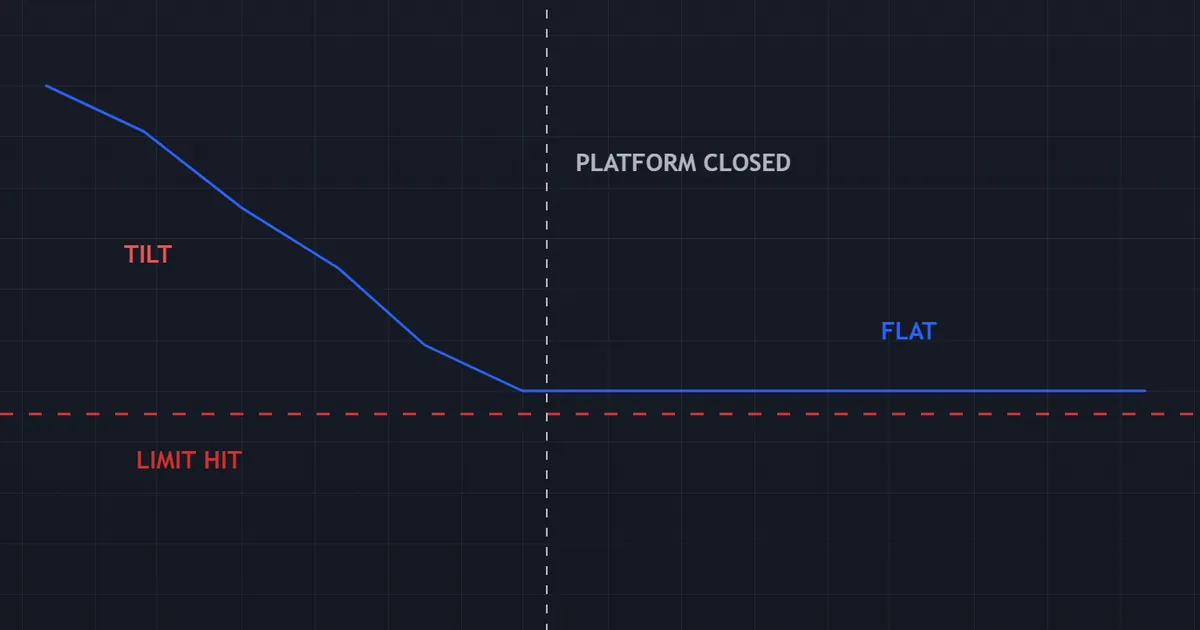
Tilt returns through a small number of side doors. The equity panel below shows how a hard limit changes the shape of a bad session.
The Next Morning Carry-Over
Yesterday’s damage travels with you. Traders open the platform determined to fix it, which turns a fresh session into a continuation of the old one.
Trading Straight After Good News or a Big Win
Winner’s tilt gets far less attention than the losing kind. A large gain loosens your size discipline just as effectively, so apply the same breakers on strong days.
Reducing Size but Increasing Frequency
Half the lot size taken four times as often produces the same exposure. Count trades as well as lots, because the spiral hides in either number.
An Account That Matters Too Much
Capital you cannot afford to lose raises the emotional stakes on every trade. Under that pressure, tilt arrives sooner and runs further.
A Second Account or a Second Platform
A daily limit on one account means little when another sits open beside it. Traders on tilt migrate rather than stop, and the second account rarely carries the same rules.
Apply the limit to your capital rather than to a login. One figure across every account keeps the breaker honest.
Weekend Analysis That Rehearses the Loss
Replaying a bad Friday for three days keeps the trigger alive. You arrive on Monday already primed, which shortens the fuse before the first candle prints.
Review once, write the lesson, then leave it. A closed loop protects the next session far better than a long post-mortem.
Tracking Nothing but Profit
A profit column hides process failures during a winning week. Log rule breaks separately in our free trade journal so the pattern shows up before the damage does.
When Tilt Points at Something Bigger
Most episodes respond to written rules and a walk around the block. A minority signal something that no checklist will fix.
The Signs Worth Taking Seriously
Watch for chasing losses across days rather than hours. Watch for hiding results from people close to you, or for trading money set aside for something else.
Sleep gives another honest reading. Regular nights lost to open positions point at a level of pressure worth addressing directly.
The Right Response
Stop trading and speak to someone qualified. If trading affects your sleep, your finances or your relationships, stepping away and seeking professional support remains the correct move rather than a last resort.
Nothing about that decision reflects weakness. The market runs every week, and an account can sit idle for as long as you need.
Related Concepts to Study Next
Tilt overlaps with several behaviours that deserve their own reading. Each neighbouring guide covers one part of the same machinery.
Begin with our overview of emotions in trading for the wider map of states that push on your process. Then read our guide to drawdown in trading, since the depth of a hole shapes how hard the next session pulls at you.
Traders who fix the size creep usually fix the rest by accident. So start with the sizing rules, then work back toward the emotional trigger that set the session off.
Then build the breakers into your routine rather than your memory. A rule stored on paper survives a bad morning, while a rule stored in your head rarely does.
FAQ
What does tilt in trading mean?
It describes a temporary state where emotion overrides your process after a loss or a run of losses. Decision quality drops, position size creeps upward, and trades appear that match no written setup. The term comes from poker, which borrowed it from pinball machines.
How do I know if I am on tilt right now?
Check three observable facts rather than your mood. Compare your current lot size with the one you planned, count your consecutive losses, and try to name the setup behind your last entry in one sentence.
What is the fastest way to stop a tilt session?
Close the platform and leave the room for at least thirty minutes. A hard daily loss limit or a two-loss rule does the same job automatically, which works far better than deciding in the moment.
Is winner’s tilt real?
Yes, and it catches experienced traders regularly. A strong run loosens size discipline and invites trades outside the plan, so the same breakers belong on good days as well as bad ones.
Why does size always increase during tilt?
Recovery arithmetic drives it. A larger position promises to close the gap quickly, and the mind quietly ignores the matching increase in downside. Locking your lot size before the session removes the decision entirely.
Does an automated strategy remove tilt?
It moves the pressure rather than removing it. The decisions shift to switching the system off, overriding a trade or raising the lot size after a drawdown, and every one of those choices sits in the same place emotionally.
How do I recover the account after a tilt session?
Cut your risk per trade for the next twenty positions and take only setups that match the written plan. Slow repair at a reduced size protects the capital that remains, while any attempt to win it back quickly tends to repeat the original session.
Can I trade the same day after a tilt episode?
Usually not, and the attempt tends to restart the cycle. Take the rest of the day off, write down the trigger, and return the next session at your normal size. Results are not guaranteed; past performance is not indicative of future results.
External references
- For background on this concept, see Tilt in Poker on Wikipedia.
- For broader market context, see Emotional Neutrality at Investopedia.

About the author
Written by Dominic Walsh, a Forex trader and MT4/MT5 indicator, Expert Advisor and script developer. Every tool on forexmt4systems.com is tested on live charts before release and ships with ready-to-use compiled MT4 (.ex4) and MT5 (.ex5) files. Learn more about the trader and developer behind this site.
How we build, test and correct every tool: Editorial & Testing Policy. Trading carries risk; see the disclaimer.