
Every trader remembers the position taken purely to get even. So the useful question is simple: what is revenge trading, and why does an otherwise sensible person do it?
Revenge trading means entering a position mainly to recover a recent loss. The setup no longer matters. The score does, and that swap of motive causes most of the damage.
What Is Revenge Trading, Exactly
The label describes a motive rather than a chart pattern. A trade counts as revenge when the reason for entering points backwards, not forwards.
Nothing about the entry has to look reckless from the outside. Because the trigger sits in the trader’s head, only a journal reveals it later.
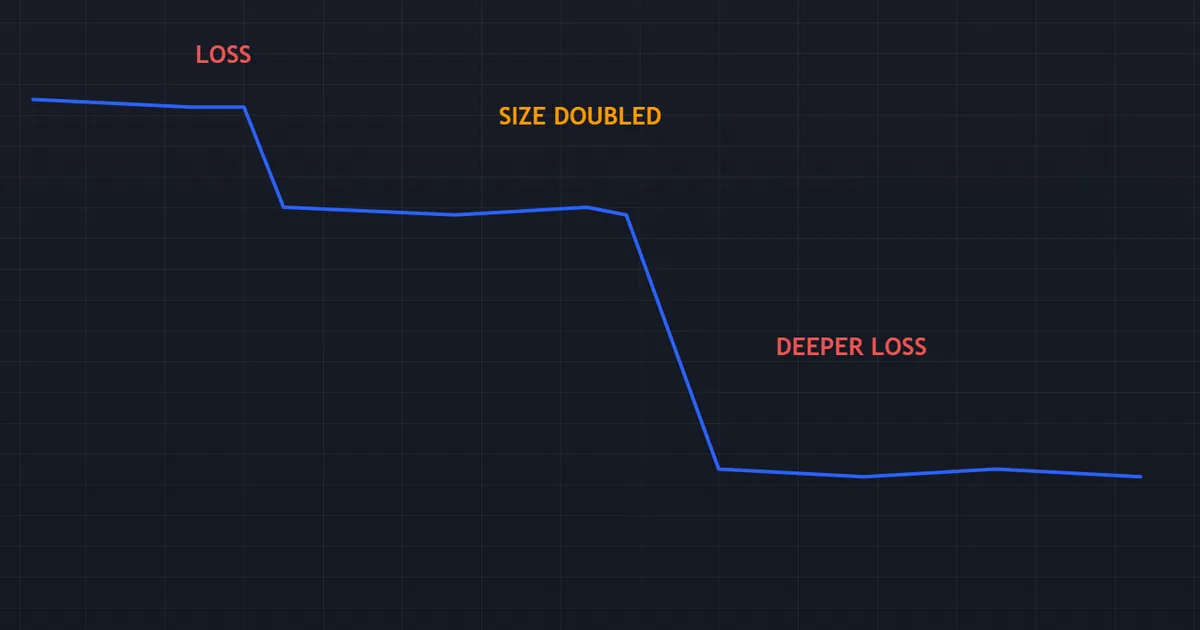
The panel above shows the usual shape. An equity curve takes an ordinary loss, then falls much faster as size doubles on the trade that follows.
Notice the steepness of that second leg. One normal loss rarely hurts an account, while the reaction to it frequently does.
The Sequence in One Line
Loss, then anger, then a bigger position taken sooner. That chain repeats across thousands of trading records.
Each link feels reasonable while it happens. So the fix has to break the chain early, before the third link forms.
How It Differs From Overtrading
Both habits raise activity, though the fuel differs. Restlessness and boredom drive most extra trades, while one specific loss drives this one.
The distinction matters for the cure. A trade cap alone will not save you here, since a single oversized position can do the damage. Our guide to overtrading covers the volume side of the problem.
The Tells You Can Check
Four signs show up in almost every case. Size jumps without a written reason, the entry arrives minutes after a stop-out, the setup fails your own checklist, and the target sits at yesterday’s balance.
Any two of those together deserve a hard stop. Because the pattern repeats so reliably, a rule catches it more dependably than insight ever will.
Why the Name Fits
The word sounds theatrical, yet it describes the feeling accurately. Traders in this state talk about getting even with the market.
Markets, of course, take nothing personally. So the opponent exists only in the trader’s head, which is precisely why logic alone fails to end the fight.
The Behaviour Underneath It
This reaction has deep roots in documented psychology. Prospect theory, developed by Daniel Kahneman and Amos Tversky, showed that losses weigh more heavily than equivalent gains.
That asymmetry explains a great deal. A hundred dollar loss stings far more than a hundred dollar gain pleases, so the urge to erase it runs strong.
The Biases That Drive It
Read the list, and mark the ones that sound familiar.
- Loss aversion. The pain of a loss outweighs the pleasure of a matching gain, so erasing it feels urgent.
- Sunk-cost thinking. Money already gone pulls a trader into further risk to justify the first decision.
- Break-even anchoring. The old balance becomes the target, even though the market never noticed it.
- Gambler’s fallacy. After three losers, the next trade feels owed. Independent outcomes ignore that logic.
- Ego threat. A loss reads as a verdict on the trader, so the next trade tries to answer it.
- Arousal and stress. Heart rate rises, patience drops, and the brain favours quick action over careful review.
None of those describe a careless person. Because each one works below conscious argument, willpower in the moment rarely wins.
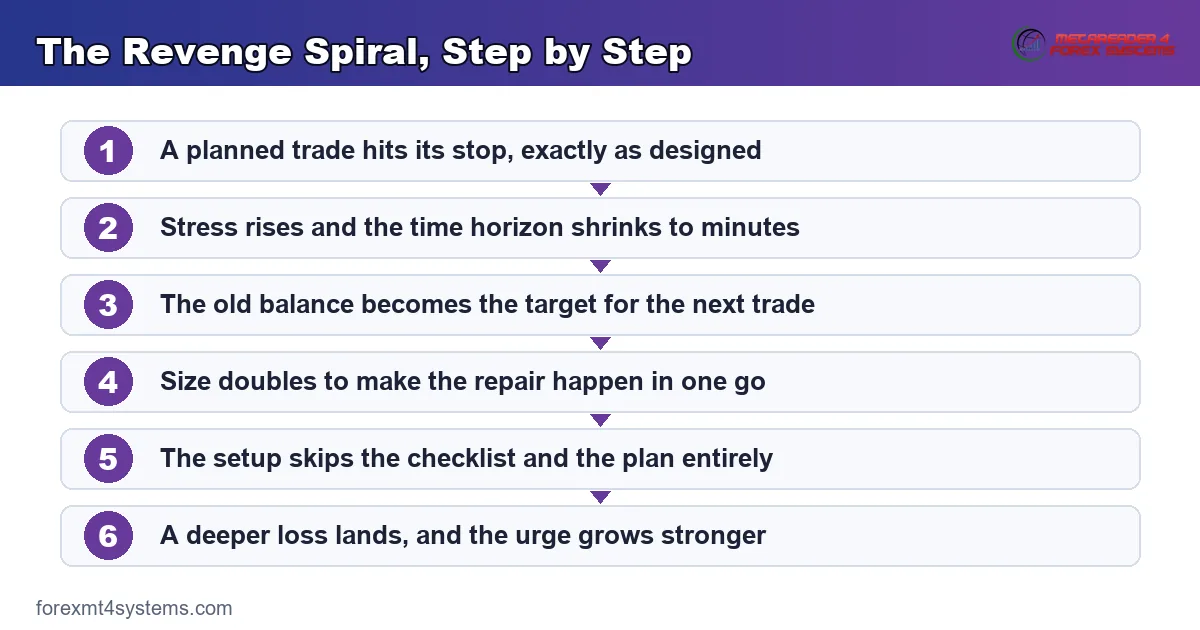
The flow graphic lays the spiral out in order. Keep it near the desk, and the second step becomes much easier to catch.
Why the Urge Peaks Right After a Loss
Stress hormones rise the moment a stop gets hit. Attention narrows, and the time horizon shrinks to the next few minutes.
So the worst decision window opens exactly when the account feels most fragile. Because that window closes on its own within half an hour, a timed pause solves most of the problem.
Why the Size Grows
Recovering a loss at normal size takes several good trades. The mind rejects that timeline and hunts for one large trade instead.
So risk rises exactly when judgement falls. That pairing turns a two percent day into a ten percent day faster than any market move could.
Winning the Chase Makes It Worse
Occasionally the oversized trade works. The balance recovers, and relief floods in.
So the brain files the whole sequence as a success. Because rewards teach faster than lectures, one lucky chase can install the habit for years.
How to Spot It in Your Own Record
Memory flatters everyone, so the record settles the question. Three checks take about ten minutes a week.
Run them every Friday, then track the results across a quarter. Direction matters far more than any single week.
Tag Every Trade With a Motive
Give each entry one word: planned, impulse or recovery. Choose the word at the moment of entry, never afterwards.
Total the tags at the end of the week. Because the count ignores profit, it stays honest through a lucky run and a rough one alike.
Measure the Gap Between Trades
Note the minutes between a losing exit and the next entry. Short gaps after losses point straight at the habit.
Compare that figure against your gaps after winners. So a clear difference tells you the loss, rather than the market, opened the position.
Compare Planned and Unplanned Results
Split the month into two piles, then total each one. Most traders find the planned pile carries the entire result.
That comparison ends the argument quietly. Because your own numbers made the case, nobody has to lecture you.
What This Habit Actually Costs
The bill arrives through three channels. Each one compounds the others.
Money leaves first, then confidence, then the plan itself. Rebuilding all three takes far longer than the original loss ever would.
The Arithmetic of Chasing
Drawdowns work against you in an unhelpful way. A twenty percent loss needs a twenty-five percent gain to repair it, while a fifty percent loss needs a hundred percent gain.
So each escalation raises the recovery bar sharply. Our guide to risk of ruin shows how quickly repeated oversized bets erode the odds of surviving at all.
What the Public Data Shows
Regulators in Europe and the United Kingdom require contract-for-difference brokers to publish the share of retail accounts that lose money. Those mandated disclosures typically land somewhere between roughly seventy and eighty-five percent.
Read the figure carefully. It counts retail CFD accounts at one provider over a rolling year, rather than every trader everywhere. It still tells you that costs and behaviour beat most participants, which is the honest reason to take a chasing habit seriously.
The Damage Beyond the Balance
A chased loss teaches the wrong lesson twice over. If the trade wins, the habit collects a reward. If it loses, the trader concludes that the strategy failed.
So the record turns unreadable. Because no clean sample of planned trades survives, you cannot tell a weak plan from weak execution.
Time Lost to Recovery
A chased loss steals weeks as well as money. The account spends that time climbing back rather than compounding.
So the true cost includes every gain the balance never made. Because compounding rewards a steady base, one bad hour can flatten a whole quarter.
A Worked Example of the Spiral
Numbers make the cost concrete, so follow one ordinary morning. The figures show the mechanics and predict nothing about your own trading.
Picture a ten thousand dollar account with a one percent rule. Each trade risks one hundred dollars, and the plan allows a two percent daily loss.
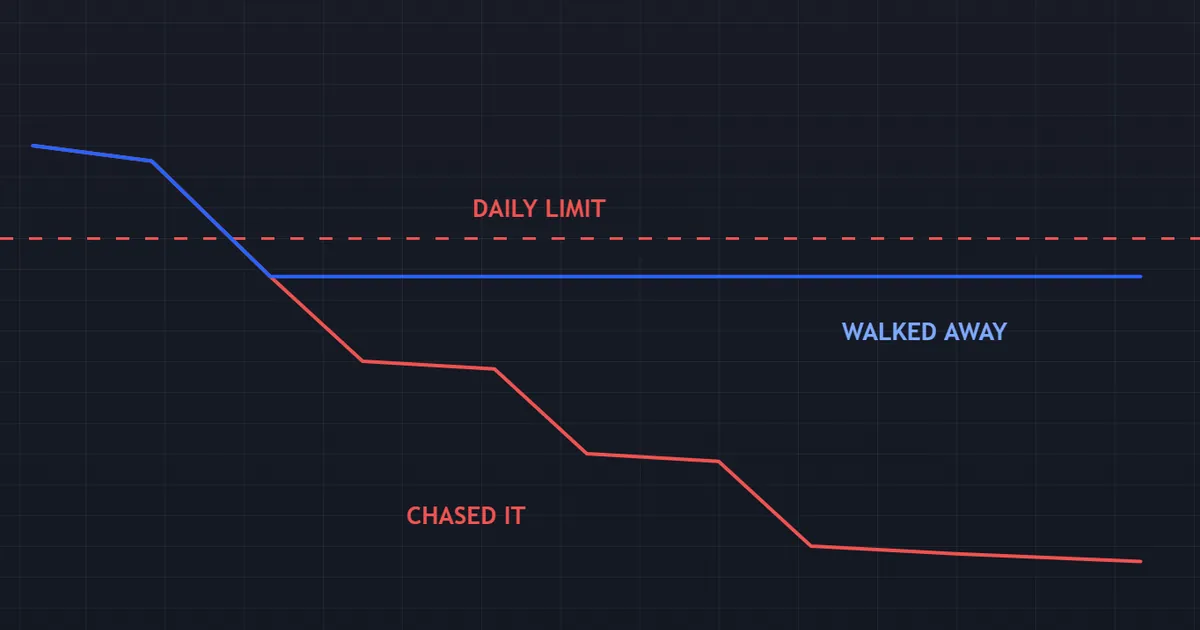
Two setups fail before lunch, so the account sits two hundred dollars down. The plan says stop, since the daily limit has arrived.
Instead the trader triples size on a fifth-rate setup. That trade risks three hundred dollars, and it loses.
Where the Morning Ends
The account now sits five hundred dollars down, or five percent. Panic pushes size up again, this time to six hundred dollars of risk.
That trade loses too. The day closes eleven hundred dollars down, so the account needs roughly a twelve percent gain simply to return to where it opened.
A Disciplined Version of the Same Day
Now replay the morning with the limit enforced. The trader stops at two hundred dollars and closes the platform.
Recovery then needs about two percent rather than twelve. Same market, same setups, and a completely different month.
What the Sums Leave Out
This example assumes clean fills and no slippage. A stressed trader on a fast market often gets neither.
Wider spreads and rushed exits add to the bill. So the real gap between the two versions runs wider than the arithmetic shows.
The example also assumes the spiral ends after two escalations. Plenty of accounts keep going until the margin call answers the question for them.
How to Stop Revenge Trading
Advice to stay calm fails under stress. A rule works only when a number, a timer or a locked screen enforces it.
Pick three from this list rather than all seven. Because a rule you honour beats a perfect rule you drop, start narrow.
Write each chosen rule on a single card, and keep it beside the screen. Review the card at the weekend, and change nothing during the week itself.
A Hard Daily Loss Limit
Choose a figure before the week starts, and treat it as the end of the day. Two percent of the balance suits many plans.
When it arrives, close everything. Our guide to the daily loss limit covers how to size one and how to enforce it properly.
A Cooling-Off Timer
Set a fixed pause after every loss. Fifteen minutes away from the desk fits most intraday plans, and a full day fits most swing plans.
Leave the room, since watching the chart defeats the point. Because the urge fades quickly, a short walk removes most of the risk.
Size That Never Moves After a Loss
Fix your risk per trade as a percentage, and forbid any change inside a session. Size decisions belong to a weekly review, never to a bad hour.
Our free position size calculator works the lot size back from your stop distance so the figure stays mechanical.
A Pre-Committed Trade List
Write the setups you will take before the session opens. Anything outside that list waits until tomorrow.
The list acts as a filter when your judgement wobbles. So the decision happens while you feel calm, which is the whole point.
A Journal Field for State of Mind
Add one field to every entry: calm, rushed or angry. Score it honestly at the moment of the trade.
Review the field weekly, and total the results by state. Our free trade journal keeps that note beside each position so the pattern shows up fast.
Cut Size After a Streak
Halve your risk after three consecutive losses, and restore it only after two planned winners. The rule slows the spiral automatically.
It also protects the account while confidence rebuilds. See our guide to a losing streak in trading for the wider recovery plan.
Book a Review Slot Instead of a Trade
Give the urge somewhere useful to go. After a loss, open the journal and write two lines about the setup.
The task occupies the same minutes the chase would have taken. So the impulse burns off against paperwork rather than against your balance.
Download the complete indicator database
Put these concepts on your charts. One email unlocks the full library of 1,380+ indicators with compiled MT4 and MT5 files, plus my TradingView scripts. No paywall, no spam, unsubscribe any time.
Get free access to my indicator database
One email unlocks 1,380+ free MT4, MT5 and TradingView indicators — the complete library. No single-tool download; you get the whole database.
Common Mistakes and the Fix
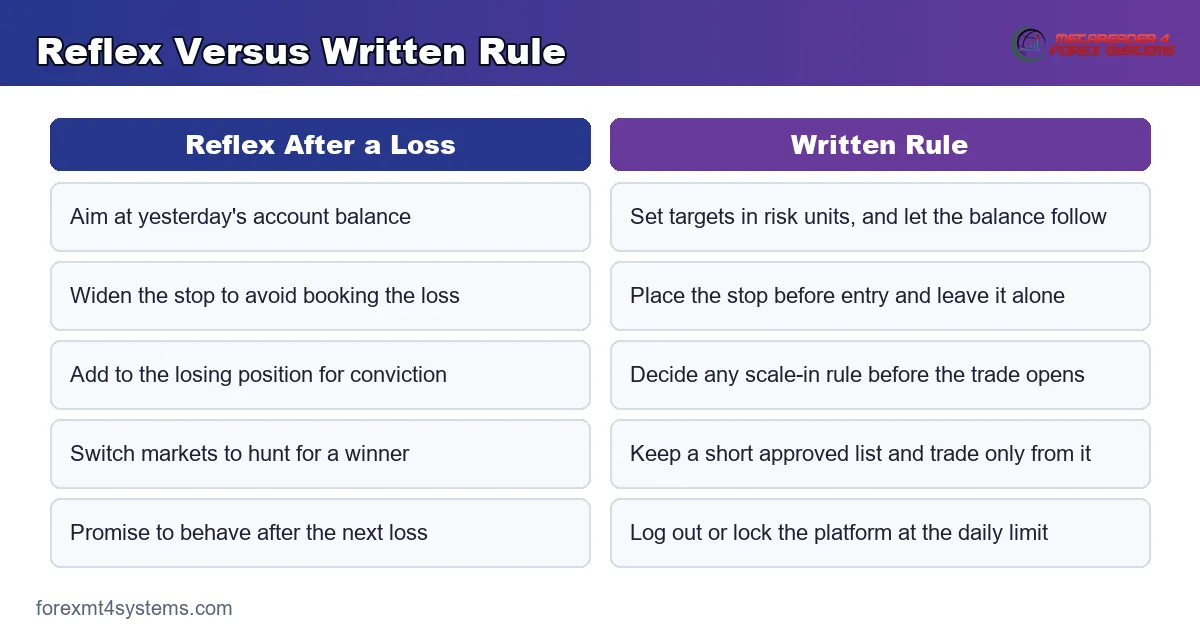
The same errors appear in record after record. The comparison graphic below sets each reflex beside the written rule that answers it.
Treating the Old Balance as a Target
Yesterday’s number carries no meaning for today’s market. Chasing it invites size that the plan never allowed. Set targets in your own risk units instead, and let the balance follow.
Widening the Stop to Avoid the Loss
Moving a stop turns a planned loss into an unplanned one. The position then controls the trader. Place the stop before entry, and treat it as untouchable once the order fills.
Adding to a Losing Position
Averaging down looks like conviction and usually reflects denial. Exposure grows as the thesis weakens. Decide any scale-in rule in advance, and never make that call while red.
Switching Markets to Find a Winner
A quiet chart tempts a stressed trader into an unfamiliar one. Unfamiliar markets punish that quickly. Keep a short approved list, and treat everything else as closed.
Relying on Willpower Alone
Promises made after a loss rarely survive the next one. Build a barrier that acts without you. Log out, use a platform lock, or set a broker-side daily limit where the option exists.
Judging the Rule by One Outcome
A chase that wins does not prove the chase was right. Judge each decision against your written plan, then judge the plan over a quarter. That order stops luck from rewriting your rules.
Quick Reference Checklist
Keep this list where you can see it during a session. Read it the moment a loss lands.
Seven lines carry the whole argument. None of them asks you to feel differently, which is exactly why they hold under pressure.
- A trade taken to recover a loss is a revenge trade, whatever the chart shows.
- The urge peaks within minutes of a stop-out and fades within about half an hour.
- Size that rises after a loss signals the spiral more clearly than any other tell.
- A hard daily loss limit ends the day before the third escalation.
- Stops belong in place before entry, and they stay there.
- Cut risk by half after three straight losses, and restore it slowly.
- Log your state of mind, then total your results by state each week.
Pitfalls and Edge Cases
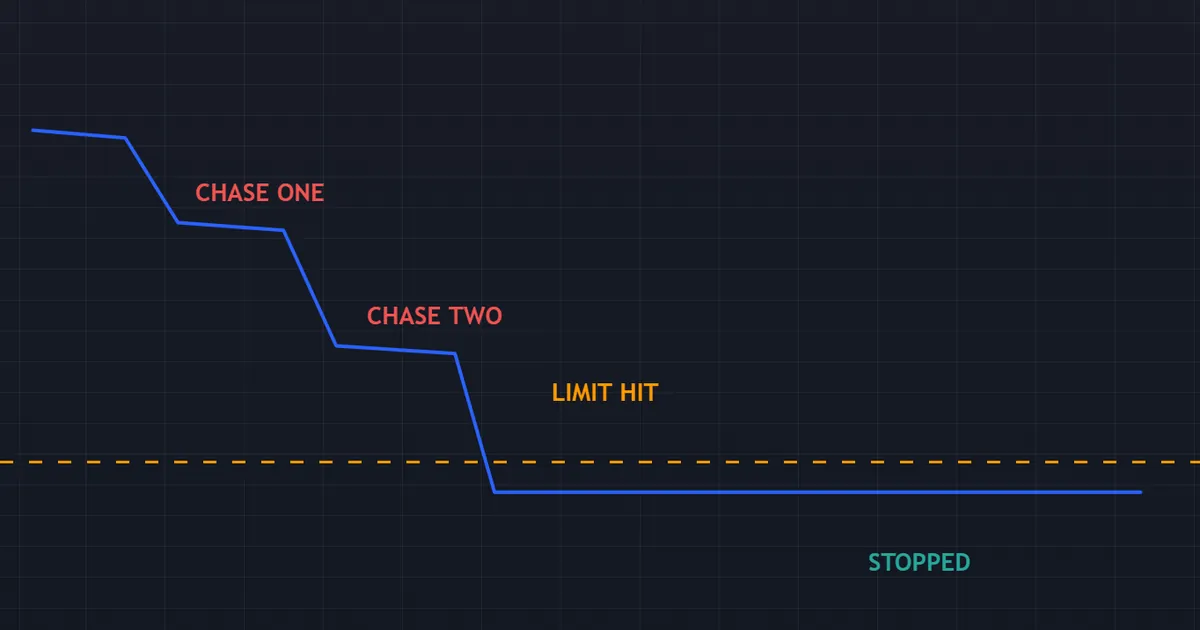
A few wrinkles bend the clean picture, so keep them in view. The panel below shows the account flattening once the limit finally bites.
It Hides Inside Normal Size
Not every chase looks obvious. A trader can take five ordinary trades in an hour with the same motive behind each one. Count entries per hour after a loss, and treat a cluster as the same warning.
Prop Accounts Punish It Twice
On an evaluation account, one chased trade can breach the daily limit and end the attempt. So the escalation costs the fee as well as the balance. Keep sizing mechanical while any evaluation runs.
Hedging Instead of Closing
Opening an opposite position feels safer than accepting a loss. Costs double while the decision stays unmade. Read our note on how to use a stop loss, then close cleanly instead.
Automation Moves the Impulse
An expert advisor removes the clicking without removing the feeling. Traders then override the system or change its settings mid-run. Freeze the parameters for a set period, and log every change with a reason.
Event Days Amplify Everything
Major data releases widen spreads and speed the tape up. A chase in those minutes fills badly and slips further. So mark event windows on the calendar, and treat the hour after a loss there as closed.
Tilt Outlasts the Session
The mood often carries into the following morning. So a trader who stopped correctly can still open badly. See our guide to tilt in trading for how to reset properly.
When It Stops Being a Trading Problem
Some cases run past technique, and pretending otherwise helps nobody. If chasing losses disturbs your sleep, strains your finances or damages your relationships, no checklist will settle it.
Step away from the market, and speak to a qualified professional. Compulsive loss-chasing shares features with problem gambling, and proper support services exist for exactly that. Nothing written here replaces that kind of help.
Related Concepts to Study Next
This habit sits inside a wider picture, so a few neighbouring topics repay an hour of reading. Each one explains part of the loop that turns a small loss into a large one.
Begin with the wider subject in our guide to trading psychology, which frames every habit on this page. The links above then cover overtrading, losing streaks, tilt, stop placement and the daily loss limit. Work through them in that order, and pair each idea with a rule you write down the same day. Because the market supplies the losses whatever you do, your only real control sits in how you answer them.
FAQ
What is revenge trading in simple terms?
It means opening a position mainly to win back a recent loss. The motive points backwards, so the trade answers the last result rather than the current market. Size usually rises, the checklist gets skipped, and the entry follows a stop-out within minutes.
How do I know a trade was a revenge trade?
Check three things in the journal. Did the size jump without a written reason, did the entry follow a loss closely, and did the setup match your plan? Two yes answers settle it, whatever the outcome turned out to be.
Why does size always grow during the spiral?
Recovering at normal size takes several good trades, and the mind rejects that timeline. One large position promises an instant repair. Risk therefore climbs at the exact moment when stress has already narrowed your judgement.
Does a winning chase count as a problem?
Yes, and arguably a worse one. A profitable chase rewards the behaviour, so the habit strengthens. Judge the decision against your plan rather than against the result, or luck will slowly rewrite your rules.
What single rule helps most?
A hard daily loss limit, enforced by closing the platform, does more than any mindset advice. Pair it with a fifteen minute pause after every loss. Those two rules cover the window where the urge runs strongest.
Is a cooling-off period long enough at fifteen minutes?
For most intraday traders, yes, provided you leave the desk. The sharpest part of the urge fades quickly once the screen disappears. Swing traders usually need the rest of the day, since their positions carry far longer and the stakes per trade run higher.
How long does it take to break the habit?
Most traders see a change within a few weeks once the rules become mechanical rather than optional. Progress shows up as fewer unplanned entries and a flatter run of daily losses, not as a smooth balance. The market still decides each individual trade. Results are not guaranteed; past performance is not indicative of future results.
External references
- For background on this concept, see Martingale System at Investopedia.
- For broader market context, see Emotional Self-Regulation on Wikipedia.

About the author
Written by Dominic Walsh, a Forex trader and MT4/MT5 indicator, Expert Advisor and script developer. Every tool on forexmt4systems.com is tested on live charts before release and ships with ready-to-use compiled MT4 (.ex4) and MT5 (.ex5) files. Learn more about the trader and developer behind this site.
How we build, test and correct every tool: Editorial & Testing Policy. Trading carries risk; see the disclaimer.