
Learning how to manage trading stress matters more than most traders admit. The pressure rarely announces itself, yet it shows up in every decision you make at the screen.
This guide keeps the topic practical rather than clinical. You will find the five levers that genuinely move the dial, a worked audit, and a plain note about when to stop and ask for qualified help.
What Trading Stress Actually Is
Stress describes your response to demand, not the demand itself. Two traders can face the same drawdown and carry completely different loads.
Occupational research points at the same pattern across many jobs. High demand paired with low control produces the heaviest strain, and trading delivers both in unusual amounts.
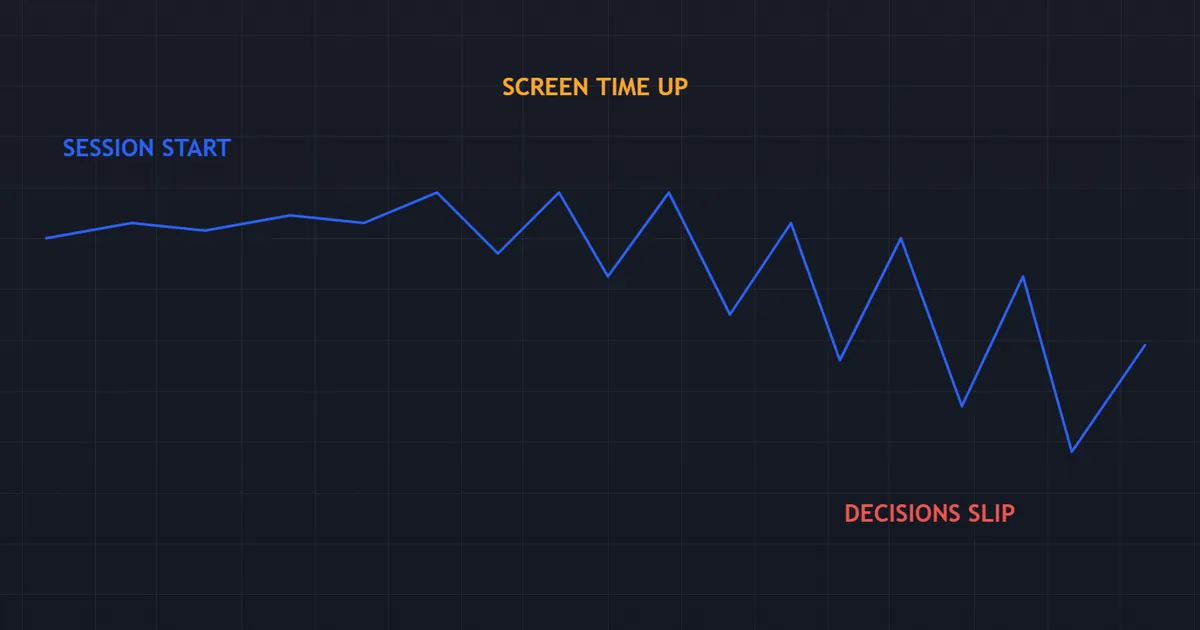
You choose the entry and nothing after it. That gap between responsibility and control explains why a quiet screen can still leave you exhausted.
The Physical Side You Can Measure
Your body reports the load before your mind does. Shallow breathing, a tight jaw, restless legs and a racing pulse all arrive before the thought does.
Later signals cost more. Broken sleep, a shorter temper away from the desk and a drifting appetite point at a load that has run too long.
Track two of these each day in a single column. Because the readings come from your body rather than your profit, they stay honest during a good week.
Pressure Versus Stress
Pressure means something real depends on your decisions. Most traders want that, since it sharpens attention and keeps the process serious.
Stress arrives when the load outruns your capacity to carry it. The same position feels manageable after eight hours of sleep and impossible after four.
So the fix rarely involves caring less. It involves lowering the load or raising the capacity, and both respond well to boring changes.
Why Trading Produces Its Own Version
Feedback here comes fast, in money, and with no clear link to skill. A good decision can lose and a poor one can pay, which removes the reassurance most work provides.
Markets also run without a finish line. Nothing tells you the day went well, so the mind keeps searching for a verdict that never arrives.
Add solitude and the picture completes. Traders work alone, compare themselves with edited highlights online, and rarely talk to anyone about a bad week.
A Sharp Spike Versus a Long Grind
Two very different loads share the same name. A sharp spike arrives during a news release or a fast move against an open position.
Spikes pass quickly and rarely cause lasting damage. Your body handles them well, provided the position sits within a size you accepted in advance.
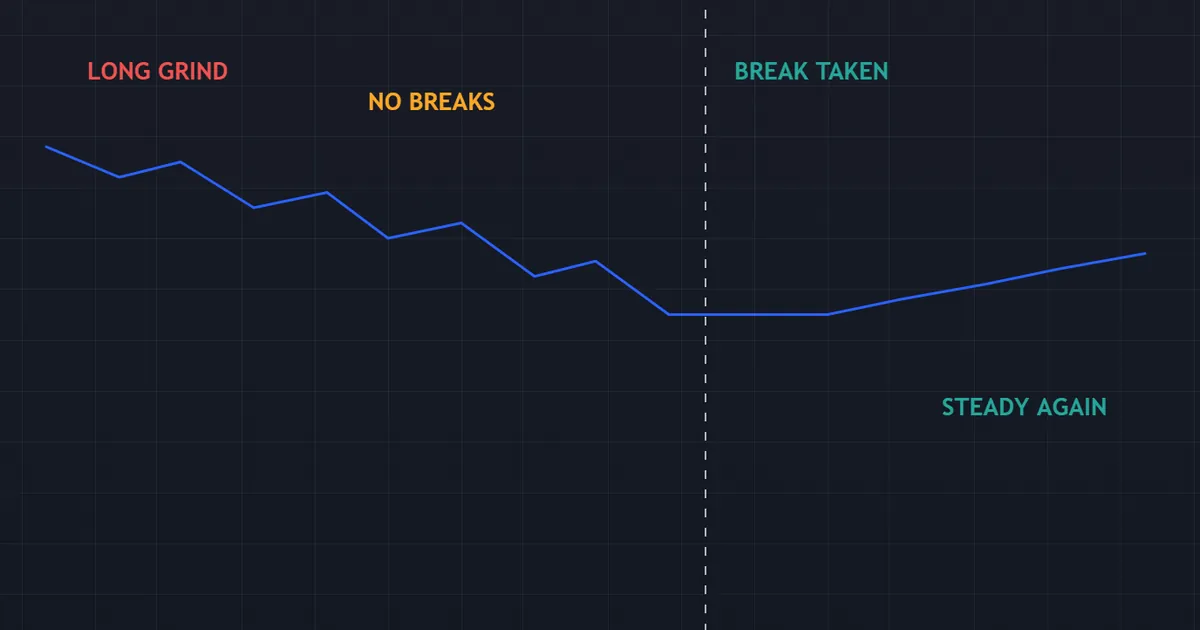
The long grind does the real harm. Weeks of screen time, unresolved drawdown and broken evenings accumulate slowly, so nothing ever feels bad enough to act on.
Treat the grind as the priority. Spikes need a stop order, while the grind needs a routine.
How to Manage Trading Stress in a Live Session
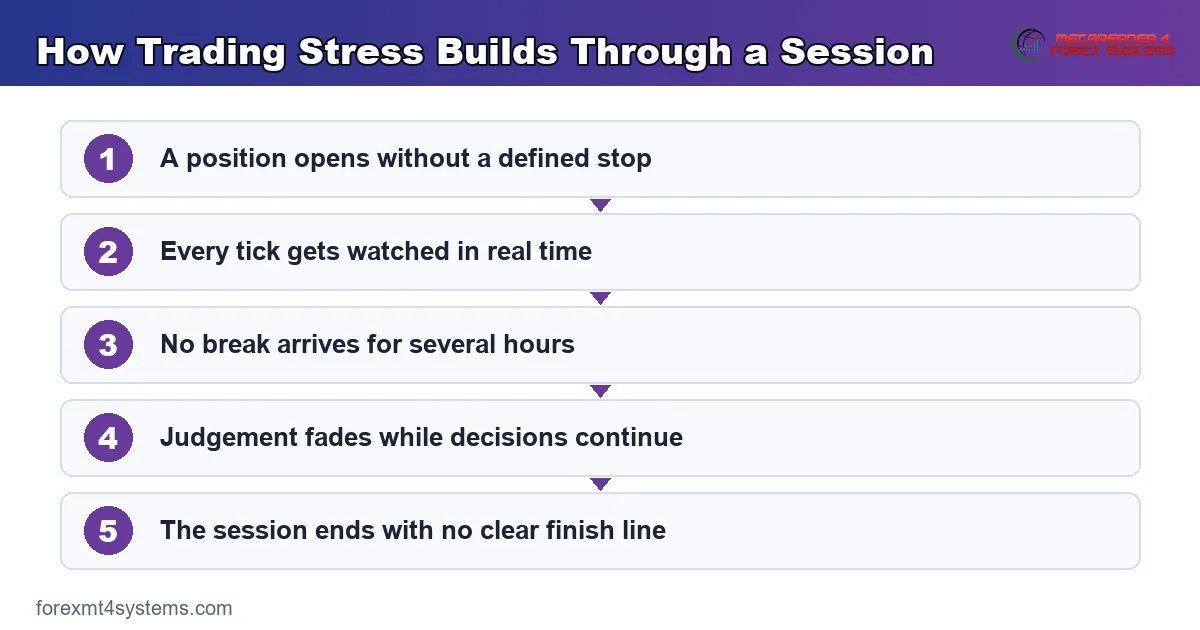
Session-level control comes first, since the damage happens there. Run the six steps below in order and most of the load drops away.
- Set the numbers before the open. Risk per trade, maximum trades and a stopping figure, all written down.
- Place the stop with the order. An unprotected position generates far more strain than a defined one.
- Leave the screen once the trade sits. Set an alert and walk away rather than watching every tick.
- Break every ninety minutes. Stand up, look at something distant, and drink water before the next block.
- Stop at the time you chose. An open-ended session invites one more attempt and drains the evening.
- Write two lines and close the platform. A short log ends the day cleanly instead of leaving it running in your head.
None of that requires willpower during the session. Each step converts a live decision into a rule you already made while calm.
Why the Stop Order Matters So Much
A position without a stop keeps every outcome open. Your mind then holds the whole range of possibilities, which costs energy continuously.
A defined stop closes the range. The worst case turns into a known figure, so the position occupies far less attention.
Our guide to position sizing covers how to pick a stop from the chart rather than from your comfort. The two choices interact more than most traders realise.
Why the Break Matters More Than the Chart
Attention degrades on a predictable curve. After ninety minutes of screen time, decision quality falls whether or not you feel tired.
Short breaks reset that curve cheaply. Five minutes standing away from the desk buys back more than an extra indicator ever will.
Set a timer rather than trusting your judgement. Judgement is exactly the faculty the fatigue degrades first.
Preparing the Session the Night Before
Half the load comes from decisions made at speed. Move those decisions to the evening and the session turns into execution rather than problem solving.
Mark your levels, list the two or three setups you will accept, and write the risk figure beside them. Ten minutes of preparation removes an hour of searching.
Then leave the charts alone until the session opens. Reviewing the same levels four more times adds nothing except fatigue.
The Five Levers That Actually Move Stress
Advice about staying calm rarely changes anything. These five levers change the load itself, which is why they work.
Lever One: Position Size Relative to Your Tolerance
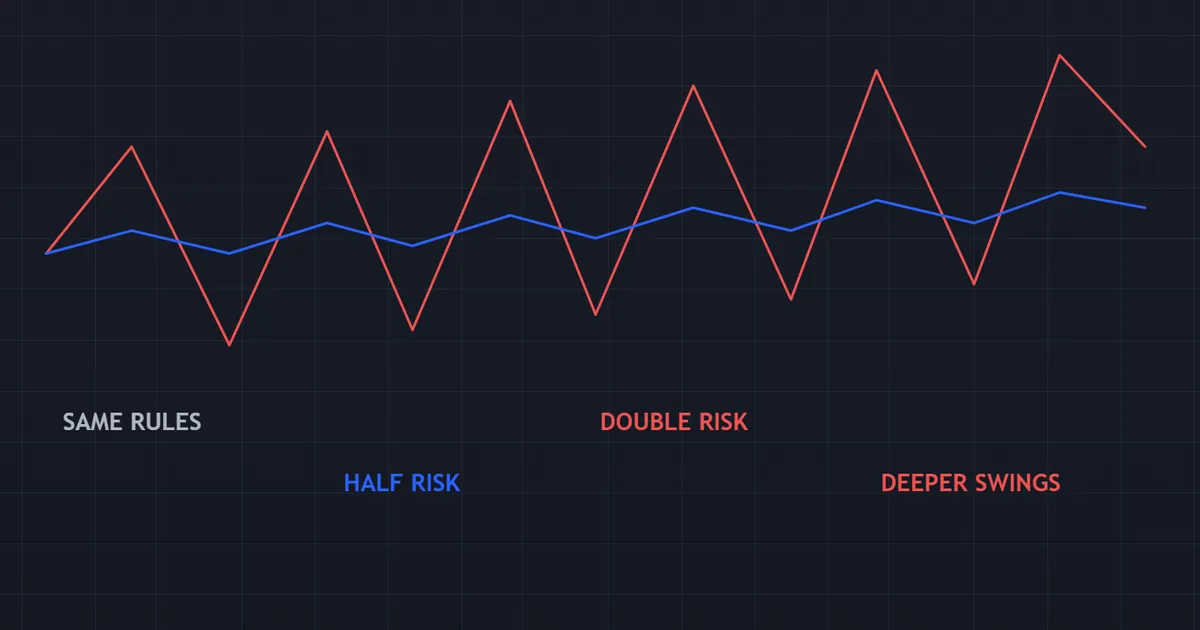
Size drives more stress than any other input. A position risking three percent produces a different body state from one risking half a percent.
Find your own line by testing it. Drop the risk until you can leave the platform for an hour without checking, then treat that figure as your ceiling.
Our free risk of ruin calculator shows what different risk levels do to the odds of wiping an account. Seeing the arithmetic often settles the argument faster than any advice.
Lever Two: Screen Time
Hours in front of charts correlate poorly with results and strongly with strain. Watching a position tick does nothing to the outcome, yet it consumes attention all day.
Set alerts at your levels and close the platform between them. Swing traders often cut screen time by three quarters with no change to their record.
Then protect one full day a week away from markets. That day does more for the following week than an extra session of analysis.
Lever Three: Sleep
Sleep loss hits exactly the faculties trading needs. Risk judgement, impulse control and patience all degrade before you notice any tiredness.
Late sessions cost twice. You trade badly at midnight, then trade badly again the next morning on a short night.
Choose sessions that fit your time zone rather than fighting it. A trader who sleeps properly and trades one session beats a tired trader covering three.
Lever Four: Session Limits
Open-ended trading has no natural end, so the load never resolves. A limit gives the day a finish line and hands back a sense of control.
Use whichever limit fits your style. A stopping figure, a trade count, a fixed clock time or all three together each close the session cleanly.
Our note on small account risk management explains how tight limits protect a modest balance. The same limits protect your evenings as a side effect.
Lever Five: Identity Separated From Outcome
This lever sounds soft and lands hardest. When a losing day means you are a losing person, every trade carries far more weight than money.
Separate the two deliberately in writing. Score your day on rules followed, then record the profit in a different column entirely.
Traders who make that split describe a noticeable drop in dread. The loss still costs money, though it no longer costs a verdict about who you are.
A Worked Example of a Stress Audit
An audit turns a vague feeling into a short list of changes. Picture a trader running two sessions a day with no fixed limits.
The account rarely blows up, yet the sleep suffers and the weekends fill with charts. Nothing looks broken, which makes the problem easy to ignore.
Score each lever from one to five, where five means fully under control. The table shows the audit and the change that follows each score.
| Lever | Score before | Change made | Score after |
|---|---|---|---|
| Position size | 2 | Risk cut from two percent to half a percent | 4 |
| Screen time | 1 | Alerts set, platform closed between levels | 4 |
| Sleep | 2 | Late session dropped entirely | 4 |
| Session limits | 2 | Three trades a day, hard stop at noon | 5 |
| Identity | 3 | Rules-followed column added to the journal | 4 |
Reading the Audit
Notice which change costs the least. Setting alerts takes ten minutes and removes hours of low-value watching every week.
Notice which change hurts the most. Dropping a session feels like giving up opportunity, though the trades taken while tired rarely paid for themselves.
Repeat the audit monthly. Scores drift, and a slipping figure gives you weeks of warning before the strain shows up anywhere else.
What the Audit Will Not Fix
An audit cannot fix an account funded with money you need. That pressure sits outside your process, so no routine will settle it.
It also cannot fix a strategy with no tested record. Uncertainty about the method produces a specific dread that only evidence removes.
Our guide on how to deal with trading losses covers the emotional side of a bad run. Read it beside the audit rather than instead of it.
Download the complete indicator database
Put these concepts on your charts. One email unlocks the full library of 1,380+ indicators with compiled MT4 and MT5 files, plus my TradingView scripts. No paywall, no spam, unsubscribe any time.
Get free access to my indicator database
One email unlocks 1,380+ free MT4, MT5 and TradingView indicators — the complete library. No single-tool download; you get the whole database.
Building a Weekly Routine That Holds
Session rules handle the day, though the week needs its own shape. Three appointments carry almost all of it.
A Preparation Slot on Sunday
Spend thirty minutes marking levels and reading the calendar for the week ahead. Knowing which days carry a news release removes a whole category of surprise.
Write the week’s risk figure in the same slot. One number set on Sunday resists the pull of a Wednesday drawdown far better than a fresh decision would.
A Review Slot on Friday
Read the journal once, at a fixed time, and stop when the page ends. Continuous reviewing keeps the week alive in your head long after it closed.
Count rules followed before you count money. That order changes what the review feels like, and it changes what you learn from it.
A Full Day With No Charts
Choose one day and keep the platform shut. Markets close at the weekend anyway, so the cost of a genuine break sits close to nothing.
Traders resist this more than any other habit. Because the fear of missing something drives it, the resistance itself measures how much the break is needed.
Fill the day with something unrelated to screens. Exercise, company and time outdoors all restore capacity faster than rest alone.
Common Mistakes When Managing Trading Stress
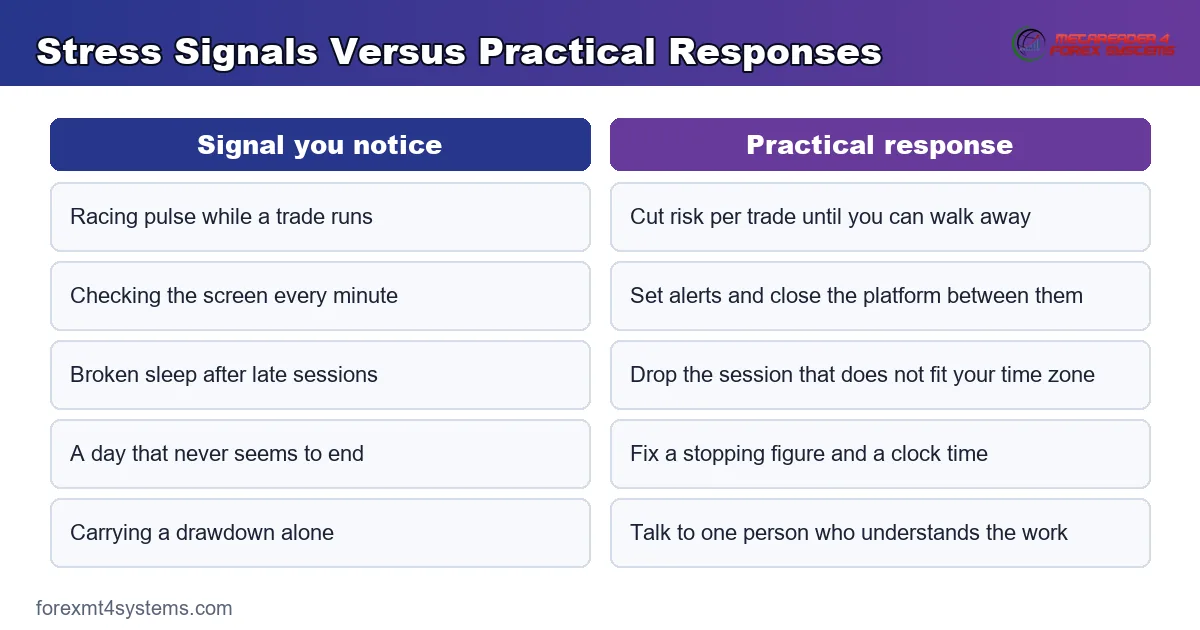
Traders usually treat the symptom and leave the cause running. The comparison panel below sets each signal beside the response that actually helps.
Treating Stress as a Mindset Problem Only
Breathing exercises help a stressed trader hold a sensible position. They will not rescue a position sized four times too large.
Check the mechanics first. Size, stops and session length explain most of the load before psychology enters the picture.
Adding More Analysis to Feel Safer
Extra indicators and extra timeframes promise certainty. They deliver more conflicting inputs, which raises the load rather than lowering it.
Cut the chart back to what your plan actually uses. A simpler screen produces faster decisions and less second-guessing.
Using Caffeine to Cover Fatigue
Stimulants mask tiredness without restoring judgement. You end the session wired, sleep badly, and start the next day further behind.
Treat fatigue as a stop signal rather than an obstacle. A missed session costs far less than a session traded on empty.
Trading to Fix a Bad Mood
The platform makes a poor mood regulator. Entering a position to feel better ties your emotional state directly to the next price tick.
Choose a different outlet on hard days. Our list of trading psychology tips covers habits that handle the mood without involving your account.
Keeping the Pressure Private
Isolation amplifies everything. Traders who never discuss a drawdown carry it alone, and the load compounds quietly over months.
Talk to one person who understands the work. A short conversation resets perspective faster than a weekend of chart review.
Measuring Only the Money
A profit column tells you nothing about sustainability. Log sleep, screen hours and rule breaks in our free trade journal so the trend shows up early.
Trading Stress Quick-Reference Checklist
Run this list every Friday. Seven answers tell you whether the coming week needs a change.
- Did I sleep at least seven hours on most nights this week?
- Could I leave every open position for an hour without checking?
- How many hours did I actually spend in front of charts?
- Did each session end at the limit I set, or when I ran out of energy?
- Did I take one full day away from markets?
- Did I score the week on rules followed as well as profit?
- Would I describe the week to a friend, or would I hide it?
Question two carries the most weight. A no there points straight at position size rather than at your character.
Pitfalls That Quietly Raise the Load
Strain builds through small habits rather than dramatic events. The equity panel below shows the shape of a long grind and the break that ends it.
Trading Across Too Many Sessions
Covering London, New York and Asia sounds thorough. It means no natural stopping point, so the day never really closes.
Watching Positions Through the Night
A swing position checked at three in the morning costs a night of sleep for no benefit. The stop does its job whether you watch or not.
Scaling Up Too Soon After a Good Run
Confidence rises faster than tolerance. Doubling the size after three green weeks reintroduces the strain you spent months removing.
Comparing Your Week With Social Media
Feeds show the best day of somebody’s month. Measuring an ordinary week against that stream manufactures pressure with no basis in your own plan.
Letting the Drawdown Define the Month
Every method spends time under water. Our guide to drawdown in trading shows why a normal dip feels like failure without a reference point.
Carrying an Unfinished Position Into the Evening
An open trade follows you to dinner. Because the outcome stays undecided, the mind keeps a background process running for hours.
Set the stop and the target, then decide in advance that you will not intervene. That decision, made once, buys back the whole evening.
Skipping the Log on the Worst Days
Traders record good sessions and skip painful ones. Because the painful days hold the useful information, the gap removes exactly the data you need.
When to Step Away and Ask for Help
Everything above assumes ordinary pressure inside a hobby or a job. Some situations sit well outside that range, and they deserve a direct answer.
The Signs That Change the Answer
Watch for sleep lost regularly to open positions. Watch for money moved from bills or savings into the account, and for results hidden from people close to you.
Watch for a mood that now tracks the equity curve day by day. Each of those points beyond a routine you can adjust yourself.
What to Do About It
Stop trading first and treat the pause as sensible rather than shameful. If trading affects your sleep, your finances or your relationships, stepping away and seeking qualified professional support remains the right move.
A doctor, a therapist or a specialist support service handles this properly. No article, journal template or position size rule substitutes for that conversation.
The market keeps running afterwards. An account can sit untouched for as long as you need, and nothing about the pause costs you an opportunity worth having.
Related Concepts to Study Next
Stress connects to nearly every other behaviour at the screen, so one neighbouring guide rounds out the picture. Read it alongside the audit above.
Our overview of emotions in trading maps the states that push hardest on a live decision. It explains what the load turns into once it reaches your entries.
Then hold your risk figure steady for a full month. Traders who stop renegotiating size mid-week report the clearest drop in strain, and the record gets easier to read as well.
FAQ
How do I manage trading stress during a live session?
Fix your risk, trade count and stopping figure before the open, place the stop with every order, then leave the screen between alerts. Break every ninety minutes and close the platform at the time you chose rather than when energy runs out.
Does position size really change how stressed I feel?
More than anything else on the list. A position you can leave alone for an hour produces a completely different body state from one you must watch. Use that test to set your ceiling.
How much screen time is too much?
Any time spent watching a position that already has a stop and a target adds strain without adding value. Set alerts at your levels, close the platform between them, and judge the change after two weeks.
Should I trade at all after a bad night of sleep?
Usually not, or only at a reduced size with a lower trade count. Sleep loss degrades risk judgement and patience first, which are exactly the faculties a live session needs.
Is it normal to feel this much pressure?
A degree of pressure comes with the work and sharpens attention. Persistent strain that reaches your sleep, your mood or your relationships sits outside that range and calls for a break and qualified support.
Does trading a demo account remove the pressure?
It removes the financial consequence, so the load disappears along with the useful practice. A better bridge involves trading live at a size small enough that the emotional signal stays real while the loss stays trivial.
How long does it take for a routine to help?
Most traders notice a change within two or three weeks, usually from the sleep and screen-time levers first. Give any single change a fortnight before judging it, since one bad week proves very little either way.
Will a routine remove trading stress completely?
No, and a small amount serves you well. A good routine lowers the load to a level you can carry for years, which matters far more than eliminating it. Results are not guaranteed; past performance is not indicative of future results.
External references
- For background on this concept, see Occupational Stress on Wikipedia.
- For broader market context, see Stress Testing at Investopedia.

About the author
Written by Dominic Walsh, a Forex trader and MT4/MT5 indicator, Expert Advisor and script developer. Every tool on forexmt4systems.com is tested on live charts before release and ships with ready-to-use compiled MT4 (.ex4) and MT5 (.ex5) files. Learn more about the trader and developer behind this site.
How we build, test and correct every tool: Editorial & Testing Policy. Trading carries risk; see the disclaimer.