
Most trading psychology tips fail the moment a session turns ugly. They ask you to feel calm exactly when calm has left the building.
So this guide takes a different route. Every one of these trading psychology tips converts a feeling into something you can write down, count or lock. Fifteen of them follow, grouped by when you use them.
What Good Trading Psychology Tips Should Do
A useful tip changes a decision, not a mood. It tells you what to do at a specific moment, and it leaves no room for interpretation.
Behavioural finance explains why that matters. Under stress, people fall back on habit rather than reasoning, so the rule has to exist before the pressure arrives.
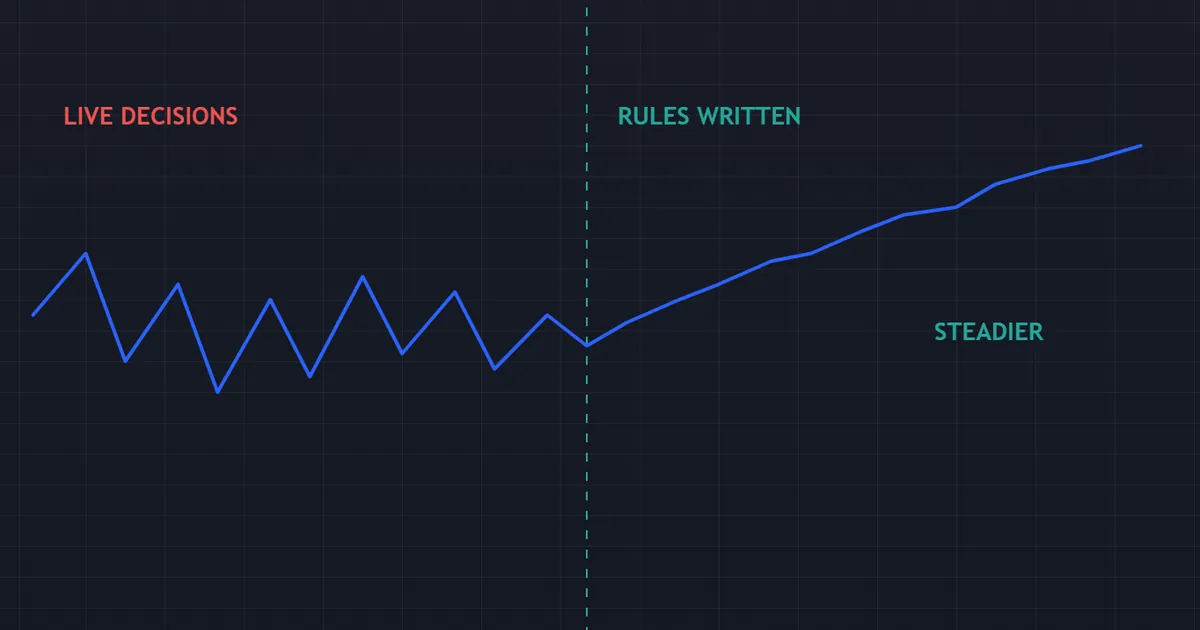
The panel above shows the difference in one picture. An equity curve wanders while decisions get made live, then steadies once written rules take the decisions instead.
Notice that the second stretch still contains losses. Rules do not remove losing trades, since they only remove the unplanned ones.
That distinction sets the standard for everything below. A tip earns its place by cutting unplanned decisions, never by promising better outcomes.
Rules Beat Resolutions
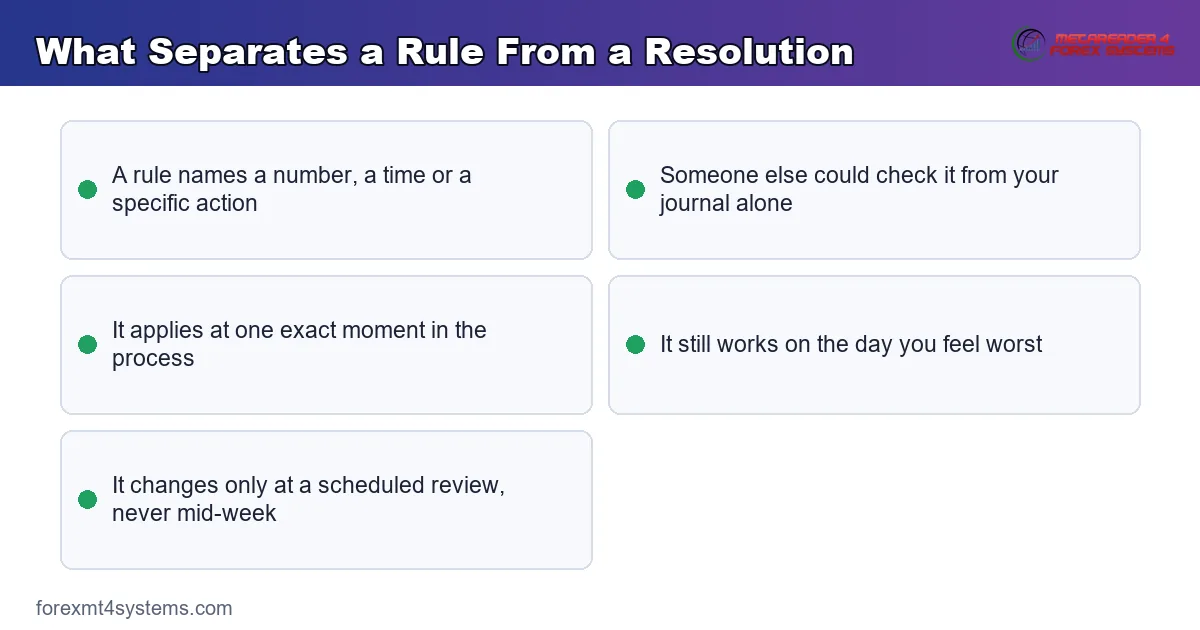
A resolution sounds like a promise to behave better. A rule names a number, a time or an action.
Compare the two forms. Stay disciplined means nothing at half past two on a red day, while stop after a two percent loss means something exact.
The Test for a Good Tip
Ask three questions of any advice you read. Could a stranger check whether you followed it? Does it apply at a specific moment? Does it work when you feel awful?
Three yes answers make it usable. Anything else belongs on a poster rather than in a plan.
How to Adopt Them
Take three tips, not fifteen. Write them on one card, and keep the card beside the screen.
Run them for a month before adding more. Because a habit needs repetition rather than enthusiasm, a short list you follow beats a long list you admire.
Pick the three that answer your own worst pattern. If losses trigger extra trades, start with the limit and the pause. If size drifts upward, start with the sizing rule instead.
The Biases These Rules Answer
Each rule on this page targets a documented pattern rather than a vague weakness. Naming the pattern makes the rule far easier to keep.
Six of them account for most trading errors. Read the list, and mark the ones you recognise from your own record.
- Loss aversion. A loss hurts more than an equal gain pleases, so traders hold losers and cut winners early.
- Sunk-cost thinking. Money already spent pulls people into further risk to justify the first decision.
- Confirmation bias. Once a view takes hold, contrary evidence gets filtered out quietly.
- Overconfidence. A good run reads as skill, so size and frequency creep upward.
- Recency bias. The last few candles feel more informative than the last few hundred.
- Herd behaviour. A crowded opinion feels safer than a lonely one, whatever the chart says.
Notice that none of these describe carelessness. Because each one runs below conscious argument, a written rule beats good intentions every time.
Tips for Before the Session
Most of the work happens before the first chart opens. Decisions made in a quiet room hold up far better than decisions made in a live market.
These four cost about ten minutes a day. They also prevent the majority of unplanned trades.
1. Write the Day’s Approved Setups
List the setups you will accept today, and name the markets you will watch. Anything outside that list waits until tomorrow.
The list acts as a filter when judgement wobbles. So the hard decision happens while you still feel calm.
2. Set the Daily Loss Limit in Numbers
Choose a figure before the week starts, then treat it as the end of the day. Two percent of the balance suits many plans.
Write the actual amount on the card, not the percentage. Because a specific figure removes the arithmetic, it also removes the argument.
3. Fix Position Size Before You Look at a Chart
Decide your risk per trade as a percentage, and lock it for the week. Size belongs to a calm review, never to a live session.
Our guide to position sizing covers how to pick that figure and how to defend it when a setup looks tempting.
4. Mark the Closed Windows
Check the economic calendar, then mark the minutes you will sit out. Major releases widen spreads and speed the tape up.
A closed window costs you nothing on a normal day. On a bad day it saves the sort of fill that ruins a month.
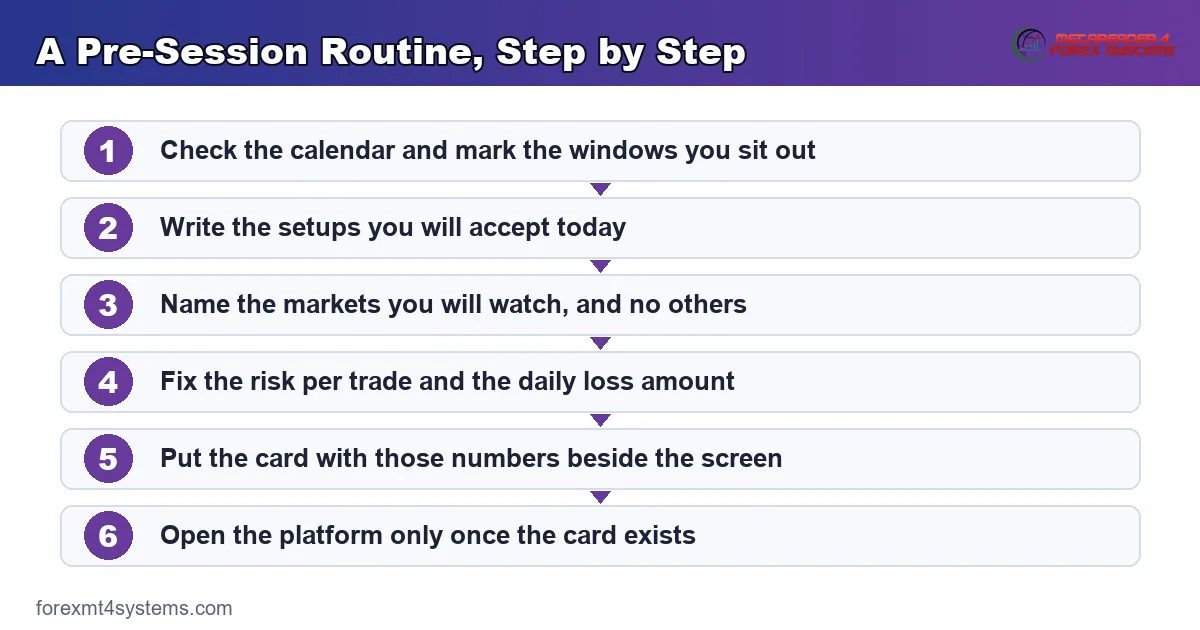
The flow graphic sets those four steps in order. Ten quiet minutes buy you most of the day’s discipline.
Tips for During the Session
Live trading offers very few good decision moments. These four rules protect the ones that matter.
Each of them runs in seconds. None asks you to feel any particular way.
5. Run a Five-Question Checklist
Before every click, answer five questions. Which setup does this match, where does the stop sit, what size does that imply, what invalidates the idea, and does the calendar allow it?
A slow answer means no trade. So the checklist filters impulse entries without any need for willpower.
6. Place the Stop Before the Entry
Set the stop as part of the order, never afterwards. A stop added later tends to sit where hope wants it.
Then leave it alone. Because a moved stop turns a planned loss into an unplanned one, that single rule prevents most large losses.
7. Take a Fixed Pause After Every Loss
Stand up for fifteen minutes when a stop gets hit. Leave the room, since watching the chart defeats the purpose.
Stress narrows attention for roughly half an hour after a loss. So the pause covers exactly the window where chasing starts.
8. Say the Reason Out Loud
Speak one sentence before you click: this is a pullback entry at the level I marked. Hearing yourself say it exposes a weak idea instantly.
Traders skip this because it feels silly. It works for the same reason a checklist works, by forcing the thought into words.
A Worked Example of Three Rules in a Week
Rules sound abstract until numbers arrive, so follow one ordinary week. The figures show the mechanics and predict nothing about your own results.
Picture a twenty thousand dollar account with a one percent rule. Each trade risks two hundred dollars, and the daily limit sits at two percent, or four hundred dollars.
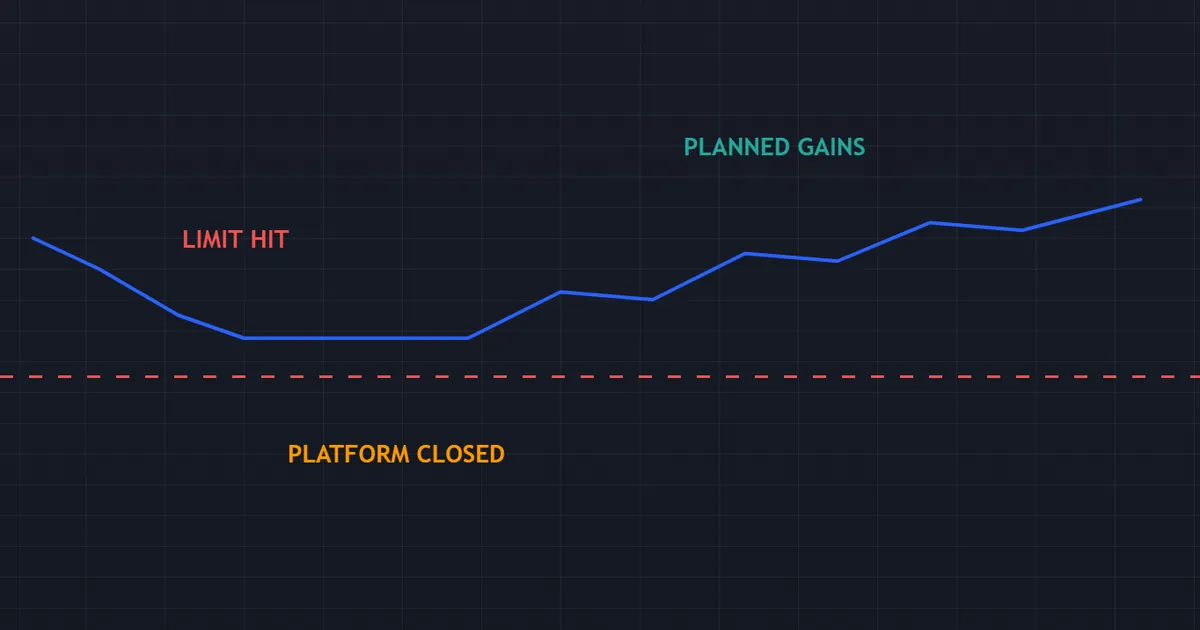
Monday brings two losses, so the day ends at the limit. The trader closes the platform with four hundred dollars gone.
Without that limit, the same Monday usually runs to three or four more trades. Two of those would carry raised size, which turns a two percent day into a six percent day.
The Rest of the Week
Tuesday and Wednesday produce one planned winner each, worth three hundred dollars apiece. Thursday brings a loss, and Friday a second winner.
The week closes two hundred dollars up. Nothing heroic happened, and no rule got broken.
What the Rules Actually Saved
Compare that outcome against the version with no limit. The account would have started Tuesday twelve hundred dollars down instead of four hundred.
Recovery then needs six percent rather than two. So the rule did not make money on Monday. It simply protected every day that followed.
What the Sums Leave Out
This example assumes clean fills and a working strategy. Neither one holds automatically.
Costs, slippage and a weak edge all sit outside the arithmetic. So treat the numbers as a floor for planning rather than as a forecast.
Tips for After the Session
The review decides whether anything improves. Traders who skip it repeat the same month for years.
These four take fifteen minutes a day and an hour a week. They also turn vague feelings into countable numbers.
9. Journal the Motive, Not Just the Result
Add one field to every entry: planned, impulse or recovery. Choose the word at the moment of the trade.
Total the tags each Friday. Our free trade journal keeps that field beside each position so the pattern surfaces quickly.
10. Grade the Decision, Not the Outcome
Mark each trade as followed the plan or broke the plan. Profit plays no part in that grade.
A profitable rule-break still counts as a break. Because luck rewards bad habits often enough to teach them, the grade protects you from your own good fortune.
11. Total Your Results by State of Mind
Score your state at entry: calm, rushed or angry. Then sum the results for each label at the end of the month.
Almost every trader finds one label carries the losses. So the number ends an argument that no amount of advice could.
12. Close the Platform When the Rules Are Met
Stop when the day’s plan finishes, whether that came from a limit, a target or a full trade count. Leaving the screen open invites one more idea.
Book the extra hour for something else entirely. Sleep and daylight do more for next week’s decisions than another chart will.
Traders resist this rule more than any other on the list. Watching a market you cannot trade builds nothing except the urge to trade it.
Tips for the Long Run
Three habits work on a scale of months rather than minutes. They matter most during the stretches that test you.
Each one reduces pressure before it builds. That beats managing pressure once it arrives.
13. Size Down After a Streak
Halve your risk after three consecutive losses, then restore it after two planned winners. The rule slows any spiral automatically.
It also protects the balance while confidence rebuilds. Our free risk of ruin calculator shows how much that adjustment changes your odds of surviving a bad run.
14. Review the Plan on a Schedule
Change your strategy only at fixed points, such as the first Sunday of a month. Mid-week edits nearly always answer a feeling rather than evidence.
Keep a written log of every change and its reason. So the plan evolves through evidence rather than through mood.
15. Keep One Rule Outside Trading
Set a hard finish time, protect your sleep, and get outside daily. None of that sounds like trading advice.
All of it shows up in your decisions. Tired traders widen stops, chase entries and skip reviews, so rest belongs in the plan.
How to Track Whether the Rules Work
A rule earns its place through evidence. Three numbers tell you whether these habits changed anything at all.
Pull them monthly, then compare across a quarter. Direction matters far more than any single reading.
Unplanned Trades as a Share
Count the entries tagged impulse or recovery, then divide by the total. That share should fall month after month.
Because the number ignores profit, it stays honest during a lucky stretch. So it measures behaviour rather than luck.
Your Worst Day Each Month
Track the largest single-day loss you took. A working limit shrinks that figure quickly, even in a month that ends red.
Compare the worst day against your written limit. So any breach shows up as a rule failure rather than a market event.
Results Split by State of Mind
Total each month by the label you recorded at entry. Calm, rushed and angry rarely produce similar numbers.
Watch the gap between the calm pile and the rest. Because that gap prices your behaviour directly, it makes the case for every rule listed here.
Download the complete indicator database
Put these concepts on your charts. One email unlocks the full library of 1,380+ indicators with compiled MT4 and MT5 files, plus my TradingView scripts. No paywall, no spam, unsubscribe any time.
Get free access to my indicator database
One email unlocks 1,380+ free MT4, MT5 and TradingView indicators — the complete library. No single-tool download; you get the whole database.
Common Mistakes When Applying These Tips
Good rules fail in predictable ways. The graphic below lists the checks that turn a rule into a habit.
Adopting All Fifteen at Once
A long list feels productive and collapses within a week. Take three, run them for a month, then add more. Slow adoption beats an ambitious restart every January.
Writing Rules That Cannot Be Checked
Trade with discipline fails the test, since nobody could verify it. Rewrite each rule until a stranger reading your journal could mark it done or missed.
Dropping a Rule After a Good Week
Success tempts traders to loosen the very constraints that produced it. Keep the rules fixed through good stretches, and review them only on schedule.
Judging a Rule by One Trade
A limit that stops you before a rally feels expensive. Judge each rule across a quarter of trades instead, where the arithmetic settles the question.
Relying on Memory Instead of a Barrier
Promises made after a loss rarely survive the next one. Log out, lock the platform, or set a broker-side limit where that option exists.
Skipping the Weekly Review
Rules without a review become decoration. Book a fixed hour each week, and treat it as the most important appointment in the plan.
Quick Reference Checklist
Keep the whole set on one page. Read it before the session, and again at the weekend.
Fifteen lines cover the entire method. None of them asks you to feel a particular way, which is exactly why they survive a genuinely bad afternoon.
- Write the day’s approved setups, and trade nothing outside the list.
- Set the daily loss limit as an amount, then honour it.
- Fix your risk per trade before the session opens.
- Mark the calendar windows you will sit out.
- Run a five-question checklist before every entry.
- Place the stop with the order, and leave it alone.
- Pause fifteen minutes after every loss, away from the desk.
- Say the reason for the trade out loud.
- Journal the motive beside the result.
- Grade the decision rather than the outcome.
- Total your results by state of mind each month.
- Close the platform once the day’s rules are met.
- Halve size after three losses, and restore it slowly.
- Change the plan only at scheduled review points.
- Protect sleep, daylight and a hard finish time.
Pitfalls and Edge Cases
A few wrinkles bend the clean picture, so keep them in view. The panel below shows what happens when one rule quietly lapses.
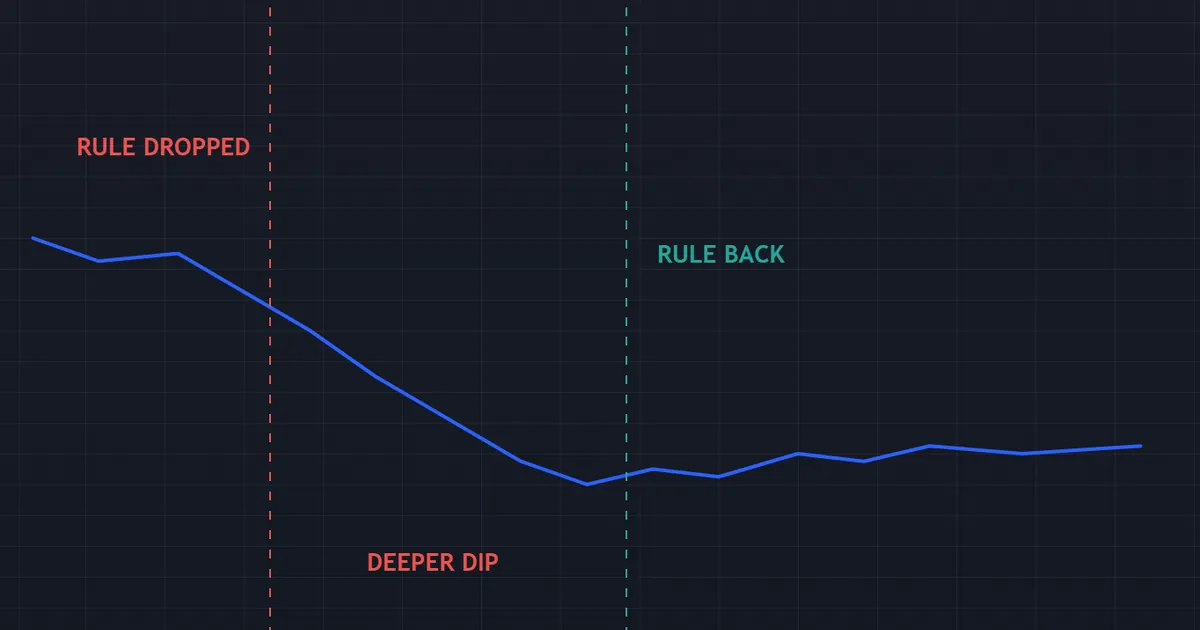
Rules Can Hide a Weak Strategy
Perfect discipline applied to a poor edge still loses money, only more slowly. So review the strategy separately from the behaviour, and judge each on its own evidence.
Too Many Rules Cause Paralysis
A checklist of twenty items stops trades that the plan wanted. Keep the live checklist to five questions, and move everything else into the pre-session routine.
Prop Accounts Change the Weighting
On an evaluation account, a single limit breach ends the attempt outright. So the loss limit and the sizing rule outrank every other item on the list while the evaluation runs.
Copying Someone Else’s Numbers
A two percent limit suits many traders and suffocates others. Set the figures from your own strategy and account, then review them quarterly rather than weekly.
Rules Slip Quietly Rather Than Loudly
Almost nobody abandons a rule outright. The pause shortens, the checklist loses a question, and the limit becomes a suggestion. So audit the card itself each month, and rewrite anything that has drifted.
Confusing a Bad Month With a Broken Plan
Variance produces losing months inside a sound approach. Our guide to risk management mistakes covers how to tell the two apart before you tear anything up.
When Psychology Is Not the Real Problem
Some situations run past technique, and pretending otherwise helps nobody. If trading disturbs your sleep, strains your finances or damages your relationships, no checklist will settle it.
Step away from the market, and speak to a qualified professional. Compulsive trading shares features with problem gambling, and proper support services exist for exactly that. Nothing written here replaces that kind of help.
Related Concepts to Study Next
These rules work better once you understand the forces they answer. Each of the following topics explains one of them.
Start with trading psychology as a whole, then read about loss aversion in trading, the asymmetry that makes losses feel heavier than gains. For the analysis side, see confirmation bias in trading, and for the danger that follows a good run, see overconfidence in trading. To see how deep a normal losing run can go, run the numbers through our drawdown calculator.
FAQ
Which trading psychology tips matter most for a beginner?
Three of them carry most of the value. Set a daily loss limit as an amount, place the stop with the order, and pause for fifteen minutes after every loss. Those three cover the moments where new traders lose the most money.
How long before a new rule feels normal?
Most traders report that a rule stops feeling like a restriction after three or four weeks of daily use. The trick lies in repetition rather than motivation, so keep the list short enough to follow every single day.
Do these rules work for swing traders?
Yes, though the timings stretch. A swing trader’s pause after a loss usually runs to the rest of the day, and the review happens weekly rather than daily. The structure stays identical.
Can a journal really change behaviour?
A journal turns a vague feeling into a number you can argue with. Once you see that most of last month’s losses carried the label rushed, the case makes itself. Progress then shows up as fewer unplanned entries.
What if I follow every rule and still lose?
Then the problem sits in the strategy rather than the behaviour, which is useful news. Review the edge separately, using a sample of planned trades only. Clean data makes that judgement possible.
Is a demo account a fair place to practise the rules?
Partly. A demo builds the routine, the checklist and the journal habit at no cost. It cannot reproduce the feeling of real money moving, so expect the pause rule and the loss limit to feel much harder once you switch across.
Should I trade smaller while building these habits?
Yes, and most traders find it the single easiest change to make. Smaller size lowers the emotional weight of each trade, which makes every other rule easier to hold. Nothing about the approach removes risk from the market. Results are not guaranteed; past performance is not indicative of future results.
External references
- For background on this concept, see Behavioral Finance at Corporate Finance Institute.
- For broader market context, see Yerkes-Dodson Law on Wikipedia.

About the author
Written by Dominic Walsh, a Forex trader and MT4/MT5 indicator, Expert Advisor and script developer. Every tool on forexmt4systems.com is tested on live charts before release and ships with ready-to-use compiled MT4 (.ex4) and MT5 (.ex5) files. Learn more about the trader and developer behind this site.
How we build, test and correct every tool: Editorial & Testing Policy. Trading carries risk; see the disclaimer.