
Confirmation bias in trading means hunting for evidence that backs the view you already hold. Charts make that easy, because they always offer something that agrees.
The habit feels like careful research from the inside. This guide covers the studies behind the effect, the exact chart behaviour it produces, and a pre-trade check that tests the other side before you click.
What Confirmation Bias in Trading Means
Confirmation bias describes a tilt in how people gather and read evidence. We favour what fits our current belief and skip what does not.
So the bias works before you notice it. By the time you feel confident, the filtering already happened.
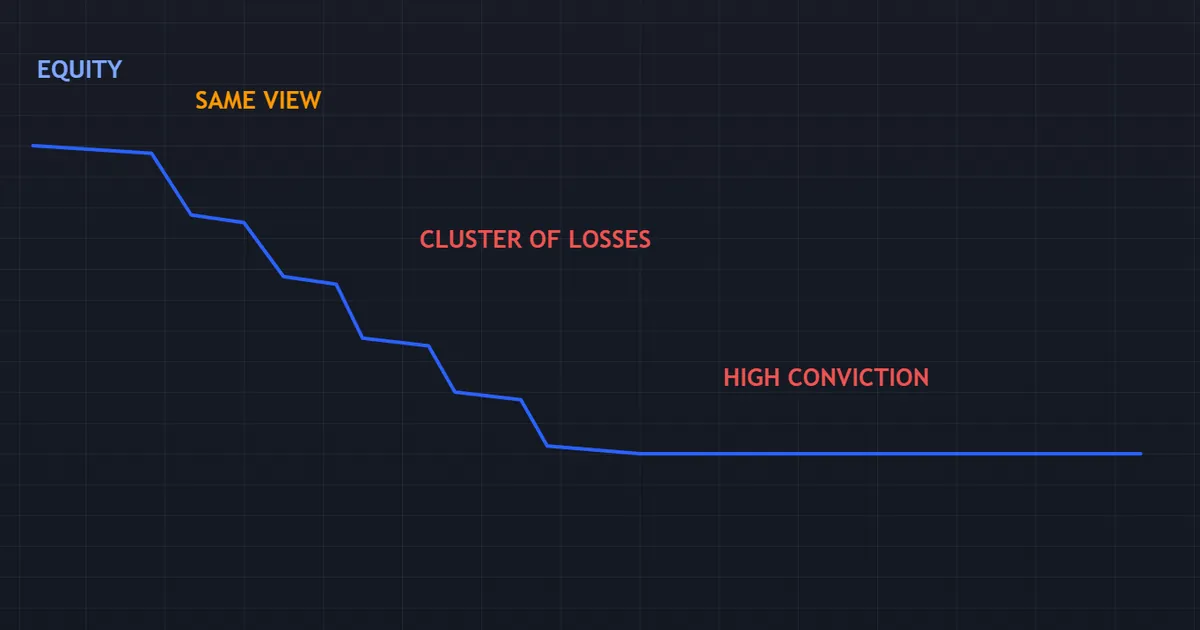
The equity curve above shows the footprint. A run of trades in one direction, each one taken with high conviction, all sharing the same flawed read.
Notice that the losses arrive in a cluster. One bad idea, repeated with confidence, does more damage than five unrelated mistakes.
Where the Term Came From
Peter Wason coined the phrase in the 1960s. His experiments looked at how people test rules.
He found that subjects tried to confirm a rule rather than break it. So the search itself carried a tilt, long before anyone weighed the evidence. That finding holds up across decades of later work.
The Card Test That Shows It
Wason gave people four cards and a simple rule to check. Most picked the cards that could confirm the rule.
Very few picked the card that could disprove it. So the error sat in the choice of evidence, not in the logic applied afterwards. Traders repeat that exact pattern every time they look for reasons to stay long.
Three Ways the Bias Operates
It shapes what you search for first. It shapes how you read anything ambiguous.
Then it shapes what you remember later. So the same chart can support two opposite stories, and each trader recalls the parts that suited them. Because all three steps feel normal, the bias hides in plain sight.
Being Biased and Being Wrong Differ
A biased trader can call the direction correctly. The bias sits in the method, not in the answer.
So a winning trade proves nothing about the process behind it. Because outcomes and process come apart over small samples, judging your research by your results keeps the habit alive.
Why It Feels Like Research
Biased research still involves real work. You open charts, read reports and check levels.
So the effort convinces you of the conclusion. Because time spent feels like evidence gathered, an hour of one-sided study builds more confidence than five minutes of balanced study. That is exactly backwards.
How the Bias Builds a Trade
The sequence runs the same way for almost everyone. Five steps take you from a hunch to a large position.
Read them in order, then compare against your last strong conviction trade.
- A first impression forms. A glance at the chart suggests a direction before any analysis begins.
- The search starts one-sided. You look for reasons that support the direction you already picked.
- Agreeing evidence gets weight. Two supportive signals feel solid, while one contrary signal feels like noise.
- Confidence rises with effort. The time you spent reading becomes proof that the idea is sound.
- Size follows confidence. A stronger feeling produces a bigger trade and a looser stop.
Notice that no step involves a lie. Every action looks reasonable on its own, which is what makes the chain so hard to break.
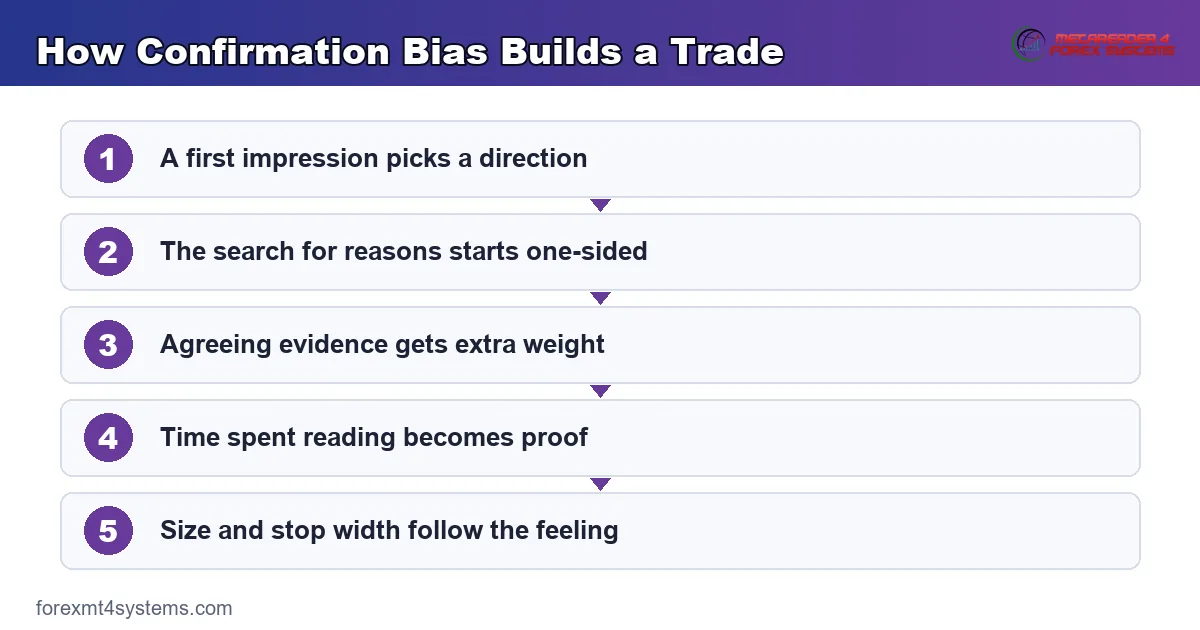
The flow above traces those five steps in one panel. Pin it near the screen, because spotting step two is far easier than undoing step five.
The Order Matters More Than the Effort
Forming the view first is the whole problem. Everything after that inherits the tilt.
So change the order rather than working harder. Write the case for both directions before you decide, and the same effort produces a very different answer.
More Screens Make It Worse
Extra indicators feel like extra rigour. They mostly supply more raw material for the filter.
So a busy chart tends to raise confidence without raising accuracy. Because you can always find one tool that agrees, tool count and certainty rise together while the edge stays flat.
Confidence Does Not Count as Evidence
Step four does the quiet damage. Effort turns into certainty, and certainty then sets the size.
So separate the two on paper. Note your confidence, then note the evidence behind it, and check whether the second column justifies the first. Because the gap shows up instantly, this single habit catches most oversized trades.
Why Markets Feed the Bias So Well
Some settings resist the bias. Markets do the opposite at almost every turn.
Four features of trading make the tilt stronger than it would be elsewhere. Knowing them helps you see where to place the guard rails.
Charts Contain Every Story
A price chart holds thousands of bars and dozens of readings. Some part of it supports any view you bring.
So the supply of agreeing evidence never runs dry. Because a shortage of evidence usually stops a biased search, and no shortage exists here, the search simply keeps going until it succeeds.
Ambiguity Acts as Fuel
Clear facts leave little room to interpret. Market signals rarely qualify as clear.
So a candle, a level or a headline reads differently depending on your position. Because ambiguity gives the bias somewhere to work, the messiest evidence produces the most confident opinions.
Feedback Arrives Late and Noisy
A biased read can still win. A careful read can still lose.
So the market never tells you plainly whether your process worked. Because outcome and process blur together over small samples, traders keep bad habits that happened to pay off recently.
The Cost Compounds Across Trades
A single biased read costs one planned loss. A biased view held for a month costs several.
So the damage scales with how long you hold the belief, not with how wrong it was. Because clusters do more harm than scattered errors, catching the view early matters more than judging any one trade.
Where It Shows Up on the Chart
Theory only helps if you can catch the behaviour live. Four habits give it away.
Each one leaves a mark you can audit afterwards.
Picking the Timeframe That Agrees
You check one view and it disagrees. So you check another, and another, until one supports the trade.
That search always ends in a yes. Because some timeframe always agrees with you, deciding the timeframe before the direction removes the loophole entirely.
Adding Tools Until One Agrees
An oscillator says no, so a second indicator goes on the chart. The third one finally says yes.
So the extra tools served the conclusion rather than testing it. Because each addition felt like diligence, the trader ends up more certain and less informed than when they started.
Reading News to Fit the Position
Headlines rarely point one way cleanly. A held position decides which half you notice.
So a mixed report reads as bullish to a long and bearish to a short. Because the same words support both, news adds confidence far more often than it adds information.
Ignoring the Level That Breaks the Idea
Every trade idea has a level where it stops making sense. That level rarely gets written down.
So price passes it and the story adapts instead. Because a stop placed at that level forces the issue, our guide on how to use a stop loss matters more here than any indicator setting.
Hunting for a Reason to Stay In
The bias does its worst work after entry. A trade moves against you and the search starts again.
So you find a longer-term reason, a fresh level or a supportive headline. Because none of that existed in your original plan, it amounts to writing a new trade around an old position.
Anchoring to the First Level You Saw
The first support line you drew tends to stick. Later evidence gets measured against it.
So a level chosen in ten seconds quietly outranks an hour of study. Because you can test this easily, redraw your levels on a clean chart and see whether the same ones appear.
A Worked Example of the Filter
One comparison makes the cost clear. Two traders look at the same chart on the same morning.
Both start with the same hunch. Only their process differs after that.
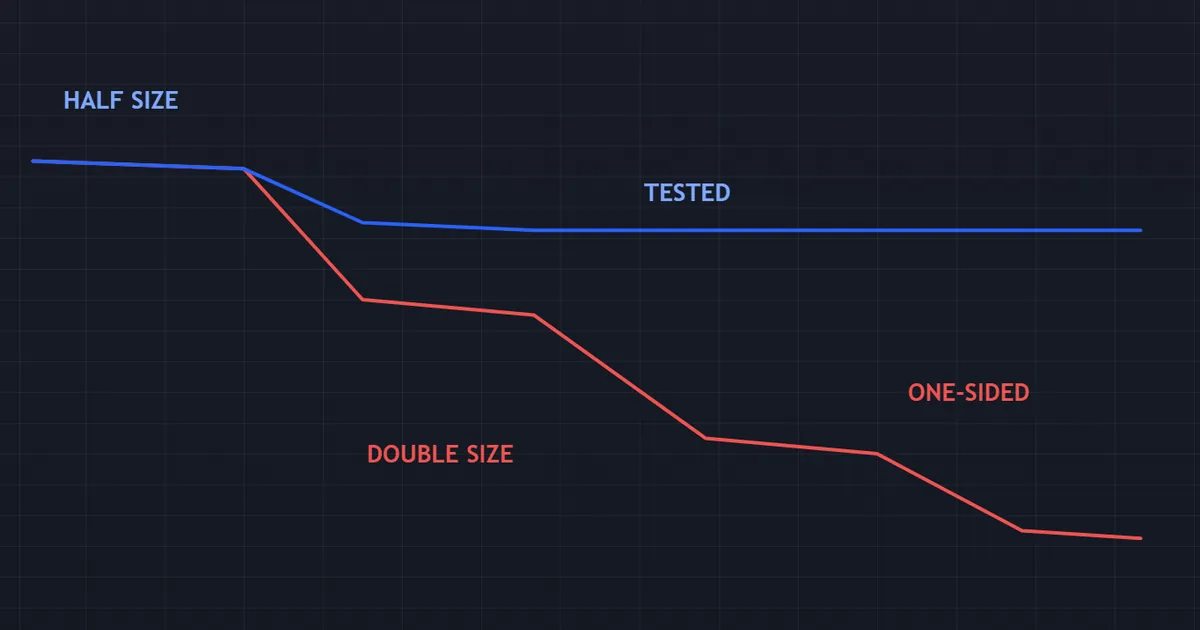
The first trader lists reasons to buy and finds four. Confidence rises, size doubles, and the stop sits wider than usual.
The second writes the case against the trade first. Two solid objections appear, so the trade goes on at half size with a tight stop at the level that would break the idea.
What Actually Changed
The chart never changed. The entry price stayed the same for both traders.
Only the order of the questions moved, and the risk taken moved with it. So when the idea failed, one trader lost a planned amount while the other lost several times that. Because both saw the same setup, the gap came purely from process.
Score the Idea Before You Size It
Try a simple rule. Count the solid objections you can list, then cut size for each one.
Zero objections usually means you stopped looking. Because a genuinely one-sided setup is rare, an empty objection list should lower your confidence rather than raise it.
Download the complete indicator database
Put these concepts on your charts. One email unlocks the full library of 1,380+ indicators with compiled MT4 and MT5 files, plus my TradingView scripts. No paywall, no spam, unsubscribe any time.
Get free access to my indicator database
One email unlocks 1,380+ free MT4, MT5 and TradingView indicators — the complete library. No single-tool download; you get the whole database.
Common Mistakes and the Fixes That Work
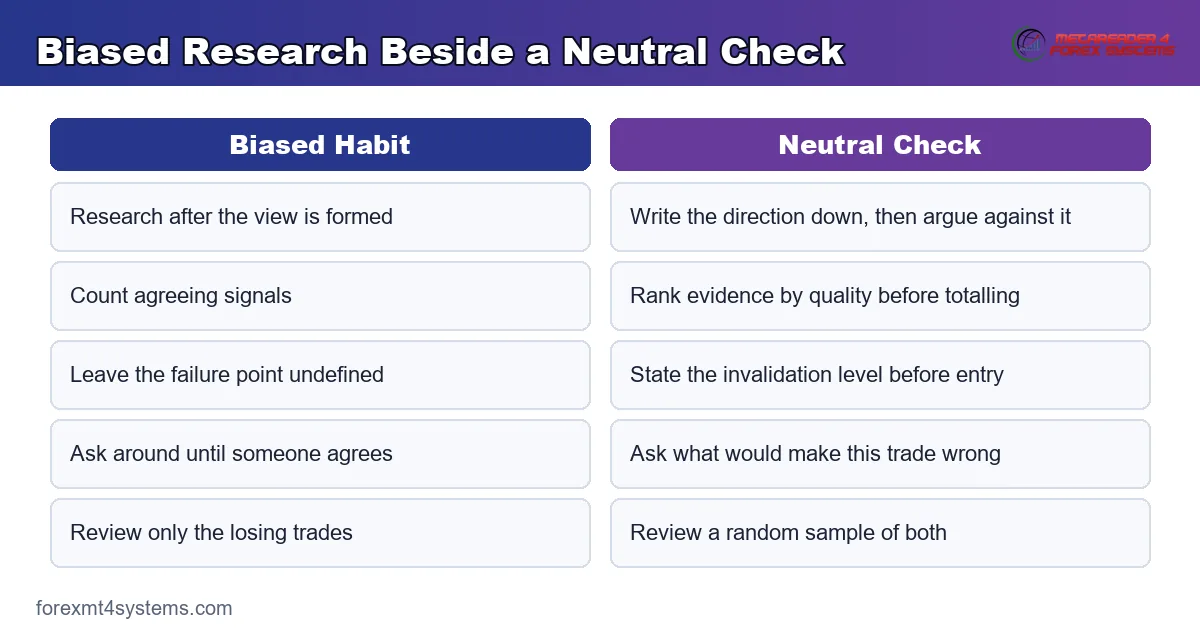
Five habits carry most of the damage. Each one has a mechanical fix.
Researching After You Decide
Most traders form a view in seconds, then research for an hour. That order produces a case, not a test.
Write the direction down before you look for reasons. Then spend the first half of your research arguing the other side, and let the balance settle the trade.
Counting Signals Instead of Weighing Them
Four weak agreements feel stronger than one solid objection. They rarely are.
Rank your evidence by quality before you total it. Because one broken structural level outweighs three indicator readings, a weighted view beats a headcount every time.
Skipping the Written Invalidation Level
An idea with no failure point can never fail. It simply keeps adapting.
State the level that ends the idea before you enter. Then place the stop there, so the market answers the question instead of you.
Seeking Agreement From Other People
Posting your idea for feedback sounds balanced. In practice, most traders keep asking until someone agrees.
Ask a specific question instead: what would make this trade wrong? Because that phrasing invites objections, it produces useful answers rather than comfort.
Reviewing Only the Trades That Lost
Winning trades hide the same flawed process. A biased read can still get lucky.
Review a random sample of both, using a trade journal that records your reason for entry. Because the reason matters more than the result, that field does the real work.
Building a Neutral Research Routine
Single fixes fade after a fortnight. A routine survives, because it asks nothing of your mood.
Three rules turn the fixes above into something repeatable. Set them once and follow them daily.
Fix the Tool Set Before the Session
Decide which timeframe and which tools you use, then leave both alone. Any addition made mid-analysis serves the view you already hold.
So the tool list belongs in your plan rather than on the chart. Because a fixed set removes the shopping step, it closes the easiest route the bias has.
Write Both Cases Every Time
Two short lists cover it: reasons for, reasons against. Fill the second list first.
So the search starts on the side you naturally skip. Because the effort matches on both sides, the comparison at the end carries real weight for once.
Let the Objection Count Set the Size
Turn the against list into a number. More solid objections mean a smaller position.
So conviction stops driving size directly. Because the rule runs on a count rather than a feeling, it holds up on the days when your judgement does not.
A Pre-Trade Check That Tests the Other Side
Run this before you place the order. It takes about ninety seconds.
| Question | Why it works |
|---|---|
| What would make this trade wrong? | Forces a search for contrary evidence |
| Which timeframe did I pick first, and why? | Catches timeframe shopping |
| Did I add any tool after forming the view? | Exposes evidence added to agree |
| Where exactly does the idea fail? | Produces a real invalidation level |
| Would I take the opposite trade at this price? | Tests whether the setup is genuinely one-sided |
| How many solid objections can I list? | Sets the size before conviction does |
Answer all six in writing. Because written answers resist quiet editing, the file becomes evidence you can review later.
Keep the sheets for a month, then read them back. So a pattern emerges that no single session would reveal, and the questions you always answer thinly point straight at your weakest step.
Pitfalls and What Still Goes Wrong
Some problems survive a good process, so keep them in sight. The panel below shows the version that hurts most.
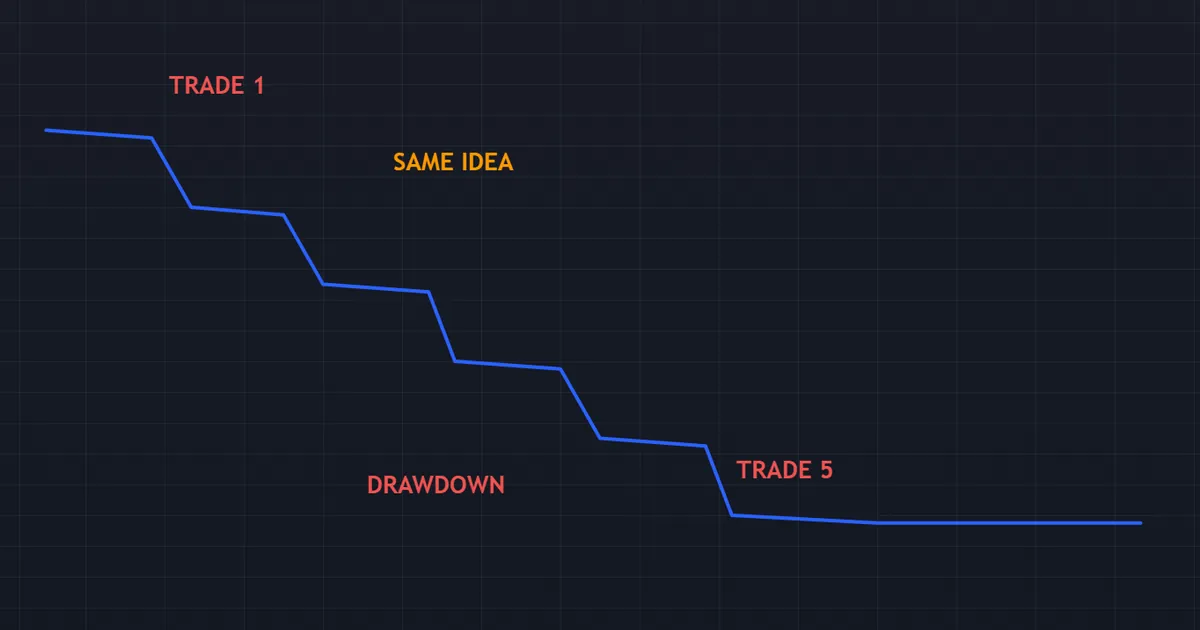
One view, held across five trades, produces a cluster of losses in the same direction. Each entry looked independent at the time.
Backtesting With the Same Filter
Historical review invites the same tilt. You scroll until you find charts where the idea worked.
So a hand-picked sample proves nothing at all. Because a rule-based test removes the choosing, define the rules first and let the expectancy calculator read the whole sample rather than your favourites.
Overcorrecting Into Paralysis
Traders who learn about the bias sometimes stop trusting anything. Every setup then acquires an objection.
So the fix becomes a new problem. Because a workable process needs a stopping rule, cap your research time and accept that some doubt always remains. Our guide to analysis paralysis covers that trap.
Confidence and Accuracy Move Apart
More evidence raises certainty faster than it raises accuracy. That gap widens the longer you study one idea.
So treat strong conviction as a warning rather than a green light. Because size usually follows feeling, our note on overconfidence in trading picks up exactly where this leaves off.
Group Settings Amplify Everything
A chat room full of the same view feels like independent agreement. It rarely is.
So weight a hundred agreeing posts as roughly one opinion. Because members read the same sources and copy each other, the crowd size tells you nothing about the evidence behind it.
A Setup That Only Works in One Regime
Some ideas hold up in trends and fall apart in ranges. The bias hides that boundary neatly.
So a trader keeps taking the setup while conditions quietly change. Because the losing period looks like ordinary variance, the regime shift usually gets spotted months late. Record the market condition beside each trade, and the boundary shows up on its own.
The Bias Survives Knowing About It
Reading this article changes very little on its own. Wason’s subjects understood logic perfectly well.
So build the check into the routine instead. Because a written pre-trade question runs whether or not you feel biased that day, structure beats awareness in every practical test.
Related Concepts to Study Next
This bias sits alongside several others, and they reinforce each other. Fix the research order, and a few of the neighbours weaken at the same time.
Start with our overview of cognitive biases in trading for the full map, then read our introduction to what trading psychology covers. For the risk side, our list of common risk management mistakes shows where a biased read usually lands.
Work through those in order over a week. Because each one attacks a different stage of the same chain, reading them together builds a routine rather than a collection of tips.
The Short Version
Confirmation bias works on the search, not on the sums. So the fix belongs at the start of your process rather than at the end.
Write the direction down, argue the other side first, keep the tool set fixed, and set the invalidation level before you enter. Then let the objection count decide your size. Because all five steps run on paper, none of them asks you to feel differently on a hard day.
FAQ
What is confirmation bias in simple terms?
It means looking for evidence that supports what you already believe, and skipping evidence that does not. Peter Wason described the effect in the 1960s. His card experiments showed that people try to confirm a rule rather than break it.
How do I know if it is affecting my trading?
Look for clusters of losses in the same direction, timeframe shopping, and indicators added after you formed a view. A journal that records your reason for entry exposes all three. Review a random sample of winners as well as losers.
Does adding more indicators help?
Usually the opposite. Extra tools give the filter more material, so confidence rises while accuracy stays flat. Decide which tools you use before you look at the chart, then leave the set alone.
What single change helps the most?
Write the case against your trade before the case for it. That one reversal in order does more than any indicator setting, because it attacks the search step where the bias actually operates.
Does a winning trade mean my research was sound?
Not on its own. A one-sided read can still land on the right direction, especially over a handful of trades. Grade the process by whether you tested the other side, and grade the method on a large sample instead.
Is confirmation bias the same as overconfidence?
They travel together and differ in mechanism. Confirmation bias shapes which evidence you gather, while overconfidence inflates how much you trust your judgement. One tends to feed the other, which is why size creeps up after a long research session.
Why does the bias get worse after entry?
Because an open position gives you a stake in one answer. The search for supporting evidence restarts, and it now has money behind it. Writing the invalidation level before entry removes most of that pressure, since the market decides rather than your reading.
Can I remove the bias completely?
No, and knowing about it will not switch it off. Structure handles it better than awareness: a written pre-trade check, a fixed tool set, and an invalidation level agreed before entry. Those steps reduce a known leak rather than settling any outcome. Results are not guaranteed; past performance is not indicative of future results.
External references
- For background on this concept, see Confirmation Bias on Wikipedia.
- For broader market context, see Confirmation Bias at Investopedia.

About the author
Written by Dominic Walsh, a Forex trader and MT4/MT5 indicator, Expert Advisor and script developer. Every tool on forexmt4systems.com is tested on live charts before release and ships with ready-to-use compiled MT4 (.ex4) and MT5 (.ex5) files. Learn more about the trader and developer behind this site.
How we build, test and correct every tool: Editorial & Testing Policy. Trading carries risk; see the disclaimer.