
Cognitive biases in trading are the quiet reason a sound plan still loses money. They act on everyone, and they rarely feel like errors while they happen.
This guide walks through ten cognitive biases in trading, one at a time. For each one you get the documented effect, the trade it produces, and the counter-measure that blunts it.
Where These Shortcuts Come From
A bias is not a character flaw. It works as a shortcut your brain uses to decide quickly with too little information.
Markets hand you incomplete information all day. So the shortcuts fire constantly, and most of them stay invisible.
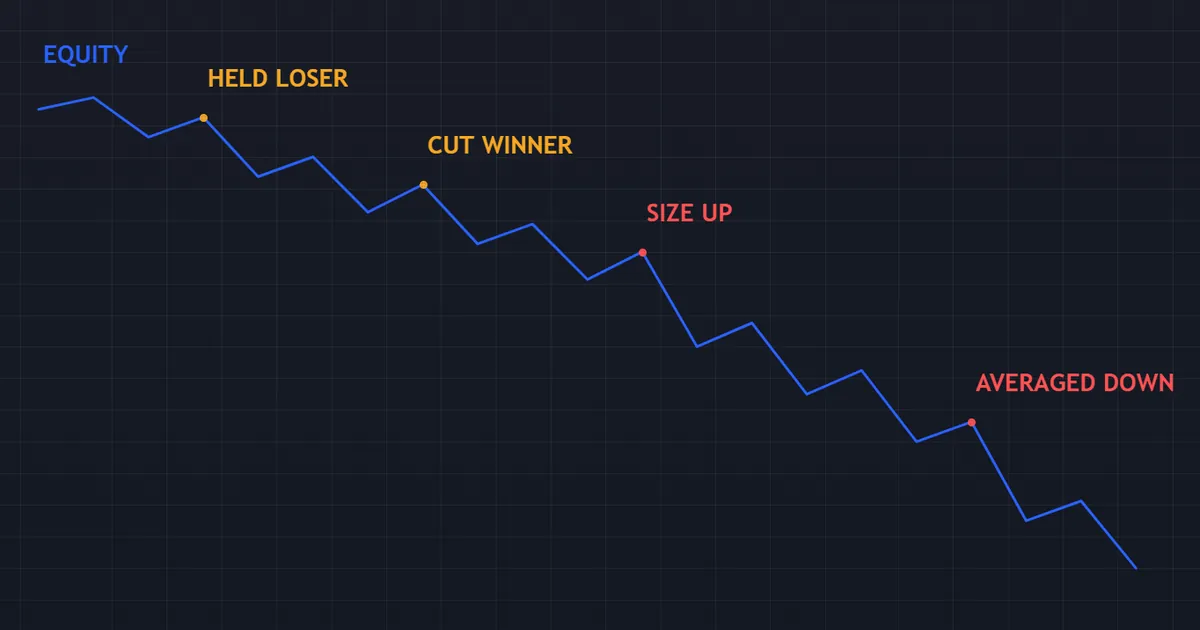
The equity curve above marks four moments where a shortcut replaced the plan. Each marker looks small on its own.
Together they explain most of the slope. Because none of them felt like a mistake at the time, the trader never wrote them down.
Speed Beats Accuracy
Your brain trades accuracy for speed by design. That bargain works well when a car swerves toward you.
It works badly when a candle closes against your idea. So the same reflex that keeps you safe on a road costs you money on a chart.
The Market Feeds Every Bias
Price moves randomly enough to reward almost any story. So whatever you believe, the tape will agree with you somewhere.
That feedback makes a bias sticky. Because a lucky outcome feels like proof, a poor habit can survive for months.
Leverage Multiplies the Damage
A biased decision in a cash account costs you a small slice of capital. The same decision on a leveraged account costs a multiple of it.
So margin turns a thinking error into an account event. Because forex runs on leverage by default, these errors matter more here than in most markets.
Bias Feels Like Judgement
Nobody experiences a bias from the inside. Instead you experience a reason, and the reason sounds sensible.
So you cannot beat these errors by trying harder in the moment. You beat them with rules you write while calm, and with a record you check later.
How a Bias Turns Into a Losing Trade
The path from thought to loss follows the same five steps almost every time. Learn the chain, and you can break it anywhere along the line.
- The chart offers a mixed picture, and you need a decision now.
- Your mind reaches for the reading that feels most comfortable.
- A rule bends quietly to fit that reading.
- Risk grows without anybody choosing to grow it.
- The loss lands larger than the plan allowed.
Every step happens inside a few seconds. So the whole chain can run before you notice any of it.
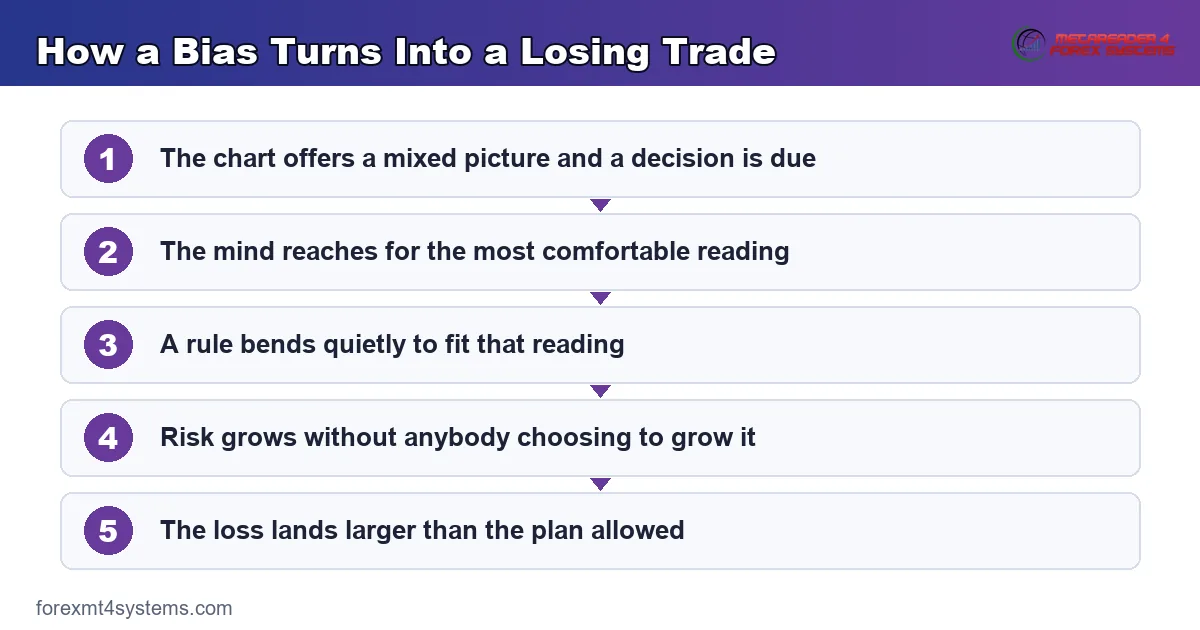
The flow diagram above puts those steps in one panel. Notice that step three, rather than step one, marks where money starts leaking.
Because the rule bends silently, nothing alerts you. So the only reliable catch point sits in a written plan you prepared earlier.
Cognitive Biases in Trading, One at a Time
Ten biases cover almost everything traders do to themselves. They overlap, and several often fire inside a single trade.
Read the list once for recognition. Then use the checklist further down as your working tool.
Confirmation Bias
Confirmation bias describes the habit of seeking evidence that supports what you already believe. Researchers have documented it across medicine, law and investing.
At the platform it looks like adding indicators until one of them agrees. It also looks like reading only the analysts who share your view.
So the counter-measure runs backwards. Write the level that would prove you wrong, and write it before you enter. Our guide to confirmation bias in trading takes that idea further.
One habit exposes it fast. Before each entry, state the strongest argument against your own trade in a single line.
Overconfidence
The overconfidence effect describes confidence that outruns real accuracy. It grows fastest right after a good run.
In trading it shows up as bigger size, skipped checks and a shorter review. Traders also mistake a calm market for personal skill.
So cap risk per trade in the plan rather than in the moment. Read our note on overconfidence in trading before your next winning streak ends.
Watch the size field rather than your mood. If the lot size drifts upward without a written reason, the bias already reached the ticket.
Loss Aversion
Loss aversion comes from prospect theory. A loss hurts roughly twice as much as an equal gain pleases, and Kahneman and Tversky measured that gap in the nineteen seventies.
The trading version moves a stop to avoid feeling the loss. Nothing about the chart changed, yet the risk on the trade doubled.
So place the stop with the broker at entry. Our guides on loss aversion in trading and how to use a stop loss cover the mechanics.
A hard stop removes the argument at the worst possible moment. So the decision happens once, while you still think clearly.
The Disposition Effect
The disposition effect describes a strong tendency to sell winners early and hold losers long. Researchers found the same pattern across brokerage records in several markets.
It shrinks your average gain and stretches your average loss. Two habits therefore attack the same number from both sides.
So decide the exit before entry, and let the plan close the trade rather than the feeling. A fixed target and a fixed stop remove the argument entirely.
Your log exposes this one clearly. Compare average gain with average loss, and the imbalance shows up within thirty trades.
Recency Bias
Recency bias gives the newest events more weight than they deserve. One dramatic session can rewrite your whole view of a market.
After three losses in a row, traders shrink size at exactly the wrong moment. After three wins they double it.
So score setups against a fixed checklist. Judge the method over a hundred trades rather than five, since a short run tells you almost nothing.
Recency also distorts your view of the market itself. Two quiet weeks convince traders that volatility has gone, right before it returns.
Anchoring
Anchoring means fixing on a number and judging everything against it. The anchor frequently has no relevance to the decision at hand.
Your entry price works as the classic anchor. A round number, yesterday’s high or an analyst target can do the same job.
So ask what the chart says now. Because the market never saw your entry, the only useful question concerns the current picture.
Targets suffer from the same pull. Traders anchor to a round number and hold a winner far past the level their plan named.
The Sunk Cost Fallacy
Sunk cost reasoning keeps you committed because of what you already spent. Economists treat that money as gone and irrelevant to the next choice.
Traders add to a loser to justify the first entry. The same logic keeps a broken strategy alive after months of study.
So treat every position as a fresh decision. Allow one position per idea, and stop averaging down for good.
The fee for a course or a challenge works the same way. Money already spent belongs to the past, so it cannot justify a worse decision today.
The Gambler’s Fallacy
The gambler’s fallacy expects a run to correct itself. Four losses do not make the fifth trade any more likely to work.
It drives size increases after a losing streak, which turns a normal drawdown into a serious one. The coin has no memory, and neither does the market.
So keep risk flat through the streak. Our expectancy calculator shows what your sample actually says about your method.
The mirror image also appears. Traders skip a valid setup after several wins, because a loss now feels overdue.
Hindsight Bias
Hindsight bias makes past events look far more predictable than they felt. Psychologists call it the knew-it-all-along effect.
It ruins your review, because every missed move now looks obvious. You then punish yourself for a decision that made sense with the information available.
So log your reasoning before the outcome arrives. Grade the decision against that note, never against the chart you can see today.
Hindsight also feeds overconfidence directly. Once the past looks predictable, the future starts to look predictable too.
Herd Behaviour
Herd behaviour describes people copying a crowd instead of their own analysis. Social feeds amplify it enormously.
A trade taken from a screenshot carries no plan with it. You inherit somebody else’s entry and none of their reasoning.
So write your own invalidation level, or skip the idea. If you cannot say where the idea fails, you do not have an idea yet.
Crowds also grow loudest at extremes. So the moment a trade feels universally obvious deserves more caution, not less.
When Each Bias Tends to Fire
These errors do not arrive at random. Each one prefers a particular moment, and knowing the moment gives you a warning.
| Moment in your week | Bias most likely to fire | What it does to the order |
|---|---|---|
| Straight after three winners | Overconfidence | Size drifts up and checks get skipped |
| Straight after three losers | Gambler’s fallacy | Risk rises to recover the run |
| Trade sitting slightly red | Loss aversion | The stop moves further away |
| Trade sitting slightly green | Disposition effect | The target shrinks and the winner closes early |
| Researching a new idea | Confirmation bias | Only agreeing evidence gets read |
| Scrolling a feed at the weekend | Herd behaviour | A trade appears with no plan behind it |
Print that table and mark the row you meet most. One targeted fix beats a general promise to behave better.
A Worked Example of Two Biases in One Trade
Take a trader who buys a break higher, with a stop twenty pips below the entry. The plan risks half a percent of the account.
Price stalls, then drifts back through the entry. Two biases now arrive together.

Anchoring lands first. The entry price feels like fair value, so the current price looks cheap rather than wrong.
Loss aversion lands second. Closing now makes the loss real, while holding keeps it theoretical for a little longer.
So the stop moves twenty pips lower, and the risk quietly doubles. The trade might still recover, yet the process already failed.
What the Journal Would Show
A note written before the entry would read plainly. It would name the level, the risk and the point of invalidation.
The same trader reading that note a week later spots the change immediately. So keep a trade journal with one line for the reason and one for the invalidation level.
How the Same Trade Should Have Ended
Nothing about the setup was wrong. The break happened, the stop sat at a sensible level, and the risk matched the plan.
Price then failed, which normal trades do regularly. So the stop fills, the loss stays at half a percent, and the trader takes the next signal with a clear head.
That version feels far worse in the moment. Over a hundred trades, though, it produces a completely different equity curve.
Download the complete indicator database
Put these concepts on your charts. One email unlocks the full library of 1,380+ indicators with compiled MT4 and MT5 files, plus my TradingView scripts. No paywall, no spam, unsubscribe any time.
Get free access to my indicator database
One email unlocks 1,380+ free MT4, MT5 and TradingView indicators — the complete library. No single-tool download; you get the whole database.
Mistakes Traders Make When Fighting Bias
Knowing the list changes nothing on its own. These five errors waste most of the effort traders put into this topic.

The comparison graphic above sets each bias beside the counter-measure that actually holds. Pin it somewhere you can see during a session.
Trying to Feel Differently
Traders decide to stop feeling fear. That plan collapses within a single session.
Feelings arrive whether you approve of them or not. So change the rule instead of the feeling, and let the rule act while you settle.
Reading About Bias and Recording Nothing
You cannot spot your own patterns from memory. Memory happens to be the exact thing a bias distorts.
So write the trade down at the time, in one short line. Then the pattern shows itself inside a fortnight.
Blaming Bias for a Weak Method
Sometimes the discipline holds and the method still loses. Psychology cannot rescue a negative expectancy.
So check the numbers before you blame your head. A hundred logged trades will tell you which problem you really have.
Fixing Everything at Once
Ten biases and ten new rules produce nothing at all. The list collapses by Wednesday.
So pick the single bias that costs you most, then work on it for a month. One fixed habit beats ten attempted ones.
Judging Decisions by Outcomes
A careful decision can lose, and a reckless one can pay. Outcome bias grades the process by the result.
So grade the decision first, and record the result in a separate column. Over time those two columns tell very different stories.
Waiting for Certainty First
Some traders answer bias by demanding proof before every entry. Certainty never arrives, so the setups pass by unfilled.
So accept a defined risk instead of a certain outcome. Your job involves acting on a favourable balance of odds, never on a sure thing.
Bias Counter-Measure Checklist
Run this list before and after each session. It takes two minutes and catches most of the ten.
- Write the invalidation level before you enter the trade.
- Place the stop with the broker at entry, never later.
- Cap risk per trade in the plan, and hold that cap through streaks.
- Score every setup against the same written checklist.
- Record the reason for entry in one sentence.
- Allow one position per idea, with no averaging down.
- Review the log weekly rather than after every trade.
- Grade the decision, then record the outcome separately.
A Two-Week Self-Test
Reading about bias proves nothing about your own trading. A short test settles the question with your own numbers.
Run it for two weeks, and change nothing else while it runs.
- Before each entry, write the invalidation level and one reason, in under fifteen words.
- Note the intended risk in percent, then note the risk you actually took.
- Mark any trade where the stop moved after entry.
- Mark any trade you closed before the planned target.
- Mark any trade taken without a written reason.
- At the end, total each mark and compare it with your net result.
The totals name your dominant bias without any theory. Most traders find one column far heavier than the rest.
Then fix that one column for a month. Because the marks give you a count rather than an opinion, progress becomes measurable.
Pitfalls and Edge Cases
A few wrinkles bend the tidy picture, so keep them in view. The equity curve below shows an anchored trader deepening an ordinary drawdown.
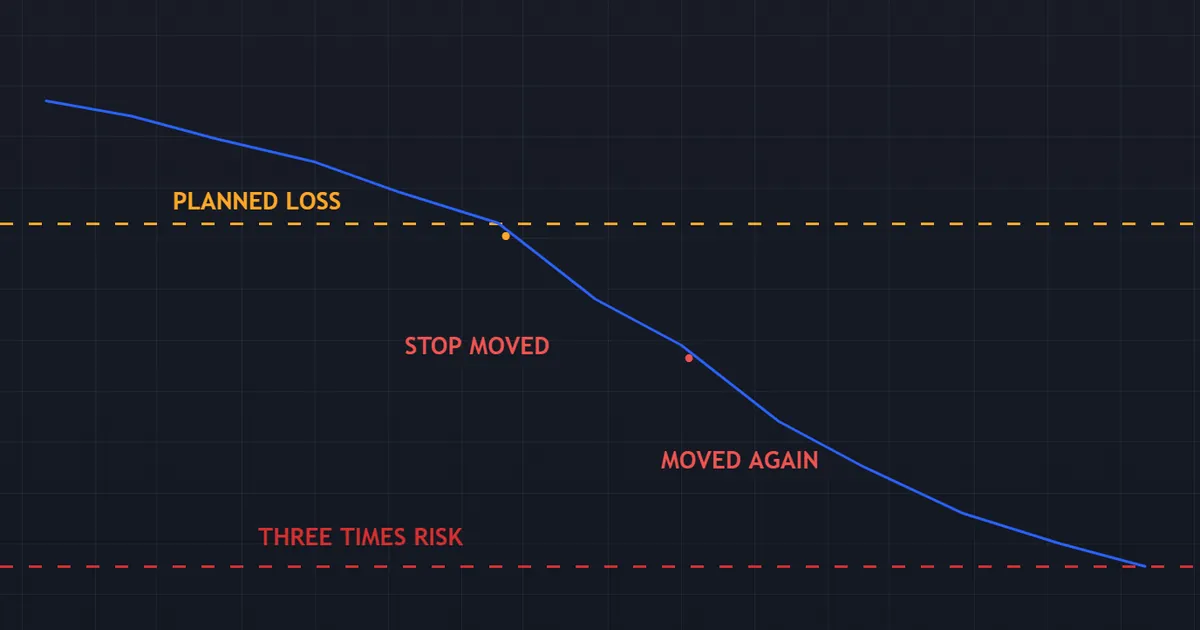
Notice the shape of it. One routine loss grows to three times its planned size, purely because the stop moved twice.
The Bias Blind Spot
People spot bias in others easily and miss it in themselves. That asymmetry carries its own name in the research.
So do not lean on self-assessment. Use the written record instead, since a record flatters nobody.
Rules That Fight Each Other
Two sensible rules can contradict each other under pressure. A rule to cut losses fast sits badly beside a rule to give trades room.
So rank your rules in advance. When they clash mid-trade, the ranking decides for you, and the loudest feeling loses its vote.
Rules You Can Reinterpret
A vague rule bends under pressure. A rule such as manage the trade sensibly permits absolutely anything.
So write rules with numbers inside them. Then the rule either held or it did not, and your log can say which.
Bias Can Also Protect You
Caution after a bad week sometimes reflects a real signal. Your method may genuinely suit calm conditions and struggle in wild ones.
So test the feeling against the data before you dismiss it. Because both answers happen, the log settles the question faster than argument.
Costs Hide Behind a Good Story
Bias makes traders count outcomes and forget friction. Spreads, commissions and swaps still arrive on every biased trade.
So a habit that looks merely annoying can turn a small edge negative. Add the costs to your log, and the true price of the habit appears.
When the Pressure Grows Beyond Trading
Some difficulty sits outside the scope of a checklist. Chasing losses, hiding trades and losing sleep all point to something larger.
If trading affects your sleep, your finances or your relationships, step away and seek qualified professional support. That decision protects far more than an account.
Related Concepts to Study Next
Bias work pairs naturally with risk control, because a written risk rule removes most of the room a bias needs. Start with our overview of what trading psychology covers, then read about revenge trading for the sharpest example of a bias in motion. For the sizing side of the same problem, see our guide to risk per trade.
FAQ
Which cognitive bias costs traders the most money?
Loss aversion usually does the most damage, because it moves stops and turns small planned losses into large real ones. The disposition effect runs close behind, since it cuts winners early while losers keep running. Both attack your average trade from opposite ends. Fixing either one changes your numbers more than any new indicator will.
Can I train myself out of these biases?
Not entirely, and nobody manages it by willpower alone. What works is designing around them with written rules, a fixed stop placed at entry, and a log you review weekly. The bias still fires, but it no longer reaches the order ticket.
How do I tell a bias from a genuine change of mind?
Check the timing and the evidence. A genuine change points to new information on the chart, and you can state it in one sentence. A bias arrives when price moves against you and the only new input happens to be discomfort. So write the reason down at the moment you change your mind, and read it again the next morning.
Does a trading journal really help with bias?
Yes, more than any other single habit. Bias distorts memory, so a note written before the outcome gives you the only honest record of what you thought. Two weeks of entries usually reveal the pattern that a year of reflection missed. Keep the fields short, since a long form stops getting filled in by Thursday.
Are cognitive biases the same as emotions?
No, although they interact constantly. A bias describes a systematic error in judgement, while an emotion describes a feeling that raises the odds of that error. Fear does not decide to move your stop, yet it makes the anchored reasoning feel reasonable. In practice you treat them together, because the same written rule blocks both.
How long before the counter-measures show up in my results?
Expect a few months rather than a few days. The rules take effect immediately, but you need a reasonable sample before the numbers separate a real improvement from ordinary variance. Track the process first, then let the equity follow. Most traders notice the behavioural change long before the account shows it, which is exactly the order you should expect. Results are not guaranteed; past performance is not indicative of future results.
External references
- For background on this concept, see List of Cognitive Biases on Wikipedia.
- For broader market context, see Hindsight Bias at Investopedia.

About the author
Written by Dominic Walsh, a Forex trader and MT4/MT5 indicator, Expert Advisor and script developer. Every tool on forexmt4systems.com is tested on live charts before release and ships with ready-to-use compiled MT4 (.ex4) and MT5 (.ex5) files. Learn more about the trader and developer behind this site.
How we build, test and correct every tool: Editorial & Testing Policy. Trading carries risk; see the disclaimer.