
Ask ten traders what is a trading journal and you will hear ten versions of the same vague answer. Most describe a diary of feelings, which is the least useful thing it could be.
A journal is a measurement instrument. It does not create an edge, and it never will, but it makes an existing one visible and it makes the absence of one obvious.
What Is a Trading Journal, Exactly
Strip away the motivational language and a journal is a record with fixed fields. Each closed trade produces one row.
Those rows accumulate into something your memory cannot supply. After eighty trades, patterns appear that no amount of recollection would have surfaced.
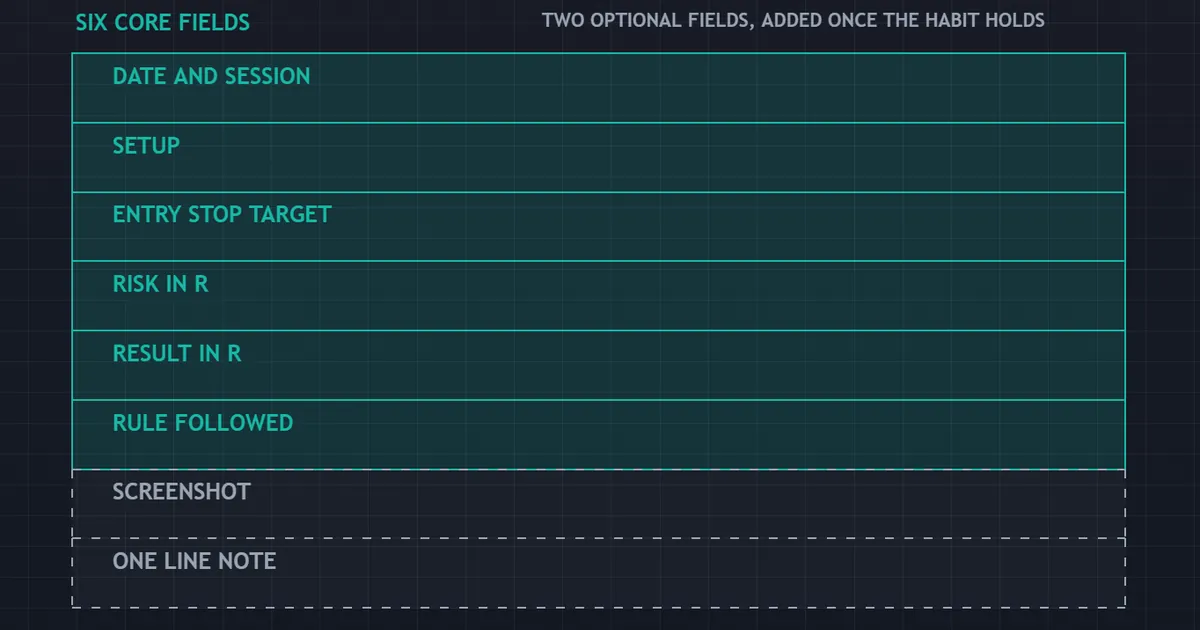
The panel above lists the fields a usable log actually holds. Nothing on it takes more than a few seconds to record.
A Measurement Instrument, Not a Diary
Thermometers do not make rooms warmer. They tell you the temperature, and everything useful follows from knowing it.
A journal works the same way. It reports what you did and what happened, then leaves the decisions to you.
That framing changes what you record. Measurement needs consistent fields, not paragraphs about how a Tuesday felt.
It also lowers the bar for starting. A thermometer needs no inspiration to work, and neither does a row of six columns filled in at the same two moments of every trade.
What a Journal Cannot Do
No log improves a method that has no edge. It will simply document the decline in unusually clear terms.
Logging also fails to enforce discipline. Writing down that you broke a rule does not stop you breaking it again next week.
What the record does supply is evidence. You stop arguing about whether a habit is costing you and start reading the number.
Why the Definition Matters
Traders abandon journals because they built the wrong thing. A free-text diary produces no comparisons, so nothing ever gets learned from it.
Fixed fields solve that. Numbers in columns can be sorted, grouped and counted, while prose cannot.
Our companion guide to what a trading plan is covers the rules side, and the journal measures whether you followed them.
The Fields That Earn Their Place
Most journal templates collect far too much. Six fields carry almost all the value.
- Date and instrument. Enough to find the chart again later.
- Setup name. One label from a short fixed list, never free text.
- Entry, stop and target. The three prices, written before the trade opens.
- Risk in currency and in R. What one unit of loss was worth on this trade.
- Outcome in R. The result expressed as a multiple of that risk.
- Rule followed, yes or no. A single flag covering entry, size and exit.
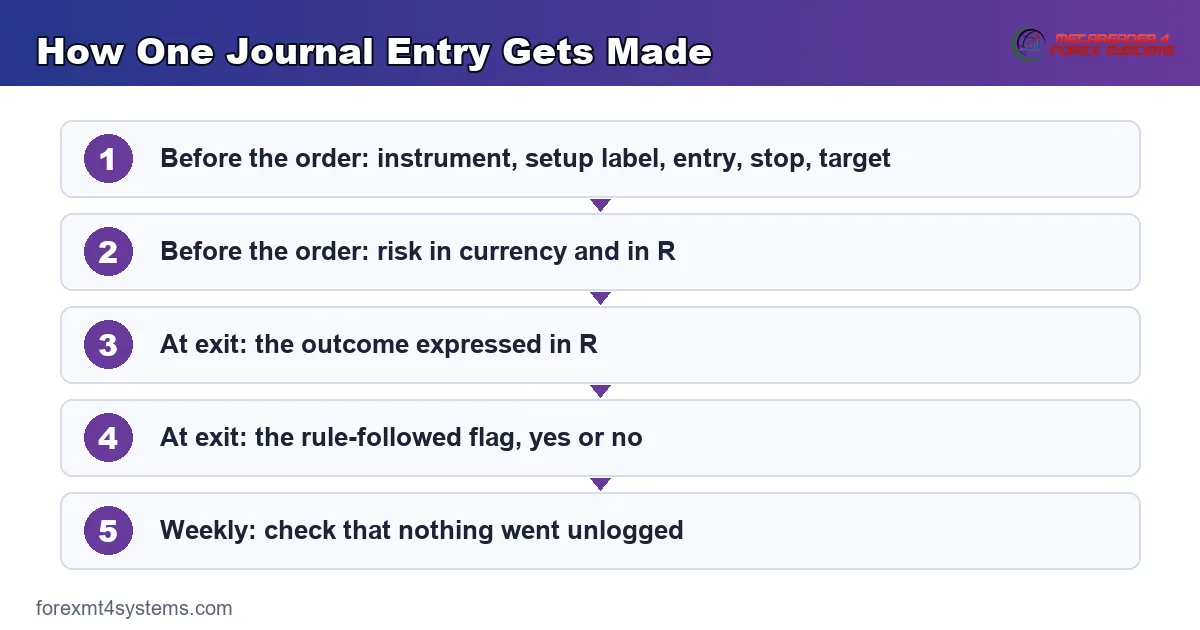
Notice that emotion appears nowhere in the core six. It earns a place later, once the mechanical data exists.
Why R Does the Heavy Lifting
Currency amounts cannot be compared across different position sizes. A gain on a large position and a gain on a small one look similar and mean different things.
Expressing every result as a multiple of the risk taken solves that. A loss becomes minus one, and a good trade becomes plus three regardless of size.
Our guide to R multiples explains the arithmetic in full.
Two Fields Worth Adding Early
Once the core six run smoothly, add the session and a screenshot link. Both answer questions that come up constantly.
Session tells you whether your results cluster in one part of the day. Screenshots let you re-read a setup without trusting your memory of it.
Add nothing else for at least fifty trades. Every extra column raises the chance you stop filling any of them.
Fields That Sound Useful and Are Not
Confidence ratings out of ten produce noise. Nobody scores them consistently, so the column never groups into anything readable.
Long narrative notes fail for the same reason. They feel productive at the time and resist analysis completely.
Indicator values at entry rarely earn their keep either. If a reading matters, it belongs inside the setup definition rather than in a column.
The Cadence That Keeps It Alive
A journal dies from friction. Three short habits keep it running.
At Entry: Thirty Seconds
Record the instrument, the setup label and the three prices before the order goes live. That is the whole task.
Doing it before entry matters more than it sounds. Prices written afterwards drift toward whatever would have looked sensible.
At Exit: One Line
Fill in the result in R and the rule-followed flag. Ten seconds covers it.
Resist the urge to explain a loss immediately after taking it. Explanations written in that moment tend toward self-defence rather than accuracy.
Weekly and Monthly
Once a week, check that every trade got logged. Gaps grow quietly and ruin the sample.
Once a month, group the rows and read them. Our guide on how to review your trades covers what to look for.
What the Record Reveals
The point of all this arrives at the review. A few weeks of clean rows answer questions that felt unanswerable.
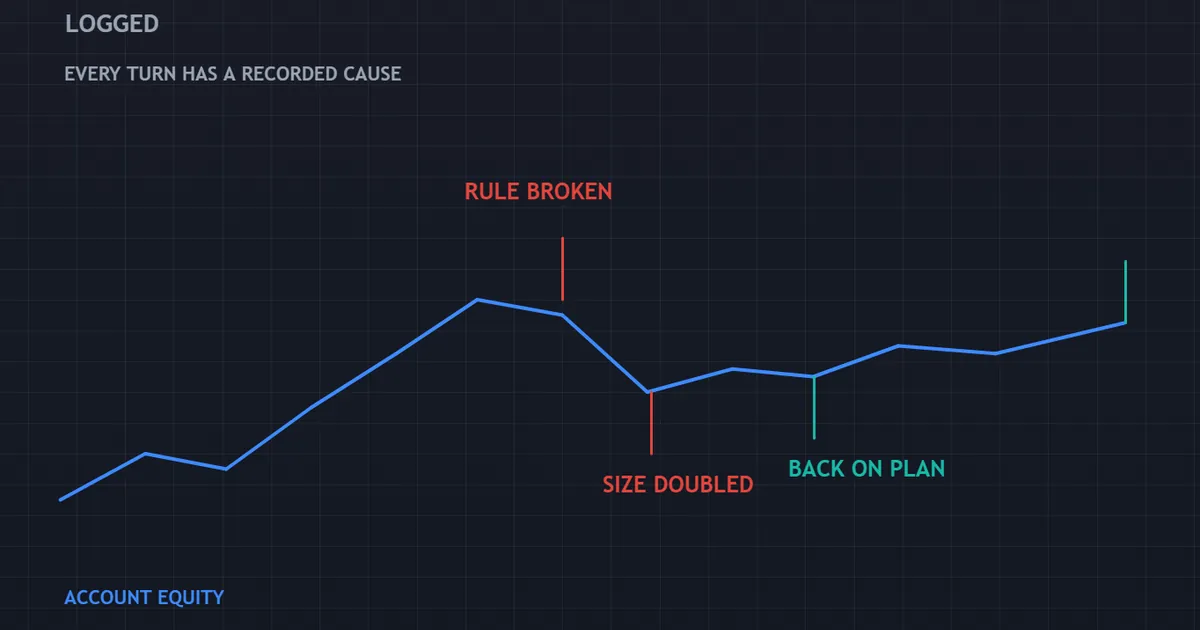
The panel above marks a stretch of results with the events the log captured. Reading them together turns a vague sense of a bad month into something specific.
Where the Result Actually Came From
Sort the rows by outcome in R and the shape becomes obvious. Often two or three trades produced most of the gain.
That single observation changes behaviour. Traders who see it stop cutting winners quite so eagerly.
Execution Against Method
Split the rows by the rule-followed flag and compare the two groups. This is the most valuable comparison a journal offers.
Where the followed trades look healthy and the broken ones drag, the method is fine and the execution is not. Where both groups look similar, the method itself needs attention.
Without the flag, that distinction stays invisible. Traders then rebuild a working method because their discipline slipped.
Which Setups Deserve the Screen Time
Group by setup label and count the rows. Most traders find one label producing half the trades and very little of the result.
Cutting that setup frees attention immediately. It also shrinks the trade count, which usually helps on its own.
Cost as a Line Item
Spread and commission vanish inside a result unless the log separates them. Traders then blame the method for a bill the broker sent.
Add the total cost per trade once the six core fields run smoothly. Over a hundred rows it turns a vague suspicion into a figure.
Why Most Journals Get Abandoned
Almost everybody starts one. Very few still have it running six months later.
Friction Beats Motivation Every Time
A template that takes four minutes per trade will not survive a busy week. Thirty seconds will.
Design for your worst day rather than your best. The version you fill in when tired is the only version that matters.
No Question to Answer
People log for months without ever asking the data anything. Boredom follows, then the habit lapses.
Pick a question before you start. Something specific, such as whether your afternoon trades match your morning ones.
The Record Says Something Unwelcome
Journals often stop right after a clear finding. Seeing in print that one favourite setup drags the record is genuinely uncomfortable.
Expect that moment and plan for it. The discomfort is the tool working, not the tool failing.
Reading the Numbers Without Fooling Yourself
A record can be misread as easily as a chart. Three habits protect the conclusions.
Count Before You Interpret
Check how many rows sit behind any observation. Four trades in a group cannot support a decision, however striking the pattern looks.
Write the sample size beside every finding. Doing so kills most premature conclusions on sight.
Beware the Story You Already Believe
Traders arrive at a review with a theory and find support for it. The rows that disagree get explained away as unusual conditions.
Test the opposite case deliberately. If you think mornings work better, group the afternoons first and see what the numbers say.
Separate Conditions From Method
A quiet quarter produces poor results for a breakout approach regardless of execution. That is the market, not the rule.
Note the broad conditions alongside each month. Without that context, every calm stretch looks like a broken method.
Common Mistakes and Their Fixes
Six habits turn a journal into decoration. Each has a plain correction.
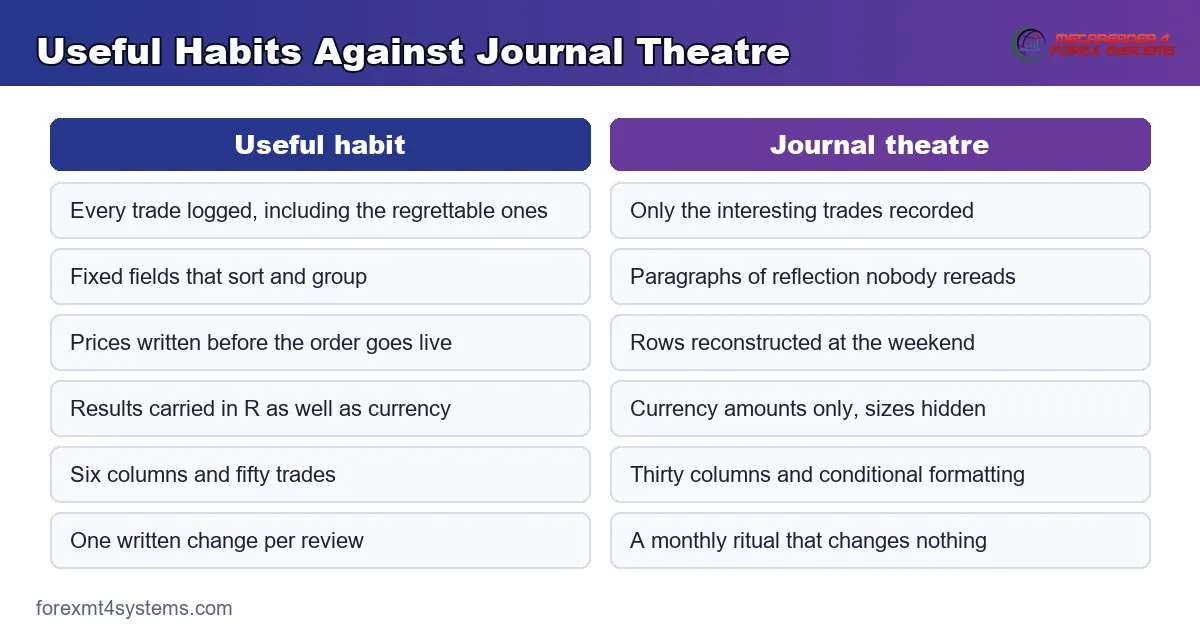
Logging Only the Interesting Trades
Selective logging destroys the sample before it exists. The boring trades are exactly the ones that reveal drift.
Log every trade, including the ones you regret opening.
Writing Prose Instead of Fields
Paragraphs cannot be counted or sorted. A page of reflection tells you less than one clean column.
Keep prose to a single optional note and let the fields do the work.
Filling It In After the Fact
Reconstructing entries at the weekend produces a tidy fiction. Memory quietly edits the prices toward whatever makes sense now.
Log at entry and at exit, or accept that the record describes your imagination.
Recording Currency Only
Money amounts hide the size differences that drive them. Two trades with the same result in currency can represent completely different risks.
Add the R column and the comparison becomes valid immediately.
Building a Spreadsheet Instead of Trading
Elaborate templates with thirty columns and conditional formatting feel like progress. They mostly delay the moment you have to look at the results.
Start with six fields and add nothing for fifty trades.
Reviewing Without Acting
A monthly review that produces no change is a ritual. The record only earns its keep when something in your behaviour shifts.
End every review with one specific change, then leave everything else alone until the next one.
Download the complete indicator database
Put these concepts on your charts. One email unlocks the full library of 1,380+ indicators with compiled MT4 and MT5 files, plus my TradingView scripts. No paywall, no spam, unsubscribe any time.
Get free access to my indicator database
One email unlocks 1,380+ free MT4, MT5 and TradingView indicators — the complete library. No single-tool download; you get the whole database.
A Minimum Viable Journal
The table below is the whole thing. Anything beyond it is optional.
| Field | When you fill it | What it answers later |
|---|---|---|
| Date and instrument | At entry | Where and when your results cluster |
| Setup label | At entry | Which ideas actually carry the record |
| Entry, stop, target | At entry, before the order | Whether the plan existed before the trade |
| Risk in currency and R | At entry | Whether sizing stayed consistent |
| Outcome in R | At exit | The shape of your result distribution |
| Rule followed | At exit | Execution problems against method problems |
| Session | At entry, optional | Whether one part of the day dominates |
| Screenshot link | At entry, optional | What the setup genuinely looked like |
Our free trade journal tool builds these fields in, so the habit costs almost nothing to start.
Copy that table into a sheet and you have a working journal in about ten minutes. Resist adding columns until the rows reach fifty, because every extra field raises the friction on the days when you least want to log anything.
What a Journal Cannot Fix
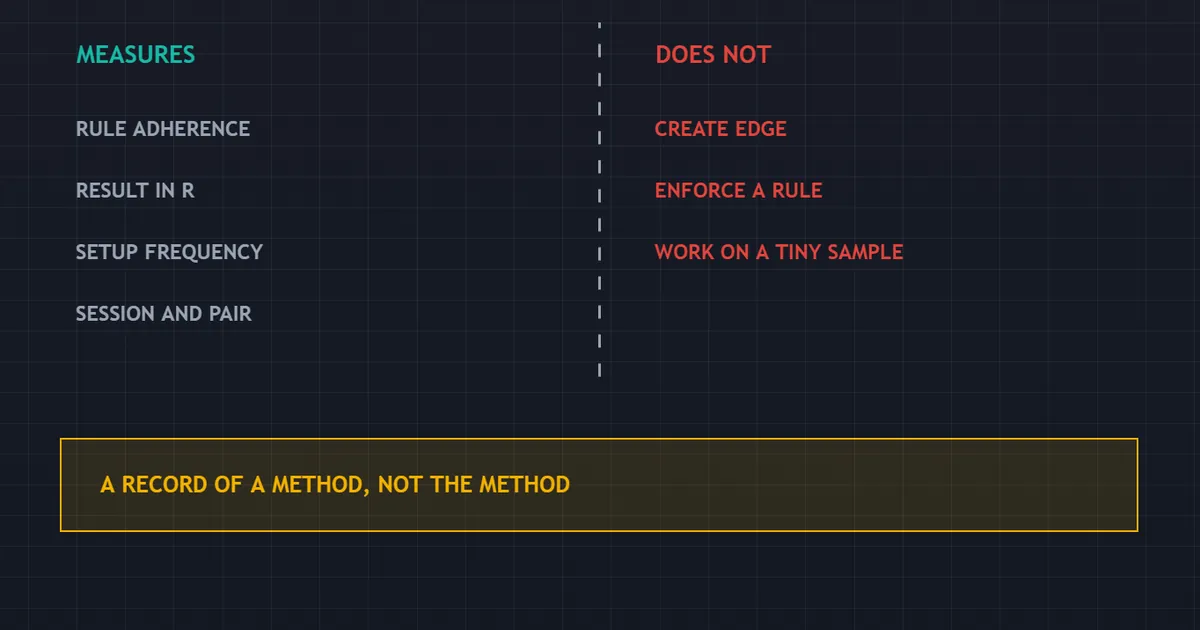
Expectations need setting honestly here. The panel below marks the boundary.
It Does Not Create an Edge
A record measures a method; it does not improve one. Traders who journal a losing approach diligently simply document the losses in better detail.
That detail still has value. Knowing precisely where the money went beats a general sense that things are going badly.
It Does Not Enforce Discipline
Writing down a rule break creates no consequence on its own. Plenty of traders keep immaculate records of repeated errors.
What helps is a rule attached to the record, such as stopping for the day after two broken-rule trades. The journal supplies the trigger and you supply the rule.
It Does Not Replace a Sample
Ten rows tell you almost nothing. Reading conclusions into a fortnight of data leads straight to changes that the evidence never supported.
Give any question at least fifty trades, and preferably a hundred. Our note on overtrading covers what happens when traders force that sample too quickly.
Turning the Record Into Decisions
A journal earns its keep at the point of change. Three rules keep that process honest.
Change One Thing at a Time
Altering three rules after a poor month tells you nothing about which one mattered. The next sample becomes uninterpretable.
Pick the single change with the clearest evidence behind it. Then leave everything else untouched until the following review.
Write the Prediction Down
Before making a change, note what you expect it to do. Fewer trades, a smaller average loss, a higher proportion of rules followed.
Checking that prediction later separates real improvement from a lucky stretch. Without it, every change looks successful in hindsight.
Keep the Old Rows
Never delete history when the method changes. The old sample is your only comparison point.
Mark the change date in the log and carry on. Feeding the numbers through an expectancy calculator before and after makes the effect readable.
Journals for Different Holding Periods
The six fields hold whatever you trade. Cadence and emphasis shift with the holding period.
Fast Styles Need Batching
Logging forty trades individually during a session is impossible. Record the prices as you go and complete the rows afterwards.
Keep the rule flag honest even so. That single column carries most of the value for high-frequency work.
Slow Styles Need Interim Notes
A position held for two months produces one row and very little else. Add a short dated note whenever the reason for holding changes.
Those notes rescue the review. Without them a single row summarises eight weeks of decisions into almost nothing.
Every Style Needs the Same Six Fields
Holding period changes the rhythm rather than the structure. Setup, prices, risk, result and the rule flag apply everywhere.
Keeping the schema identical also lets you compare styles later. Traders who change methods often wish they had.
Getting Started This Week
The first ten rows are the hardest. After that the habit largely runs itself.
Day One: Build the Six Columns
Open a sheet and create the six core fields, nothing more. Resist every temptation to design something clever.
Write your short list of setup labels at the top. Three or four names is plenty at the start.
Week One: Log Everything
Record every trade, including the ones you take against your own rules. Those rows carry more information than the good ones.
Do not read the totals yet. A week of data invites conclusions that a week of data cannot support.
Month One: Read It Once
Sort by outcome in R, then split by the rule flag. Two questions, five minutes, one written observation.
Then close it and carry on. Our worked trading journal examples show what a filled month looks like in practice.
How the Journal Feeds the Plan
The two documents work as a pair. One states the rules, the other measures adherence to them.
The Plan Supplies the Labels
Setup names in the journal should come straight from the plan. Inventing a new label mid-month usually means the rules drifted.
Where a trade fits no existing label, that is worth noticing. It normally signals an improvised entry rather than a gap in the plan.
The Journal Supplies the Evidence
Rules get changed on opinion far too often. A logged sample turns that argument into a comparison.
Bring the numbers to every plan revision. Then a change rests on rows rather than on a bad week.
Neither Works Alone
A plan without a journal is untested. A journal without a plan measures adherence to nothing.
Build both, in that order, and keep them in the same place. The pair takes an evening to set up and does its work for years.
Related Guides Worth Reading Next
A journal sits inside a wider process, so the next steps depend on which part feels weakest.
Read our practical guide on how to keep a trading journal if the habit keeps lapsing, since it deals with friction rather than theory. Traders whose rules are still loose should start with the plan itself instead, because a journal cannot measure adherence to rules that were never written down.
Anyone comparing tools across their setups can browse our indicator library afterwards. Whatever you add, the log should record which setup label it belongs to.
FAQ
What is a trading journal supposed to contain at minimum?
Six fields cover it: date and instrument, setup label, the entry, stop and target prices, risk in currency and in R, outcome in R, and a flag for whether you followed your rules. Everything else is optional. A log with those six columns answers most of the questions traders actually ask about their own results. Session and a screenshot link are the two additions worth making once the habit holds for fifty trades.
Will keeping a journal make me profitable?
No, and any claim otherwise misreads what the tool does. A journal measures a method rather than improving one, so a losing approach stays a losing approach with better documentation. What changes is your ability to see where the result came from, which is what makes a sensible adjustment possible.
How often should I review the record?
Check weekly that nothing went unlogged, then read the data properly once a month. Weekly reading tempts you into changes that a small sample cannot justify. Monthly gives enough rows to see a pattern while still being frequent enough to catch drift early.
Should I record my emotions?
Only after the mechanical fields run reliably, and only in a fixed format. A one-word tag from a short list can be sorted and counted, while a paragraph cannot. Most traders find the rule-followed flag captures the useful part of the emotional story anyway. Broken rules and strong emotions tend to arrive together, so the flag already marks the trades worth revisiting.
Spreadsheet, notebook or dedicated tool?
Whichever one you will actually fill in every day. A spreadsheet sorts and groups without effort, which matters at review time. Paper works for the entry discipline but makes analysis slow, so most traders end up moving the rows into a sheet eventually. Whatever you pick, keep one file rather than several, since split records defeat the entire purpose.
How many trades before the journal tells me anything?
Around fifty rows before any pattern deserves attention, and closer to a hundred before you act on a conclusion. Smaller samples reflect market conditions more than method quality. Keep logging past the point where you feel certain, because that feeling arrives long before the evidence does. Results are not guaranteed; past performance is not indicative of future results.
External references
- For background on this concept, see Logbook on Wikipedia.
- For broader market context, see KPIs at Corporate Finance Institute.

About the author
Written by Dominic Walsh, a Forex trader and MT4/MT5 indicator, Expert Advisor and script developer. Every tool on forexmt4systems.com is tested on live charts before release and ships with ready-to-use compiled MT4 (.ex4) and MT5 (.ex5) files. Learn more about the trader and developer behind this site.
How we build, test and correct every tool: Editorial & Testing Policy. Trading carries risk; see the disclaimer.