
Ask five traders what is a trading plan, and you will hear five different answers. One describes a strategy, another a checklist, a third a folder of past screenshots.
All three answers point at something real. None of them names the whole thing, so this guide starts with a definition and then lists every part.
What Is a Trading Plan?
A trading plan is a written document stating, in advance, how you will act in the market. It covers what you trade, when you act, how much you risk, and when you stop.
The key word there is advance. Every choice in the document happens while nothing rides on it, so pressure cannot bend the answer later.
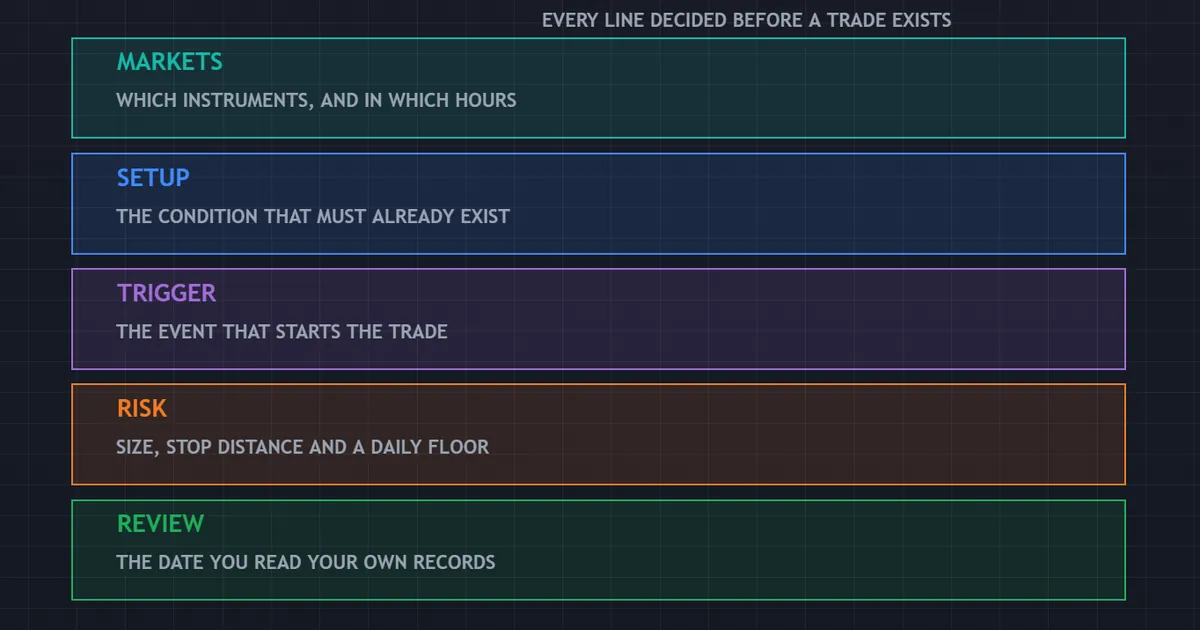
Above sits a panel of the components most working plans share. Each one answers a question that would otherwise arrive mid-trade, when a good answer becomes far harder to reach.
A Document, Not a Feeling
A plan lives in a file you can open. If you cannot show it to another person, you do not have one yet.
That sounds pedantic, and it matters more than any other rule here. Rules you hold in your head drift quietly, because nothing records what they said last week.
So the format hardly matters. A single page in a text file does the job as well as any polished template.
What a Trading Plan Is Not
It is not a strategy. A strategy describes one way to find trades, while a plan wraps every strategy you run inside one operating standard.
Nor is it a journal. Your trade journal records what happened afterwards, and the plan states what should happen first.
Finally, it is not a forecast. Nothing in the document predicts the market, because every line describes your own behaviour instead.
Why Writing It Down Changes the Decision
Choices made in advance and choices made mid-trade come from different places. The first sort weighs evidence, and the second sort mostly manages discomfort.
People who study choice under pressure describe the same split. Time and stakes narrow attention, so options that looked obvious an hour earlier stop appearing at all.
Writing the rule down moves the thinking back into the calm period. You still have to follow it, although at least the reasoning already happened properly.
Who Actually Needs One
Anybody placing more than a handful of trades a month benefits. Below that frequency you can remember every decision, so the document adds little.
Above it, memory stops coping. Twenty trades a month produces a mess of half-recalled reasons, and the mess grows faster than your ability to sort it.
Traders working toward a funded account face a harder version. Prop rules add daily and overall limits that your own plan has to respect, and forgetting one of them ends the account.
The Components Every Plan Contains
Working plans differ in style, and they cover the same ground. Eight sections do the job for almost every trader.
- Markets and sessions. Which instruments you trade, and the hours you trade them.
- Timeframes. The chart you read for context, and the chart you act on.
- Setup. The conditions that make a chart worth watching at all.
- Trigger. The single event turning interest into a live order.
- Invalidation. The price that ends the idea, chosen before entry.
- Risk per trade and per day. A percentage of the account, never a lot size.
- Exits. Targets, partials, trail rules, and a time stop.
- Review cadence. The day you read your own records, and what you look at.
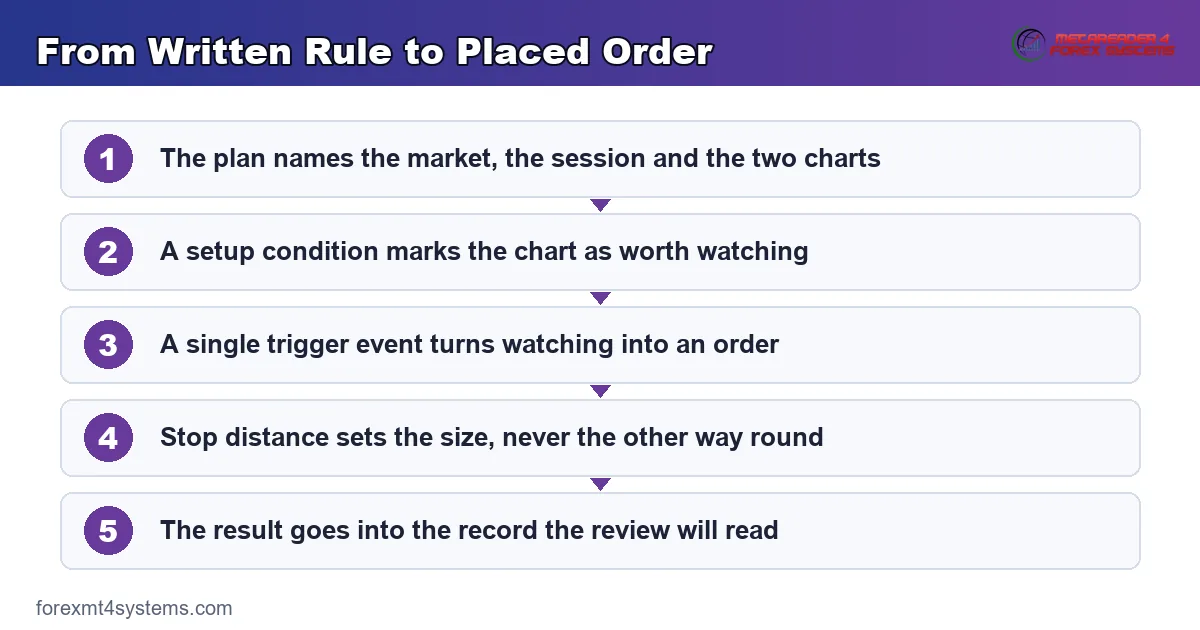
Notice how few of those describe the market. Six of the eight describe you, and that split is the whole point.
Order matters as well. Each line depends on the one above it, so a setup written before you name a timeframe usually ends up meaning two things at once.
Work down the list rather than around it. Traders who start with exits almost always circle back and rewrite the entry rules anyway.
How Each Component Earns Its Place
Every section exists because a specific mistake happens without it. Walking through them in order shows why.
Markets and Sessions
Narrow beats broad here. Two or three instruments give you enough repetition to learn their rhythm within a few months.
Sessions matter just as much. A pair behaves differently at three in the morning than it does during the London hours, so name the window you actually watch.
Timeframes
Most traders use two charts. One frames the context, the other places the order, and the plan names both so the pairing never shifts mid-week.
Without that line, traders drop to a lower chart after a loss. The move feels like precision, though it usually just adds noise and cost.
Setup and Trigger
These two get confused constantly. A setup makes a chart interesting, while a trigger makes you press the button.
Splitting them protects you from early entries. You can watch a setup form for an hour and still take nothing, because the trigger never printed.
Write the trigger as an event, not a mood. A close beyond a marked level qualifies; a feeling that price looks ready does not.
Invalidation
Before entry, pick the price proving the idea wrong. That number then sets your stop, and your stop distance sets your position size.
Traders who skip this step end up sizing by habit. Our guide to risk per trade shows how the two numbers connect.
Risk Limits
State risk as a percentage, and state a daily stopping point too. One caps a single mistake, and the other caps a bad afternoon.
A limit only counts when you write it down. An intention to stop after a rough run bends the moment the run starts.
Position Size Comes Last
Size is an output, never an input. Your risk percentage and your stop distance decide it, and neither of those depends on how confident you feel.
Running that arithmetic by hand every time wears thin. Our position size calculator handles it in seconds, which removes the excuse for guessing.
Name the method in the plan as well. A rule pointing at one specific approach survives busy mornings better than a vague instruction to size sensibly.
Exits and Review
Exits need the same detail as entries. Say what you do at target, what you do when price stalls, and how long you wait before giving up on an idea.
Then set the review date. Weekly works for most people, and the date matters more than the length of the session.
Where the Plan Meets the Rest of Your Process
A plan does not sit alone on the desk. Three other pieces feed it, and each one fails quietly without the others.
The Journal Supplies the Evidence
Your plan states intentions, while your records state outcomes. Reading one against the other is the only honest way to see which rules you actually keep.
Log the rule you followed beside the result. A note reading “trigger fired, size correct, exit early” teaches more than any profit column ever does.
The Review Closes the Loop
Evidence without a reading appointment goes stale. Pick a weekday, block twenty minutes, and treat the slot as fixed.
Look for repeats rather than single events. One early exit means nothing, while four in a fortnight names a rule that needs rewriting.
Your Tools Supply the Context
Whatever you use to read a chart belongs in the setup section by name. A rule mentioning a specific reading beats a rule mentioning momentum in general.
Settings count too. A moving average length or an oscillator period that shifts between trades makes the record impossible to compare later.
Pin the numbers, then leave them alone until review. Changing them mid-week is drift wearing the costume of research.
Risk Limits Keep You in the Sample
An edge needs many trades before it says anything at all. Sizing that survives a losing run keeps you present for the count.
That is the quiet argument for a daily stopping point. It protects the sample rather than your feelings.
A Trading Plan Does Not Create an Edge
Here is the honest part most articles leave out. Writing rules down adds nothing to the market itself.
If your method has no edge, a beautiful document changes none of that. It simply produces losses in a tidier order.
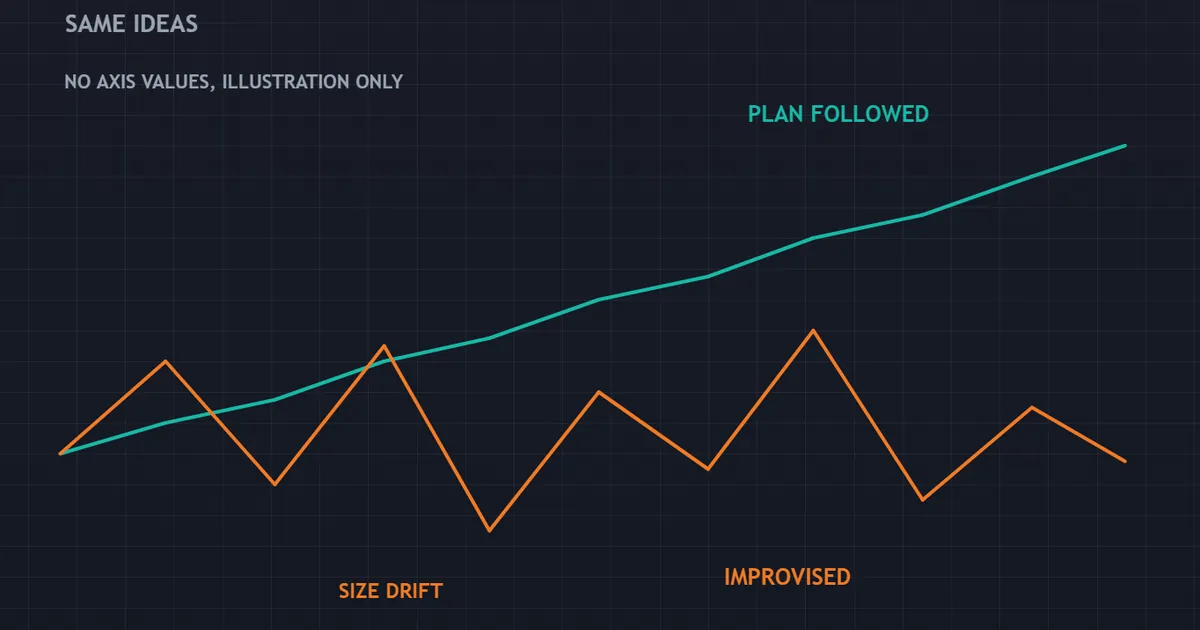
The panel above shows two equity curves built from the same set of ideas. One follows a written standard, the other improvises size and exits, and the improvised line swings much wider.
What a Plan Actually Changes
A plan makes an existing edge executable. That word does the heavy lifting, so it deserves unpacking.
An edge only pays out across many repetitions. Repetition needs consistency, and consistency needs rules that stay the same when you feel tired, bored or annoyed.
Without a plan, your method changes shape every week. Any small advantage then disappears inside the variation you added yourself.
It Also Makes Absence Measurable
The second benefit gets even less attention. A written standard turns a vague sense of drift into countable evidence.
Compare each trade against the document. Count how many followed every rule, and count how many did not.
Those two numbers tell you something a feeling never will. If most of your damage sits in the second group, the method may be fine and the discipline needs work instead.
The Uncomfortable Corollary
Sometimes the first group carries the damage. Every rule held, and the account still slid.
That result stings, and it is genuinely useful. It points at the method rather than the person, which is the only way to fix a method with any confidence.
Two Traders, One Method
Picture two people running identical rules for a year. One follows the document, the other takes the trades that feel right on the day.
Their results will differ, and the method never changed. The difference comes entirely from which trades each person actually took.
That gap explains why copying a profitable trader rarely transfers. You inherit the rules without inheriting the behaviour, and the behaviour carried most of the load.
Why the Claim Gets Overstated
Marketing loves the plan because it sounds like a solution. Buy the template, follow the steps, and the hard part supposedly disappears.
Reality runs the other way round. Finding something that works takes far longer than writing it down, and the writing only preserves what you already found.
So treat the document as scaffolding. It holds a method steady long enough for you to judge it, and judging it honestly is the real work.
Download the complete indicator database
Put these concepts on your charts. One email unlocks the full library of 1,380+ indicators with compiled MT4 and MT5 files, plus my TradingView scripts. No paywall, no spam, unsubscribe any time.
Get free access to my indicator database
One email unlocks 1,380+ free MT4, MT5 and TradingView indicators — the complete library. No single-tool download; you get the whole database.
Common Mistakes People Make With Plans
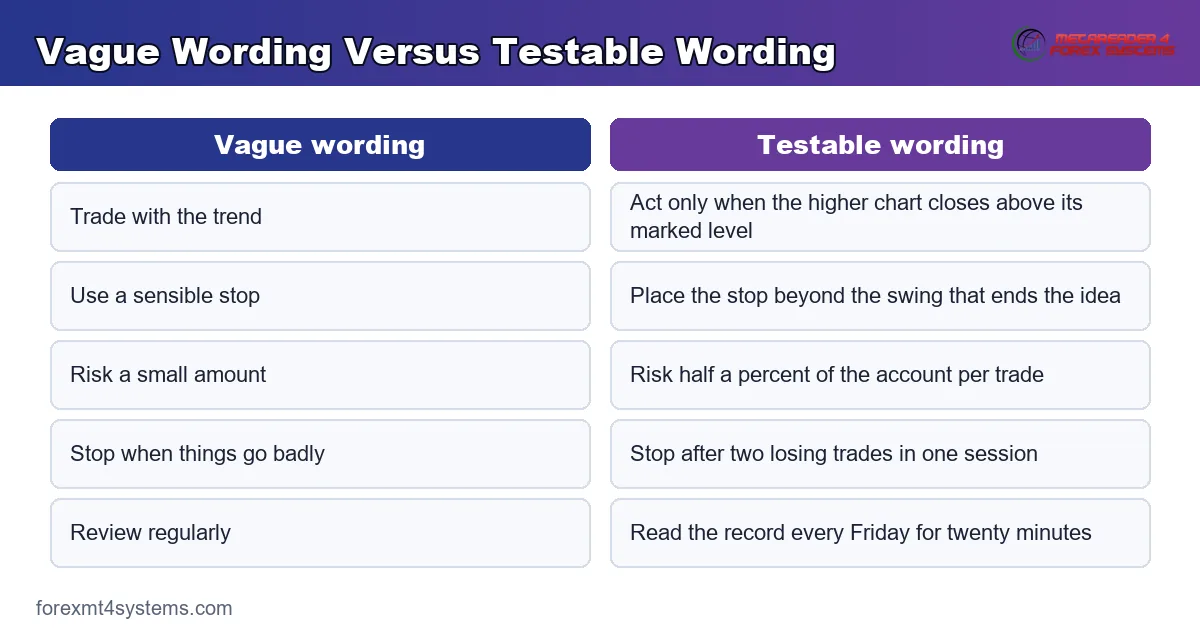
Five habits turn a helpful document into a decorative one. The comparison below shows the wording fix for the most common of them.
Writing Rules Nobody Could Test
“Trade with the trend” reads well and means nothing. Two people applying it will take different trades on the same chart.
Replace every adjective with a measurement. Say which chart, which reading, and which close, so the rule either happened or did not.
Copying Somebody Else’s Plan
A plan built around the New York hours suits a trader who sits down then. Copy it while working a day job, and every rule fights your calendar.
Take the structure from other people, and fill it with your own constraints. Our trading plan example exists to be adapted, never transcribed.
Leaving Out Exits
Entry rules get all the attention, while exits decide most outcomes. A plan naming five entry conditions and no exit rule is half a plan.
Never Reading It Again
Plenty of traders write a good document once and file it forever. Six months later their behaviour has drifted, and nothing flagged the change.
Open the file before each session. Ten seconds of reading keeps the rules present rather than theoretical.
Sizing Before the Stop
Choosing the lot size first, then hunting a stop that fits, inverts the whole process. The chart should set the stop, and the stop should set the size.
Write that order of operations into the plan. Doing so removes a decision from the moment you can least afford one.
Treating It as Permanent
The opposite failure also happens. Some traders refuse to change a rule that clearly does not fit their life.
A plan should change on a schedule, not on impulse. Change it at review time, with a reason written beside the edit.
Quick Reference: What Belongs in the Document
Use this table as a completeness check. Any blank row is a decision you have postponed rather than avoided.
| Section | The question it answers | Written as |
|---|---|---|
| Markets | What do I trade? | A named list, two or three items long |
| Sessions | When am I at the screen? | Clock hours in your own timezone |
| Timeframes | Which charts do I use? | One for context, one for execution |
| Setup | What makes a chart interesting? | Conditions anyone could verify |
| Trigger | What makes me act? | A single event, usually a close |
| Invalidation | What proves me wrong? | A price, chosen before entry |
| Risk | How much can one idea cost? | A percentage of the account |
| Daily limit | When do I stop for the day? | A loss figure or a trade count |
| Exits | How does a trade end? | Target, partial, trail, time stop |
| Review | When do I read my records? | A weekday and a duration |
How to Tell Whether Your Plan Is Doing Its Job
Three signs mark a plan that works as intended. None of them involves the account balance.
Every Rule Answers Yes or No
Read each line and ask whether last week’s trades obeyed it. If any line leaves you unsure, that line needs numbers.
Ambiguity always resolves in your own favour under pressure. Removing it is the cheapest improvement available to you.
Your Losses Look Alike
Similar losses signal consistent sizing. Wildly uneven ones signal that confidence, boredom or frustration reached the order ticket.
Scan the size column first at review. It exposes drift faster than any other field in the record.
Reviews Keep Finding Something
A useful review turns up at least one adjustment worth making. Weeks of finding nothing usually mean the reading went too shallow.
Change one rule at a time, though. Editing three at once leaves you unable to tell which edit mattered.
Where Plans Go Wrong in Practice
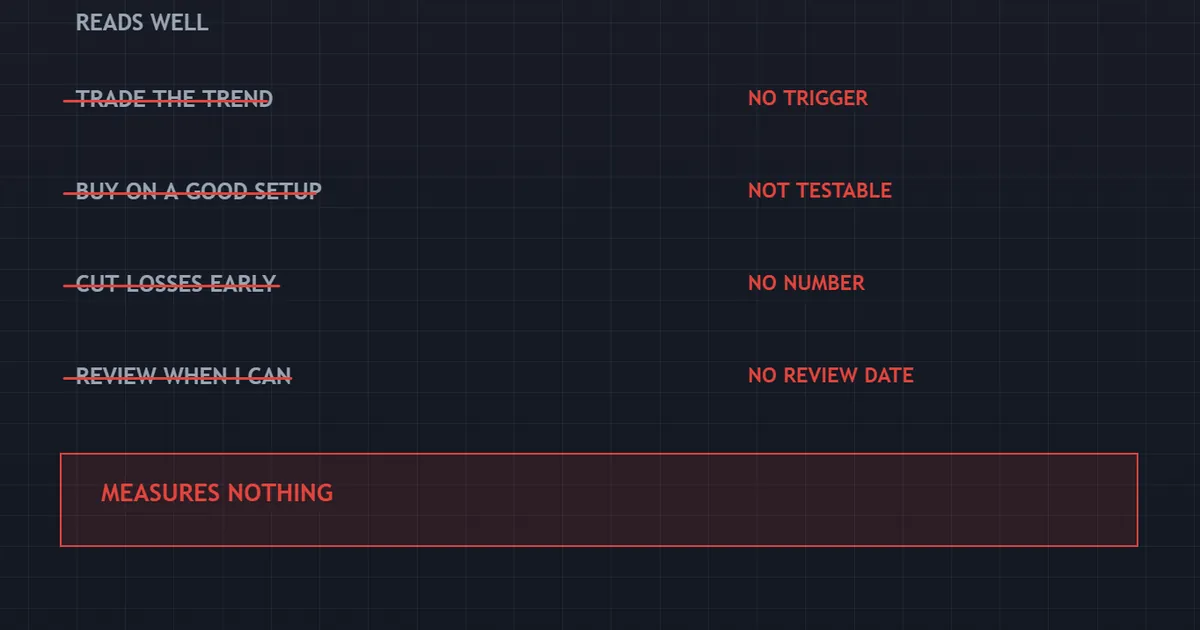
Most failed plans are not wrong. They are unusable, which is a different problem with a different fix.
Too Vague to Fail
The panel above shows the classic version. Every line sounds sensible, yet nothing in it could ever be marked right or wrong afterwards.
A rule that cannot fail cannot teach you anything. You can follow it perfectly and still have no idea whether you followed it.
Too Long to Read
Fourteen pages of detail impress nobody at eight in the morning. Long plans get skimmed, then ignored, then forgotten.
One page is the target. Anything longer belongs in a separate notes file that you read at review time.
Built for a Life You Do Not Have
Some plans describe an ideal week rather than a real one. They assume quiet mornings, a spare hour at lunch, and nobody interrupting.
Then an ordinary Tuesday arrives and the whole structure collapses. Write for your worst realistic day, and the good days look after themselves.
Silent Drift
This one hurts the most, because nothing announces it. Your size creeps up, your stop widens, and each individual step felt reasonable.
Only a comparison catches drift. Reading your logged trades against the written rule is the cheapest audit available, and our notes on trading discipline rules cover the habit side.
Related Concepts Worth Reading Next
A plan connects to several other pieces, and each one deepens it. Three make sense to read soon.
Start with the build process in our guide on how to create a trading plan, which walks each decision in order. After that, look at what a trading journal is, since the journal supplies the evidence your review needs.
Then read the failure catalogue in trading plan mistakes. Knowing the common traps in advance saves you from discovering them slowly.
Traders whose setups lean on chart tools can browse our MetaTrader indicators library while drafting the setup section. Whatever you pick, name it in the plan so the rule stays specific.
One more suggestion before you start writing. Give yourself a fortnight of ordinary trading first, and note every decision you make without a rule behind it.
That list becomes your first draft. A plan built from your own gaps beats one built from a template, because it answers the questions you genuinely struggle with.
FAQ
How long should a trading plan be?
One page, in most cases. The document has to survive contact with a busy morning, and a long file simply does not get opened. Keep the rules on a single page, then put your reasoning, notes and research in a second file you only read during review.
Is a trading plan the same as a trading strategy?
No. A strategy describes one repeatable way to find and manage trades. A plan sits above that and covers everything around it: which markets, which hours, how much risk per idea, when to stop for the day, and when to review. One plan can hold several strategies inside it.
Do I need a plan if I only trade a small account?
Yes, and arguably more so. Small accounts leave less room for a run of unplanned trades, and habits formed early tend to persist. Writing the rules while the stakes stay modest is far easier than rewriting them later under pressure. Traders who intend to scale up later find the exercise doubly useful, since a plan built at a small size transfers cleanly, whereas improvised habits do not.
What should a beginner write first?
Start with the three lines that cost the most when missing: risk per trade, the daily stopping point, and the price that ends each idea. Those three cap the damage while you work out everything else. Setup and trigger wording will take several revisions to get right, and that is normal, so leave space for the rules to sharpen over the first few months.
How often should I change my plan?
On a schedule, never on impulse. Most traders review weekly and edit monthly, which gives each rule enough trades to say something. Whenever you do change a line, write the reason beside it so future reviews can judge the decision.
What is the most commonly missed component?
The review cadence. Traders write markets, setups and risk limits, then leave out the date on which they read their own records. Without that line the plan has no feedback loop, so drift accumulates unnoticed for months.
Will a written plan improve my results?
Not by itself. A plan makes an existing edge executable and makes its absence visible, which are both valuable, and neither creates an advantage that was not already there. If your method loses money, following it more consistently produces tidier losses rather than gains, so treat the plan as a measuring instrument first. Results are not guaranteed; past performance is not indicative of future results.
External references
- For background on this concept, see Plan on Wikipedia.
- For broader market context, see Business Plan at Corporate Finance Institute.

About the author
Written by Dominic Walsh, a Forex trader and MT4/MT5 indicator, Expert Advisor and script developer. Every tool on forexmt4systems.com is tested on live charts before release and ships with ready-to-use compiled MT4 (.ex4) and MT5 (.ex5) files. Learn more about the trader and developer behind this site.
How we build, test and correct every tool: Editorial & Testing Policy. Trading carries risk; see the disclaimer.