
Most trading plan mistakes have nothing to do with the market. The document simply stops being usable, and nobody notices until months of records look strange.
Six failure modes cover almost every case. Each one has a symptom you can spot this week, and each one has a fix that takes minutes rather than weekends.
Trading Plan Mistakes: What Actually Breaks a Plan
A plan rarely fails loudly. It decays, one exception at a time, until the trades you take share little with the rules you wrote.
So the useful question is never whether your plan is good. Ask instead whether you could mark last week’s trades against it.

Above sits a panel of the six modes. Read it as a diagnostic list rather than a warning, since most working plans carry at least one of them.
Why These Six and Not Others
Every failure below breaks the same thing: the link between what you wrote and what you did. Once that link goes, the document stops measuring anything.
Other complaints matter less than traders think. A plan with an unfashionable method still teaches you something, provided you can check whether you followed it.
How to Run the Diagnosis
Set aside fifteen minutes and open two files. Your plan on the left, your last twenty logged trades on the right.
Go through the trades one at a time. Mark each as followed, partly followed, or not covered by any line.
The third category is the interesting one. Trades your document never anticipated point straight at the gap, and that gap is usually one of the six below.
Count the categories before reading further. A number gives you a baseline, and you will want one when you repeat the exercise next month.
Method quality sits outside this list on purpose. Judging a method needs a clean record, and a broken document is exactly what prevents you from having one.
The Six Failure Modes
Here is the full list. Symptoms follow in the sections below, along with the smallest change that repairs each one.
- Too vague to test. Every line sounds sensible and none can be marked right or wrong.
- Too rigid to follow. The rules assume a week your life does not contain.
- Borrowed from a different life. Somebody else’s hours, account and temperament.
- No invalidation. Nothing states the price that ends an idea.
- No review date. The document has no scheduled reader.
- Silent drift. Behaviour moves away from the page without any decision.

Notice how the last one depends on the fifth. Drift only stays silent while nobody reads the plan against the record.
One: Too Vague to Test
This failure is by far the most common. It also disguises itself well, because a vague plan reads beautifully.
The Symptom
Pick any line and ask whether Tuesday’s trade obeyed it. If the honest answer starts with “sort of”, that line is decoration.
Phrases carrying the problem include trade with the trend, wait for a clean setup, use a sensible stop, and avoid choppy conditions. All four feel meaningful and none of them settles anything.
Why It Happens
Vague wording is comfortable. You can break a precise rule openly, whereas a soft one absorbs whatever you did and calls it compliance.
Most traders write vaguely for that exact reason, without ever meaning to. The wording protects a feeling of consistency that the record would otherwise contradict.
The Fix
Rewrite each line so a stranger could mark it. Name the chart, the condition and the event, then read it back and look for adjectives.
One test settles it quickly. Hand the plan and last week’s trades to somebody else, and see whether their marking matches yours.
Do not expect the rewrite to read well. Precise rules sound clumsy, and clumsy wording is a fair price for a record you can actually audit.
The Vague Lines That Cost Most
Not every soft phrase does equal damage. Three positions in the document matter far more than the rest.
A vague trigger costs you entries at random times, which scatters your record. A vague stop rule turns every losing trade into a fresh negotiation.
Worst of all is a vague risk line. Something like keep risk sensible leaves size floating with your mood, and mood correlates badly with opportunity.
So sharpen those three first. The setup wording can stay slightly loose for a while without doing much harm.
A Worked Rewrite
Take a typical soft line: enter on a pullback in an uptrend when momentum returns. Three phrases in that sentence mean whatever you need them to mean.
Now rewrite it in parts. Uptrend becomes the four hour close sitting above its fifty period average. Pullback becomes price returning to a level you marked before the week started.
Momentum returning becomes a fifteen minute close back through that level. Nothing in the new version depends on how the chart feels.
The rewrite lost some elegance and gained something better. You can now mark every trade last month as compliant or not, without any argument.
Two: Too Rigid to Follow
The opposite failure gets less attention and does similar damage. A plan can be perfectly precise and still impossible to run.
The Symptom
You skip sessions the plan requires. Or you follow it for nine days, miss one, and abandon the whole thing for a fortnight.
Compliance under seven trades in ten usually points here. Rules people cannot keep are rarely discipline problems; they are design problems.
Why It Happens
Plans get written on Sunday evening, when energy feels abundant. Four charts, three sessions and an hour of preparation all seem reasonable at that moment.
Then Wednesday arrives with a late night behind it. The document now describes somebody else’s week.
The Fix
Write for your worst realistic day rather than your best. Cut the plan until you would follow it while tired, distracted and slightly annoyed.
Add one flexible clause as well. A written line permitting a skipped session prevents the all-or-nothing collapse that follows a single miss.
Then measure the change rather than assuming it worked. Compliance across the next twenty trades tells you whether the cut went far enough.
The All or Nothing Collapse
Rigid plans fail in a characteristic pattern. Perfect compliance runs for a stretch, one session gets missed, and the whole document goes unused for weeks.
The trigger is rarely the missed session itself. It is the sense that the streak has broken, which makes the remaining rules feel pointless.
Write the recovery into the plan and that collapse stops happening. A single line saying a missed session changes nothing removes the all-or-nothing framing entirely.
Three: Borrowed From a Different Life
Copied plans fail for reasons that have nothing to do with quality. The original may work perfectly for its author.
The Symptom
Your plan names hours you cannot sit, instruments you never watch, or a review slot on a day you always work. Somebody else’s constraints leak through every line.
A second tell involves rules nobody explained. If you cannot say why a line exists, it probably arrived with the template.
Why It Happens
Borrowing feels efficient, and part of it genuinely is. Structure transfers cleanly, so the ten headings usually suit everybody.
Answers do not transfer. Hours, account size, temperament and screen time differ for every trader, and those four decide most of the content.
Costs differ as well. A rule built around a commission account behaves differently on a spread account, so targets that worked for the author can sit underwater for you.
The Fix
Keep the skeleton and replace every answer. Our trading plan example exists for taking apart that way, one line at a time.
Then justify each line in a sentence. Any rule you cannot defend belongs to somebody else, so delete it.
What Does Transfer
Some parts of somebody else’s plan genuinely belong in yours. The headings transfer, since every trader needs hours, instruments, setup, trigger, risk and review.
The order of operations transfers too. Level first, direction second, trigger third, size taken from the stop distance last.
Habits transfer as well. A weekly review, a compliance count and a written reason beside every edit all work regardless of method.
Content does not. Treat any specific number in a borrowed plan as a placeholder, then test it against your own charts before keeping it.
What the First Three Cost
None of these failures announces itself in the balance. They show up as trades that resemble the plan only loosely.
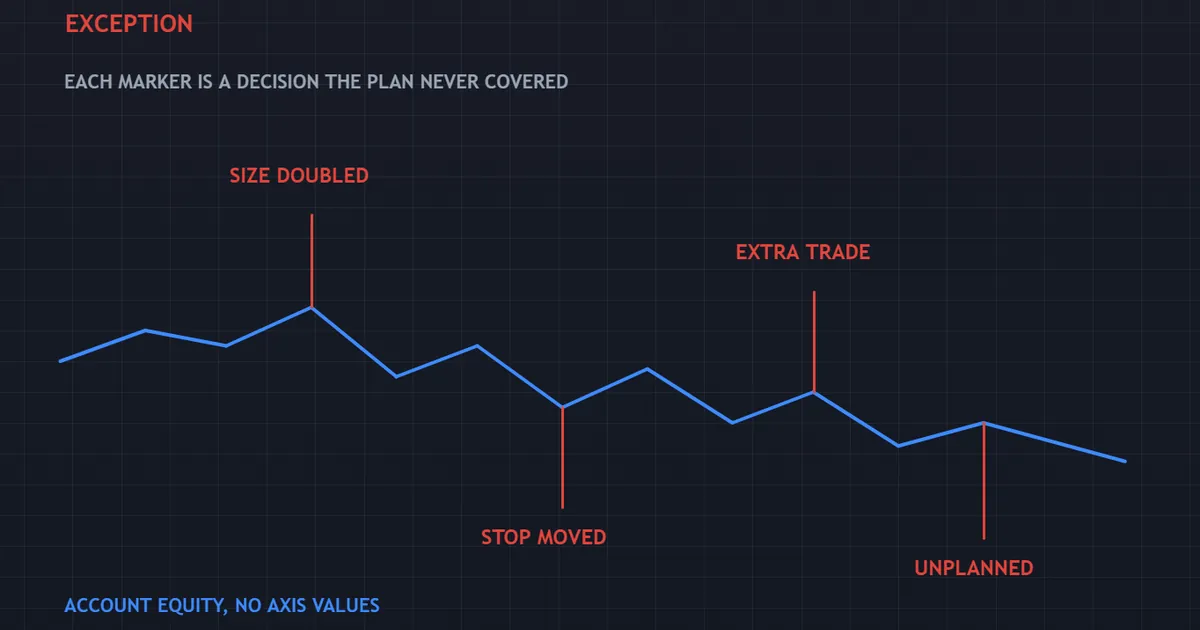
The panel above marks an equity curve at each unwritten exception. Every marker is a decision the document never covered, taken quickly, under pressure.
Two markers usually sit close together as well. One exception tends to invite the next, since the first one already proved the rules were negotiable.
The Damage Is Rarely One Big Event
Traders expect a single disaster. What actually happens is twenty small departures, none of them dramatic on its own.
Added together they change the character of the record. You end up unable to say whether the method works, because you never ran it cleanly.
Why the Record Goes Unreadable
Comparison needs a fixed reference. A plan that shifts quietly gives you a hundred slightly different experiments and no way to combine them.
Averages across those trades mislead badly. Mixing half a percent risk with two percent risk produces a figure describing neither, yet the spreadsheet reports it happily.
That is the real cost. Not the individual losses, but a year of data you cannot draw any conclusion from.
Traders in that position usually change method next. They abandon something workable, since nothing in the record defends it, and the new method inherits the same broken document.
Breaking that cycle needs no new strategy at all. Fix the plan first, run it cleanly for a quarter, and then judge whatever you were already doing.
A Cost You Can Actually Count
There is one number worth tracking here. Divide the trades that followed every line by the total, then watch that percentage month by month.
Most traders start somewhere near six in ten. Moving to nine in ten changes nothing about the market and everything about what your record can tell you.
Track it beside your results rather than instead of them. Two columns, read together, separate a method problem from an execution problem in about a minute.
Download the complete indicator database
Put these concepts on your charts. One email unlocks the full library of 1,380+ indicators with compiled MT4 and MT5 files, plus my TradingView scripts. No paywall, no spam, unsubscribe any time.
Get free access to my indicator database
One email unlocks 1,380+ free MT4, MT5 and TradingView indicators — the complete library. No single-tool download; you get the whole database.
Four: No Invalidation
Plenty of documents describe entries in detail and never name the price that ends the idea. That single omission causes more damage than the other five combined.
The Symptom
Stops move outward during trades. Or positions get closed on feel, sometimes early and sometimes very late.
Another sign is the sizing method. Traders without a written invalidation usually pick a lot size first, then find a stop that fits it.
Why It Happens
Naming the level that proves you wrong is uncomfortable. It forces you to accept the trade might fail before you have even taken it.
Skipping the line preserves optimism. It also removes the only input your position size depends on.
The Fix
Write the invalidation as a structure, not a number. Beyond the swing that formed the setup travels better than a fixed pip count.
Then size from it. Our guide to risk per trade covers the arithmetic that connects the two.
Five: No Review Date
A plan without a scheduled reader is a plan nobody reads. This failure explains why the other five persist for months.
The Symptom
You cannot remember when you last opened the document. Or you read it constantly and never compare it against your logged trades.
The second version fools people. Reading the plan is not reviewing it; the review needs both halves side by side.
Why It Happens
Reviews get scheduled as intentions rather than appointments. Sunday evening, when there is time, tends to mean never in practice.
Bad weeks make it worse. Traders skip the review precisely when the record has most to say.
The Fix
Name a weekday and a length, then hold both. Friday for twenty minutes suits many people, and any fixed slot beats an open intention.
Our note on how to review your trades covers what to read, and our trade journal supplies the record itself.
Six: Silent Drift
Drift is the failure everybody has and nobody notices. Nothing announces it, since every individual step looked reasonable at the time.
How Drift Builds
One larger position after a confident read. One stop widened because the level looked close. One extra instrument added during a quiet week.
Three months later your average size has doubled. Nobody decided that, and no single moment looks like the culprit.
The Symptom
Compare the size column across a quarter. A steady drift upward or downward is the clearest evidence available, and it takes a minute to spot.
Trade frequency tells a similar story. Rising counts usually point at boredom, while falling counts often follow a painful stretch.
The Fix
Only a comparison catches drift, so build one into the review. Count how many trades matched every line, and track that percentage over time.
Our guides on overtrading and how to be a disciplined trader cover the habits underneath it.
Drift Runs Both Ways
Upward drift gets all the attention, and the downward version is just as costly. After a rough stretch, size shrinks and setups get skipped.
That looks like prudence and behaves like something else. Cutting size after losses while keeping it after wins quietly changes the shape of your results.
Both directions show up in the same column. Track average size against your written percentage, and either drift becomes obvious within a month.
Quick Reference: Symptom, Cause and Fix
Use this table as a diagnosis sheet. Start from the symptom you recognise rather than the failure you expect.

| What you notice | The failure behind it | The smallest fix |
|---|---|---|
| You cannot mark last week’s trades | Too vague to test | Replace every adjective with a condition |
| You skip sessions the plan requires | Too rigid to follow | Cut it to your worst realistic day |
| Rules you cannot explain | Borrowed from a different life | Justify each line or delete it |
| Stops move outward mid-trade | No invalidation written | Name the structure that ends the idea |
| Months since you opened the file | No review date | Book a weekday and a duration |
| Average size has quietly changed | Silent drift | Track compliance as a percentage |
The Over-Correction Trap
Fixing these failures carries its own risk. Traders who discover the list often repair everything at once, which creates a seventh problem.

A New Rule After Every Loss
The panel above shows the pattern. One painful trade produces a fresh clause, and five losses later the document runs to three pages.
Those clauses eventually contradict each other. A plan demanding both patience and speed on the same setup suits nobody.
Why It Feels Productive
Adding a rule converts a bad feeling into an action. The relief is real, and the improvement usually is not.
Most new clauses address a single occurrence. Occurrences repeat rarely enough that the rule spends its life blocking nothing.
The Fix
Collect complaints during the week and handle them in one review. Batching shows you which problems actually repeat, and most do not.
Change one line per review, then leave it for twenty trades. Editing three at once removes your ability to tell which change mattered.
Deleting counts as an edit too. A plan usually improves faster by losing a clause than by gaining one.
Related Guides Worth Reading Next
Two neighbouring articles help you rebuild rather than patch. Pick whichever matches your situation.
If your document needs a rewrite from scratch, work through how to create a trading plan, which walks each decision in build order. For the concept itself, what a trading plan is explains what belongs inside and what a plan cannot do.
Traders whose setup rules lean on chart tools can browse our MetaTrader indicators library while rewriting. Whatever you use, pin the settings in the plan so the rule stays checkable.
FAQ
Which trading plan mistake causes the most damage?
A missing invalidation, by some distance. Without a written level that ends the idea, stops get chosen to fit a preferred position size, then moved when price approaches them. Every other failure on the list makes your record harder to read, while this one changes the size of your losses directly.
How do I know whether my plan is too vague?
Hand it to somebody else along with a week of your trades, and ask them to mark which trades followed the rules. Disagreement between their marking and yours shows exactly which lines carry ambiguity. Doing this once usually reveals two or three phrases that were doing no work at all.
Is it a mistake to change my plan often?
Changing it on a schedule is healthy, while changing it after individual trades is not. Most drift enters through edits made in reaction to a single painful outcome. Batch your complaints, handle them at review time, and give each change twenty trades before judging it.
My plan looks fine but I keep breaking it. What now?
Treat that as a design problem before a discipline problem. Rules that people repeatedly break usually ask for something impractical, such as hours that clash with work or a preparation routine nobody could sustain. Cut the plan until you would follow it on a bad day, then rebuild upward slowly.
Should a beginner’s plan be shorter?
Shorter and blunter, yes. Three lines that always get followed teach you more than twenty that get followed sometimes. Risk per trade, the price that ends an idea, and a daily stopping point cover the expensive decisions, and everything else can arrive once those three hold.
How many rules should a plan contain?
Few enough that you can recite them, which for most traders means somewhere between eight and twelve lines. Beyond that the document stops being a working reference and turns into a policy manual. If a plan keeps growing at every review, that growth is usually the over-correction trap rather than genuine refinement.
Will fixing these mistakes improve my results?
It will make your results readable, which comes first. A plan you can mark, follow and review lets you judge a method across dozens of trades rather than guessing from a handful. If the method has no advantage, a cleaner document reveals that faster rather than changing the outcome, and that early clarity is worth having. Results are not guaranteed; past performance is not indicative of future results.
External references
- For background on this concept, see Planning Fallacy on Wikipedia.
- For broader market context, see Discretionary Investment Management at Investopedia.

About the author
Written by Dominic Walsh, a Forex trader and MT4/MT5 indicator, Expert Advisor and script developer. Every tool on forexmt4systems.com is tested on live charts before release and ships with ready-to-use compiled MT4 (.ex4) and MT5 (.ex5) files. Learn more about the trader and developer behind this site.
How we build, test and correct every tool: Editorial & Testing Policy. Trading carries risk; see the disclaimer.