
The position trading vs swing trading question usually gets answered with a holding period and nothing else. That answer is true and almost useless.
Hold time is the visible difference. Underneath it sit swap costs, a much wider stop, a smaller position and a very different relationship with the news.
Position Trading vs Swing Trading at a Glance
Both styles ride the same kind of move. They simply choose different slices of it.
A swing trader takes a leg that lasts two days to two weeks. A position trader holds the whole run, which may take two months.
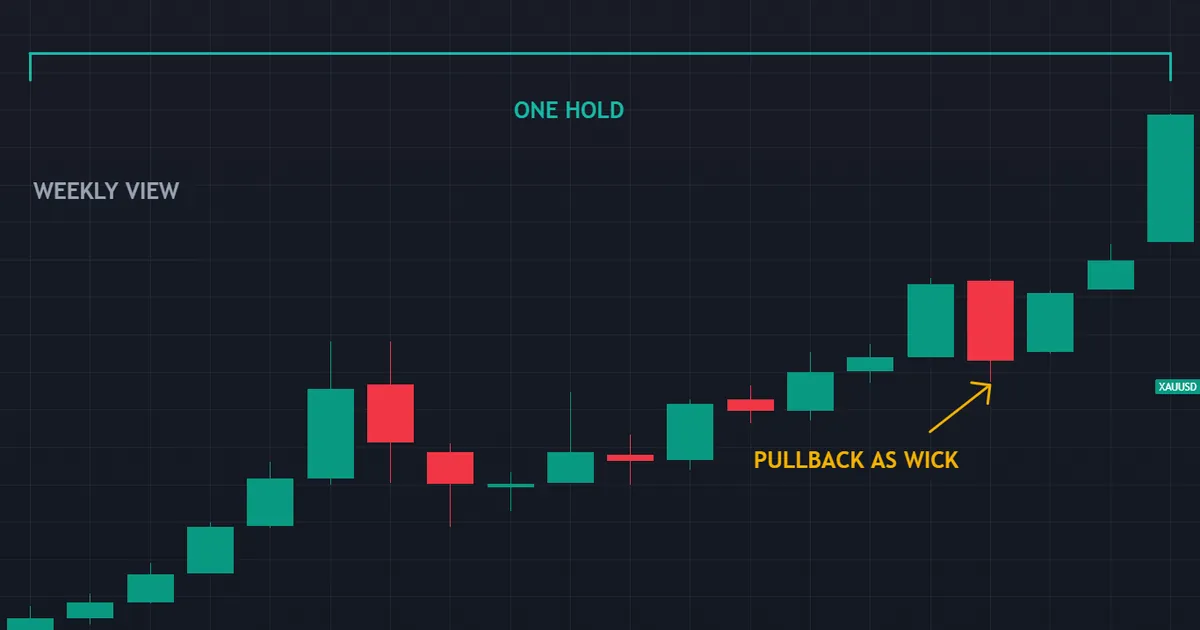
Above sits XAUUSD on weekly bars. That is the frame a position trader works in, where a fortnight of chop occupies a couple of candles.
The Same Market, Two Holding Periods
Neither style has its own market. Both look at the same instruments and the same moves.
What separates them is where they choose to get off. A swing trader exits at the first meaningful stall, while a position trader plans to sit through several.
That decision then drives everything downstream. Stop width, size, cost, screen time and even the type of analysis all follow from it.
So the comparison is less about markets than about commitment. Once you fix the holding period, most of the other choices stop being choices at all and become arithmetic.
What the Weekly View Shows
Weekly bars hide detail on purpose. A three-day reversal that would panic a swing trader shows up as a wick.
Position traders rely on that compression. It removes most of the noise that would otherwise pull them out early.
The cost is precision. Entries and stops on a weekly chart sit a long way apart, which has direct consequences for size.
Where the Labels Come From
Nobody regulates these terms, so usage drifts. Some traders call a three-week hold a swing trade, others call it a position.
Treat the labels as rough buckets rather than definitions. What matters is the holding period you actually commit to before entry.
A written hold expectation beats any label. It tells you whether a two-day stall counts as information or as noise.
The Five Differences That Matter
Five practical differences separate the two styles. Everything else is commentary.
- Holding period. Days to a fortnight against weeks to months.
- Swap exposure. A handful of rollovers against dozens of them.
- Backdrop weight. Structure and levels against rate and policy direction.
- Stop width and size. A moderate stop against a far wider one at the same risk.
- Feedback speed. Dozens of trades a year against a handful.
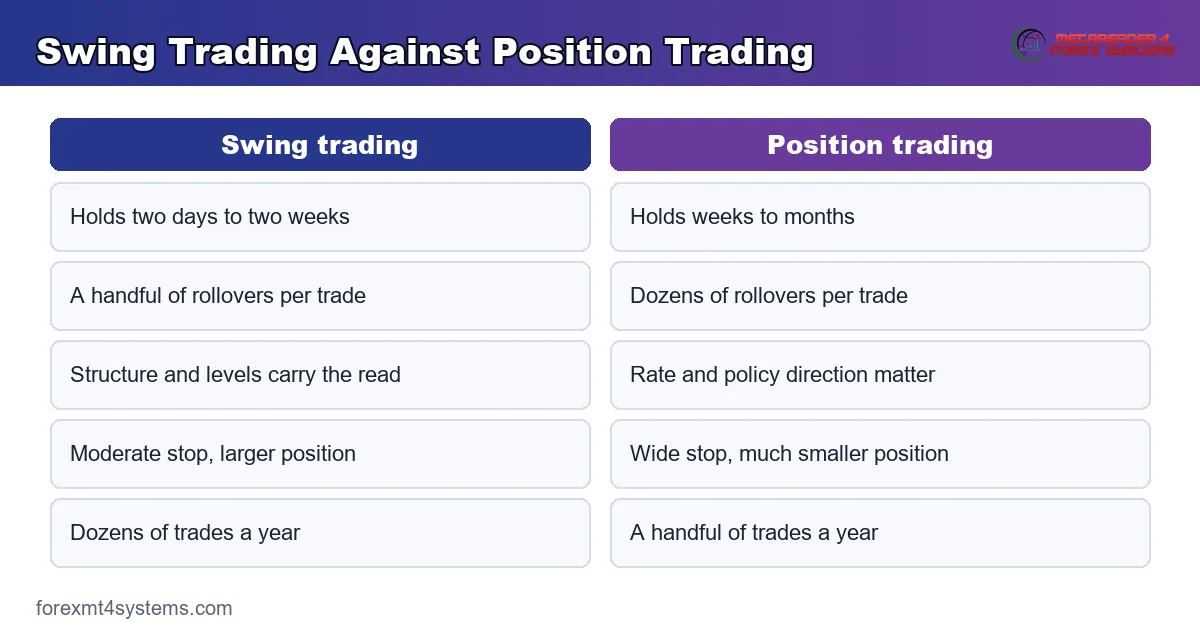
Work down that list and the choice usually resolves itself. Two of the five tend to decide it outright.
One: Holding Period
Swing trades resolve inside a fortnight, so a losing idea clears quickly. You find out whether the read was sound within days.
Position trades take months to answer. That slow verdict tests patience and ties up margin for a long stretch.
Our note on multi-timeframe analysis covers how to frame one holding period inside another.
Two: Swap Exposure
Every night a position stays open, the broker debits or credits a financing charge. A five-day swing trade meets that four or five times.
A two-month position meets it around forty times, with a triple charge on the weekly rollover day. On a negative-swap pair, that adds up to a real drag.
Check the figure before committing. Our swap calculator turns the nightly rate into a number you can weigh against your objective.
Three: How Much the Backdrop Matters
Swing traders can work almost entirely from structure. A two-week move rarely needs a view on central bank policy.
Position traders cannot ignore it. A trade held for three months sits inside a rate cycle, a commodity supply story or a shift in risk appetite.
That does not mean forecasting. It means knowing what the market currently prices, so a surprise does not arrive as a complete shock.
Four: Stop Width and Position Size
Here is the difference traders underestimate most. A weekly stop might sit four or five times further away than a daily one.
At the same risk per trade, that forces the position to shrink by the same factor. The trade feels tiny, and it should.
Run the arithmetic rather than guessing at it. A position size calculator makes the shrinkage obvious in seconds.
Five: Trade Count and Feedback Speed
A swing trader may take forty trades a year across a small watchlist. A position trader might take eight.
Sample size follows directly. Judging a position method takes years, while a swing method gives a readable record within one.
The Same Move on Daily Bars
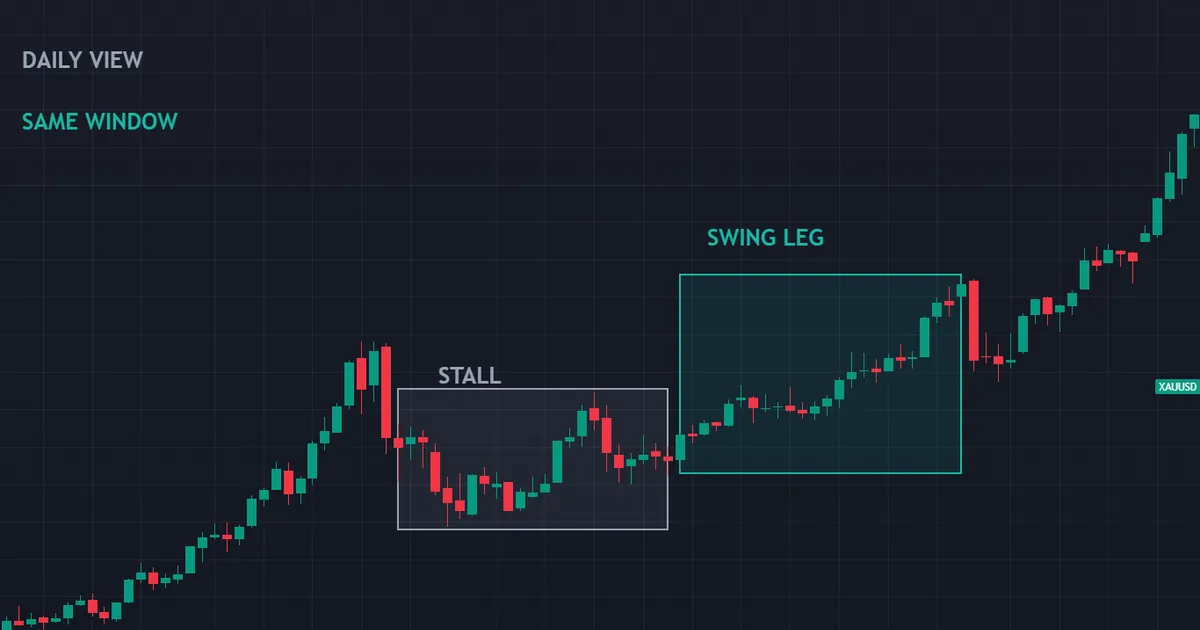
Now look at the identical market and the identical window on daily bars. Nothing about the market changed, only the resolution.
What Changes When You Zoom In
Detail that the weekly chart compressed into a wick now spreads across several sessions. Pullbacks look like reversals, and consolidations look like tops.
A swing trader would take two or three separate trades inside this window. Each one ends at a stall that the position trader simply sat through.
More trades means more entries, more exits and more cost. It also means more chances to be right, and more chances to be shaken out.
Why This Is One Chart, Not Two Examples
Both images show the same instrument over the same stretch of time. That identity is the whole teaching point.
Traders often compare styles using two different markets, which proves nothing. Holding period, not market selection, is what actually differs here.
So when someone says a style suits gold, ask which timeframe they mean. The answer usually reveals a holding preference dressed up as market analysis.
Common Mistakes and Their Fixes
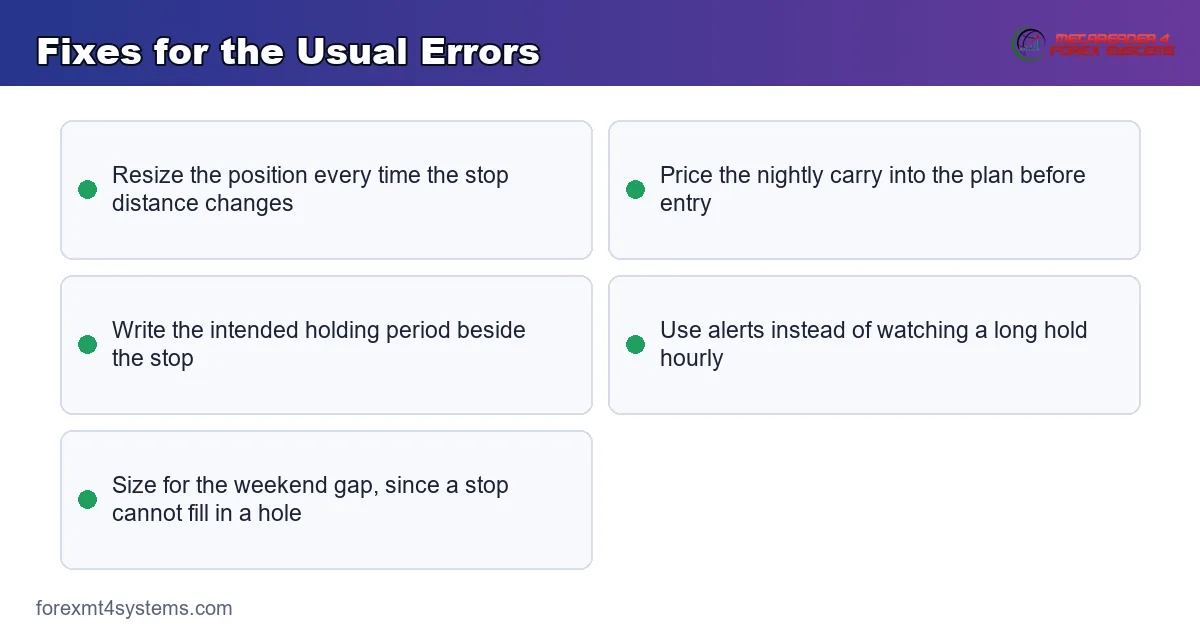
Six errors dominate this comparison. Each has a direct correction.
Carrying Swing Size Into a Position Trade
Widening the stop without shrinking the lot multiplies the loss. The trade now risks several times what the plan allowed.
Recalculate size from the new stop distance every time the timeframe changes.
Ignoring the Financing Bill
A negative swap of a few units per night looks trivial. Multiply it by forty nights and it can consume a meaningful share of the objective.
Price the carry into the plan before entry, and remember that rates vary by broker and change without notice.
Turning a Swing Trade Into a Position Trade
A swing trade that goes wrong gets rebranded as a long-term view. That is not a style change; it is a stop being removed.
Decide the holding period before entry and write it down beside the stop.
Watching a Position Trade Hourly
A months-long idea checked six times a day will get closed early. Every intraday wobble looks like the beginning of the end.
Set alerts at the levels that matter and close the platform.
Skipping the Weekend Question
Positions held across the weekend face a gap at the Monday open. Stops do not protect against a price that never trades.
Read our note on weekend gaps and size accordingly.
Comparing the Two on Trade Count
Position trading looks inactive next to swing trading, which some traders read as inefficiency. Activity is a cost, not an achievement.
Judge each style on how well you execute it, never on how busy it keeps you.
Quick Reference Comparison
The table below collects the practical differences in one place.
| Dimension | Swing trading | Position trading |
|---|---|---|
| Typical hold | Two days to two weeks | Several weeks to several months |
| Working chart | Four-hour and daily | Daily and weekly |
| Rollovers paid | A handful per trade | Dozens per trade |
| Stop width | Moderate, framed by recent swings | Wide, framed by weekly structure |
| Position size at equal risk | Larger | Much smaller |
| Backdrop needed | Light | Substantial |
| Trades per year | Dozens | A handful |
| Screen time | Twenty to forty minutes daily | An hour a week |
Read the rows that touch your constraints hardest. Those decide the answer far more than preference does.
Notice that no row promises a better outcome. The table describes demands and costs, because those are the parts anyone can verify in advance.
Where Holding Costs Quietly Decide It
Carry rarely appears in style comparisons, yet it settles plenty of them. The panel below shows how the bill grows with time.
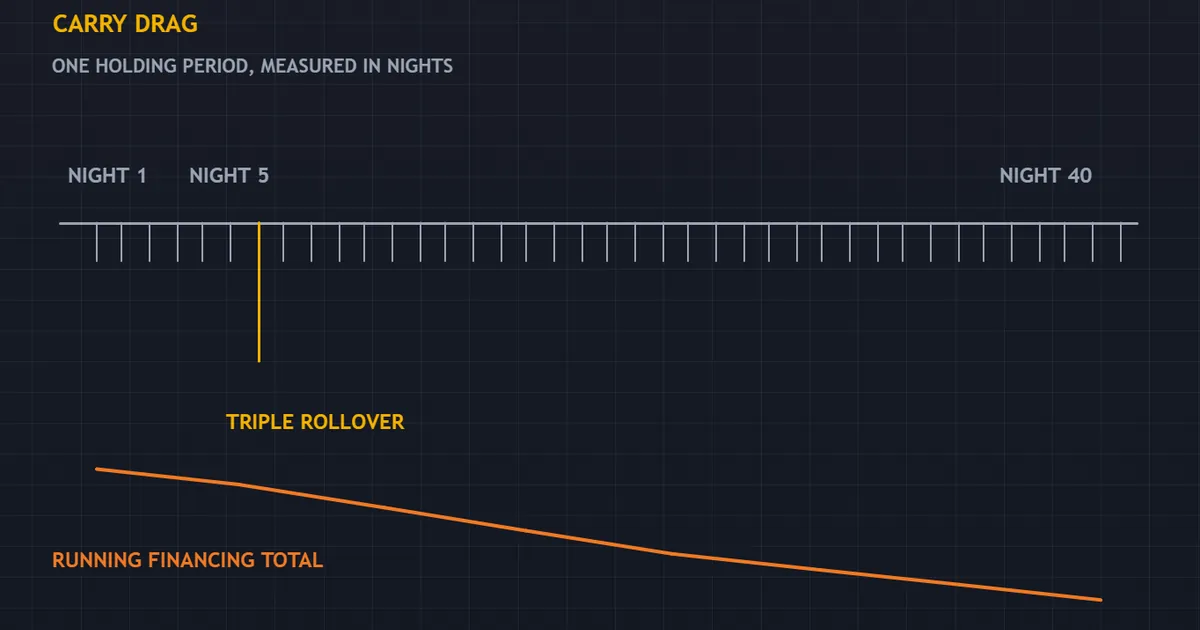
Forty Nights of Financing
A nightly financing charge that barely registers on a five-day trade becomes visible over two months. The charge accrues whether the trade works or not.
On the other side, a positive carry pays you to wait. Traders sometimes choose direction partly on that basis, which is a real consideration rather than a trick.
Why the Rate Cannot Be Treated as Fixed
Swap rates come from the interest differential plus whatever the broker adds. Both parts move.
A pair that pays you today can cost you next quarter after a central bank meeting. Our guide to swap in forex explains where the number comes from.
How This Changes Instrument Choice
Position traders naturally drift toward pairs where the carry does not fight them. Swing traders can largely ignore the issue.
That is a genuine structural difference between the styles. It also explains why the two groups often trade different instruments while claiming to trade the same market.
Sizing the Wider Stop Properly
The size question deserves its own section, because it causes more damage than anything else here.
Same Risk, Different Lot
Risk per trade should not change with holding period. If you risk one percent on a swing trade, you risk one percent on a position trade.
The stop distance changes, so the lot must change to compensate. A stop four times wider means roughly a quarter of the position.
Our guide to position sizing walks through the calculation step by step.
Why the Small Position Feels Wrong
A correctly sized position trade looks trivially small on the platform. Traders raise it to feel meaningful, then discover the real risk during the first drawdown.
The small size is the point. It buys the room the wide stop needs.
Margin and Open Trade Count
Long holds tie up margin for months. Running six position trades at once can leave very little free margin for anything new.
Plan the maximum number of concurrent positions in advance. Otherwise the seventh good idea arrives with nowhere to go.
How Each Style Handles a Losing Trade
Losses feel different at different holding periods. That difference matters more than most comparisons admit.
The Swing Loss Is Quick and Clean
A swing trade that fails hits its stop within days. The capital comes back, the lesson lands, and you move on.
Frequency softens the blow as well. One loss among forty a year barely registers emotionally.
The Position Loss Is Slow and Loud
A position trade can sit underwater for six weeks before resolving either way. Watching that daily wears people down.
Scarcity makes it worse. When you only take eight trades a year, each one carries far more emotional weight than it should.
Plan for that in advance. Deciding how you will behave during a long drawdown works better than deciding it while inside one.
Both Need the Same Written Exit
Neither style survives a moving stop. The temptation simply arrives on a different schedule.
Write the invalidation price at entry and leave it alone. That rule does not change with holding period.
Download the complete indicator database
Put these concepts on your charts. One email unlocks the full library of 1,380+ indicators with compiled MT4 and MT5 files, plus my TradingView scripts. No paywall, no spam, unsubscribe any time.
Get free access to my indicator database
One email unlocks 1,380+ free MT4, MT5 and TradingView indicators — the complete library. No single-tool download; you get the whole database.
Entry Timing Across the Two Styles
Both styles benefit from a better entry, though for opposite reasons. The mechanics differ more than the theory suggests.
Swing Entries Reward Precision
A tighter entry on a swing trade shortens the stop and lifts the size. Precision therefore pays directly.
Most swing traders drop one timeframe below their working chart to time it. A four-hour idea gets executed on the hourly.
Position Entries Reward Patience
Shaving twenty pips off a weekly-chart entry changes almost nothing. The stop sits hundreds of pips away regardless.
What matters instead is entering at all. Position traders miss far more by waiting for a perfect price than they ever save by getting one.
Scaling in solves part of this. Two or three partial entries across a week remove the pressure of picking a single moment.
Neither Style Needs a Perfect Fill
Entry quality ranks below sizing and exit discipline in both cases. Traders reverse that order constantly.
Spend the effort where the outcome lives. A written exit and a correct lot size beat a clever entry every time.
Building the Watchlist for Each Style
Instrument choice quietly follows the holding period. Most traders never notice the connection.
Swing Watchlists Can Be Narrow
A handful of liquid pairs produces enough setups over a fortnight cycle. Six to ten instruments usually keeps a swing trader busy.
Spread matters less than at scalping frequency, though it still counts. Objectives measured in tens of pips absorb an ordinary spread comfortably.
Position Watchlists Need Breadth
Long holds mean fewer opportunities per market. A position trader watching four pairs may wait months for a qualifying setup.
Widening the list solves that. Metals, indices and a broader currency set give the same rule more chances to trigger.
Correlation Bites Harder on Long Holds
Three correlated positions held for months are effectively one large bet. A single macro shift moves all of them together.
Group the watchlist by driver before sizing. One unit of risk per group keeps a bad quarter from becoming a bad year.
Which One Should You Run
Three questions settle it for most traders. Answer them honestly and the choice narrows quickly.
How Fast Do You Need Feedback
Learning needs a sample. Someone building a first method benefits from the faster loop that swing trading provides.
Position trading suits traders who already trust their process. Waiting years for a verdict is only tolerable when the process is settled.
How Stable Is Your Attention
Position trading demands that you leave things alone for weeks. Swing trading demands a daily routine you can actually keep.
Pick the demand you can meet. Our framework on how to choose a trading style works through the wider version of this question.
What Does Your Account Allow
Very wide stops on a small account push the position below the minimum lot. That single constraint rules out weekly-chart position trading for many people.
Check it before committing. The arithmetic is unforgiving and it does not negotiate.
How Much Carry Can You Absorb
Long holds on a negative-swap pair pay a nightly toll for months. That toll comes out of the same objective you are trying to reach.
Swing trading sidesteps most of it. Where the carry runs strongly against you, the shorter hold is often the more sensible answer.
Moving Between the Two Without Damage
Traders often shift from one style to the other as circumstances change. Doing it cleanly protects the record.
Finish the Open Book First
Let existing trades run to their original rules. Applying a new holding period to a live position confuses both records permanently.
Then start the new style with a fresh section in your log. Blending the two produces an average that describes neither.
Rebuild the Size Rule Before the First Trade
Moving from daily to weekly stops changes every lot calculation. Work through the arithmetic once, on paper, before placing anything.
Traders who skip this step usually discover the error during the first adverse week. By then the position is already too large to hold comfortably.
Give the New Style a Fair Sample
Position trading cannot be judged over three months. Set the review point by trade count rather than by calendar.
Twenty trades gives you a first impression. Anything shorter tells you about the market rather than the method.
Related Guides Worth Reading Next
Both styles sit inside the same broader family, so the next step depends on which side attracted you.
Read our guide to trend following if the position side appealed, since it explains the low strike rate and long flat periods that come with long holds. It also covers why the exit rule, rather than the entry, does most of the work.
Traders leaning toward the swing side can browse our support and resistance indicators archive, since level-based framing carries more weight over shorter holds.
FAQ
Is position trading vs swing trading really just about hold time?
Hold time is the surface difference. Underneath it sit swap exposure, stop width, position size, margin usage and how much the macro backdrop matters. Two traders holding the same instrument for five days and five months are running genuinely different businesses, even though the chart on screen looks identical.
Which style suits a smaller account better?
Swing trading, in most cases. Wide weekly stops at a sensible risk per trade force the position size down, and on a small account that can land below the broker minimum. Tighter stops over shorter holds keep the arithmetic workable, though they demand a more regular routine. Raising leverage to force a bigger position does not solve the problem, since the loss in currency terms grows in step with it.
Do position traders need to follow the news?
They need to know what the market already prices, which is not the same as forecasting. A trade held across a rate cycle will meet several policy decisions, and a surprise moves price hardest when it lands against consensus. Awareness of the backdrop is a risk control rather than a prediction tool. Knowing that a central bank meets next Thursday tells you when to check your exposure, not which way to lean.
How much does swap really cost over a long hold?
It depends entirely on the pair, the direction and the broker, and the rate changes over time. What matters is the method: find the nightly figure, multiply it by the expected nights, remember the triple charge on rollover day, then compare that total to your objective. A carry that eats a large share of the target usually kills the trade idea.
Can I run both styles at the same time?
You can, provided you keep separate records and separate risk budgets. Problems start when a swing trade quietly becomes a position trade after it goes wrong. Write the intended holding period on each trade at entry, and treat any change to it as a rule break rather than a decision.
Which style produces better results?
Neither, as a general rule. Holding period changes the cost structure, the feedback speed and the psychological load, not the quality of an edge. The style you can execute consistently, at a risk you can sustain, will do more for your record than the label ever will. Results are not guaranteed; past performance is not indicative of future results.
External references
- For background on this concept, see Position Trading at BabyPips Forexpedia.
- For broader market context, see Time Horizon at Investopedia.

About the author
Written by Dominic Walsh, a Forex trader and MT4/MT5 indicator, Expert Advisor and script developer. Every tool on forexmt4systems.com is tested on live charts before release and ships with ready-to-use compiled MT4 (.ex4) and MT5 (.ex5) files. Learn more about the trader and developer behind this site.
How we build, test and correct every tool: Editorial & Testing Policy. Trading carries risk; see the disclaimer.