
Knowing what is swap in forex saves you from a cost that quietly grows every night you hold a trade. Swap is the interest you pay or earn for keeping a position open past the daily rollover. So a trader who ignores it can watch a winning idea slowly bleed away over a week.
This guide explains what is swap in forex, where the number comes from, and how to turn it from a mystery into a plan. It walks through the interest-rate logic, the triple charge on Wednesday, and the simple math you can run before any overnight trade.
What Is Swap in Forex, in Plain Terms
Every forex trade means holding one currency and borrowing the other. You buy euros with dollars, so you own euros and owe dollars. Each currency carries its own interest rate, set by its central bank.
Swap settles the difference between those two interest rates. When you hold a position overnight, your broker credits the rate on the currency you own and debits the rate on the currency you owe. So the swap is simply the net of those two rates for one night, credited or debited to your account automatically.
The direction decides whether you gain or lose. Hold the higher-yielding currency, and the net can fall in your favour, a positive swap. Hold the lower-yielding one, and the net works against you, a negative swap. So the exact same pair can pay one trader and charge another on the very same night.
Here sits the key point. Swap has nothing to do with whether your trade wins or loses on price. It is a separate, nightly interest cost or credit that lands whenever you carry a position past the rollover.
The Rollover Moment
Look at a concrete frame first. The chart shows EURUSD on the one-hour timeframe near 1.14, with a vertical line marking 5 p.m. New York time. That line is the rollover, the exact moment the broker applies the swap.
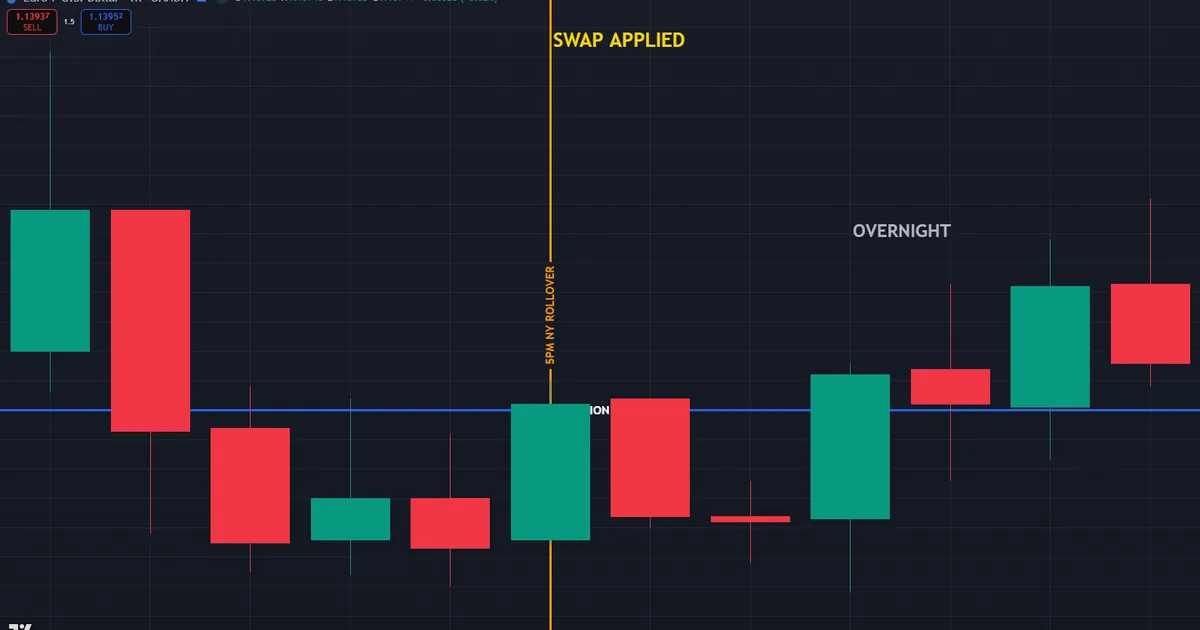
Trace the day around that line. Before 5 p.m. New York, the position simply floats with price. At the rollover instant, the broker adds or subtracts the swap, and a new trading day begins. So a trade closed before that line pays no swap at all.
Why does this matter so much? A day trader who exits before the rollover never touches swap. A swing trader who holds for a week meets it several times over. So your holding period, more than anything else, decides how large the swap grows on a trade.
Where the Swap Number Comes From
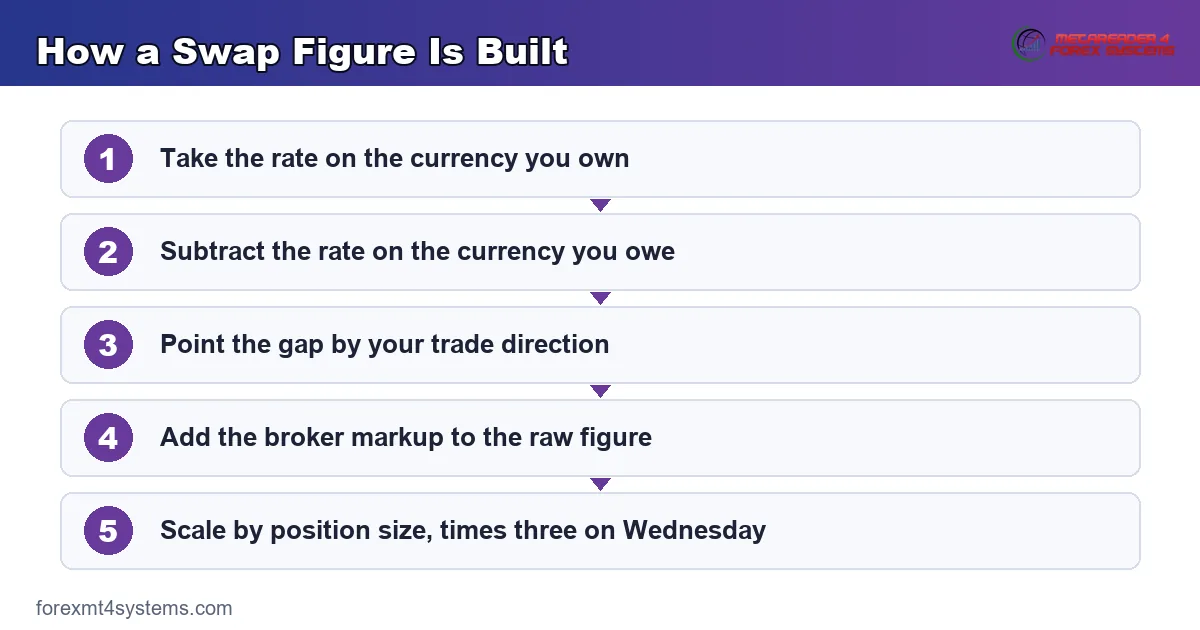
The swap looks mysterious until you break it into parts. A few ideas explain the whole figure.
- The interest-rate differential. Start with the rate on the currency you own minus the rate on the currency you owe. A wide gap creates a larger swap in either direction.
- The direction of your trade. Buying the higher-yielding currency points the differential your way, while selling it points the differential against you. So the same pair can pay or charge depending on your side.
- The broker markup. Your broker adds its own margin to the raw differential, usually widening the debit and trimming the credit. So the swap you see rarely matches the pure interest gap.
- The position size. Swap scales with the notional value of your trade. A larger lot carries a proportionally larger nightly figure.
- The triple charge. Most brokers book three days of swap on Wednesday to account for weekend settlement. So one night of the week carries triple the usual number.
So the swap blends the rate gap, your direction, a markup, and your size. The concept graphic below lines up these parts step by step.
Why Interest Rates Sit Behind It
Every currency is really a claim on a country’s money, and that money earns interest. When you hold euros, you effectively lend at the euro rate. When you owe dollars, you effectively borrow at the dollar rate. So a trade is a tiny loan in one currency funded by a tiny loan in another.
Swap simply settles that borrowing and lending each night. The rate you earn on what you hold offsets the rate you pay on what you owe. So the net of the two, adjusted by your broker, becomes the number on your statement.
This framing explains the whole system. A wide rate gap creates a large swap, a narrow gap creates a small one, and your direction decides the sign. Because central-bank policy sets those rates, the swap ultimately traces back to interest-rate decisions far from your chart.
Positive and Negative Swap
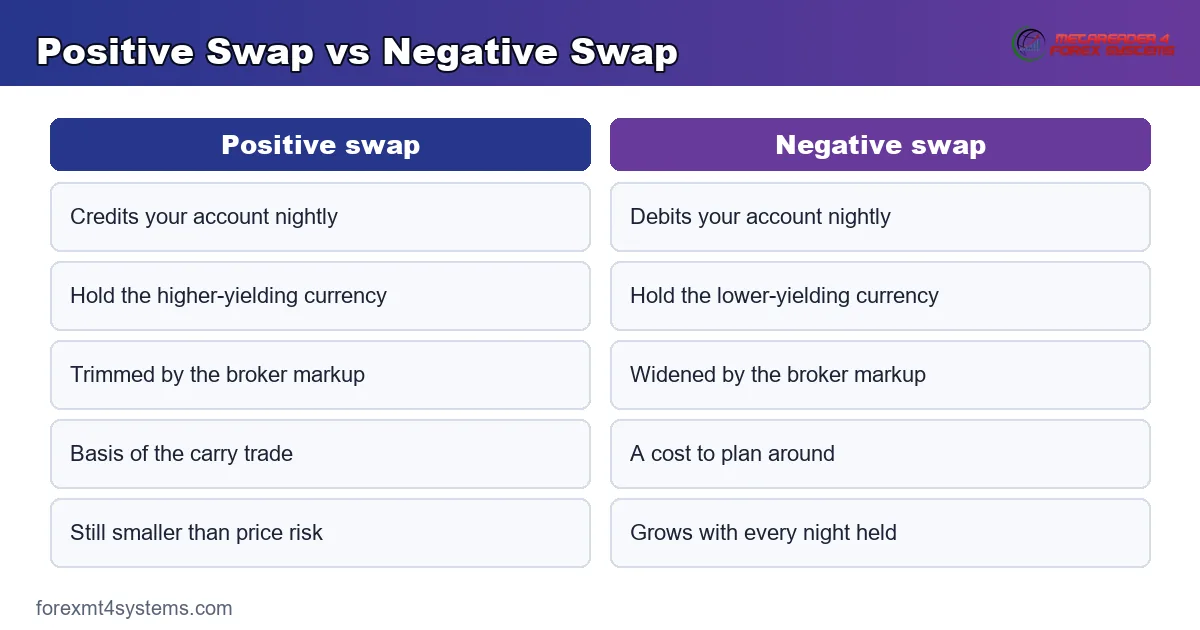
The sign in front of the swap tells the whole story. A positive swap credits your account each night, while a negative swap debits it. So the same pair can help one trader and cost another, purely by direction.
Picture two currencies with a clear rate gap. A trader who buys the higher-yielding one and sells the lower-yielding one may earn a small nightly credit. The trader on the opposite side pays that credit, plus the broker’s markup.
Traders sometimes chase this credit on purpose, a habit called the carry trade. They hold a positive-swap position for weeks to collect the nightly interest. Yet the price risk still dwarfs the swap, so the carry never turns a bad trade good.
History offers a caution here. Popular carry trades can unwind fast when sentiment shifts, and the price drop erases months of collected swap in a day. So the nightly credit is real, but it never insures you against a sharp reversal in the pair.
The Triple Swap on Wednesday
One night of the week behaves differently. Most brokers charge or credit three days of swap at the Wednesday rollover, not one. So a position held across Wednesday night meets a figure three times the usual size.
The reason lies in settlement. Forex trades settle two business days after the trade, and a Wednesday position would settle over the coming weekend. Since the market does not book swap on Saturday and Sunday, the broker rolls those days into Wednesday.
This quirk matters for planning. A negative-swap trade held across Wednesday costs triple that night, which can sting on a large position. So many swing traders check the day of the week before they open or hold a costly carry.
How Swap Works in Practice
Numbers turn the idea into a plan. Picture a trader holding one standard lot of a pair where the nightly swap on the sell side runs at a small negative figure.
Suppose the broker quotes a swap of minus 7 USD per night on that lot. Hold for four ordinary nights, and the cost reaches 28 USD. Add a Wednesday in the middle, and that night alone charges triple, near 21 USD, pushing the week higher. So the swap grows with every night you carry the trade.
Flip to the positive side to see the mirror. A trader on the opposite direction might earn a small credit each night, though the broker’s markup keeps that credit modest. So the same pair rewards one side and charges the other, and the markup quietly favours the broker on either direction of the trade. You can estimate any pair with our free swap calculator.
A Worked Weekly Example
Trace a full week to feel the effect. A swing trader buys a pair on Monday and plans to hold through Friday, expecting a slow rise in price.
Watch the swap stack up. Monday, Tuesday, and Thursday each book one night at the quoted rate, while Wednesday books three. So by Friday the trader has paid or earned six nights of swap in total, even though only five calendar days passed. The chart below marks each rollover along the trade.
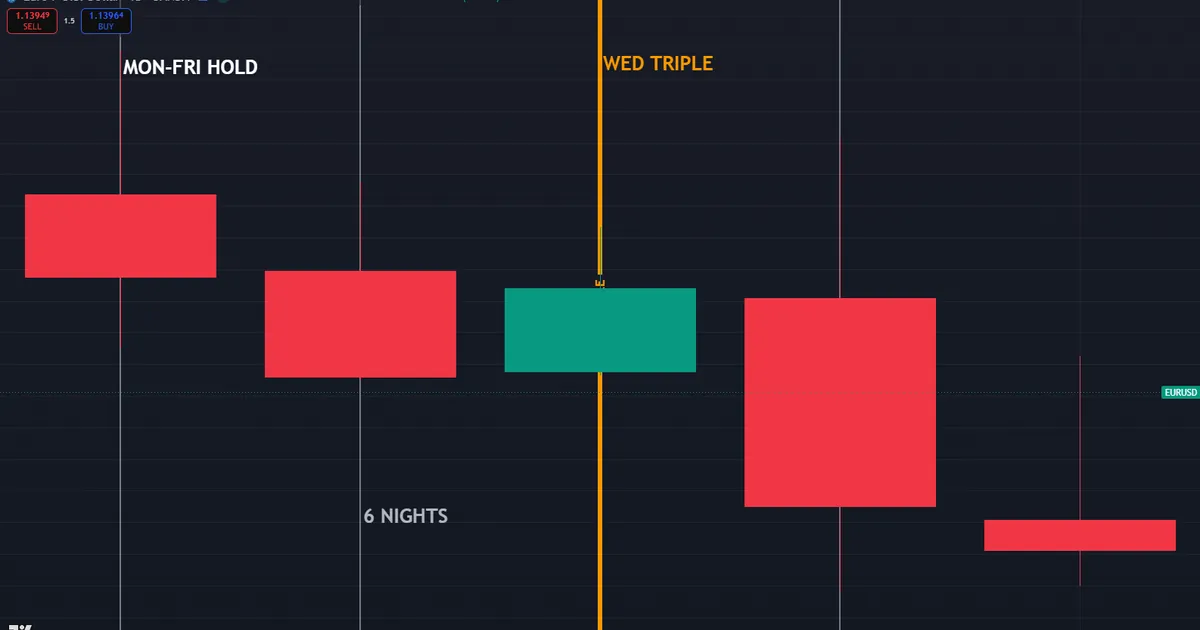
Now weigh that against the price move. If the trade gained many pips, a modest negative swap barely dents the profit. Yet if price drifted sideways for the week, the swap can turn a flat trade into a small loss. So the swap matters most when the price move stays small.
One habit settles the question in advance. Before any multi-night trade, check the quoted swap for your direction and multiply it by the nights you plan to hold. So you enter knowing the carry cost, not guessing at it later.
Scale the same math to your real size. A trader running two lots doubles every nightly figure, and a trader running a tenth of a lot shrinks it just as fast. Because swap tracks the notional value, the total always moves with your position size, so a big carry demands a closer look than a small one.
Managing Swap on Your Trades
Swap rewards a little planning. So build a few simple checks into your routine before you hold anything overnight.
Check your direction’s swap first. The buy side and the sell side of a pair carry different numbers, and one is often far worse than the other. So confirm the figure for your exact side, not the pair in general.
Then weigh the swap against your expected hold. A quick two-day trade rarely cares about swap, while a two-week carry lives and dies by it. Because the cost compounds nightly, the longer the hold, the more the swap matters.
When Swap Can Be Avoided
The simplest way to skip swap is to close before the rollover. A trader who exits every position before 5 p.m. New York never books an overnight charge. So intraday styles sidestep swap entirely by design.
Some accounts offer another route. A swap-free or Islamic account replaces the interest charge with a flat admin fee on certain pairs, built for traders whose beliefs forbid interest. So check whether your broker offers one if overnight interest is a concern.
Choosing Pairs With Swap in Mind
Swap can steer your pair selection over the long run. A trader who always holds overnight may favour the positive-swap direction on a pair with a wide, stable rate gap. So the carry becomes a small tailwind rather than a headwind.
Still, keep the priorities straight. Price direction dominates every trade, and the swap only nudges the edges. So never pick a losing setup just to earn a nightly credit; let the chart lead and treat swap as a tiebreaker.
Reading Your Broker’s Swap Table
Most brokers publish a swap table inside the platform or on their site. Open it before any overnight trade, and find your pair and direction. The table lists a separate figure for the buy side and the sell side, quoted per lot.
Read the units with care. Some brokers quote swap in points, some in the account currency, and some in a mix. So confirm what the number means before you multiply it, or the total you plan for will miss the mark.
Watch for updates too. A broker can revise its swap table after a central-bank meeting or a policy shift. Because the figures move, treat the table as a live document and recheck it whenever rates change.
Download the complete indicator database
Put these concepts on your charts. One email unlocks the full library of 1,380+ indicators with compiled MT4 and MT5 files, plus my TradingView scripts. No paywall, no spam, unsubscribe any time.
Get free access to my indicator database
One email unlocks 1,380+ free MT4, MT5 and TradingView indicators — the complete library. No single-tool download; you get the whole database.
Common Mistakes and How to Fix Them
Swap trips up beginners in a handful of predictable ways. Most trace back to forgetting that the cost lands every single night, and the fixes follow beneath the graphic.
Ignoring Swap on Long Holds
A trader who holds for weeks without checking swap can lose a real chunk to interest. The nightly figure looks tiny, yet it compounds. So total the swap across your planned hold before you enter, not after.
Forgetting the Wednesday Triple
A position carried across Wednesday night meets three days of swap at once. A trader caught unaware sees an unexpected debit. So mark Wednesday on your calendar and plan any costly carry around it.
Assuming Both Directions Cost the Same
The buy and sell sides of a pair carry different swaps, and the gap can be wide. Assuming symmetry leads to nasty surprises. So look up the figure for your exact direction every time.
Chasing Positive Swap Blindly
A positive nightly credit tempts traders into the carry trade, yet price risk still rules. A small credit means nothing against a large adverse move. So treat swap as a minor edge, never as a reason to hold a losing trade.
Overlooking the Broker Markup
The swap you see already includes the broker’s margin, which widens the debit and shrinks the credit. A trader who expects the pure rate gap feels cheated. So read the broker’s own swap table rather than assuming the raw differential.
Quick-Reference Swap Checklist
Run this short list before you hold any trade overnight. A minute here prevents a surprise debit later. So tick each item, and let a failed check keep you flat or shorten your hold.
- Swap figure confirmed for your exact direction, buy or sell.
- Planned holding period counted in nights, not calendar days.
- Wednesday triple charge accounted for in the total.
- Swap total weighed against the expected price move.
- Rollover time near 5 p.m. New York noted for the pair.
- Swap-free account considered if interest is a concern.
- Position size checked, since swap scales with the lot.
Pitfalls and Edge Cases
Study the trap as hard as the rule. Here is a common one. A trader opens a large negative-swap position on Tuesday, plans to hold a few days, and forgets the calendar entirely.
Then the debit arrives. Wednesday night books triple swap, the account drops more than expected, and the trader blames the broker for an error that never happened. The chart below marks that triple charge landing right at the Wednesday rollover line.
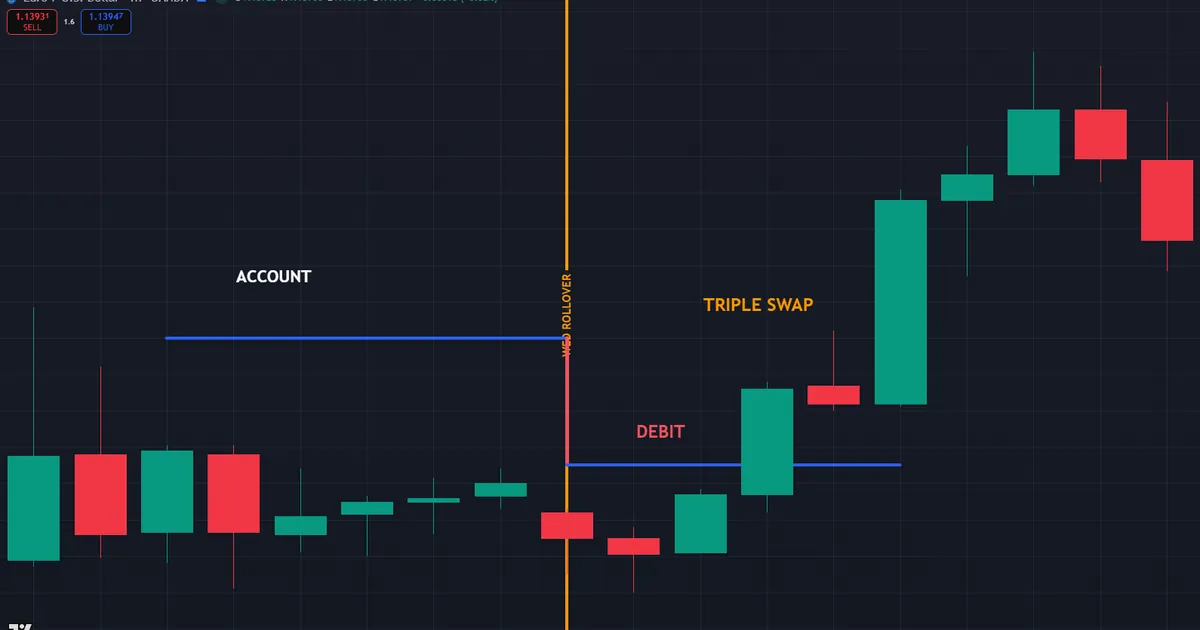
So what went wrong? The trader treated swap as a flat nightly cost and ignored the Wednesday quirk. A triple charge on a large lot is real money. Hence the rule that limits the damage: always check the day of the week before you hold a costly carry.
A second edge case catches the scalper who drifts. A trader who meant to close intraday gets distracted, holds past 5 p.m. New York, and books an unplanned swap on a pair with a heavy negative figure. Because the rollover waits for no one, a forgotten exit turns a clean scalp into an overnight cost.
Both traps share one root. Each trader forgot that the rollover clock, not their intention, decides the swap. So watch the time and the day as closely as the price, and the swap holds no surprises.
Swap Can Outlast a Small Move
Be honest about slow trades. A position that drifts sideways for two weeks still books swap every night, even as the price goes nowhere. So a negative-swap trade that fails to move can leak into a loss on interest alone. Because the cost never pauses, a stalled carry deserves an early exit rather than endless patience.
Swap Rates Can Change
Be honest about the moving parts. Central banks adjust interest rates, and brokers update their swap tables in turn. So a pair that pays a credit today can charge a debit after a rate decision. Check the current figure rather than trusting last month’s number.
Gaps Do Not Erase Swap
Remember that swap lands even on a quiet weekend. A position held across Friday into Monday still books its charge, and the weekend gap can move price on top of it. Because both effects hit at once, an over-the-weekend hold carries extra risk on a leveraged trade.
Related Concepts to Study Next
Swap connects to a web of basics, and a few deserve your next reading hour. Start with our guide to the forex trading sessions, since the 5 p.m. New York rollover sits at the heart of the swap. Then read our breakdown of leverage in forex, because leverage decides how large a swap your position size can carry.
Two more guides round out the picture. Because swap scales with the money set aside for a trade, study our guide to margin in forex to see how position size ties together. Then review the major currency pairs, since the rate gaps behind swap differ from pair to pair. To turn rates into a real figure, our currency converter helps you value a swap in your own account currency.
FAQ
What is swap in forex?
Swap is the interest you pay or earn for holding a forex position overnight. It comes from the difference between the interest rates of the two currencies in the pair, plus a broker markup. So it is a nightly cost or credit separate from your price profit or loss.
When is swap charged?
Swap lands at the daily rollover, usually 5 p.m. New York time. A trade closed before that moment books no swap. A trade held across it books one night, and a trade held across Wednesday night typically books three nights at once.
Why is swap tripled on Wednesday?
Forex trades settle two business days after the trade, so a Wednesday position would settle over the weekend. Since the market does not book swap on Saturday and Sunday, the broker rolls those days into Wednesday. So one night carries triple the usual figure.
Can swap be positive?
Yes, a positive swap credits your account each night. It happens when you hold the higher-yielding currency and sell the lower-yielding one, so the rate gap points your way. Still, the broker markup keeps the credit modest, and price risk always outweighs it.
How do I avoid paying swap?
Close every position before the 5 p.m. New York rollover, and you never book an overnight charge, which suits intraday styles. Alternatively, some brokers offer a swap-free account that replaces the interest with a flat admin fee on certain pairs.
Does swap depend on my position size?
Yes, swap scales with the notional value of your trade, so a larger lot carries a proportionally larger nightly figure. Multiply the quoted swap per lot by your size and by your planned nights to estimate the total. Results are not guaranteed; past performance is not indicative of future results.
External references
- For background on this concept, see Rollover at BabyPips.
- For broader market context, see Overnight rate on Wikipedia.
- The central bank policy rate that sits underneath a currency’s interest cost is set out in Interest rates and Bank Rate at the Bank of England.

About the author
Written by Dominic Walsh, a Forex trader and MT4/MT5 indicator, Expert Advisor and script developer. Every tool on forexmt4systems.com is tested on live charts before release and ships with ready-to-use compiled MT4 (.ex4) and MT5 (.ex5) files. Learn more about the trader and developer behind this site.
How we build, test and correct every tool: Editorial & Testing Policy. Trading carries risk; see the disclaimer.