
Two firms can offer the same platform, the same pairs and the same spreads, then treat your money under completely different rules. Forex regulatory bodies decide which rules apply, and the answer changes with the country on your account agreement.
Most traders check for a licence logo and stop there. The useful questions come next: which body, which entity, and what that body actually forces the firm to do.

What Forex Regulatory Bodies Actually Do
A regulator is not a referee for your trades. It supervises the firm, not the market and not your results.
Licensing
Nobody may take retail client money without permission. The body grants that permission, sets what the firm may sell, and can withdraw it.
Money Rules
Client funds must sit apart from company funds, in accounts at a bank. Firms also hold minimum capital, file reports and submit to audits.
Conduct Rules
Rulebooks cover marketing, risk warnings, order handling and complaint handling. A firm must publish how it executes orders, then follow what it published.
Enforcement
Fines, restrictions and licence withdrawal follow breaches. Public registers list the outcomes, so a firm’s history sits in the open for anyone who looks.
Why This Matters in Plain Terms
Rules sound dull. They decide how much you can lose, how you can trade, and what you get back if the firm goes under.
Three Real Effects
A cap on leverage sets the largest trade your deposit can open. A ban on hedging sets whether you can hold both sides at once.
A payout fund sets what you get back if the firm fails. Each one is a plain fact about your account, not a legal detail.
The Test That Cuts Through
Ask three short questions. What is my cap? Can I hedge? Who pays if the firm goes under?
Fail to answer all three and you do not yet know where your money sits. That is the whole point of this guide.
Where People Go Wrong
Most traders read the brand name and stop. The brand is not the firm, and the firm is not the licence.
One group can run five firms in five places. You signed with just one of them.
What a Licence Actually Buys You
Marketing pages treat a licence as a badge. It works better as a list of specific rights.

Four Concrete Protections
Segregated money keeps client cash outside the pool that creditors reach. Capital rules filter out firms too thin to absorb a bad week.
A compensation scheme, where one exists, pays out up to a cap if the firm fails. A complaints body gives you somewhere to go when the firm says no.
What It Does Not Buy
No licence protects you from losing trades. None of them cap your losses on a position, and none of them review whether the firm’s product suits you.
Why the Differences Matter
Those four protections vary wildly by country. One place caps leverage at 30 to 1 and pays compensation, while another caps nothing and pays nothing.
The United Kingdom and the FCA
The Financial Conduct Authority supervises retail trading firms in Britain. Its rules run among the strictest anywhere.
Leverage and Product Rules
Retail leverage on major currency pairs stops at 30 to 1. Lower caps apply to minor pairs, gold, indices, commodities, shares and crypto, stepping down to very small multiples.
Firms must apply negative balance protection per account. They must also close positions automatically once equity falls to half the required margin.
Client Money and Compensation
Client money rules force segregation and regular reconciliation. If a covered firm fails, the compensation scheme pays eligible claims up to a per-person cap.
Complaints
You complain to the firm first. If the answer disappoints you, the Financial Ombudsman Service reviews the case for free and can order redress.
The European Union: ESMA, CySEC and BaFin
Europe works on two levels. One body sets the standard, and national bodies license the firms.
What ESMA Did
The European Securities and Markets Authority introduced union-wide limits in 2018. Those measures capped leverage, required negative balance protection, forced a margin close-out rule and banned trading bonuses.
ESMA licenses nobody itself. National regulators adopted the measures into their own rulebooks and made them permanent.
CySEC
The Cyprus Securities and Exchange Commission licenses a large share of the brokers serving Europe. A Cyprus licence passports across the union, so one authorisation reaches many countries.
Cyprus runs an investor compensation fund with a per-client cap. Payouts have historically taken a long time to arrive.
BaFin
Germany’s regulator moved early and hard. It required negative balance protection for retail clients before the union-wide rules arrived, and it has restricted several product types on its own initiative.
Reading an EU Licence
Check which national body issued it and which entity holds it. The passport means the firm follows the home rulebook, not the rulebook of the country where you live.
The United States: the CFTC and NFA
American rules differ from everywhere else, and traders often meet them without warning. Two bodies share the work.
Who Does What
The Commodity Futures Trading Commission is the government regulator. The National Futures Association is the self-regulatory body that firms must join, and it runs the register you check.
The Rules That Surprise People
Retail leverage stops at 50 to 1 on major pairs and 20 to 1 on the rest. Capital requirements for retail forex dealers run to eight figures, which leaves very few firms in the market.
Two rules catch traders arriving from elsewhere. First-in-first-out closing forces you to exit the oldest position in a pair before a newer one. Holding a long and a short in the same pair at once is not permitted.
What Is Missing
No compensation scheme covers retail forex customers if a dealer fails. Investor protection schemes for securities do not extend to forex accounts.
Complaints
Complaints go to the firm, then to the association, which runs an arbitration process. The commission handles enforcement rather than individual disputes.
Australia and ASIC
Australia spent years as a light-touch destination. That changed in 2021.
The Product Intervention Order
The Australian Securities and Investments Commission imposed leverage caps in March 2021 and has extended them since. Major pairs stop at 30 to 1, with the familiar step-down for other asset classes.
Negative balance protection and a margin close-out rule came with the order. Firms also lost the ability to offer trading inducements.
Complaints and Compensation
The Australian Financial Complaints Authority handles disputes. A last-resort compensation scheme exists, though its scope is narrower than the British equivalent.
The Offshore Arm Question
Several groups holding an Australian licence also operate an offshore entity. Clients outside Australia frequently land on the offshore one, and the Australian rules then do not apply to them.
Switzerland and Japan: FINMA and the FSA
Two more jurisdictions matter, for opposite reasons.
FINMA
The Swiss Financial Market Supervisory Authority treats retail forex as banking. A firm needs a bank or securities house licence, which sets a very high entry bar.
Very few brokers clear it. Those that do fall under Swiss depositor protection up to a per-client cap.
The Japanese FSA
Japan’s Financial Services Agency caps retail leverage at 25 to 1. Firms must hold client money in trust accounts, which is a stronger arrangement than plain segregation.
Japan also restricts who may market to residents. A foreign broker cannot simply accept Japanese clients without local permission.
What Differs by Jurisdiction
Three things vary enough to change how you trade. Everything else is detail.

Leverage Caps
Caps range from 25 to 1 in Japan through 30 to 1 across Britain, Europe and Australia, up to 50 to 1 in America. Offshore entities frequently advertise 500 to 1 or more.
A higher cap is not a feature. Our note on leverage in forex covers why the available maximum rarely matches a sensible position, and our position size calculator shows what your own risk limit permits.
Hedging Rules
Most jurisdictions let you hold opposing positions in one pair. America does not, and the first-in-first-out rule also changes how partial exits work.
Anyone running an automated system across regions should check this first. A strategy that locks positions simply cannot run on an American retail account.
Compensation Schemes
Britain and the European Union both pay eligible claims up to a cap when a firm fails. Australia offers a narrower last-resort scheme, America offers nothing for forex, and offshore centres offer nothing at all.
| Jurisdiction | Body | Retail cap on majors | Hedging | Compensation if the firm fails |
|---|---|---|---|---|
| United Kingdom | FCA | 30 to 1 | Permitted | Scheme with a per-person cap |
| European Union | ESMA standard, national licences such as CySEC and BaFin | 30 to 1 | Permitted | National fund with a per-client cap |
| United States | CFTC and NFA | 50 to 1 | Not permitted | None for retail forex |
| Australia | ASIC | 30 to 1 | Permitted | Narrow last-resort scheme |
| Japan | FSA | 25 to 1 | Permitted | Trust account protection |
| Switzerland | FINMA | Set by banking rules | Permitted | Depositor protection up to a cap |
| Offshore centres | Local registrar | Often uncapped | Permitted | None in practice |
Download the complete indicator database
Put these concepts on your charts. One email unlocks the full library of 1,380+ indicators with compiled MT4 and MT5 files, plus my TradingView scripts. No paywall, no spam, unsubscribe any time.
Get free access to my indicator database
One email unlocks 1,380+ free MT4, MT5 and TradingView indicators — the complete library. No single-tool download; you get the whole database.
Offshore Registration Is Not Regulation
This is the single biggest confusion in the retail market. Two very different things share one word.

What an Offshore Licence Usually Is
Several small jurisdictions sell a company registration with a financial services label attached. Fees are modest, capital demands are light, and supervision after the paperwork is minimal.
Nothing about that arrangement is illegal. It simply gives you none of the four protections listed earlier.
How to Spot the Swap
Groups often show a respected licence on the homepage and onboard you to a different entity. The footer names the entities, and the client agreement names yours.
Read that agreement before depositing. Our guide to what a regulated forex broker is walks through checking a register properly.
Why Firms Do It
Offshore entities can offer leverage that a strict regulator forbids. High leverage sells, and the rules that block it also block the marketing.
Behaviour patterns rather than accusations tell you what to watch. Our list of forex broker red flags covers the ones worth taking seriously.
Two Traders, Two Rulebooks
Take two traders with the same skill and the same deposit. Only the country on the account differs.
Trader One
She signs with a firm in London. Her cap is 30 to 1, so a small deposit opens a small trade.
Her account cannot fall below zero. Should the firm fail, a fund pays her claim up to a set limit.
Trader Two
He signs with the offshore arm of the same group. His cap is 500 to 1, so the same deposit opens a much bigger trade.
No fund stands behind him. Should that firm stop paying out, his last step is an email that nobody answers.
The Point
Neither trader made a bad choice on purpose. One read the footer, and one did not.
What the Rules Mean for a Small Account
Big words hide a simple set of trade-offs. Here they are in short form.
A Cap Is Not a Limit on Risk
A cap of 30 to 1 still lets a small deposit take on a large trade. It slows the damage, and it does not stop it.
Your Own Limit Comes First
Set your risk per trade first, then check the cap. The cap should never be the thing that sizes your trade.
Why the Big Numbers Sell
High leverage looks like more power for less cash. In use it means a smaller move can close your trade.
Small Accounts and Payout Limits
Most payout limits sit well above a small balance. So a fund of that kind covers the whole account for many new traders.
That is worth more than a big leverage number. It just makes for a much worse advert.
Where a Complaint Goes
Disputes follow a fixed path in a well-regulated country. Knowing the path before you need it saves weeks.
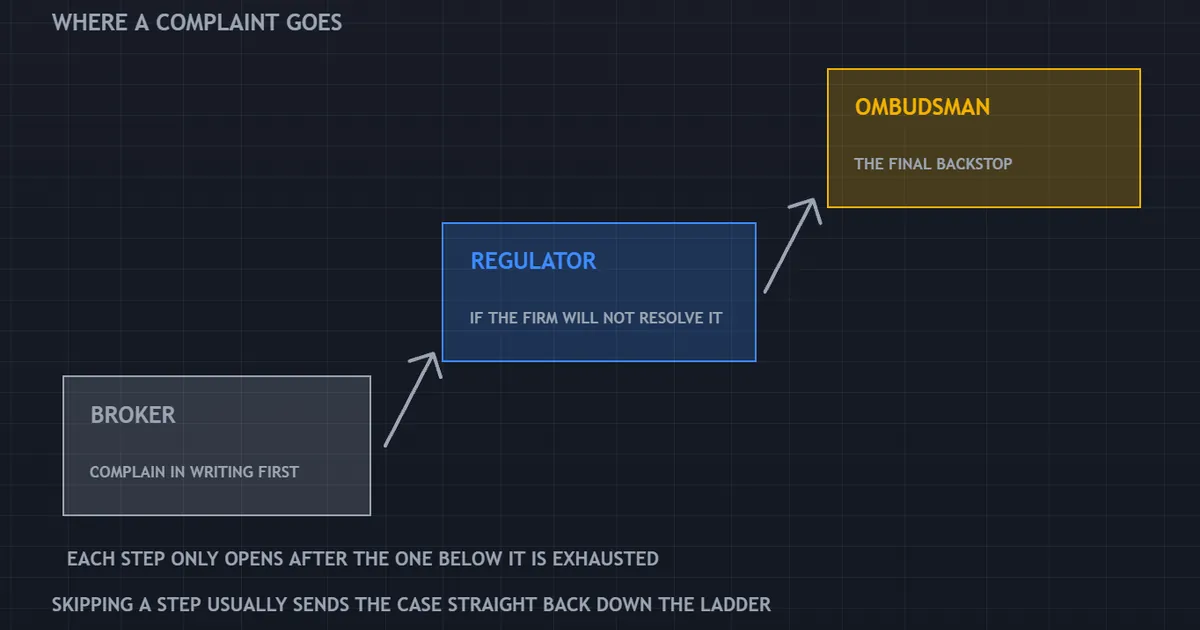
Step One: The Firm
Every regulated firm runs a formal complaints process with a deadline for its final answer. Put your case in writing, attach the statements, and keep the reference number.
Step Two: The Regulator or Ombudsman
If the final answer disappoints you, escalate. Britain uses an ombudsman service, Australia uses a complaints authority, European countries use national bodies, and America uses association arbitration.
These services cost the trader nothing in most cases. They also publish decisions, which builds a record other traders can read.
Step Three: Compensation
Compensation schemes only engage when a firm fails, not when you dislike a decision. Claims take time and pay up to a cap, so treat the scheme as a backstop rather than as insurance.
What Never Works
Forum threads and social media campaigns move nothing. Chargebacks against a properly executed trade rarely succeed either, since the firm holds the order records.
Checking Which Entity You Signed With
The licence that matters is the one covering your account. Four checks settle it in ten minutes.
Find the Entity Name
Look at the footer, the client agreement and the deposit instructions. All three should name the same company.
Look It Up on the Register
Every serious regulator runs a public search. Enter the licence number rather than the brand, because brands are not what regulators license.
Match the Details
Company name, licence number, address and permitted activities should all line up. A mismatch on any of the four deserves a question before a deposit.
Check the Permissions
Registers list what the firm may do. A payment licence is not a licence to hold client trading accounts, and the two look similar to an untrained eye.
Our overview of how forex brokers work explains why the entity holding your money matters more than the brand on the platform.
What Regulation Cannot Do
Supervision solves a narrow set of problems. Traders routinely expect it to solve a wider set.
It Cannot Stop You Losing
Market risk sits entirely with you. Every regulated firm publishes the share of its retail accounts that lose money, and the figure stays high everywhere.
It Cannot Vet Strategies
Nobody at a regulator reviews your method or your risk settings. Those decisions remain yours, whatever licence sits behind the platform.
It Cannot Move Quickly
Investigations take months and enforcement takes longer. A firm can behave badly for a long time before any public action appears.
It Cannot Cover Everything You Trade
Funded-account programmes, signal services and copy providers often sit outside the perimeter entirely. Our look at whether prop firms are legitimate covers that gap, and our MetaTrader indicators library sits on the tooling side rather than the money side.
A Practical Order of Checks
Run these in order before funding any account. Each one takes a couple of minutes.
- Name the entity. Read the client agreement and note the exact company you contract with, not the brand.
- Verify the licence. Search the regulator’s own register by number, and confirm the permissions cover client trading accounts.
- Read the leverage on offer. An offer far above the local cap tells you which entity you are really joining.
- Check the compensation position. Find out whether a scheme covers you, and up to what cap.
- Find the complaints route. Note the ombudsman or authority that handles disputes for that jurisdiction.
- Test a withdrawal early. Move a small amount out in the first week, and record how long it takes.
Negative balance protection deserves its own check too, since it varies by entity even within one group. Our note on negative balance protection explains what the rule covers and where it does not apply.
The Short Version
Six lines hold most of this guide. Keep them and you can skip the rest.
Six Things to Hold On To
A licence is a set of rules, not a badge. The rules bind the firm, and they do not bind the market.
The entity on your form is the one that counts. A logo on a home page counts for nothing.
Caps on leverage differ by place. So does the right to hold both sides of a pair at once.
Some places pay you back if a firm fails. Others pay you nothing at all.
An offshore firm may be honest. Still, if it is not, you have no one to ask for help.
None of this makes a trade work. Your plan does that part, or it does not.
FAQ
Which forex regulator is the strictest?
Britain, the European Union and Japan sit at the strict end for retail rules, while Switzerland sets the highest bar for entry by treating the business as banking. America imposes the tightest trading restrictions through its hedging and ordering rules, yet offers no compensation scheme for forex. Strictness varies by dimension, so compare the specific protections rather than ranking the bodies.
Is an offshore broker automatically a scam?
No, and framing it that way misses the point. An offshore entity may run an honest business, and plenty do. What you lose is the enforcement, the compensation scheme and the complaints route, so a dispute leaves you with very little leverage. Judge the missing protections rather than the intentions.
Why does my broker offer 500 to 1 leverage if caps exist?
Because the entity offering it sits outside the capped jurisdiction. Groups run several companies, and the one on your agreement decides which rulebook applies. Check the footer and the agreement, then compare the leverage on offer with the local cap. A large gap answers the question by itself.
Can I trade with a broker regulated in another country?
Often yes, depending on where you live and what your own rules allow. Understand that the home regulator supervises the firm, not you, and that a compensation scheme may exclude non-residents. Read the eligibility terms of the scheme before assuming it covers your account.
Does regulation protect me from losing money on trades?
No, and no regulator claims otherwise. Rules govern how the firm handles your money, your orders and your complaints. Market risk stays with you in every jurisdiction, which is why every regulated firm publishes a warning about the share of retail accounts that lose money.
How do I check a licence number?
Go to the regulator’s own website rather than following a link from the broker. Search the public register by number, then match the company name, address and permitted activities against the client agreement. A firm listed only as a payment provider, or listed under a different name, is worth a direct question before you deposit anything. Results are not guaranteed; past performance is not indicative of future results.
External references
- For background on this concept, see Our Role at ASIC.
- For broader market context, see The United States Commodity Futures Trading Commission on Wikipedia.
- The split between the government regulator and the industry self-regulatory body is explained in NFA in Focus: The Self-Regulatory Model at the NFA.

About the author
Written by Dominic Walsh, a Forex trader and MT4/MT5 indicator, Expert Advisor and script developer. Every tool on forexmt4systems.com is tested on live charts before release and ships with ready-to-use compiled MT4 (.ex4) and MT5 (.ex5) files. Learn more about the trader and developer behind this site.
How we build, test and correct every tool: Editorial & Testing Policy. Trading carries risk; see the disclaimer.