
Most forex broker red flags show up long before a single unit of cash leaves your bank. They sit in the page footer, in the bonus terms, and in the way a help desk dodges a plain question.
This guide names no firm and ranks none. It maps out patterns instead, plus the checks you can run in about twenty minutes.
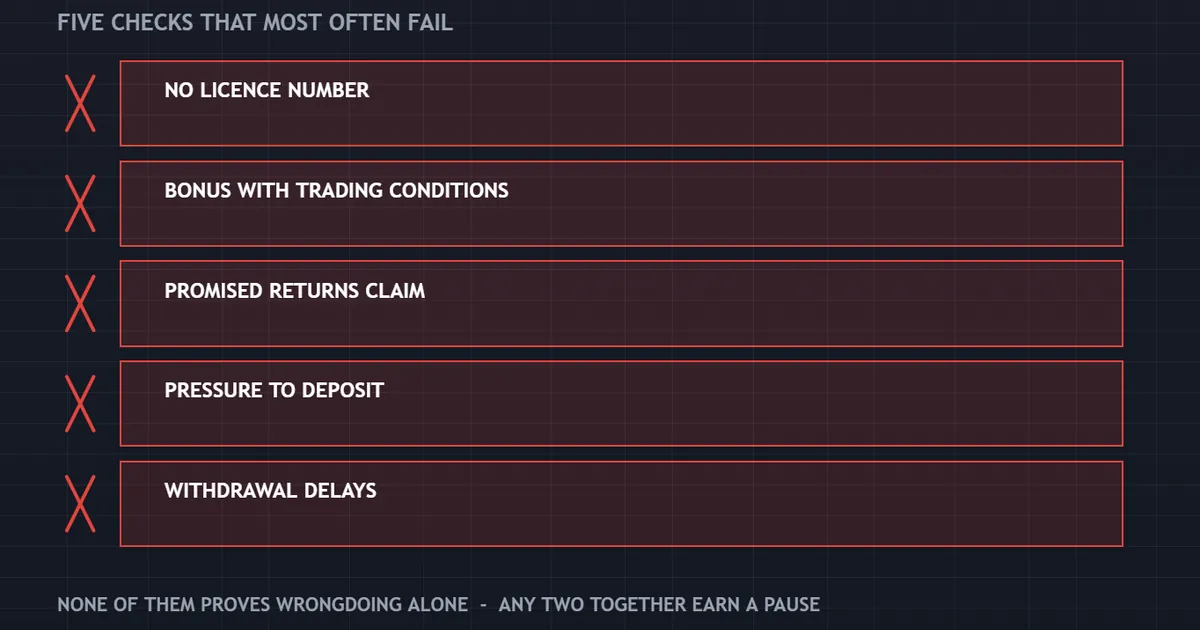
Five warning rows sit in the panel above. None of them proves bad faith on its own, and any two at once earn a pause.
Forex Broker Red Flags You Can Check Before Depositing
Start from one plain idea. A firm that holds client money should make its licence, its legal name and its payout terms easy to find.
So a hunt for those three tells you a lot. And a help desk that answers all but those three tells you more.
The Twenty Minute Check
- Find the legal entity. Scroll to the footer, note the company name, the registration number and the country of incorporation.
- Find the licence number. Note the regulator named beside it, then leave the website entirely.
- Search the official register. Type that number into the regulator’s own search page and read what comes back.
- Match the details. Company name, trading names, website address and permitted activities should all line up with the site you came from.
- Read the payout clause. Open the client agreement, search for withdrawal, and read the whole section rather than the summary.
Why the Register Beats the Badge
A logo on a web page proves nothing. Anyone can drop a crest into a footer in a minute.
A register comes from the watchdog itself. The FCA, CySEC, ASIC, BaFin and FINMA each run one, and the NFA runs a check tool for firms that take on clients in the United States.
What You Are Looking For
You want four things to match. Firm name, licence number, web address, and the work the licence lets the firm do.
One clean match tells you where your money will sit. A near miss on any of the four is worth a second look.
Where to Look, Watchdog by Watchdog
| Regulator | Area covered | What the public record shows |
|---|---|---|
| FCA | United Kingdom | Firm reference number, permitted activities, trading names, approved domains and any published warning |
| CySEC | Cyprus, passported across the EU | Licence number, current status, domains operated and any suspension or withdrawal of authorisation |
| BaFin | Germany | Authorised institutions, plus published notices about firms operating without permission |
| ASIC | Australia | Australian financial services licence number, the licensee name and the authorisations attached to it |
| FINMA | Switzerland | Supervised institutions and a public warning list of unauthorised providers |
| CFTC and NFA | United States | Registration status, disciplinary history and background details through the NFA search tool |
The Licence, the Legal Name and Clone Sites
Rules bind a legal entity, not a brand. That gap trips up more new traders than any other point here.

Run those checks in order. Each takes a couple of minutes, and the whole set costs far less than one bad deposit.
One Brand, Two or Three Firms
Big groups often run a UK firm, an EU firm and an offshore one. New clients get routed by the country they live in.
Your cover follows the firm named on your own form. So the group’s best licence may say nothing at all about your account.
Offshore Sign-Up Is Not Oversight
Some places sell a company listing with almost no watchdog behind it. A paper certificate proves the firm exists, and no more than that.
None of this makes offshore crooked. It does mean you carry the risk yourself, since no one stands behind the setup if the firm folds.
Clone Sites
A clone copies a real firm’s name, licence number and address. It then runs a near identical web page with new bank details.
Watchdogs publish alerts about these. The FCA keeps a public warning list, and both ASIC and CySEC post similar notes.
Check the contact details against the register, never against the site. Our guide to what regulated actually means walks through the lookup.
How a Clone Site Actually Works
Walk through the trick once and it stops working on you. A copy of a real firm goes up on a near identical web address, often one letter apart from the real one.
Every honest detail gets lifted straight across. Company name, licence number, office address, even the staff photos and the terms document.
One field changes, and only one. The bank details on the payment page point somewhere new, which is the whole purpose of the exercise.
So the badge check passes and the deposit still lands in the wrong place. Your money never reaches the licensed firm, so that firm owes you nothing and the scheme behind it covers nothing either.
Beat it with a habit, not with a hunch. Type the regulator’s own web address by hand, search the licence number there, then open the site from the link on the register rather than from a search advert.
What the Rules Actually Buy You
| Protection | What it does | What it does not do |
|---|---|---|
| Segregated client funds | Keeps client money in accounts separate from company money | Protect you from your own trading losses |
| Capital requirements | Forces the firm to hold a minimum buffer against failure | Make failure impossible in a severe market event |
| Negative balance protection | Limits a retail loss to the balance sitting on the account | Apply to professional clients in most jurisdictions |
| Compensation scheme | Pays eligible clients up to a stated limit if the firm collapses | Cover trading losses, or cover an offshore entity at all |
| Complaints route | Gives an independent body power to review your case | Ensure the outcome lands in your favour |
| Conduct supervision | Sets standards for pricing, execution and client communication | Vet every advert or every phone call in advance |
Claims That Should Stop You Reading
Sales copy carries useful signals. A few phrases show up almost only on pages worth leaving.
Promised Returns
Any pledge of a fixed monthly percent belongs in the bin. Trade results vary, so a firm that claims a set figure has either fooled itself or is trying to fool you.
Firms under a watchdog rarely talk that way, because the rules forbid it. Silence on returns means little, and a bold claim means a lot.
Someone Offering to Trade for You
A phone call that offers to run your account earns a firm no. That work needs its own permission, and the caller is nearly always in sales.
Ask for the mandate in writing. Then check the register to see if the firm may do that work at all.
Pressure and Deadlines
A deposit offer with a clock on it exists to stop you checking. Haste helps the seller, never the buyer.
So treat a deadline as a reason to slow down. A firm worth using next week is still worth using next month.
Chat Moving Off the Record
Talk that drifts from a work email to a private chat app wipes out the paper trail. Keep it all in writing on official channels.
Screenshot the rest. Complaint bodies work from proof, not from memory.
Language Patterns Worth Noting
- Fixed monthly percentages. Presented as a normal outcome rather than a projection, often beside a chart with no start date anywhere on it.
- Recovery offers. An approach promising to retrieve money lost elsewhere, usually for an upfront fee, which is a well documented second approach on the same wallet.
- Signals bundled with deposits. A larger deposit unlocking better calls, which ties the quality of advice to a sales target rather than to analysis.
- Testimonials with no detail. First names, stock photographs and figures with no statement, dates or conditions attached to any of them.
- A proprietary edge nobody explains. A method described as unique yet never set out, since a rule nobody can state cannot be reviewed or debugged later.
Bonus Terms That Lock Your Own Money
Bonus credit sparks more fights than any other feature. Read how it works before you tick the box.
How the Condition Works
A firm adds an amount to the account as funds you may trade. Terms then set a volume target, often in lots, that must be met before any payout goes out.
And that target very often binds your own cash too. So money you paid in can sit locked behind a goal you never meant to chase.
Why the Target Is Bigger Than It Looks
Targets come in lots traded, not in cash. A small bonus can call for a volume that costs far more in spread than the bonus ever gave you.
Do the sum first. Take the lots you must trade, times your cost per lot, then set that beside the credit.
Read the Payout Clause Line by Line
One clause repays the reading time better than the rest of the agreement combined. Search the document for withdrawal and read the whole section slowly.
Four details matter there. The stated window in working days, the routes the firm will use, the fees it may deduct, and the grounds on which it may hold a request.
Vague drafting counts as a finding. Wording such as a reasonable period, with no number anywhere near it, leaves the firm free to define reasonable later.
Watch for a clause allowing changes to the terms at will. Every agreement carries one, though a fair version gives you notice and a right to close the account first.
Save that page as a file on the day you sign. Terms get revised, old versions vanish from the site, and a complaint handler will ask you which version applied to your account.
The Simple Rule
Turn bonuses down unless you have read the terms twice. Retail clients in the EU rarely see them at all, since ESMA rules limit that kind of offer.
A big incentive aimed at a client in a limited region tells you which firm you have reached. That fact alone answers a few questions.
Download the complete indicator database
Put these concepts on your charts. One email unlocks the full library of 1,380+ indicators with compiled MT4 and MT5 files, plus my TradingView scripts. No paywall, no spam, unsubscribe any time.
Get free access to my indicator database
One email unlocks 1,380+ free MT4, MT5 and TradingView indicators — the complete library. No single-tool download; you get the whole database.
Payout Friction as a Late Warning
Once a payout stalls, your cash already sits with the firm. Patterns matter far more than any one slow week.
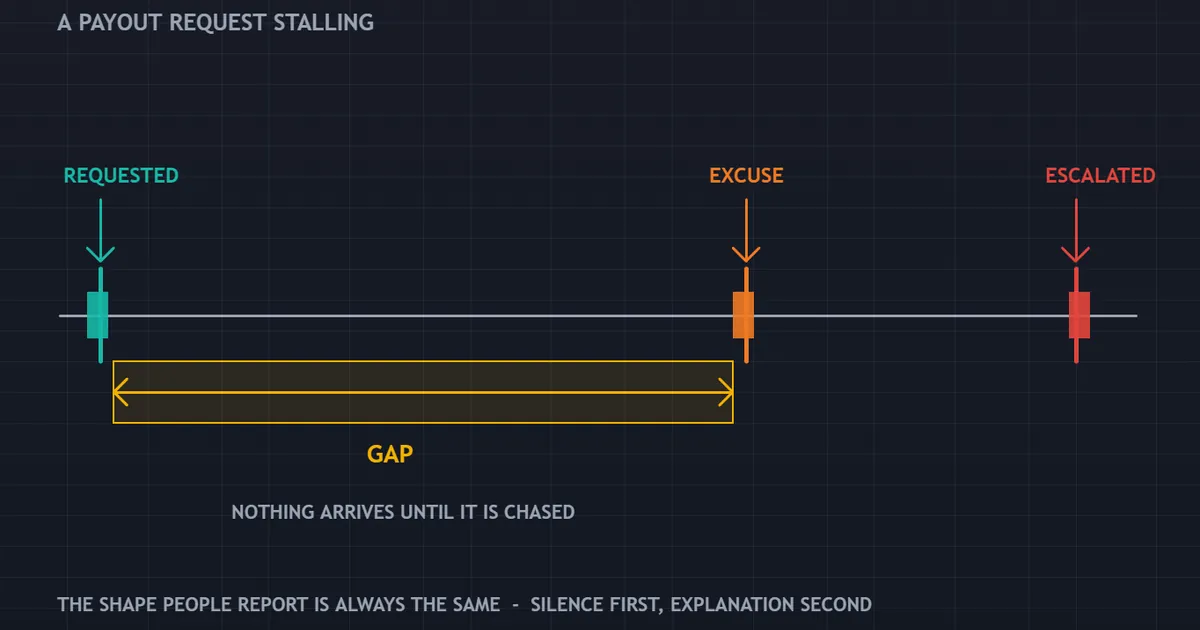
The timeline above shows the shape people report. A request, a long hush, a reason, then a complaint.
A Delay Alone Proves Nothing
Plenty of fair reasons slow a payment down. ID checks, payment route rules, weekends and middle banks all add days with nothing wrong.
Our guide to broker payout problems covers the fair causes in depth. Read that before you fear the worst.
The Pattern That Does Matter
Watch for reasons that keep changing. First a document, then a bonus rule, then a tech fault, each one arriving only after you chase.
Watch too for deposits that work while payouts stall. Payment systems rarely break in one direction only.
Pressure to Keep Trading
A payout request met with a trade idea earns a firm no. An offer of extra credit at that moment adds terms, not value.
Put the request in writing, then send it again. Keep every reply.
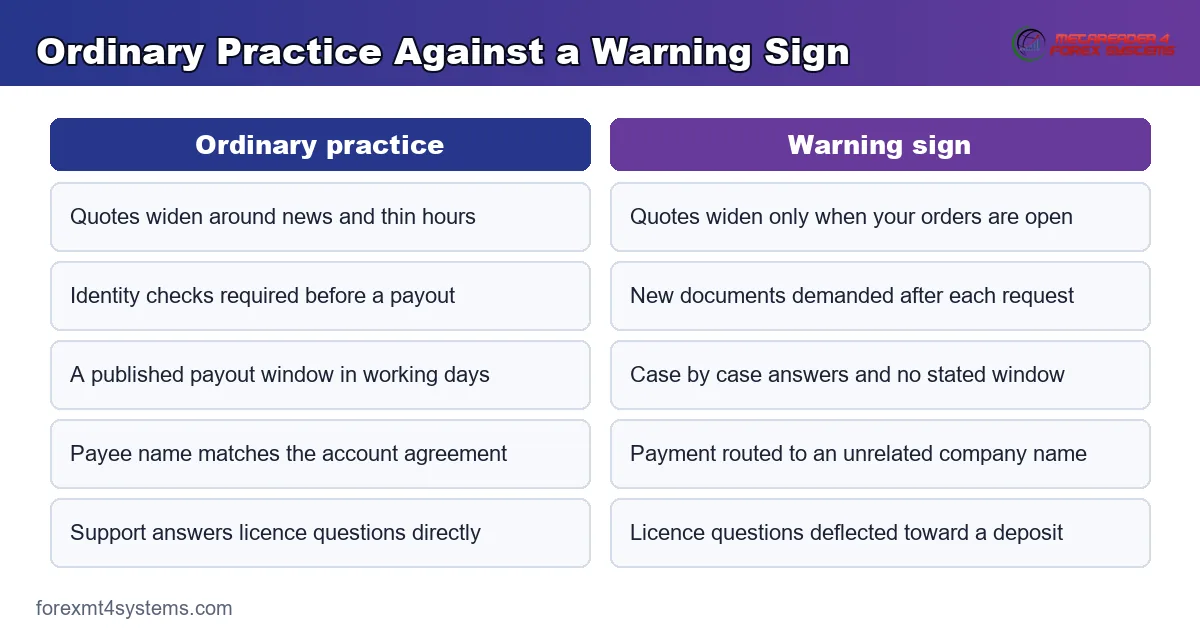
Ordinary Practice Against a Warning Sign
Fairness counts here. Some normal broker habits look shady to a new trader, and mixing the two wastes your time.
Wider Spreads Are Normal
Quotes widen around news, at the weekly open and through thin hours. None of that points to foul play.
Our note on why spreads widen covers the how and the why. Compare live pricing with our spread comparison tool rather than trusting an advert.
A Stop Getting Hit Is Rarely a Hunt
Price tagging your stop and then turning feels aimed at you. Stops bunch at the same obvious levels, and price drifts toward them with nobody steering.
Check the wick on a second feed before you complain. A real feed fault shows up fast when you hold two sources side by side.
ID Checks Are the Law
Identity checks come from law, not from spite. Firms must know who their clients are, and they must check the payment method too.
Get that done before you fund. This one step removes the most common cause of a slow first payout.
How to Weigh Two Flags Against One
Single findings rarely settle anything. Almost every point on this page has an innocent version, so one on its own earns a question rather than a verdict.
Two findings change the picture. A vague payout clause beside a bonus that binds your deposit describes a house style, not a coincidence.
One finding stands apart from that rule. A licence number that fails to match the public register has no harmless reading, so treat it as an answer on its own.
Weight the rest by what they cost you. Wide spreads cost pennies per trade and a wrong payee name can cost the whole balance, which tells you where to spend your attention.
Where Your Deposit Actually Lands
Payment routing earns its own look. The brand you signed with and the firm that takes your cash can differ.
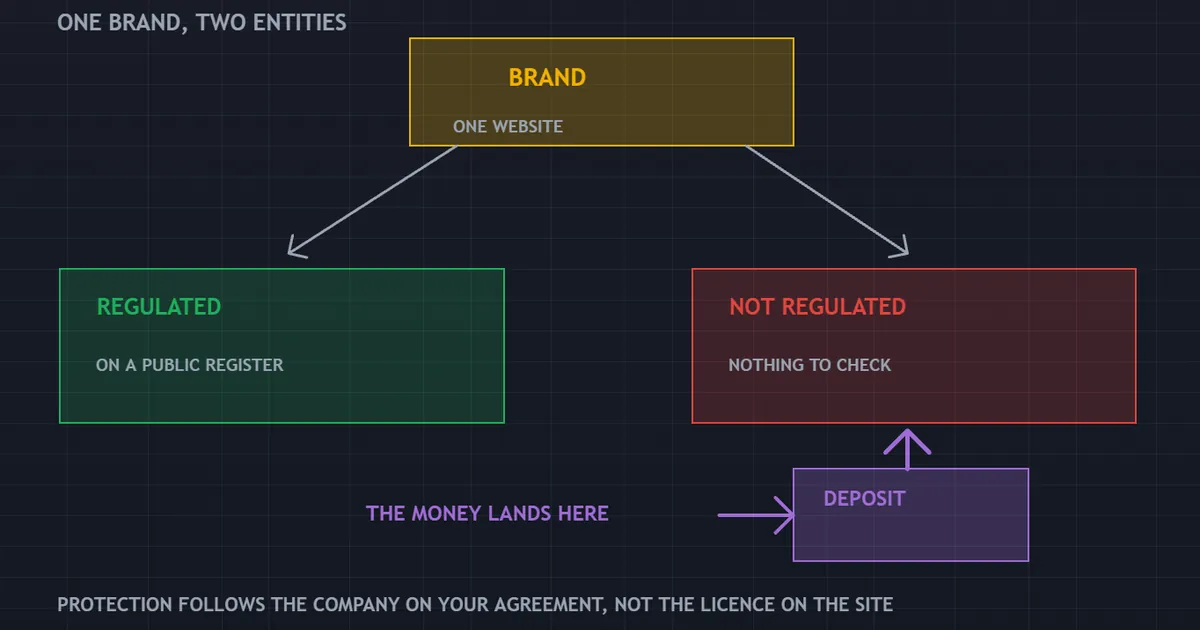
One brand, two firms, and the arrow points at the one with no licence. That setup turns up more often than new traders expect.
Check the Payee Name
Read the payee name on the payment page. It should match the firm named on your client agreement.
A payment to some other company name earns a stop. Ask why, in writing, before you send a thing.
Payment Method Signals
- Crypto only. A firm that takes no card and no bank transfer has removed both the chargeback route and the bank’s own record of the payment.
- Processors with no link to the brand. Payment landing with a company you cannot connect to the group, and which the client agreement never mentions anywhere.
- Personal accounts. Any request to send funds to a named individual rather than a company, which no supervised firm would ever make of a client.
- Route mismatch on the way out. Deposits taken by card while payouts travel only by an obscure method, reversing the usual same-route rule.
- Processors that keep changing. Fresh payment details every few weeks, explained away as a technical migration between providers.
Keep Your Own Record
Save the payment receipt, the payee details and the date. Card issuers and complaint bodies both work from that paperwork.
- The signed client agreement. Downloaded as a file on the day you opened the account, since published terms get revised and the archived version rarely stays reachable.
- Every payment confirmation. Amount, date, beneficiary name and reference, kept for deposits and payouts alike in a single folder.
- Screenshots of the bonus terms. Captured at the moment you accepted or declined, because promotional pages disappear once a campaign ends.
- The full support thread. Exported rather than screenshotted where the platform allows it, with timestamps and ticket references intact.
- Your own trade record. Statements downloaded monthly, so a disputed balance can be reconstructed without relying on the firm’s portal staying available.
What to Do If You Already Deposited
Finding a problem after you fund feels worse than it needs to. Several routes stay open, and speed helps all of them.
A Practical Order of Steps
- Stop adding money. No further deposits, and no acceptance of credit offered as a way to release the funds already sitting there.
- Request a full payout in writing. Use the official channel, state the amount, and keep the reference number safe.
- Complete every verification item. Remove any legitimate reason for delay, because that strengthens your position at every later stage.
- Escalate to compliance. Most firms operate a formal complaints procedure with a published response window attached to it.
- Take it to the regulator or ombudsman. Where the entity holds a licence, an external route exists and an independent body reviews the file.
- Ask your bank or card issuer. Chargeback rules carry strict time limits, so raise the question early rather than after months of chasing.
The Limits of a Complaint
Outside routes depend on the firm. An offshore listing usually leaves no ombudsman and no payout scheme behind it.
Our overview of forex regulatory bodies sets out which body covers which country. Check yours before you write.
Recovery Offers
People who lose money often get an offer to win it back for a fee. Treat each one as a second raid on the same wallet.
Watchdogs and complaint bodies charge you nothing. So an upfront fee answers the question by itself.
Mistakes Traders Make While Checking
Even careful people run these checks badly. Four errors come up again and again.
- Trusting review sites. Many rank firms by affiliate payment rather than by conduct, so a top slot often measures marketing spend instead of quality.
- Reading the badge, skipping the register. A logo takes seconds to copy while a register entry takes a licence, so only one of the two carries information.
- Checking the group, not the entity. Groups hold several licences, and yours attaches to the single company named on your own client agreement.
- Judging by platform quality. Anyone can license a polished trading platform, so a smart interface says nothing about who holds your money.
- Reading only the summary page. Marketing pages describe the bonus and the terms document defines it, and only one of those two governs your account.
Why Ranking Pages Read the Way They Do
Understand the money behind a ranking and you can read one safely. Most comparison pages earn a fee for every funded account they send onward.
Fees differ by firm, and the order on the page often follows the fee. That habit explains why the same handful of names sit at the top of dozens of unrelated sites.
None of that makes the pages worthless. It makes them a source for facts you can verify elsewhere, such as a minimum volume step or a stated payout window.
So read them for questions rather than for answers. Take the claims to the register and to the client agreement, then let those two documents decide.
Reviews from other traders need the same care. A single angry post proves very little, while fifty posts describing the same clause in the same terms describe something real.
A Sensible Way to Compare Firms
Build your own shortlist from registers, not from rankings. Start at the watchdog, filter by permission, then look at the firms left standing.
Judge those on cost, fills and payout terms. Our indicator library works the same on any of them, so the platform rarely decides much.
Prop Firms Sit Under Other Rules
Funded account providers fall outside most broker rules. New structure, new cover, new questions to ask.
Our look at whether prop firms are legitimate maps that separate world.
Two Questions Worth Asking Support
Send both in one message and watch what comes back. First, which legal entity holds my account and under which licence number?
Second, how long does a payout take, and by which route? Both answers exist in the terms, so a firm should send them in a line or two.
Most firms reply inside a day. Vague wording, or a reply that pivots to a deposit offer, tells you plenty at no cost.
Build a Short Weekly Habit
Check your account once a week, even when nothing hurts. Read the balance, the open trades and any new terms email.
Small changes show up there first. A new payment page or a fresh bonus offer is worth a minute of your time.
FAQ
What is the single strongest warning sign?
A licence number that fails to match the register. Every other point on this page is a pattern with a possible innocent cause, while a gap between the claimed watchdog and the official record has no innocent version. Check the number, the firm name and the web address as a set, since clone sites copy the first two and change the third.
Does an offshore licence mean a broker is crooked?
No, and the gap matters. Plenty of groups run offshore firms for plain business reasons, such as serving clients their EU firm may not take on. What changes is your spot when things go wrong, because oversight, payout schemes and complaint routes mostly vanish, leaving you to rely on the firm’s own conduct.
Are wide spreads or slipped fills proof of foul play?
Usually not. Spreads widen around news and thin hours at every firm, and fills drift when price moves while your order travels. Hold the same window against a second data source before you draw a line, and treat only a steady one-way gap across many trades as worth raising with support.
How do I check a broker’s regulator myself?
Go straight to the watchdog’s own site rather than through a link on the broker page. Search by firm name and by licence number, then check that the permitted work covers dealing in investments and holding client money. Note the web addresses on that entry too, because a real record names the domains the firm may trade under.
Should I ever accept a deposit bonus?
Only after you have read the full terms and worked out the volume target in lots. A bonus that binds your own deposit turns a free extra into a lock, and the spread you pay to clear the target often costs more than the credit was worth. Turning it down keeps your money yours, which is the whole point of the account.
What should I do if support stops replying?
Move to the formal complaints route in writing, with dates, amounts and reference numbers, then give the firm the response window its own policy states. Take it to the watchdog or the relevant ombudsman once that window closes, and speak to your bank or card issuer early because chargeback rules run on strict time limits. Results are not guaranteed; past performance is not indicative of future results.
External references
- For background on this concept, see Protect Yourself From Scams at the FCA.
- For broader market context, see Bucket Shop on Wikipedia.

About the author
Written by Dominic Walsh, a Forex trader and MT4/MT5 indicator, Expert Advisor and script developer. Every tool on forexmt4systems.com is tested on live charts before release and ships with ready-to-use compiled MT4 (.ex4) and MT5 (.ex5) files. Learn more about the trader and developer behind this site.
How we build, test and correct every tool: Editorial & Testing Policy. Trading carries risk; see the disclaimer.